

DNA and Paternity Testing During Pregnancy: What Is Possible
Key Takeaways
- A pregnant person's blood carries cell-free DNA shed by the placenta, and from about week 10 there is usually enough of it to analyze, according to MedlinePlus and Mayo Clinic.
- Non-invasive prenatal paternity testing needs a venous blood sample from the pregnant person plus a cheek swab from the possible father; it cannot identify an unknown man.
- Independent validation of prenatal paternity accuracy is thinner than for chromosomal screening, so vendor accuracy figures should be read as claims rather than settled evidence.
- CVS is performed at weeks 11 to 14 and amniocentesis at weeks 15 to 20, each with a miscarriage risk NHS estimates at roughly 1 in 100, which is why they are not done for paternity alone.
- Routine prenatal genetic screening counts chromosomes and says nothing about paternity, even though both tests use the same cell-free DNA in the same blood draw.
- A court-usable result requires witnessed sample collection and documented chain of custody; a self-collected peace-of-mind test, however accurate, is not admissible.
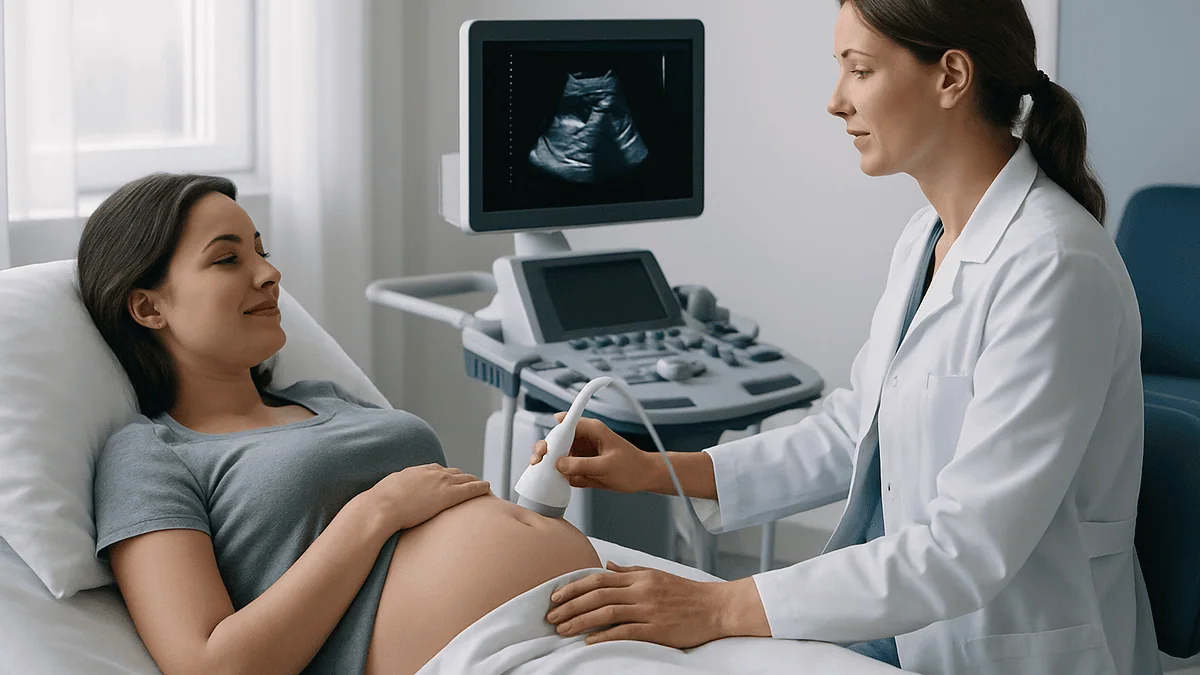
Yes. A paternity DNA test can be done during pregnancy using a blood sample from the pregnant person, which carries small fragments of the baby's DNA from roughly the tenth week onward, compared against a cheek swab from the possible father. This non-invasive approach poses no physical risk to the pregnancy. Invasive procedures such as CVS and amniocentesis can also yield fetal DNA, but clinicians normally reserve them for medical reasons.
The question usually arrives quietly. Not in the exam room, where the conversation is about folate and due dates, but later, typed into a phone at two in the morning: can you do a DNA test while pregnant? Behind it sits a tangle of timing, relationships, and the simple wish to know something before a birth certificate makes it official.
The science has a real answer now, and it is more interesting than the advertising suggests. A pregnant person’s bloodstream carries tiny fragments of DNA shed by the placenta, the same material that clinics already use to screen for chromosomal conditions. Laboratories learned to read those fragments for paternity as well.
What follows separates what is genuinely possible from what is oversold: how early a test can work, what accuracy claims actually rest on, why your obstetrician may look puzzled when you ask, and what the riskier alternatives involve.
What does a DNA test while pregnant actually mean?
Three very different tests hide behind one search phrase, and confusing them leads to real disappointment. The first is prenatal screening for chromosomal conditions, often called cell-free DNA screening or NIPT. Your obstetric team may offer it routinely. It looks for extra or missing chromosomes, such as those associated with Down syndrome, and it says nothing about who the father is.
The second is prenatal paternity testing. It borrows the same biological trick, fetal DNA circulating in the pregnant person’s blood, but analyzes inherited markers rather than chromosome counts, then compares them with a sample from the possible father. Most people typing this question mean this test.
The third is diagnostic testing through chorionic villus sampling (CVS) or amniocentesis. These procedures collect placental tissue or amniotic fluid directly and can answer both genetic and paternity questions with a high degree of certainty, but they involve a needle and a small risk of miscarriage, which is why they are ordered for medical indications rather than curiosity.
Keep those three categories in mind and the rest of this article falls into place. A screening result that says the baby is at low risk for a chromosomal condition is welcome news, but it has not tested paternity. A paternity report, in turn, tells you nothing about the baby’s health. Knowing which door you are knocking on saves time, money, and a good deal of emotional whiplash.
How can a baby's DNA be found in the mother's blood?
The placenta is a busy, short-lived organ, and like all tissue it constantly sheds cells that break apart. Their DNA ends up as free-floating fragments in the maternal bloodstream, mixed in with the far larger amount of DNA from the pregnant person’s own cells. According to MedlinePlus, this cell-free DNA comes from the placenta and is generally identical to the fetus’s own DNA, which is why a blood draw can stand in for a sample from the baby.
The proportion of fragments that belong to the pregnancy is called the fetal fraction. Early on it is small, a few percent of the total, and it rises as the pregnancy progresses. Laboratories need enough of it to distinguish the baby’s genetic signal from the background of maternal DNA. When the fraction is too low, a sample may simply fail to produce a result and a redraw is requested.
For paternity, the laboratory sequences these fragments and identifies genetic variants present in the fetal DNA that could not have come from the mother. Those must have been inherited from the biological father. Comparing them against the cheek swab of the possible father shows whether he shares the expected pattern. Because half of a child’s DNA comes from each parent, a true biological father will match at essentially every informative marker; an unrelated man will not.
A useful image: think of trying to hear one instrument in an orchestra. In the tenth week the instrument is faint. By the second trimester it is louder and far easier to isolate.
How early can you do a DNA test on an unborn baby?
Mainstream medical sources tie the timing to fetal fraction. MedlinePlus and Mayo Clinic both describe cell-free DNA testing as an option from about week 10 of pregnancy, because before that point too little placental DNA circulates for reliable analysis. Paternity testing depends on the same biology, so the same floor applies in practice, even though some commercial laboratories advertise slightly earlier windows.
Earlier is not automatically better. A sample drawn at seven or eight weeks has a higher chance of returning an inconclusive result, which means waiting for a second appointment anyway. Dating also matters: many people are a week or two off in estimating how far along they are, especially with irregular cycles, and an ultrasound dating scan gives a more reliable count than the calendar.
Beyond the lower limit there is no upper cutoff. Non-invasive paternity testing can be performed at any point after the fetal fraction is adequate, right up to delivery. If you have missed the first trimester, nothing is lost; if anything, later samples are more robust.
The invasive options run on their own schedule. NHS guidance places CVS between weeks 11 and 14 and amniocentesis between weeks 15 and 20, though both can be done later if medically necessary. Those windows exist for safety and diagnostic reasons, not for paternity convenience, and no clinician will schedule a needle procedure earlier than the standard window simply to answer a paternity question sooner.
How accurate is a DNA test while pregnant?
Here the honest answer needs more nuance than the headlines offer. For chromosomal screening, cell-free DNA testing has been studied in very large populations and its performance is well characterized. Prenatal paternity testing uses related methods, but the independent, peer-reviewed validation is thinner. Most published accuracy figures come from the laboratories that sell the tests, using their own data. That does not make them wrong; it means an outside reader should treat them as a claim rather than a settled fact.
Several factors shape reliability. A higher fetal fraction gives a clearer signal. The number of genetic markers analyzed matters, since more markers make a coincidental match between an unrelated man and the fetus vanishingly unlikely. Quality control matters too: a reputable laboratory reports an inconclusive result rather than guessing when the data are weak.
Two kinds of error are worth understanding. A false exclusion wrongly rules out the real father; a false inclusion wrongly confirms an unrelated man. Good laboratories design their thresholds to make both rare, but a test cannot be more precise than the sample it receives. Contaminated swabs, mislabeled tubes, and blood drawn before the fetal fraction is adequate all undermine the result.
Compare this with testing after birth. A cheek swab from the newborn provides pure, abundant DNA with no maternal background to filter out, and the methodology has decades of forensic and legal validation behind it. If absolute certainty for a legal matter is the goal, many families choose to confirm a prenatal result after delivery.
Can my OB-GYN do a DNA test while pregnant?
Usually not directly, and the reason is practical rather than obstructive. Obstetric practices order tests that inform pregnancy care: infection screens, blood counts, glucose testing, and prenatal genetic screening for chromosomal conditions. Paternity testing does not change how a pregnancy is managed, so it sits outside the standard menu, and most practices have no arrangement with a paternity laboratory.
What your clinician can do is help you avoid the wrong test. If you ask for a DNA test, they may assume you mean chromosomal screening and order that, which is genuinely useful for other reasons but will not identify a father. Be specific: say paternity.
Some practices will draw the blood sample if you bring a laboratory kit, or refer you to a phlebotomy service that can. Others prefer not to be involved because of documentation and liability questions. Neither response is a judgment on you.
Where obstetricians do become directly involved is with CVS or amniocentesis. If one of these procedures is already planned for a medical reason, such as an abnormal screening result or a known inherited condition in the family, it is reasonable to ask whether the collected sample could also be used for paternity analysis. The answer will depend on the laboratory and on consent paperwork, but the conversation is a legitimate one to have.
Whatever route you take, a clinician who knows you want paternity information can also help you think through timing, dating accuracy, and emotional support.
Can you find out the father of your child while pregnant?
Yes, with a condition that trips people up: the test needs a sample from the man in question. Prenatal DNA analysis identifies the fetal variants that did not come from the mother, but it can only confirm paternity by matching those variants against a specific candidate. There is no database that will look up an unknown father from a pregnant person’s blood.
If two possible fathers are involved, each can provide a cheek swab and the laboratory compares both. Related candidates, such as brothers, present a harder puzzle because they share a large portion of their DNA; a careful laboratory should be told in advance so it can analyze additional markers and interpret the result cautiously.
When the possible father declines to participate, the non-invasive test cannot proceed in any meaningful way. Some people ask whether a sample from his parents or siblings could substitute. In principle, close relatives can provide indirect evidence, but this is less definitive, more expensive, and not something every laboratory offers prenatally. In most such situations the practical answer is to wait until after the birth, when a court can order testing if it comes to that.
Consent is also an ethical line. Collecting someone’s DNA without their knowledge, for example from a discarded toothbrush, is legally problematic in many places and produces results no court will accept. Reputable laboratories require identification and signed consent from every adult tested.
CVS and amniocentesis: the invasive options compared
Before cell-free DNA methods existed, the only way to test a fetus’s DNA was to collect it directly. Two procedures do this, and both remain part of standard prenatal care when a diagnostic answer about the baby’s health is needed.
| Method | Typical timing | Sample | Miscarriage risk | Paternity use |
|---|---|---|---|---|
| Non-invasive (cell-free DNA) | From about week 10 | Maternal blood plus father’s cheek swab | None from the test itself | Common; commercial |
| Chorionic villus sampling | Weeks 11 to 14 | Small piece of placental tissue | Roughly 1 in 100 per NHS estimates | Possible if already indicated |
| Amniocentesis | Weeks 15 to 20 | Amniotic fluid with fetal cells | Up to 1 in 100 per NHS estimates | Possible if already indicated |
The timing and risk figures come from NHS patient guidance and are broadly consistent with Mayo Clinic’s descriptions, though newer analyses suggest the procedure-related loss rate may be lower than older estimates. Both procedures are performed under ultrasound guidance by trained specialists and typically take minutes, followed by a period of rest.
Why not simply choose the more definitive invasive route? Because a small but real risk of losing the pregnancy is not something clinicians will accept for a question that has no bearing on medical care and can be answered safely by other means. In most settings, a request for CVS or amniocentesis solely for paternity will be declined, and the conversation redirected to non-invasive testing or to testing after birth.
Are at-home prenatal paternity tests real?
Partly. The phrase at home describes where the kit arrives, not where the science happens. A genuine prenatal paternity test requires venous blood from the pregnant person, drawn into specialized tubes that preserve cell-free DNA, and no reliable laboratory accepts a finger-prick or saliva sample for the maternal side. So the typical at-home kit contains a cheek swab for the possible father and instructions to visit a phlebotomy service or mobile blood-draw provider for the pregnant person’s sample.
Products that claim to test paternity from a pregnant person’s saliva or urine should raise immediate doubt. Cell-free fetal DNA is found in blood, and the fraction in other fluids is not adequate for this purpose.
Timelines vary, and any specific turnaround promise belongs to the vendor, not to medical consensus. What you can reasonably expect is a wait of days to a couple of weeks once the laboratory receives both samples, with the possibility of a redraw if the fetal fraction proves too low.
Read the fine print on accreditation. Laboratories performing relationship testing for legal purposes in the United States are generally accredited by an independent body and follow documented chain-of-custody procedures. For a peace-of-mind test you collect yourself, that chain is broken by design, which is fine for personal knowledge but useless in court. Also check what the laboratory does with leftover samples and genetic data; privacy policies differ widely and are worth five minutes of your attention.
Legal paternity versus peace of mind: why chain of custody matters
The same laboratory, the same blood tube, the same cheek swab can produce a report that a court accepts or one it dismisses. The difference is not the DNA. It is who watched the sample being collected.
A legally defensible test requires that every participant show government identification, that a neutral third party collects and seals the samples, and that documentation tracks the specimens from collection to result. This chain of custody proves the swab labeled with the possible father’s name actually came from his cheek. Without it, a report is simply a piece of paper that anyone could have generated with anyone’s DNA.
Peace-of-mind testing skips those steps. You swab, you mail, you receive a result. It is cheaper and more private, and for many families it is all they need. But if the question might ever touch child support, custody, inheritance, immigration, or a birth certificate correction, choosing the legal pathway from the start avoids paying twice.
Prenatal results add one more wrinkle. Some jurisdictions and agencies prefer, or require, confirmation on a sample taken from the child after birth before acting on the result. Ask the laboratory whether its prenatal report has been accepted in the type of proceeding you anticipate. Family law attorneys deal with this routinely and can tell you what local courts expect. Knowing before you test is far easier than discovering after.
Twins, transfusions and other situations that complicate results
Cell-free DNA testing assumes one pregnancy and one maternal genome in the blood sample. Several situations break that assumption, and a laboratory should be told about each before analysis.
Twins are the most common complication. Fraternal twins have different DNA, and their fragments are mixed together in the same blood sample. MedlinePlus notes that cell-free DNA screening is less reliable in multiple pregnancies, and the same principle limits paternity testing; if the twins could have different fathers, a blended sample cannot always separate them. Identical twins share DNA and pose less of a problem.
A vanishing twin, where one embryo stopped developing early, can leave residual placental DNA in circulation for weeks and muddy the picture. Early ultrasound findings of a second sac should be disclosed.
A recent blood transfusion or a prior bone-marrow or stem-cell transplant introduces another person’s DNA into the pregnant person’s bloodstream. That foreign signal can confuse the algorithm trying to isolate fetal variants. Pregnancies conceived with donor eggs also require special handling, because the analysis relies on knowing which variants belong to the pregnant person, and those will not match a donor-derived fetus in the expected way.
Finally, if the possible fathers are close relatives, the laboratory needs to know so it can extend its marker panel. None of these situations makes testing impossible, but each raises the chance of an inconclusive result and makes an experienced, transparent laboratory more valuable than a cheap one.
Why prenatal genetic screening is not a paternity test
A surprising number of people leave a prenatal appointment believing their DNA test has been done, only to learn weeks later that it answered an entirely different question. The mix-up is understandable. Both tests draw blood, both analyze cell-free fetal DNA, and both are casually called a DNA test.
Chromosomal screening counts. It measures whether fragments from chromosome 21, 18, 13 and the sex chromosomes appear in the expected proportions. Too much chromosome 21 material, for example, raises the likelihood of Down syndrome. The test reports risk, not a diagnosis, which is why Mayo Clinic and MedlinePlus both describe it as screening that may be followed by diagnostic testing.
Paternity analysis compares. It examines specific inherited variants, sometimes thousands of them, and asks whether the pattern is consistent with a particular man. Chromosome counts are irrelevant to it.
The two tests also travel through different systems. Screening is ordered by a clinician, often covered by insurance for eligible pregnancies, and interpreted alongside ultrasound and family history. Paternity testing is almost always arranged privately, paid for out of pocket, and reported to the individuals rather than to a medical record.
One does not substitute for the other, and doing one does not make the other unnecessary. Some families do both, using the same phlebotomy visit for separate tubes sent to separate laboratories. Clarity with your clinician about which test you want prevents the disappointment of receiving a reassuring screening report when what you were waiting for was a name.
Cost, insurance and timing: the practical realities
Because paternity testing has no bearing on pregnancy care, health insurance in the United States almost never covers it, whether prenatal or postnatal. Prenatal non-invasive testing is also markedly more expensive than a postnatal cheek-swab test, reflecting the sequencing depth needed to read a fetal signal buried in maternal DNA. Exact prices vary by laboratory and change frequently, so any figure quoted here would be out of date quickly; the reliable pattern is that testing after birth costs a fraction of testing before it.
Legal chain-of-custody service adds cost for the supervised collection and documentation. Expedited processing usually costs more again.
Timing decisions often come down to a trade-off between certainty and urgency. If the answer will shape decisions that must be made during pregnancy, such as a partner’s involvement in prenatal care or plans for the birth, the non-invasive prenatal test offers safe, reasonably reliable information at a premium. If the answer can wait a few months, a postnatal test is cheaper, more thoroughly validated, and more readily accepted for legal purposes.
Two practical steps help either way. Confirm your dating with ultrasound so the sample is not drawn too early. And ask the laboratory directly what happens if the first sample is inconclusive: whether a redraw is included in the price, and how long the second attempt takes. A laboratory that answers those questions plainly is usually a laboratory that handles the science carefully too.
The emotional side: deciding whether to test now or after birth
A paternity question rarely exists in a vacuum. It arrives wrapped in a relationship, a history, sometimes a fear. The technical choices are simpler than the human ones, and it is worth treating the decision with the same care you would give any other significant step in pregnancy.
Consider what you will do with each possible result. If the answer confirms what you expected, will it bring relief or simply move the worry elsewhere? If it does not, who will you tell, and when? People who think this through in advance tend to describe the process as manageable; those caught off guard describe it as a shock layered on top of an already demanding season of life.
Consider, too, who else is affected. The possible father has his own stake and his own right to consent. A partner who is not the biological father may still intend to parent. Extended family may have opinions that are loud and unhelpful. A test result does not resolve any of that; it only provides a fact around which the conversations can be organized.
Support exists. Genetic counselors are trained to explain results and their limits without judgment, and many will discuss paternity testing even though it is outside their usual chromosomal focus. Perinatal mental health providers, social workers attached to obstetric practices, and family therapists all see these situations regularly. Reaching out is not an admission that something is wrong; it is a way of making sure that whatever the envelope contains, you are not opening it alone.
When to see a doctor: red flags and where to turn for support
Non-invasive prenatal paternity testing involves only a standard blood draw, so it carries no pregnancy-related warning signs beyond ordinary bruising at the needle site. The situation differs after an invasive procedure. Seek care promptly if, in the days following CVS or amniocentesis, you notice vaginal bleeding, a persistent leak of clear fluid, cramping or abdominal pain that does not settle with rest, fever or chills, or a change in the baby’s movements later in pregnancy. NHS and Mayo Clinic guidance lists these as reasons to contact your maternity team without delay; most turn out to be minor, but they need assessment.
A different kind of red flag deserves equal attention. If the uncertainty around paternity is causing you to lose sleep for many nights, withdraw from people who care about you, or feel persistently hopeless, tell your obstetric provider. Anxiety and depression during pregnancy are common, treatable, and taken seriously by prenatal care teams. You do not have to explain the whole situation to be offered help.
If you feel unsafe because of how a partner or family member might react to a result, that is a reason to speak with a clinician or a confidential support line before testing, not after. Obstetric practices routinely connect patients with resources for this, quietly and without judgment.
Bring your questions about test choices to the same appointment. Your clinician may not perform the paternity test, but they can confirm your dating, flag complications such as twins or a prior transfusion that affect reliability, and point you toward genetic counseling if the result raises further questions about the baby’s health.
Frequently asked questions
Can you do a DNA test while pregnant?
Yes. Paternity can be tested during pregnancy with a blood sample from the pregnant person, which contains small amounts of the baby’s DNA from the placenta, plus a cheek swab from the possible father. This non-invasive approach poses no physical risk to the pregnancy. Invasive procedures such as CVS and amniocentesis also yield fetal DNA but are reserved for medical indications because they carry a small risk of miscarriage.
Can my OBGYN do a DNA test while pregnant?
Most obstetric practices do not offer paternity testing directly, because it does not affect pregnancy care and they typically have no arrangement with a paternity laboratory. Your clinician can still help: confirming your dates, drawing blood for a kit you provide or referring you to a phlebotomy service, and making sure you are not mistakenly given chromosomal screening when you asked for paternity. Be explicit about which test you mean.
Can you find out the father of your child while pregnant?
Yes, provided the possible father supplies a sample. Prenatal testing identifies fetal DNA variants that did not come from the mother and compares them with a specific man’s cheek swab. It cannot look up an unknown father from a database. If two men are possible, both can be tested. If the candidate refuses, the non-invasive test cannot proceed meaningfully and the question usually waits until after birth.
How early can you do a DNA test on an unborn baby at home?
In practice, from about the tenth week of pregnancy, the point at which MedlinePlus and Mayo Clinic describe enough placental DNA circulating in maternal blood for reliable analysis. Some vendors advertise earlier windows, but earlier samples more often return inconclusive results. The at-home part is limited: the father can swab his cheek at home, but the pregnant person needs a venous blood draw by a phlebotomist.
How accurate is a DNA test while pregnant?
Reputable laboratories report high accuracy, but most published figures come from the laboratories themselves, and independent validation is more limited than for chromosomal screening. Reliability depends on adequate fetal fraction, the number of genetic markers analyzed, correct sample handling, and disclosure of complications such as twins or a prior transfusion. A postnatal cheek-swab test remains the most extensively validated option and is often used to confirm a prenatal result.
Does the NIPT screening test tell you who the father is?
No. Prenatal cell-free DNA screening, often called NIPT, counts chromosome fragments to estimate the risk of conditions such as Down syndrome. It does not compare the baby’s DNA with any potential father and reports nothing about paternity. Paternity testing uses the same kind of blood sample but analyzes inherited variants through a different laboratory process. If you want both, they must be ordered separately.
Is a prenatal paternity test safe for the baby?
The non-invasive version is as safe as any routine blood draw, because only the pregnant person’s blood is collected; the baby is not touched. The invasive alternatives, CVS and amniocentesis, involve a needle passing near or into the pregnancy and carry a miscarriage risk NHS estimates at roughly 1 in 100, which is why they are performed only when there is a medical reason, not for paternity alone.
Can a prenatal paternity test be used in court?
Only if it was performed with documented chain of custody: identification checked, samples collected and sealed by a neutral third party, and paperwork tracking every step. Self-collected peace-of-mind tests are not admissible regardless of accuracy. Some courts or agencies also prefer confirmation on a sample from the child after birth. Ask the laboratory and, ideally, a family law attorney what your jurisdiction accepts before testing.
What if I am pregnant with twins?
Twins complicate cell-free DNA testing because fragments from two pregnancies mix in one blood sample. MedlinePlus notes that screening is less reliable in multiple pregnancies, and the same limitation applies to paternity analysis, especially if the twins could have different fathers. Identical twins are less of a problem since they share DNA. Always tell the laboratory about a twin or vanishing-twin pregnancy before your sample is analyzed.
Is it better to wait and test after the baby is born?
It depends on how urgently you need the answer. Postnatal cheek-swab testing is cheaper, more thoroughly validated, more widely accepted for legal purposes, and carries no complications from fetal fraction or twins. Prenatal non-invasive testing costs more and has thinner independent validation but provides safe information months earlier. If the result will shape decisions during pregnancy, prenatal testing is reasonable; if it can wait, postnatal is simpler.
References
- MedlinePlus Genetics: What is noninvasive prenatal testing (NIPT) and what disorders can it screen for?
- MedlinePlus: Prenatal Cell-Free DNA Screening
- NHS: Amniocentesis
- NHS: Chorionic villus sampling
This article is for general information only and is not a substitute for professional medical advice. Please consult a qualified doctor about your individual situation.

More from the Blog

Retinal Scans: What an Eye Photo Reveals About Diabetes, Blood Pressure and the Brain
A retinal scan is a photograph or light-based scan of the back of the eye. It can show early blood-vessel damage from diabetes and…
The BRCA Gene Test: Who Should Consider It and What Results Change
The BRCA gene test is a blood or saliva test that looks for inherited changes in the BRCA1 and BRCA2 genes, which can substantially…
Prostate MRI: How It Changed Prostate Cancer Diagnosis
Prostate MRI, a detailed magnetic scan of the prostate gland, is now widely used before biopsy when a PSA test or examination raises concern.…
Ovarian Cancer Screening and CA-125: Why There Is Still No Routine Test, and Who Is Monitored
No routine ovarian cancer screening test is recommended for women at average risk. Two large randomized trials, PLCO and UKCTOCS, found that annual CA-125…
3D Mammograms and Breast Ultrasound: How Modern Breast Screening Layers Up
A 3D mammogram, or digital breast tomosynthesis, captures X-ray images in thin slices so radiologists can see through overlapping tissue. Studies suggest it detects…

APOE4: What Carrying the Alzheimer’s Risk Gene Means, and Does Not Mean
APOE4 is the most common gene variant linked to late-onset Alzheimer's disease. One copy roughly doubles to triples lifetime risk compared with the most…