

Does a Salmonella Infection Need Antibiotics? When Hydration Is Enough and When It Is Not

Key Takeaways
- In randomized trials pooled by a Cochrane review, antibiotics did not shorten Salmonella diarrhea in healthy people and left more of them still shedding the bacteria at follow-up.
- Salmonella symptoms typically begin 6 hours to 6 days after exposure and last 4 to 7 days, according to the CDC.
- Adults keep shedding Salmonella in stool for a median of 4 to 5 weeks after recovery, so handwashing discipline must outlast the symptoms.
- The CDC generally recommends antibiotics only for severe or invasive illness and for higher-risk groups such as infants under about 3 months, older adults with vascular disease, and people with weakened immunity, implants or heart valve disease.
- Oral rehydration solution works because glucose pulls sodium across the gut wall and water follows, which plain water alone cannot replicate.
- Typhoid fever, caused by Salmonella Typhi, is invasive from the outset and is always treated with antibiotics, unlike ordinary food-poisoning Salmonella.
Most Salmonella infections do not need antibiotics. In otherwise healthy people the illness usually settles within about a week with fluids, rest and time, and antibiotics can prolong the period the bacteria are shed in stool. Clinicians generally reserve antibiotics for severe illness, signs the infection has spread beyond the gut, and higher-risk groups such as young infants, older adults and people with weakened immunity.
The rotisserie chicken was probably fine. The potato salad that sat in the trunk on a warm afternoon was probably not. Two days later, someone is awake at 3 a.m. with cramps that come in waves, a fever, and a bathroom trip every forty minutes. By morning the question forming in their head is the one typed into search bars thousands of times a week: does salmonella need antibiotics, or is this something the body simply has to work through?
It is a fair question, and the honest answer has two halves. For most people, a course of antibiotics would add little and might even lengthen the time the bacteria linger. For a smaller group, treatment is genuinely important and delaying it carries real risk.
What follows is the reasoning clinicians use to tell those two situations apart, the evidence behind it, and the warning signs that turn a wait-and-hydrate plan into a same-day call.
Does salmonella need antibiotics? The short answer, and why it is not a simple yes or no
Salmonellosis is the name for illness caused by Salmonella bacteria, a group of germs that live in the intestines of animals and reach people through contaminated food, water, hands or contact with animals. The CDC estimates it causes about 1.35 million infections, 26,500 hospitalizations and 420 deaths in the United States each year, with food the source of most cases (CDC).
Those numbers look alarming until you notice the ratio. Fewer than one in fifty infections leads to a hospital stay. The overwhelming majority are a miserable but self-limiting stomach illness, meaning it resolves on its own without specific treatment. For that group, the CDC and Mayo Clinic are explicit: antibiotics are not routinely recommended, and care centers on replacing lost fluids.
So why not just prescribe them anyway, to be safe? Three reasons keep coming up in the evidence. Antibiotics do not appear to shorten the diarrhea in healthy adults. They can lengthen the time Salmonella is shed in stool, which matters for household spread. And every unnecessary course nudges resistance upward in a bacterium that is already becoming harder to treat.
The exception is the person in whom the infection is not staying in the gut, or is unlikely to stay there. Very young infants, adults over about 50 with suspected blood vessel disease, people with weakened immune systems, and anyone with a high fever and signs of a bloodstream infection fall into a different category, where treatment is standard (CDC Clinical Overview).
The rest of this article walks through how a clinician sorts one situation from the other. The decision, in every case, sits with the treating team who can examine the person and see the test results.
What actually happens in the gut during a Salmonella infection
Salmonella is swallowed, survives the acid of the stomach in sufficient numbers, and reaches the small intestine and colon. There it does something many food-poisoning germs do not: it actively invades the cells lining the gut wall rather than simply releasing a toxin from the surface.
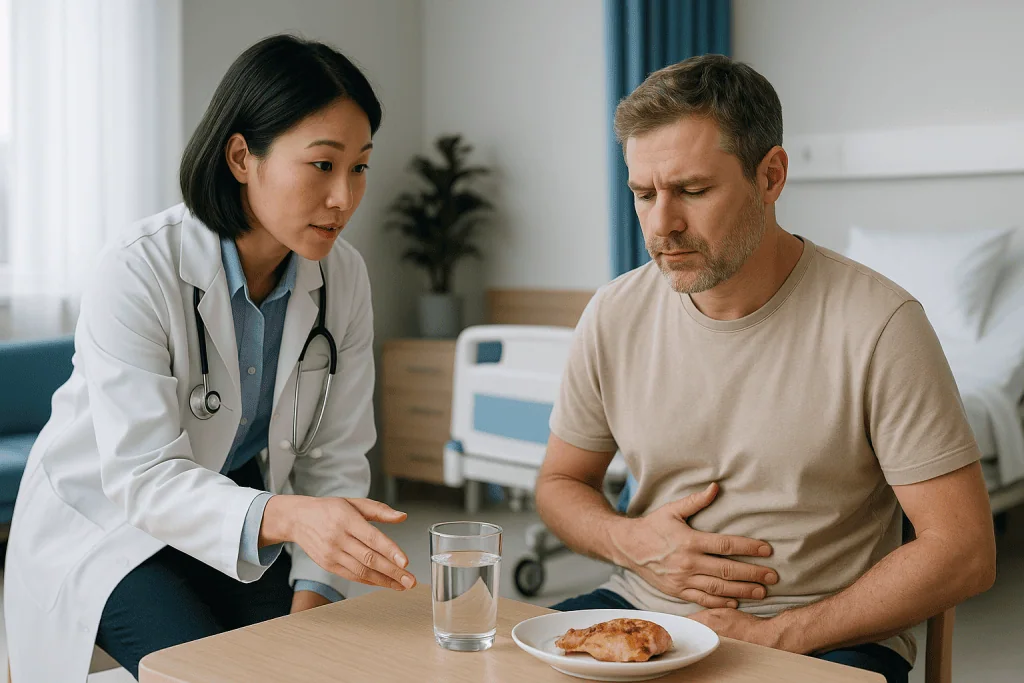
That invasion triggers an inflammatory response. Immune cells flood the area, the lining becomes leaky and inflamed, and the gut responds by pushing water and salts into the bowel to flush the intruder out. The result is the familiar picture of watery diarrhea, cramping, nausea and fever. Symptoms typically begin 6 hours to 6 days after exposure and last 4 to 7 days (CDC).
The fever is worth pausing on. It signals that the immune system has recognized the invasion and is mounting a systemic response, which is exactly what you want. In most people that response contains the bacteria within the gut wall and nearby lymph nodes, and the infection burns itself out.
In a minority, Salmonella crosses further, into the bloodstream. This is called bacteremia, meaning live bacteria circulating in the blood. The CDC clinical overview notes that roughly 5 percent of people with non-typhoidal Salmonella develop bacteremia, and from the blood the organism can seed bones, joints, the lining of the heart or the wall of a large artery (CDC Clinical Overview).
This mechanism explains the whole antibiotic debate. When the infection is confined to the gut, the body’s flushing response is already doing the job and an antibiotic adds little. When the bacteria have escaped into the blood, or are likely to in a vulnerable person, the calculation changes completely.
Can your body fight off Salmonella on its own? What the evidence says
Yes, in the great majority of cases. The question is really about which parts of the body do the work and how long it takes.
The first defense is mechanical. Diarrhea is unpleasant, but it physically removes bacteria from the gut faster than they can multiply. This is one reason clinicians are cautious about medicines that slow the bowel in an invasive infection: the flushing has a purpose.
The second defense is the gut lining itself. Cells that Salmonella has invaded are shed and replaced, taking the bacteria with them. The lining of the small intestine renews itself over a matter of days, which lines up with the typical 4 to 7 day illness (CDC).
The third layer is the immune system. White blood cells engulf bacteria in the gut wall and lymph nodes; antibodies develop over the following one to two weeks and help clear stragglers. Mayo Clinic describes most healthy people recovering within a few days to a week without specific treatment (Mayo Clinic).
The one piece of this that surprises people is what happens after symptoms stop. The immune system clears illness faster than it clears carriage. The CDC clinical overview reports that adults continue to shed Salmonella in stool for a median of about 4 to 5 weeks after infection, children under five for longer, and a small proportion, under 1 percent, become long-term carriers for a year or more (CDC Clinical Overview). Feeling well and being germ-free are two different milestones.
So can Salmonella go away on its own? For a healthy adult with an uncomplicated infection, that is not just possible; it is the expected course. The job of the person at home is to keep hydration ahead of losses while the body finishes its work.
Why antibiotics are usually held back for mild Salmonella illness
It seems counterintuitive. Salmonella is a bacterium; antibiotics kill bacteria; why would a clinician decline to prescribe one? The answer comes from trials that tested exactly this.

A Cochrane systematic review pooled randomized trials comparing antibiotics with placebo or no treatment in otherwise healthy people with non-typhoidal Salmonella diarrhea. It found no meaningful difference in how long the diarrhea, fever or other symptoms lasted. It did find that people given antibiotics were more likely to have Salmonella detectable in their stool at follow-up, and more likely to report adverse effects such as nausea (Cochrane review, PubMed).
Read that again slowly, because it is the crux. Treatment did not make people better faster and left more of them still carrying the germ. The likeliest explanation is that antibiotics disturb the protective community of gut bacteria that normally competes with Salmonella and helps evict it. Clear out the competition and the invader has more room.
There is a second, population-level concern. Salmonella strains resistant to commonly used antibiotic classes are increasingly reported worldwide, and the WHO lists antimicrobial resistance in foodborne bacteria as a growing public health problem (WHO). Each course prescribed where it offers no benefit contributes to that pressure without helping the individual.
None of this means antibiotics are harmful across the board or that anyone should decline a prescription they have been given. It means the default for a healthy person with an uncomplicated gut infection is supportive care, and the burden of proof sits with the reasons to treat, not the reasons to wait. Where a clinician does prescribe, it is because one of those reasons is present, and that judgment belongs to them.
Who is usually advised to take antibiotics, and who is usually asked to wait
Guidance from the CDC’s clinical overview divides people into two broad groups: those with severe or invasive illness, and those at elevated risk of the infection spreading beyond the gut (CDC Clinical Overview). For both, antibiotics are generally recommended. For everyone else, they are generally not.
Severe illness is judged clinically. It usually means high fever, signs of dehydration that oral fluids cannot correct, bloody diarrhea with systemic symptoms, or laboratory evidence of bacteria in the blood. A person in this state is typically assessed in person, often with blood cultures, and may need intravenous fluids alongside treatment.
Higher-risk groups named in the CDC guidance include:
- Infants younger than about 3 months, whose immune systems are still immature.
- Adults over about 50 with known or suspected atherosclerosis, because Salmonella can infect damaged artery walls.
- People with weakened immunity from illness or treatment, including advanced HIV, cancer therapy or transplant medicines.
- People with heart valve disease, artificial heart valves or vascular grafts.
- People with artificial joints or other implanted hardware.
- People with sickle cell disease, who are prone to Salmonella bone infection.
For these groups, the concern is not the diarrhea itself but where the bacteria might settle if they reach the blood. Treatment aims to prevent that seeding rather than to shorten the gut symptoms.
Everyone outside these categories, which is most adults and older children with an ordinary infection, is usually advised to focus on fluids and rest. Where antibiotics are used, the classes most often described in guidance are fluoroquinolones, third-generation cephalosporins and macrolides, chosen according to local resistance patterns and the individual’s circumstances. Which one, whether one is needed at all, and for how long, are decisions for the prescribing clinician who has the culture result in front of them.
How do you confirm Salmonella? Tests, timelines and what a result changes
Salmonella cannot be confirmed by symptoms alone. Watery diarrhea, cramps, fever, nausea and vomiting are shared by dozens of viral and bacterial infections, and the timing of onset overlaps with several of them. Confirmation requires a laboratory test on a stool sample, and occasionally on blood.
The traditional method is stool culture, in which the sample is grown on special plates to see whether Salmonella colonies appear. Results typically take 2 to 3 days. Many laboratories now also use culture-independent diagnostic tests, which detect bacterial genetic material and can return a result within hours (CDC Clinical Overview). A positive rapid test is usually followed by culture, because only a cultured organism can be tested for antibiotic susceptibility and typed for outbreak tracking.
Clinicians do not test every case of diarrhea. Mayo Clinic notes that testing is more likely when illness is severe or prolonged, when there is blood in the stool, when the person is in a higher-risk group, or when an outbreak is suspected (Mayo Clinic). A healthy adult with two days of watery diarrhea and no fever may reasonably never be tested.
What does a positive result change? For a mild case in a low-risk person, often very little beyond confirming the cause and prompting public health reporting. For a higher-risk person, it strengthens the case for treatment and, crucially, the susceptibility report tells the clinician which antibiotic classes the strain will actually respond to.
Blood cultures are drawn when fever is high or persistent, when the person looks systemically unwell, or when they belong to a group prone to invasive disease. A positive blood culture moves the situation firmly into the treat category. Salmonella symptoms in adults who are otherwise well rarely warrant this step; in an infant or an older adult with a high fever, it is routine.
Hydration alone versus antibiotic treatment: how the two approaches compare
The table below summarizes how clinicians generally weigh the two strategies, drawing on CDC, Mayo Clinic and the Cochrane review cited in this article. It describes typical practice, not a rule for any individual.
| Question | Hydration and supportive care | Antibiotic treatment |
|---|---|---|
| Who it usually suits | Healthy older children and adults with uncomplicated gut symptoms | Severe or invasive illness; infants under about 3 months; older adults with vascular disease; weakened immunity; implants or heart valve disease |
| Effect on symptom duration | Illness runs its natural course, typically 4–7 days (CDC) | No clear shortening of diarrhea in healthy people (Cochrane review) |
| Effect on shedding | Median shedding about 4–5 weeks in adults (CDC Clinical Overview) | May prolong the time bacteria are detectable in stool (Cochrane review) |
| Main goal | Prevent dehydration while the body clears the infection | Prevent or treat spread to blood, bones, joints or blood vessels |
| Main downside | Requires vigilance for dehydration and red flags | Side effects, resistance pressure, disturbed gut bacteria |
| Who decides | Person at home, with clinician advice | Prescribing clinician, guided by culture and susceptibility results |
Two points deserve emphasis. First, the columns are not competing philosophies; a person on antibiotics still needs the hydration plan, arguably more so. Second, the boundary between them moves with circumstances. A healthy adult who starts in the left column can shift to the right if fever climbs or blood appears in the stool, which is why the warning signs later in this article matter more than any starting classification.
Salmonella treatment at home: hydration done properly
Replacing fluid sounds simple until you are the one doing it between bathroom trips. The details matter.
What is lost in diarrhea is not just water but sodium, potassium and bicarbonate. Plain water restores volume but not salts, and drinking large amounts of it alone can occasionally dilute blood sodium. Oral rehydration solution, a measured mix of glucose and salts available as sachets or ready-made drinks, is designed around a specific mechanism: glucose in the small intestine drags sodium across the gut wall with it, and water follows. The WHO and NHS both describe oral rehydration solution as the preferred fluid for significant diarrhea, made up exactly as the packet directs (WHO; NHS).
Sipping small amounts often works better than large gulps, which can trigger vomiting. Broths, diluted juices and weak tea contribute fluid and some salt. Very sugary drinks and undiluted fruit juice can worsen diarrhea by pulling water into the bowel. Alcohol and caffeine are best avoided until recovery.
Food is less critical than fluid, but there is no evidence that starving the gut helps. The NHS advises eating when you feel able, starting with plain, easily digested foods and returning to a normal diet as appetite recovers (NHS). Dairy sometimes aggravates symptoms for a week or two because the inflamed lining temporarily produces less lactase, the enzyme that digests milk sugar.
One caution applies to over-the-counter anti-diarrheal medicines. Mayo Clinic advises against using them when there is fever or blood in the stool, because slowing the bowel can keep an invasive organism in contact with the gut wall longer (Mayo Clinic). Anyone considering one should ask a pharmacist or clinician first.
Handwashing with soap after every bathroom visit and before preparing food is the single most effective step to protect the household, given how long shedding continues.
How long does salmonella last? What the following days and weeks usually look like
Timelines vary, but published ranges give a reasonable map.
Days 1 to 3 are usually the worst. Diarrhea is most frequent, cramps most intense, and fever, if present, tends to peak. This is when dehydration risk is highest and when the warning signs later in this article should be checked most often. Most people have no appetite, which is fine as long as fluids keep going in.
Days 3 to 7 typically bring improvement. Fever settles, bowel movements become less frequent and more formed, and energy starts to return. The CDC gives 4 to 7 days as the typical total duration of illness (CDC). If things are getting worse rather than better at this point, or a fever persists beyond about three days, that is a reason to be reassessed.
Week 2 and beyond is recovery. Loose stools can persist intermittently for a couple of weeks as the gut lining fully heals, and temporary difficulty with dairy is common. Fatigue can outlast the diarrhea.
Shedding continues well past recovery: a median of 4 to 5 weeks in adults, longer in young children (CDC Clinical Overview). This is why some workplaces, particularly food handling and healthcare, have return-to-work policies that go beyond simply feeling well. Local public health guidance governs this, not personal judgment.
A small number of people develop reactive arthritis, an inflammatory joint pain that appears one to several weeks after the gut infection and is thought to be an immune response rather than live infection in the joint. Mayo Clinic notes it can last months and can be accompanied by eye irritation and painful urination (Mayo Clinic). New joint pain in the weeks after Salmonella warrants a clinician visit rather than a wait-and-see approach.
Typhoid is different: when Salmonella always needs treatment
Everything above concerns non-typhoidal Salmonella, the strains behind ordinary food poisoning. There is a second family that behaves very differently, and confusing the two is a genuine source of misunderstanding online.
Salmonella Typhi and Salmonella Paratyphi cause typhoid and paratyphoid fever, collectively called enteric fever. These strains infect only humans, spread through water and food contaminated by human waste, and are largely a concern for people who have traveled to or live in regions with limited sanitation. The WHO notes that typhoid causes an estimated 9 million illnesses and around 110,000 deaths a year globally (WHO).
Enteric fever does not look like food poisoning. Diarrhea may be absent or mild, at least early. The hallmark is a sustained, climbing fever developing over one to three weeks after exposure, often with headache, abdominal discomfort, weakness and sometimes a faint rash. Constipation is as common as diarrhea. Because the bacteria are in the bloodstream almost from the start, the infection is invasive by definition.
For that reason enteric fever is always treated with antibiotics, and the debate that applies to non-typhoidal infection does not apply here. Untreated, it carries a significant risk of intestinal perforation and other complications. Resistance to several antibiotic classes is now widespread in parts of South Asia, which makes culture and susceptibility testing especially important and makes the choice of agent a specialist decision (WHO; CDC).
Vaccines against typhoid exist and are recommended for many travelers to higher-risk regions; they do not protect against non-typhoidal Salmonella or against paratyphoid. Anyone who develops a persistent fever after travel should say so early in the conversation with their clinician, because the working diagnosis and the urgency change accordingly.
Antibiotic resistance and why it shapes the decision more than it used to
A generation ago, the case against treating mild Salmonella rested mainly on lack of benefit. Today resistance adds a second, sharper argument.
Salmonella lives in food animals, and antibiotics used in agriculture as well as in human medicine exert selective pressure on it. Strains resistant to older agents such as ampicillin and trimethoprim-sulfamethoxazole have been common for years. More concerning is the rise of strains with reduced susceptibility to fluoroquinolones and third-generation cephalosporins, the classes most often relied on when treatment is genuinely needed. The CDC tracks these patterns through national surveillance and reports that a meaningful share of human isolates now carry resistance to at least one clinically important class (CDC). The WHO identifies fluoroquinolone-resistant Salmonella as a priority pathogen for new drug development (WHO).
Why does this matter to one person deciding about one prescription? Because resistance is a shared resource problem. Each unnecessary course selects for resistant organisms in that person’s gut, which are then shed and can spread. Over a population, this erodes the effectiveness of the very drugs a vulnerable infant or an immunocompromised adult may one day depend on.
It also matters practically. When treatment is indicated, the clinician needs to choose an agent the strain is actually susceptible to. This is why culture, rather than a rapid molecular test alone, remains important in serious cases, and why a clinician may start one class and switch when susceptibility results return. Those adjustments are normal and are not a sign that something has gone wrong.
The takeaway is not that antibiotics are bad. It is that they are precious, and that withholding them where they do not help is part of keeping them useful where they do.
What people often get wrong about Salmonella and antibiotics
Some myths persist because they sound sensible. Here are the ones that come up most, with what the evidence actually shows.
“It is bacterial, so it needs an antibiotic.” Not for the gut infection itself in a healthy person. Randomized trials found no shortening of illness and longer shedding with treatment (Cochrane review). The body’s own clearance mechanisms handle uncomplicated infection well.
“Bloody diarrhea always means antibiotics.” Blood in the stool is a reason to be seen and tested, not an automatic prescription. It reflects gut wall inflammation, which Salmonella and several other organisms cause. The clinician weighs it alongside fever, overall condition and risk factors.
“Once I feel better I cannot spread it.” Adults shed Salmonella for a median of 4 to 5 weeks after recovery (CDC Clinical Overview). Handwashing discipline needs to outlast symptoms by weeks, not days.
“Antibiotics will stop me being a carrier.” The trial evidence points the other way for acute infection: treated people were more likely to still test positive at follow-up (Cochrane review).
“Anti-diarrheal tablets will speed recovery.” They may relieve urgency but do not shorten the infection, and Mayo Clinic advises against them when fever or bloody stools are present (Mayo Clinic).
“Salmonella only comes from chicken and eggs.” Poultry and eggs are major sources, but outbreaks have been traced to produce, nut butters, flour, and contact with reptiles, backyard poultry and pet food (CDC). Any raw food handled without care can be a vehicle.
“Typhoid and food poisoning Salmonella are the same thing.” They are related bacteria with very different behavior. Enteric fever is invasive from the outset and always treated; ordinary salmonellosis usually is not.
Questions to ask your care team
A short conversation, prepared in advance, gets more from a clinic visit or telephone consultation than a long one improvised on the spot. These questions are framed to help you understand the reasoning behind whatever plan is recommended, not to steer it.
- Based on my age, health and how I look today, do I fall into a group where antibiotics are usually recommended, or one where waiting is the standard approach?
- Do you want a stool sample, and if so, will it be a culture, a rapid test or both? When should I expect results, and will anyone contact me if they change the plan?
- What specific signs would mean my situation has shifted from watch-and-hydrate to needing treatment or an in-person assessment?
- How should I judge whether I am keeping up with fluid losses at home, and at what point would you want me to come in for intravenous fluids?
- Are there any of my regular medicines that I should ask about while I am unwell, for example ones that affect the kidneys or blood pressure and can be a problem when dehydrated?
- Is it safe for me to use an over-the-counter anti-diarrheal medicine, given my symptoms?
- If an antibiotic is prescribed, what class is it, why that one, and what should I expect over the first 48 hours? What side effects would you want to hear about?
- How long am I likely to remain infectious, and what does that mean for work, school or caring for an infant or older relative at home?
- Is there anyone else in my household who should be tested or watched more closely because of their own risk factors?
- What symptoms in the coming weeks, such as joint pain, would you want me to report?
Write the answers down. Fever and dehydration make memory unreliable, and having the thresholds on paper turns a vague worry at 2 a.m. into a clear next step.
When to call your doctor: red-flag signs that hydration alone is not enough
Most Salmonella infections can be managed at home, but the plan depends on recognizing when it is no longer working. The signs below are drawn from CDC, NHS and Mayo Clinic guidance on when diarrheal illness needs medical assessment (CDC; NHS; Mayo Clinic). Any one of them is a reason to call the same day; several together, or rapid deterioration, is a reason for urgent or emergency care.
- Signs of dehydration that are not improving with oral fluids: very little urine or none for eight hours or more, dark urine, dizziness on standing, a dry mouth, sunken eyes, or in infants a sunken soft spot and fewer wet diapers.
- Inability to keep fluids down because of persistent vomiting.
- A high fever, generally above 102°F (39°C), or any fever that persists beyond about three days.
- Blood in the stool, or stools that are black and tarry.
- Diarrhea lasting more than three days without improvement, or worsening after initial improvement.
- Severe or localized abdominal pain, especially with a rigid or very tender abdomen.
- Confusion, unusual drowsiness or difficulty waking, particularly in children and older adults.
- New severe headache, neck stiffness, or a new joint that is hot, swollen and painful.
- Symptoms in an infant under three months, an adult over about 65, a pregnant person, or anyone with weakened immunity, heart valve disease, vascular grafts, artificial joints or sickle cell disease, even if symptoms seem mild.
- A persistent fever after recent travel to a region where typhoid is common.
Call sooner rather than later. Clinicians would far rather hear about a concern that turns out to be nothing than see someone arrive dehydrated and septic because they waited to be sure. The decision about testing, fluids and whether an antibiotic is needed rests with the treating team; the decision to pick up the phone rests with you, and the threshold for doing so should be low.
Frequently asked questions
Can you treat Salmonella without antibiotics?
Yes, and for most healthy people that is the standard approach. The CDC and Mayo Clinic advise that uncomplicated Salmonella gut infection is managed with fluids, rest and time rather than antibiotics, because trials show treatment does not shorten the illness and may prolong shedding. Antibiotics are reserved for severe or invasive illness and for higher-risk groups. Your clinician decides which category applies to you.
Can your body fight off Salmonella on its own?
In the great majority of cases it does. Diarrhea flushes bacteria out, the gut lining sheds infected cells and renews itself over days, and the immune system clears what remains. The CDC gives 4 to 7 days as the typical illness. Shedding in stool continues for weeks after recovery, and a small minority of people, particularly infants and those with weakened immunity, need help in the form of antibiotics.
What are the main symptoms of Salmonella?
The most common features described by the CDC are diarrhea, which may be watery or occasionally bloody; abdominal cramps; fever; nausea and vomiting; and headache or general achiness. These overlap with many other stomach infections, so symptoms alone cannot confirm Salmonella. A stool test is the only way to be sure, and a clinician decides whether testing is worthwhile based on severity and risk.
How do you confirm Salmonella?
Salmonella is confirmed by testing a stool sample, either by culture, which takes about 2 to 3 days, or by a rapid molecular test that detects bacterial genetic material within hours. Culture is still important in serious cases because it allows antibiotic susceptibility testing. Blood cultures are added when fever is high or the person is at risk of invasive infection. Mild cases in healthy adults are often not tested at all.
How long does salmonella last in adults?
Symptoms usually last 4 to 7 days according to the CDC, with the first two or three days typically the most intense. Loose stools and fatigue can linger for a week or two afterward as the gut heals. Adults continue to shed the bacteria in stool for a median of about 4 to 5 weeks, so infectiousness outlasts symptoms considerably. Illness persisting beyond three days without improvement should be reassessed.
Can salmonella go away on its own without any treatment?
For an otherwise healthy adult or older child with an uncomplicated infection, yes; that is the expected course. Supportive care means keeping fluid and salt intake ahead of losses, not doing nothing. Infants under about three months, older adults with vascular disease, pregnant people and anyone with weakened immunity or implanted devices should be assessed even if symptoms seem mild, because their risk of the infection spreading is higher.
What is the best salmonella treatment at home?
Fluid and salt replacement is the core of home care. Oral rehydration solution made up as the packet directs is the preferred fluid for significant diarrhea, sipped frequently in small amounts. Eat plain food when able, avoid very sugary drinks and alcohol, and wash hands thoroughly after every bathroom visit. Ask a pharmacist or clinician before using anti-diarrheal medicines, which are not advised when fever or bloody stools are present.
Why would antibiotics make Salmonella last longer?
The leading explanation is that antibiotics disturb the normal community of gut bacteria that competes with Salmonella and helps clear it. A Cochrane review of randomized trials found that treated healthy people were more likely to still have Salmonella in their stool at follow-up than untreated people, without any shortening of symptoms. This applies to uncomplicated gut infection, not to invasive disease where treatment is essential.
Is Salmonella food poisoning the same as typhoid?
No. Ordinary food poisoning is caused by non-typhoidal Salmonella strains and usually stays in the gut. Typhoid and paratyphoid fever are caused by Salmonella Typhi and Paratyphi, spread through water and food contaminated by human waste, and are invasive from the start with a sustained climbing fever. Enteric fever is always treated with antibiotics. Anyone with persistent fever after travel should tell their clinician early.
When should I go to the doctor with Salmonella?
Call the same day if you cannot keep fluids down, pass very little urine, feel dizzy on standing, have a high fever or one lasting more than three days, see blood in your stool, or have severe abdominal pain. Seek care promptly regardless of severity if the ill person is an infant, over about 65, pregnant, or has weakened immunity, heart valve disease, implants or sickle cell disease.
References
- CDC: Clinical Overview of Salmonellosis
- CDC: About Salmonella Infection
- NHS: Food poisoning
- WHO: Salmonella (non-typhoidal) fact sheet
This article is for general information only and is not a substitute for professional medical advice. Please consult a qualified doctor about your individual situation.

More from the Blog

When Does a Fever After Travel Need Typhoid Testing? How Care Is Organized From Day One
A fever after travel usually needs typhoid testing when it starts within about 30 days of returning from a region where typhoid is common,…

Latent vs Active Tuberculosis: How Treatment Differs and Why Latent TB Is Still Treated
Latent TB infection and active TB disease are both treated, but differently. Latent TB, where bacteria are dormant and not contagious, is usually managed…

Which COVID-19 Cases Need Hospital Care? Oxygen Readings, Risk Factors and the Monitoring Plan
COVID-19 usually needs hospital care when breathing becomes hard at rest, when a pulse oximeter reads about 92 percent or lower, or when confusion,…

Dengue Blood Tests Explained: What Platelet Counts and Liver Tests Tell Your Doctor Each Day
In dengue, doctors repeat a complete blood count, often daily, because the platelet count usually falls to its lowest point around the time the…
Why Antibiotics Are Not Prescribed for a Common Cold: What Symptom-Relief Care Involves
Antibiotics do not help a cold. Colds are caused by viruses, and antibiotics only act on bacteria, so they neither shorten the illness nor…

Life After Meningitis Treatment: Hearing Checks, Neurological Follow-Up and Rehabilitation
Recovery after meningitis is usually gradual rather than sudden. Viral meningitis often settles within about 7 to 10 days, while bacterial meningitis typically needs…