

Which COVID-19 Cases Need Hospital Care? Oxygen Readings, Risk Factors and the Monitoring Plan

Key Takeaways
- An adult oxygen saturation of 92 percent or lower on a correctly taken home reading is treated as an emergency in NHS guidance, while 93 to 94 percent warrants same-day clinical advice.
- A resting breathing rate above 30 breaths per minute is one of the WHO's defining features of severe COVID-19, and counting breaths for a full minute is as useful as the oximeter.
- Serious deterioration in COVID-19 most often happens after the first several days of illness, which is why monitoring should continue through day 10 even after fever breaks.
- Age is the strongest single risk factor for hospitalization, with chronic lung, heart and kidney disease, diabetes, obesity, pregnancy and immune suppression each adding further risk.
- Antiviral medicines work by limiting viral replication and are most useful in the first days of symptoms, so people in higher-risk groups should ask about eligibility early.
- Most people with mild to moderate COVID-19 are no longer contagious by about day 10, but the CDC advises five additional days of precautions after fever has resolved and symptoms improve.
COVID-19 usually needs hospital care when breathing becomes hard at rest, when a pulse oximeter reads about 92 percent or lower, or when confusion, chest pain, blue or gray lips, or inability to stay awake appear. Older age and conditions such as lung, heart or kidney disease, diabetes, pregnancy or a weakened immune system raise the risk of deterioration and lower the threshold for an in-person assessment.
The thermometer says 101.3 again, same as yesterday, and the cough has settled into a dry, tiring rhythm that wakes you around three in the morning. You are not gasping. You are not fine either. Somewhere between those two states sits the question that sends people scrolling at dawn: when does COVID need hospital care, and how would I actually know?
The honest answer is that clinicians do not decide on a hunch. They look at a short list of measurable things: how hard the body is working to breathe, how much oxygen is reaching the blood, how long the illness has been going, and which pre-existing conditions are in the background. None of those requires a medical degree to track at home, as long as you know what you are measuring and what counts as a change.
This explainer walks through that list the way an admitting clinician would, so that if the moment comes, you are checking numbers rather than guessing at them.
When does COVID need hospital care? How clinicians actually decide
Hospital admission for COVID-19 is not triggered by a positive test, a high fever or even a miserable week in bed. It is triggered by evidence that the lungs, heart or brain are not keeping up. The World Health Organization sorts COVID-19 into mild, moderate, severe and critical illness, and the dividing lines are physical signs rather than how unwell someone feels. Severe disease, in the WHO framework, means markers such as a blood oxygen saturation below 90 percent on room air or a resting breathing rate above 30 breaths per minute in an adult.
Why those two numbers? Because they measure the one organ COVID-19 most reliably damages. The virus inflames the small air sacs in the lungs, where oxygen crosses into the blood. When enough of those sacs fill with fluid and inflammatory cells, oxygen transfer drops. The body compensates first by breathing faster, then by working harder with the muscles between the ribs and in the neck. Clinicians read those compensations as a warning that reserve is running out.
A second layer of the decision is trajectory. Someone whose numbers are borderline but improving is a different patient from someone whose numbers are borderline and sliding. Hence the emphasis on a monitoring plan rather than a single snapshot.
The third layer is context: age, chronic conditions, pregnancy, immune status and whether there is a capable adult at home who can watch for changes overnight. Two people with identical readings can reasonably receive different advice. That is not inconsistency; it is risk assessment, and the treating team weighs all three layers together.
COVID oxygen levels: when to go to hospital and what the numbers mean
Oxygen saturation, written as SpO2, is the percentage of hemoglobin in your red blood cells that is carrying oxygen. A fingertip pulse oximeter estimates it by shining light through the skin. In a healthy adult at sea level, readings usually sit between about 95 and 100 percent.
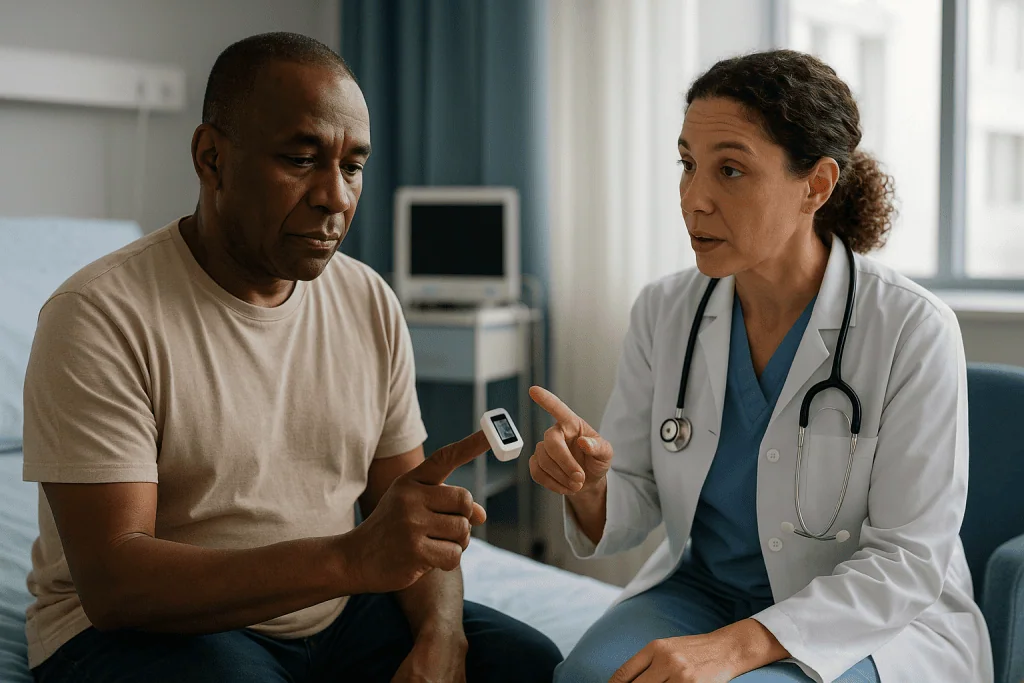
With COVID-19 the number matters because the lungs can fail quietly. Some people develop markedly low oxygen without feeling as breathless as the reading suggests, a pattern clinicians sometimes call silent hypoxia. Hypoxia simply means too little oxygen reaching the tissues. The person may be talking, texting and insisting they are okay while their saturation drifts into the 80s.
Guidance from the NHS, which ran one of the largest home oximetry programs during the pandemic, uses clear bands for adults with COVID-19:
- 95 percent or above on repeated checks: continue monitoring at home unless other symptoms change.
- 93 or 94 percent: contact a clinician the same day for advice.
- 92 percent or below: seek emergency care, because this level usually calls for supplemental oxygen and in-person assessment.
Those thresholds assume a person whose normal baseline is in the healthy range. Someone with long-standing lung disease may live at 90 or 91 percent every day, and for them the meaningful sign is a drop of several points from their usual figure, not a fixed cutoff. Anyone in that situation should ask their own clinician what their personal action numbers are before they get sick, not after.
One reading is never the whole story. Clinicians look at the pattern over hours and days, alongside breathing rate and how the person looks and sounds.
How to take a reliable pulse oximeter reading at home
Oximeters are easy to misread, and the mistakes almost always push the number down, which creates false alarms, or occasionally up, which creates false reassurance. A few habits fix most of the problems.
Sit down and rest for a few minutes before measuring. Warm the hand first; cold fingers constrict blood flow and the device may struggle to find a pulse. Remove nail polish or acrylic nails from the finger being used, because pigment interferes with the light. Place the probe on the middle or index finger, keep the hand still at roughly heart level, and wait until the number stops fluctuating, which typically takes 30 seconds to a minute. Record the lowest steady value rather than the first one that flashes.
Take readings at the same times each day, for example morning, afternoon and bedtime, and write them in a notebook or phone note with the time, your temperature and how you felt. A column of numbers tells a clinician far more than a single figure recalled from memory.
Two limitations deserve honesty. First, pulse oximeters can overestimate oxygen levels in people with darker skin tones, meaning the true saturation may be a few points lower than displayed. If you have darker skin and feel worse than the number suggests, trust the symptoms and call. Second, consumer devices vary in quality, and smartwatch readings are not validated as medical tools for this purpose.
Breathing rate is a useful partner measurement. Count breaths for a full minute while the person is resting and not talking. Adults normally breathe around 12 to 20 times per minute; a sustained rate above 24 to 30 at rest is a sign to seek advice promptly.
COVID high risk groups: which factors raise the chance of needing hospital care
Age is the single strongest predictor. CDC data consistently show that the likelihood of severe illness, hospitalization and death climbs steeply with each decade past 50, with adults over 65 carrying the greatest share of hospital admissions. This is partly because the immune response becomes less precise with age, and partly because older adults more often carry the conditions listed below.
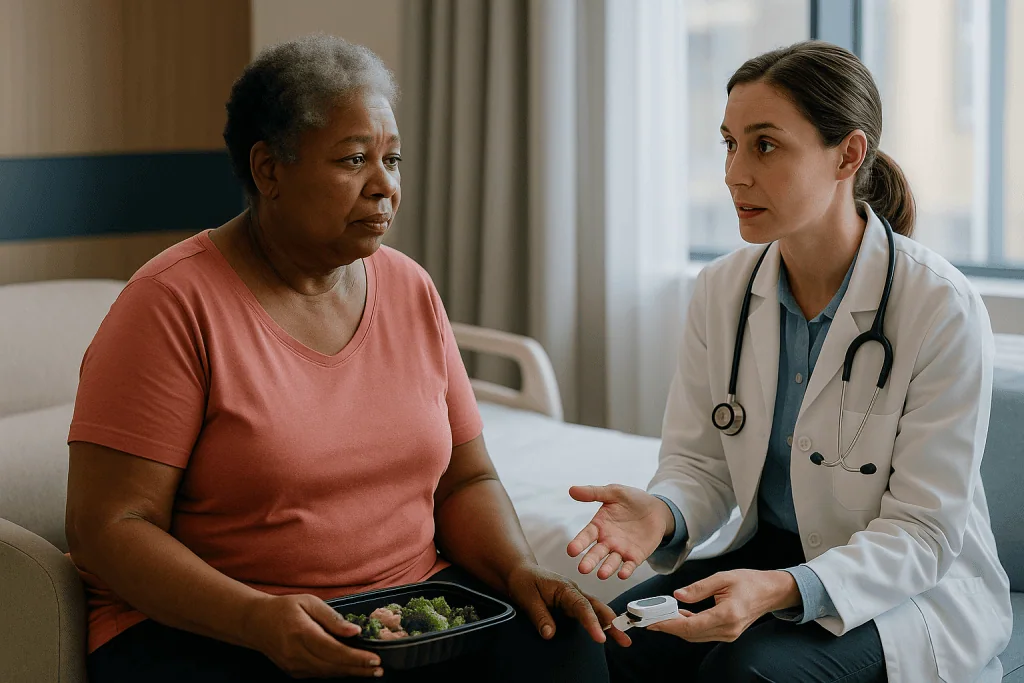
Beyond age, the CDC identifies a set of medical conditions associated with higher risk of severe COVID-19. The ones with the most consistent evidence include:
- Chronic lung disease such as COPD, moderate to severe asthma, interstitial lung disease or pulmonary hypertension.
- Heart conditions, including heart failure, coronary artery disease and cardiomyopathy.
- Diabetes, both type 1 and type 2.
- Obesity, with risk rising as body mass index increases.
- Chronic kidney disease, especially for people on dialysis.
- A weakened immune system, whether from cancer treatment, organ transplant medicines, advanced HIV or primary immune disorders.
- Pregnancy and the weeks after delivery.
- Current or former smoking, and physical inactivity.
Having more than one of these compounds the risk, and so does living in a care facility or being unvaccinated. Vaccination does not change the symptoms you watch for, but it substantially lowers the odds that an infection progresses to the severe stage described in this article.
Risk factors do not mean a person must go to hospital. They mean the threshold for picking up the phone should be lower, that any monitoring plan should be tighter, and that early antiviral treatment, where a clinician judges it appropriate, becomes a more pressing conversation in the first days of illness rather than later.
Who usually recovers at home, and who is usually asked to come in
Most people who catch COVID-19 do not need a hospital. The WHO and CDC both describe the typical course as a mild to moderate respiratory illness managed with rest, fluids, fever control and time. That group includes the majority of healthy adults under 65, most vaccinated people, and most children.
A person is generally well suited to home care when they can breathe comfortably at rest and during light activity, their oxygen saturation stays at 95 percent or higher, they can drink enough to pass urine normally, they are mentally clear, and there is someone who can check on them. Feeling wretched is not a disqualifier; fever, aching muscles, headache, loss of smell and a heavy cough are all compatible with safe recovery at home.
Clinicians lean toward in-person assessment, and sometimes admission, when one or more of the following apply: oxygen saturation at or below 92 percent, visible effort to breathe, a breathing rate persistently above 30, new confusion or drowsiness, chest pain, signs of dehydration, or an inability to manage basic self-care. They also look harder at people in the high-risk groups above, at those whose symptoms worsened after an initial improvement, and at anyone living alone with no one to notice a decline overnight.
There is also a middle category: people who do not need a ward bed but do need a closer look. An emergency department visit may end with a chest X-ray, blood tests, a period of observation and discharge home with a tighter monitoring plan or a prescription. Being sent home after assessment is a reasonable outcome, not a sign the visit was unnecessary.
The three-zone monitoring plan at a glance
A monitoring plan turns anxiety into a checklist. The version below mirrors the structure used in home oximetry programs and clinical guidance from the NHS and CDC. It is a framework for conversation with your own clinician, not a replacement for one, and the numbers assume an adult with a normal baseline.
| Zone | What you observe | What to do |
|---|---|---|
| Green: managing at home | SpO2 95 percent or above on repeated checks; breathing comfortable at rest; drinking and passing urine normally; alert; fever responding to rest and simple measures | Check oximeter, temperature and breathing rate two to three times a day; record readings; rest; keep appointments for any prescribed antiviral review |
| Amber: same-day advice | SpO2 93 or 94 percent; breathing rate rising toward 24 to 30 at rest; breathless on light activity you could manage yesterday; fever persisting past day five; unable to keep fluids down; readings slipping day over day | Call your clinician or nurse line the same day; increase checks to every few hours; do not wait overnight to see if it settles |
| Red: emergency care now | SpO2 92 percent or below; struggling to speak in full sentences; chest pain or pressure; blue, gray or pale lips, face or nail beds; new confusion; cannot be woken or kept awake; coughing up blood | Call emergency services or go to the nearest emergency department; say it is suspected COVID-19 so staff can prepare |
Notice that several amber signs are about direction rather than absolute values. A reading of 94 on day three that was 97 on day one deserves a call even though 94 is not itself an emergency. The table rewards consistent measurement, which is why the plan starts with recording numbers from the very first day of illness.
What the first two weeks of COVID usually look like
Symptoms typically appear two to 14 days after exposure, with most people noticing them within about five days, according to the Mayo Clinic and CDC. The opening days often bring sore throat, congestion, fatigue, headache, fever and cough. For the majority, this is the whole story: a peak around days three to five, then a gradual climb back over one to two weeks, with cough and tiredness lingering longest.
The pattern clinicians watch for is different. In the subset who become seriously ill, deterioration tends to come not at the start but after several days, often around the end of the first week into the second. The early viral phase gives way to an exaggerated inflammatory response in the lungs, and this is when oxygen levels can fall and breathing becomes labored. Some people describe a false dawn: a day of feeling better, followed by a sudden slide.
That timing shapes the monitoring plan. The first few days are the window for antiviral treatment in people who qualify, because antivirals work by limiting how much the virus copies itself, and there is less virus to limit once the inflammatory phase has begun. Days five through 10 are when oximeter checks matter most, even if the fever has broken. Anyone who feels markedly worse in the second week, particularly with breathlessness, should treat that as a change worth reporting.
After the acute illness, energy and stamina commonly take weeks to return fully. Persistent breathlessness on exertion, chest discomfort or a racing heart during that recovery period should be reviewed by a clinician rather than attributed automatically to deconditioning.
When should you go to the ER with COVID? Shortness of breath and other red flags
Breathlessness is the symptom people worry about most and understand least. Feeling winded after climbing stairs with a fever is common and not, by itself, an emergency. The kind of shortness of breath that matters is present at rest, is getting worse rather than better, or stops you doing ordinary things: finishing a sentence, walking to the bathroom, lying flat to sleep.
The CDC lists specific emergency warning signs that mean a person should get care immediately rather than wait for an appointment:
- Trouble breathing or persistent shortness of breath at rest.
- Persistent pain or pressure in the chest.
- New confusion, or difficulty thinking clearly.
- Inability to wake up or stay awake.
- Pale, gray or blue-colored skin, lips or nail beds, judged against the person’s usual skin tone.
Add to that list an oxygen saturation of 92 percent or below, coughing up blood, signs of severe dehydration such as very little urine or dizziness on standing, and a sudden collapse or fainting.
Practical points help in the moment. If you call emergency services, tell the dispatcher it is suspected or confirmed COVID-19. If someone is driving you, sit upright rather than reclined, which helps breathing. Bring your written log of oximeter readings and temperatures, a list of your medicines and allergies, and the name of your regular clinician. If you are caring for someone else, keep your phone charged and stay with them until help arrives.
Emergency departments would rather assess a person with suspected deterioration and send them home than see them 12 hours later in crisis. Thresholds exist precisely so that you do not have to decide alone whether a bad night is dangerous.
What happens in hospital: oxygen, anti-inflammatory medicines and antivirals
Admission begins with assessment: oxygen saturation, breathing rate, blood pressure, temperature, a chest X-ray and blood tests that look at inflammation, kidney function, clotting and oxygen and carbon dioxide levels. From these the team decides how much support is needed and where in the hospital it should happen.
Supplemental oxygen is the cornerstone. It can be delivered through soft prongs in the nostrils, a face mask, or a high-flow system that pushes warmed, humidified oxygen at higher rates. If those are insufficient, non-invasive ventilation uses a tight mask to help keep the air sacs open; mechanical ventilation through a breathing tube is reserved for critical illness. Many patients are also asked to spend hours lying on their front, a technique called proning, which improves how well different regions of the lung match airflow to blood flow.
Medicines are chosen by illness stage. In people who need oxygen, a corticosteroid such as dexamethasone is commonly used; corticosteroids dampen the runaway inflammatory response that drives lung injury in the later phase. Other immune-modulating medicines may be added for those who are deteriorating despite steroids. Antiviral medicines, which block the virus from copying itself, are most useful early in the illness and may be given in hospital to some patients. Because people with severe COVID-19 are at increased risk of blood clots, a blood thinner is often used to prevent them while in hospital.
Each of these decisions depends on the individual’s oxygen needs, other conditions and existing medicines, and all of them belong to the treating team. Patients and families can reasonably ask what each treatment is for, what the team is watching to judge whether it is working, and what would prompt a change of plan.
How to monitor a family member with COVID at home
Caring for someone with COVID-19 at home is mostly watchfulness, and it goes better with structure. Set three check-in times a day and treat them as appointments. At each one, record oxygen saturation, temperature, breathing rate counted over a full minute, how much they have had to drink, and a one-line note on how they seem compared with the last check. Keep the log somewhere a clinician can see it quickly if needed.
Encourage fluids regularly rather than in large amounts; dehydration worsens fatigue and dizziness and can tip a borderline situation. Simple fever measures and rest are appropriate, and any over-the-counter or prescribed medicines should be used exactly as the person’s clinician or pharmacist has advised. Help them change position through the day and spend some time sitting upright or lying on their side or front, which supports the lower parts of the lungs.
Watch for the signs the person cannot see in themselves. New confusion, unusual sleepiness, slurred speech, or a change in skin, lip or nail-bed color are easier to notice from the outside. So is breathing effort: look for flaring nostrils, visible pulling in at the base of the neck or between the ribs, and difficulty finishing sentences.
Protect yourself and others in the household. The CDC advises good ventilation, masking when in the same room, separate sleeping space where possible, and attentive hand hygiene. If you belong to a higher-risk group yourself, ask a clinician early about your own options.
Finally, agree in advance what will prompt a call and who will make it, including overnight. Deciding thresholds calmly at noon is far easier than deciding them at three in the morning.
How long is COVID contagious? Are you still contagious after 5 days?
Yes, many people are still contagious after five days, though usually much less so than at the start. Studies summarized by the CDC show that the amount of virus people shed peaks in the days around symptom onset and falls steadily afterward. By around day 10, most people with mild to moderate illness are no longer spreading infectious virus, although the exact point varies from person to person.
Current CDC respiratory virus guidance reflects that curve. People can return to normal activities once their symptoms are improving overall and they have been fever-free for at least 24 hours without fever-reducing medicine. For the next five days, the CDC advises added precautions such as wearing a well-fitting mask around others, improving ventilation, keeping distance where practical, and being thoughtful about contact with people at higher risk. Those extra days exist because some people remain infectious even as they feel better.
Two groups fall outside the typical pattern. People who were severely ill, and people with significantly weakened immune systems, can shed infectious virus for considerably longer, sometimes for weeks, and should follow the specific advice of their treating team about isolation and testing. Anyone in that position who develops new symptoms after seeming to recover should also seek advice.
Testing has limits here. Antigen tests detect viral protein and tend to turn negative as infectiousness falls, so a negative antigen test after symptoms have improved is reasonably reassuring. PCR tests, which detect genetic material, can remain positive for weeks after a person has stopped being contagious and are not useful for deciding when to end precautions.
What people often get wrong about COVID and hospital care
“If I can talk, my lungs are fine.” Not reliably. Silent hypoxia is a recognized feature of COVID-19 in which oxygen levels fall further than breathlessness suggests. The oximeter exists precisely because sensation lags behind physiology.
“The hospital will just send me home, so why go.” Being assessed, X-rayed, observed and discharged is a good outcome. Emergency departments stratify risk; sending someone home with a tighter plan is one of their tools, not a verdict that the visit was wasted.
“Once the fever breaks I am out of danger.” The inflammatory phase that drives severe disease often starts after the fever has eased, typically around the end of the first week. Monitoring should continue through day 10 regardless of temperature.
“Young, healthy people never need hospital.” Rarely is not never. Age and chronic conditions shift the odds substantially, but severe illness can occur in people without known risk factors, which is why the red-flag signs apply to everyone.
“Antibiotics will help.” COVID-19 is viral. Antibiotics have no effect on the virus and are used only when a clinician suspects a bacterial complication such as a secondary pneumonia.
“A good oximeter reading means the whole picture is good.” Oxygen is one measure. Dehydration, confusion, chest pain and inability to care for oneself are reasons for assessment even when the saturation reads 97.
“A positive PCR means I am still infectious.” PCR can stay positive long after contagiousness ends. Symptom course, time since onset and antigen testing are better guides.
Each of these myths tends to push people in the same direction: toward waiting. The evidence points the other way. Earlier assessment and earlier treatment, where appropriate, are what change the course of this illness.
Questions to ask your care team
Good questions get better care, and with COVID-19 the most useful ones are about thresholds and timing. Write the answers down; fever and fatigue erode memory.
If you are managing at home:
- Given my age and health history, am I someone who should be considered for early antiviral treatment, and by what day would that decision need to be made?
- What oxygen saturation and breathing rate should prompt me to call you, and what numbers should send me straight to emergency care?
- I have a lung or heart condition and my usual oxygen reading is lower than average. What is my personal action threshold?
- Should any of my regular medicines be paused, continued or watched more closely while I am ill?
- How can I reach someone outside office hours, and what information should I have ready?
If you or a family member has been admitted:
- What is the main thing you are treating right now, and what measurements tell you whether it is working?
- What level of oxygen support is being used, and what would make you step it up or down?
- Which medicines have been started, what is each one for, and how long do you expect them to be needed?
- What would need to be true for discharge, and what monitoring and follow-up will be arranged for home?
- Who is the right person to speak with for daily updates, and when?
None of these questions second-guesses the clinicians. They simply make the plan visible, which helps everyone, including the team, stay aligned when the situation changes.
When to call your doctor
Keep this short list where you can see it. Call your clinician, nurse line or out-of-hours service the same day if any of the following apply: your oxygen saturation reads 93 or 94 percent on repeated checks, or has dropped several points from your usual baseline; your resting breathing rate is persistently above 24; you feel more breathless than yesterday during light activity; your fever is still high after five days or returns after settling; you cannot keep fluids down or are passing very little urine; you belong to a higher-risk group and have not yet discussed antiviral treatment; or you simply feel you are getting worse rather than better in the second week.
Call emergency services or go to the nearest emergency department without delay if any of these appear: oxygen saturation of 92 percent or lower; difficulty breathing at rest or inability to speak in full sentences; persistent chest pain or pressure; new confusion or unusual drowsiness; inability to wake or stay awake; blue, gray or pale lips, face or nail beds; coughing up blood; or fainting. These are the signs the CDC and NHS single out as emergencies, and they do not improve by waiting until morning.
If you are pregnant, severely immunocompromised, or caring for an infant or an older adult with COVID-19, your threshold for calling should be lower still, and your treating team may give you specific numbers that differ from the general figures here. Follow theirs.
Everything in this article is a framework for a conversation. The decision about whether a particular person needs hospital care, which treatments are appropriate, and when it is safe to go home always rests with the clinicians who can examine them.
Frequently asked questions
When is COVID serious enough to go to the hospital?
COVID-19 is serious enough for hospital care when breathing is difficult at rest, oxygen saturation is 92 percent or below, or there is chest pain, new confusion, inability to stay awake, or blue, gray or pale lips or nail beds. These are the emergency signs identified by the CDC and NHS. Higher-risk individuals should seek advice earlier, at the first sign of worsening.
How do I know if I need to go to the hospital with COVID?
Measure rather than guess. Check oxygen saturation and resting breathing rate two to three times daily and note the trend. A reading of 92 percent or lower, a breathing rate persistently above 30, or any of the CDC’s emergency warning signs means go now. Readings of 93 to 94 percent or a clear day-over-day decline mean call a clinician the same day.
When should you go to the ER when you have COVID?
Go to the emergency department, or call emergency services, for trouble breathing at rest, persistent chest pain or pressure, new confusion, inability to wake or stay awake, discolored lips or skin, coughing up blood, fainting, or an oxygen saturation of 92 percent or below. Tell staff it is suspected COVID-19 and bring your log of readings and a list of medicines.
Are you still contagious after 5 days of COVID?
Often, yes, though usually less so than at the start. The CDC notes that viral shedding peaks around symptom onset and most people with mild to moderate illness are no longer infectious by about day 10. After fever has been gone for 24 hours and symptoms are improving, the CDC recommends five further days of precautions such as masking around others.
What covid oxygen levels mean I should go to hospital?
For an adult with a normal baseline, an oxygen saturation of 92 percent or below on a properly taken reading is a reason to seek emergency care, according to NHS guidance. Readings of 93 or 94 percent call for same-day clinical advice. People with chronic lung disease whose usual readings are lower should ask their clinician for a personal threshold.
Covid shortness of breath: when should I worry?
Worry when breathlessness is present at rest, is getting worse rather than better, or stops you finishing sentences, walking across a room or lying flat. Being winded on stairs while feverish is common and not an emergency on its own. Pair the symptom with an oximeter reading and a breathing rate count, and call a clinician if either is outside the green zone.
Which covid high risk groups should have a lower threshold for calling a doctor?
The CDC identifies adults over 65, people with chronic lung, heart or kidney disease, diabetes, obesity, a weakened immune system, and those who are pregnant or recently delivered as higher risk. Anyone in these groups should contact a clinician early in the illness to discuss antiviral eligibility and should seek advice at the first sign of worsening rather than waiting.
Can oxygen levels be low even if I feel okay?
Yes. COVID-19 can cause what clinicians call silent hypoxia, in which blood oxygen falls further than the sensation of breathlessness suggests. This is why home pulse oximetry is recommended for people at higher risk and why readings should be taken on a schedule rather than only when symptoms feel worse. A low reading in someone who feels fine still needs assessment.
How long does covid last before it gets better or worse?
Symptoms usually begin two to 14 days after exposure, peak around days three to five, and ease over one to two weeks in most people, according to the Mayo Clinic and CDC. In the minority who become severely ill, deterioration typically begins toward the end of the first week, which is why monitoring should continue even after early improvement.
What treatments are given in hospital for severe COVID?
Hospital care centers on supplemental oxygen, delivered by nasal prongs, mask, high-flow systems or ventilation depending on need. Clinicians commonly use corticosteroids to calm lung inflammation in people requiring oxygen, may add other immune-modulating medicines, use antivirals in some patients, and often give blood thinners to prevent clots. Which treatments are used depends on the individual and is decided by the treating team.
References
- CDC: Symptoms of COVID-19, including emergency warning signs
- CDC: Underlying conditions and the higher risk for severe COVID-19
- CDC: Preventing spread of respiratory viruses when you're sick
- NHS: COVID-19 symptoms and what to do
This article is for general information only and is not a substitute for professional medical advice. Please consult a qualified doctor about your individual situation.

More from the Blog

Latent vs Active Tuberculosis: How Treatment Differs and Why Latent TB Is Still Treated
Latent TB infection and active TB disease are both treated, but differently. Latent TB, where bacteria are dormant and not contagious, is usually managed…

Dengue Blood Tests Explained: What Platelet Counts and Liver Tests Tell Your Doctor Each Day
In dengue, doctors repeat a complete blood count, often daily, because the platelet count usually falls to its lowest point around the time the…

Why Antibiotics Are Not Prescribed for a Common Cold: What Symptom-Relief Care Involves
Antibiotics do not help a cold. Colds are caused by viruses, and antibiotics only act on bacteria, so they neither shorten the illness nor…

Life After Meningitis Treatment: Hearing Checks, Neurological Follow-Up and Rehabilitation
Recovery after meningitis is usually gradual rather than sudden. Viral meningitis often settles within about 7 to 10 days, while bacterial meningitis typically needs…

Bacterial vs Viral Meningitis: Why the Cause Decides the Treatment Pathway and the Follow-Up
Bacterial and viral meningitis look alike at the bedside but follow different paths. Bacterial meningitis is a medical emergency treated in hospital with intravenous…

Whooping Cough in Adults: Why Cases Are Rising and When a Cough Is Pertussis
Whooping cough (pertussis) in adults is rising because protection from the acellular vaccine fades within a few years, the pandemic interrupted normal exposure, and…