

Fitting Pediatric Physical Therapy Into Family Life: Bath Time, Bedtime and Play Routines

Key Takeaways
- The WHO recommends infants who are not yet mobile get at least 30 minutes of supervised tummy time spread across the day, which is why diaper changes are the most reliable anchor for it.
- Both WHO and NHS guidance frame activity for one- to four-year-olds as a daily total of at least 180 minutes spread through the day, so six one-minute practices often beat one scheduled session.
- The CDC lists walking without holding on as a milestone most children reach by 18 months, and milestone lists are meant for tracking trajectory, not for setting deadlines.
- Warm water relaxes tight muscles and buoyancy takes part of a child's weight, which is why reaching, squatting and trunk rotation are often easiest to practice in the bath.
- Slow stretches suit bedtime; vigorous balance and strength games should stay in the afternoon because they can push sleep later in young children.
- Products marketed as pediatric therapy aids have not generally been shown to outperform cushions, towels, balls and stairs, so check with the therapist before buying anything.
Pediatric physical therapy home exercises work best when they are folded into routines a child already has: tummy time during a diaper change, reaching and squatting games in the bath, gentle stretches before bed, and stairs, balls and obstacle courses at play. A therapist chooses a small number of activities for each child, shows caregivers how to do them safely, and adjusts the plan at follow-up visits.
The sheet of pediatric physical therapy home exercises is still on the fridge, held up by a dinosaur magnet. It has been there for nine days. In that time the household has managed two sets of the heel cord stretch, one attempt at the single-leg balance game, and a lot of guilt. The therapist was kind and clear. The problem was never the exercises. The problem was the extra 20 minutes nobody could find between daycare pickup, dinner and the long negotiation that is bedtime.
Most families who are handed a home program hit this wall. Pediatric physical therapists know it, which is why the better conversations in clinic are less about sets and repetitions and more about where in an ordinary day a movement can live. A squat becomes picking bath toys off the tub floor. A trunk stretch becomes a yoga-animal game before stories. Tummy time becomes the thing that happens on the changing mat, every time.
This article is about that translation: what the therapist is actually trying to build, which routines carry which movements, what the first weeks tend to look like, and the signs that mean you should stop and call.
What are pediatric physical therapy home exercises, and why do therapists care so much about them?
Pediatric physical therapy is a branch of rehabilitation that helps infants, children and teenagers move, balance and build strength when development, injury or a medical condition gets in the way. A home exercise program is the short list of movements the therapist asks the family to practice between visits. It is not homework in the school sense. It is the mechanism by which a weekly clinic appointment turns into a daily habit of the nervous system.
The reasoning is simple arithmetic. A child who sees a therapist for 45 minutes a week has roughly 10,000 waking minutes in that same week. Motor skills, whether rolling, walking or catching a ball, are learned through repetition in real contexts, not through one carefully supervised rehearsal. The NHS describes physiotherapy as a partnership in which education and advice, movement and exercise, and hands-on techniques all matter, and it notes that patients and carers are expected to take an active role rather than receive treatment passively. That applies with extra force to a toddler, who cannot be told to practice and must instead be given reasons, in the form of toys, songs and people, to move.
So the home program is less an add-on than the main event. The therapist’s visit is where the plan is designed, checked and corrected. Daily life is where the actual change happens. Families who understand this tend to stop asking how to fit therapy into the day and start asking which parts of the day already contain the movement they need. Bath time, bedtime and play are the three most reliable answers, because they happen anyway, they involve a caregiver’s full attention, and they are already physical.
What does a physical therapist do for a child? How the process actually works
The first visit is mostly watching. A pediatric physical therapist will observe how a baby holds the head in tummy time, how a toddler gets up from the floor, how a school-age child runs, jumps and lands. Standardized developmental tools are often used alongside this observation, and the therapist will ask about birth history, feeding, sleep and what the family has noticed at home. The CDC’s developmental milestone checklists, which describe what most children do by a given age (such as walking without holding on by 18 months), are a common reference point in these conversations.

From that assessment the therapist writes goals that are specific and measurable: sitting without hands for a set time, climbing the stairs with alternating feet, keeping the head centered rather than tilted. Then comes the part that families actually experience week to week. Sessions mix hands-on techniques, such as gentle stretching or positioning, with activities that are frankly play: reaching over a wedge, crawling through a tunnel, kicking a ball toward a target. The therapist is manipulating difficulty the whole time, changing the height of a surface or the softness of a cushion so that the child is challenged but succeeding.
The home program is distilled from what worked in the session. A good therapist will typically choose only a handful of activities, demonstrate each one on the child while the caregiver watches, then ask the caregiver to try it while the therapist coaches. Written or video instructions follow. At each return visit the therapist checks the child’s progress, adjusts the plan, and asks honestly what has and has not been possible at home. That last question is not a test. It is the information the therapist needs to make the program fit your life rather than an ideal one.
Who is usually asked to do a home exercise program for kids, and who is usually asked to wait?
Home programs are offered across a wide range of situations. Infants with a persistent head tilt from tightness in a neck muscle (congenital muscular torticollis) and babies with a flattened area on the skull are often given positioning and stretching routines early, because the head and neck change quickly in the first months. Children with developmental delay, low muscle tone, cerebral palsy (a group of conditions affecting movement and posture caused by injury to the developing brain), spina bifida, Down syndrome or a genetic condition commonly have long-term programs that change as they grow. Older children recovering from a fracture, a sprain or surgery usually have shorter, more targeted plans.
Some children are asked to wait, and the reasons are worth understanding. A therapist may hold off on strengthening after surgery until the surgeon confirms that the bone or repair can bear load. A child with an acute illness, a fever or an unexplained limp is typically evaluated by a physician before exercise is prescribed, because the priority is finding out why. Babies who are simply at the slower end of a normal range may be given general advice on tummy time and floor play and reviewed again rather than enrolled in a formal program. The Mayo Clinic notes that the signs of cerebral palsy, for instance, can appear in infancy or preschool years and that evaluation involves a team, which is why therapists are careful not to label a pattern of movement before a diagnosis is made.
Who decides is not the website or the magazine. It is the treating team, usually a pediatrician together with a physical therapist, sometimes with a developmental specialist or orthopedic surgeon. If your child has been asked to wait and you do not know why, that is a fair and useful question to bring to the next visit.
How can I do PT at home without turning the living room into a clinic?
Start by throwing out the mental image of a dedicated therapy hour. The families who keep going are not the ones with the most equipment or the most discipline. They are the ones who attached each exercise to something that already happens. Behavioral researchers call this habit stacking; pediatric therapists have been doing it informally for decades.
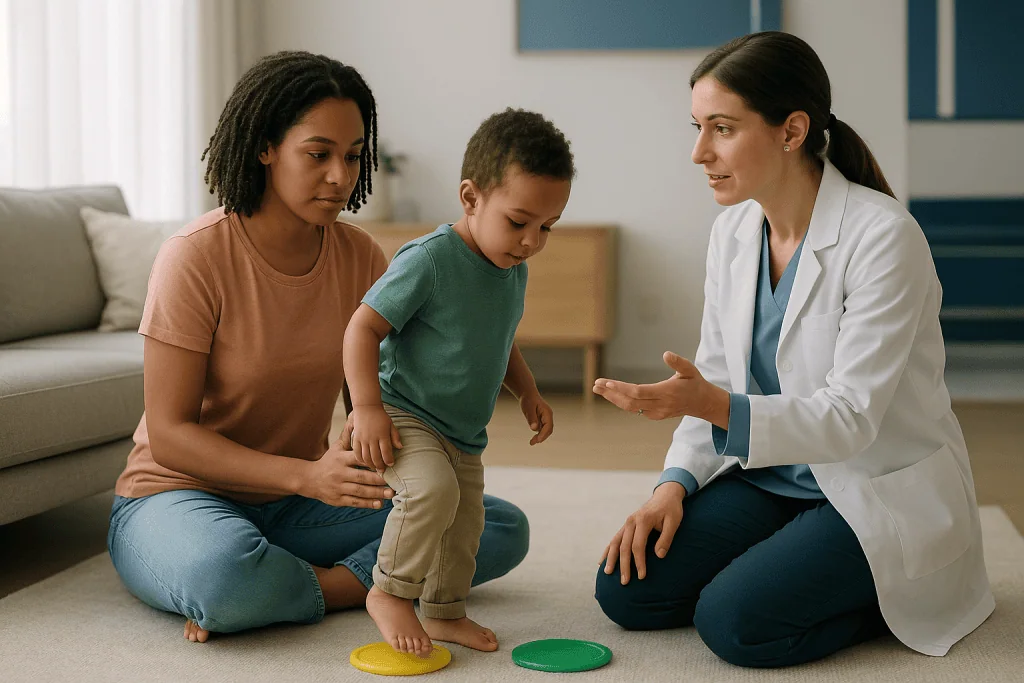
Three principles help. The first is to pick the anchor before the exercise. Ask the therapist which movements matter most, then look at your own day for a slot with the same body position. Diaper changes put a baby on the back and then, easily, on the tummy. Bath time puts a toddler in a supported sit with reasons to reach. Bedtime puts the whole family on the floor or a mattress with the lights low, which suits slow stretches.
The second principle is short and often beats long and rare. Both the WHO and the NHS phrase their physical activity guidance for children under five as a daily total spread across the day (at least 180 minutes for one- to four-year-olds), not as a single block, precisely because young children move in bursts. A minute of practice six times a day is usually more useful, and far more achievable, than a rigid session that keeps getting postponed.
The third is that the caregiver’s job is to set up the environment, not to perform the movement for the child. A ball placed slightly out of reach does more for a crawler than a hand that moves the leg. The therapist can tell you where the line sits for your child’s condition, because for some diagnoses hands-on stretching is genuinely part of the plan. Ask, and ask again when the plan changes.
Bath time: the warm-water window for reaching, squatting and trunk control
Warm water does something useful to a tight or anxious body: it relaxes. Muscles that resist a stretch on the floor often give a little more in the tub, and the buoyancy takes part of a child’s weight, which can make an unsteady sit feel safer. That is why therapists so often point to bath time as the best 10 minutes in the day for certain goals.
For infants who can sit with support, a bath seat or a caregiver’s hand at the hips turns the tub into a reaching station. Floating toys drift just out of reach, inviting a rotation of the trunk to the left or right, which is exactly the movement a therapist may be targeting in a baby with torticollis who prefers to look one way. For toddlers, retrieving a sunk toy from the bottom of the tub is a full squat with a reward at the end. Pouring water from a cup held high works shoulder range. Standing to be rinsed, with hands on the tub rim, is a supported stand with weight shifting from foot to foot.
Older children with balance goals can practice stepping in and out of the tub with a grab bar and a caregiver’s hand, which is a real-life task, not an abstract exercise. Kicking against the water while lying back works hip and knee movement against gentle resistance.
Safety has to come first and never bends to the program. Water supervision is constant, within arm’s reach, for any child who cannot reliably sit alone, and a non-slip mat is not optional. Water temperature should be checked before the child gets in. If your therapist has given a specific bath activity, ask them to show it in clinic with a basin or on a mat first, so the first attempt in the tub is a repeat rather than an experiment.
Bedtime: stretches, slow movement and the routine that already exists
Bedtime has one quality no other part of the day has: it is predictable, and it is already a routine. Children who resist anything new will accept a stretch if it has become the thing that comes after pajamas and before the second story. Sleep itself matters here. The WHO’s guidance for children under five recommends 11–14 hours of good-quality sleep for one- to two-year-olds and 10–13 hours for three- to four-year-olds, and a calm, physical wind-down tends to support that rather than compete with it.
The movements that suit bedtime are slow ones. A child with tight calf muscles, for instance, may have been shown a gentle stretch that is easier to hold when the child is drowsy and the room is dim. Hamstring and hip stretches can be built into a lying-down game: feet to the ceiling, legs apart and together, knees to chest. Many therapists use animal poses borrowed from children’s yoga because a child will hold a cat or a cobra for far longer than a stretch with a Latin name. For babies, the changing mat before the sleep sack is the natural place for gentle rolling practice or a last short tummy time, as long as the baby is then placed on the back to sleep.
What does not belong at bedtime is anything vigorous. Jumping, balance challenges and strengthening that raises the heart rate tend to push sleep later, which undermines the next day’s energy for play. Keep those for the afternoon.
One caution from clinic experience: never let a stretch become a battle at bedtime, because the child will begin to associate the routine itself with the struggle. If a stretch provokes crying or resistance, stop, note it, and tell the therapist, who may change the technique or move it to another slot.
Fun physical activities for children that double as pediatric physical therapy home exercises
Play is where most of the week’s practice actually happens, and the therapist’s secret is that nearly every classic children’s game is already an exercise in disguise. The job is to pick the ones that match the goal.
For balance and single-leg stability, hopscotch, stepping stones made from cushions, and walking along a strip of tape on the floor all work. Freeze dance is a reaction and postural control exercise that children ask to repeat. For strength through the legs and trunk, animal walks (bear crawl, crab walk, frog jumps) load the hips and shoulders in ways a therapist would otherwise have to engineer with equipment. Pushing a laundry basket of books across the carpet is a weighted push. Climbing on and off the couch, with permission, is a step-up.
For coordination and bilateral skills, throwing and catching a soft ball, batting a balloon to keep it off the floor, and kicking toward a goal made of two shoes all build the timing that running and sports later need. Obstacle courses are the universal tool: a tunnel to crawl through, a pillow mountain to climb, a chair to go under, a line to balance along. Change one element each day and the child will treat it as new.
The totals the guidelines describe are generous but achievable in this format. The WHO recommends that three- to four-year-olds get at least 60 minutes of moderate to vigorous activity within their daily 180, and the CDC and WHO both recommend that children and adolescents aged 6 to 17 average 60 minutes of moderate to vigorous activity a day. A home PT plan is not extra on top of this. It is a way of choosing which 60 minutes.
Which routine carries which goal? A quick matching table
Families often ask for a single page they can stick on the fridge beside the therapist’s sheet. The table below is a starting map, not a prescription. Your therapist’s instructions always take priority, and some entries will not apply to your child’s condition.
| Daily routine | Body position it already creates | Therapy goals it suits | Example activities |
|---|---|---|---|
| Diaper change / dressing | Lying on back, then tummy | Head control, tummy time, rolling, symmetry | Toy to the non-preferred side; short tummy time after each change |
| Bath time | Supported sit or stand, warm water | Trunk rotation, reaching, squatting, stretching tight muscles | Retrieve sunk toys; pour from a high cup; step in and out with support |
| Mealtime | Seated, feet supported | Sitting posture, hand-to-mouth coordination | Footrest under feet; finger foods placed slightly off center |
| Play (afternoon) | Floor, standing, moving | Balance, strength, coordination, endurance | Obstacle course; animal walks; balloon volleyball; stairs with a hand held |
| Bedtime | Lying down, dim light | Slow stretches, calm positioning, rolling for infants | Animal yoga poses; legs-to-ceiling games; gentle calf or hip stretch as shown |
Two notes on using it. First, the table deliberately lists no repetitions or durations. Those numbers depend on the child’s age, diagnosis and tolerance, and they come from the therapist. Second, the best anchor is not always the obvious one. A child who dislikes the bath will not learn a squat there, but might happily practice the same squat picking up blocks at cleanup. Move the activity, keep the movement.
Toddler physical therapy at home: floor time, tummy time and the first stairs
The first three years are the period in which home practice carries the most weight, because the skills being learned are the ones everything else sits on. Babies learn to lift the head, push up, roll, sit, crawl, pull to stand and walk largely by being given the floor and a reason to move across it.
Tummy time is the clearest example. The NHS and WHO both recommend that infants who are not yet mobile get tummy time spread through the day, with the WHO specifying at least 30 minutes across the day for infants, while awake and supervised. For a baby who hates it, which is common, a therapist may suggest starting on a caregiver’s chest, over a rolled towel, or for the length of one song, then building up. Babies with a flattened area on the back of the head are often given extra tummy time precisely because it takes pressure off the skull while strengthening the neck.
Once a child is crawling and cruising along furniture, the home becomes the gym. Low, stable furniture arranged so that gaps between pieces widen slightly over the weeks encourages stepping between supports. A favorite toy on the couch cushion invites pulling to stand; the same toy on the floor invites a controlled lower, which is harder and more important. Stairs, done with a hand held and never alone, are among the best strengthening tasks a toddler can do, and most homes have them.
The CDC milestone lists are useful for watching trajectory rather than for anxiety. Many children take independent steps around the first birthday, and the CDC lists walking without holding on as a milestone most children reach by 18 months. The point of the home program is not to beat a date. It is to make sure the child has enough opportunity, and the right support, to get there in their own way.
What the first weeks of pediatric physical therapy home exercises usually look like
The honest answer to how quickly a child changes is that it depends on the goal, and your therapist should be able to tell you what they expect for your child. There are, though, some common shapes to the first weeks.
Week one is usually about learning the activities, not performing them well. Expect to feel clumsy, and expect the child to be confused by the new demand. Most therapists would rather hear that you did one exercise daily than all five twice. Weeks two and three are where routines either stick or quietly disappear, which is why the anchoring matters more than motivation. Families who put a reminder where the anchor happens (a sticky note on the bath taps, a picture on the changing mat) tend to do better than those relying on memory.
By the first follow-up visit, typically scheduled anywhere from one to several weeks after the initial assessment depending on the child’s needs, the therapist will usually re-check the specific measures from the first visit: how long a head stays centered, how far a joint moves, how many steps a child takes before a hand comes down. Small changes are the expected result at this stage. For a newborn with torticollis the neck can loosen noticeably over weeks; for a child with cerebral palsy the time scale is months and years, with the program evolving as the child grows.
None of this is a promise. Children have growth spurts, illnesses, sleep regressions and new siblings, and progress stalls for all of those reasons and sometimes for none. The NHS describes physiotherapy as something that aims to help people recover, maintain function and reduce the risk of problems in the future. All three can be true at once in a child, and plateaus are part of the pattern, not a failure of the family.
What people often get wrong about home PT for children
Myth one: more is better. Families who feel behind sometimes double the stretches or push the balance games to exhaustion. Tissue, especially in a growing child, responds to consistent, moderate load, not to heroic sessions, and a child who is pushed to tears learns to avoid the activity. If the therapist gave you a range, the lower end done daily is usually the better choice than the upper end done rarely.
Myth two: the exercises are the therapy. The therapist is treating a pattern of movement, not a muscle. A toe-walking child does not simply need a stretch; the therapist is also thinking about sensory preferences, footwear, strength through the hips and the way the child stands at the sink. Doing the stretch while ignoring the rest of the advice is doing a fraction of the plan.
Myth three: it has to be the parent. Grandparents, childcare providers and older siblings can all be taught one activity each, and the child often performs better for someone who is not the main caregiver, because the emotional stakes are lower. Ask the therapist to film a short demonstration on your phone so you can share it.
Myth four: special equipment is required. Most home programs are designed around cushions, towels, stairs, balls and furniture. Products marketed as therapy aids, from wedges to weighted items to specialized shoes, have not generally been shown in good-quality studies to outperform ordinary household alternatives, and some can interfere with a child’s own balance reactions. Buy nothing without checking with the therapist first.
Myth five: a missed week erases the gains. It does not. Skills a child has already learned are durable. Pick the anchor back up and move on; do not try to compensate with a marathon.
When a child refuses: pain, boredom and the question of consent
Every family doing pediatric physical therapy home exercises eventually hits a day, or a month, when the child will not. Sorting out why is the single most useful thing a caregiver can do, because the three common reasons call for different responses.
The first reason is discomfort. A stretch should feel like a stretch, not a pain, and a baby who cries sharply rather than grumbles, or a child who says it hurts, is giving information the therapist needs. Stop that activity and report it. Pain that appears with an exercise that was previously tolerated, swelling, or a joint that looks different warrant a call rather than persistence.
The second is boredom, and it is the easiest to fix. Children of all ages lose interest in repetition faster than adults do. The same squat can be retrieving a toy, feeding a stuffed animal on the floor, or pressing a button at knee height; the therapist is interested in the squat, not the story. Rotating through three versions of each activity, and letting the child choose which, restores cooperation surprisingly often.
The third is control. Toddlers and school-age children refuse things because refusing is one of the few powers they have. Offering a choice between two anchored slots (bath or bedtime), a choice of song, or the role of coach for a parent who does the exercise too, gives back a sense of agency without dropping the activity.
There is also a deeper point about consent. Children with lifelong conditions will be doing some form of movement practice for years, and a child who experiences therapy as something done to them tends to disengage in adolescence. Therapists increasingly build programs around the child’s own goals, whether riding a bike or keeping up on the playground. Ask what your child wants to be able to do, and then ask the therapist how the program serves that.
Questions to ask your care team before you leave the clinic
The ten minutes at the end of a session are where a home program is either made workable or quietly set up to fail. These questions are the ones experienced families wish they had asked at the first visit.
- Which two of these activities matter most if we can only do two? Priorities make a long list survivable.
- What is each activity for, in plain language? Knowing that a stretch targets a specific tight muscle, or that a game trains balance reactions, lets you recognize substitutes.
- Where in our day do you suggest each one lives? Describe your actual routine, including the chaotic parts, and let the therapist match movements to it.
- Can you show me on my child, then watch me try? Then record it on my phone?
- What does doing it right look like, and what does doing it wrong look like? For stretches in particular, ask what you should feel under your hands and what the child’s face should tell you.
- What should make us stop and call you, and what is normal grumbling?
- How will we know it is working? Ask what the therapist will measure at the next visit.
- Who else can be taught this? Ask whether a childcare provider or grandparent can attend a session.
- Does my child need any equipment at all, and if so, what would you use from around the house?
- What is the plan if we miss a week because of illness or travel?
Write the answers down or ask the therapist to. Memory after a clinic visit with a small child in tow is unreliable, and the plan only works if the whole household can read it.
When to call your doctor: red flags during home physical therapy for children
Home programs are safe for the overwhelming majority of children, but the people doing them are not clinicians, and knowing when to stop and call matters more than any single exercise. Treat the following as reasons to pause the program and contact the child’s doctor or therapist the same day.
- Pain that is new, sharp or persists after the activity stops, or a child who guards or refuses to move a limb that was previously used freely.
- Swelling, redness, warmth or a change in the shape of a joint or limb.
- A baby who becomes limp, unusually stiff or arches strongly during handling, or whose head control seems to be getting worse rather than better.
- Loss of a skill already gained, such as a child who was walking and now cannot, or a baby who stops rolling.
- Any fall during a balance activity that results in a head strike, vomiting, drowsiness, or confusion.
Seek emergency care immediately for breathing difficulty, a blue or very pale color, a seizure, a suspected fracture, or a child who cannot be roused. These are not therapy problems and should never wait for a therapy appointment.
Separately, the CDC advises that caregivers who are concerned about any aspect of a child’s development, including movement, speak to the child’s doctor rather than wait and see, because early evaluation gives the most options. The same applies to progress that has stalled for longer than the therapist predicted, or to a program that is causing distress for the child or the family. A therapist would much rather redesign the plan than have it abandoned silently. Every decision about continuing, changing or stopping the program, and about any medicine or procedure that may be part of a child’s wider care, sits with the treating team.
Frequently asked questions
How do I get physical therapy at home for my child?
Most home programs begin with a referral from the child’s pediatrician to a pediatric physical therapist, who assesses the child and designs activities for caregivers to practice between visits. Some children also qualify for early intervention services that deliver therapy in the home or at daycare. Ask the pediatrician which pathway applies to your child’s situation and age.
What does a physical therapist do for a child in the first visit?
The therapist watches how the child moves, often using standardized developmental tools, and asks about birth, feeding, sleep and what the family has noticed. From that they set specific goals, try activities in the session to see what works, and then teach the caregiver a small number of those activities to do at home, usually with written or video instructions.
How can I do PT at home when there is no time?
Attach each activity to a routine that already happens rather than adding a session. Tummy time after diaper changes, reaching and squatting games in the bath, and slow stretches before stories each take a minute or two. Guidelines for young children describe activity as a daily total spread through the day, which supports this short-and-often approach.
What are some fun physical activities for children that also count as therapy?
Obstacle courses, animal walks such as bear crawls and frog jumps, balloon volleyball, hopscotch, freeze dance and stair climbing with a hand held all train balance, strength or coordination. Which ones suit your child depends on the goals in the program, so ask the therapist to label each game with the skill it is building.
Are pediatric PT exercises at home safe to do without a therapist present?
Yes, when the therapist has demonstrated each activity on the child, watched the caregiver perform it, and explained what should and should not be felt. Water supervision in the bath is constant, balance activities are done on soft, clear surfaces, and any sharp pain, swelling or loss of a skill means stopping and calling the care team.
How long does a home exercise program for kids usually last?
It depends on the condition. Short programs after a sprain or a fracture may run for weeks, infant positioning programs for torticollis often run over months, and children with cerebral palsy or other lifelong conditions typically have programs that evolve for years. The therapist sets and revises the expected timeline at each follow-up.
What is toddler physical therapy at home mostly focused on?
Floor time. Toddlers learn to crawl, pull to stand, cruise and walk by being given the floor, stable furniture and reasons to move between them. Home practice at this age usually centers on tummy time for younger infants, controlled lowering from standing, stepping between supports and supervised stairs rather than on formal exercises.
How much tummy time does a baby need each day?
The WHO recommends that infants who are not yet mobile get at least 30 minutes of tummy time spread across the day while awake and supervised, and the NHS gives similar advice. Babies who dislike it can start on a caregiver’s chest or over a rolled towel for very short periods and build up gradually.
What should I do if my child cries during the home exercises?
Stop the activity and work out why. A stretch should feel like a stretch, not a pain; sharp crying, guarding or a limb the child will not use are reasons to call the therapist. Grumbling from boredom or a wish for control usually responds to changing the game, offering a choice of when, or letting another adult lead.
Do I need to buy equipment for pediatric physical therapy home exercises?
Usually not. Most programs are designed around cushions, rolled towels, balls, stairs and ordinary furniture. Marketed therapy aids have not generally been shown to outperform household alternatives, and some can interfere with a child’s own balance reactions. Ask the therapist before buying anything, including shoes or supports.
References
- World Health Organization: Guidelines on physical activity, sedentary behaviour and sleep for children under 5 years of age
- NHS: Physical activity guidelines for children (under 5 years)
- NHS: Physiotherapy
- World Health Organization: Physical activity fact sheet
This article is for general information only and is not a substitute for professional medical advice. Please consult a qualified doctor about your individual situation.
Add us as a Preferred Source to see more of our trusted health content across Google Search, AI Overviews and Discover.

More from the Blog

Kawasaki Disease Treatment in Hospital: What the IVIG Infusion Day Involves for Your Child
Kawasaki disease treatment in hospital usually centers on a single intravenous immunoglobulin (IVIG) infusion run slowly through a drip over roughly 10 to 12…

Stages of a Cold in Babies: The Usual Timeline, Day by Day, and When to Call the Doctor
The stages of a cold in babies usually follow a set pattern: a stuffy, sneezy start over the first two days, the worst congestion…

Are Chickenpox Parties a Bad Idea? Deliberate Exposure Myths Pediatricians Correct
Chickenpox parties are not recommended by pediatric and public health bodies. Deliberately exposing a child to varicella risks a full infection with possible complications…

Speech, Occupational or Physical Therapy for Developmental Delay: How the Plan Is Matched
Speech therapy, occupational therapy and physical therapy are matched to the specific area where a child's development is behind, not to the label of…

What to Expect After Whooping Cough Treatment: Lingering Cough, Fatigue and Follow-Up Visits
After whooping cough treatment, antibiotics clear the bacteria and shorten the time you can spread it, but they rarely shorten the cough itself. Coughing…

When Is It Safe to Get the Site Wet After Pediatric Plastic Surgery? Bathing and Play Return
Most children can have a brief shower or careful wash around the incision 24 to 48 hours after pediatric plastic surgery, but soaking in…