

Fixed vs Removable Dental Prosthetics: How Dentists Match the Device to Your Teeth and Bone
Key Takeaways
- A fixed prosthesis sends chewing force into teeth or bone through implants, while a removable denture places most of that force on gum tissue, which explains the main differences in comfort and stability.
- The jawbone ridge shrinks after tooth loss and a conventional denture cannot slow that change, which is why the NHS notes dentures need relining or replacing over time.
- The Cleveland Clinic describes conventional dentures as typically lasting about 7 to 10 years and tooth-borne bridges 5 to 15 years with good care.
- Osseointegration, the bonding of bone to an implant, takes several months according to the Mayo Clinic, and bone grafting can add several more before definitive teeth are fitted.
- An implant-retained overdenture snaps onto a few implants yet still comes out for cleaning, offering a stable middle ground when bone is insufficient for a fully fixed arch.
- Peri-implantitis, plaque-driven inflammation around an implant, means daily cleaning with interdental brushes or a water flosser matters as much as the surgery itself.
Fixed dental prosthetics, such as crowns, bridges and implant-supported arches, are cemented or screwed in and stay in the mouth; removable prosthetics, such as partial and complete dentures, are taken out for cleaning. Dentists match the device to how much jawbone remains, gum health, the number and strength of remaining teeth, and the patient's ability to maintain it, with the final plan decided by the treating team.
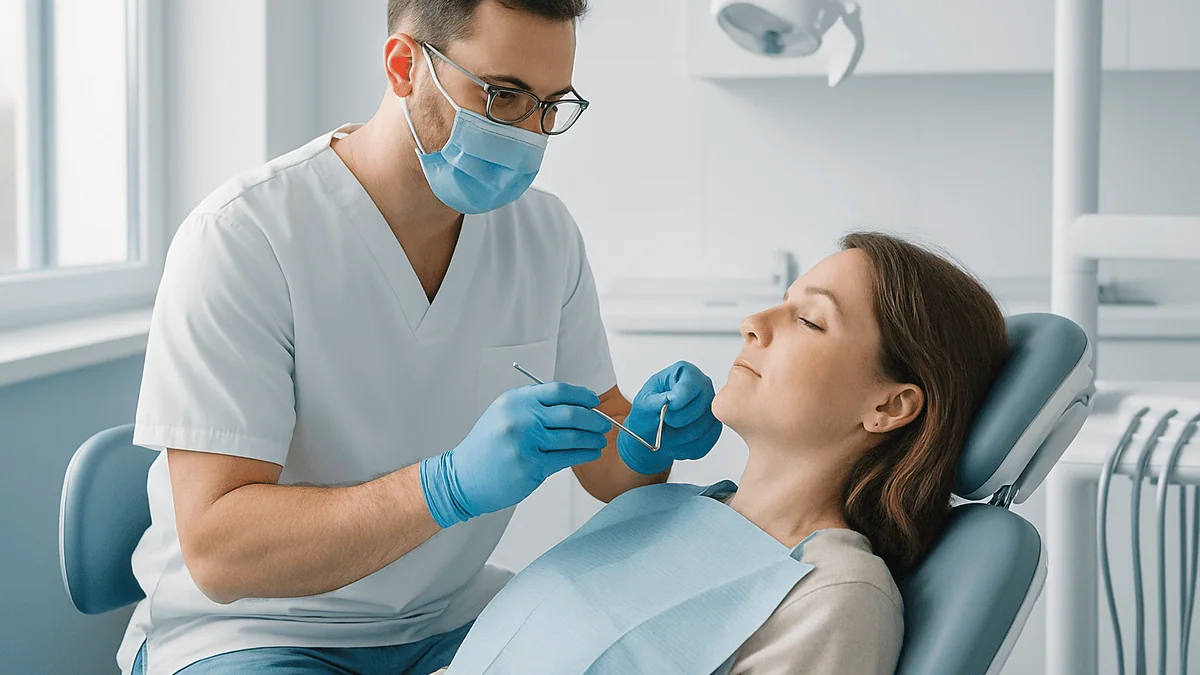
The consultation room has a small mirror on a stick, and most people spend the first minute looking at the gap rather than at the dentist. Then comes the question that brought them in: does this get glued in, or does it come out at night? Behind that simple wording sits the entire debate over fixed vs removable dental prosthetics, and behind that debate sits something the patient cannot see in the mirror at all: the shape and volume of the bone under the gum.
A prosthesis is any artificial device that replaces a missing body part; in dentistry it replaces one tooth, several teeth or a whole arch. The choice is rarely a matter of taste alone. It is closer to fitting a foundation to the ground it has to stand on.
This explainer walks through how each type stays put, what the bone has to offer, who is usually suited to which option, and what the weeks afterward tend to look like, so the conversation with your own care team starts from evidence rather than guesswork.
What are fixed vs removable dental prosthetics?
A fixed prosthesis is a replacement tooth or set of teeth that is permanently attached in the mouth, either cemented onto prepared natural teeth or screwed onto dental implants, and cannot be taken out by the wearer. A removable prosthesis, usually called a denture, sits on the gums or clips to teeth or implants and is lifted out for cleaning.
Within the fixed family sit three everyday devices. A crown is a cap that covers a single damaged tooth or a single implant. A bridge spans a gap by anchoring an artificial tooth, called a pontic, to crowns on the neighboring teeth; the Cleveland Clinic describes bridges as typically lasting between 5 and 15 years with good care. A full-arch implant prosthesis replaces every tooth in the upper or lower jaw on a small number of implants.
The removable family has two main members. A partial denture replaces some teeth and usually holds on with clasps that hook around remaining natural teeth. A complete denture replaces a whole arch and relies on suction, saliva and the shape of the gum ridge for retention. Both are described in plain terms on the NHS dentures page.
The distinction that matters clinically is not glue versus clips. It is what carries the chewing load. A fixed prosthesis transfers bite force into bone through teeth or implants. A removable denture transfers much of that force onto soft gum tissue, which was never designed to be chewed on. That single difference explains most of what follows: comfort, stability, how the jawbone behaves over years, and how much surgery is involved.
Nobody arrives at a fixed or removable decision in isolation. Dentists weigh the number and health of remaining teeth, gum disease, bone volume, general health, and how easily a person can clean what is placed. The device is fitted to the mouth, not the other way round.
How does a fixed prosthesis actually stay in place?
Two mechanisms hold fixed prosthetics: natural teeth and osseointegration. Osseointegration is the process by which living bone grows onto the surface of a titanium implant until the two are locked together. The Mayo Clinic notes this bone growth can take several months before the implant is stable enough to carry a crown.
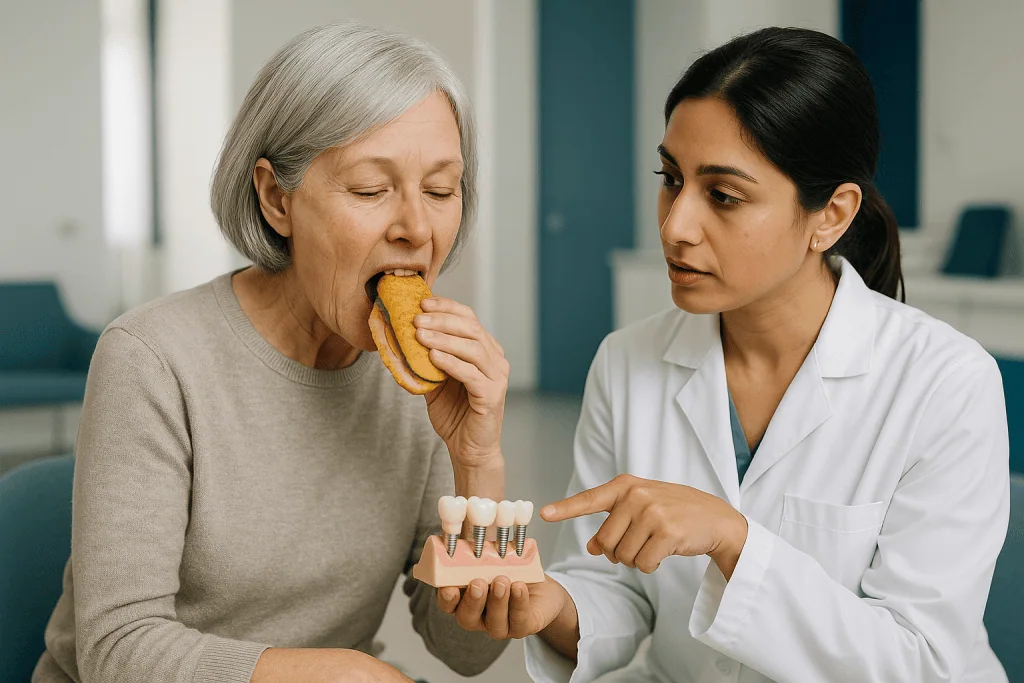
Picture a bridge first. The dentist shapes the teeth on either side of the gap, removing a layer of enamel so that a crown can slide over each one. A laboratory makes a single piece: two crowns joined by a pontic. That piece is cemented in place, and from then on the two neighboring teeth act as pillars carrying three teeth’s worth of load. The bridge is strong, but it depends entirely on the health of those pillars.
An implant works differently. A small post is placed into the jawbone where a tooth root used to be. Over the healing period, bone cells colonize the roughened surface of the post. Once integrated, a connector called an abutment is attached to the implant, and a crown or bridge is screwed or cemented onto the abutment. Force from chewing now travels down the implant into bone, roughly mimicking a natural root.
Full-arch fixed prostheses extend this idea. Several implants placed around the arch share the load of a single connected set of teeth. Because the implants are joined together by the prosthesis, they brace one another, which is why fewer implants can carry more teeth than a one-for-one arrangement would suggest.
What all fixed devices share is that they cannot be adjusted at home. If a bridge chips or an implant crown loosens, only the dental team can address it, which is one reason regular review visits are built into every fixed plan.
How does a removable denture work, and why does it loosen over time?
A complete denture is a precisely shaped acrylic plate that rests on the gum ridge. Retention comes from three sources: a thin film of saliva acting like water between two glass plates, a peripheral seal where the denture edge meets soft tissue, and the shape of the ridge itself. Upper dentures usually hold better than lower ones because the palate offers a broad surface for suction, while the lower denture must share space with the tongue and floor of the mouth.
Partial dentures add mechanical grip. Metal or flexible clasps wrap around remaining teeth, and rests sit on tooth surfaces to stop the denture sinking into the gum. The remaining teeth do part of the work, which is why gum disease or decay in those teeth can undermine a partial denture just as surely as it would a bridge.
The loosening that so many wearers describe is not a manufacturing fault. It is biology. When a tooth is lost, the alveolar ridge, the horseshoe of bone that used to hold the roots, no longer receives the stimulation of chewing forces and gradually shrinks. This process is called resorption. The NHS explains that gums and jawbone shrink over time after tooth loss, so dentures made to fit a ridge at one point will eventually sit on a different shape and require relining or replacement. The Cleveland Clinic describes conventional dentures as typically lasting around 7 to 10 years before replacement is needed.
Relining means adding new material to the fitting surface so the denture matches the changed ridge. It restores fit for a while, but it cannot stop the underlying bone change. That is the honest limitation at the heart of the removable option.
Why jawbone volume decides more than personal preference
Ask a prosthodontist, a dentist specialized in replacing teeth, what the first question is, and the answer is often the same: how much bone is left? An implant needs enough bone height and width to be surrounded on all sides, and the Mayo Clinic lists adequate bone to secure the implant, or the ability to have a bone graft, as a condition for implant surgery.
Bone is lost for several reasons. The longest-standing cause is time since extraction; the ridge resorbs fastest in the first months and continues slowly for years. Periodontal disease, the chronic infection of the gums and bone around teeth, destroys supporting bone before the teeth are even lost. Long-term denture wear can accelerate ridge loss because soft tissue pressure is not the kind of stimulation bone responds to. Some medicines and medical conditions also affect bone healing.
Dentists measure what remains with three-dimensional imaging, usually a cone-beam CT, which shows bone thickness, the position of the nerve canal in the lower jaw, and the floor of the sinus in the upper jaw. Those two anatomical landmarks set hard limits: an implant cannot safely encroach on the nerve that supplies feeling to the lip and chin, and it cannot simply be pushed into the sinus.
When bone is thin, options branch. A bone graft, in which natural or synthetic material is added and allowed to consolidate, can rebuild volume, though the Mayo Clinic notes this healing can add several months to the timeline. A sinus lift raises the sinus floor to create room. Alternatively, the plan may shift toward a removable device or an implant-retained overdenture that needs fewer, shorter implants.
Preference still matters. But preference is negotiated with anatomy, and anatomy holds the stronger hand.
Who is usually offered a fixed option, and who is asked to wait
Fixed prosthetics are generally considered for people who have healthy remaining teeth to support a bridge, or adequate bone for implants, together with gums free of active disease and general health that allows minor oral surgery to heal normally. The Mayo Clinic frames implant candidates as adults whose jawbone has finished growing, who have healthy oral tissues, and who are willing to commit several months to the process and to good oral hygiene afterward.
Waiting is common, and it is rarely a refusal. Active gum disease is usually treated first, because placing an implant into an infected environment invites the same infection around the implant, a condition called peri-implantitis. Uncontrolled diabetes, heavy smoking, recent head and neck radiotherapy, and certain bone-modifying medicines each affect how bone and soft tissue heal; the Mayo Clinic specifically notes that heavy smokers and people with uncontrolled chronic disorders may need individual evaluation. Any decision about pausing or altering medicines sits with the prescribing clinician, never with the patient acting alone.
Adolescents whose jaws are still growing are usually asked to wait, because an implant does not move with the growing bone while neighboring teeth do. Someone who has just had an extraction may also wait while the socket heals and the ridge settles, depending on the surgeon’s chosen protocol.
Removable options suit people for whom surgery is not advisable, those with extensive bone loss who prefer not to undergo grafting, people who need teeth replaced quickly while healing continues, and anyone who values the ability to remove and clean the device easily. Dexterity, vision and access to regular care all count.
Neither pathway closes the door on the other. A removable denture worn during healing can be a stage on the way to a fixed prosthesis, and a fixed plan can be revised if circumstances change.
Fixed vs removable dental prosthetics compared at a glance
Numbers and mechanisms tell the story more honestly than adjectives. The table below sets the two families side by side on the points patients raise most often. Where a figure appears, it comes from the cited source; individual results vary and no row is a promise.
| Feature | Fixed (crown, bridge, implant arch) | Removable (partial or complete denture) |
|---|---|---|
| How it stays in | Cemented to teeth or screwed to implants | Suction, saliva film, clasps or implant clips |
| Where chewing force goes | Into teeth or bone through implants | Largely onto gum tissue |
| Surgery required | Yes for implants; none for a tooth-borne bridge | Usually none, unless implants are added |
| Typical lifespan | Bridges 5–15 years (Cleveland Clinic); implants can last many years with care | About 7–10 years before replacement (Cleveland Clinic) |
| Effect on jawbone | Implants transmit load to bone | Ridge continues to shrink |
| Daily cleaning | Brushing, flossing, threaders or water flosser | Removed, brushed and soaked |
| Adjustability | Only by the dental team | Relining and adjustments possible |
| Time to final result | Months, longer with grafting (Mayo Clinic) | Weeks for a conventional denture |
Two rows deserve emphasis. The load-path row explains almost every comfort difference: chewing on bone-supported teeth feels closer to natural teeth than chewing on a plate resting on gum. The jawbone row explains the long-term difference: a removable denture cannot slow ridge loss, whereas an implant gives bone something to respond to.
The table also shows why the choice is not a simple ladder from worse to better. The removable column wins on speed, avoidance of surgery and adjustability. The fixed column wins on stability and bone behavior. Which column matters more depends on the person holding the mirror.
What are the downsides of removable dentures?
People searching for the downsides of removable dentures are usually asking whether the frustrations they have heard about are real. Most are, though their severity varies enormously between individuals and between upper and lower jaws.
Stability is the first. A complete lower denture rests on a narrow ridge and shares the mouth with a mobile tongue, so movement while eating or speaking is common, especially in the early weeks. Sore spots develop where the acrylic presses unevenly, and the NHS advises returning to the dentist for adjustment rather than living with them.
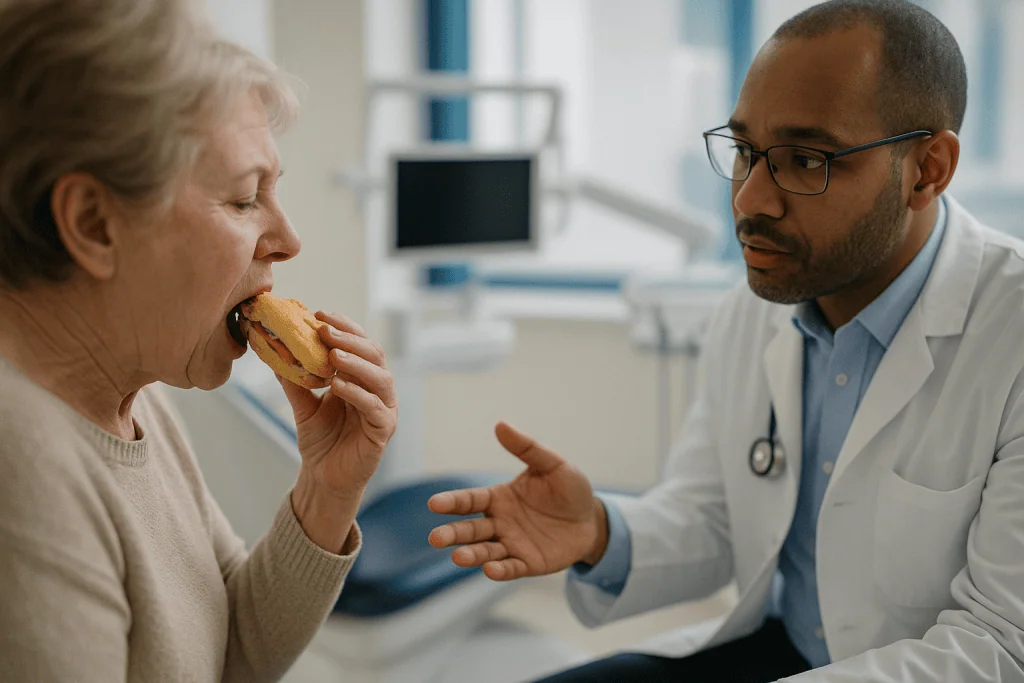
Chewing efficiency is the second. Because the denture sits on soft tissue, bite force is limited by what the gums can tolerate, and tough or fibrous foods are harder to manage. Many wearers adapt by cutting food smaller and chewing on both sides at once to balance the plate.
Bone loss is the third and least visible. The ridge under a denture continues to resorb, which is why fit deteriorates and relining becomes necessary; the NHS notes that dentures may need relining or replacing as gums and bone shrink over time. As the ridge flattens, the lower face can lose some of its support, and the denture has less to grip.
Other drawbacks are practical. Upper complete dentures cover the palate, which can dull taste and temperature sensation and takes some people weeks to stop noticing. Denture adhesives can help retention but do not fix a poorly fitting base. Partial denture clasps place extra load on the teeth they hook onto, and food can trap around them, raising the risk of decay if cleaning slips.
None of this makes dentures a poor choice. For many people they are the appropriate, lower-risk option. But an informed choice means naming the trade-offs clearly before the impressions are taken.
What are the trade-offs of fixed prosthetics?
Fixed devices carry their own costs to the body, and honesty requires listing them with the same care.
A tooth-borne bridge requires healthy neighboring teeth to be reshaped, which removes enamel permanently. If one of those anchor teeth later develops decay or nerve problems, the whole bridge is affected. Cleaning underneath the pontic demands floss threaders or a water flosser, and the Cleveland Clinic points out that decay under a bridge is a common reason for failure.
Implants involve surgery, and the Mayo Clinic lists the risks: infection at the implant site, injury to surrounding structures such as neighboring teeth or blood vessels, nerve damage causing pain, numbness or tingling in the lip, gums or chin, and sinus problems when upper implants protrude into the sinus cavity. Most of these are uncommon and many are temporary, but they are real and are discussed in every consent conversation.
Time is a trade-off in itself. Osseointegration takes months, and grafting adds more; during that period a temporary device is often worn. Anyone hoping to walk out with a final fixed set of teeth in a single afternoon should have that expectation examined against the actual plan.
Peri-implantitis, inflammation and bone loss around an implant, behaves like gum disease around a natural tooth and is driven by the same plaque bacteria. Implants do not decay, but the bone that holds them can be lost if hygiene lapses or gum disease was never fully controlled.
Maintenance is lifelong. Screws can loosen, porcelain can chip, and full-arch prostheses usually need periodic removal by the dentist for professional cleaning. A fixed prosthesis is fixed for the patient, not for the clinician, and the review schedule reflects that.
Weighed against removable options, these are different risks rather than simply more risk. Surgery and time on one side; soft-tissue load and ongoing bone change on the other.
Which is better, fixed or removable dentures?
The honest answer to which is better, fixed vs removable dentures, is that the evidence supports different devices for different mouths, not a single winner. Guideline bodies and mainstream clinical sources describe the choice as individualized, and that is not evasiveness; it reflects how many variables sit on the scale.
For someone with a healthy, well-preserved jaw, good gum health and a wish to eat without conscious effort, a fixed implant-supported prosthesis addresses the two biggest complaints about dentures, movement and bone loss, at the cost of surgery and months of healing. For someone with advanced ridge resorption who does not want grafting, or whose medical picture makes surgery less advisable, a well-made removable denture may be the more appropriate choice, and a small number of implants to steady it can be added if bone allows.
A middle question is often more useful than better or worse: what would go wrong with each option in this particular mouth, and how recoverable would that be? A bridge on weak anchor teeth fails when those teeth fail. An implant in thin bone risks exposure of its threads. A lower complete denture on a flat ridge may never feel secure. The dentist’s job is to predict which failure mode is most likely and steer away from it.
Patients bring the other half of the equation. How much surgery are you willing to undergo? Can you commit to detailed cleaning around implants for the rest of your life? Would removing a denture at night feel like relief or loss? These are legitimate clinical inputs, not soft extras.
Better, then, is a property of the match between device and person. The right question for your care team is not which device is superior, but which failure you would rather avoid.
Implant-supported dentures vs fixed arches: the middle ground
Between a conventional denture and a fixed full-arch bridge sits a hybrid that many people have never heard of: the implant-retained overdenture. An overdenture is a removable denture that snaps onto a small number of implants using attachments such as ball-and-socket fittings or a bar with clips. It comes out for cleaning like a denture, but it does not slide around like one.
The mechanics explain its appeal. Two to four implants in the lower jaw give the denture a fixed reference point, dramatically reducing the side-to-side movement that plagues conventional lower dentures. The implants also deliver chewing stimulus to the bone around them. Because the denture still rests partly on the gum, it spreads load across both implants and soft tissue, which is one reason it can work where bone is insufficient for a fully fixed arch. The Cleveland Clinic describes implant-supported dentures as an option that improves stability compared with conventional dentures.
Comparing implant-supported dentures vs fixed arches comes down to a few practical points. A fixed arch stays in permanently, feels most like natural teeth, and is cleaned in the mouth; it needs more implants, more bone, and professional removal for deep cleaning. An overdenture needs fewer implants, is easier to clean because it comes out, and can be relined as the gum changes; the attachments wear and need periodic replacement, and some people dislike that it is still, at heart, a denture.
The overdenture also offers a staged pathway. Implants placed now can support a removable overdenture, and if bone and circumstances allow later, the same or additional implants can sometimes carry a fixed prosthesis. That flexibility makes it a frequent recommendation for people whose bone sits in the borderline zone, though whether it suits a particular mouth is a judgment for the treating team after imaging.
What do the following weeks and months usually look like?
Timelines differ sharply between the two routes, and knowing the shape of each helps people plan work, travel and expectations.
A conventional denture moves quickly. Impressions are taken, a wax try-in checks appearance and bite, and the finished denture is fitted, typically over a few weeks. The NHS notes that new dentures can feel strange and that eating and speaking take practice; sore spots in the first days are common and are relieved by adjustment visits. If teeth were extracted at the same time, an immediate denture is worn while the gum heals and shrinks, then relined or remade once the ridge has settled, which the NHS describes as happening over months.
A tooth-borne bridge usually spans two or three visits: preparation and a temporary bridge, then fitting of the laboratory-made piece. Mild sensitivity in the prepared teeth is common and usually settles.
Implants follow the longest arc. The Mayo Clinic outlines the sequence: any needed extraction, bone grafting if required with its own healing time of several months, implant placement, a healing period of several months for osseointegration, abutment placement, and finally the crown or prosthesis. Swelling, bruising, minor bleeding and discomfort are expected for a few days after each surgical step, and soft foods are usually advised while the site heals. A temporary denture or temporary fixed teeth may be worn throughout.
Across all routes, the first review appointments are where adjustments happen: a pressure spot relieved, a bite refined, a clasp tightened. Skipping them because things feel roughly fine is a common way for small irritations to become ulcers or for early problems to go unnoticed. The team sets the schedule; the patient’s job is to keep it and to report anything unexpected in between.
How do you care for each type of prosthesis day to day?
Cleaning is where the fixed-versus-removable difference becomes a daily reality, and where most long-term problems either start or are prevented.
Removable dentures come out. The NHS recommends brushing them with a non-abrasive cleaner, not ordinary toothpaste which can scratch acrylic, over a basin of water or a folded towel so a dropped denture does not break, and soaking them according to the dentist’s instructions. Gums, tongue and any remaining teeth are brushed separately. Most dentists advise removing dentures at night to rest the tissues, and the NHS notes that wearing them continuously can contribute to gum inflammation and fungal infection under the plate.
Partial dentures need attention at the clasps, where plaque gathers against natural teeth. The teeth themselves are brushed and flossed as normal, with particular care at the surfaces the clasps touch.
Fixed bridges are cleaned in place. Brushing covers the visible surfaces, but the space beneath the pontic traps food and plaque, so a floss threader, interdental brush or water flosser is used to clean under it daily. The Cleveland Clinic emphasizes that neglecting this area is a leading reason bridges fail early.
Implant crowns and arches are brushed like teeth, with extra attention where the prosthesis meets the gum. Interdental brushes and water flossers help reach under a full-arch prosthesis. Because peri-implantitis is plaque-driven, this daily routine matters as much as the surgery did. Professional cleaning intervals are set by the dental team; full-arch prostheses are often unscrewed periodically so the implants and tissues can be assessed directly.
Whatever the device, the shared rules hold: no biting ice or hard objects, report chips or looseness promptly, and keep review appointments even when nothing feels wrong. Prosthetics do not send warning signals as reliably as natural teeth do.
What people often get wrong
Several beliefs circulate widely enough to shape decisions, and most do not hold up against the evidence.
The first is that implants are permanent in the sense of maintenance-free. They are not. Bone around an implant can be lost to peri-implantitis, screws loosen and porcelain chips. Long service is realistic with care, but the care is the condition, not an optional extra.
The second is that dentures are only for very old people. Tooth loss follows gum disease, trauma, decay and some medical treatments at any adult age, and removable prosthetics are used across the lifespan, often as a stage within a longer plan.
The third is that a loose denture just needs stronger adhesive. Looseness usually signals that the ridge has changed shape beneath a denture made for an earlier shape. Adhesive masks the gap; relining or remaking addresses it. The NHS is explicit that fit problems should be assessed by a dentist.
The fourth is that everyone can have implants if they are willing. Bone volume, nerve position, sinus anatomy, gum disease and general health each set limits. Grafting expands who is eligible, but it does not erase anatomy, and some people are appropriately advised toward removable options.
The fifth is that fixed teeth are finished in a day. Some protocols place a temporary fixed prosthesis on the day of surgery, but the Mayo Clinic describes the full process as taking many months, with the definitive teeth fitted only after bone has integrated.
The sixth is that a partial denture protects the remaining teeth. Clasped teeth carry extra load and trap plaque; without meticulous cleaning they can be lost sooner, not later.
The last is that choosing a removable device means settling for less. For a mouth with limited bone or health constraints, it can be the more appropriate and lower-risk choice, and appropriate is the standard that matters.
Questions to ask your care team
A good consultation leaves room for questions, and the most useful ones are specific to your own mouth rather than to prosthetics in general. Taking a short written list helps, because it is easy to forget once the imaging is on the screen.
- How much bone do I have where the teeth are missing, and does it change which options are realistic for me?
- Do I have any active gum disease that needs treating before a prosthesis is made or an implant placed?
- If you are recommending a bridge, how healthy are the anchor teeth, and what happens to the bridge if one of them fails later?
- If you are recommending implants, how many, where, and will I need bone grafting or a sinus lift first?
- What will I wear while healing, and how will it feel to eat and speak during that time?
- How long is the whole plan likely to take from start to definitive teeth, and what could lengthen it?
- What are the specific risks in my case, including the position of the nerve in my lower jaw or the sinus in my upper jaw?
- What daily cleaning will this device need, and do you think I will manage it given my dexterity and eyesight?
- How often will I need to come back for maintenance, and what routinely wears out or needs replacing?
- What would you recommend if I chose the other option instead, and what would I be trading?
- Do any of my medicines or medical conditions affect healing, and do you need to speak with my physician before we proceed?
The answers should be concrete. Vague reassurance about a device being the best or most modern is less useful than a clear account of what could go wrong and how it would be handled. A team that answers the last question candidly, describing the option they did not recommend as fairly as the one they did, is giving you the information a real decision requires.
When to call your doctor
Most discomfort after fitting a denture, bridge or implant is mild and expected, and it fades over days as tissues adapt or heal. Some signs, though, warrant a call to the dental team or a doctor rather than waiting for the next scheduled visit.
After implant surgery or an extraction, the Mayo Clinic and Cleveland Clinic advise seeking care for swelling that worsens after the first two or three days instead of settling, bleeding that does not stop with firm pressure, fever, pus or a bad taste from the wound, or pain that escalates rather than eases. Numbness or tingling of the lip, chin or tongue that persists beyond the anesthetic wearing off needs prompt assessment, because it can indicate nerve involvement. Difficulty swallowing or breathing, or rapidly spreading swelling into the neck or under the eye, is an emergency and should be treated as one.
For any fixed prosthesis, call if a crown, bridge or implant feels loose or moves when touched, if a piece breaks off, or if the gum around it becomes red, swollen or bleeds easily, since these are early signs of infection or mechanical failure.
For dentures, sore spots that do not settle within a few days, ulcers that fail to heal, persistent redness under the plate, a burning sensation, or white patches that can be wiped away all merit a visit; the NHS notes that fungal infection under a denture is common and treatable when identified. Any mouth ulcer or patch that lasts longer than three weeks should be examined regardless of its apparent cause.
A short rule covers most situations: worsening rather than improving, new rather than expected, or anything that affects breathing or swallowing. In those cases, the phone call is the right next step, and the team would rather hear from you early than late.
Frequently asked questions
What are the differences between fixed and removable prosthetics?
Fixed prosthetics are cemented onto teeth or screwed onto implants and stay in the mouth, while removable prosthetics are dentures taken out for cleaning. Fixed devices carry chewing force into teeth or bone; removable dentures rest largely on gum. Fixed options usually need more bone or healthy anchor teeth and, for implants, surgery and months of healing. Removable options are quicker, avoid surgery, and can be relined as the jaw changes shape.
What are the key differences between fixed prosthodontics vs removable prosthodontics?
Fixed prosthodontics covers crowns, bridges and implant-supported arches that the wearer cannot remove; removable prosthodontics covers partial and complete dentures and overdentures. The key differences are how the device is retained, where bite force is transmitted, whether surgery is needed, how the device is cleaned, and how the jawbone behaves over years. Dentists choose between them based on bone volume, gum health, remaining teeth and the patient’s ability to maintain the device.
What are the downsides of removable dentures?
The main downsides of removable dentures are movement during eating and speaking, reduced chewing efficiency because force is limited by what the gums tolerate, and ongoing jawbone shrinkage that loosens the fit over time. Upper dentures cover the palate and can dull taste, partial denture clasps trap plaque against natural teeth, and relining or replacement becomes necessary as the ridge changes. Sore spots are common early on and should be adjusted by a dentist.
Which is better, fixed or removable dentures?
Neither is better in every case; the appropriate choice depends on the individual mouth. Fixed implant-supported teeth address denture movement and bone loss but require surgery, adequate bone and months of healing. Removable dentures avoid surgery and suit people with limited bone or health constraints, at the cost of stability. Mainstream clinical sources describe the decision as individualized, and the treating team makes it after examination and imaging.
Can I have a fixed prosthesis if I have already lost a lot of jawbone?
Sometimes, but not always. Bone grafting or a sinus lift can rebuild volume, though the Mayo Clinic notes healing after grafting can take several months. Where bone is too thin or too close to the nerve canal or sinus, dentists may suggest an implant-retained overdenture, which needs fewer implants, or a conventional denture. Three-dimensional imaging shows what is realistic, and the final recommendation rests with your care team.
How long does an implant-supported fixed prosthesis take from start to finish?
The Mayo Clinic describes dental implant treatment as a process spanning many months, because bone must grow onto the implant before it can carry teeth, and grafting, if needed, adds its own healing time. Some protocols place temporary fixed teeth on the day of surgery, but definitive teeth are fitted only after integration is confirmed. Your dentist will give a timeline specific to your bone and health.
How do implant-supported dentures compare with a fixed arch?
An implant-supported overdenture snaps onto a few implants and is removed for cleaning, giving far more stability than a conventional denture while needing less bone than a fixed arch. A fixed arch stays in permanently, feels closer to natural teeth, and is cleaned in the mouth, but needs more implants and professional removal for deep cleaning. Overdenture attachments wear and need periodic replacement; both options require lifelong maintenance visits.
Do fixed prosthetics need less maintenance than dentures?
No, they need different maintenance rather than less. Bridges require daily cleaning beneath the artificial tooth with a threader or water flosser, and the Cleveland Clinic notes decay under bridges is a common failure cause. Implants can develop peri-implantitis, plaque-driven bone loss, so meticulous hygiene and regular professional reviews are essential. Dentures need daily removal, brushing and soaking, plus periodic relining as the jaw changes.
Why does my lower denture feel looser than my upper one?
Upper dentures gain suction from the broad palate, while lower dentures sit on a narrow ridge and must share space with a moving tongue and the floor of the mouth. The lower ridge also tends to lose bone faster after tooth loss, giving the denture less to grip. If looseness is new or worsening, a dentist should check the fit; relining or a small number of implants to retain the denture may be discussed.
What signs after a prosthesis is fitted mean I should call the dentist?
Call promptly for swelling that worsens after the first few days, bleeding that will not stop, fever, pus, numbness that persists after anesthetic wears off, or a loose or broken crown, bridge or implant. Denture sore spots that do not settle, ulcers lasting more than three weeks, or redness and white patches under the plate also warrant a visit. Difficulty breathing or swallowing is an emergency.
References
- Dentures – NHS
- Dental Bridges – Cleveland Clinic
- Dental Implants – Cleveland Clinic
- Dental Health – MedlinePlus
This article is for general information only and is not a substitute for professional medical advice. Please consult a qualified doctor about your individual situation.

More from the Blog

How Long Do All-on-4 Implants Last? Longevity, Care and What Can Go Wrong
With diligent daily cleaning and regular professional maintenance, the four titanium implants supporting an All-on-4 restoration commonly last 20 years or longer, and long-term…

When Removable Dentures Stop Fitting: Relining, Rebasing and When a Remake Is Needed
Removable dentures usually stop fitting because the jawbone and gum underneath slowly shrink, not because the denture itself changes much. Dentists first assess the…
Preparing for a Dental Bridge: Gum Treatment, Decay Repair and Checking the Supporting Teeth
Preparing for a dental bridge usually means getting the mouth ready before anything is cemented: treating gum inflammation or periodontal disease, repairing decay in…
Teledentistry Before You Travel for Dental Treatment: What a Remote Review Can Plan in Advance
Teledentistry before traveling for treatment is a video or photo-based review with a dentist that happens before you leave home. It can gather your…
The Day Before Dental Implant Surgery: Eating Rules, Medication Questions and What to Bring
The day before dental implant surgery is mostly about following the fasting and medication instructions your surgical team gave you, not inventing new ones.…
How to Prepare for a Teledentistry Appointment: Photos, X-Rays and Your Dental History
To prepare for a teledentistry appointment, write down the one question you most want answered, then gather clear phone photos of the area (front,…