

Foods That Lower Cholesterol: The Portfolio Approach

Key Takeaways
- The full portfolio diet lowered LDL cholesterol by roughly 28–30% in controlled trials and about 13% when people followed it on their own for a year.
- About 2 grams of plant sterols daily, realistically only from fortified spreads or drinks, taken with meals, lowers LDL by roughly 8–10% within a few weeks.
- Nothing 'flushes' cholesterol from the body; the only true exit is bile acids leaving in stool, which is exactly the door soluble fiber holds open.
- Coconut oil is roughly 90% saturated fat, more than butter, and raises LDL in clinical trials despite its wellness reputation.
- Dietary cholesterol in eggs raises blood cholesterol far less than saturated fat does for most people, though about a quarter of people are 'hyper-responders.'
- LDL responds to diet within about four weeks, so a lipid panel 8–12 weeks after changing your eating pattern will show whether it's working for you.
Quick Answer
The foods with the strongest evidence for lowering cholesterol are oats, barley, beans, lentils, nuts, soy foods, and products fortified with plant sterols. Eaten together as a daily portfolio, these foods lowered LDL cholesterol by roughly 13 to 30 percent in clinical studies. The effect comes from soluble fiber, plant sterols, nuts, and soy protein working through different mechanisms at once.
The lab report sits on the kitchen counter next to the coffee maker, one number circled in pen: LDL, higher than last year. It’s a quiet moment thousands of people have every week, usually followed by the same question, can I fix this with food, or is that wishful thinking?
The honest answer is more interesting than either extreme. A single bowl of oatmeal won’t rewrite your lipid panel. But in the early 2000s, researchers in Toronto asked what would happen if you stacked every cholesterol-lowering food into one daily eating pattern, fiber-rich grains, beans, nuts, soy, and sterol-fortified foods, all at once. They called it the portfolio diet, borrowing the logic of investing: diversify, and small individual gains compound.
Two decades of research later, the portfolio approach remains one of the best-supported dietary strategies in cardiology. Here’s what it actually does, what it can’t do, and how to put it on a real plate.
What is the portfolio approach to lowering cholesterol?
Most diet advice for cholesterol is subtractive: eat less butter, less fatty meat, less fried food. The portfolio approach flips that. It’s additive: a deliberate stacking of four food categories that each lower LDL cholesterol through a different biological route.
The four pillars are soluble fiber (oats, barley, beans, psyllium, okra, eggplant), plant sterols and stanols (found naturally in small amounts in plants, and in meaningful amounts in fortified spreads and drinks), nuts (about a handful a day), and soy protein (tofu, soy milk, edamame). The pattern is built on a base that’s low in saturated fat, because adding good foods while keeping the bad actors is like bailing a boat without plugging the leak.
The logic is mechanistic diversity. Soluble fiber traps bile acids in the gut. Sterols block cholesterol absorption. Nuts improve the fat profile of the diet and appear to modestly reduce LDL on their own. Soy protein replaces animal proteins that typically arrive bundled with saturated fat. Because each pillar works on a different lever, their effects add up rather than overlap, which is exactly what the original trials found. Harvard Health and other mainstream sources have echoed this stacking principle ever since: no single food is a hero, but a well-built team is genuinely effective.
How much can food really lower LDL? An honest look at the numbers
Here’s where evidence beats enthusiasm. In the original tightly controlled trial, participants who ate the full portfolio, every meal provided by researchers, lowered LDL cholesterol by roughly 28 to 30 percent over four weeks. That’s a striking figure, in the same neighborhood as some first-line medical therapies.

Real life is messier. When researchers later gave people the plan and sent them home to shop and cook for themselves, average LDL reduction over a year was closer to 13 percent. People who stuck with it most faithfully did considerably better; people who drifted did worse. That gap between 13 and 30 percent is not a flaw in the science: it’s a measure of adherence, and it’s worth being candid about.
For context, each of the pillars alone moves LDL by single digits: roughly 5 to 10 percent for adequate soluble fiber, 8 to 10 percent for plant sterols, about 5 percent for a daily serving of nuts, and 3 to 5 percent for soy protein. Stack them and the arithmetic starts to matter.
One caveat deserves plain language: your starting point, genetics, and overall diet shape your response. Some people see dramatic drops; others see modest ones. Diet is powerful, but it is not a promise, which is why follow-up testing, not hope, should tell you whether it’s working.
Soluble fiber: the sponge in your breakfast bowl
If the portfolio has a workhorse, it’s soluble fiber: the gel-forming kind found in oats, barley, beans, lentils, apples, citrus, okra, and psyllium husk. Insoluble fiber (think wheat bran) is excellent for digestion, but it’s the soluble type that moves cholesterol numbers.
The mechanism is elegantly physical. In your gut, soluble fiber forms a viscous gel that binds bile acids, digestive compounds your liver manufactures from cholesterol. Normally, bile acids are recycled. Trapped in fiber, they exit the body instead, and your liver must pull cholesterol out of the bloodstream to make replacements. Your breakfast is, quite literally, making your liver spend its cholesterol.
How much do you need? Mayo Clinic notes that 5 to 10 grams of soluble fiber daily produces a measurable LDL drop, and the portfolio studies aimed higher, around 20 grams. For perspective:
- A bowl of cooked oatmeal (about 1.5 cups) delivers roughly 3 grams of beta-glucan, the soluble fiber in oats
- Half a cup of cooked black beans adds about 2 to 3 grams
- A medium apple with the skin contributes about 1 gram
- Cooked barley rivals oats, gram for gram
The practical trick is spreading it across the day, oats at breakfast, beans at lunch, barley or lentils at dinner, rather than attempting one heroic morning bowl. Your gut will also thank you for the gradual approach; ramping up fiber slowly reduces bloating.
Plant sterols and stanols: the cholesterol decoys
Plant sterols are the strangest pillar of the portfolio, because you can’t realistically eat enough of them from whole foods alone. They occur naturally in vegetable oils, nuts, seeds, and grains, but in trace amounts. The research-backed target of about 2 grams a day comes almost entirely from fortified products: certain spreads, some yogurt drinks, and fortified juices, all labeled with ‘plant sterols’ or ‘plant stanols.’
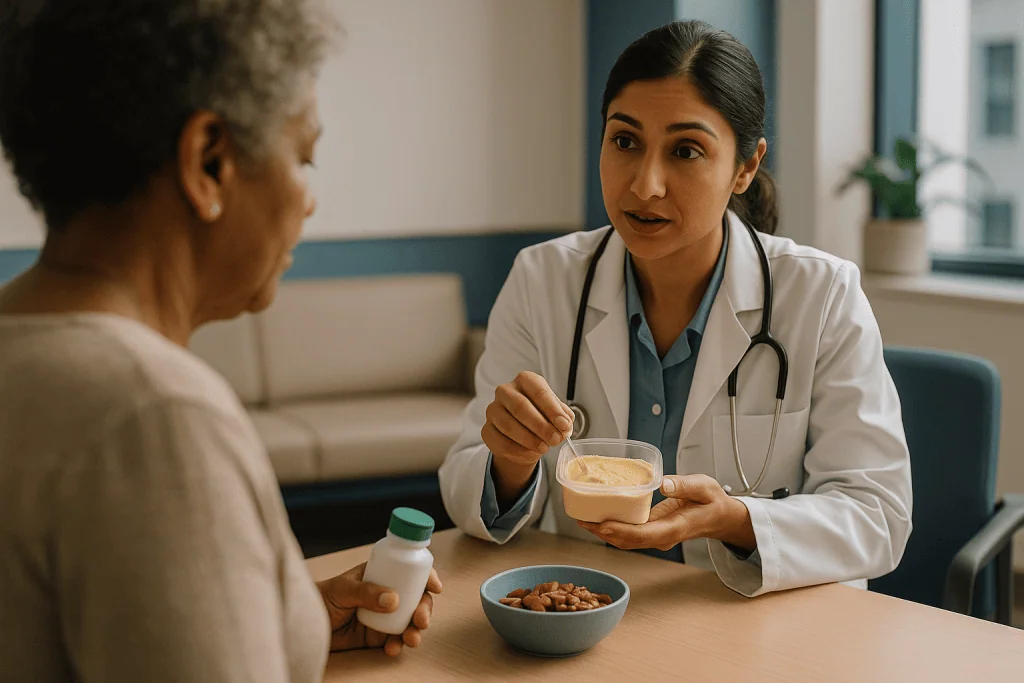
Their mechanism is molecular mimicry. Sterols look so much like cholesterol that they compete for the same absorption machinery in your small intestine. When a sterol occupies the slot, cholesterol from your meal, and from bile, passes through unabsorbed. The decoy itself is barely absorbed either; it mostly just leaves.
The effect is among the best documented in nutrition science: about 2 grams daily lowers LDL by roughly 8 to 10 percent within a few weeks, a figure consistent across dozens of trials and endorsed by sources including the NHS. Two honest footnotes belong here. First, sterols lower LDL, but no trial has been large enough to prove they reduce heart attacks by themselves: the evidence chain runs through LDL, which is a well-validated marker. Second, they only help if eaten with meals, when cholesterol absorption is actually happening. A sterol spread on morning toast does more work than the same spread eaten alone at midnight.
Nuts: a small handful, a measurable difference
Almonds were the nut in the original portfolio trials, but the broader evidence is generous: walnuts, pistachios, peanuts (technically a legume), and mixed nuts all show similar effects. A daily serving of about 30 to 45 grams, a small cupped handful, lowers LDL by roughly 5 percent on average.
Several mechanisms share the credit. Nuts are rich in unsaturated fats that displace saturated fat in the diet, and they carry their own small payload of plant sterols and fiber. Their cell walls also resist digestion enough that some of their fat is never absorbed, one reason studies consistently find that regular nut eaters don’t gain the weight the calorie math would predict.
The failure mode with nuts isn’t the nut; it’s the packaging. Honey-roasted, candied, or heavily salted varieties bury the benefit under sugar and sodium. Raw or dry-roasted, unsalted or lightly salted, is the version the research actually studied.
A practical note on cost, since nuts aren’t cheap: peanuts perform respectably in the research and cost a fraction of almonds or walnuts. Buying whichever plain nut is on sale is a perfectly evidence-consistent strategy. So is stretching them, chopped over oatmeal or a salad, a handful goes further than it does eaten straight from the jar.
Soy protein: the quiet fourth pillar
Soy has ridden a strange reputational rollercoaster over thirty years, miracle food in the 1990s, subject of suspicion in the 2000s, and now settled into a sensible middle: a modestly useful, thoroughly safe protein source.
The direct effect is real but small. Around 25 grams of soy protein daily, roughly what you’d get from a cup of edamame plus a glass of soy milk, or a solid serving of tofu, lowers LDL by about 3 to 5 percent. The indirect effect may matter more: every meal built around tofu or tempeh is a meal not built around fatty ground beef or processed meat, and that substitution removes saturated fat from the equation.
Two persistent worries deserve a straight answer. The concern that soy’s isoflavones act like estrogen and raise breast cancer risk has not been borne out; major reviews summarized by Harvard Health and others find that moderate soy consumption is safe, and in populations that eat soy regularly it’s associated with neutral-to-favorable outcomes. The concern about effects on men’s hormones has similarly failed to materialize in clinical studies at normal food intakes.
If tofu feels foreign in your kitchen, start where texture is forgiving: edamame as a snack, soy milk in your oatmeal (a tidy two-pillar move), or crumbled tempeh in chili, where the spices do the heavy lifting.
What are the six foods that lower cholesterol?
Search this phrase and you’re likely echoing a widely shared list: Harvard Health’s roster of cholesterol-lowering foods, and the British organization HEART UK’s ‘six cholesterol-busting foods,’ which map almost perfectly onto the portfolio pillars. The consensus six:
- Oats and barleyfor beta-glucan, the gel-forming soluble fiber
- Beans, lentils, and other pulsessoluble fiber plus a low-saturated-fat protein swap
- Nutsunsaturated fats, fiber, and natural sterols in one package
- Soy foodstofu, soy milk, edamame, tempeh
- Foods fortified with plant sterols or stanolsthe absorption blockers
- Vegetable oils and unsaturated-fat foodsolive, canola, and sunflower oils replacing butter; avocado; fatty fish for overall heart health
Notice what the list is really saying: five of the six are additions, and the sixth is a swap. That framing matters psychologically. Diets built entirely on restriction tend to collapse; diets built on ‘eat this daily’ give you something to do at every meal.
It’s also worth naming what didn’t make the list despite loud internet advocacy: apple cider vinegar, garlic supplements, lemon water, and cinnamon all have evidence ranging from weak to absent for meaningful LDL reduction. Fatty fish earns its place for triglycerides and overall cardiovascular risk rather than LDL specifically: a distinction worth knowing when you read your own lab report.
What flushes cholesterol out of your body?
This is one of the most-searched cholesterol questions on the internet, and it deserves a myth-busting answer: nothing ‘flushes’ cholesterol. No detox tea, cleanse, or morning lemon ritual rinses it from your arteries. Cholesterol isn’t debris floating loose in your blood waiting to be washed away: it’s a waxy molecule your own liver manufactures and carefully manages, packaged into lipoprotein particles like LDL and HDL.
What the body actually does is closer to accounting than plumbing. The liver is the main exit route: it converts cholesterol into bile acids, secretes them into the intestine to digest fat, and either reabsorbs them or lets them leave in stool. That last step is the only true ‘exit,’ and it’s exactly the door that soluble fiber props open by binding bile acids so they can’t be recycled.
Three levers genuinely shift the ledger:
- Soluble fiber increases bile acid loss, forcing the liver to spend blood cholesterol making more
- Plant sterols block reabsorption of cholesterol in the gut
- Reducing saturated fat makes liver cells display more LDL receptors, pulling more LDL out of circulation
Exercise helps too, mainly by raising HDL and lowering triglycerides rather than dramatically dropping LDL. So the honest translation of ‘what flushes cholesterol’ is: a fiber-rich, low-saturated-fat diet that persuades your liver to withdraw cholesterol from your bloodstream, day after day. Less dramatic than a flush. Far better supported.
Which drink can reduce cholesterol?
No beverage is a magic bullet, but a few earn a place in the portfolio, and a few popular candidates don’t.
Soy milk is the strongest performer, since it delivers soy protein directly; swapping it for whole dairy milk removes saturated fat at the same time, a two-for-one trade. Oat drinks can contribute beta-glucan, though amounts vary widely by brand, check the label for beta-glucan or soluble fiber content, because some oat drinks are mostly water and starch. Sterol-fortified mini-drinks, sold as small daily yogurt-style shots, are among the easiest ways to reach the 2-gram sterol target.
Green tea has genuine but modest evidence: meta-analyses of randomized trials find regular consumption lowers LDL by a few points, real, measurable, and not remotely a substitute for the food pillars. Think of it as rounding, not restructuring.
Now the debunking. Apple cider vinegar‘s cholesterol evidence comes from small, short studies with inconsistent results; mainstream sources don’t recommend it for lipids. Red wine deserves particular caution: the idea that it protects the heart has eroded badly under better research, and no health authority recommends starting to drink for cardiovascular benefit. If you drink, less is better.
The most underrated cholesterol beverage move is subtraction: replacing sugar-sweetened drinks, which raise triglycerides and contribute to weight gain, with water, tea, or coffee. What you stop pouring matters as much as what you start.
What foods are the worst for high cholesterol?
The portfolio only works on a sound foundation, so this question matters as much as any list of superfoods. The main dietary driver of high LDL is saturated fat, and its biggest sources in a typical American diet are more mundane than most people expect.
- Fatty and processed meatssausage, bacon, hot dogs, salami, and high-fat ground beef top the saturated fat charts
- Full-fat dairy in quantitybutter, cream, and cheese; cheese alone is one of the largest saturated fat sources in the US diet
- Baked goods and pastriescroissants, cookies, and pie crusts combine butter or palm oil with refined starch and sugar
- Coconut and palm oilplant-based, yes, but coconut oil is roughly 90 percent saturated fat, more than butter, and it raises LDL in trials despite its wellness-world halo
- Deep-fried fast foodoften cooked in saturated-fat-heavy oils, in large portions
Trans fats, the partially hydrogenated oils once common in margarine and packaged snacks, were the worst offenders, raising LDL while lowering HDL. The good news: artificial trans fats have been effectively banned from the US food supply since 2018, so this battle is largely won, though tiny amounts persist in some imported or trace-labeled products.
The American Heart Association’s practical advice is to keep saturated fat to about 6 percent of calories if you’re actively lowering cholesterol, for a 2,000-calorie day, that’s roughly 13 grams, or about what a single butter croissant contains. That number makes the stakes concrete without requiring a spreadsheet at every meal.
Do eggs still matter? Dietary cholesterol, revisited
For decades, eggs were nutrition’s most famous villain, and the shift in scientific thinking about them confuses almost everyone. Here’s the current state of the evidence, stated plainly.
Dietary cholesterol, the cholesterol in food, turns out to raise blood cholesterol far less than saturated fat does. Your liver runs a feedback loop: eat more cholesterol, and it manufactures less. For most people, that loop absorbs an egg a day without meaningful change in LDL, which is why US dietary guidelines dropped their long-standing cholesterol cap in 2015 and why Harvard Health describes moderate egg intake as compatible with heart health for most people.
Two important exceptions keep this from being a blanket pass. Roughly a quarter to a third of people are ‘hyper-responders’ whose LDL does climb noticeably with dietary cholesterol. And people with diabetes or existing heart disease appear more sensitive in some studies, so many clinicians advise more moderation there.
Shrimp tells a similar story: high in cholesterol, nearly free of saturated fat, and repeatedly cleared by research as a reasonable choice.
The genuinely useful takeaway is about company, not the egg itself. An egg scrambled in olive oil beside whole-grain toast is a different meal from three eggs with bacon, sausage, and buttered white toast. In cholesterol terms, the sidekicks were always the real problem.
How to build a portfolio day, meal by meal
Abstract targets become dinner only with specifics, so here is the portfolio translated into a plausible day. Breakfast: oatmeal cooked in soy milk, topped with chopped almonds and berries, three pillars before 8 a.m. Lunch: a lentil or black bean soup with a barley side salad, dressed with olive oil. Snack: an apple and a small handful of walnuts. Dinner: stir-fried tofu with vegetables over barley or brown rice, cooked in canola or olive oil. A sterol-fortified spread or mini-drink taken with any meal covers the fourth pillar.
The daily targets, and what each is worth on its own:
| Portfolio pillar | Daily target | Typical LDL reduction alone |
|---|---|---|
| Soluble fiber (oats, barley, beans, psyllium) | 10–20 g soluble fiber | ~5–10% |
| Plant sterols/stanols (fortified foods) | ~2 g, with meals | ~8–10% |
| Nuts (any plain variety) | ~30–45 g (a small handful) | ~5% |
| Soy protein (tofu, soy milk, edamame) | ~25 g protein | ~3–5% |
Perfection is not required: the year-long real-world study found benefits scaled with adherence, meaning a 60-percent portfolio delivers roughly 60 percent of the effect. If four pillars feel overwhelming, start with the two easiest wins: oats-plus-beans for fiber and a daily handful of nuts. Add soy and sterols once the first habits stop requiring willpower. A partial portfolio you actually eat beats a perfect one you abandon by February.
How long before your cholesterol numbers change?
Faster than most people expect. LDL cholesterol responds to dietary change within weeks, not years: the original portfolio trials measured their headline reductions after just four weeks of full adherence. Plant sterols show effects in two to three weeks; soluble fiber’s impact builds over a similar window.
That speed cuts both ways. The benefits fade just as quickly if the eating pattern stops, because you’ve changed the liver’s daily inputs, not its underlying programming. The portfolio is a standing arrangement with your metabolism, not a one-time correction, which is precisely why it needs to be built from foods you can genuinely imagine eating next year.
For measurement, most clinicians suggest rechecking a lipid panel about 8 to 12 weeks after a significant dietary change, long enough for the effect to stabilize and show up cleanly. A few practical notes make that follow-up more meaningful. Lipid values bounce around by several percent from normal biological variation, so don’t over-interpret a 4-point wiggle in either direction. Keep other variables steady if you can: a new exercise program, weight change, or an illness near the blood draw can all move the numbers. And track your own trend over multiple tests rather than treating any single reading as a verdict. One data point is a snapshot; three are a story.
When to see a doctor about your cholesterol
High cholesterol produces no symptoms, no headaches, no fatigue, no warning twinge. The only way to know your numbers is a blood test, which is why the American Heart Association recommends that adults have cholesterol checked every four to six years starting at age 20, and more often if results are abnormal or other risk factors exist.
Certain situations call for a conversation with a clinician sooner rather than later:
- A family history of early heart diseasea parent or sibling with a heart attack or stroke before 55 (men) or 65 (women)
- Very high LDL readings, which can signal familial hypercholesterolemia, an inherited condition affecting roughly 1 in 250 people that diet alone cannot adequately control
- Existing diabetes, high blood pressure, or kidney disease, which change how aggressively cholesterol should be managed
- Yellowish deposits around the eyes or on tendons, an occasional physical sign of severely elevated lipids
- Chest pain, pressure, unusual shortness of breath, or symptoms of strokethese are emergencies; call 911, don’t adjust your breakfast
One more honest point: for many people, especially those with established cardiovascular disease or high calculated risk, evidence-based medical treatment substantially reduces heart attacks and strokes, and diet works alongside it rather than instead of it. The portfolio approach stacks with medication beautifully: the trials that established this were never framed as either/or. Let your own risk profile, worked out with a clinician, decide the mix.
The bottom line: diversify, then be patient
Strip away the branding and the portfolio approach is a simple wager backed by unusually good evidence: four modest effects, stacked daily, outperform any single ‘superfood’ by a wide margin. Oats and beans pull bile acids out the exit. Sterols block the entrance. Nuts and soy upgrade the fats and proteins around them. None of it is glamorous, and that’s rather the point, glamour is what sells detox teas, while oatmeal quietly earns its 5 to 10 percent.
If one opinion from this article deserves emphasis, it’s this: consistency beats intensity. The person who eats a decent-but-imperfect portfolio for five years will almost certainly end up with better arteries than the person who executes it flawlessly for six weeks every January. LDL responds in weeks but rewards you over decades, because cardiovascular risk accumulates slowly and quietly.
Start with whichever pillar fits your actual life. Maybe that’s swapping your usual breakfast for oatmeal with nuts, or trading half your week’s meat dinners for lentils and tofu. Get a baseline lipid panel if you don’t have a recent one, make the changes, and retest in two to three months. The number on that follow-up report, not any headline, including this one, is the only evidence about your body that truly counts. Food can move it further than most people believe, as long as nobody promises you it’s a flush.
Frequently asked questions
What flushes cholesterol out of your body?
Nothing flushes cholesterol, no detox drink or cleanse rinses it away. The body’s only real exit route is the liver converting cholesterol into bile acids, which can leave in stool. Soluble fiber from oats, barley, beans, and psyllium binds those bile acids so they can’t be recycled, forcing the liver to pull more cholesterol from your blood. That daily process, not any flush, is what actually lowers your numbers.
What are the six foods that lower cholesterol?
The six foods with the strongest evidence are oats and barley, beans and lentils, nuts, soy foods like tofu and soy milk, products fortified with plant sterols or stanols, and unsaturated oils such as olive or canola replacing butter. Eaten together daily, the portfolio approach, they lowered LDL by about 13 to 30 percent in studies, far more than any single food achieves alone.
Which drink can reduce cholesterol?
Soy milk has the best evidence, since it provides soy protein while displacing saturated fat from whole dairy. Sterol-fortified mini-drinks and beta-glucan-rich oat drinks also contribute to the portfolio. Green tea lowers LDL by a few points in trials, real but modest. Apple cider vinegar lacks convincing evidence, and no health authority recommends alcohol, including red wine, for heart benefit. Replacing sugary drinks with water helps your overall lipid profile too.
What foods are the worst for high cholesterol?
Foods high in saturated fat drive LDL up the most: fatty and processed meats like sausage and bacon, butter, cream, large amounts of cheese, pastries and baked goods, deep-fried fast food, and coconut and palm oils. Artificial trans fats were worse still, but they’ve been effectively banned from the US food supply since 2018. The American Heart Association suggests keeping saturated fat to about 6 percent of calories when actively lowering cholesterol.
How quickly can diet lower cholesterol?
Within weeks. The original portfolio diet trials measured LDL reductions of nearly 30 percent after just four weeks of full adherence, and plant sterols show effects in two to three weeks. The catch is that benefits fade equally fast if you stop, because you’ve changed the liver’s daily inputs rather than anything permanent. Most clinicians suggest rechecking a lipid panel 8 to 12 weeks after making significant dietary changes.
Can you lower cholesterol without medication?
Often, yes, meaningfully, though not always sufficiently. The portfolio diet lowered LDL by about 13 percent in real-world conditions and up to 30 percent with strict adherence, and exercise, weight management, and quitting smoking add further cardiovascular benefit. Whether diet alone is enough depends on your starting numbers and overall risk. People with inherited high cholesterol or existing heart disease usually need medical treatment alongside diet, decided with a clinician.
Are eggs bad for high cholesterol?
For most people, an egg a day fits within a heart-healthy diet, because dietary cholesterol raises blood cholesterol much less than saturated fat does: the liver compensates by making less. However, roughly a quarter of people are hyper-responders whose LDL does climb with dietary cholesterol, and those with diabetes or heart disease may warrant more caution. What you serve alongside eggs, bacon versus whole-grain toast, often matters more than the egg.
Does apple cider vinegar lower cholesterol?
The evidence is weak. Studies of apple cider vinegar and cholesterol are small, short, and inconsistent, and no major health organization recommends it for lipid management. It’s not harmful in normal culinary amounts, but expecting it to move your LDL is misplaced. The same daily effort spent on a bowl of oatmeal or a handful of nuts is backed by decades of trials showing measurable reductions.
How much oatmeal should I eat to lower cholesterol?
About 3 grams of beta-glucan daily, roughly 1.5 cups of cooked oatmeal, produces a measurable LDL reduction, typically in the 5 to 10 percent range when part of an overall healthy diet. Steel-cut, rolled, and instant oats all contain beta-glucan, though heavily sweetened instant packets add sugar you don’t need. Pairing oats with beans, barley, or psyllium later in the day pushes soluble fiber toward the portfolio target of 10 to 20 grams.
Is coconut oil good or bad for cholesterol?
Bad, by the evidence. Coconut oil is about 90 percent saturated fat, a higher proportion than butter, and randomized trials consistently show it raises LDL cholesterol compared with unsaturated oils like olive or canola. It does raise HDL somewhat, but that hasn’t been shown to offset the LDL increase. Despite its wellness-world reputation, mainstream sources including Harvard Health advise treating coconut oil as an occasional ingredient, not a health food.
References
This article is for general information only and is not a substitute for professional medical advice. Please consult a qualified doctor about your individual situation.

More from the Blog

Garlic: The Kitchen Staple With Cardiology Papers
Garlic is a healthy, low-calorie flavoring with some genuinely studied effects. Clinical trials suggest regular garlic intake may modestly lower blood pressure in people…

Quinoa: The Complete-Protein Grain, Fact-Checked
Quinoa is one of the few plant foods that supplies all nine essential amino acids, including lysine, which most cereal grains lack. One cooked…

Low-Sugar Fruits: The Sweetness-to-Sugar Rankings
The lowest-sugar fruits include limes, lemons, avocados, cranberries, raspberries, strawberries, and blackberries, all containing roughly 1 to 5 grams of sugar per 100 grams.…

Fructose, Honey and Sugar: How the Body Handles Each
Fructose is the simple sugar that gives fruit, honey and table sugar much of their sweetness. Table sugar is half fructose and half glucose;…

Foods High in Vitamin A: Two Forms, One List
Foods high in vitamin A include beef liver, oily fish such as herring and salmon, eggs, and fortified dairy, which supply ready-to-use retinol, plus…

How Much Protein Is in an Egg? The Complete Breakdown
One large egg contains about 6.3 grams of protein, roughly 3.6 grams in the white and 2.7 grams in the yolk. The amount varies…