

Garlic: The Kitchen Staple With Cardiology Papers
Key Takeaways
- Allicin, garlic's signature compound, only forms when a clove is crushed or chopped, and the enzyme that creates it is destroyed by heat, which is why many cooks crush garlic and wait about 10 minutes before cooking.
- Pooled clinical trials show garlic preparations lowered systolic blood pressure by roughly 8 to 9 mmHg in people with hypertension, while people with normal blood pressure saw little change.
- A rigorous NIH-funded trial found six months of raw garlic or garlic supplements produced no significant change in LDL cholesterol, so any cholesterol benefit is likely small at best.
- The belief that garlic prevents colds rests largely on a single 146-person trial that has never been convincingly replicated, and independent reviewers rate the evidence as insufficient.
- Garlic doesn't detoxify the liver or kidneys, those organs detoxify the body, and human evidence for garlic in fatty liver disease is limited to small, preliminary trials.
- Concentrated garlic products can increase bleeding risk and interact with blood thinners and certain HIV medicines, which is why surgical teams commonly advise stopping them about a week before planned procedures.
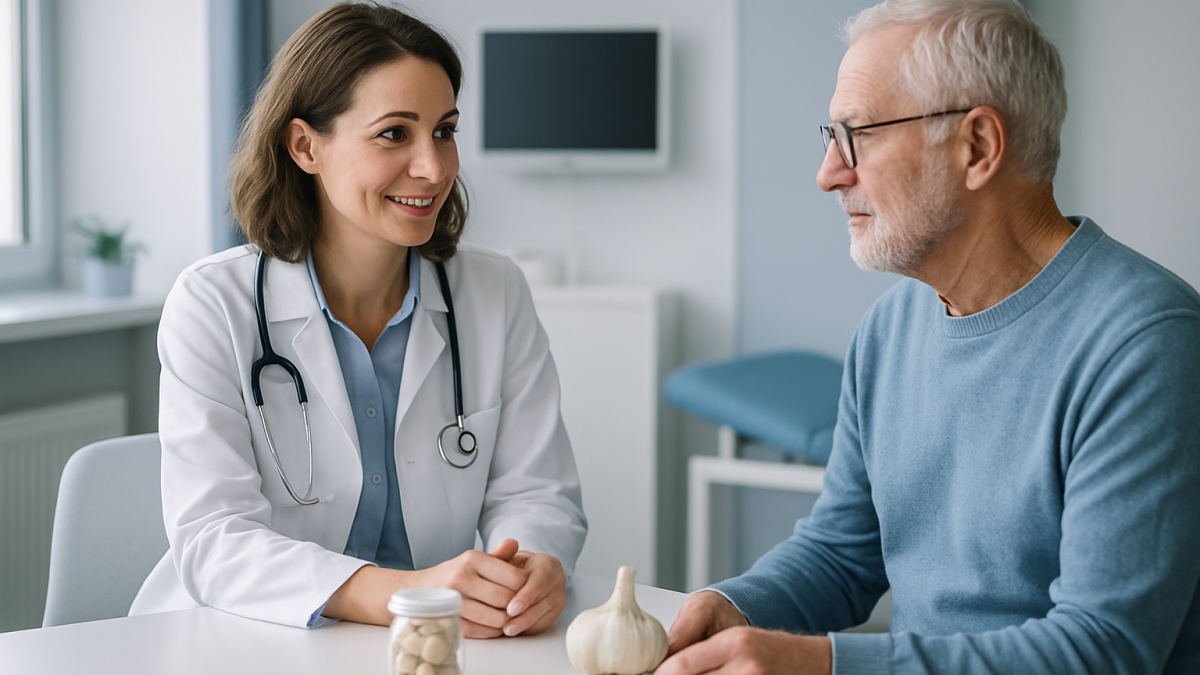
Garlic is a healthy, low-calorie flavoring with some genuinely studied effects. Clinical trials suggest regular garlic intake may modestly lower blood pressure in people with hypertension, and it may slightly improve cholesterol, though results are mixed. It does not cure, prevent, or treat disease on its own. Eaten as food it is safe for most people; concentrated garlic products can interact with blood-thinning medicines.
There’s a moment every home cook knows: minced garlic hits hot oil, and within three seconds the whole kitchen changes. That smell, sharp, sulfurous, unmistakable, is not just dinner announcing itself. It’s chemistry, specifically a cascade of sulfur compounds that scientists have been chasing through laboratories for more than fifty years.
Search a medical database for garlic and you’ll find thousands of papers, including randomized controlled trials published in serious cardiology and nutrition journals. Few foods can say that. Fewer still carry as much folklore: your grandmother’s cold remedy, the clove-a-day cure-all, the internet’s favorite “natural antibiotic.”
So which is it, superfood or seasoning? The honest answer sits somewhere in between, and it’s more interesting than either extreme. Some claims about garlic hold up surprisingly well under scrutiny. Others collapse the moment you read past the headline. Here’s the full accounting.
What happens if you eat garlic daily?
For most people, eating a clove or two of garlic every day means better-tasting food, a small dose of beneficial plant compounds, and, let’s be candid, noticeable breath. Nothing dramatic happens in either direction, and that’s worth saying plainly, because the internet often suggests otherwise.
Over weeks and months, though, regular intake may nudge a few numbers. The best-supported effect is on blood pressure: pooled analyses of clinical trials have found average reductions of roughly 8 to 9 mmHg systolic in people who already have hypertension. Effects on cholesterol are smaller and less consistent, and effects on blood sugar are modest at best. None of these changes replaces medical care, but they’re not nothing either, comparable in scale to some other well-regarded dietary habits.
Daily garlic also fits a broader pattern that nutrition researchers keep circling back to: allium vegetables, garlic, onions, leeks, shallots, appear repeatedly in the diets of populations with lower rates of certain chronic diseases. That’s an association, not proof, but it’s a reason garlic keeps earning its place in dietary guidance about eating more plants.
The downsides of daily garlic are mostly social and digestive. Raw garlic on an empty stomach can trigger heartburn or nausea in sensitive people, and large amounts may cause gas or loose stools. If a daily clove agrees with you, there’s no evidence-based reason to stop.
Allicin: why crushed garlic is chemically different from a whole bulb
A whole, intact garlic clove contains almost none of the compound that made garlic famous. Allicin, the molecule behind both the smell and much of the studied biological activity, doesn’t exist until you damage the clove.
Here’s the mechanism, and it’s genuinely elegant. Garlic cells store a stable, odorless compound called alliin in one compartment and an enzyme called alliinase in another. Crushing, chopping, or chewing breaks the walls between them. Enzyme meets substrate, and within seconds allicin forms: a defense system that evolved to deter pests, which humans then decided was delicious.
Two practical consequences follow:
- Heat deactivates the enzyme. Toss whole or freshly chopped garlic straight into a hot pan and you shut down allicin production before it really starts. Many cooks and some researchers suggest crushing garlic and letting it rest about 10 minutes before cooking, giving the reaction time to finish. The kitchen-level evidence for this trick is thinner than its popularity suggests, but the underlying chemistry is sound and the habit costs nothing.
- Allicin is unstable. It degrades quickly into a family of other sulfur compounds, which may themselves be biologically active. This instability is why garlic supplements vary so wildly in what they actually deliver, a problem we’ll return to.
One clove of raw garlic weighs about 3 grams and contains roughly 4 calories, a bit of manganese and vitamin B6, and trace vitamin C. Nutritionally it’s a rounding error. The sulfur chemistry is the whole story.
Does garlic really lower blood pressure?
This is garlic’s strongest scientific claim, and the reason the title of this article isn’t an exaggeration, garlic genuinely has cardiology papers.
Multiple randomized controlled trials, pooled in meta-analyses, have tested garlic preparations against placebo in people with elevated blood pressure. A frequently cited 2016 analysis in the Journal of Nutrition found average reductions of about 8 to 9 mmHg systolic and 6 mmHg diastolic in participants with hypertension, over study periods of two to six months. For context, that magnitude sits in the same neighborhood as cutting sodium substantially or adopting a regular walking habit.
Proposed mechanisms are plausible: garlic’s sulfur compounds appear to boost production of hydrogen sulfide and nitric oxide, both of which relax blood vessel walls. There’s also early evidence of small effects on arterial stiffness.
Now the honest caveats, because they matter:
- Most trials were small, often fewer than 100 participants, and used concentrated preparations, not kitchen garlic.
- People with normal blood pressure saw little to no change, which is actually reassuring.
- Study quality varied, and effects differed between preparations.
The bottom line from mainstream sources like the National Center for Complementary and Integrative Health: garlic is “possibly effective” for high blood pressure, encouraging language by supplement standards, but nowhere near a green light to abandon prescribed treatment. If you have hypertension, garlic belongs alongside your care plan, not instead of it, and your clinician should know you’re using it in concentrated form.
Can garlic lower cholesterol? The evidence is messier than headlines suggest
Twenty years ago, garlic looked like a cholesterol remedy in the making. The story since then is a useful lesson in how nutrition science self-corrects.
Early trials and meta-analyses suggested garlic could lower total cholesterol meaningfully, some pooled estimates found drops of around 15 to 17 mg/dL in people with elevated levels who took garlic for more than two months. Then came a rigorous, NIH-funded trial published in 2007 that tested raw garlic and two commercial garlic preparations, six days a week for six months, in adults with moderately raised LDL. The result: no significant effect on any cholesterol measure, in any group.
Later meta-analyses split the difference, modest reductions in total and LDL cholesterol in some populations, essentially no effect on HDL or triglycerides, and considerable inconsistency between studies depending on the preparation used and how high participants’ cholesterol was to begin with.
Where does that leave a reasonable reader? Three fair conclusions:
- If garlic lowers cholesterol at all, the effect is small, likely under 10 percent, and possibly zero for many people.
- It is not comparable to prescription cholesterol-lowering treatment, and no mainstream medical body suggests it is.
- As part of an overall plant-forward eating pattern, garlic still earns its keep, just not as a targeted cholesterol tool.
Mayo Clinic’s assessment is characteristically measured: research on garlic and cholesterol has produced conflicting results, and any benefit appears modest. That’s the honest state of play.
Does garlic prevent colds? Grandma versus the Cochrane review
Every winter, the folk wisdom resurfaces: eat garlic, skip the cold. There is exactly one decent clinical trial behind this belief, and it deserves to be described accurately rather than inflated.
In that 12-week study, 146 adults took either a garlic preparation or a placebo through cold season. The garlic group reported 24 colds; the placebo group reported 65. Striking numbers, but it was a single, small trial, colds were self-reported, and the distinctive garlic taste makes true blinding difficult (participants may guess which group they’re in, which skews self-reports).
Independent reviewers who evaluated the evidence concluded there is insufficient evidence to say whether garlic prevents or treats the common cold, precisely because everything hinges on that one study. No one has convincingly replicated it in the two decades since, which is itself informative. Genuinely strong effects tend to get replicated.
What about the underlying biology? In laboratory dishes, garlic compounds do show antimicrobial and antiviral activity, and small studies suggest possible effects on immune cell function. But “kills microbes in a petri dish” is a bar that lemon juice and bleach also clear. It tells us little about what happens in a human body after a garlicky dinner.
A fair verdict: garlic might reduce cold frequency, the evidence is thin, and eating it costs you nothing but breath mints. Just don’t rely on it in place of hand-washing, sleep, and the boring fundamentals that actually carry the load.
What diseases does garlic fight? An honest reframe
People search this question constantly, so let’s answer it carefully: garlic doesn’t “fight” diseases the way a treatment does. What the research actually shows is a set of associations and modest measurable effects, worth knowing, as long as the words stay precise.
Cardiovascular disease. The blood pressure data discussed above is the strongest thread. Some trials have also examined markers like arterial stiffness and coronary calcium progression, with preliminary but not conclusive findings. No trial has shown that garlic prevents heart attacks or strokes: that study would require thousands of people followed for years, and it hasn’t been done.
Cancer. Large observational studies in several countries have found that people who eat more allium vegetables tend to have lower rates of certain cancers, particularly stomach and colorectal cancer. The National Cancer Institute has noted this pattern while emphasizing the core problem: people who eat lots of garlic often differ from people who don’t in dozens of other ways, overall diet, smoking, income, activity. Observational data can’t untangle that, and controlled trials haven’t confirmed a protective effect. “Associated with lower risk in population studies” is the strongest defensible sentence.
Infections. Garlic compounds are antimicrobial in the lab. In humans, garlic is not an antibiotic substitute, and using it as one for an actual infection is genuinely risky. This point is non-negotiable.
The pattern across all three: garlic looks like a plausibly helpful background player in a healthy diet, not a weapon against any named disease. Any source telling you otherwise is selling something.
Is garlic good for the liver and kidneys?
Short answer: as a food, garlic is fine for both organs in healthy people, and the popular idea that it “detoxifies” them gets the biology backwards. Your liver and kidneys are the detox system. No food flushes, cleanses, or resets them.
That said, there is some real research here, mostly early-stage. For the liver, a handful of small clinical trials have examined garlic in people with non-alcoholic fatty liver disease, reporting improvements in liver enzyme levels and liver fat in some participants. Interesting, preliminary, and involving a few dozen to a couple hundred people per study: the kind of evidence that justifies bigger trials, not confident claims. Animal studies also suggest garlic’s sulfur compounds may support the liver’s own antioxidant enzymes, though animal findings routinely fail to translate to humans.
One counterpoint worth knowing: very large amounts of raw garlic have caused liver irritation in animal studies. Culinary quantities carry no such concern.
For the kidneys, the human evidence is thinner still, mostly laboratory and animal work suggesting antioxidant effects. Nothing supports using garlic to treat or protect against kidney disease. People with advanced kidney disease often follow carefully tailored diets and should run any concentrated supplement, garlic included, past their care team, since supplements are a common source of unexpected trouble in that population.
The takeaway: enjoy garlic freely as food, skip any product promising liver or kidney “cleansing,” and treat organ-specific claims as unproven until larger trials say otherwise.
Garlic and blood sugar: a small effect, honestly labeled
Blood sugar is one of those areas where garlic research produces statistically significant results that are easy to oversell.
Several meta-analyses pooling trials in people with type 2 diabetes have found that garlic preparations, taken alongside standard care, modestly lowered fasting blood glucose and, in some analyses, longer-term glucose markers over one to three months. The effect sizes were real but small: the kind of change that shows up in a study’s statistics without transforming anyone’s day-to-day glucose readings.
Mechanistically, researchers point to garlic’s sulfur compounds possibly improving insulin sensitivity and reducing oxidative stress. Plausible, but not firmly established in humans.
Three things keep this finding in perspective:
- Every positive trial studied garlic added to standard diabetes care, never replacing it. There is no evidence garlic manages diabetes on its own, and no responsible clinician would suggest trying.
- The trials used varied preparations and were often small and short, so pooled results come with wide uncertainty.
- People taking glucose-lowering prescriptions should mention concentrated garlic products to their clinician, since stacking anything that lowers blood sugar deserves a conversation.
For someone simply trying to eat in a blood-sugar-friendly way, the more useful frame is this: garlic makes vegetables, beans, and whole grains taste dramatically better, and those foods have robust evidence behind them. Garlic’s best glucose trick may be making the proven foods easier to eat often.
Raw, cooked, roasted, aged, black: does preparation actually matter?
It does, more than for most foods, because garlic’s key compounds are created by an enzyme that heat destroys and degrade on a timescale of minutes to hours. Here’s how the common forms compare on what’s actually known.
| Form | Allicin potential | What the evidence says | Kitchen reality |
|---|---|---|---|
| Raw, crushed | Highest | Closest to lab conditions where allicin forms fully | Harsh flavor; can irritate the stomach and mouth |
| Crushed, rested ~10 min, then cooked | Moderate | Chemistry supports the resting step; direct health-outcome data is limited | Best flavor-to-compound compromise for most cooking |
| Cooked immediately, or whole roasted | Low | Enzyme deactivated before allicin forms; other sulfur compounds remain | Sweet, mellow; still a worthwhile food |
| Aged garlic extract | Allicin-free by design | Contains stable compounds like S-allyl cysteine; used in several blood pressure trials | Supplement form, not a kitchen ingredient |
| Black garlic (fermented) | Very low | Higher in certain antioxidants; human trials scarce | Molasses-sweet; a flavor ingredient more than a health one |
| Garlic powder | Variable, often low | Depends heavily on processing; trial results inconsistent | Convenient; fine for flavor, unreliable for compounds |
One nuance that surprises people: allicin isn’t the only player. When it degrades, or when garlic is aged, it yields other sulfur compounds, some of which appear active in their own right. That’s why aged garlic extract, which contains no allicin at all, still performed respectably in blood pressure trials. Roasted garlic isn’t “ruined”; it’s just a different chemical profile. Cook garlic the way you’ll actually eat it regularly. Consistency beats optimization.
Are garlic supplements better than eating garlic?
Not obviously, and in some ways they’re worse, because you often don’t know what you’re getting.
The core problem is standardization. Allicin is unstable, so a pill can’t simply contain it. Instead, most products contain the precursor compound plus the enzyme, betting the reaction happens after you swallow. Stomach acid can destroy that enzyme, which is why coatings and formulations vary, and why independent testing has repeatedly found that the actual allicin yield from commercial products ranges from close to the label claim down to nearly nothing. Two bottles with identical-sounding labels can be entirely different products in practice.
Meanwhile, dietary supplements in the United States are not reviewed for effectiveness before sale, and quality control is largely the manufacturer’s responsibility. Clinical trials that showed benefits used specific, characterized preparations; the bottle at the store may or may not resemble them.
There are two honest arguments for supplements: the trials with the best blood pressure results used concentrated forms, and some people simply won’t eat garlic daily. If that’s you, a few ground rules apply:
- Tell your clinician, especially if you take blood thinners, blood pressure or glucose-lowering prescriptions, or certain HIV medicines, garlic has documented interactions.
- Stop concentrated garlic products before planned surgery; surgical teams commonly advise this because of bleeding risk.
- Be skeptical of “odorless” claims paired with big promises, reduced odor often signals reduced active compounds.
For most people, the food is the better bet: cheap, verifiable, delicious, and attached to an eating pattern with far stronger evidence than any capsule.
Side effects: who should go easy on garlic?
Garlic’s safety record as a food is excellent, humans have eaten it for at least 5,000 years. But “generally safe” isn’t “universally consequence-free,” and a few groups genuinely need to pay attention.
People on blood-thinning medicines. Garlic inhibits platelet aggregation: the clumping that starts a clot. In culinary amounts this is trivial; in concentrated supplement form it can add to the effect of prescription anticoagulants and antiplatelet drugs, raising bleeding risk. This is the interaction mainstream references flag most consistently.
Anyone with surgery scheduled. For the same reason, stopping concentrated garlic products beforehand, often about a week, per your surgical team’s guidance, is standard advice. Mention it during your pre-operative review; supplements are the thing patients most often forget to disclose.
People on certain HIV medicines. Garlic supplements have been shown to reduce blood levels of at least one antiretroviral drug class. If you take HIV medicines, ask before adding any garlic product.
Sensitive stomachs. Raw garlic can cause heartburn, nausea, and gas. Garlic is also high in fructans, which is why people managing irritable bowel symptoms on low-FODMAP eating plans often limit it. Garlic-infused oil, interestingly, delivers the flavor with far fewer fructans.
Skin contact. Raw garlic held against skin causes chemical burns: a recurring emergency-clinic story thanks to folk-remedy poultices. Never tape a garlic clove to your body, and never put garlic oil in an ear.
True garlic allergy exists but is rare. Breath and body odor, alas, are neither rare nor dangerous.
What garlic won't do: the myths worth retiring
Because garlic has real research behind it, it attracts unreal claims that borrow its credibility. A short, respectful debunking round:
It won’t detox anything. “Detox” is a physiological job description belonging to your liver and kidneys, which perform it continuously without dietary assistance. No study shows garlic flushing toxins, and the concept doesn’t survive contact with basic biology.
It won’t cure infections. Lab-dish antimicrobial activity is not clinical effectiveness. Treating a genuine bacterial infection with garlic instead of proper medical care delays treatment that works, and delayed treatment is how minor infections become serious ones. During recent global outbreaks, the World Health Organization had to state explicitly that eating garlic does not protect against respiratory viruses. That it needed saying tells you how far the myth traveled.
It won’t fix earaches. Garlic oil in the ear canal is a persistent folk remedy. It can’t reach a middle-ear infection (the eardrum is in the way), and it can burn the canal or complicate an examination.
It isn’t a weight-loss food. Some rodent studies get recycled into headlines; human evidence is essentially absent.
“Natural” doesn’t mean “gentle.” The same compounds that give garlic biological activity give it side effects and drug interactions. That’s not a contradiction: it’s how active substances work, whether they come from a pharmacy or a bulb.
None of this diminishes garlic. It just relocates it: from miracle shelf to the more honorable category of genuinely healthy food with a few measurable effects.
When to see a doctor
Garlic questions occasionally point to situations that deserve professional eyes rather than a spice rack. See a clinician promptly if any of these apply:
- You’re using garlic to self-treat a real condition. High blood pressure, high cholesterol, diabetes, or a suspected infection all warrant proper evaluation. Garlic can coexist with treatment; it cannot substitute for diagnosis.
- You notice unusual bleeding or bruising while taking garlic supplements, especially alongside blood-thinning medicines. Nosebleeds that won’t stop, blood in urine or stool, or bruises appearing without injury all merit a same-week appointment, or urgent care if bleeding is significant.
- You have allergy symptoms after garlic: hives, swelling of lips or tongue, wheezing, or trouble breathing. Swelling and breathing difficulty are emergencies, call emergency services rather than waiting.
- You have surgery or a dental procedure coming up and take any garlic product. This is a quick, easy conversation that prevents a genuinely avoidable complication.
- You have kidney or liver disease and are considering any concentrated supplement. Tailored guidance beats general internet advice every time in these situations.
- Persistent digestive symptomsongoing heartburn, bloating, or changed bowel habits, shouldn’t be automatically blamed on garlic. If cutting it out for a couple of weeks doesn’t resolve things, get evaluated rather than continuing to guess.
A good rule: garlic decisions about flavor are yours alone; garlic decisions that touch medications, procedures, or diagnosed conditions belong in a conversation with your care team.
Frequently asked questions
What happens if we eat garlic daily?
For most people, nothing dramatic: you get flavor, a few beneficial sulfur compounds, and garlic breath. Over months, regular intake may modestly lower blood pressure if yours is elevated; trials found average reductions of roughly 8 to 9 mmHg systolic in people with hypertension. Effects on cholesterol and blood sugar are smaller and inconsistent. Possible downsides are heartburn, gas, or stomach upset, especially with raw garlic on an empty stomach.
What are the 10 benefits of garlic?
Honestly, lists of ten pad the evidence. Research meaningfully supports a shorter set: modest blood pressure reduction in people with hypertension, possible small cholesterol and blood sugar effects, useful nutrients like manganese and vitamin B6, and population-level associations with lower rates of certain cancers. Claims about immunity, detoxing, weight loss, and infection-fighting rest on weak or lab-only evidence. Four honest benefits beat ten inflated ones.
Is garlic good for the liver and kidneys?
As a food, garlic is safe for both organs and doesn’t ‘detox’ them: the liver and kidneys detoxify the body on their own. Small clinical trials suggest garlic might modestly improve liver enzyme levels in fatty liver disease, but the evidence is preliminary. Kidney evidence is mostly from animal studies. People with liver or kidney disease should ask their care team before using any concentrated garlic supplement.
What diseases does garlic fight?
None, in the treatment sense, no disease is cured or fought off by garlic. What research shows is modest blood pressure lowering in people with hypertension, small and inconsistent cholesterol and blood sugar effects, and observational links between allium-rich diets and lower rates of stomach and colorectal cancers, which don’t prove cause and effect. Garlic is a healthy background ingredient, not a therapy for any named condition.
Is raw garlic healthier than cooked garlic?
Raw crushed garlic delivers the most allicin, since heat destroys the enzyme that creates it. But cooked garlic isn’t worthless, other sulfur compounds survive cooking, and aged garlic extract, which contains no allicin at all, still performed well in blood pressure trials. A practical compromise: crush or chop garlic, let it rest about 10 minutes, then cook. Eat it however you’ll eat it consistently.
How much garlic should I eat per day?
There’s no official recommended amount. Clinical studies typically used the equivalent of roughly one to two fresh cloves daily, or standardized extracts, over two to six months. One or two cloves a day is a reasonable, well-tolerated culinary amount for most adults. More isn’t clearly better and raises the odds of stomach upset, gas, and body odor. Consistency over months matters more than quantity on any given day.
Can I take garlic supplements with blood thinners?
Ask your prescriber first: this is one of garlic’s best-documented interactions. Garlic inhibits platelet clumping, and concentrated supplements can add to the effect of prescription anticoagulant and antiplatelet medicines, raising bleeding risk. Ordinary culinary amounts of garlic in food are generally not a concern. If you take any blood-thinning medicine, disclose garlic supplements at every appointment, and stop them before planned surgery per your surgical team’s guidance.
Does eating garlic on an empty stomach have special benefits?
No credible evidence supports the popular claim that morning garlic on an empty stomach works better. No clinical trial has compared timing, and the studied effects, on blood pressure, for instance, developed over weeks regardless of when garlic was eaten. What an empty stomach reliably does is increase the chance of heartburn and nausea from raw garlic. Eat it with food, whenever suits you.
Is black garlic healthier than regular garlic?
Not proven. Black garlic, regular garlic aged under controlled heat and humidity, contains higher levels of certain antioxidant compounds and almost no allicin. Laboratory findings are interesting, but human trials are scarce and small, so no one can honestly say it outperforms fresh garlic. Its real advantages are culinary: sweet, mellow, and gentle on digestion. Enjoy it as a flavor, not as an upgrade.
How do you get rid of garlic breath?
Partially, at best. Garlic’s sulfur compounds enter the bloodstream and exit through the lungs, so brushing helps only with mouth residue: the breath itself can last a day or more. Small studies suggest eating raw apple, lettuce, or mint alongside garlic reduces the odor compounds, likely through enzyme and polyphenol reactions. Milk with the meal helps somewhat too. Time is the only complete cure.
This article is for general information only and is not a substitute for professional medical advice. Please consult a qualified doctor about your individual situation.

More from the Blog

Quinoa: The Complete-Protein Grain, Fact-Checked
Quinoa is one of the few plant foods that supplies all nine essential amino acids, including lysine, which most cereal grains lack. One cooked…
Low-Sugar Fruits: The Sweetness-to-Sugar Rankings
The lowest-sugar fruits include limes, lemons, avocados, cranberries, raspberries, strawberries, and blackberries, all containing roughly 1 to 5 grams of sugar per 100 grams.…
Fructose, Honey and Sugar: How the Body Handles Each
Fructose is the simple sugar that gives fruit, honey and table sugar much of their sweetness. Table sugar is half fructose and half glucose;…

Foods High in Vitamin A: Two Forms, One List
Foods high in vitamin A include beef liver, oily fish such as herring and salmon, eggs, and fortified dairy, which supply ready-to-use retinol, plus…
How Much Protein Is in an Egg? The Complete Breakdown
One large egg contains about 6.3 grams of protein, roughly 3.6 grams in the white and 2.7 grams in the yolk. The amount varies…
Ghrelin and Leptin: The Hunger Hormones Explained, and How Sleep and Diet Change Them
Leptin is a hormone released by fat cells that tells the brain how much energy the body has stored; ghrelin is released by the…