

Gastric Banding Surgery Step by Step: Placing the Adjustable Band and the Access Port

Key Takeaways
- The band is placed through the pars flaccida, a thin membrane beside the upper stomach, so it sits high enough to create a small pouch without encircling the esophagus.
- Stitches folding the lower stomach up over the band, called plication sutures, are the main surgical defense against later slippage.
- The access port is anchored to the abdominal wall fascia, and a port that flips face-down is one of the most common reasons for a minor revision procedure.
- MedlinePlus puts operating time at roughly 30–60 minutes, with most people home the same day or after one night, shorter than typical stays for gastric bypass.
- The band is left largely empty at surgery; meaningful restriction begins only with adjustments, which usually start after the first several weeks of healing.
- NIDDK reports that banding carries lower early complication rates but a higher likelihood of needing a second operation than sleeve gastrectomy or bypass.
Gastric band surgery is a keyhole (laparoscopic) operation done under general anesthesia. Through a few small incisions, the surgeon wraps an inflatable silicone ring around the upper stomach to create a small pouch, then connects it by tubing to an access port stitched beneath the skin of the abdominal wall. Later, saline is added or removed through that port to tighten or loosen the band.
The consultation ends, and a small silicone ring sits on the desk between you and the surgeon. It looks like a bicycle inner tube for a doll. It is hard to believe something that light is meant to change how you eat for years. You turn it over, feel the thin tubing, notice the coin-sized disc at the end, and the questions arrive all at once: where does that go, how does it stay put, and what does the day of surgery actually feel like?
Most explanations of how gastric band surgery is done stop at “a band is placed around the stomach.” That sentence is true and almost useless. It skips the part patients actually want: the order of events, the reason for each step, what the surgeon is looking for, and why the port under the skin matters as much as the band itself.
This explainer walks through the operation in sequence, from the anesthesia room to the first adjustment weeks later, with the evidence laid out plainly, including the parts that are less flattering to the procedure.
How gastric band surgery is done: the short version
Strip away the jargon and the operation has three moving parts: a band, a tube, and a port. The band is a soft silicone ring with an inflatable inner cuff. The tube is thin flexible tubing. The port is a small reservoir, roughly the diameter of a bottle cap, with a tough self-sealing top that a needle can pass through many times.
The surgeon places the band around the very top of the stomach, just below where the esophagus (the swallowing tube) joins it. This divides the stomach into a small pouch above the band and the larger, unchanged stomach below. Food collects in the pouch first, stretching its wall. Stretch receptors there send fullness signals to the brain earlier than they would from an intact stomach, which is the intended mechanism, according to the National Institute of Diabetes and Digestive and Kidney Diseases (NIDDK). Nothing is cut away and no intestine is rerouted, which is why the band is often described as the least anatomically disruptive of the bariatric operations.
The tubing runs from the band down to the port, which is fixed to the muscle layer of the abdominal wall beneath the skin. Adding sterile saline through the port inflates the cuff and narrows the opening between pouch and stomach; withdrawing saline widens it. This adjustability is what separates a band from a fixed-ring procedure and is the reason for the follow-up visits that define life after banding.
Almost all bands today are placed laparoscopically, meaning through several small incisions with a camera and long instruments rather than one large cut. MedlinePlus notes the operation typically takes about 30–60 minutes of operating time, though the full stay in the surgical suite is longer once anesthesia and recovery are counted.
Who is usually offered a gastric band, and who is asked to wait
Eligibility is framed around body mass index (BMI), a ratio of weight to height used as a screening measure, together with health conditions linked to excess weight. NIDDK describes bariatric surgery as an option that may be considered for adults with a BMI of 40 or higher, or 35 or higher with a weight-related condition such as type 2 diabetes, high blood pressure, or obstructive sleep apnea. The NHS uses broadly similar thresholds and adds that a person should usually have tried structured nonsurgical approaches first.

Meeting a number does not settle the matter. Bariatric teams typically assess several things before agreeing to any operation, and a band in particular:
- Whether the person understands that the band works only with lasting changes to eating patterns, and that it requires regular adjustment visits.
- Whether reflux, a large hiatal hernia (part of the stomach pushed up through the diaphragm), or esophageal motility problems are present, since these can make a band a poor fit.
- Mental health, alcohol use, and the presence of untreated eating disorders, which are evaluated because they affect both safety and the ability to follow the post-surgery plan.
- Fitness for general anesthesia, including heart and lung function.
People are often asked to wait rather than refused outright. Common reasons include a pregnancy planned within the next year or two, uncontrolled blood sugar, current smoking (which impairs healing), or an ongoing medical work-up that is not finished. NIDDK also notes that gastric banding is now performed less frequently than sleeve gastrectomy or gastric bypass because weight loss tends to be smaller and re-operations more common, so a team may recommend a different procedure. The choice belongs to the patient and their treating team together, based on the individual picture, not on a general ranking of operations.
From the preoperative clinic to the operating room
The weeks before surgery are busier than most people expect. A dietitian usually introduces the liquid and soft-food stages that follow the operation, and many programs ask for a short pre-operative eating plan to shrink the liver slightly, because the left lobe of the liver sits directly over the top of the stomach and must be lifted out of the way during the procedure. Blood tests, an electrocardiogram, and sometimes an upper endoscopy (a camera passed down the throat to inspect the stomach) or a swallow X-ray are arranged so the surgeon knows the anatomy in advance.
On the day itself, you arrive fasted, meet the anesthesiologist, and go through a checklist confirming allergies, current medicines, and consent. If you take medicines for diabetes, blood pressure, or clotting, the team will already have told you which to continue and which to pause; those instructions come from the prescribing clinician and vary from person to person, so this article does not list them.
General anesthesia means you are fully unconscious and a breathing tube supports your lungs throughout. Once you are asleep, several practical steps happen before any incision. Compression sleeves are placed on the calves to reduce the risk of blood clots. The abdomen is cleaned with antiseptic. Many surgeons pass a thin tube through the mouth into the stomach to empty it and to help position the band later. You are then tilted head-up, which uses gravity to let the intestines fall away from the upper abdomen and gives the surgeon a clearer view of the stomach.
None of this is unique to banding; it is the standard opening sequence for laparoscopic upper-abdominal surgery, described in the Mayo Clinic and Johns Hopkins overviews of bariatric procedures.
Creating keyhole access: incisions, gas, and the camera
The operation proper starts with carbon dioxide. Through a small incision, the surgeon introduces gas into the abdominal cavity to lift the abdominal wall away from the organs, creating a working space roughly the size of a small dome tent inside you. The gas is absorbed and breathed out afterward, but its temporary presence explains the shoulder-tip ache many people feel for a day or two after any laparoscopic operation: the gas irritates the diaphragm, and the diaphragm shares a nerve pathway with the shoulder.
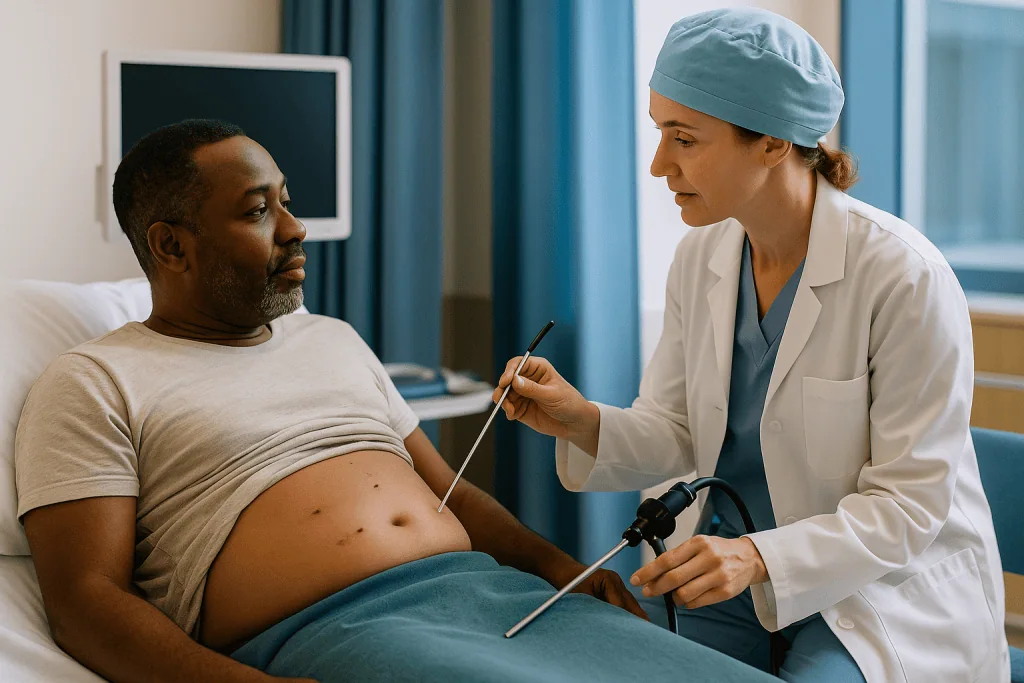
Next come the ports, though these are surgical ports, not the access port that will be left behind. MedlinePlus describes one to five small cuts, each usually a few centimeters or less, through which hollow tubes are placed. A camera goes through one; long-handled instruments go through the others. The surgeon watches a screen rather than looking directly into the abdomen, and the image is magnified, which is one reason keyhole surgery can be so precise around delicate structures.
A liver retractor is placed through one of the ports to hold the left lobe of the liver up and out of the way. With the stomach exposed, the surgeon identifies the landmarks that decide where the band will sit: the angle where the esophagus meets the stomach, the top edge of the stomach, and the pad of fat over the junction.
This is also the moment a hiatal hernia is looked for. If a part of the stomach has slid up through the diaphragm, many surgeons repair it before placing the band, because an unrepaired hernia is associated with later band slippage and reflux. Whether a repair is done, and how, is a judgment call made on the table, which is why consent forms often mention it in advance.
Step by step: how gastric band surgery is done around the stomach
The band itself is placed using a technique surgeons call the pars flaccida approach. Pars flaccida is the thin, translucent part of the membrane that connects the stomach to the liver. Opening a window here lets the surgeon pass an instrument behind the upper stomach at exactly the right level, high enough to create a small pouch, low enough to avoid the esophagus.
The sequence usually runs like this:
- A small opening is made in the pars flaccida on the right side of the upper stomach, near the right crus of the diaphragm (one of the muscular pillars that surround the esophageal opening).
- A blunt instrument is passed gently behind the stomach, from right to left, emerging at the angle of His, the notch where the esophagus meets the top of the stomach on the left side.
- The band, still deflated, is introduced through one of the port sites, grasped, and pulled through the tunnel just created so that it encircles the top of the stomach.
- The band is closed with its buckle or locking mechanism, forming a complete ring.
- The stomach wall below the band is stitched up and over the front of the band to the pouch above it, using several sutures. These plication stitches, as they are called, hold the band in place and reduce the chance of the stomach sliding up through it later.
The pouch created above the band is small, described by MedlinePlus as holding roughly an ounce of food. The band is left unfilled or only minimally filled at the end of the operation, so early on there is little restriction; swelling from surgery alone narrows the passage in the first weeks. Real restriction comes with the later adjustments described below.
Placing the access port under the skin: gastric band port placement explained
With the band secured, attention turns to the part you will feel with your fingers for years afterward. The band’s tubing is brought out through one of the incisions, usually on the left side of the upper abdomen, though placement varies with the surgeon’s preference and the patient’s build. The surgeon enlarges that incision slightly and creates a pocket over the fascia, the tough fibrous sheet covering the abdominal muscles.
The port is connected to the tubing and then anchored to the fascia. Fixation matters. A port that is not firmly attached can rotate or flip face-down, which makes it impossible to reach with a needle and is one of the more common reasons for a minor revision operation. Surgeons anchor it with sutures, a mesh-like base, or a hook system built into the device, depending on the model. The tubing is tucked so that it does not kink or sit under tension, and any excess length is arranged in a gentle curve rather than a sharp bend.
The port must be shallow enough to be felt and punctured through the skin at adjustment visits, yet deep enough that it is not obviously visible or uncomfortable when lying on the stomach. In people with a thicker layer of abdominal fat, surgeons sometimes choose a site closer to the ribs where the fat layer is thinner, or rely on X-ray guidance at fill appointments.
The camera is used for a final look at the band position and to check that there is no bleeding. The gas is released, the instruments are withdrawn, and the small incisions are closed with dissolvable stitches or skin glue. A single dressing over each site is typical. From the outside, the only lasting evidence of the operation is a handful of small scars and a slight firmness under the skin where the port sits.
How long does gastric band surgery take, and is it a big operation?
People ask this two ways: how long they will be under, and how serious it is. Both deserve honest answers.
On time, MedlinePlus puts the operation at around 30–60 minutes for an uncomplicated case. Add anesthesia induction beforehand and waking up in the recovery area afterward, and the whole episode commonly fills a morning or an afternoon. Many people go home the same day or after one night, according to MedlinePlus, which compares favorably with the two-night stays often described for gastric bypass.
On seriousness, the fair description is: a genuine abdominal operation with a comparatively light footprint. It requires general anesthesia and carries the risks of any surgery, including bleeding, infection, and blood clots. But nothing is removed, no staple lines are created, and the digestive tract is not reconnected, so the operation avoids the leak risk that dominates conversations about sleeve gastrectomy and bypass. NIDDK and Johns Hopkins both note that banding has a lower early complication rate than the other common bariatric operations.
The trade-off, which is the honest heart of this topic, is that the band’s risks are shifted to later. The lower operative risk is real, and so is the higher chance of needing another operation years down the line to fix, reposition, or remove the device. Someone deciding between procedures is not choosing between a safe operation and a risky one; they are choosing which pattern of risk, early or delayed, and which set of demands afterward, suits their life. That is a conversation for the surgical team, with the person’s own priorities at the center.
Gastric band, sleeve, and bypass: how does a gastric band work compared with the alternatives?
A table cannot make the decision, but it does show where the band sits among the options a bariatric team will usually discuss. The features below are drawn from NIDDK and NHS descriptions of the three most common procedures.
| Feature | Adjustable gastric band | Sleeve gastrectomy | Gastric bypass |
|---|---|---|---|
| What is done | Inflatable ring around upper stomach; nothing removed | About three-quarters of the stomach removed along a staple line | Small pouch created and joined directly to the small intestine |
| Main mechanism | Early fullness from a small pouch | Smaller stomach plus hormonal changes | Smaller stomach, hormonal changes, and reduced absorption |
| Adjustable | Yes, through the port | No | No |
| Reversible | Yes, band can be removed | No | Technically possible but complex; rarely done |
| Typical weight loss | Generally lower than the other two (NIDDK) | Intermediate to high | Generally highest |
| Follow-up burden | Frequent adjustment visits, especially in the first one to two years | Regular checks, vitamin monitoring | Lifelong vitamin and mineral supplementation and monitoring |
| Characteristic later problems | Slippage, erosion, port or tubing issues, reflux, need for removal | Reflux, staple-line issues, weight regain | Nutritional deficiencies, dumping syndrome, internal hernia, ulcers |
Two points stand out. First, the band’s strengths, adjustability and reversibility, are also the source of its maintenance demands: the device only works if it is tuned, and tuning means appointments. Second, the hormonal effects that sleeve and bypass produce, including changes in appetite hormones that NIDDK describes, are largely absent with a band, because the stomach and intestine are left intact. The band restricts; it does not much alter the body’s chemistry of hunger.
Gastric band recovery time: the first days and weeks
Recovery from banding tends to be quicker than from the other bariatric operations, but “quick” still has a shape, and knowing it prevents unnecessary worry.
The first day or two usually bring a sore abdomen around the incisions, that gas-related shoulder ache, and some nausea from anesthesia. Walking is encouraged within hours, both to move the residual gas along and to lower the risk of blood clots in the legs. Sips of clear fluids start the same day. MedlinePlus notes that most people are discharged the same day or the next morning.
The diet then moves through stages that the NHS describes in its guidance on what happens after weight loss surgery. Typically:
- Clear and then full liquids for roughly the first week or two, with attention to sipping slowly.
- Pureed foods, the texture of smooth yogurt, for the next stage.
- Soft foods that can be mashed with a fork.
- A return to regular textures at around six weeks, eaten in small portions and chewed thoroughly.
The staged diet exists because the newly placed band and the stitches over it need time to settle. Solid food too early can cause vomiting, and repeated vomiting in the early weeks is associated with band slippage.
Light activity is generally fine within days, and many people return to desk work within one to two weeks, while heavy lifting is usually deferred for several weeks to protect the incisions and the port fixation; the surgical team sets the specific limits. Restriction at this stage is mild or absent, because the band is largely empty. Some people are surprised and even disappointed that they do not feel much different. That is expected. The tool is in place; the tuning has not begun.
How the band is adjusted: what a fill appointment looks like
The adjustment, often called a fill, is the step that turns a passive ring into an active tool. MedlinePlus indicates the first adjustment usually comes after the initial weeks of healing, commonly around six weeks, once swelling has settled and the stitches have matured.
The visit itself is brief and takes place in a clinic room rather than an operating room. You lie flat, sometimes with your head slightly raised or asked to tense your abdominal muscles so the port stands out. The clinician locates the port by touch, cleans the skin, and may numb it with a local anesthetic. A special non-coring needle, designed to slide between the fibers of the port’s self-sealing top rather than punch a hole in it, is passed through the skin into the reservoir. The clinician draws back first to confirm the needle is in the port and to measure how much saline is already present, then adds or removes a small volume.
Some centers do adjustments under fluoroscopy, a live X-ray, so they can watch a swallow of contrast liquid pass through the band and see exactly how narrow the opening is. Others rely on symptoms and weight trends. Both approaches are used in mainstream practice.
Afterward, you are usually asked to drink water in the clinic to confirm liquids pass, then to return to liquids for a day or so before easing back to normal textures. The band is considered well adjusted when portions feel satisfying at a modest size without regurgitation, heartburn, or night cough. Too tight is not better than too loose; over-tightening is linked to reflux, esophageal dilation (stretching of the swallowing tube), and eating soft high-calorie foods that slip through easily, which undermines the whole purpose. Reaching that balance often takes several visits over the first year or two.
What is life like after gastric banding?
Ask people who have lived with a band for years and a consistent picture emerges: meals become smaller and slower, and the band is a constant companion rather than a background device.
Eating changes in texture and pace more than in flavor. Foods have to be chewed until they are nearly liquid before swallowing. Bread, dry meat, rice, and fibrous vegetables are the classic offenders that can lodge above the band, producing a sudden pressure behind the breastbone and sometimes regurgitation. Most people learn to eat protein first, to put the fork down between bites, and to stop at the first sign of fullness rather than the last. Drinking with meals tends to wash food through the pouch and shorten the feeling of fullness, so fluids are often separated from food by a short gap.
Follow-up is a lifelong feature, not a phase. The NHS and Mayo Clinic both stress that bariatric surgery of any type requires ongoing review; for the band specifically, the schedule is heaviest in the first two years while the fill level is being found, then settles into periodic checks. Blood tests for vitamins and minerals are still done, because smaller portions can mean smaller intakes even though the band does not impair absorption the way bypass does.
Life events interact with the band. In pregnancy, teams often loosen the band to allow adequate nutrition. Before certain scans or during a prolonged illness with vomiting, it may also be loosened. Weight regain over the years is common with all bariatric procedures and is not a personal failing; with a band, it prompts a review of fill level, eating patterns, and whether the device is still positioned correctly.
The candid summary is that a band rewards attention and punishes neglect. People who thrive with one tend to describe it as a tool they keep learning to use.
Risks and complications in plain language
Every surgical explainer lists risks; the useful ones explain what the words mean and when they tend to appear.
Early risks are those of any laparoscopic abdominal operation: bleeding, wound infection, blood clots in the legs or lungs, injury to nearby organs such as the spleen or esophagus, and reactions to anesthesia. NIDDK notes these are less frequent after banding than after sleeve or bypass, largely because nothing is cut or stapled inside.
Later risks are where the band’s particular character shows, and NHS and MedlinePlus describe the following:
- Slippage: part of the lower stomach works its way up through the band, enlarging the pouch above it. Symptoms include new vomiting, reflux, pain, or difficulty swallowing. It often needs an operation to reposition or remove the band.
- Erosion: the band gradually wears into the stomach wall. This can be surprisingly quiet, sometimes showing up as a port-site infection or loss of restriction, and requires band removal.
- Port and tubing problems: the port flips, the tubing kinks or leaks, or the port site becomes infected. These are usually fixed with a minor procedure under local or general anesthesia.
- Esophageal dilation and reflux: a band that is too tight for too long can stretch the esophagus and cause persistent heartburn, night cough, or aspiration.
- Food intolerance and vomiting: common early and after fills, but persistent vomiting is a warning sign, not a feature to tolerate.
The single most important fact about band complications is their timing. NIDDK reports that people with bands are more likely than those with other procedures to need a second operation, and these re-operations cluster years rather than weeks after placement. A person weighing up the band should hear this clearly, alongside the lower early risk, from their own surgical team.
How many years does a gastric band last?
The device is designed to stay in place indefinitely; there is no built-in expiry date and no scheduled replacement the way there is for some joint implants. Silicone tolerates years inside the body well. The honest answer to “how long does it last” is therefore not about the material but about whether the band continues to do its job and continues to be tolerated.
Published follow-up studies, summarized in the NIDDK and Johns Hopkins overviews, show that a meaningful share of bands are eventually removed or converted to another procedure. The reasons fall into three groups. Some are removed for the complications described above: slippage, erosion, or intractable reflux. Some are removed because weight loss has been inadequate and the person and their team decide a sleeve or bypass is a better fit. Some are simply removed at the person’s request after years of eating restrictions they no longer want.
This article deliberately does not quote a percentage for removal rates, because reported figures vary widely with follow-up length, surgical technique, patient population, and era, and a single number would give a false sense of precision. What the evidence consistently shows is a pattern: the longer the follow-up, the higher the cumulative proportion of bands that have been removed or revised. A bariatric team can share the figures from their own practice and from the specific band system used.
Removal is itself a laparoscopic operation, usually shorter than the original placement. The stomach generally returns to its previous shape, and the person’s appetite and capacity return with it, which is why removal is typically discussed alongside a plan for what comes next, whether that is conversion to another procedure or a structured nonsurgical program.
What people often get wrong about gastric bands
Some misunderstandings surface so often in clinic that they deserve direct correction.
“The band does the work.” It does not. The band changes how quickly fullness arrives; it does not change what a person chooses to eat between meals or whether high-calorie liquids slide straight through. NIDDK is explicit that all bariatric procedures depend on lasting changes in eating and activity.
“Tighter is better.” An over-tightened band forces people toward soft, slippery foods, provokes reflux, and can stretch the esophagus. The goal of adjustment is comfortable satiety at small portions, not maximal restriction.
“It’s reversible, so there’s nothing to lose.” Reversibility is a genuine advantage, but removal is still an operation, and years spent with a band that never worked well are not neutral for health or morale. Reversibility is a safety valve, not a reason to choose the procedure lightly.
“Once it’s placed, you’re done.” The opposite is closer to the truth. The band is the beginning of a follow-up relationship, with the most intensive period in the first one to two years, according to Mayo Clinic and NHS guidance.
“The band is the safest option, full stop.” It has lower early complication rates, which is a meaningful advantage for some people, particularly those at higher anesthetic risk. It also has higher long-term re-operation rates. Both statements are true at once.
“Vitamins aren’t a concern because nothing is bypassed.” Absorption is preserved, but intake falls, and monitoring is still recommended by mainstream guidance. The specifics of any supplementation belong with the treating team.
None of these myths makes the band a poor choice. They make it a choice that should be made with clear eyes.
Questions to ask your care team
Consultations pass quickly. Arriving with questions written down turns a passive briefing into a real conversation. These are the ones that tend to matter most for someone considering a band:
- Why do you think a band suits me better than a sleeve or bypass, and what would change your view?
- How many band placements does your program do each year, and how do you handle adjustments and late problems?
- Will you check for and repair a hiatal hernia during the operation?
- Where will my port sit, and how will you decide if I will need X-ray guidance for fills?
- How often will I be seen in the first year, and who do I contact between visits if something feels wrong?
- What does your program’s own experience show about band removal or revision over five and ten years?
- Which of my current medicines change around surgery, and who gives me those instructions?
- How will the band be managed if I become pregnant, need a major operation, or have an illness with prolonged vomiting?
- What signs would make you want to see me urgently?
- If the band is removed one day, what are the likely next steps?
A good team welcomes these questions and will answer the uncomfortable ones, including those about re-operation, without defensiveness. The MedlinePlus and Mayo Clinic pages on bariatric surgery are reasonable reading before the appointment, and the NHS overview lays out the general pathway in plain language. Bring a companion if you can; two sets of ears catch more, and the details of the port, the fills, and the follow-up schedule are exactly the kind of practical information that is easy to lose in the moment. The decision remains yours and your team’s, informed by your own health and priorities rather than by any general ranking of procedures.
When to call your doctor
Most discomfort after banding is minor and expected: sore incisions, a shoulder ache from residual gas, tiredness for a week or so. Certain signs are different and should prompt a same-day call to the surgical team, or emergency care if they are severe. This applies in the first weeks and also years later, because band problems can appear long after placement.
- Vomiting that persists, especially inability to keep down fluids or saliva, which can signal a slipped or over-tight band and quickly leads to dehydration.
- Severe or worsening abdominal pain, or pain in the chest or between the shoulder blades.
- Fever, chills, or redness, warmth, swelling, or discharge at any incision or over the port site; a late port-site infection can be the first sign of erosion.
- Difficulty swallowing that is new or getting worse, or a sudden loss of all restriction after months of stability.
- Heartburn or regurgitation at night, coughing or choking when lying down, or a new hoarse voice.
- A swollen, painful calf, or breathlessness and chest pain, which can indicate a blood clot and are emergencies.
- Black or bloody vomit or stools.
- Feeling faint, a racing heart, or passing very little urine, which suggest dehydration or bleeding.
If you cannot reach your bariatric team and symptoms are severe, go to the nearest emergency department and tell staff you have an adjustable gastric band; that single sentence changes how they assess you. NHS and MedlinePlus guidance both emphasize that persistent vomiting or pain after banding should never be waited out. The treating team decides what needs to happen next, whether that is loosening the band, imaging, or an operation, and their decision will be faster and safer if you call early rather than late.
Frequently asked questions
Is a gastric band a big operation?
It is a real abdominal operation under general anesthesia, but among bariatric procedures it has the lightest footprint. Nothing is removed or stapled, and the digestive tract is not rerouted, so early complication rates are lower than for sleeve or bypass, according to NIDDK. The trade-off is a higher chance of needing another operation years later to fix, reposition, or remove the device.
How long does it take to recover from gastric band surgery?
Most people leave the hospital the same day or the next morning, per MedlinePlus, and many return to light work within one to two weeks. The staged diet, moving from liquids to purees to soft foods, usually reaches normal textures at around six weeks according to NHS guidance. Heavy lifting is typically deferred for several weeks to protect the incisions and the port fixation; your team sets the specifics.
How many years does a gastric band last?
There is no fixed lifespan; the silicone device is intended to remain indefinitely. In practice, a meaningful proportion of bands are removed or converted to another procedure over the years because of slippage, erosion, reflux, inadequate weight loss, or personal preference. Reported figures vary widely with follow-up length and technique, so ask your surgical team about their own long-term experience rather than relying on a single number.
What is life like after gastric banding?
Meals become smaller and slower, with food chewed thoroughly and fluids kept separate from eating. Regular adjustment visits are a fixed feature, most intensive in the first one to two years while the fill level is found. Vitamin and mineral levels are still monitored. People who do well tend to describe the band as a tool that rewards attention and requires ongoing effort rather than a device that works on its own.
How does a gastric band work to reduce hunger?
The band divides the stomach into a small upper pouch and the larger stomach below. Food fills the pouch quickly, stretching its wall and triggering fullness signals to the brain earlier than an intact stomach would. Unlike sleeve gastrectomy or bypass, the band does not substantially change appetite hormones, because the stomach and intestine remain intact. It restricts volume rather than altering the body’s chemistry of hunger.
Where is the gastric band port placed and can you feel it?
The port is usually anchored to the fascia over the abdominal muscles, most often on the left upper abdomen, though the site varies with the surgeon and the person’s build. It is placed shallow enough to be located by touch for adjustments, so many people can feel a small firm disc under the skin. It is generally not visible, though a slight bump may show in slimmer people.
What are the main steps of the gastric band operation?
After general anesthesia, the abdomen is inflated with carbon dioxide and small incisions are made for a camera and instruments. The liver is lifted aside, a hiatal hernia is checked for, and a tunnel is created behind the upper stomach through the pars flaccida membrane. The band is pulled through, locked, and secured with stitches folding the stomach over it. The tubing is connected to a port fixed beneath the skin, and the incisions are closed.
Does a gastric band fill hurt?
Most people describe it as a brief sting, similar to a blood draw. The clinician locates the port by touch, may numb the skin with a local anesthetic, and passes a special needle into the reservoir to add or remove saline. The visit is short and done in a clinic room. Some programs use live X-ray to watch a swallow pass through the band. Mild soreness at the site afterward is common and short-lived.
Can a gastric band be removed, and what happens to the stomach?
Yes, removal is a laparoscopic operation that is usually shorter than the original placement. The stomach generally returns to its previous shape and capacity, and appetite typically returns with it. For that reason, removal is normally planned alongside a next step, whether conversion to another bariatric procedure or a structured nonsurgical program, decided together with the treating team.
What are the warning signs of a slipped gastric band?
New or worsening vomiting, especially inability to keep down fluids, is the most common sign, often with reflux, pain in the upper abdomen or chest, or difficulty swallowing. Symptoms can appear suddenly or build over weeks, and they can occur years after placement. These signs warrant a same-day call to the bariatric team or emergency care if severe, since a slipped band can compromise blood flow to the stomach.
References
This article is for general information only and is not a substitute for professional medical advice. Please consult a qualified doctor about your individual situation.

More from the Blog

Robotic vs Laparoscopic Bariatric Surgery: How Surgeons Decide Which Approach Fits You
Robotic and laparoscopic bariatric surgery are both minimally invasive; the difference is how the surgeon controls the instruments, not what is done to the…
Gastric Band vs Gastric Sleeve: Reversible Device or Lasting Reshaping, Compared Honestly
An adjustable gastric band is a removable silicone ring fitted around the upper stomach and tightened through a port under the skin; a gastric…

Robotic Bariatric Surgery: What the Robotic Arms Change Inside the Operating Room
Robotic bariatric surgery uses a surgeon-controlled console and wristed instruments to perform standard weight-loss operations, such as sleeve gastrectomy or gastric bypass, through small…

Gastric Balloon vs Gastric Sleeve: Temporary Device or Surgery, and How Doctors Compare Them
A gastric balloon is a temporary, saline-filled device placed in the stomach through the mouth and usually removed after about six months, while a…

Preparing for an Obesity Clinic Appointment: Weight History, Medicines and Questions to Bring
To prepare for an obesity clinic appointment, bring a written weight history (your weight at key life stages, past attempts, what helped and what…

Gastric Sleeve Results Over the Years: What Realistic Long-Term Expectations Look Like
Gastric sleeve results long term typically show the largest weight loss in the first one to two years, with a partial regain for many…