

Getting a Second Opinion on Liver Disease: What to Bring and Which Questions to Ask

Key Takeaways
- ALT and AST measure liver cell injury, while albumin and INR measure liver function, so normal enzymes do not exclude advanced scarring (MedlinePlus).
- A second pathologist can re-read existing biopsy slides without another procedure, and interpretation differences on grade, stage and cause are well recognized.
- According to NIDDK, roughly 3–5% weight loss reduces liver fat and about 7–10% is associated with improvement in inflammation and scarring in fatty liver disease.
- Elastography estimates scarring by measuring liver stiffness, but readings can be skewed by recent eating, active inflammation or abdominal fat, so ask about scan conditions.
- The CDC recommends hepatitis A and B vaccination for people with chronic liver disease because a second viral insult on an injured organ carries higher risk.
- The NIH Office of Dietary Supplements has linked some herbal and bodybuilding supplements to liver injury, which is why your supplement list belongs in the file.
A liver disease second opinion is a fresh review of your diagnosis and treatment plan by another liver specialist, usually a hepatologist. Bring your complete blood test history, imaging reports and the actual images, any biopsy report and slides, a list of every medicine and supplement, and written questions. It adds the most value before irreversible decisions, when results conflict, or when an autoimmune or inherited cause is possible.
The folder on the kitchen table is two inches thick. Inside are three years of blood test printouts, an ultrasound report that says “coarse echotexture,” and one word circled in pen so many times the paper has thinned: fibrosis. The appointment that produced that word lasted eleven minutes. The questions started on the drive home.
This is where most people arrive at the idea of a liver disease second opinion: not in a crisis, but in the quiet gap between what they were told and what they understood. The liver is a forgiving organ with a vague vocabulary. “Fatty,” “inflamed,” “scarred,” and “stage 2” can describe very different futures, and the difference often hinges on a test that was never ordered or a number nobody explained.
A second review does not mean the first clinician was wrong. It means the stakes are high enough to want two careful readers. What follows is how that review works, exactly what to carry in, and the questions that tend to change the conversation.
How a liver disease second opinion actually works
A second opinion is a structured re-reading of your case by a clinician who was not involved the first time. For liver disease that clinician is usually a hepatologist, a physician who specializes in the liver, bile ducts and gallbladder, or a gastroenterologist with a liver focus. The reviewer starts with your records, not with you, and that order matters: the original data is compared against current guidelines before anyone talks about treatment.
Three things happen in a thorough review. The diagnosis is checked: does the pattern of blood tests, imaging and any biopsy actually fit the label on your chart? The stage is checked: how much scarring, if any, is present, and was it measured in a reliable way? The plan is checked: are the monitoring intervals, lifestyle targets and any medicines consistent with what the evidence supports for someone with your findings?
Some second opinions end with the sentence, “I agree with everything, and here is why.” That is a good outcome, not a wasted one. Agreement from an independent reviewer settles the restless part of the mind and makes the hard work of follow-through easier. Other reviews reorder priorities, request a missing test, or shift the diagnosis to a cause that explains the numbers better.
The review can be in person or virtual. Many liver questions are record-driven, so a remote consultation that includes the actual images and pathology slides can be as informative as a visit. What a remote reviewer cannot do is examine your abdomen, check for fluid or jaundice, or feel an enlarged spleen, so a hands-on examination is often still requested when the stage is uncertain. Whatever format you choose, the second clinician advises; your treating team, including you, decides.
When to see a hepatologist for a second look, and when waiting is reasonable
Not every abnormal liver test deserves a second specialist. The reviewer’s time, and yours, is best spent where a different reading could change what happens next. Several situations fit that description well.
- A diagnosis of cirrhosis, advanced fibrosis, or a liver mass, where decisions about surveillance, procedures or transplant evaluation may follow.
- Blood tests that keep moving while the explanation stays the same, for example “fatty liver” in someone of normal weight who drinks little or nothing.
- Any autoimmune, genetic or cholestatic (bile-flow) diagnosis, because these are less common and the confirming tests are easy to leave undone.
- A recommendation for a liver biopsy, long-term immunosuppression, or a new medicine class when you do not understand why the alternative was ruled out.
- Conflicting reports: an ultrasound that says one thing and an elastography scan that says another.
Who is usually asked to wait? Someone with a single mildly raised enzyme, a clear temporary explanation such as a recent viral illness or a new medicine, and a repeat test already booked. In that setting the most informative “second opinion” is simply the second blood draw, which the Mayo Clinic notes is standard practice before any liver label is applied. Likewise, if you are already under a hepatologist and a scan is scheduled within weeks, the result of that scan will tell a reviewer more than your current file can.
Timing matters in one more way. A second opinion is most useful before an irreversible step, not after. If a procedure is proposed, asking for time to seek a review is a normal request, and a clinician who is confident in the plan will usually welcome it. The exception is an emergency, where delay carries its own risk; the red-flag section at the end of this article describes those situations.
What to bring: the records that change the conversation
The quality of a second opinion is capped by the quality of the file. A reviewer working from a two-line referral letter can only tell you what the first doctor already said. Give them the raw material and the conversation changes.

Start with every liver-related blood test you can find, going back as far as possible, ideally in a single chronological list with the lab’s reference ranges. Trends matter more than any one value; a slowly rising bilirubin over three years tells a different story than a one-off blip. Add your most recent complete blood count, because a falling platelet count is one of the earliest indirect signs of portal hypertension (raised pressure in the vein that feeds the liver).
For imaging, bring the written reports and the images themselves, usually on a disc or via a secure portal link. Radiologists disagree with each other more often than patients expect, and a reviewer may want their own radiologist to look. If you have had a biopsy, request the pathology report and ask the original laboratory to release the glass slides or digital scans. A liver biopsy second opinion from a second pathologist is one of the highest-yield parts of the entire process.
Then the context: a complete list of prescribed medicines, over-the-counter products, herbal and dietary supplements, and alcohol intake described honestly in drinks per week. The NIH Office of Dietary Supplements notes that several herbal products have been linked to liver injury, so the supplement list is not a formality. Include family history of liver disease, diabetes or iron overload, and any past hepatitis test results.
Finally, bring your own one-page summary: what you were told, what you were offered, and what you do not understand. Reviewers read it first.
How to read your liver blood tests before the appointment
You do not need to interpret your own labs. Knowing what each line measures, though, turns the appointment from a lecture into a dialogue. MedlinePlus groups the standard panel into markers of injury, markers of bile flow, and markers of function, and that grouping is the key to understanding why a reviewer lingers on some numbers and skips others.
ALT and AST are enzymes released when liver cells are damaged; they signal injury, not how much liver is left. ALP and GGT rise when bile is not flowing freely, which points toward the ducts rather than the cells. Bilirubin is the yellow pigment the liver clears; when it climbs, the eyes and skin may follow. Albumin, a protein the liver manufactures, and the INR or prothrombin time, which measures clotting proteins the liver makes, are the true function tests. A liver can have normal ALT and still be failing, and a liver can have an ALT several times the upper limit and be structurally fine.
Two patterns catch a reviewer’s eye. The first is injury enzymes that are normal while albumin drifts down and INR drifts up, which suggests the inflammatory phase has burned out and scarring is doing the talking. The second is an AST that sits above ALT in someone with no alcohol history, a ratio that prompts questions about the completeness of the alcohol conversation and about advanced fibrosis.
Many reviewers also calculate a scoring index from routine results, combining age, AST, ALT and platelet count to estimate the likelihood of significant scarring. Ask whether one was calculated, what it suggests, and whether it agrees with your imaging. When it does not, that disagreement is precisely where a second opinion earns its keep.
Scans, elastography and a liver biopsy second opinion
Blood tests describe chemistry. Imaging describes structure, and structure is where staging lives. Three tools dominate, and each answers a slightly different question.

Ultrasound is usually first. It shows fat, gross scarring, enlarged spleen, fluid and masses, but it cannot reliably grade fibrosis, and “fatty infiltration” on an ultrasound report says nothing about whether inflammation is present. Elastography measures liver stiffness, either with a dedicated probe (transient elastography) or built into an ultrasound or MRI machine. Stiffness tracks scarring reasonably well, and the Mayo Clinic lists it among the standard non-invasive ways to assess cirrhosis. It is less reliable in people with significant abdominal fat, active inflammation, or recent eating, which is why a reviewer may ask when the scan was done and whether you had fasted.
Biopsy remains the reference test when non-invasive results conflict or the cause is unclear. A thin needle removes a core of tissue the width of a pencil lead; the pathologist grades inflammation and stages scarring, typically from F0 (none) to F4 (cirrhosis). The procedure carries real if uncommon risks, chiefly bleeding and pain, and it samples a tiny fraction of the organ, so it can under- or over-call disease when scarring is patchy.
That sampling problem is exactly why a liver biopsy second opinion is worth requesting if tissue has already been taken. A second pathologist, ideally one who reads liver biopsies routinely, re-examines the same slides. Interpretation differences on grade, stage and even cause are well recognized, particularly in autoimmune and overlap conditions where the features are subtle. Nobody has to be re-biopsied for this; the glass or digital slides travel instead of the patient.
Which liver disease are we talking about? A reviewer's checklist
The word “liver disease” covers conditions that share an organ and little else. Part of what a second reviewer does is check that the label on your chart was reached by excluding its neighbors, because the most common cause is not always the correct one. The table below summarizes what typically confirms each diagnosis and what a reviewer most often finds incomplete. It is a map of the conversation, not a self-diagnosis tool.
| Condition | Usual confirming evidence | What a second reviewer often re-checks |
|---|---|---|
| Metabolic dysfunction-associated steatotic liver disease (fatty liver) | Fat on imaging plus metabolic risk factors; other causes excluded | Whether alcohol, medicines and viral hepatitis were actually ruled out; whether fibrosis was staged |
| Alcohol-related liver disease | Drinking history with a compatible enzyme pattern | Whether a second, co-existing cause is adding to the damage |
| Hepatitis B or C | Blood tests for viral markers and viral load | Whether the tests were done at all; whether treatment eligibility was discussed |
| Autoimmune hepatitis | Specific antibodies, raised immunoglobulins, usually biopsy | Biopsy interpretation; overlap with bile-duct disease |
| Primary biliary cholangitis | Raised ALP with a characteristic antibody | Whether the antibody was ordered when ALP was the main abnormality |
| Hereditary hemochromatosis (iron overload) | Iron studies followed by genetic testing | Whether iron studies were ever included in the work-up |
| Cirrhosis of any cause | Imaging, elastography, platelet count, function tests | Whether complications surveillance, including for liver cancer, is scheduled |
Notice how often the right-hand column says “whether a test was done.” Liver work-ups are frequently stopped at the first plausible answer. Fatty liver is so common that it can become the default label, and a reviewer’s most frequent contribution is not a new theory but a completed checklist: viral markers, iron studies, autoimmune antibodies, a thyroid test, and an honest alcohol history. Ask your reviewer to walk you through this table line by line and say, for each row, “excluded,” “confirmed,” or “not yet tested.”
Questions to ask your liver specialist at a second opinion
Good questions are specific, and they are about evidence and options rather than reassurance. Write them down; appointments compress time. These are the ones that most often shift a plan.
- Which exact findings support this diagnosis, and which findings do not fit it?
- What stage of scarring do you believe I have, which test is that based on, and how confident are you in that test for someone with my build and history?
- Have viral hepatitis, iron overload, autoimmune causes and medication-related injury all been excluded, and can you show me the results?
- What is the cause of the damage, and if that cause were fully addressed, what does the evidence say would happen to my liver over the next few years?
- If you are suggesting a biopsy or a medicine, what are the alternatives, including monitoring, and what would make you choose each one?
- What are the known risks of this plan, and which of them would you want to hear about immediately?
- How often should my blood tests and scans be repeated, and which specific result would change the plan?
- Should I be in a cancer surveillance program, and if not, why not?
- Do you and my original team disagree on anything, and can the two of you speak directly?
- Which of my medicines, supplements or habits concerns you most, and which concern you least?
Two habits make these questions work harder. First, ask the reviewer to grade their own certainty in plain language: “very confident,” “probable,” or “we need more data.” Second, ask what they would want if the patient were a family member, then listen for the pause. Honest clinicians use that pause well.
Finally, bring a companion or ask to record the conversation. Liver appointments carry a lot of vocabulary, and the person who takes notes rarely absorbs the content at the same time. The questions above belong to your care team as a whole; the answers should be shared with everyone treating you.
Fatty liver second opinion: what a fresh pair of eyes adds
Fatty liver is the most common reason people seek a liver disease second opinion, and the most common reason they are told they did not need one. Both can be true. The condition, now formally called metabolic dysfunction-associated steatotic liver disease, means fat has accumulated in liver cells, usually alongside insulin resistance, excess weight or type 2 diabetes. On its own, fat is largely harmless. The question that matters is whether inflammation has started and whether scarring has followed.
That is where a fresh review helps. The National Institute of Diabetes and Digestive and Kidney Diseases (NIDDK) describes a spectrum from simple fat through steatohepatitis (fat with inflammation and cell injury) to fibrosis and cirrhosis. A first appointment often stops at “fatty liver on ultrasound,” with no attempt to place you on that spectrum. A reviewer will usually calculate a fibrosis score from routine bloods and, if it is indeterminate or high, arrange elastography. Those two steps separate the large group who need lifestyle support and periodic checks from the smaller group who need closer specialist follow-up.
The review also revisits the treatment targets. According to NIDDK, losing roughly 3–5% of body weight reduces liver fat, and a reduction of about 7–10% is associated with improvement in inflammation and scarring. Those are ranges from guidance, not promises, and they translate into a program, not a lecture. A reviewer should talk about how that weight change happens for you, what support exists, and how progress will be measured.
Medicines are a newer part of this conversation. A drug class has been approved for steatohepatitis with significant fibrosis, and others used for diabetes and weight are being studied. Whether any of them is appropriate depends on your stage, your other conditions and your preferences; that is a decision for the prescribing clinician, informed by the second opinion but not replaced by it.
Can liver disease be reversed?
People ask this question in the first minute, so it deserves a straight answer. Often, partly, and it depends almost entirely on two things: the cause and the stage.
The liver regenerates in a way no other solid organ can. Remove the injury and liver cells rebuild; inflammation settles; early scarring can soften and shrink. This is why cause matters so much. Hepatitis C is the clearest example: the Mayo Clinic notes that modern antiviral medicines taken over a typical course of 8–12 weeks clear the virus in the great majority of people treated, and liver inflammation improves afterward. Hepatitis B is usually controlled rather than eliminated, with long-term antiviral treatment that suppresses the virus. Alcohol-related inflammation can improve markedly with sustained abstinence. Fatty liver responds to weight reduction in the ranges described above. Autoimmune hepatitis is managed with medicines that dampen the immune attack, and many people reach remission under specialist care.
Stage sets the ceiling. Fibrosis, meaning early and moderate scarring, has repeatedly been shown to regress once its cause is treated. Cirrhosis, the advanced stage in which scar tissue has reorganized the whole architecture of the organ, is much less likely to reverse, though it can be compensated: the remaining liver keeps doing its job for years, and complications can be prevented or managed. The NHS describes cirrhosis as damage that cannot usually be undone but whose progression can be slowed or stopped by treating the cause.
So the honest reframe is not “Will this go away?” but “What is driving it, how far has it gone, and what happens to the trajectory if the driver is removed?” A second opinion that answers those three questions with evidence has told you nearly everything that can be known about your future liver, and that is a better foundation than any single word.
Best and worst habits for your liver, by the evidence
Reviewers see the same handful of habits do most of the damage, and the same handful do most of the repair. None of them come in a bottle.
Alcohol is the largest modifiable factor for people who drink. The NHS recommends staying below 14 units a week spread over several days for adults in general; for anyone with established liver disease, specialists frequently advise none, because a damaged liver has less reserve to process it. Weight and blood sugar come next. Excess abdominal fat and insulin resistance drive fat into liver cells, and the weight-loss ranges from NIDDK quoted earlier are the most evidence-backed single intervention for fatty liver. Physical activity helps even before weight changes, by improving how muscles handle sugar and fat.
Vaccination is underused. The CDC recommends hepatitis A and B vaccination for people with chronic liver disease, because a second viral hit on an already injured organ is far more dangerous than on a healthy one. Ask whether your immunity has been checked.
On the harmful side, the quiet offenders are products that promise to help. The NIH Office of Dietary Supplements warns that some botanical and bodybuilding supplements have been associated with liver injury, and “liver cleanse” products have no evidence of benefit. Over-the-counter pain relievers deserve care too: acetaminophen is safe for most people within the labeled limits, but combining several products that contain it, or using it heavily alongside alcohol, is a well-documented route to liver injury. Tell your team everything you take.
Coffee occupies an interesting middle ground. Observational studies have linked regular coffee intake with lower rates of fibrosis and liver cancer, and the Mayo Clinic reports this association, but it is not a treatment and the trials that would prove cause and effect have not been done. Enjoy it if you already do; do not start it as medicine.
How to reduce liver inflammation, and why "quickly" is the wrong word
The search phrase people type is “reduce liver inflammation quickly.” It is an understandable wish and, for most causes, a misleading frame. Liver inflammation is a response to an ongoing insult; it falls when the insult stops and not before. The speed depends on which insult it was.
For alcohol, inflammation can begin to settle within weeks of stopping, and blood enzymes often follow. For viral hepatitis C, antiviral treatment over its typical 8–12 week course removes the trigger, and inflammation markers improve afterward, as the Mayo Clinic describes. For fatty liver, improvement is measured in months, tracking the weight and metabolic changes that drive it; there is no documented shortcut. For medicine-induced injury, inflammation usually eases after the responsible drug is identified and stopped under supervision, but the identification step can take time and should never be done by stopping prescribed medicines on your own.
What does not reduce inflammation, despite enthusiastic marketing: detox teas, milk thistle and other herbal products, juice fasts, or any supplement sold with the word “cleanse.” The evidence for these is absent or of very low quality, and the NIH notes that some herbal products have themselves caused liver injury. A second opinion appointment is a good place to put every bottle on the table and ask, product by product, what the reviewer would keep.
One more honest point. Mild enzyme elevations sometimes resolve without any intervention at all, which is why the Mayo Clinic describes repeat testing as a standard first step. If your inflammation is mild, the fastest route to a calmer liver may simply be removing alcohol, pausing non-essential supplements, and retesting on the schedule your team sets, then letting the trend tell the story.
What the weeks after a second opinion usually look like
The appointment ends; the file goes back in the folder. What happens next is more predictable than people expect, and it follows one of three paths.
The first is agreement. The reviewer confirms the diagnosis and plan, perhaps with small refinements to monitoring intervals. A written summary goes to your original team, and the practical work resumes: lifestyle changes, scheduled blood tests, scans at the intervals your clinicians set. Many people describe this outcome as the moment they finally commit to the plan, because the doubt that was draining their energy has gone.
The second is a completed work-up. The reviewer identifies tests that were never done, typically viral markers, iron studies, autoimmune antibodies or elastography, and orders them or asks your original team to. Results usually arrive over the following weeks, and a follow-up conversation, often brief, confirms or adjusts the diagnosis. This path is common and rarely dramatic.
The third is a changed diagnosis or stage. Perhaps a pathology re-read moves your fibrosis stage, or an antibody turns a “fatty liver” label into an autoimmune one. Here the two teams should speak directly, and you should expect a clear explanation of what changed, why, and what it means for treatment. Ask for that explanation in writing.
In all three cases, one habit protects you: keep the folder going. Add every new result to your chronological list and ask for copies of letters between clinicians. If medicines are started or adjusted, ask the prescriber how and when the effect will be measured, what side effects warrant a call, and when the first review is. Liver disease is managed over years, and the people who do well tend to be the ones who understand their own trend line as well as their doctors do.
What people often get wrong about a liver disease second opinion
Myths cluster around second opinions in general and liver disease in particular. Correcting them is part of the service.
“Asking will offend my doctor.” In mainstream practice, requesting a second opinion for a serious or chronic diagnosis is routine, and most clinicians have asked colleagues for exactly this on their own patients. Phrase it as wanting to understand fully before committing, and provide the reviewer’s name so letters can flow both ways.
“If I feel fine, my liver is fine.” The liver has no pain nerves in its tissue and enormous spare capacity. Significant fibrosis and even compensated cirrhosis frequently produce no symptoms at all, which the Mayo Clinic highlights as the reason cirrhosis is often discovered incidentally. Feeling well is reassuring; it is not evidence.
“A second opinion is only for cancer or transplant.” Those are high-stakes cases, but the largest group that benefits is people with an incomplete fatty liver work-up, where a missing test or an unstaged scan quietly changes the picture.
“Normal liver function tests mean no disease.” As MedlinePlus explains, ALT and AST reflect injury, not function, and they can be normal in advanced scarring. Albumin, INR and platelet count tell a different and sometimes more important story.
“Fatty liver is harmless.” Simple fat usually is. The subgroup with inflammation and progressing fibrosis is not, and only staging separates the two.
“The second opinion is the decision.” It is advice. Your treating team, with you, weighs it against everything else they know about you. Two good opinions that disagree are an invitation to a three-way conversation, not a tie-break.
“Supplements will protect me while I wait.” There is no evidence that any over-the-counter product improves liver outcomes, and some have caused harm. The only protective interventions with solid evidence are removing the cause, vaccination where recommended, and the monitoring your clinicians schedule.
When to call your doctor
Most of liver care is slow and scheduled. A small set of symptoms is not, and they do not wait for a second opinion or a routine follow-up. If any of the following occurs, contact your care team the same day or seek emergency care, as the Mayo Clinic and NHS advise for people with known or suspected liver disease.
- Vomiting blood, or passing black, tarry or bloody stools; these can signal bleeding from swollen veins in the esophagus or stomach.
- New confusion, unusual drowsiness, personality change or difficulty staying awake, which may indicate hepatic encephalopathy, a build-up of toxins the liver normally clears.
- Rapid swelling of the abdomen, especially with fever, pain or breathlessness; fluid in the abdomen can become infected.
- Yellowing of the skin or whites of the eyes that is new or worsening, particularly with dark urine and pale stools.
- A high temperature, shaking chills or severe abdominal pain.
- Very little urine, or swelling of the legs that worsens over a day or two.
- Easy bruising or bleeding that does not stop as expected.
These signs matter most for people already diagnosed with cirrhosis, where small changes can escalate, but anyone with abnormal liver tests should treat them as urgent until a clinician says otherwise. If you have been told to monitor for specific side effects of a medicine, use the thresholds your prescriber gave you, and never stop a prescribed medicine on your own because of worry; call instead.
Between emergencies, a lower bar applies. Call within a few days if you notice persistent itching, unexplained weight loss, ongoing nausea, or if a new medicine or supplement coincides with feeling unwell. Your team would rather hear about a false alarm than a late one. Every decision about tests, treatment and timing rests with the clinicians who know your full history, and a second opinion is there to make their job, and yours, better informed.
Frequently asked questions
When should I see a hepatologist for a second opinion?
Seek a hepatologist’s review when the diagnosis is serious or unclear: a new finding of cirrhosis, advanced fibrosis or a liver mass, any autoimmune or genetic diagnosis, a recommended biopsy or long-term medicine you do not fully understand, or test results that conflict with each other. A single mildly raised enzyme with an obvious temporary cause and a repeat test already booked usually does not need one yet.
Can liver disease be reversed?
Often partly, depending on cause and stage. The liver regenerates once the injury stops, so inflammation and early to moderate scarring can improve when hepatitis is treated, alcohol is stopped, or weight is reduced. Cirrhosis, the advanced stage, is much less likely to reverse, although its progression can frequently be slowed or halted and complications managed. A second opinion should tell you where you sit on that spectrum and why.
What are the symptoms of a mildly inflamed liver?
Usually none. Mild liver inflammation is almost always silent, which is why it is typically discovered on routine blood tests rather than through symptoms. Some people report fatigue or vague discomfort under the right ribs, but these are non-specific and cannot be used to judge the liver. Only blood tests, imaging and sometimes biopsy can measure inflammation, and your clinician should interpret them in the context of your history.
What are the best and worst habits for my liver?
The most protective habits, by evidence, are limiting or avoiding alcohol, reaching and holding a healthy weight, controlling blood sugar, staying physically active, and being vaccinated against hepatitis A and B if recommended. The most harmful are heavy or binge drinking, excess abdominal weight, unsupervised use of herbal or bodybuilding supplements, and combining several products containing acetaminophen. No supplement or cleanse has evidence of protecting the liver.
How can I reduce liver inflammation quickly?
There is no quick method, because inflammation falls only when its cause is removed. Stopping alcohol can begin to help within weeks; treating viral hepatitis removes the trigger over its treatment course; fatty liver improves over months with weight and metabolic changes. Detox products and herbal remedies do not reduce inflammation and some have caused liver injury. Repeat testing on your team’s schedule is the honest way to track progress.
Is a fatty liver second opinion worth it?
It is worth it when the first assessment stopped at “fat on ultrasound” without staging scarring or excluding other causes. A reviewer typically calculates a fibrosis score from routine bloods, arranges elastography if needed, and checks that viral, iron and autoimmune tests were done. For most people this confirms a reassuring picture; for a smaller group it identifies progressing disease that needs closer follow-up.
Do I need another biopsy for a liver biopsy second opinion?
Usually not. The original laboratory can release the glass slides or digital scans, and a second pathologist experienced in liver tissue re-reads them. This matters because biopsies sample a tiny portion of the organ and interpretation of grade, stage and cause can differ between readers, particularly in autoimmune and overlap conditions. A repeat biopsy is only considered if the sample was inadequate or the clinical picture has changed.
What questions should I ask a liver specialist?
Ask which findings support the diagnosis and which do not fit, what stage of scarring you have and which test that rests on, whether viral, iron, autoimmune and medication causes were excluded, what the alternatives to any proposed test or treatment are, which results would change the plan, and whether you should be in cancer surveillance. Ask the specialist to rate their own confidence in plain language.
Will asking for a second opinion offend my current doctor?
In mainstream practice, no. Requesting an independent review for a chronic or serious diagnosis is routine, and clinicians often ask colleagues for informal second opinions themselves. Explain that you want to understand the diagnosis fully before committing, and ask that the two teams exchange letters. A clinician confident in the plan generally welcomes confirmation, and the outcome is often a stronger relationship rather than a strained one.
Can a liver disease second opinion be done virtually?
Yes, in many cases. Much of a liver review is record-based, so a remote consultation that includes your full blood test history, imaging files and pathology slides can be highly informative. A virtual reviewer cannot examine your abdomen for fluid, an enlarged spleen or jaundice, so a hands-on examination may still be requested when the stage is uncertain. Ask in advance exactly which files the reviewer needs.
References
- MedlinePlus: Liver Function Tests
- NIDDK (NIH): Nonalcoholic Fatty Liver Disease and NASH
- NHS: Cirrhosis
- NHS: Alcohol units
This article is for general information only and is not a substitute for professional medical advice. Please consult a qualified doctor about your individual situation.

More from the Blog

Autoimmune Hepatitis Diagnosis: Antibody Tests, Imaging and When a Liver Biopsy Is Needed
Autoimmune hepatitis is diagnosed by combining blood tests (raised liver enzymes and immunoglobulin G), autoantibody tests such as ANA, anti-smooth muscle and anti-LKM1, and…

Living Gluten-Free With Celiac Disease: Label Reading, Eating Out and Travel Without Slips
A gluten free diet with celiac disease means removing all wheat, barley and rye, every day, for life, because even small amounts can damage…
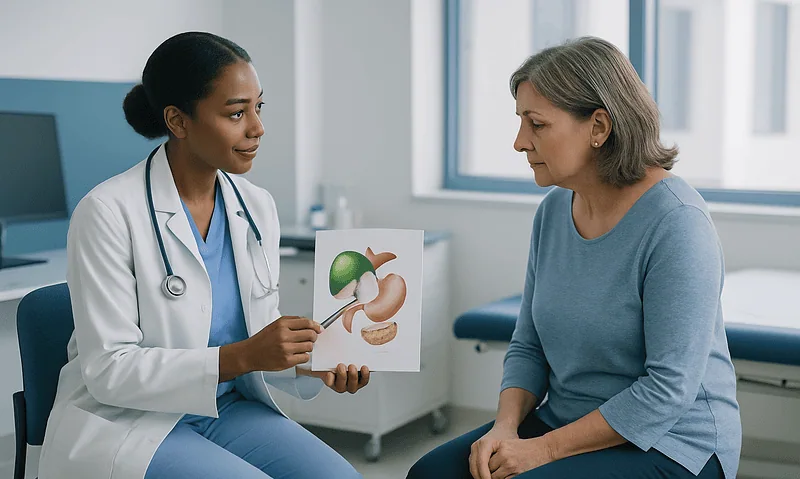
Preparing for Gallstone Surgery: Blood Tests, Fasting and Which Medicines Are Paused
Preparing for gallstone surgery usually means a pre-assessment visit with blood tests (blood count, kidney and liver function, sometimes clotting), a fasting window of…

Why Variceal Banding Is Often Repeated: How Many Sessions and What Follow-Up Endoscopy Checks
Variceal banding is usually repeated every 2 to 4 weeks until the varices are flattened or gone, a point endoscopists call eradication. Liver guidance…

IBS Myths: Is It All in Your Head and Does Cutting Out Gluten Always Help?
IBS is not all in your head. It is a recognized disorder of gut-brain interaction in which the bowel and nervous system miscommunicate, producing…

Living With Chronic Liver Disease: Weight, Alcohol, Sleep and the Check-Ups That Matter
Living with chronic liver disease usually means protecting the working tissue you still have: avoiding alcohol if your team advises it, aiming for gradual…