

Redness, Leakage or Pain Around a PEG Tube: What Is Normal and When to Call Your Team

Key Takeaways
- A PEG tract takes roughly two to four weeks to mature, so a tube dislodged in that window is treated as urgent because contents can leak into the abdomen rather than along the tunnel.
- Most redness at a stoma is irritation from acid, formula or trapped moisture, not infection; spreading warmth, swelling, pus and fever are the signs that point toward infection.
- Leakage is usually mechanical, caused by a bumper that is too loose or too tight, a tract stretched by weight change, or raised pressure in the stomach, and upsizing the tube tends to worsen it.
- The pink, easily bleeding lump at the edge of the opening is hypergranulation tissue, a common and benign healing overgrowth managed in clinic, not at home.
- Alcohol wipes and hydrogen peroxide damage peristomal skin; mild soap or plain water, rinsed and dried thoroughly, is what mainstream guidance recommends for daily cleaning.
- Buried bumper syndrome, where the internal disc embeds in the stomach wall, is linked to a chronically over-tightened external bumper and shows as pain with feeds, resistance to flushing and a tube that no longer rotates.
Mild pinkness, a little clear or pale drainage, and tenderness are common around a PEG tube in the first couple of weeks. Leakage, spreading redness, pus, a bad smell, fever, worsening pain, or bleeding are not routine and warrant a same-day call to your feeding tube team. A tube that has come out entirely needs urgent care, because the opening can begin to close within hours.
It is usually a caregiver who notices first. A damp patch on the pajama top, a faint sour smell, a ring of pink skin that looks angrier than it did yesterday. The person with the tube may not feel much at all, or may wince every time the dressing is lifted. Either way, the same question lands at the kitchen table: is this the tube settling in, or is this something going wrong?
Searching “peg tube leaking redness what to do” at eleven at night returns a jumble of leaflets, most written for nurses and few willing to say plainly what counts as ordinary. This article tries to do that. It walks through what the skin around a gastrostomy tube is supposed to look like, why fluid and redness happen, which changes can be managed at home with simple care, and which ones belong on the phone with your team today.
Nothing here replaces the instructions you were given at discharge. Those instructions were written for your tube, your skin and your medical history, and they win every time.
How a PEG tube sits in the body, and why the skin around it matters
A PEG tube, short for percutaneous endoscopic gastrostomy, is a soft feeding tube placed through the skin of the abdomen directly into the stomach, usually with the help of a camera passed down the throat. The channel it travels through is called the stoma or tract: a short tunnel from skin surface to stomach wall, often no longer than a finger joint.
Two parts hold everything in place. Inside the stomach sits a small disc, balloon or mushroom-shaped bumper that stops the tube sliding out. On the outside, a flat plastic ring, often called the external bumper or bolster, rests against the skin and stops the tube slipping further in. Between them, the stomach wall and the abdominal wall are gently pressed together so they heal into a sealed tunnel.
That seal is the whole point. In the first few weeks the body is still building it, laying down new tissue so that the stomach lining and skin form a continuous, closed channel. While that happens, the tract is fragile. A review of PEG complications in the World Journal of Gastroenterology describes the tract as typically maturing over roughly two to four weeks, which is why early problems are treated more cautiously than later ones.
Once the tract has matured, the skin at the edge of the opening becomes the site’s weak point. It is exposed to stomach acid if contents seep out, to moisture if dressings stay damp, and to friction every time the tube is pulled or twisted. Nearly every common complaint about a PEG site, from leakage to redness to pain, comes back to one of those three things: the fit of the tube, the state of the tract, or the care of the skin.
What is normal around a new PEG site in the first two weeks
The days immediately after placement are the hardest to read, because some changes that would worry you months later are simply part of healing now.
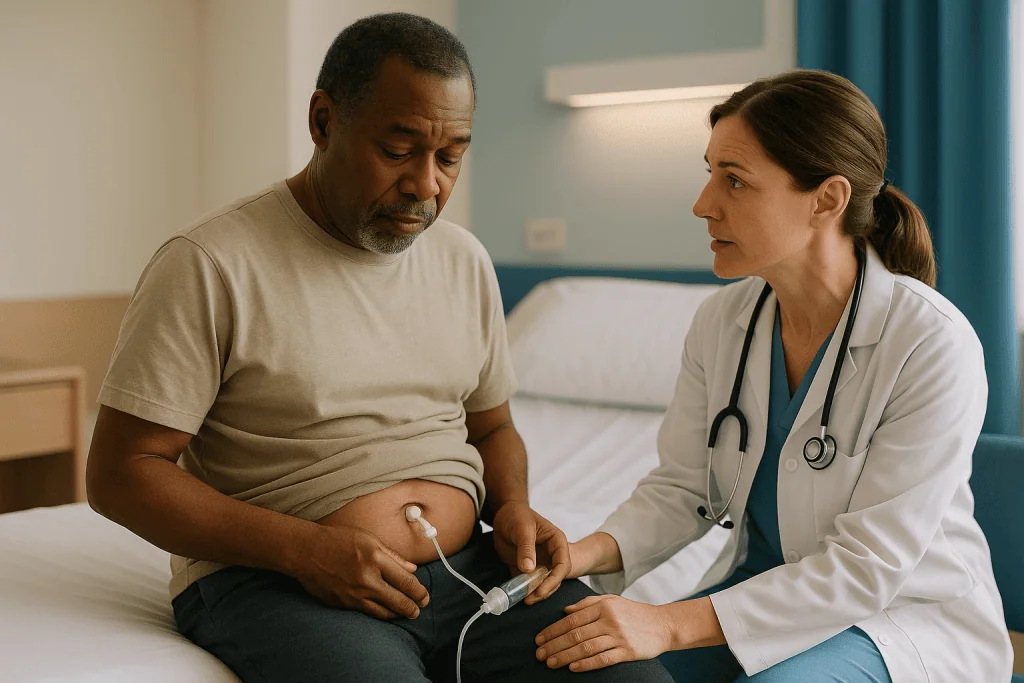
Expect a small amount of clear, pale yellow or slightly pink drainage on the dressing. The tract has just been made and the tissue weeps the way any fresh wound does. A thin ring of pink skin around the tube, roughly the width of the external bumper, is also typical and tends to fade as the tissue settles. Mild soreness when the site is cleaned, when you sit up, or when you cough is expected during this period, and MedlinePlus discharge guidance notes that discomfort usually eases over the first week or so.
What should not be happening even early on: redness that spreads outward beyond the bumper and keeps growing, drainage that turns thick, green or foul-smelling, bleeding that soaks a dressing, or pain that climbs instead of fading. A fever at any point after placement, or any sign of leakage of stomach contents into the abdomen rather than out onto the skin, is a call-now situation and is covered later.
Many teams ask you to leave the dressing in place for the first day or two and to avoid submerging the site in a bath or pool until the tract is established; MedlinePlus advises asking your provider before swimming or bathing. Showers are often allowed sooner, with the site patted dry afterwards.
If you have been shown how to rotate the tube a quarter turn or to loosen the external bumper slightly, follow that instruction exactly. Some tubes should be rotated daily; others, particularly certain low-profile or jejunal extensions, should never be. Your discharge sheet, not a general article, decides that.
Why a G-tube leaks around the stoma: the common causes
Leakage means fluid, usually stomach contents or formula, escaping around the outside of the tube rather than through it. It is one of the most frequent reasons people phone a feeding tube clinic, and in most cases it has a mechanical explanation rather than a frightening one.
The first suspect is fit. If the external bumper is too loose, the tube can move in and out of the tract with every breath and movement, slowly widening the opening. If it is too tight, it presses on the skin, causes breakdown and, paradoxically, can also lead to leakage as the tissue underneath erodes.
Next is the tract itself. Over months, especially in people who have lost or gained a lot of weight, the tunnel can stretch wider than the tube inside it. Some teams call this an enlarged stoma. Fluid finds the gap.
Then there is what is happening inside the stomach. Slow stomach emptying, constipation, coughing, a tight abdominal binder or a very full stomach after a large feed all raise pressure and push contents outward. Excess stomach acid can do the same and burns the skin on the way.
Less often, leakage reflects an infection around the tract, a cracked or degraded tube, or a balloon-type retention device that has lost volume and no longer holds the tube snugly against the stomach wall.
The World Journal of Gastroenterology review lists peristomal leakage among the recognised minor complications of PEG, reported in a small minority of patients, and stresses that the response should address the cause rather than simply upsizing the tube. Putting a bigger tube into a stretched tract tends to stretch it further.
Redness around a PEG tube: irritation or peg tube site infection signs?
Red skin is the symptom that sends most people to the search bar, and the honest answer is that redness alone tells you very little. The pattern around it tells you a great deal.

Irritant dermatitis, which is skin inflamed by contact with something, is the most common cause. Stomach acid leaking onto the skin, formula drying under the bumper, damp dressings, soap residue or adhesive from tape can all produce a sharply bordered area of redness that matches exactly where the moisture or product sat. The skin may look shiny, feel sore or itchy, and sometimes break down into a shallow raw patch. It usually improves within days once the irritant is removed and the skin is kept clean and dry.
Infection looks and behaves differently. According to the Cleveland Clinic’s overview of PEG tubes and the World Journal of Gastroenterology review, the signs that point toward peristomal infection include redness that spreads beyond the bumper and keeps widening, warmth and swelling, increasing rather than easing pain, thick yellow or green discharge, a bad smell, and sometimes fever. The review reports that wound infection at the site is among the most frequent complications of PEG, which is why most centres now give a single preventive antibiotic dose at the time of placement; that decision sits with the procedural team.
A third possibility, less often discussed, is a fungal rash. Warm, moist skin under a bumper suits yeast, which typically shows as bright red, slightly raised skin with tiny satellite spots at the edges and persistent itch.
The practical point is not to self-diagnose but to describe accurately. A photo taken in good light, with a coin for scale, is worth more to a clinic nurse than any amount of guessing.
Is it normal for a G-tube site to be painful?
Some discomfort, yes. Persistent or escalating pain, no.
In the first week, the tract is a fresh wound through muscle and skin, and tenderness when it is touched, pressed by clothing, or stretched during movement is expected. MedlinePlus discharge material describes soreness as common early on, settling as the site heals. Pain that is present only during cleaning or feeds and otherwise fades is usually in this category.
Beyond the early period, a settled PEG site should be largely pain-free. Pain that returns or steadily worsens needs an explanation, and the usual candidates are all things your team can check:
- Pressure from a bumper that is too tight, which hurts most directly under the ring and may come with a dent or pale, blanched skin.
- Infection, where pain spreads outward and is accompanied by heat, swelling and discharge.
- Granulation tissue, the pink overgrowth discussed in the next section, which is tender and bleeds when brushed.
- Leakage of acidic stomach contents, which produces a burning, raw pain confined to the wet area.
- Buried bumper, a slow problem in which the internal disc migrates into the stomach wall and can cause pain with every feed and resistance when the tube is flushed.
One kind of pain stands apart. Severe abdominal pain, a hard or swollen belly, pain that comes on suddenly during or after a feed, or pain with vomiting, fever or feeling very unwell can signal that feed or stomach contents have reached the abdominal cavity rather than the skin. The World Journal of Gastroenterology review lists peritonitis among the serious complications of PEG. That is not a wait-and-see symptom; it is an emergency call.
If pain changes your willingness to clean the site or to run feeds, say so. Teams would far rather adjust a bumper than discover a neglected site weeks later.
The pink, bleeding lump at the edge of the stoma: granulation tissue
Ask anyone who has lived with a gastrostomy tube for a year and they will probably recognise this one. A soft, beefy-red or pink bump grows at the edge of the opening, bleeds easily when the dressing catches it, oozes a little, and sometimes looks worse after a day of more tube movement than usual.
This is hypergranulation tissue: over-enthusiastic healing. When the body is trying to close a wound that is constantly re-opened by a tube moving through it, it keeps producing the moist, blood-rich repair tissue that would normally be covered by new skin. The tube prevents that covering, so the tissue piles up.
It is common, it is not cancer, and it is not an infection in itself, although the raw surface can harbour bacteria and the moisture it produces can irritate nearby skin. The World Journal of Gastroenterology review and feeding tube care guidance from the Cleveland Clinic both treat it as a minor complication that is managed in clinic.
What drives it is movement and moisture. A tube that pistons in and out because the bumper is loose, a dressing that stays wet, or repeated friction from clothing all encourage it. Stabilising the tube so it does not slide, keeping the area dry, and avoiding harsh rubbing during cleaning all reduce the stimulus.
Treatment, when needed, is decided by the care team. Options described in mainstream guidance range from topical preparations applied in clinic to chemical cautery with silver nitrate performed by a trained clinician. None of these are home remedies, and applying over-the-counter creams without advice can make the surrounding skin worse.
Bleeding from granulation tissue is usually a smear rather than a flow. Bleeding that soaks a dressing, drips, or comes from inside the tube is a different matter and is covered in the red-flag section.
Normal, watch, or call: a quick guide to what you are seeing
Caregivers often say the hardest part is not the care itself but the uncertainty. The table below summarises what mainstream guidance from MedlinePlus, the Cleveland Clinic and the World Journal of Gastroenterology review treats as routine, what deserves closer watching with a message to your team, and what should prompt a same-day call. It is a guide to the conversation, not a substitute for it.
| What you see | Usually expected | Watch and tell your team | Call the same day |
|---|---|---|---|
| Skin colour | Thin pink ring the width of the bumper, fading over days | Redness confined to the bumper area that persists past the early weeks | Redness spreading outward, hot or swollen |
| Drainage | Small amount, clear or pale, mainly in the first weeks | Ongoing damp dressings; formula visible on the skin after feeds | Thick, green, foul-smelling or increasing discharge; pus |
| Pain | Mild tenderness on touch, easing over the first week | Soreness that lingers or returns after a pain-free period | Severe pain, pain with a hard belly, pain during feeds with vomiting |
| Bleeding | Pink-tinged smear on a dressing | Repeated small bleeds from a pink lump at the edge | Bleeding that soaks a dressing or comes from inside the tube |
| Tube position | External bumper rests lightly on the skin; tube rotates if instructed | Tube seems longer or shorter outside than before | Tube out of the stoma, or will not flush or rotate |
| General state | Feeling as expected for your condition | Appetite or energy lower than usual | Fever, chills, confusion, feeling very unwell |
If anything on your dressing sits in the right-hand column and you cannot reach your feeding tube team, use your usual urgent care or emergency pathway. The number for out-of-hours advice should be on your discharge paperwork; if it is not, ask for it at the next appointment.
PEG tube leaking redness what to do: a step-by-step home response
When you first notice leakage or new redness, there is a short, sensible sequence of things to check before you pick up the phone, and then a sensible way to describe what you found. None of it involves adjusting the tube beyond what you were already taught.
Start by washing your hands; the CDC’s handwashing guidance applies to every contact with a stoma. Then look at the fit. Is the external bumper resting on the skin, or is there a visible gap that lets the tube slide? Is it pressing hard enough to dent the skin? If your discharge instructions show you how to loosen or snug the bumper by a small amount, follow those steps exactly and no further. If they do not, leave it and note what you saw.
Check the tube itself for cracks, kinks, or a clamp left open. Confirm the feeding set is properly attached, because a loose connection drips formula down the tube and onto the skin, mimicking a stoma leak.
Clean the area with the method you were shown, usually mild soap and water or plain water, rinse, and pat fully dry. Replace any wet dressing with a dry one. A damp pad against red skin only makes it worse. Avoid thick creams, powders or antiseptics unless your team has prescribed them, since many trap moisture or sting on raw skin.
Review the last day or two. Were feeds larger or faster than usual? Has there been coughing, straining, constipation or vomiting? Has the person’s weight changed noticeably? These raise pressure in the stomach and are things a clinic can address.
Then make the call, with a photo and three facts ready: when it started, what the drainage looks and smells like, and whether there is pain, fever or feeling unwell. MedlinePlus discharge guidance lists leakage and redness as reasons to contact your provider rather than wait for the next appointment.
How to clean a PEG tube site day to day
Most skin trouble around a gastrostomy tube is prevented rather than treated, and the prevention is unglamorous: clean, dry, stable.
MedlinePlus and Cleveland Clinic guidance both describe a daily routine along these lines. Wash your hands. Inspect the skin, lifting the external bumper gently if your tube allows it, and look for the changes described above. Clean around the stoma with warm water and, if advised, a mild soap, working outward from the tube in a circle so that nothing is dragged back toward the opening. Remove any dried crust rather than leaving it to rub. Rinse so that soap does not sit on the skin, then dry thoroughly with a clean towel or gauze. Replace a dressing only if your team has recommended one; many mature sites do better with no dressing at all, because open air keeps the skin drier.
Tube care matters as much as skin care. Flushing the tube with water before and after each feed and each medicine, in the volume your team specified, keeps it clear and reduces the backing up that drives leakage. Keep the tube secured so it does not swing or pull; a loop of tape or a stabilising device prevents the pistoning that stretches the tract and feeds granulation tissue.
A few things to avoid: alcohol wipes and hydrogen peroxide on the skin, which dry and damage it; picking at scabs; tight waistbands over the site; and leaving the bumper clamped hard against the skin “to stop leaks”, which does the opposite over time.
Rotation deserves a specific word. Some tubes are meant to be turned a quarter or half turn daily to stop the internal bumper embedding in the stomach wall. Others must not be rotated. If you are not certain which applies to yours, ask before you turn it.
Who usually has a PEG tube, and who is usually asked to wait
Understanding why the tube is there helps make sense of the attention paid to the site.
A PEG is generally considered when someone cannot safely take enough food, fluid or medicine by mouth for longer than a few weeks, and the stomach and bowel otherwise work. The Cleveland Clinic and MedlinePlus list common reasons: swallowing difficulty after a stroke or with neurological conditions, head and neck cancers where the throat is obstructed or treated, severe illness where a nasal tube is no longer practical, and certain conditions in children affecting growth or swallowing. The decision is a joint one, weighing nutrition against the person’s wishes, prognosis and the likelihood that swallowing will recover.
Some people are asked to wait or to consider an alternative. If feeding will be needed for only a short time, a nasal tube is often preferred because it avoids creating a stoma. If the stomach cannot be reached safely with the endoscope, if there is fluid in the abdomen, if blood clotting is impaired, if there is an active infection of the abdominal wall, or if the person is too unwell for sedation, the procedure may be postponed or a different route chosen. The World Journal of Gastroenterology review lists these among the recognised contraindications.
Timing also matters for the site. A PEG placed during an acute illness is sometimes inserted into skin that is swollen, fragile or poorly nourished, and that skin heals more slowly. Teams factor this in, and it is one reason the same amount of redness may be judged differently in different people.
Alternatives discussed in neutral guidance include nasogastric tubes, radiologically or surgically placed gastrostomies, jejunal tubes that bypass the stomach, and in some situations supported eating by mouth with texture modification. Which path fits is a conversation for the treating team, not a decision anyone should make from a leaflet.
Dislodged PEG tube: is it an emergency?
Yes, treat it as one, and the reason is simple: the body wants to close the hole.
A gastrostomy tract is a wound held open by a tube. Remove the tube and the tract begins to narrow. MedlinePlus discharge guidance warns that the opening can start to close within hours, which is why it instructs people to call right away if the tube comes out. The urgency depends on timing. If the tube comes out before the tract has matured, in roughly the first few weeks described earlier, stomach contents can leak into the abdominal cavity rather than following the tunnel to the skin, and a replacement cannot simply be pushed back along the same path. That is a hospital situation.
If the tube comes out after the tract is well established, the main risk is the stoma shrinking before a new tube is placed. Many teams train caregivers to keep a spare tube or a soft catheter at home for exactly this purpose and to insert it to hold the tract open while arranging urgent review. If you have been trained and have the equipment, follow that training. If you have not, do not improvise with anything else: cover the opening with a clean dry dressing and seek urgent care.
Either way, the next steps belong to a clinician. A tube that has been replaced at home usually needs its position confirmed before feeds restart, sometimes with an X-ray contrast check, because a tube that has gone into the wrong space can cause serious harm when formula is run through it.
Partial dislodgement, where the tube seems to have slipped so that more or less of it shows outside than before, should also be reported the same day. Do not push it back in and do not pull it further out; stabilise it and call.
Buried bumper and other less common problems at the site
Most site trouble is leak, redness, pain or granulation. A few other problems are worth knowing by name so you recognise the description if your team uses it.
Buried bumper syndrome happens when the internal retention disc migrates out of the stomach lumen and embeds itself in the stomach wall or the tract, usually because the external bumper has been held too tight for a long time. Signs include difficulty or pain when feeding, resistance when flushing, leakage around the tube, and the tube no longer rotating or sliding freely. The World Journal of Gastroenterology review reports it in a small percentage of long-term PEG users and classes it as a serious complication requiring endoscopic or surgical management.
Tube degradation is more mundane. Silicone and polyurethane tubes stiffen, crack and discolour over months, and a worn tube can leak through its own wall or at the connector, mimicking a stoma leak. Clinics change tubes on a schedule for this reason.
Gastric outlet obstruction can occur if a tube migrates inward and the internal bumper blocks the passage out of the stomach, producing vomiting and bloating. Skin pressure injury develops under a bumper that is too tight, and looks like a pale or dark dent that becomes an open sore.
Bleeding from inside the tube, as opposed to a smear on the dressing, may come from the stomach lining or from the tract and needs assessment. Cellulitis, infection spreading through the skin away from the stoma, and necrotising infection are rare but are the reason spreading redness with fever is never waited out.
Each of these is diagnosed by a clinician, often with a quick look at the tube in clinic. The household’s job is to notice that something has changed and to say so promptly.
What the following weeks and months usually look like
A PEG site has a rhythm, and knowing it helps you judge whether you are on track.
In the first week, per MedlinePlus discharge guidance, expect dressings, a small amount of drainage and some soreness, with a follow-up contact from the team. The World Journal of Gastroenterology review describes the tract maturing over roughly two to four weeks; during this window the site is handled gently, bathing is restricted, and any dislodgement is treated as urgent.
By the second month, a well-settled site is usually dry, pale, and barely noticed. Many people stop using a dressing. The external bumper is checked periodically because weight changes alter how snugly it sits; a loss of several kilograms can turn a comfortable fit into a loose one that lets the tube piston, and a gain can make it tight.
Over the following months, the main tasks are routine: daily inspection and cleaning, flushing to keep the tube clear, watching for granulation tissue, and keeping the tube secured. Tubes are replaced on a schedule set by the manufacturer and the team; balloon-type tubes typically need changing more often than bumper-type tubes, and the interval is a clinical decision, not something to extend at home.
Some people regain the ability to swallow safely and the tube is removed. After removal, the tract usually closes on its own over days, and a small amount of leakage from the closing opening is expected briefly. A tract that keeps leaking well after removal is reported to the team, as it occasionally needs closing.
None of these timelines is a promise. Nutrition, diabetes, steroid use, skin condition and the underlying illness all change how quickly a site settles, and the team adjusts expectations accordingly.
What people often get wrong about PEG site redness and leaks
A few beliefs circulate widely enough that they deserve a direct correction.
“Redness means infection, so I need antibiotics.” Most redness around a stoma is irritation from moisture or acid, and antibiotics do nothing for that. Mainstream guidance reserves antibiotic treatment for sites with signs of true infection, assessed by a clinician.
“Tightening the bumper will stop the leak.” It may for a day, at the cost of pressure damage to the skin and, over time, the risk of buried bumper. Leaks are managed by finding the cause, not by clamping harder.
“A bigger tube will fill the hole.” The World Journal of Gastroenterology review specifically cautions against upsizing a tube in a stretched tract because the tract simply stretches to match. Some teams instead remove the tube briefly so the tract can shrink, then replace one of the same size, under supervision.
“If the tube falls out, the hole will stay open until the clinic opens tomorrow.” It may not. MedlinePlus warns the stoma can begin closing within hours.
“Antiseptic wipes and peroxide keep it clean.” They strip and damage skin. Plain water or mild soap is what guidance recommends.
“Granulation tissue is a tumour.” It is overgrown healing tissue, common and benign, managed in clinic.
“A PEG means no more eating by mouth.” Many people with a tube continue to eat or taste food if their swallowing assessment allows it. The tube supplements; it does not necessarily replace.
“Pain is just part of having a tube.” Early tenderness is expected. Ongoing pain is a signal that fit, infection or tissue overgrowth needs attention, and it should be reported rather than tolerated.
Questions to ask your care team about PEG site care
Clinic appointments are short and site problems are easier to prevent than to fix, so arriving with a list is worthwhile. These questions are drawn from the issues that most often cause confusion at home.
- Should I rotate this tube, and if so how often and how far? Are there situations where I should stop rotating it?
- How snug should the external bumper be, and may I adjust it myself if the fit changes? What does “too tight” look like on this skin?
- What is the volume and timing of flushes you want for this tube, and does it change when medicines are given through it?
- Do you want a dressing on the site, and if so what kind and for how long?
- What product, if any, do you recommend for cleaning, and what should I avoid?
- If the tube comes out, exactly what should I do and where should I go, including at night and on weekends? Should I have a spare tube or catheter at home, and will you train me to use it?
- What amount of leakage or redness is acceptable for this site, and at what point do you want a call rather than a note at the next visit?
- How will weight change affect the fit, and how often will you re-check it?
- When is this tube due for a scheduled change, and what are the signs it is wearing out?
- Is there anything in the current medicine list that irritates the stomach or slows emptying and could be contributing to leaks?
- Who is the first point of contact for site problems, and what is the out-of-hours route?
Write the answers down. Many of them, particularly rotation and bumper adjustment, differ between tube types, and remembering the advice given for a previous tube can be worse than not remembering at all.
When to call your doctor
Every decision about a PEG site rests with the treating team, but the team can only act on what it is told. Mainstream guidance from MedlinePlus, the Cleveland Clinic and the World Journal of Gastroenterology review identifies the following as reasons to contact your feeding tube team the same day, or to use emergency services if you cannot reach them.
Call urgently, or go to emergency care, for:
- The tube has come out completely, or has slipped so that its position has clearly changed.
- Severe abdominal pain, a hard or swollen belly, pain with vomiting, or sudden pain during or after a feed.
- Fever or chills, especially with redness or discharge at the site.
- Bleeding that soaks a dressing, drips, or comes from inside the tube; blood in vomit or black stools.
- Formula or stomach contents appearing to leak somewhere other than the skin surface, or a feed that will not go in and causes pain.
- Breathing difficulty, coughing or choking during feeds, which can indicate feed reaching the lungs.
- Confusion, drowsiness or looking very unwell, particularly in someone frail or elderly.
Call the same day for:
- Redness that is spreading outward, hot, swollen or increasingly painful.
- Thick, green, yellow or foul-smelling discharge.
- Leakage that is new, increasing, or burning the skin.
- Skin breakdown, an open sore under the bumper, or a dent in the skin.
- A tube that will not flush, will not rotate when it previously did, or feels stuck.
- Persistent vomiting, bloating or diarrhoea linked to feeds.
- A pink lump at the stoma edge that bleeds repeatedly.
Mention at the next routine contact: mild persistent pinkness, occasional damp dressings, small granulation tissue that is not bleeding, or questions about fit after weight change.
When in doubt, call. Feeding tube teams expect these questions and would rather hear about a minor change early than a major one late.
Frequently asked questions
What are the common causes of leaks in PEG tubes?
Most PEG leaks come from fit or pressure. An external bumper that is too loose lets the tube slide and widens the tract; one that is too tight erodes the skin. A tract stretched by weight loss, raised stomach pressure from constipation, coughing or large feeds, excess acid, a deflated balloon on balloon-type tubes, and a worn or cracked tube are other frequent causes. Infection around the tract is a less common cause. Your team identifies which applies before changing anything.
Is a dislodged gastrostomy tube an emergency?
Yes, treat it as one. The opening can begin to close within hours, and a tube that comes out before the tract has matured, typically in the first few weeks, risks stomach contents entering the abdominal cavity. If you have been trained and have a spare tube or catheter, follow that training to hold the tract open; otherwise cover the site with a clean dry dressing and seek urgent care. A replaced tube usually needs its position confirmed before feeding restarts.
Is it normal for a G-tube site to be painful?
Mild tenderness in the first week or two is expected while the tract heals, particularly when the site is cleaned or pressed. A settled site should be largely pain-free. Pain that persists, returns or worsens usually has a cause your team can find: a bumper that is too tight, infection, granulation tissue, acid burn from leakage, or a buried bumper. Severe abdominal pain, a hard belly, or pain with vomiting or fever needs emergency assessment.
How do I care for and maintain my G-tube day to day?
Wash your hands, inspect the skin daily, clean around the stoma with warm water or mild soap working outward from the tube, rinse, and dry thoroughly. Use a dressing only if advised. Flush the tube with water before and after feeds and medicines in the volume your team set, keep the tube secured so it does not pull or slide, and rotate it only if your specific tube requires it. Avoid alcohol wipes, peroxide and tight waistbands over the site.
What are the signs of a PEG tube site infection?
Redness that spreads outward beyond the bumper and keeps widening, skin that is hot and swollen, pain that increases rather than eases, thick yellow or green discharge, a bad smell, and sometimes fever or chills. Irritation from moisture or acid, by contrast, tends to stay within the area that was wet and improves within days once the skin is kept clean and dry. Any suspected infection should be assessed by your feeding tube team the same day.
Why is my G-tube leaking around the stoma after months of no problems?
A change after a long settled period usually means something has shifted. Weight loss can loosen the fit so the tube pistons and the tract widens; weight gain can make the bumper tight. Tubes also degrade over months and may crack or leak at the connector. Constipation, coughing, slower stomach emptying or larger feeds raise pressure. A balloon-type tube may have lost volume. Report the change so the team can check fit and tube condition.
Can I shower or bathe with a PEG tube?
Usually yes for showers once your team confirms the site has sealed, with the site patted dry afterwards. Soaking in a bath or swimming is generally restricted until the tract has fully matured, and MedlinePlus advises asking your provider before submerging the site. Keep the tube clamped or capped during washing, avoid directing a strong spray at the stoma, and replace any dressing with a dry one after bathing.
What is the pink lump at the edge of my PEG site that bleeds?
It is most likely hypergranulation tissue, an overgrowth of the moist healing tissue the body produces when a wound is repeatedly disturbed by a moving tube. It is common and benign, though it can ooze, bleed when brushed, and irritate surrounding skin. Reducing tube movement and keeping the area dry helps. Treatment, if needed, is done in clinic by a trained clinician; home remedies and over-the-counter creams are not advised without guidance.
Should I tighten the bumper to stop my PEG tube leaking?
No. Over-tightening the external bumper presses on the skin, causes pressure sores, and over time can push the internal bumper into the stomach wall, a complication called buried bumper syndrome. Leaks are managed by finding the cause, whether fit, tract size, stomach pressure or a worn tube. If you were taught to make small adjustments, stay within that instruction and report persistent leakage to your team rather than clamping harder.
How do I clean a PEG tube site if the skin is already red and sore?
Gently. Use warm water or the mild soap your team recommended, avoid rubbing, rinse thoroughly, and pat dry rather than wipe. Remove any wet dressing and leave the skin uncovered if your team allows it, since trapped moisture worsens soreness. Do not apply alcohol, peroxide, powders or creams unless prescribed. Take a well-lit photo and contact your team the same day if the redness is spreading, painful, discharging or accompanied by fever.
References
- MedlinePlus: Feeding tube insertion – gastrostomy
- MedlinePlus: PEG tube insertion – discharge
- Cleveland Clinic: Percutaneous Endoscopic Gastrostomy (PEG)
- NIH / PubMed Central: Percutaneous endoscopic gastrostomy: indications, technique, complications and management (World Journal of Gastroenterology)
This article is for general information only and is not a substitute for professional medical advice. Please consult a qualified doctor about your individual situation.

More from the Blog

Planning Endoscopy or Colonoscopy in Istanbul: Stay Length, Sedation and the Trip Home
If you are having an upper endoscopy or colonoscopy while away from home, the medical picture is reassuring but not instant: both are usually…

Which H. Pylori Test Comes First for a Stomach Ulcer? Breath, Stool and Biopsy Compared
For a suspected stomach ulcer, most guidelines favor a non-invasive H. pylori test first, usually a urea breath test or a stool antigen test,…

What Remission Looks Like in Autoimmune Hepatitis and Why Monitoring Continues
Autoimmune hepatitis remission means the immune attack on the liver has quieted: liver enzymes and immunoglobulin G return to normal, and a biopsy, if…

Lactose Intolerance Myths: Do You Have to Give Up All Dairy for Good?
No. Most people with lactose intolerance do not need to give up all dairy. The condition means the small intestine makes less lactase, the…

Preparing for Varices Endoscopy: Fasting, Clotting Tests and the Blood Thinner Question
Preparing for varices endoscopy usually means fasting for several hours beforehand, having blood tests that check clotting and platelet levels, and reviewing every medicine…

Why Cirrhosis Patients Have Regular Ultrasound Scans and Blood Tests: Surveillance Explained
People with cirrhosis have an ultrasound scan and blood tests about every six months because scarred liver tissue carries a higher risk of liver…