

Gout Treatment Explained: Calming the Attack First, Then Lowering Uric Acid Long Term

Key Takeaways
- Gout care has two separate jobs: anti-inflammatory medicine calms the flare within days, while urate-lowering medicine works over months to dissolve the crystals that cause the next one.
- An untreated gout attack usually peaks within the first 4 to 12 hours and settles within about 5 to 7 days, which is why anti-inflammatory treatment started on day one makes the biggest difference.
- A blood uric acid level can read normal during a flare, so a single normal result does not rule out gout; examining joint fluid for urate crystals is the definitive test.
- Long-term urate lowering is usually discussed after two or more flares in a year, or sooner if tophi, kidney stones, joint damage or chronic kidney disease are present.
- Flares often increase in the first months of urate-lowering therapy because dissolving crystals shed into the joint, which is why guidelines pair it with temporary anti-inflammatory cover.
- Alcohol, especially beer and spirits, and sugar-sweetened drinks raise urate more reliably than most foods, while dairy and plant purines do not appear to increase gout risk.
gout/">Gout treatment works in two phases. First, a flare is calmed, usually with an anti-inflammatory medicine such as an NSAID, colchicine or a corticosteroid, plus rest and ice; most attacks ease within about a week. Second, for people with repeated flares, tophi or kidney involvement, long-term urate-lowering medicine keeps blood uric acid low enough that crystals slowly dissolve. The treating clinician chooses the plan.
It starts at three in the morning. A man in his fifties wakes because the weight of a cotton sheet on his big toe feels like a dropped brick. By breakfast the joint is shiny, purple and too hot to touch, and he is wondering whether he broke something in his sleep. Three days later he has one prescription in his hand and a sentence from the doctor he only half caught: something about a second medicine, later, for the long run.
That half-heard sentence is the whole story. Gout treatment two phases is the shorthand clinicians use: first calm the attack, then lower uric acid so the attacks stop coming. Most people only ever hear about the first half, which is why so many repeat it every few months for years, treating the pain while the crystals quietly accumulate.
This explainer walks through both halves, what the evidence shows about each, where the real decisions sit, and the questions worth asking before you agree to anything.
Why gout treatment two phases is the right mental model
Picture the plan as two jobs with two different clocks. The first is urgent: an inflamed joint, usually in a foot, that needs calming within hours and days. The second is slow and quiet: bringing blood uric acid down and keeping it there for years, so the crystals that caused the flare dissolve and stop forming. NHS and Mayo Clinic guidance, and the rheumatology guidelines behind them, describe care in exactly these two phases, and the distinction matters because the medicines, timelines and goals differ.
Uric acid is a waste product made when the body breaks down purines, natural compounds found in your own cells and in many foods. Most people clear it through the kidneys. When blood levels stay high, urate can crystallize in cooler, peripheral joints, and a flare is the immune system reacting to those crystals.
| Question | Phase one: calming the flare | Phase two: lowering urate |
|---|---|---|
| Goal | Reduce inflammation and pain now | Keep urate below the crystal-forming threshold |
| Medicine classes | NSAIDs, colchicine, corticosteroids | Xanthine oxidase inhibitors, uricosurics |
| When it starts | As early in the flare as possible | Usually once the flare has settled |
| How long | Days (NHS: untreated attacks last about 5 to 7 days) | Long term, often for many years |
| What you feel | Relief over hours to days | Nothing at first; fewer flares over months |
| Feedback | Less pain and swelling | Blood tests only |
Calming a flare does nothing to the underlying urate load; MedlinePlus is clear that untreated high urate leads to more frequent attacks and, over years, joint damage and tophi, lumps of crystal under the skin. Lowering urate does nothing for today’s pain, and in the first months it can briefly make flares more likely. Holding both ideas at once explains why a clinician may give you one medicine for this week and discuss a completely different one for the next decade, and why neither replaces the other.
What does gout feel like, and why is it so often the big toe?
People describe the first hours in strikingly similar language: a joint that feels broken, skin that looks shiny and purplish red, warmth you can feel with the back of a hand, and pain severe enough that a bedsheet is unbearable. Mayo Clinic notes that flares often begin at night and that pain is typically at its worst within the first 4 to 12 hours. Swelling can spread beyond the joint, so a whole foot may look puffy.

The base of the big toe is the classic site, but the NHS lists the ankle, knee, fingers, wrist and elbow as common alternatives. Early on, flares usually involve one joint at a time. As gout becomes established, two or more joints may flare together, and both feet can be involved, sometimes at once and sometimes alternating.
After the peak, the joint settles over days. The NHS states that an attack usually lasts 5 to 7 days and then improves, even without treatment, though treatment shortens the misery considerably. Some people notice peeling or itchy skin over the joint as swelling goes down. Between attacks most feel entirely normal, which is one reason gout gets dismissed as a one-off.
Not everything that hurts in a big toe is gout. A bunion, a stress fracture, an infected joint and pseudogout (a related condition caused by calcium crystals rather than urate) can all look similar. That is why Mayo Clinic describes drawing fluid from the joint and examining it under a microscope for urate crystals as the most definitive test. A blood test for uric acid helps, but levels can read normal or even low during a flare, so a single normal result does not rule gout out.
What actually happens inside the joint during a flare
Think of urate like sugar in cold tea. Below a certain concentration it stays dissolved; above it, crystals drop out, and cold speeds the process. Toes and feet run cooler than the trunk, which is one reason they are hit first. Minor injury, dehydration and sudden shifts in urate level also tip the balance, which is why a flare can follow a long walk, a surgery or a night of poor fluid intake.
The crystals themselves are needle-shaped. When they shed from the joint lining into the fluid, resident immune cells recognize them as foreign and release signalling proteins, including interleukin-1, that summon white blood cells in enormous numbers. Those cells swallow crystals, rupture, and release more inflammatory chemicals. The result is the heat, swelling and pain of a flare: an acute inflammatory cascade, not an infection, although it can look like one.
Why does a flare stop on its own? The body coats crystals in proteins that make them less provocative, and the inflammatory response has built-in brakes that switch on after a few days. That explains the NHS observation that attacks usually settle within about a week regardless. It also explains why anti-inflammatory medicines work best when started early, before the cascade is fully running.
The deeper problem is that crystals do not leave when the pain does. Deposits remain in cartilage, tendons and bone, quietly enlarging if blood urate stays high. Over years they form tophi, erode bone and can deposit in the kidneys, where urate also contributes to kidney stones. Phase two of treatment exists because that silent deposition keeps going between the painful episodes you notice.
What is the first line treatment for a gout flare?
Guidelines agree on the principle: start an anti-inflammatory treatment as early as possible, ideally within the first day, and continue it until the flare has settled. Three medicine classes are considered first-line options, and Mayo Clinic and the NHS describe all three.
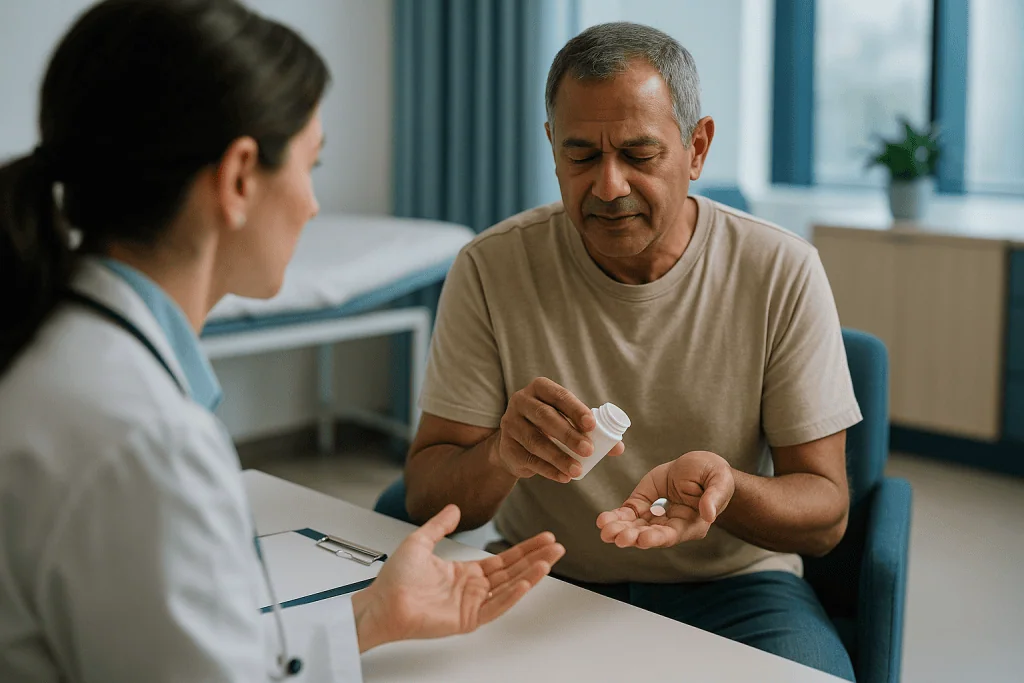
Non-steroidal anti-inflammatory drugs (NSAIDs) block enzymes that drive inflammation. They act quickly, but they are often unsuitable for people with kidney disease, stomach ulcers, heart failure or those taking blood thinners. Colchicine, a plant-derived medicine used for gout for centuries, interferes with the white cells that swarm into the joint; its usefulness is limited by nausea and diarrhea, and it interacts with several common medicines. Corticosteroids dampen inflammation broadly and can be given by mouth, by injection into a muscle, or injected directly into a single large joint; they are often chosen when the other two are unsafe.
Which one a clinician picks depends on your kidneys, your heart, your stomach, your other medicines and how many joints are involved. There is no universal best choice, and guidelines explicitly leave the selection to the prescriber. For flares that do not respond, or for people who cannot take any of the three, biologic medicines that block interleukin-1 exist, though they are specialist-only options.
Two practical points are easy to miss. First, if you already take a urate-lowering medicine, guidelines generally advise against stopping it during a flare, because the level swing can prolong the attack; confirm this with your own clinician rather than deciding alone. Second, a blood urate test taken mid-flare is unreliable, as Mayo Clinic notes, so the decision about long-term treatment is usually made some weeks later, once the joint is calm.
Self-care during a flare: what helps and what to skip
Medicine does the heavy lifting, but the NHS self-care advice is worth following precisely because it is simple, safe and surprisingly good at taking the edge off.
- Rest and raise the limb. Keep the foot above hip level when sitting or lying; gravity reduces swelling.
- Cool the joint. The NHS suggests an ice pack or bag of frozen vegetables wrapped in a towel for up to 20 minutes at a time, repeated through the day.
- Keep pressure off it. A cradle or hoop that lifts bedclothes off the toe is a low-tech fix many people swear by.
- Drink water through the day unless a clinician has limited your fluids. Dehydration concentrates urate.
- Avoid alcohol and sugary drinks during the flare; both raise urate and can lengthen the episode.
What not to do matters just as much. Massaging or heating the joint worsens inflammation. Crash dieting or fasting raises urate in the short term and can prolong a flare. Adding an over-the-counter anti-inflammatory on top of a prescribed one, without asking, doubles the stomach and kidney risk rather than the relief.
Walking boots and crutches are reasonable for a few days if a weight-bearing joint is involved. Returning to normal activity as pain allows is better than prolonged rest; the joint stiffens quickly when immobilized.
A last, honest note: self-care alone will not shorten the natural course much. The NHS still expects an untreated attack to run 5 to 7 days. The reason to treat early with medicine is that the first day or two are the worst, and those are the days where prompt treatment makes its difference.
What are the four stages of gout?
Patient education from the NIAMS at the National Institutes of Health and from MedlinePlus presents gout as a progression rather than a series of unrelated attacks. Four stages are commonly outlined.
Stage one: asymptomatic hyperuricemia. Blood urate is high but there are no symptoms. Most people with high urate never develop gout, so this stage is not usually treated with medicine; it is a prompt to look at kidney function, blood pressure, alcohol and diuretics.
Stage two: acute gout. The first flare, usually one joint, usually a foot. Imaging studies suggest crystals have typically been accumulating for years before this moment.
Stage three: intercritical gout. The symptom-free intervals between flares. These are deceptive; ultrasound and dual-energy CT, imaging tools that detect urate deposits, often show crystals still sitting in joints. Without urate lowering, intervals tend to shorten and flares to involve more joints.
Stage four: chronic tophaceous gout. Tophi form, joints become persistently stiff or deformed, and X-rays may show bone erosions. This stage is less common where long-term treatment is available, but it still happens after years of untreated disease.
Two cautions. The stages are a teaching model, not a timetable; nobody can tell you how long each lasts, and progression is not inevitable. The model is also why clinicians increasingly treat gout as a chronic metabolic condition in the same family as high blood pressure: the goal of phase two is to park someone permanently in a crystal-free version of stage three, where flares no longer happen because the deposits have dissolved.
Gout treatment two phases: what phase two actually does
Phase two is urate-lowering therapy, usually shortened to ULT. Its single aim is to hold blood urate below the concentration at which crystals form, so existing deposits slowly dissolve and new ones cannot grow. Guidelines set a numeric target level, which your clinician will quote to you, and treatment is adjusted gradually, guided by repeat blood tests, until that target is reached; the approach is often called treat-to-target.
Three mechanisms are in use, as described by Mayo Clinic and MedlinePlus. Xanthine oxidase inhibitors (allopurinol and febuxostat) block the enzyme that makes uric acid in the first place; allopurinol is the most widely used first option worldwide. Uricosuric medicines (such as probenecid) make the kidneys excrete more urate. A third approach, pegloticase, is an enzyme given by infusion that breaks urate down directly; it is reserved for severe gout that has not responded to the others.
Taking these medicines is simple; managing them is not. A rare but serious skin reaction to allopurinol is more common in people with a particular gene variant, which is more frequent in some ancestries, and some clinicians test for it beforehand. Febuxostat carries cardiovascular warnings in some regulatory guidance. Kidney function shapes every choice, and a full medicine list matters because of interactions.
Crystals leave slowly. Expect a period of months before flares become clearly less frequent, and longer for tophi to shrink. The NHS describes long-term treatment as something taken every day, often for many years, because urate climbs back within weeks if it stops. Phase two is therefore a commitment, which is exactly why the decision to begin it deserves a proper conversation rather than a reflex prescription.
Who is usually offered long-term urate lowering, and who is asked to wait
Not everyone with a first flare needs long-term medicine, and this is where guidelines are refreshingly specific. Urate lowering is usually recommended when gout is already causing structural trouble or clearly recurring. Mayo Clinic and the NHS list the typical triggers for that conversation: two or more flares in a year, tophi, joint damage visible on imaging, kidney stones, or chronic kidney disease.
Being offered ULT after a very first flare is less automatic. Many clinicians will discuss it if urate is very high, if there is kidney disease, or if the first flare was severe and involved several joints. Otherwise a single flare is often managed with phase-one treatment, blood tests a few weeks later, and a plan to revisit if attacks return. That is not neglect; it reflects genuine uncertainty about whether a one-off flare will recur.
Who is usually asked to wait, and why:
- People in the middle of a flare. Starting ULT during an active attack has traditionally been avoided; some newer guidance allows it with anti-inflammatory cover, but the timing is a clinical judgment.
- People with high urate but no flares, tophi or stones. Treating asymptomatic hyperuricemia with medicine is not routinely recommended.
- Anyone whose kidney function, liver tests or interacting medicines need sorting out first.
Pregnancy, breastfeeding and planning a pregnancy change the options, and some gout medicines are avoided; that is a specialist conversation.
Older adults are not excluded. Gout in later life is common, often linked to diuretics, and ULT is used routinely with kidney-based adjustment. The deciding factors are flare frequency, crystal deposits and kidney health, never age by itself.
Why starting urate-lowering medicine can trigger a flare at first
It feels like a betrayal: you start the medicine meant to stop attacks and promptly get one. The mechanism is well understood. As blood urate falls, crystals already in the joint begin to dissolve and loosen from the cartilage. Shedding crystals provoke the same immune reaction as newly formed ones. So the first months of effective treatment are, paradoxically, a period of higher flare risk.
Guidelines handle this in two ways. First, urate is lowered gradually rather than abruptly, which reduces the amount of sudden crystal release. Second, an anti-inflammatory cover, usually colchicine or an NSAID, and sometimes a corticosteroid where neither suits, is taken alongside ULT during the early months. The NHS describes this prophylaxis; its typical duration is a period of months after the target level is reached, with the exact length set by your clinician based on how you respond.
Knowing this upfront changes behavior. People who are warned find it easier to keep taking ULT through an early flare, whereas people who are not warned often conclude the medicine “does not work” or “makes it worse” and abandon it, losing the long-term benefit. If a flare does occur while on ULT, the standard guideline advice is to treat the flare and continue the ULT, but confirm your own plan with the prescriber.
How long until flares genuinely tail off? The evidence summarized in Mayo Clinic and NHS resources points in one direction: once urate has been held at target, flare frequency falls over the first year and tophi shrink over a longer period. Nobody can promise a date. What is well established is the direction of travel: lower urate, held steadily, means fewer flares with time.
What the following days, weeks and months usually look like
Expectations shape adherence, so here is the typical arc, with the caveat that every range below is a typical pattern from the cited sources, not a promise.
The first 24 to 48 hours. Pain peaks. Mayo Clinic notes that pain is usually most severe within the first 4 to 12 hours. With an anti-inflammatory started early, many people notice relief beginning within the first day; without one, the joint stays at its worst for longer.
Days 3 to 7. Swelling and redness subside; the joint becomes usable. The NHS gives 5 to 7 days as the usual length of an untreated attack. Skin over the joint may flake. Normal walking returns gradually, and the joint may feel slightly tender for another week or two.
Weeks 2 to 6. The joint is calm. This is when a blood urate test is meaningful and when the phase-two conversation usually happens. If ULT is started, early adjustments begin, with blood tests to track the fall and protective cover against breakthrough flares.
Months 1 to 6. Urate reaches target in many people who tolerate and continue treatment. Flares may still occur as crystals dissolve. This is the most common period for people to stop treatment, and the worst time to do so.
Six months onward. Flares become less frequent, then rare. Tophi, if present, slowly shrink. Blood tests settle into a periodic rhythm agreed with your clinician. Many people describe this phase as forgetting they have gout, which is the goal.
Setbacks are normal: a flare after surgery, dehydration during an illness, a lapse in medicine. None of them erases progress. What matters is urate held at target over years, not a perfect month.
Diet, alcohol and body weight: what the evidence actually shows
Food advice for gout has a long and mostly unhelpful history, so here is what the evidence supports, drawing on Mayo Clinic, Harvard Health and the NHS.
Alcohol matters most. Beer and spirits raise urate production and reduce excretion; beer is doubly problematic because it is itself rich in purines. Sugar-sweetened drinks, especially those containing fructose, raise urate through a separate metabolic route. Organ meats, game and some seafood such as anchovies, sardines and shellfish are high in purines and are linked to flares when eaten in quantity. Red meat counts too, though less dramatically.
On the other side, dairy, especially lower-fat dairy, is associated with lower urate, and plant foods that contain purines, such as lentils and spinach, do not appear to raise gout risk in the way animal purines do. Coffee, cherries and vitamin C have each been associated with modestly lower urate in observational studies; Harvard Health and Mayo Clinic both describe this evidence as suggestive rather than proven, so none should replace prescribed treatment.
Body weight is relevant because higher body weight is associated with higher urate and more flares. Gradual, sustained change, where a clinician considers it appropriate, tends to lower urate; crash dieting and fasting do the opposite in the short term. Diet changes alone typically lower urate only modestly, which is why people with recurrent gout usually need medicine regardless of how carefully they eat. Eating well supports phase two; it does not substitute for it.
Medicines deserve a review. Thiazide and loop diuretics, some blood pressure drugs and some immune-suppressing medicines raise urate. Never stop these on your own; raise them with the prescriber, who may have alternatives that are kinder to urate.
What people often get wrong about gout
“Gout comes from rich living.” The Victorian cartoon of the port-drinking gentleman has outlived its usefulness. Genetics, kidney function and medicines account for far more of the variation in urate than diet does, and the NHS lists family history, kidney problems and certain medicines alongside food and drink as causes. Many people with gout eat modestly.
“It was one bad night; it is over.” MedlinePlus and Mayo Clinic both describe gout as chronic and progressive without treatment. The quiet intervals are deceptive; crystals remain.
“Flare medicine prevents the next attack.” It does not. NSAIDs, colchicine and steroids quiet inflammation; they do nothing to urate.
“A normal blood test means it is not gout.” Urate can read normal during a flare. Joint fluid examination remains the definitive test.
“The medicine made it worse, so I stopped.” Early flares on ULT are expected, caused by dissolving crystals, and are the reason prophylaxis exists. Stopping at this point forfeits the benefit.
“Once my levels are normal, I can stop.” Urate rebounds within weeks if ULT stops, and flares typically return. Guidelines describe ULT as long-term treatment.
“Cherry juice or a supplement will fix it.” The evidence is observational and modest. Harvard Health describes these as possibly helpful adjuncts, not treatments.
“Only older men get gout.” Men are affected more often and earlier, but women’s risk rises after menopause, and gout occurs in younger adults, particularly with kidney disease or a family history.
“Gout only affects the toe.” Ankles, knees, hands, wrists and elbows are common sites, and tophi can appear on the ears and fingers. Gout is also associated with kidney stones and with cardiovascular and metabolic conditions, which is one reason clinicians check blood pressure, blood sugar and lipids when it is diagnosed.
Questions to ask your care team
A gout consultation is often short, and the long-term decisions are easy to skate past. These questions keep the two phases distinct and put the decisions where they belong, with the prescriber.
- Is this definitely gout, or should the joint fluid be examined to rule out infection or pseudogout?
- Which flare medicine fits my kidneys, stomach, heart and other prescriptions, and for how long should I expect to take it?
- What should I do if the flare has not improved after a few days?
- When should my uric acid be measured so the result is reliable?
- Do I meet the usual criteria for long-term urate-lowering treatment, or is it reasonable to wait and see?
- If we start urate lowering, what target level are we aiming for and how often will I need blood tests?
- Will I be given cover against early flares, and for roughly how long?
- What should I do if I get a flare while taking the long-term medicine?
- Do any of my current medicines, such as diuretics, raise urate, and are there alternatives?
- Which of my other conditions, such as kidney disease, high blood pressure or diabetes, change the plan?
- What changes to alcohol, drinks and food would make a measurable difference for me specifically?
- Who do I contact if I develop a rash, fever or another possible side effect?
Bring a list of every medicine and supplement you take, including over-the-counter pain relievers and anything bought online, since interactions shape the choice more than almost anything else. Ask for the urate target and your latest result in writing; tracking that number over time is the clearest evidence of whether phase two is working. If the plan is to wait, ask what would change the decision, so you are not guessing after the next flare.
When to call your doctor
Most gout flares are painful but not dangerous. A few situations are different, because they may not be gout at all, or because treatment has caused a problem. Seek urgent care, on the same day, if any of the following apply.
- A hot, swollen joint together with fever, chills, shivering or feeling generally unwell. A joint infection (septic arthritis) can mimic gout and needs rapid treatment; Mayo Clinic and the NHS both flag this.
- Pain that is worsening after the first two days, or a flare that has not started to improve within about a week of treatment.
- A joint you cannot move at all, or redness spreading up the limb.
- A widespread rash, blistering, peeling skin, mouth ulcers or a high temperature after starting allopurinol or any new medicine; this can signal a rare but serious drug reaction and needs immediate assessment.
- Black or bloody stools, vomiting blood, or severe stomach pain while taking an anti-inflammatory.
- Persistent vomiting or diarrhea on colchicine, which can cause dehydration and means the medicine needs review.
- Severe flank or back pain, blood in the urine, or difficulty passing urine, which can indicate a kidney stone.
- Chest pain, breathlessness or sudden swelling of one leg, which need emergency assessment regardless of gout.
Make a routine appointment if flares are becoming more frequent, if lumps appear under the skin near joints or on the ears, if a joint stays stiff or swollen between attacks, or if you have started long-term treatment and are unsure whether to continue after an early flare. Pregnancy, planning a pregnancy or a new diagnosis of kidney disease are also reasons to ask for the plan to be reviewed. None of these are decisions to make alone; the treating team has the blood results and the full medicine list, and they can weigh risks you cannot see.
Frequently asked questions
What is the first line treatment for a gout flare?
Guidelines list three first-line options: an NSAID, colchicine or a corticosteroid, started as early in the flare as possible and continued until it settles. Which one is chosen depends on kidney function, stomach and heart health, and other medicines, so the prescriber makes the call. Rest, elevation and ice packs wrapped in a towel for up to 20 minutes at a time, as the NHS suggests, support the medicine but do not replace it.
Is it common to have gout in both feet?
Yes, particularly once gout has been present for a while. Early flares usually affect one joint, most often the base of a big toe, but as crystal deposits accumulate, attacks can involve both feet at once or alternate between them, and spread to ankles, knees and hands. Flares in multiple joints are one of the signals that typically prompt a conversation about long-term urate-lowering treatment.
What are the four stages of gout?
Patient education commonly describes four stages: asymptomatic hyperuricemia (high urate without symptoms), acute gout (the first flare), intercritical gout (symptom-free intervals in which crystals remain) and chronic tophaceous gout (lumps of crystal, persistent stiffness and bone erosion). The stages are a teaching model rather than a timetable; progression is not inevitable, and long-term urate lowering aims to stop it.
What does gout feel like?
A flare typically brings sudden, severe pain in one joint, most often the big toe, with redness, heat and swelling so tender that a bedsheet can feel unbearable. Mayo Clinic notes that pain is usually worst within the first 4 to 12 hours, often starting at night. The joint then settles over about a week, sometimes with peeling skin, and most people feel entirely normal between attacks.
How long does a gout attack last?
The NHS states that an attack usually lasts 5 to 7 days and then improves, even without treatment. Anti-inflammatory medicine started early shortens the most painful first day or two, and the joint may feel mildly tender for another week or so afterward. A flare that is still worsening after the first two days, or has not begun to improve after a week of treatment, should be reviewed by a clinician.
Can I stop urate-lowering medicine once my levels are normal?
Guidelines describe urate-lowering therapy as long-term treatment, because blood urate climbs back within weeks of stopping and flares typically return. A normal level on treatment means the medicine is doing its job, not that the underlying tendency has gone. Any change to a prescribed gout medicine should be discussed with the prescribing clinician, who can weigh your flare history, kidney function and any side effects.
Why did I get a flare after starting long-term gout treatment?
As blood urate falls, crystals already lodged in the joint dissolve and loosen, and shedding crystals trigger the same immune reaction as new ones. This is expected in the first months and is why guidelines pair urate-lowering therapy with temporary anti-inflammatory cover. The standard advice is to treat the flare and continue the long-term medicine, but confirm that plan with your own prescriber rather than stopping on your own.
Does a normal uric acid blood test rule out gout?
No. Mayo Clinic notes that urate levels can read normal or even low during a flare, because the inflammatory process temporarily changes how the kidneys handle urate. A reliable level is usually measured some weeks after the joint has settled. The definitive test is drawing fluid from the joint and finding needle-shaped urate crystals under the microscope, which also rules out infection and pseudogout.
Do cherries or vitamin C treat gout?
The evidence does not support them as treatments. Observational studies have linked cherries, vitamin C and coffee with modestly lower urate or fewer flares, and Harvard Health and Mayo Clinic describe this as suggestive rather than proven. They may be reasonable additions for people who enjoy them, but they do not calm a flare or lower urate to the degree that recurrent gout usually requires, and they should not replace prescribed medicine.
Does gout go away on its own?
An individual flare does settle on its own, usually within about a week according to the NHS, but the condition does not. MedlinePlus describes untreated gout as progressive: crystals keep accumulating between attacks, flares tend to become more frequent and involve more joints, and tophi and joint damage can develop over years. Whether long-term urate lowering is appropriate is a decision for the treating clinician based on flare frequency and kidney health.
References
This article is for general information only and is not a substitute for professional medical advice. Please consult a qualified doctor about your individual situation.
Add us as a Preferred Source to see more of our trusted health content across Google Search, AI Overviews and Discover.

More from the Blog
How Psoriatic Arthritis Treatment Coordinates Rheumatology and Dermatology Care
Psoriatic arthritis treatment usually brings a rheumatologist and a dermatologist together because one immune process drives both the joint inflammation and the skin plaques.…

How Sjogren’s Syndrome Treatment Is Tailored to Dry Eyes, Dry Mouth and Joint Pain
Sjogren's syndrome treatment is individualized because the disease affects people differently: dry eyes are managed with lubricants, anti-inflammatory drops and sometimes tear-duct plugs; dry…

How Parents Can Support a Child Through Juvenile Idiopathic Arthritis Treatment
Parents support a child through juvenile idiopathic arthritis treatment by keeping medicines, blood tests and eye checks on schedule, making injection days calm and…

Rheumatoid Arthritis Rash: How Nodules, Vasculitis and Medicine Reactions Look and Differ
Rheumatoid arthritis does not produce one signature rash. The skin changes people search for usually fall into three groups: firm, painless rheumatoid nodules near…

New Cough or Nerve Symptoms With Sjogren’s Syndrome: When to Call Your Rheumatologist
With Sjogren's syndrome, a new dry cough that lasts more than a few weeks, new breathlessness, or numbness, tingling, burning or weakness in the…

When Reactive Arthritis Keeps Coming Back: How Recurring Symptoms Change the Plan
Reactive arthritis that keeps coming back usually means one of three things: a new triggering infection, a lingering immune response that never fully settled,…