

Grass-Fed Beef and Organ Meats: Nutrition Facts vs the Hype

Key Takeaways
- Grass-fed beef has roughly 2–5 times the omega-3 of grain-finished beef, yet a serving still contains under about 100 mg, compared with well over 1,500 mg in the same weight of salmon.
- Protein, heme iron, zinc and vitamin B12 are essentially identical in grass-fed and grain-fed beef; the measurable differences are confined to fat, vitamin E and beta-carotene.
- No randomized trial has ever shown that choosing grass-fed beef lowers heart disease or cancer risk; the health claims are extrapolated from nutrient composition alone.
- The US Department of Agriculture withdrew its grass-fed labeling standard in January 2016, so '100% grass-fed' or a third-party certification seal is more reliable than the word 'grass-fed' alone.
- A single 3 oz serving of beef liver supplies about 6,500 mcg of vitamin A, more than twice the adult tolerable upper intake level of 3,000 mcg per day.
- The NHS advises avoiding liver and liver products entirely in pregnancy, and people with gout, Wilson disease or hemochromatosis are generally told to limit or avoid organ meats.
Grass-fed beef is modestly leaner than grain-finished beef and contains somewhat more omega-3 fats, conjugated linoleic acid and vitamin E, but the absolute differences are small and no trial has shown it improves heart health or cancer risk. Organ meats are dense in vitamin A, B12, iron and copper, which makes them nutritious in small portions and risky in large or daily ones.
Scroll through any feed this winter and you will meet the same scene: a creator on a sunlit porch slicing into a thick steak, a jar of dried liver capsules beside the cutting board, and a caption promising that eating “like our ancestors” fixes energy, skin and hormones. As of January 2026, searches for grass fed beef and organ meats have climbed alongside the so-called animal-based diet, a social-media trend that pairs pasture-raised red meat with liver, heart and kidney while cutting out most plants.
The pull is understandable. Grass is a nicer picture than a feedlot, and liver really is one of the most nutrient-dense foods you can buy. The problem is that the videos blend three separate questions into one slogan: how the animal was fed, what that does to the meat, and what the meat then does to you.
Those questions have very different answers, and very different strengths of evidence behind them. Here is what the research actually supports, what it does not, and where the hype outruns the data.
What exactly is grass-fed beef?
Nearly every beef steer in the United States starts life on grass. Calves graze beside their mothers for six to nine months, and most keep grazing for a while after weaning. The fork in the road comes in the final stretch. Conventional cattle move to a feedlot for the last four to six months and eat a grain-heavy ration, mostly corn and soy, which puts on weight and marbling quickly. Grass-fed cattle stay on pasture, hay or silage for their whole lives, and because forage is lower in calories they usually take several months longer to reach market weight.
So “grass-fed versus grain-fed” really means “grass-finished versus grass-then-grain-finished.” That is why you will see the phrase grass-finished on some packages; it signals that grain was never introduced in the finishing phase, which is the period that most shapes the fat in the meat.
Labeling is looser than most shoppers assume. In January 2016 the US Department of Agriculture withdrew its official grass-fed marketing standard, so the words on a package now reflect a producer’s own definition unless a third-party certifier has verified it. “100% grass-fed” is a stronger claim than “grass-fed,” but neither phrase guarantees the cattle were raised outdoors year-round, were never given antibiotics, or were raised in the country where the beef was packaged. Those are separate claims that need separate labels, such as “organic” or “raised without antibiotics.”
In short, grass-fed describes a diet, not a halo. It changes some features of the meat in measurable ways, which we will quantify next, and it leaves others, protein, iron, zinc and vitamin B12 among them, essentially untouched.
What changed recently, and why the topic is trending
Nothing new has happened to cattle. What changed is the conversation around red meat, and a few dated facts explain the current noise.
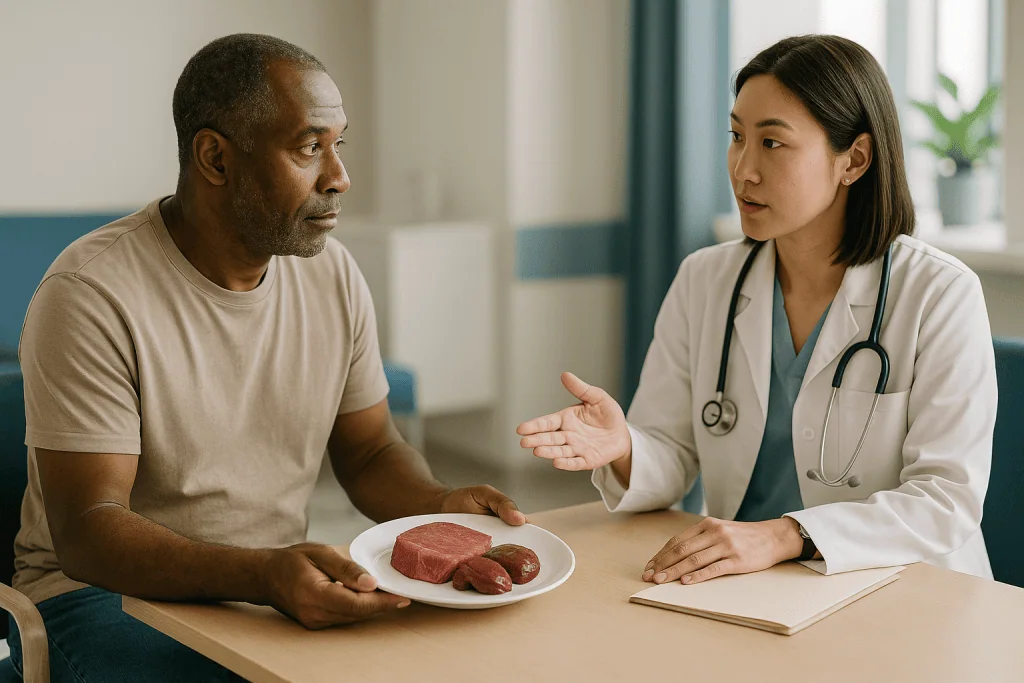
In October 2015, the World Health Organization’s cancer agency classified processed meat as carcinogenic to humans (Group 1) and unprocessed red meat as probably carcinogenic (Group 2A), estimating that each 100 g daily portion of red meat was associated with about a 17% higher relative risk of colorectal cancer. Grass-fed and grain-fed beef were not analyzed separately, a gap that marketers quickly filled with their own claims.
Four years later, in October 2019, a group of researchers published guidelines in a major medical journal suggesting most adults could continue their current red meat intake because the evidence for harm was weak. Harvard Health’s February 2020 analysis of that episode captured the fallout: the underlying studies were the same, but the authors graded the certainty differently and reached a softer conclusion. That disagreement never fully resolved, and it still fuels online arguments.
In November 2021, the American Heart Association issued updated dietary guidance that emphasized overall eating patterns rather than single foods, recommending mostly plant-based protein with lean, unprocessed meat in moderation. Again, no distinction was drawn by how cattle were fed.
Layer onto that the rise of short-form video, where “animal-based” and “ancestral” eating gained a huge following through 2024 and 2025, and the surge in organ-meat capsule sales that followed. The result is a topic where the science has barely moved in a decade but public interest has roughly doubled. That mismatch is exactly why a plain-language reckoning is useful now.
Grass-fed beef vs grain-fed beef: the nutrition numbers that actually differ
Compositional studies, where laboratories analyze meat from cattle raised on different diets, are the strongest evidence in this whole debate, and they agree on a consistent pattern. The table below summarizes typical findings per 100 g (about 3.5 oz) of cooked lean beef; exact figures vary by breed, cut, pasture and season.
| Nutrient | Grass-finished | Grain-finished | Does it matter? |
|---|---|---|---|
| Total fat | Lower, often by 2–4 g | Higher, more marbling | Modestly; cut choice matters more |
| Omega-3 fats | Roughly 2–5 times higher, still under about 100 mg | Low | Minor; a salmon serving has 20–40 times more |
| Omega-6 to omega-3 ratio | Around 1.5–3 to 1 | Around 4–8 to 1 | Unproven health effect |
| Conjugated linoleic acid (CLA) | About double | Baseline | Unproven in humans |
| Vitamin E | Higher | Lower | Small contribution to daily intake |
| Beta-carotene | Higher; fat looks yellower | Minimal | Small |
| Protein, iron, zinc, B12 | Equivalent | Equivalent | No meaningful difference |
Two things stand out. First, the big nutritional virtues of beef, roughly 26 g of complete protein, well-absorbed heme iron, zinc and vitamin B12 per serving, are identical regardless of feed. Second, the differences that do exist cluster in the fat, and grass-fed beef has less fat overall, which dilutes some of its own advantage: a leaner cut simply carries fewer fatty acids of any kind.
Saturated fat deserves a specific note because it is often misrepresented. The proportion of saturated fat is similar in both types; grass-fed beef has slightly less in absolute terms only because it has slightly less fat. Nobody should expect a grass-fed ribeye to behave like fish or olive oil in the body.
The omega-3, CLA and vitamin E claims, in context
Omega-3 fats are a family of polyunsaturated fats, found mainly in oily fish and some plants, that the body uses to build cell membranes and regulate inflammation. Grass-fed beef genuinely contains more of them, including small amounts of the long-chain forms EPA and DPA. Multiplying a tiny number by two to five, however, still yields a tiny number. A 100 g serving of grass-fed beef supplies tens of milligrams of omega-3; the same weight of Atlantic salmon supplies well over 1,500 mg. If omega-3 intake is the goal, the evidence points to fish twice a week, not to switching steak brands.
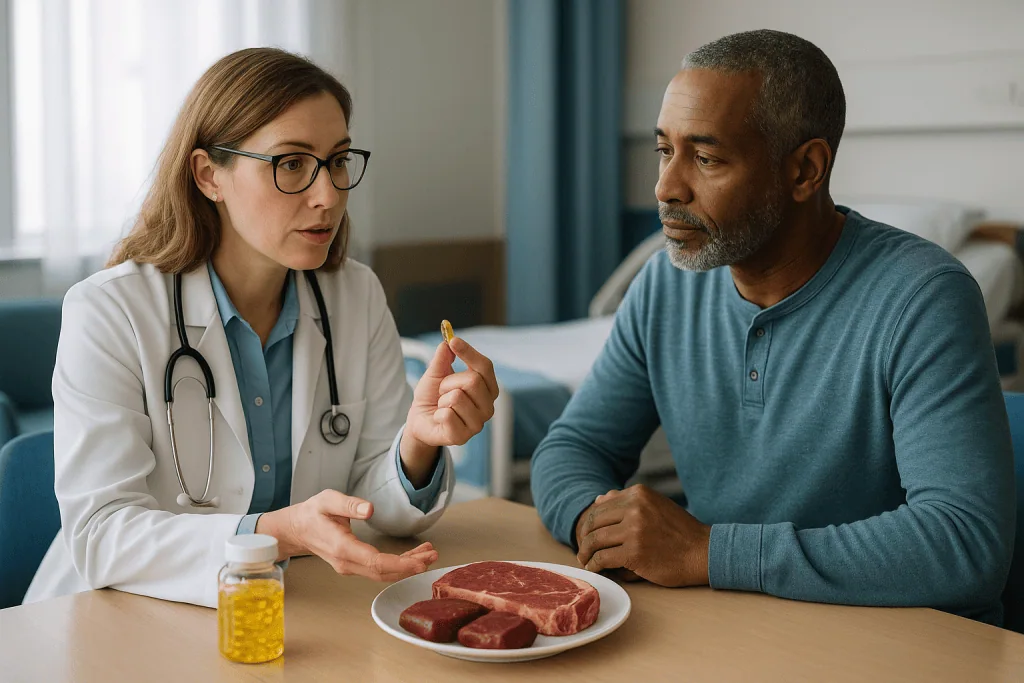
Conjugated linoleic acid, or CLA, is a naturally occurring fat in the meat and milk of grazing animals. Rodent studies in the 1990s and 2000s suggested it might reduce body fat and tumor growth, and that finding is still recycled in videos today. Human trials of CLA supplements have been disappointing: small or no effects on body composition, and some signals of worse insulin sensitivity at supplement doses. The amount in beef, even grass-fed, is far below what those trials used.
Vitamin E and beta-carotene are the most honest advantages. Cattle eating fresh green forage store these antioxidants in their fat, which is why grass-fed fat often looks creamy yellow rather than bright white. The difference is real and shows up in shelf life, since vitamin E slows the oxidation that turns fat rancid. Nutritionally, though, a serving of grass-fed beef still provides only a small slice of the daily vitamin E you would get from a handful of almonds or a tablespoon of sunflower oil.
Put together, the fatty-acid story is accurate but small. It describes a somewhat better profile, not a different food category.
What the evidence actually says, graded by strength
Evidence in nutrition comes in tiers, and this topic spans all of them.
Strong: compositional data. Dozens of laboratory analyses across countries agree that grass-finishing lowers total fat and raises omega-3, CLA, vitamin E and beta-carotene. This is about as settled as food chemistry gets.
Weak to moderate: short-term human feeding studies. A handful of small trials, generally lasting a few weeks and involving a few dozen volunteers, have compared people eating grass-fed versus grain-fed beef. Some reported small rises in blood omega-3 levels; results for cholesterol, triglycerides and inflammatory markers were mixed and mostly not statistically meaningful. None was large enough or long enough to detect changes in heart attacks, strokes or cancers.
Absent: outcome trials. No randomized trial has ever tested whether choosing grass-fed beef reduces disease or extends life. Every claim that it “protects your heart” is an extrapolation from the fatty-acid numbers, not a demonstrated result.
Moderate but non-specific: observational studies of red meat as a whole. Large cohort studies following hundreds of thousands of people link higher intake of red and especially processed meat with modestly higher rates of colorectal cancer, type 2 diabetes and cardiovascular disease. Mayo Clinic’s reviewers summarize the heart-health question the same way: grass-fed beef may offer some advantages, but the research is limited and red meat of any kind is best kept to modest portions. These cohorts did not record how cattle were fed, so they cannot exonerate or indict grass-fed specifically.
Expert opinion: dietary guidelines. The American Heart Association and the Dietary Guidelines for Americans favor overall patterns rich in vegetables, legumes, whole grains, fish and poultry, with lean unprocessed red meat in moderation. They are silent on feeding method, which is itself informative: the people who read all the studies do not consider it a decisive factor.
Is grass-fed beef really healthier? A plain verdict
Yes, slightly, on paper. No, not demonstrably, in people. Both halves of that sentence matter.
If you already eat beef and you can afford the grass-fed version, you will get a leaner cut with a modestly better fat profile and a little more vitamin E. That is a genuine, if small, nutritional edge, and some people also prefer the flavor and the farming model. There is no evidence that grass-fed beef is worse for you in any respect, so choosing it is a reasonable preference.
What the evidence does not support is the idea that grass-fed status transforms red meat into a health food or cancels the associations seen in population studies. The colorectal cancer signal reported by WHO is tied to compounds that form when any red meat is cooked at high heat, to heme iron itself, and to nitrites in processed products. None of those depends on pasture. A grass-fed hot dog is still a processed meat.
The more useful levers, in rough order of evidence strength, are these: how much red meat you eat per week, whether it is processed, how it is cooked, what it replaces on the plate, and finally how the animal was fed. Swapping a grain-fed steak for a grass-fed one moves the smallest lever. Swapping a third weekly steak for a lentil dish or a piece of fish moves a larger one.
My opinion, grounded in the data: treat grass-fed as a quality upgrade, something like choosing whole-grain bread over white, not as a permission slip to eat more. A serving of beef two or three times a week, lean cuts, minimal charring and plenty of vegetables alongside will do far more for your health than the feed label ever will.
Why organ meats are back on the menu
Organ meats, also called offal, are the edible internal organs of an animal: liver, kidney, heart, tongue, tripe (stomach lining) and sweetbreads (thymus or pancreas). A century ago they were ordinary weeknight food in most American households. They faded as muscle meat became cheap and abundant, then disappeared from many menus altogether.
Their comeback has three drivers. The first is nutrition science catching up with grandmother’s instinct: liver really is extraordinarily dense in vitamins, and dietitians have long listed it as a top food for iron and vitamin B12. The second is the whole-animal, low-waste cooking movement, which treats organs as a sustainability win because they would otherwise be discarded or rendered. The third, and loudest, is social media, where organ meats have been folded into the animal-based and carnivore trends and marketed as the “missing piece” for fatigue, fertility and skin.
That last framing is where the hype begins. Creators often describe organ meats as nature’s multivitamin, which is fair, and then imply that a multivitamin is what tired, stressed adults are missing, which usually is not. Most fatigue is not a nutrient deficiency, and when it is, the deficiency should be confirmed by a blood test rather than assumed from a video.
There is also a cultural reversal worth noticing. Communities that never stopped eating liver, kidney and tripe, from West Africa to Mexico to the Philippines, did so in modest portions inside varied diets. The current trend often strips organ meats out of that context, encouraging daily servings or concentrated capsules. The food is the same; the dose and the surrounding diet are not, and in nutrition the dose is nearly everything.
Liver, kidney and heart: the nutrition facts behind organ meats
The nutritional case for organ meats is strong and specific, so it is worth being precise about which organ offers what.
Beef liver is the standout. According to the NIH Office of Dietary Supplements, a 3 oz portion of pan-fried beef liver provides about 6,500 mcg of vitamin A, more than seven times the daily recommendation for an adult man. The same portion supplies several days’ worth of vitamin B12, a large share of daily folate and riboflavin, around 5 mg of highly absorbable heme iron, and a very large amount of copper. Few foods pack that much into so little weight.
Kidney shares many of liver’s strengths, with abundant B12, selenium and iron, while containing far less vitamin A. Heart is technically a muscle rather than a glandular organ, so it behaves nutritionally like a very lean steak with extra B vitamins and a notable amount of coenzyme Q10, a compound involved in cellular energy production. Tongue and tripe are closer to ordinary meat: good protein and zinc, nothing exceptional.
Heme iron deserves a sentence of explanation. It is the form of iron bound within animal blood and muscle proteins, and the body absorbs roughly 15–35% of it, compared with 2–20% for the non-heme iron in plants. That makes organ meats, and red meat generally, efficient sources for people with confirmed iron deficiency, which is why they have a legitimate place in dietary advice for some patients.
The pattern across these numbers is clear: organ meats are not just “nutritious,” they are concentrated. A couple of small servings a month can meaningfully fill gaps in vitamin A, B12 and iron. The same concentration is what turns daily servings into a problem, which is the subject of the next section.
The real risks of eating organ meats too often
Every nutrient has a ceiling, and liver reaches several of them fast.
Vitamin A is the clearest hazard. The preformed vitamin A in animal foods, called retinol, is stored in the body rather than excreted, and the tolerable upper intake level for adults is 3,000 mcg per day according to NIH ODS. A single 3 oz serving of beef liver delivers more than twice that. Occasional servings are fine because the body buffers short-term excess, but weekly liver plus a multivitamin plus fortified foods can push intake into the range linked to headaches, liver injury, bone loss and, in pregnancy, birth defects. For that reason the NHS advises people who are pregnant or trying to conceive to avoid liver and liver products such as pâté entirely.
Copper is a quieter concern. Liver contains so much that a few servings a week can exceed the adult upper limit, and sustained excess copper can injure the liver. People with Wilson disease, a genetic disorder of copper handling, are typically told to avoid organ meats altogether.
Purines, compounds broken down into uric acid, are especially high in liver, kidney and sweetbreads. For people with gout, these foods are among the most consistent dietary triggers of flares.
Kidney and liver are also the organs that filter and store environmental contaminants, so they can concentrate cadmium and lead, particularly in older animals. Regulatory testing keeps commercial meat within limits, but it is one more reason not to make these foods daily staples.
Finally, organ meats are rich in cholesterol, and while dietary cholesterol affects blood levels less than once thought, people already managing high LDL cholesterol may be advised to limit them. The theme is consistent: a small portion once or twice a month is where the benefits live, and frequent large portions are where the risks begin.
Organ meat supplements and 'ancestral' capsules: what you are actually buying
The fastest-growing corner of this trend is not the butcher counter but the supplement aisle. Freeze-dried liver, heart, kidney and even brain are sold as capsules, often labeled grass-fed and marketed for energy, hormones, immunity and skin.
Regulatory status first. In the United States these products are dietary supplements, which means they are not evaluated by the Food and Drug Administration for safety or effectiveness before sale and cannot legally claim to treat, prevent or diagnose any disease. Manufacturers are responsible for their own quality control, and independent testing has repeatedly found that supplement labels do not always match contents.
Nutrition second. A capsule holds roughly half a gram of dried powder. Drying removes water, so a few capsules can equal a modest bite of fresh organ, but it cannot equal a serving. The vitamin A, B12 and iron content varies with the organ, the animal and the batch, and it is rarely stated in a way a consumer can verify. Someone taking liver capsules daily alongside a multivitamin is in exactly the vitamin A stacking scenario described above, often without realizing it.
Evidence third. There are no randomized trials showing that organ meat capsules improve energy, fertility, testosterone, mood or skin in healthy adults. The claims rest on the known nutrient content of fresh organs plus testimonials, which is the weakest tier of evidence.
Safety fourth. Beyond vitamin A and copper, products containing brain or spinal tissue raise theoretical concerns about prion diseases, which is why those tissues are excluded from the human food chain in several countries.
If a clinician has identified a true deficiency, standardized supplements with known doses are a more predictable tool than dried organ powder, and the decision about which to use, and for how long, belongs with that clinician.
Common myths about grass fed beef and organ meats, corrected
Viral claims travel faster than footnotes. Here are the ones that most need correcting.
“Grass-fed beef is a good source of omega-3.” It is a better source than grain-fed beef, but still a poor one. Expect tens of milligrams per serving versus well over a thousand in oily fish. No dietary guideline counts beef toward omega-3 targets.
“Grass-fed beef doesn’t carry the cancer risk of regular red meat.” The compounds implicated, heme iron and the heterocyclic amines and polycyclic aromatic hydrocarbons formed during high-heat cooking, are present in all beef. The WHO classification applies to red meat as a category, and no study has separated out grass-fed.
“Grass-fed means organic, hormone-free and antibiotic-free.” These are independent claims. A grass-fed label says nothing about antibiotics, growth implants or organic certification unless those words also appear.
“Liver is nature’s multivitamin, so eat it daily.” The first half is true; the second ignores the vitamin A and copper upper limits that daily liver would blow past within days.
“Eating heart gives you heart health; eating liver detoxes your liver.” Organs do not transfer their function to the eater. Heart muscle is lean protein with B vitamins and some coenzyme Q10; liver is a vitamin reservoir. Neither detoxifies anything.
“The yellow fat means grass-fed beef is higher in healthy fat.” The color comes from beta-carotene stored in the fat. It signals a forage diet, not a higher fat content; grass-fed beef is usually leaner.
“Our ancestors ate this way, so it must be optimal.” Ancestral diets varied enormously by region and season, and life expectancy in those populations tells us little about chronic disease prevention at 70.
What are the drawbacks of grass-fed, and how to read the label
Grass-fed beef has trade-offs that the marketing rarely mentions, and knowing them helps you shop realistically.
Texture and flavor are the first. Less marbling means the meat can turn dry and chewy if cooked the way you would cook a heavily marbled steak. Grass-fed cuts generally do better with lower heat, shorter cooking times and a rest before slicing. The flavor is often described as grassier or more mineral, which some people love and others find gamy.
Consistency is the second. Pasture changes with the seasons, so the fat profile and even the color of grass-fed beef vary across the year and between farms, whereas feedlot rations are standardized.
Food safety is identical. Grass-fed beef is not less likely to carry E. coli or Salmonella, and ground grass-fed beef should be cooked to 160°F just like any other ground beef.
Then there is the label question people ask most often: is the beef sold at large warehouse clubs 100% grass-fed? The honest answer is that it depends on the specific product. Many warehouse stores carry imported grass-finished beef, frequently from Australia or New Zealand where year-round grazing is standard, and some carry domestic beef labeled simply “grass-fed,” which may have included grain supplementation. The package, not the store, holds the answer.
When reading labels, look for “100% grass-fed” or “grass-finished” rather than “grass-fed” alone; check for a third-party certification seal, since the federal standard was withdrawn in 2016; and remember that “product of USA” has historically been allowed on beef processed, but not necessarily raised, in the United States. None of this changes the nutritional bottom line, but it does determine whether you are paying for what you think you are getting.
How red meat and organ meats fit a heart-healthy eating pattern
Dietary guidelines do not ask anyone to give up beef. They ask that it take a supporting role, and the evidence behind that advice is the strongest in this article.
The American Heart Association’s guidance on choosing proteins recommends mostly plant sources, fish and seafood, low-fat dairy and lean poultry, with lean cuts of unprocessed red meat eaten in moderation and processed meats such as bacon, sausage and deli meats minimized. In practice, many dietitians translate this into roughly one to three servings of red meat a week, with a serving about the size of a deck of cards, around 3 oz cooked.
Within that budget, grass-fed beef is a fine choice and so are lean grain-fed cuts such as sirloin, round or 93% lean ground beef. Trimming visible fat, cooking with moist methods or moderate heat, and avoiding heavy charring reduce the compounds linked to cancer risk more reliably than any feed label.
Organ meats can sit inside the same weekly allowance rather than on top of it. A reasonable pattern for most healthy adults is a small serving of liver once or twice a month, with kidney or heart as occasional alternatives, and none at all during pregnancy or for people with gout or Wilson disease unless a clinician advises otherwise.
The plate around the meat does the heaviest lifting. Observational studies consistently show that the health profile of people who eat red meat with abundant vegetables, legumes and whole grains looks different from that of people whose red meat displaces those foods. Fiber, potassium and unsaturated fats from plants are where most of the measurable cardiovascular benefit lives.
Thought of this way, the grass-fed question becomes pleasantly small. Choose the beef you enjoy and can afford, keep portions modest, and spend your attention on everything else on the plate.
When to see a doctor
Most people can enjoy beef and occasional organ meats without medical input. Certain situations, however, call for a conversation with a clinician before changing how much of these foods you eat, and a few symptoms should prompt prompt care.
Talk to your doctor first if you are pregnant or planning a pregnancy and have been eating liver or taking liver capsules, because excess preformed vitamin A early in pregnancy is linked to birth defects. The same applies if you have gout, kidney disease, Wilson disease, hemochromatosis/">hemochromatosis (a genetic condition causing iron overload), familial high cholesterol, or any liver condition, since organ meats can worsen each of these.
Do not start high-dose iron, vitamin A or organ supplements to treat fatigue on your own. Persistent tiredness has many causes, and a simple blood test can confirm or rule out iron, B12 or thyroid problems. If a deficiency is found, your clinician will decide whether diet, a standardized supplement or further investigation is appropriate.
Seek medical attention promptly if you develop any of these red-flag signs, especially while eating organ meats or taking organ supplements frequently:
- Persistent headache, blurred vision, dizziness or nausea, which can signal vitamin A excess
- Yellowing of the skin or eyes, dark urine or pain under the right ribs, which can indicate liver injury
- Bone pain or an unexpected fracture
- A sudden, hot, swollen, intensely painful joint, often the big toe, suggesting a gout flare
- Blood in the stool, a lasting change in bowel habit or unexplained weight loss, which warrant evaluation regardless of diet
Never stop or change a prescribed medicine because of something you read about diet, including blood thinners, which interact with vitamin K in liver. Every decision about supplements, diagnostic testing and treatment belongs with the clinician who knows your history.
Frequently asked questions
Is grass-fed beef really healthier than regular beef?
Slightly, on paper, and not demonstrably in people. Grass-fed beef is leaner and has more omega-3, CLA and vitamin E, but the amounts are small and no trial has shown better health outcomes. Portion size, avoiding processed meat and limiting charring have far stronger evidence behind them than feeding method does.
What exactly is grass-fed beef?
Grass-fed beef comes from cattle that ate grass, hay or other forage for their entire lives, including the final finishing months. Conventional cattle also start on pasture but are moved to feedlots for grain finishing. Because the US federal label standard was withdrawn in 2016, ‘100% grass-fed’ or ‘grass-finished’ with a certification seal is the more reliable claim.
Is the grass-fed beef at warehouse clubs 100% grass-fed?
It depends on the specific product, not the store. Many large retailers sell imported grass-finished beef from countries where year-round grazing is standard, while other packages labeled only ‘grass-fed’ may have included grain. Check for ‘100% grass-fed’ or ‘grass-finished’ wording and a third-party certification on the individual package.
What are the drawbacks of grass-fed beef?
The main drawbacks are practical: less marbling makes it easier to overcook into a dry, chewy texture, the flavor can taste grassy or gamy to some people, and nutrient content varies with the season. Food safety is no better than conventional beef, so ground grass-fed beef still needs cooking to 160°F.
Does grass-fed beef count as a source of omega-3?
Not in any meaningful sense. A serving provides tens of milligrams of omega-3, while the same weight of salmon, sardines or mackerel provides well over a thousand. Dietary guidelines point to two servings of oily fish a week for omega-3 intake and do not credit beef of any kind toward that goal.
Are organ meats healthy or harmful?
Both, depending on the dose. Liver, kidney and heart are rich in vitamin A, B12, heme iron, copper and folate, so small portions once or twice a month can fill real gaps. Daily or large servings can exceed safe limits for vitamin A and copper, trigger gout flares, and are not advised in pregnancy.
How often can you safely eat liver?
For most healthy adults, a small serving about once or twice a month stays comfortably within nutrient limits. A single 3 oz portion of beef liver contains more than twice the adult vitamin A upper intake level of 3,000 mcg, so weekly liver combined with multivitamins or fortified foods can push intake into a risky range.
Do grass-fed organ meat capsules work?
There are no randomized trials showing that dried liver or organ capsules improve energy, hormones, fertility or skin. They are dietary supplements, not evaluated for effectiveness before sale, and their vitamin A and copper content is rarely verifiable. If you suspect a deficiency, a blood test and your clinician’s advice are the reliable path.
Does grass-fed beef lower cancer risk compared with grain-fed?
No study has shown that. The WHO classified red meat as probably carcinogenic based on compounds present in all beef, including heme iron and chemicals formed during high-heat cooking, without distinguishing feed type. Eating smaller portions, avoiding processed meats and limiting charring reduce exposure to those compounds regardless of how the cattle were raised.
Who should avoid organ meats altogether?
People who are pregnant or trying to conceive should avoid liver and liver products because of vitamin A, according to NHS guidance. Those with gout, Wilson disease, hemochromatosis or significant liver or kidney disease are usually advised to avoid or strictly limit organ meats. Anyone in these groups should ask their clinician before eating them.
This article is for general information only and is not a substitute for professional medical advice. Please consult a qualified doctor about your individual situation.

More from the Blog

Waist-to-Hip Ratio: The Measurement That Outperforms BMI
Waist-to-hip ratio compares the circumference of your waist to that of your hips and shows where your body stores fat. The World Health Organization…
High-Protein Diets: How Much Per Meal, the Kidney Question and Who Benefits Most
A high protein diet usually means getting 25–35% of daily calories from protein, or roughly 1.2–2.0 grams per kilogram of body weight. Dividing that…

Psyllium Husk: The Unglamorous Fiber With Outsized Evidence
Psyllium husk is a gel-forming soluble fiber from the seeds of Plantago ovata. Consistent clinical evidence shows it softens and regularizes stools, modestly lowers…

Cinnamon: The Blood Sugar Claims Under the Microscope
Cinnamon may modestly lower fasting blood sugar in some short-term studies, but major reviews find no reliable effect on long-term glucose control, and it…

Sardines, Tuna and Mercury: How to Eat Fish Well Without the Worry
Sardines are one of the safest, most nutrient-dense fish you can eat. A single can supplies around a gram of omega-3 fats, roughly a…

Rooibos Tea: The Caffeine-Free Red Cup, Reviewed
Rooibos is a naturally caffeine-free herbal tea from South Africa that supplies polyphenol antioxidants, including a rare one called aspalathin. Small human studies suggest…