

Hearing Tests: What an Audiogram Measures and When to Have One
Key Takeaways
- A standard hearing test measures thresholds from about 250 to 8,000 hertz, and the high end, where consonants like s and f live, is where age and noise damage show up first.
- On an audiogram, a normal result sits near the top of the chart; bone-conduction marks that stay normal while air-conduction marks drop point to a blockage that is often treatable.
- The WHO grades hearing loss as mild from 20 dB HL, moderate from 35, severe from 65 and profound from 80, averaged across speech frequencies in the better ear.
- The 2023 ACHIEVE trial found no overall cognitive benefit from hearing aids at three years but a 48 percent slowing of decline in a higher-risk subgroup, so claims in either direction should be stated cautiously.
- App and earbud hearing checks can detect that loss is present but cannot measure bone conduction, eardrum movement, or word recognition, so a positive result should lead to a full evaluation.
- Sudden hearing loss in one ear is treated as a medical emergency with a window of days, not weeks, and always warrants same-day care.
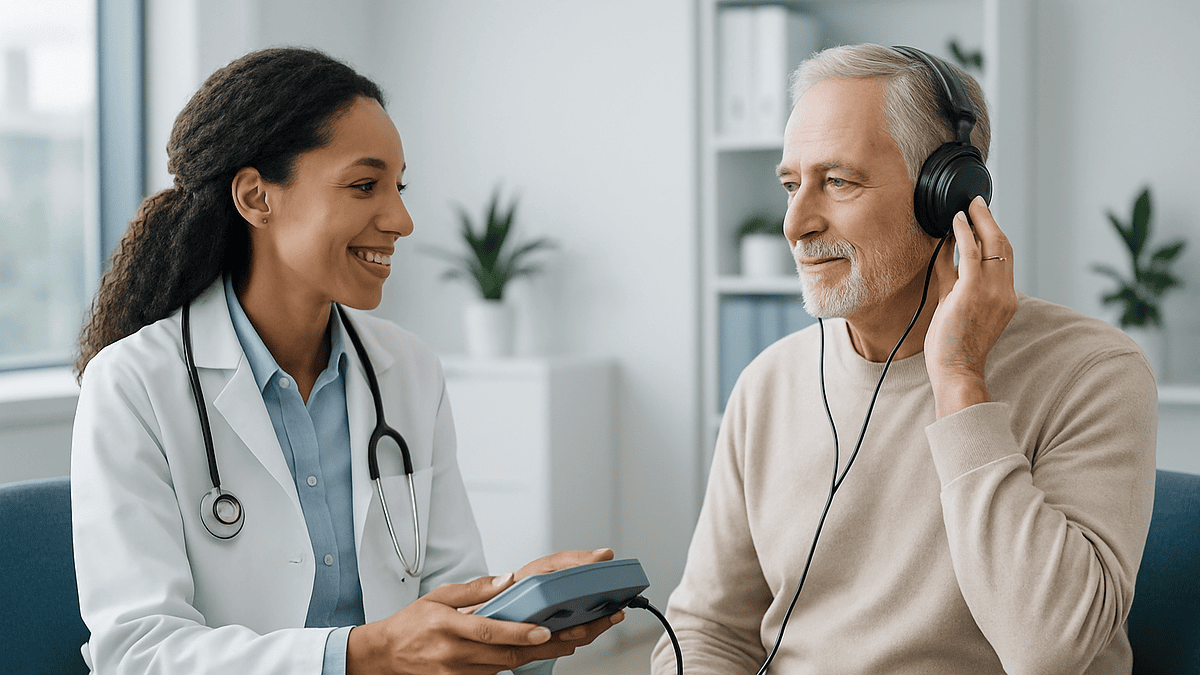
A hearing test measures the quietest sound you can hear at each pitch, usually from low rumbles around 250 hertz to high whistles near 8,000 hertz, and plots the results on a chart called an audiogram. Adults should have a baseline test, repeat it every few years, and test sooner for any noticeable change, ringing, or sudden loss, which needs same-day medical attention.
The man in the waiting room was not there for himself. His daughter had sent him a link to a hearing check that ran through his earbuds, he had scored “may have mild loss,” and the result had rattled him more than any blood pressure reading ever did. He wanted a real hearing test, with a real audiogram, to settle the question.
He is not alone. As of this writing in 2025, searches for the phrase have climbed on the back of three things: a 2023 randomized trial suggesting hearing aids can slow cognitive decline in older adults at high risk, the 2022 arrival of over-the-counter hearing aids in the United States, and a wave of smartphone and earbud features that promise a clinical-grade check in five minutes on your sofa.
Those headlines are half right. Here is what an audiogram really measures, what a free online check can and cannot tell you, and when the honest answer is simply: book the test.
Why is everyone searching for a hearing test right now?
Hearing used to be the quiet sense. You noticed it only when the television crept louder or a restaurant turned to mush. Then the dementia research arrived, and hearing loss moved from a nuisance to a public-health headline.
The World Health Organization estimates that more than 1.5 billion people live with some degree of hearing loss, that around 430 million need rehabilitation for it, and that by 2050 nearly 2.5 billion people will have some loss. WHO also warns that over 1 billion young adults risk permanent damage from unsafe listening habits, chiefly earbuds turned up too loud for too long.
Layer onto that the consumer technology. Phones and earbuds now ship with built-in hearing checks, and one earbud maker’s test and hearing-aid software received Food and Drug Administration authorization in September 2024. Suddenly a hearing test is not something you schedule; it is something that pops up as a notification.
That accessibility is good news in one respect. The National Institute on Deafness and Other Communication Disorders (NIDCD) notes that about one in eight Americans aged 12 and older has hearing loss in both ears based on standard testing, and most people wait years between first noticing trouble and doing anything about it. If an app shortens that delay, it has earned its place.
The catch is what a five-minute check leaves out. A smartphone cannot tell whether your loss sits in the middle ear or the inner ear, cannot measure your eardrum’s movement, and cannot spot the asymmetric pattern that occasionally signals something that needs a physician. The rest of this article is about that gap.
What changed recently
Three dated developments explain the current spike in interest, and each deserves a precise description rather than a headline.
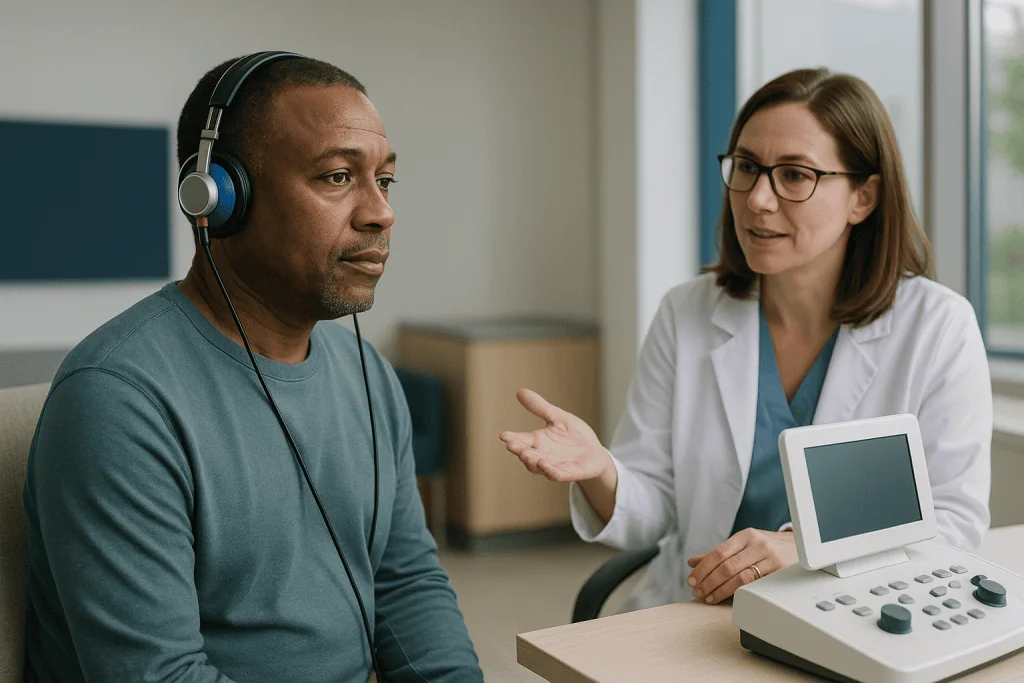
October 17, 2022. The FDA rule creating a category of over-the-counter hearing aids took effect in the United States. Adults who believe they have mild to moderate hearing loss can buy these devices without a prescription, examination, or audiogram. The NIDCD, part of the NIH, explains the category on its consumer pages. Note the phrasing: the rule is for perceived mild to moderate loss. It does not remove the value of knowing what your loss actually is.
July 2023. Results of the ACHIEVE trial, funded by the National Institute on Aging, were published and summarized in an NIH news release. Nearly 1,000 adults aged 70 to 84 with untreated hearing loss were randomly assigned to hearing aids plus audiologic counseling or to a health-education control. Across the whole group there was no significant difference in cognitive decline over three years. In the pre-specified subgroup drawn from an existing heart-health cohort, who were older and carried more risk factors for dementia, decline was about 48 percent slower in the hearing-aid group.
2024 onward. Consumer earbud and phone hearing checks moved from novelty to FDA-authorized features, and the Lancet Commission on dementia prevention, updated in 2024, continued to list hearing loss among the leading modifiable risk factors across the life course.
Put together: the evidence that hearing matters for the brain strengthened, the tools to check it multiplied, and the devices to address it became easier to obtain. None of that changed what a proper hearing test measures, which is why the next sections go back to basics.
What does a hearing test actually measure?
Strip away the soundproof booth and the headphones, and a standard hearing test asks one deceptively simple question at a series of pitches: what is the softest sound you can detect?
Two units carry the answer. Frequency, measured in hertz (Hz), is the pitch of a sound, from a low hum to a high whistle. Intensity, measured in decibels (dB), is loudness. In a hearing clinic the decibel scale is labeled dB HL, for hearing level, which is calibrated so that zero represents the average threshold of young adults with healthy ears. A result of 40 dB HL at a given pitch means you needed the tone 40 decibels louder than that reference before you heard it.
The test typically covers 250 to 8,000 Hz. That range is not arbitrary. The vowel sounds that give speech its volume sit low, roughly 250 to 1,000 Hz. The consonants that give speech its clarity, the s, f, th and k sounds that separate “fifty” from “sixty,” live up around 2,000 to 8,000 Hz. Age-related and noise-related loss nearly always starts at the top, which is why people with early loss say, with complete accuracy, “I can hear you, I just can’t understand you.”
Each ear is tested separately. Tones are presented through headphones or insert earphones (air conduction) and then through a small vibrator placed on the bone behind the ear (bone conduction), which bypasses the eardrum and middle-ear bones and stimulates the inner ear directly. Comparing those two routes is how the audiologist works out where the problem lives.
The whole pure-tone portion takes about 20 to 30 minutes. It demands attention but no skill; you press a button or raise a hand when you hear a beep, even a faint one, even if you are not sure.
Audiogram results explained: how to read the chart
An audiogram is the graph that records your thresholds. It looks upside down at first, and once you see why, the whole chart makes sense.
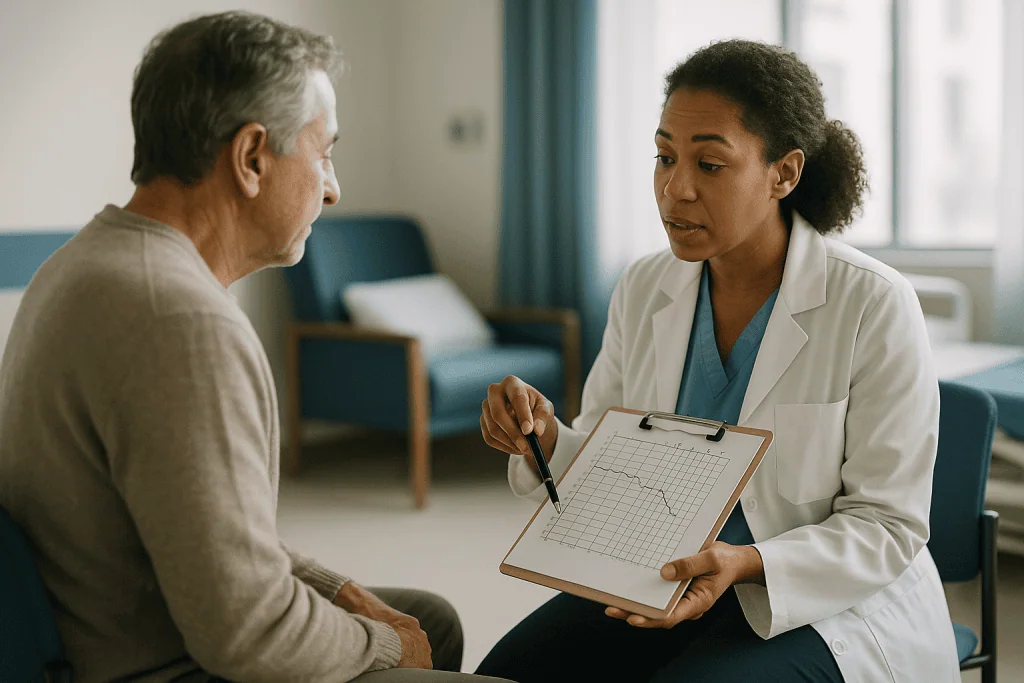
Across the bottom runs frequency, low pitches on the left, high on the right, like a piano keyboard. Down the side runs intensity in dB HL, but with the quiet sounds at the top and the loud sounds at the bottom. A mark near the top means you heard a very soft tone. A mark that sinks toward the bottom means the tone had to be loud before you caught it. Normal hearing therefore draws a line across the upper part of the chart; hearing loss pulls the line down.
The symbols are standardized. A red circle (O) marks the right ear tested by air conduction. A blue cross (X) marks the left ear. Bone-conduction results appear as brackets or arrowheads next to those marks. Shaded zones often sit in the background: the familiar “speech banana,” a banana-shaped region showing where everyday speech sounds fall, and sometimes small letters placing individual sounds on the grid.
Three shapes are worth recognizing:
- A sloping line that starts near normal on the left and dips steeply on the right is the classic pattern of age-related loss (presbycusis) and of noise damage.
- A notch, a dip around 3,000 to 6,000 Hz that recovers slightly at 8,000 Hz, is a hallmark of noise exposure.
- Two ears that look clearly different is a pattern an audiologist will not ignore, because asymmetry occasionally points to a cause beyond ordinary wear.
None of these shapes is a diagnosis. They are clues that your clinician combines with your history and the other tests described below.
What do the numbers on an audiogram mean?
Once you have the chart, the natural question is how bad is it. Clinicians answer with grades based on your average threshold across the main speech frequencies in the better ear. Different organizations draw the lines in slightly different places, which explains why one report may say “slight” where another says “mild.” The table below uses the grading scheme in the WHO World Report on Hearing, which many clinics have adopted.
| Grade (better ear) | Average threshold, dB HL | What it typically feels like |
|---|---|---|
| Normal | Below 20 | No or very slight trouble hearing sounds |
| Mild | 20 to under 35 | Soft speech or speech in noise becomes hard to follow |
| Moderate | 35 to under 50 | Conversation at normal volume is difficult without effort |
| Moderately severe | 50 to under 65 | Loud speech needed; group conversation very hard |
| Severe | 65 to under 80 | Most conversation missed, even when loud |
| Profound | 80 to under 95 | Extreme difficulty hearing even shouted speech |
| Complete | 95 and above | No speech heard |
Older American classification schemes set the normal cutoff at 25 dB HL for adults and call 16 to 25 “slight” loss, so do not be alarmed if two documents disagree by a few decibels.
Two numbers matter more than the label. The first is the gap between air and bone conduction. If bone conduction is normal but air conduction is reduced, sound is being blocked on its way in, which is conductive loss, often from wax, fluid, or a middle-ear problem, and frequently treatable. If both routes are reduced together, the inner ear or hearing nerve is involved, which is sensorineural loss, the kind associated with aging and noise. The second is the word recognition score, covered next, because two people with the same thresholds can understand speech very differently.
Pure tones are only part of a full hearing evaluation
Beeps measure sensitivity, not comprehension. A complete hearing evaluation adds several short tests that an online check simply cannot perform.
Speech audiometry. The audiologist first finds your speech reception threshold, the quietest level at which you can repeat familiar two-syllable words correctly about half the time; it should sit close to your pure-tone average. Then comes word recognition: a list of single-syllable words played at a comfortable volume, scored as a percentage. A score of 92 percent and a score of 60 percent describe very different ears, even with identical thresholds, and the difference shapes what help will realistically do.
Tympanometry. A small probe changes the air pressure in your ear canal and measures how freely the eardrum moves. It takes a few seconds per ear and detects fluid behind the eardrum, a blocked Eustachian tube, a perforation, or stiffness of the tiny middle-ear bones. This is the test that most often turns “you have hearing loss” into “you have a treatable blockage.”
Otoacoustic emissions (OAE). A healthy inner ear produces faint echoes in response to sound. A probe plays clicks and listens for them. Absent emissions point to damage in the outer hair cells of the cochlea, the snail-shaped inner-ear organ that converts vibration into nerve signals. OAE is painless, needs no response, and is a mainstay of newborn screening.
Auditory brainstem response (ABR). Electrodes on the scalp record the hearing nerve’s electrical reply to clicks. It is used when a person cannot respond reliably, in infants, and when an asymmetric result raises a question about the nerve itself.
Together these take roughly an hour. The result is not a single score but a profile: how sensitive, how clear, where the problem sits, and whether anything needs a physician before a hearing device is discussed.
What the evidence actually says
Because this topic is riding a wave of bold claims, it helps to grade them.
Strong evidence: pure-tone audiometry is the reference standard. Decades of calibration work and clinical use make the booth-based audiogram the measure against which every app and screener is judged. That is a statement about measurement, not about outcomes.
Strong observational evidence, limited trial evidence: hearing loss and cognition. Large cohort studies consistently find that adults with untreated hearing loss have higher rates of cognitive decline and dementia, and the Lancet Commission on dementia prevention estimates that roughly 7 percent of dementia cases are attributable to hearing loss in midlife. Association, however, is not proof of cause. The ACHIEVE trial, the only large randomized test so far, found no overall effect on cognition at three years, with a meaningful benefit confined to a higher-risk subgroup. The honest summary: treating hearing loss may help protect thinking in some older adults, the mechanism is plausible, and more trials are needed.
Moderate evidence: smartphone and digits-in-noise screening. Validation studies report that well-designed app-based tests, including the digits-in-noise format used in the WHO’s free screening app, correlate reasonably with clinic audiograms for detecting whether loss is present. They are weaker at measuring exactly how much loss, and silent on its cause.
Expert opinion: how often adults should be tested. No randomized trial has shown that screening symptom-free adults improves outcomes, and the US Preventive Services Task Force rated the evidence insufficient in 2021. Audiology bodies nonetheless recommend a baseline audiogram and periodic rechecks, more frequently after about age 60 or with noise exposure, on the grounds that untreated loss is common, under-recognized, and usually manageable once identified.
Can an online hearing test or earbud app replace a clinic visit?
Short answer: as a screen, yes; as a diagnosis, no. The distinction is worth drawing precisely, because the marketing rarely does.
Online checks come in two main flavors. Tone-based tests mimic the clinic by playing beeps at several pitches and asking you to respond. Their weakness is calibration: your laptop speakers, your headphones, and the background hum of your kitchen all change the actual loudness reaching your eardrum, so a reported “30 dB” is an estimate. Earbud-based tests that have passed regulatory review solve part of this by knowing exactly what hardware you are using and by checking ambient noise before they start.
Digits-in-noise tests take a cleverer route. You hear spoken numbers against a background of noise, and the test adjusts the noise until you get about half right. Because it measures speech understanding relative to noise rather than absolute loudness, it is far less sensitive to volume settings. It is also closer to the real-world complaint most people have.
What none of these can do:
- Measure bone conduction, so they cannot separate a wax blockage or middle-ear fluid from inner-ear damage.
- Perform tympanometry, so a treatable conductive problem can be mislabeled as permanent loss.
- Reliably detect asymmetry that warrants medical imaging.
- Score word recognition under controlled conditions.
A sensible way to use them: treat a “normal” result as reassuring but not final if you have symptoms, and treat any “possible loss” result as a prompt to book a proper test rather than to shop for a device. Think of them as the hearing equivalent of a pharmacy blood-pressure cuff. Useful for catching a trend, not for deciding treatment.
How to test hearing at home: honest self-checks
People search “how can I test my hearing myself” for a good reason: they want to know whether a nagging suspicion deserves an appointment. A few informal checks are reasonable, provided you understand what they show.
Start with pattern recognition, not gadgets. The NHS and Mayo Clinic list the everyday signs that most reliably precede a diagnosed loss: asking people to repeat themselves, struggling to follow conversation in restaurants or groups, finding that others seem to mumble, turning the television up beyond what family members find comfortable, difficulty hearing on the phone, and feeling worn out after social events because listening took effort. Two or more of these, persisting for weeks, is a stronger signal than any single app score.
Next, try a validated app. The digits-in-noise format described above is the best-supported home method; several versions exist, including one published by the WHO. Use headphones, sit somewhere quiet, and repeat the test on a different day. Consistency matters more than any one number.
What not to do:
- Do not test with a phone held to your ear or with speakers; volume is uncontrolled.
- Do not rub your fingers near one ear and call the result a hearing test. Finger rubbing produces a very high-pitched sound and tells you almost nothing about speech frequencies.
- Do not insert anything into the ear canal to “check for wax.” Cotton swabs push wax deeper and can injure the eardrum.
- Do not interpret a sudden change in one ear as something to monitor at home. That is a same-day medical issue, covered below.
A home check can move you from “I wonder” to “I should find out.” It cannot move you to “I know,” and it should never be the reason you delay care for a symptom that worries you.
Audiologist vs ENT: who should you see for hearing loss?
This is one of the most-asked questions about hearing care, and the answer depends on what you need.
An audiologist is a clinician with a doctoral degree in hearing and balance science. Audiologists perform and interpret the full hearing evaluation, fit and program hearing aids, manage tinnitus (the perception of ringing or buzzing without an external sound), and provide the communication counseling that the ACHIEVE trial bundled with its hearing aids. For gradual, symmetric, age- or noise-related loss, an audiologist is usually the right first stop.
An ENT, formally an otolaryngologist, is a physician and surgeon specializing in the ear, nose and throat. ENTs diagnose and treat the medical causes of hearing loss: impacted wax, infection, fluid behind the eardrum, perforations, otosclerosis (a stiffening of the middle-ear bones), and, rarely, growths on the hearing nerve. They prescribe medicines, perform surgery, and order imaging. Many ENT practices have audiologists on staff, so one visit can cover both.
In practice the two work as a team, and the audiogram often decides the referral. An air-bone gap, a clear difference between ears, hearing loss with pain, drainage or dizziness, or any sudden change are reasons an audiologist will send you to an ENT, and a well-run hearing clinic does so routinely. The reverse also happens: an ENT who finds nothing surgical will hand you back for rehabilitation.
Your primary care clinician is a perfectly good starting point too, particularly for a quick look in the ear canal to rule out the most common and most fixable culprit, wax. In some health systems a referral is required for specialist care; in others you can book an audiologist directly. Whatever the path, the aim is the same: a measured audiogram, a medical check of anything unusual on it, and a plan that you and your clinician agree on.
When should you have a hearing test, and how often?
Here the evidence runs thin and expert opinion fills the gap, so it is worth being candid about which is which.
Newborns are the clearest case. In the United States, every baby is screened before leaving hospital under state Early Hearing Detection and Intervention programs tracked by the CDC. The target is the “1-3-6” sequence: screening by one month of age, diagnostic testing by three months for those who do not pass, and intervention by six months. The NHS runs an equivalent newborn program. This is screening with strong evidence behind it, because early language exposure cannot be recovered later.
Children are generally checked at school entry and at intervals through childhood in most health systems, and any time speech or learning concerns arise.
Working adults exposed to loud noise are covered by occupational rules. In the United States, employers must provide annual audiograms for workers whose average exposure reaches 85 dB over an eight-hour shift, with a baseline on starting the job.
Other adults fall into the expert-opinion zone. A common recommendation, echoed in MedlinePlus guidance, is a baseline audiogram in early adulthood, a recheck every few years, and annual or more frequent testing after about age 60, when the prevalence of loss climbs sharply. The NIDCD estimates that roughly one in three people aged 65 to 74 and nearly half of those over 75 have hearing loss.
Anyone, at any age, should be tested promptly for new symptoms: the signs listed earlier, persistent tinnitus, ear fullness, repeated infections, or a family history of early hearing loss. People taking medicines known to be ototoxic (toxic to the inner ear), which include certain antibiotics and chemotherapy agents, are often monitored with serial audiograms arranged by their treating team.
If you cannot remember your last hearing test, the practical answer is that you are due.
Common myths about hearing tests
The viral version of this topic has produced some persistent misunderstandings. A few corrections, each tied to what the evidence shows.
“If I passed an app test, my hearing is fine.” App tests screen for the presence of loss; a pass lowers the odds but does not exclude a conductive problem, a one-sided loss, or a hidden difficulty understanding speech in noise. If you have symptoms, the symptoms outrank the score.
“Hearing aids cause dementia” or, the mirror image, “hearing aids prevent dementia.” Neither is supported. The observational link runs between untreated hearing loss and cognitive decline. The one large trial found a benefit only in a higher-risk subgroup and none overall. The fair statement is that treating hearing loss is reasonable for many reasons and may help some older adults’ cognition.
“A hearing test is painful or involves needles.” None of the standard tests hurts. Tympanometry produces a brief pressure sensation, like a plane descending. ABR uses stick-on electrodes, not needles.
“Hearing loss is just part of getting older, so testing is pointless.” Age-related loss is common, but about three-quarters of the risk factors WHO lists are avoidable or treatable, from noise and wax to infection. Testing is what separates the preventable from the inevitable.
“Over-the-counter hearing aids mean nobody needs an audiogram.” The FDA category is for perceived mild to moderate loss. Without a test you cannot know whether your loss fits that range, whether one ear differs from the other, or whether a treatable blockage is masquerading as permanent damage.
“Ringing in the ears means my hearing is being damaged right now.” Temporary tinnitus after a concert does signal that the ear was overworked. Persistent tinnitus has many causes, most benign, and deserves evaluation rather than panic.
When to see a doctor
Most hearing loss is gradual, and most of this article has treated it that way. A small number of patterns are different. They need a physician, and some need one the same day.
Seek urgent, same-day care for:
- Sudden hearing loss in one or both ears, developing over hours or up to three days, with or without ringing or fullness. Sudden sensorineural hearing loss is treated as a medical emergency because the window in which treatment can help is measured in days.
- Hearing loss after a head injury, a blast, or a sudden pressure change such as diving or a slap to the ear.
- Hearing loss accompanied by severe dizziness, vomiting, facial weakness, a severe headache, or a stiff neck.
- Ear pain with fever, swelling behind the ear, or discharge that is bloody or foul-smelling.
Book a prompt appointment, within days to a couple of weeks, for:
- Hearing that is clearly worse in one ear than the other, or tinnitus in only one ear.
- Hearing that fluctuates, comes and goes, or is accompanied by episodes of spinning vertigo.
- Pain, itching, or a feeling of blockage lasting more than a few days.
- A hearing-test result, from a clinic or an app, showing loss you had not noticed, so a physician can look for treatable causes.
- A child who is not meeting speech or language milestones, or who has frequent ear infections.
If you take a prescribed medicine and notice a change in hearing or new tinnitus, tell your prescribing clinician rather than stopping or adjusting the medicine yourself. Some medicines are known to affect the inner ear, and your clinician can weigh the balance and arrange monitoring. Every decision about testing frequency, imaging, medicines, or devices belongs with the clinician who knows your history and has your audiogram in front of them.
How to protect the hearing your next test will measure
The most useful thing about an audiogram is not the label it gives you but the baseline it creates. Here is how to keep the next one looking like the last.
Know the threshold. Occupational standards treat 85 dB averaged over eight hours as the level above which hearing protection is required, and the NIDCD notes that safe exposure time halves with every 3 dB increase. A lawnmower at about 90 dB is safe for roughly two hours; a rock concert or siren at around 110 to 120 dB can begin causing damage within minutes. Smartphone sound-level apps give a rough guide; a simpler rule is that if you must raise your voice to be heard at arm’s length, the noise is loud enough to matter.
Treat headphones as a dose. Many devices now show weekly listening levels and can cap output. Keeping personal audio below about 80 dB for adults, taking breaks, and preferring noise-cancelling models that let you listen at lower volumes are the practical steps WHO recommends under its “make listening safe” guidance.
Carry earplugs. Foam plugs reduce sound by roughly 15 to 30 dB when inserted properly. Musicians’ plugs cut volume more evenly across pitches so music still sounds like music.
Mind the ears’ neighbors. Smoking, diabetes, and cardiovascular disease are associated with higher rates of hearing loss in observational studies; the inner ear’s blood supply is delicate. Managing those conditions with your clinician benefits more than your heart.
Leave the wax alone. Wax protects the canal and usually clears itself. If it builds up, ask a clinician to remove it rather than reaching for a swab.
A baseline test turns all of this from vague advice into a measurable goal. Have the test, keep the chart, and compare.
Frequently asked questions
How can I test my hearing myself at home?
The best-supported home method is a validated digits-in-noise app used with headphones in a quiet room, repeated on different days to check consistency. Pair it with the everyday signs: asking for repeats, struggling in restaurants, turning the television up. A home check can tell you whether to book a full hearing test; it cannot tell you the cause of a loss or whether it is treatable.
How much does a full hearing test cost?
Costs vary widely by country, health system, insurer and setting, and this article deliberately avoids quoting figures because they change and depend on your coverage. In many systems a basic hearing test is covered when a clinician orders it, and some retailers and clinics offer free screenings. Ask your insurer or health service directly about coverage before booking so you know what to expect.
Is it better to see an ENT or an audiologist for hearing loss?
For gradual, symmetric loss, an audiologist is usually the right first stop because they perform the full evaluation and fit devices. See an ENT, a physician, when there is pain, discharge, dizziness, a clear difference between ears, or any sudden change, because those may have medical or surgical causes. The two work as a team and refer back and forth routinely.
How accurate is an online hearing test compared with an audiogram?
Validation studies show well-designed online and app tests correlate reasonably with clinic audiograms for detecting whether hearing loss is present, especially digits-in-noise formats that are less affected by volume settings. They are less accurate at measuring the exact degree of loss and cannot determine its cause, so treat the result as a screen that prompts a proper hearing test rather than a diagnosis.
What is a normal audiogram result?
Under WHO grading, average thresholds below 20 dB HL across the main speech frequencies in the better ear are considered normal; some older scales use 25 dB HL for adults. On the chart, normal hearing appears as marks across the upper portion, with air- and bone-conduction symbols close together. Small differences between ears, within about 10 dB, are common and usually not significant.
How long does a hearing test take?
The pure-tone portion takes about 20 to 30 minutes. A full evaluation that adds speech testing, tympanometry and otoacoustic emissions usually runs about an hour, including a discussion of results. Nothing in the standard battery is painful or requires needles. Bring a list of medicines and any history of noise exposure or ear infections, because those shape how the audiologist interprets the chart.
What does a hearing test audiogram show about the type of hearing loss?
The audiogram compares sound delivered through the ear canal with sound delivered through the bone behind the ear. If bone conduction is normal but air conduction is reduced, the loss is conductive, caused by a blockage or middle-ear problem and often treatable. If both are reduced together, the loss is sensorineural, involving the inner ear or nerve. Mixed patterns show features of both.
How often should adults have a hearing test?
No trial proves a best interval for adults without symptoms, so recommendations rest on expert opinion: a baseline audiogram in early adulthood, a recheck every few years, and annual testing after about age 60 or with regular noise exposure. Workers exposed to 85 dB averaged over a shift are tested yearly by law in the United States. New symptoms warrant testing regardless of schedule.
Can a hearing test detect tinnitus?
Tinnitus is a perception, so no test can measure it directly, but a full hearing evaluation nearly always accompanies a tinnitus workup. Most people with persistent tinnitus have some measurable hearing loss, often at high frequencies, and the audiogram helps identify it. Audiologists can also match the pitch and loudness of your tinnitus to guide management. One-sided tinnitus should be assessed by a physician.
Do I need a hearing test before buying over-the-counter hearing aids?
In the United States, no test is legally required for over-the-counter devices, which are intended for adults with perceived mild to moderate loss. A hearing test is still strongly advisable, because it confirms whether your loss falls in that range, checks for differences between ears, and rules out treatable causes such as wax or fluid. Discuss the result with your clinician before choosing a device.
References
- MedlinePlus: Hearing Tests for Adults
- NHS: Hearing tests
- WHO: Deafness and hearing loss fact sheet
- NIDCD (NIH): Noise-Induced Hearing Loss
This article is for general information only and is not a substitute for professional medical advice. Please consult a qualified doctor about your individual situation.

More from the Blog
Colon Cancer in Young Adults: Why Rates Are Rising Under 50 and When Screening Should Start
Colon cancer in young adults is rising about 1 to 2 percent a year in the United States, and people born around 1990 face…

The Pneumonia Vaccine: Side Effects and How Long It Lasts
The most common side effects of the pneumonia (pneumococcal) vaccine are a sore, red, or slightly swollen arm, tiredness, headache, muscle aches, and sometimes…

Can You Have HIV for Years Without Knowing? How Testing Works
Yes. HIV can stay undiagnosed for many years, sometimes a decade or more, because after a brief flu-like illness it often causes no obvious…

Food Intolerance Tests: What Works, What Is Marketing: the Evidence, Honestly
Only a few food intolerance tests are scientifically validated: hydrogen breath tests for lactose or fructose malabsorption, blood tests for celiac disease, and a…

The Omega-3 Index Test: A Small Test With Growing Evidence
The omega-3 index test measures EPA and DHA, the two main marine omega-3 fatty acids, as a percentage of total fatty acids in red…

HPV Vaccine for Adults: Who Benefits Up to 45 and What the Evidence Shows
Adults can receive the HPV vaccine, but the benefit shrinks with age. US guidance recommends catch-up vaccination through age 26 and a shared decision…