

Heart Disease in Women: The Different Symptoms, Risk Factors and Tests

Key Takeaways
- Heart disease caused about 310,000 deaths among US women in 2021, roughly one in five female deaths, more than all cancers combined.
- Chest pain is still the most common heart attack symptom in women, but shortness of breath, nausea, back or jaw pain and unusual fatigue are reported more often than in men.
- Diabetes raises coronary heart disease risk about 44 percent more in women than in men in pooled cohort data, and smoking about 25 percent more.
- Preeclampsia and gestational diabetes are each associated with roughly a doubling of later cardiovascular risk and now count as risk enhancers in US guidelines.
- Up to half of women referred for angiography with chest pain have no major blockage, and many of those have microvascular disease that standard tests cannot see.
- Awareness that heart disease is women's leading killer fell from 65 percent in 2009 to 44 percent in 2019 in American Heart Association surveys.
Heart disease is the leading cause of death in women, yet it is often recognized later than in men. Chest pain remains the most common heart attack symptom in women, but shortness of breath, nausea, unusual fatigue and back or jaw discomfort occur more often than in men. Risk includes shared factors such as diabetes plus pregnancy complications and early menopause, and diagnosis may require tests beyond a standard ECG.
Every first Friday of February, offices fill with red sweaters and red scarves. As of February 2026, National Wear Red Day, which falls on February 6 this year, has again pushed heart disease in women to the top of search trends, helped along by a flood of short videos insisting that a woman’s heart attack ‘looks nothing like a man’s’. Some of those clips are accurate. Several are not.
The attention is overdue. Heart disease kills more women in the United States than every form of cancer combined, and national surveys show awareness of that fact has been slipping for a decade rather than growing.
What follows is a plain reading of the evidence: where symptoms genuinely differ, where they do not, which risk factors weigh more heavily on women, and which tests a clinician may reach for when the standard ones come back reassuring but the story does not add up.
Why is heart disease in women so often recognized late?
Picture two people arriving at an emergency department with the same blocked artery. One describes a crushing pressure in the chest. The other mentions she has felt wiped out for three days, slightly sick, with an ache between the shoulder blades she blamed on a new mattress. Both are having a heart attack. Only one sounds like the textbook.
That gap between the textbook and the reality is the core problem with heart disease in women. For most of the twentieth century, the landmark heart studies enrolled mostly men, so the classic picture of a heart attack was drawn from male patients. Women do develop coronary artery disease, the narrowing of the heart’s own blood vessels by cholesterol plaque, but on average about a decade later than men, often after menopause, and often with additional symptoms that are easy to attribute to stress, indigestion or age.
The numbers are not small. According to the CDC, heart disease killed about 310,000 women in the United States in 2021, roughly one in every five female deaths, and it remains the leading cause of death for women. Yet surveys cited by the American Heart Association found that fewer than half of women correctly identified heart disease as their greatest health threat, and awareness actually fell between 2009 and 2019, with the steepest drop among younger women and women of color.
Late recognition has consequences. Registry data consistently show women waiting longer before calling for help, and being less likely to receive guideline-recommended treatment once they arrive. None of this means symptoms are mysterious or untestable. It means the default mental image needs updating, for patients and clinicians alike.
What changed recently
Three developments explain why this topic feels fresh rather than familiar.

First, awareness data. The American Heart Association’s national survey series found that recognition of heart disease as women’s leading killer dropped from 65 percent in 2009 to 44 percent in 2019. That finding, published in 2021, has become the backbone of the current Go Red for Women campaign, and it is why February 2026 messaging leans so hard on symptom education.
Second, risk calculation. In November 2023 the American Heart Association released the PREVENT equations, a set of formulas estimating 10-year and 30-year cardiovascular risk. They are sex-specific, drop race as an input, and add kidney function and, optionally, a measure of long-term blood sugar control. In August 2025 the updated American Heart Association and American College of Cardiology high blood pressure guideline adopted PREVENT for deciding when lifestyle change alone is enough and when medicine should be discussed, and it asked clinicians to weigh a history of high blood pressure in pregnancy as part of a woman’s risk picture.
Third, the mortality figures themselves. The CDC’s most recent published tally attributes roughly 310,000 female deaths in 2021 to heart disease, and the American Heart Association’s annual statistics update, released each January, continues to list cardiovascular disease as the cause of about one in three female deaths.
What has not changed is just as telling. There is still no female-specific heart attack blood test, no approved medicine that treats women’s arteries differently, and no evidence that women need a separate diet. The science has refined how risk is estimated and how non-obstructive disease is diagnosed. It has not rewritten the basics.
Heart attack symptoms in women: what the pattern really looks like
Start with the point the viral clips often skip: chest pain or pressure is still the most common heart attack symptom in women. Large registry analyses find it reported by the majority of both sexes. The difference is in what accompanies it, and in how often it is absent.
The American Heart Association and the NHS list the following as more frequently reported by women than men during a heart attack:
- Shortness of breath, with or without chest discomfort, sometimes the only symptom
- Nausea, vomiting or a sensation described as indigestion
- Pain in the back, neck, jaw or either arm, not only the left
- Unusual, heavy fatigue, sometimes beginning days earlier
- Lightheadedness, cold sweat or a sense of dread
Why would the same blocked artery produce different sensations? Several mechanisms are plausible, and none is settled. Women are more likely to have disease in the small vessels of the heart, where symptoms tend to be diffuse rather than focal. Women more often have a heart attack without a complete blockage, which may change the pain pattern. Pain perception, and the nerves carrying signals from the heart, may differ with age and hormones. And women are, on average, older at their first event, so other conditions muddy the picture.
A practical consequence: women frequently describe discomfort as ‘pressure’, ‘tightness’ or ‘aching’ rather than ‘pain’, and may answer no when asked specifically about chest pain. Clinicians trained to ask open questions catch more. So do patients who report the whole cluster of symptoms rather than the one they think counts.
What the evidence does not support is the idea that women never get chest pain, or that a heart attack in a woman is usually painless. Both exaggerations do harm, because they make the most common presentation sound atypical.
What are the common symptoms of a heart attack in women over 60?
Age reshapes the symptom list again. By 60, most women are a decade past menopause, more likely to carry high blood pressure or diabetes, and more likely to have other conditions that overlap with cardiac symptoms. Registry data show that the proportion of heart attacks presenting without chest pain rises steadily with age in both sexes, and the effect is more pronounced in women.
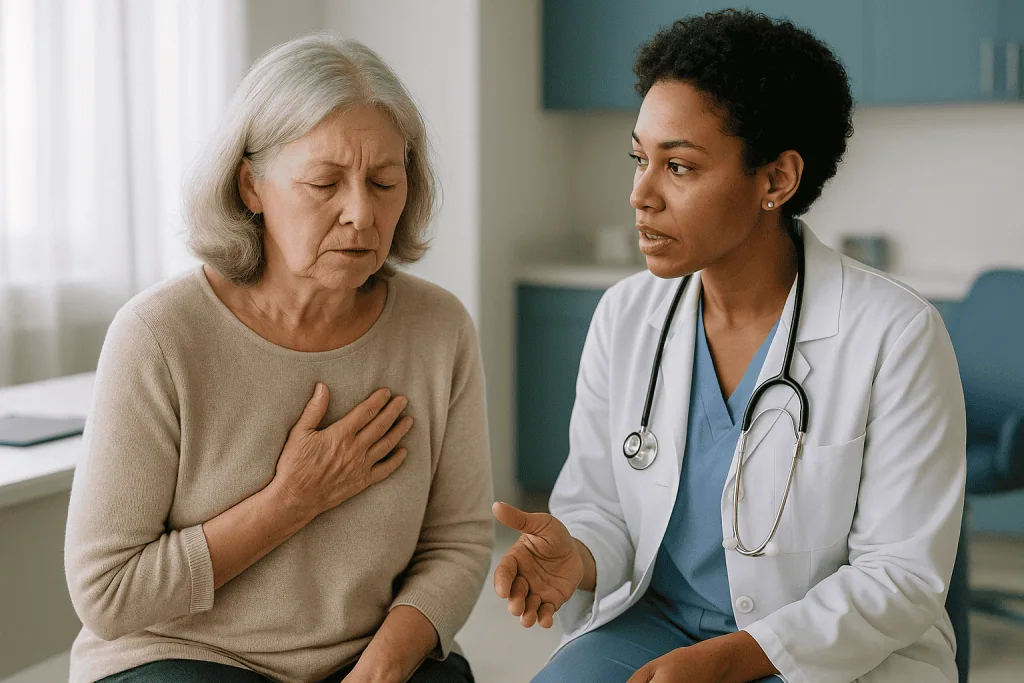
In women over 60, the common presentations include:
- Breathlessness on exertion that has crept up over days or weeks, or sudden breathlessness at rest
- Profound fatigue, sometimes described as ‘flu without the fever’
- Upper back, shoulder or jaw discomfort that comes and goes
- Nausea, loss of appetite or a vague upset stomach
- New confusion, faintness or a fall, particularly in women over 75
- Chest pressure that is milder or briefer than expected
Diabetes matters here because long-standing high blood sugar can damage the nerves that carry pain signals, a condition called autonomic neuropathy. A woman with diabetes may have a sizeable heart attack and feel mainly tired and short of breath.
Two features should raise suspicion regardless of how mild the symptoms sound. The first is novelty: a sensation the person has never had before. The second is exertion: discomfort or breathlessness that arrives with activity and eases with rest, which is the classic signature of angina, the symptom caused by reduced blood flow to the heart muscle.
Older women also face a second-order problem. Studies of emergency care show longer times to diagnosis in older women and lower rates of invasive treatment, partly because frailty and other illnesses complicate decisions, and partly because symptoms are attributed elsewhere. Carrying a written list of current medicines and conditions to the emergency department helps clinicians move faster.
Silent heart attack in women: how can you miss one?
A silent heart attack is one that causes heart muscle damage without symptoms severe enough to send the person for help at the time. It is usually discovered later, when an ECG, a recording of the heart’s electrical activity, or a heart scan shows a scar.
How common is it? Community studies that performed routine ECGs or cardiac MRI on adults found that roughly a third to nearly half of all heart attacks had gone unrecognized. Some analyses suggest the silent share is proportionally higher in women, though absolute numbers are higher in men because men have more heart attacks at younger ages. The evidence is observational, so the exact proportions should be held loosely.
‘Silent’ is also something of a misnomer. In hindsight, many people recall an episode: a week of exhaustion, a bout of ‘indigestion’ that lasted hours, a night of breathlessness blamed on a cold. The event was not symptom-free; the symptoms were unremarkable enough to be filed under something else.
Why does a silent heart attack in women matter if it has already happened? Because the risk afterward is the same as for a recognized heart attack. Scarred heart muscle raises the chance of heart failure, abnormal rhythms and a second event, and people with unrecognized heart attacks miss the medicines, cardiac rehabilitation and risk-factor treatment that would normally follow.
Who should think about this? Women with diabetes, kidney disease or a long history of high blood pressure, and women who have had an unexplained spell of the symptoms above, can reasonably raise it with their clinician. A resting ECG is quick and widely available, though a normal result does not fully exclude past damage; an echocardiogram, an ultrasound of the heart, can show whether a region of muscle is moving weakly.
Women heart disease risk factors: which ones hit harder?
The headline risk factors are the same for everyone: high blood pressure, high LDL cholesterol, diabetes, smoking, obesity, physical inactivity, poor sleep and family history. The nuance is that some weigh more heavily on women.
Diabetes is the clearest example. A 2014 pooled analysis of 64 cohort studies covering more than 850,000 people found that diabetes raised the risk of coronary heart disease about 44 percent more in women than in men, relative to people of the same sex without diabetes. Smoking shows a similar pattern: a 2011 analysis of 75 cohorts found women who smoked carried roughly 25 percent more excess coronary risk than men who smoked. Both findings are observational, meaning they show association rather than proof of cause, but they are large, consistent and biologically plausible.
High blood pressure deserves a second look in women for a different reason. Blood pressure rises more steeply in women after midlife, and women appear to suffer vascular damage at somewhat lower pressures than men. Whether treatment targets should differ by sex is unresolved; current guidelines use the same thresholds.
Then there are factors that are not sex-specific but are more common in women: autoimmune diseases such as lupus and rheumatoid arthritis, which roughly double cardiovascular risk through chronic inflammation; depression and anxiety, associated with higher risk in observational studies; and migraine with aura, linked to a modestly higher risk of stroke and heart disease.
The useful question is not ‘which risk factor is worse for women’ but ‘which of my risk factors is undertreated’. Data from several countries show women with diabetes or high cholesterol are less likely than men to reach treatment targets. That gap is modifiable, and closing it is where most of the benefit lies.
Pregnancy, PCOS and menopause: the risk factors only women carry
Pregnancy has been called nature’s stress test for the heart. Blood volume rises by about half, the heart pumps up to 50 percent more blood per minute, and the vessels have to adapt. Women whose bodies struggle with that load reveal something about their future vascular health.
Preeclampsia, high blood pressure with signs of organ stress after 20 weeks of pregnancy, is associated with roughly double the lifetime risk of heart disease and stroke, and a higher chance of chronic high blood pressure within a decade. Gestational diabetes, high blood sugar first found in pregnancy, raises the later risk of type 2 diabetes several-fold and is linked to around a doubling of cardiovascular risk. Preterm delivery carries a smaller but measurable association. These are observational links, but strong enough that the American Heart Association and the 2025 blood pressure guideline treat them as risk enhancers.
Polycystic ovary syndrome, a hormonal condition marked by irregular periods, excess androgens and often insulin resistance, clusters with obesity, diabetes and high blood pressure. Whether PCOS itself raises heart risk beyond those factors is debated; the association is clear, the independent contribution less so.
Menopause changes the lipid profile. Across the transition, LDL cholesterol tends to rise, fat shifts toward the abdomen, and blood vessels stiffen. Women who reach menopause before 45, and especially before 40, have higher cardiovascular risk in cohort studies. The obvious inference, that replacing estrogen would protect the heart, was tested in the Women’s Health Initiative randomized trials in the early 2000s. Hormone therapy did not reduce heart disease overall and raised stroke and clot risk in older women. Later analyses suggest a more neutral picture when therapy starts near menopause, but no major guideline recommends hormone therapy to prevent heart disease. Any decision about using it for menopausal symptoms belongs with the woman and her prescribing clinician.
Which types of heart disease are more common in women?
When a woman’s arteries look open on an angiogram, an X-ray of the coronary arteries using dye, the conversation sometimes ends with ‘good news, it is not your heart’. Often that is premature. Several conditions produce real cardiac damage with no large blockage, and all are more common in women.
Coronary microvascular dysfunction affects the tiny vessels an angiogram cannot show. They fail to widen properly, or constrict when they should relax, starving the muscle of blood during exertion or stress. Clinicians group this under INOCA, ischemia with no obstructive coronary arteries. Studies of women referred for angiography with chest pain find no major blockage in up to half, and a substantial share of those have measurable microvascular disease.
MINOCA, myocardial infarction with no obstructive coronary arteries, is a true heart attack, with troponin release and muscle damage, in someone whose main arteries are not critically narrowed. It accounts for roughly 5 to 15 percent of heart attacks and is two to three times more common in women than men.
Spontaneous coronary artery dissection, or SCAD, is a tear in the wall of a coronary artery that lets blood pool and squeeze the channel shut. About 90 percent of cases are in women, typically in their 40s and 50s, and it is a leading cause of heart attack during or shortly after pregnancy. It is often misread as a plaque rupture, and the management differs, so recognition matters.
Takotsubo cardiomyopathy, sometimes called broken heart syndrome, is a sudden, usually temporary weakening of the heart’s main pumping chamber, often after intense emotional or physical stress. Roughly nine in ten cases are postmenopausal women. Most recover pumping function within weeks, though the acute phase can be dangerous and recurrence is possible.
How does stress affect heart rate and the heart over time?
Ask how stress affects heart rate and the short answer is: quickly and by design. A perceived threat triggers the sympathetic nervous system to release adrenaline and noradrenaline. Within seconds the heart beats faster and harder, blood pressure climbs, and blood is shunted to muscles. This is a healthy response to an acute problem, and heart rate typically returns to baseline within minutes once the stressor passes.
Chronic stress is a different animal. When the alarm is rarely switched off, resting heart rate drifts up, blood pressure stays elevated for longer, cortisol remains high, and sleep suffers. Observational studies have linked higher activity in the amygdala, the brain’s threat center, to more inflammation in the arteries and to more cardiovascular events over the following years. Large cohorts also associate work strain, caregiving burden and social isolation with higher rates of heart disease, with the associations often stronger in women.
Two cautions keep this honest. Most of the evidence is observational, so it cannot separate stress itself from the behaviors that travel with it, such as poor sleep, smoking and skipped medicines. And the effect sizes, while real, are usually smaller than those of blood pressure or smoking.
Where stress clearly does act directly is in triggering events in people who already have heart disease. Earthquakes, bereavement and intense anger have all been followed by measurable spikes in heart attacks in population studies, and takotsubo cardiomyopathy is the most dramatic example of an emotional trigger producing physical heart injury.
What helps? Randomized trials of stress management within cardiac rehabilitation have shown fewer repeat events, and regular physical activity reliably lowers resting heart rate. These are supports, not substitutes, for treating the measurable risk factors.
Which tests diagnose heart disease in women, and where do they fall short?
No single test diagnoses heart disease in women. The sequence usually runs from simple to detailed, and the skill lies in knowing when a reassuring early result should not end the search.
| Test | What it shows | Sex-specific considerations |
|---|---|---|
| Resting ECG | Electrical pattern; signs of current or past heart attack, rhythm problems | Normal in a meaningful share of heart attacks, more often in women and in non-obstructive disease |
| High-sensitivity troponin | Blood protein released by injured heart muscle | Women have lower normal levels; sex-specific cutoffs detect more heart attacks in women |
| Exercise treadmill ECG | Electrical changes during exertion | More false positives and false negatives in women; often replaced by imaging stress tests |
| Stress echocardiogram or nuclear perfusion scan | Heart motion or blood flow under stress | Better accuracy than treadmill alone; breast tissue can affect nuclear images |
| Coronary CT angiography | Plaque and narrowing in the main arteries | Good at ruling out blockages; cannot see microvascular disease |
| Coronary artery calcium score | Calcified plaque burden | Useful for risk refinement; women develop calcium later, so a zero score is less reassuring in younger women with symptoms |
| Invasive angiography with coronary function testing | Blockages plus how small vessels respond to test drugs | The reference standard for diagnosing INOCA and vasospasm |
| Cardiac MRI | Scar, inflammation, muscle swelling | Key for sorting out MINOCA, myocarditis and takotsubo |
Two rows deserve emphasis. Troponin thresholds were historically set from mixed-sex populations, which meant some women with genuine heart attacks fell below the cutoff. Trials and registries using sex-specific thresholds have identified more heart attacks in women; whether that translates into better outcomes is still being studied.
And the treadmill test, long the default, performs worst in exactly the group most likely to have non-obstructive disease. A woman with convincing exertional symptoms and a normal treadmill result has not been cleared. The next step, and whether it is needed, is the cardiologist’s call.
What the evidence actually says
Grading the strength of each claim matters, because the strongest-sounding statements online are often the weakest-supported.
- Heart disease is the leading cause of death in women. Strong. National vital statistics from the CDC and WHO, not estimates.
- Women more often report non-chest symptoms during a heart attack. Moderate. Large registries and prospective studies agree on the direction; the size of the difference varies with how symptoms are asked about.
- Diabetes and smoking carry more excess risk in women. Moderate. Consistent pooled observational data across dozens of cohorts; no randomized trial can test this.
- Pregnancy complications predict later heart disease. Moderate. Large cohort and registry studies spanning decades; mechanism plausible, causation unproven.
- Hormone therapy prevents heart disease. Not supported. Randomized trials, the highest grade of evidence, found no overall protection and some harm in older women. Observational hints of benefit near menopause remain unconfirmed.
- Women receive less guideline-based care after a heart attack. Moderate to strong. Repeated in registries from multiple countries; the causes are multiple.
- Sex-specific troponin thresholds improve outcomes. Preliminary. They identify more heart attacks in women; outcome benefit is still under study.
- Stress causes heart disease. Weak to moderate. Observational associations, plus clear evidence of stress as a trigger in people with existing disease.
- Women need different lifestyle advice. Not supported. The protective effects of activity, not smoking, blood pressure control and a Mediterranean-style diet look similar in both sexes in trials and cohorts.
The pattern is instructive. The claims about mortality and under-treatment rest on hard counts. The claims about biology rest on good observational work with honest uncertainty. The claims that circulate most freely, that women’s heart attacks are painless or that hormones are the fix, rest on the least.
Common myths about heart disease in women
Myth: Women do not get chest pain during a heart attack. Chest pain or pressure remains the single most common symptom in women. The accurate version is that women are more likely to have other symptoms alongside it, or occasionally instead of it.
Myth: Heart disease is a man’s problem; cancer is the threat for women. Heart disease kills more women each year than all cancers combined, including breast cancer. Breast cancer is the more feared diagnosis, not the more frequent cause of death.
Myth: A normal angiogram means it is anxiety. Up to half of women referred for angiography with chest pain have no major blockage, and many of those have microvascular dysfunction or spasm that an angiogram alone cannot detect. Anxiety can coexist with heart disease; it is not a diagnosis of exclusion.
Myth: Young women are safe. Heart attack rates in women under 55 have not fallen the way they have in older groups, and some registries show an increase. SCAD, pregnancy-related events and uncontrolled risk factors account for much of this.
Myth: Hormone therapy protects the heart. Randomized trials showed no overall protection. Hormone therapy has legitimate uses for menopausal symptoms, but heart protection is not one of them under any current guideline.
Myth: If the heart attack was ‘mild’ or ‘silent’, nothing needs to change. Any heart attack signals the same future risk and calls for the same follow-up, medicines and rehabilitation.
Myth: Daily aspirin is a sensible precaution for every woman over 50. Guidelines no longer recommend routine aspirin for prevention in people without known heart disease, because bleeding risk can outweigh benefit. Whether it is right for an individual is a prescribing decision, not a pharmacy-aisle one.
Cardiac blues and anxiety after a heart attack: how to help someone
The first weeks after a heart attack can bring an emotional slump that clinicians sometimes call the cardiac blues: tearfulness, irritability, poor sleep, a sense of fragility, and sudden fear at every twinge. It is extremely common and, for most people, lifts within two to three months as confidence returns.
Anxiety is common after a heart attack too, affecting a sizeable minority of patients in the first year, and depression is diagnosed in roughly one in five. Women report both more often than men in most studies, and both are associated with poorer recovery and more repeat events in observational data. That association is one reason major cardiology guidelines recommend screening for depression after a cardiac event.
How to help someone with cardiac blues:
- Normalize it without minimizing it. Hearing that the slump is expected, and usually temporary, reduces the fear that something else is wrong.
- Encourage cardiac rehabilitation. Structured programs of supervised exercise, education and psychological support are backed by randomized trials and meta-analyses showing fewer hospital readmissions and better quality of life. Women are referred and enrolled less often than men, so a nudge matters.
- Carry some of the practical load. Driving to appointments, organizing medicine routines and cooking a few heart-friendly meals free up energy for recovery.
- Watch the calendar. Low mood still heavy at eight weeks, or that includes hopelessness, loss of interest in everything, or thoughts of self-harm, has moved beyond the blues and needs clinical attention.
- Resist policing every step. Fear in a partner can tip into surveillance, which fuels the patient’s own anxiety.
Sexual activity, returning to work and travel are frequent worries. Cardiac rehabilitation teams address all three, and the answers are usually more permissive than patients expect.
When to see a doctor
Call emergency services, without waiting to see if it passes, for any of the following, whether or not chest pain is present:
- Pressure, squeezing, fullness or pain in the center of the chest lasting more than a few minutes, or going away and returning
- Discomfort spreading to the back, jaw, neck, shoulders or one or both arms
- Sudden shortness of breath, especially with nausea, a cold sweat or lightheadedness
- Fainting, near-fainting or a rapid irregular heartbeat that does not settle
- Sudden weakness or numbness on one side, facial droop, confused speech or vision loss, which point to stroke
Registry studies show women delay calling for help longer than men, often because they doubt their symptoms qualify. Emergency clinicians would rather see ten false alarms than miss one heart attack; the price of an unnecessary trip is an afternoon, the price of a missed event can be permanent muscle damage.
Book a routine appointment, within days rather than weeks, for:
- Breathlessness, chest tightness or unusual fatigue that comes with exertion and eases with rest
- A history of preeclampsia, gestational diabetes or early menopause with no recent cardiovascular risk review
- Swelling of the ankles, new difficulty lying flat, or waking at night short of breath
- Palpitations that are becoming more frequent
- Any question about starting, stopping or changing a prescribed heart medicine
Bring a list of symptoms with dates, any home blood pressure readings, and your pregnancy history. Ask directly what your estimated 10-year risk is and which number is driving it. Every decision about testing or treatment belongs with the clinician who knows your full picture, but the questions you bring shape how far that conversation goes.
Frequently asked questions
What are the first signs of heart disease in women?
Early signs are often exertional: breathlessness, chest tightness or unusual fatigue that appears with activity and eases with rest. Women also report jaw, neck or upper back discomfort, nausea and sleep disturbance more often than men. Because these overlap with many benign conditions, a pattern that is new and linked to exertion is the signal worth reporting to a clinician.
Is heart disease really the leading cause of death in women?
Yes. CDC vital statistics show heart disease killed about 310,000 women in the United States in 2021, roughly one in every five female deaths, and it has held the top position for decades. Cardiovascular disease as a whole, which also includes stroke, accounts for about one in three female deaths according to the American Heart Association.
How are menopause and heart disease connected?
Menopause coincides with a rise in LDL cholesterol, a shift of fat toward the abdomen and stiffer blood vessels, and heart disease rates in women climb afterward. Women who reach menopause before 45 show higher risk in cohort studies. Randomized trials found hormone therapy does not prevent heart disease, so menopause is treated as a time to review risk factors, not to start hormones for heart protection.
How does stress affect heart rate?
Acute stress releases adrenaline, which raises heart rate and blood pressure within seconds and normally settles within minutes. Chronic stress keeps resting heart rate and blood pressure higher for longer and is associated, in observational studies, with arterial inflammation and more cardiovascular events. In people who already have heart disease, intense stress can trigger a heart attack or takotsubo cardiomyopathy.
Is anxiety common after a heart attack?
Very common. A sizeable minority of patients experience clinically significant anxiety in the first year, depression affects roughly one in five, and women report both more often than men. Both are linked to poorer recovery in observational data, which is why guidelines recommend screening. Cardiac rehabilitation, which includes psychological support, is backed by randomized trials for improving quality of life and reducing readmissions.
How do you help someone with cardiac blues?
Reassure them that a low, tearful, fragile period in the first weeks after a heart attack is expected and usually lifts within two to three months, encourage enrollment in cardiac rehabilitation, take on practical tasks, and avoid hovering over every movement. If mood is still heavy at about eight weeks, or includes hopelessness or thoughts of self-harm, it needs clinical assessment.
Can a woman have a normal ECG and still be having a heart attack?
Yes. A resting ECG is normal in a meaningful share of heart attacks, and this happens more often in women and in heart attacks without a complete blockage. That is why emergency teams pair the ECG with repeated troponin blood tests, ideally using sex-specific thresholds, and may add an echocardiogram or further imaging when symptoms remain convincing.
Does hormone therapy prevent heart disease in women?
No major guideline recommends it for that purpose. The Women’s Health Initiative randomized trials found hormone therapy did not reduce heart disease overall and increased stroke and clot risk in older women. Later analyses hint at a more neutral effect when started near menopause, but that remains unconfirmed. Whether to use it for menopausal symptoms is a decision for the woman and her prescribing clinician.
At what age does heart disease in women usually start?
Women typically develop coronary artery disease about a decade later than men, with rates rising sharply after menopause, so most first heart attacks in women occur after 65. The decade gap is an average, not a guarantee. Women with diabetes, smoking, early menopause, pregnancy complications or SCAD can have events in their 40s and 50s, and heart attack rates in women under 55 have not fallen.
What is broken heart syndrome and why does it mostly affect women?
Broken heart syndrome, or takotsubo cardiomyopathy, is a sudden and usually temporary weakening of the heart’s main pumping chamber, often after severe emotional or physical stress, that mimics a heart attack without a blocked artery. About nine in ten cases occur in postmenopausal women. The leading theory involves a surge of stress hormones affecting heart muscle, possibly made more likely by the loss of estrogen.
References
This article is for general information only and is not a substitute for professional medical advice. Please consult a qualified doctor about your individual situation.

More from the Blog

Heart Bypass Recovery Week by Week: From Intensive Care to Your First Walks Outside
Recovery after heart bypass surgery typically unfolds over about 12 weeks. Most people spend a day or two in intensive care, around a week…

Living With a Cardiometabolic Disorder: What Regular Monitoring Visits Actually Track
Regular monitoring visits for a cardiometabolic disorder track a small set of linked measures: blood pressure, blood sugar (usually A1c), a cholesterol panel, weight…

Permanent Pacemaker Recovery: Why Your Arm Stays Below Shoulder Level for Several Weeks
After a permanent pacemaker is implanted, most people are asked to keep the arm on the device side below shoulder height for roughly four…

The First 48 Hours After Carotid Angiography: Rest, Fluids and the Lifting Limit
After a carotid angiogram, most people lie flat for a few hours while the puncture site seals, drink extra fluids to help the kidneys…

What Coronary Angiography Results Lead To: Medication, Angioplasty, Stenting or Surgery
Coronary angiogram results usually lead to one of three paths: medication and risk-factor control when narrowings are mild or stable; angioplasty with a stent…

When Is an Aortic Problem Watched, Medicated or Repaired? How Doctors Decide the Path
Doctors decide by asking three questions: is the problem a bulge (aneurysm) or a tear (dissection), where on the aorta does it sit, and…