

How Benign Prostatic Hyperplasia Progresses: Weak Flow, Night Waking and Planning Care Early

Key Takeaways
- BPH affects about half of men aged 51 to 60 and up to 90 percent of men over 80, according to the NIDDK, yet it is non-cancerous and does not turn into cancer.
- Symptoms of obstruction, such as hesitancy and a weak stream, usually appear before storage symptoms like urgency and night waking, which come from the bladder's response rather than the gland itself.
- In the MTOPS trial, untreated men progressed at roughly 4.5 events per 100 per year, most of them symptom-score rises rather than emergencies, and larger glands with higher PSA predicted who would worsen.
- Night waking is often driven partly by overnight urine overproduction from heart, sleep or medicine factors, so a three-day bladder diary can change the treatment plan.
- Alpha-blockers relax muscle and typically act within days, while 5-alpha-reductase inhibitors shrink the gland and can take up to six months, so review timelines differ by class.
- Saw palmetto performed no better than placebo in two NIH-funded trials, and no food or supplement has been shown to shrink an enlarged prostate.
Benign prostatic hyperplasia (BPH) usually progresses slowly over years as the prostate enlarges and squeezes the urethra: a weaker, hesitant stream and more frequent trips to the bathroom tend to come first, with night waking following as the bladder stores less and empties less completely. Progression is not inevitable; symptoms often plateau, and monitoring, lifestyle changes, medicines or procedures are decided with a clinician.
The first clue is rarely dramatic. A man in his late fifties notices that the stranger at the next urinal finishes first, every time. The stream that used to arrive on demand now needs a second of coaxing. A few months later there is a new habit: scanning the restaurant for the restroom before choosing a table. Then the 3 a.m. trip to the bathroom becomes two trips, and the alarm clock starts to feel optional.
Each of those moments is a small window into how BPH progresses. The pattern is so familiar that it is often waved away as “just getting older,” which is partly true and partly a trap. The enlargement itself is benign, but the bladder downstream keeps score, and the changes it makes in response are the part that matters most.
This explainer walks through what is physically happening, which signs suggest things are likely to worsen, what the common treatment paths involve, and why planning care early usually means more choices rather than more interventions.
What is the prostate, and why does it keep growing?
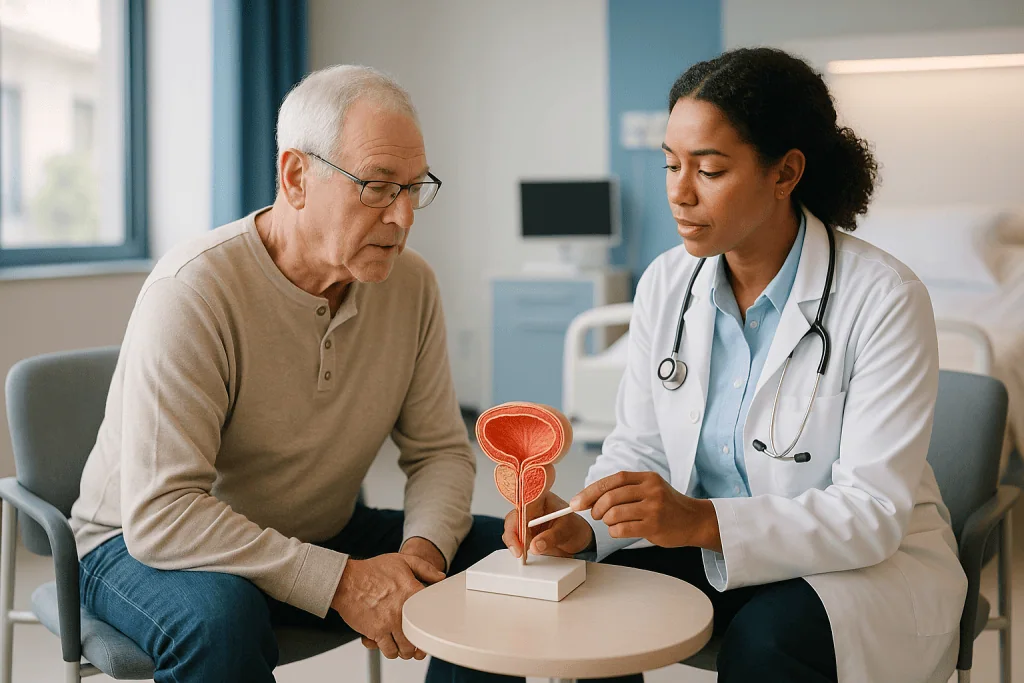
The prostate is a small gland, roughly the size of a walnut, that sits just below the bladder and wraps around the urethra, the tube that carries urine out of the body. Its job is reproductive: it makes part of the fluid that carries sperm. That job has nothing to do with urine, which is exactly why its location causes so much trouble. Any growth happens right where the plumbing is narrowest.
The gland grows twice in a lifetime. The first spurt comes with puberty. The second begins around the mid-twenties and simply never stops, which is why benign prostatic hyperplasia (BPH), the medical name for non-cancerous enlargement, is so tightly linked to age. The National Institute of Diabetes and Digestive and Kidney Diseases (NIDDK) estimates that BPH affects about half of men between 51 and 60, and as many as 90 percent of men older than 80.
Nobody has fully explained why the growth continues. The strongest evidence points to hormones. Testosterone is converted inside prostate cells into a more potent form called dihydrotestosterone (DHT), and DHT drives cell growth in the gland’s inner ring, known as the transition zone. Men who lost testicular function before puberty do not develop BPH, which is one reason researchers are confident the hormone pathway matters. Family history, obesity, diabetes and heart disease each appear to nudge the odds upward, though none acts alone.
One point worth fixing in mind early: “benign” is doing real work in that name. BPH is not cancer and does not turn into cancer. The two conditions can share the same gland, which is why routine checks still make sense, but enlargement is a separate process with its own story.
How BPH progresses: what actually happens inside the gland and the bladder
Think of the urethra as a garden hose running through the middle of a slowly inflating sponge. Two things narrow it. The first is sheer bulk: more tissue pressing inward. Clinicians call this the static component. The second is muscle tone. The prostate and bladder neck are laced with smooth muscle that tightens in response to adrenaline-type signals, and that squeeze is the dynamic component. Stress, cold weather and some cold remedies can tighten it further, which explains why symptoms can swing from one week to the next while the gland itself has not changed size at all.
Flow through a tube falls off steeply as the channel narrows, far more than most people expect. A modest reduction in diameter can halve the rate at which urine leaves, so the bladder has to push harder to achieve the same result.
Here the bladder starts adapting, and this is the real engine of progression. In the early phase the bladder wall muscle thickens, much as a bicep does under load, and emptying stays reasonably complete. In the middle phase that thickened, overworked muscle becomes twitchy: it contracts at lower volumes, producing urgency and frequent small voids. In the later phase the muscle can begin to tire. Urine is left behind after each void, the bladder stretches, and in some people it eventually loses much of its ability to contract at all.
Those residual volumes are what set up the serious complications the NHS lists: urinary tract infections, bladder stones, sudden inability to urinate, and in rare cases pressure backing up toward the kidneys. Understanding how BPH progresses, then, is less about the prostate’s size and more about how long the bladder has been compensating.
Enlarged prostate symptoms: the early pattern most people notice first
Clinicians sort enlarged prostate symptoms into two families, and the order in which they appear tells you something about where a person is on the curve. The first family is about getting urine out. Mayo Clinic and the NHS describe hesitancy (a pause before the stream starts), a weaker or thinner stream, a flow that stops and starts, straining, dribbling at the end, and the sense that the bladder has not quite emptied. These are the obstruction symptoms, and they usually show up first, often so gradually that people adjust without noticing.
The second family is about storing urine: needing to go more often by day, needing to go urgently, and waking at night. These come from the bladder’s response to obstruction rather than from the prostate directly, which is why they can arrive later and can feel more disruptive. A weak stream is an inconvenience. Urgency decides where you sit in the cinema.
Two caveats matter here. First, size and symptoms do not track closely. Mayo Clinic notes that some men with only slight enlargement have significant symptoms, while others with very large glands have few. Second, this pattern is not unique to BPH. Infection, an overactive bladder, diabetes, neurological conditions, prostate inflammation and, less commonly, prostate or bladder cancer can produce overlapping symptoms. That is why a clinician will usually ask for a urine test, a blood test for prostate-specific antigen (PSA, a protein released by prostate tissue), an examination, and sometimes a flow measurement and an ultrasound check of how much urine remains after voiding. The symptoms open the conversation; the tests settle it.
Why night waking shows up, and why it is not always the prostate
Nocturia, the medical term for waking from sleep to urinate, is the symptom people complain about most, and it is also the one most often blamed on the prostate when something else is responsible. The BPH mechanism is straightforward: an overworked bladder holds less, and if it is also leaving urine behind, it refills to its new, lower trigger point faster. Two or three awakenings a night can follow from that alone.

But the bladder is only half of the equation. The other half is how much urine the kidneys make overnight. Normally the body shifts into a conserving mode during sleep. In some people, particularly as they age, that night-time dip weakens and the kidneys keep producing at daytime rates, a pattern called nocturnal polyuria. Heart failure, poorly controlled diabetes, obstructive sleep apnea, swollen ankles that drain back into the circulation once a person lies flat, diuretic medicines taken late in the day, and a large evening fluid or alcohol intake can all drive it. A man with a modestly enlarged prostate and untreated sleep apnea may blame the gland for a problem the gland is only partly causing.
This is where a simple tool earns its keep. A frequency-volume chart, sometimes called a bladder diary, records the time and amount of every void over three days or so. If most of the day’s total output happens overnight, the problem leans toward production rather than storage, and prostate treatment alone is unlikely to fix the alarm-clock problem. Clinicians following NHS and Mayo Clinic guidance routinely ask for this record because it changes the plan. For the person filling it in, it also replaces a vague sense of “too often” with numbers that can be tracked over time.
Are there BPH stages? How BPH progresses over the years
People search for “BPH stages” expecting something like cancer staging, with numbered tiers that predict what comes next. BPH does not work that way. There is no formal staging system. Instead, clinicians describe where someone is using a handful of measurements: a symptom questionnaire, the International Prostate Symptom Score, scored from 0 to 35 and grouped into mild, moderate and severe bands; the peak flow rate; the volume left after voiding; prostate size on ultrasound; and PSA level, which rises with gland volume as well as with other conditions.
What those measurements predict is best known from a large trial run by the US National Institutes of Health called MTOPS, which followed more than 3,000 men with moderate to severe symptoms for an average of four and a half years. Researchers defined “clinical progression” as any of five events: a four-point worsening in the symptom score, acute urinary retention, new incontinence, a urinary infection, or a decline in kidney function. Among men receiving placebo, progression occurred at a rate of about 4.5 events per 100 men per year, and the large majority of those events were symptom-score rises rather than emergencies. Men with larger glands and higher PSA levels were considerably more likely to progress and to end up needing surgery.
Two honest conclusions follow. First, most men with BPH do not face a steady downhill slide; symptoms frequently fluctuate and can plateau for years. Second, the people most likely to worsen are identifiable in advance with ordinary tests, which is the entire argument for planning care early. A larger prostate with a higher PSA, a low flow rate and a meaningful residual volume is a different conversation from a small gland with bothersome but stable symptoms, even when the symptom scores look identical on paper.
Who is usually offered treatment now, and who is usually asked to wait
The single most useful question in a BPH consultation is not “how big is it?” but “how much does it bother you?” Guidance from the NHS and Mayo Clinic is consistent on this point: mild symptoms that do not interfere with life are usually managed with watchful waiting, meaning lifestyle adjustments and a scheduled check-in rather than medicine. Waiting here is active, not passive. Symptom scores, flow and residual volume are repeated, typically once a year, so that any drift is caught early.
Treatment is usually discussed when symptoms are moderate or severe and bothersome, when lifestyle measures have been tried and have not helped enough, or when the measurements suggest the bladder is under strain. Certain findings move the conversation beyond waiting regardless of how a person feels: a large volume of urine left after voiding, repeated infections, blood in the urine traced to the prostate, bladder stones, an episode of acute retention, or any sign that the kidneys are affected. In those situations the NHS lists surgery or other procedures as the usual route, because the bladder’s reserve is at stake.
Some people are asked to wait for a different reason. An untreated infection, uncontrolled diabetes or recent heart problems may need sorting first. A person whose main symptom is nocturia from night-time urine overproduction may be steered toward treating that cause before anything is done to the prostate. And a man whose symptoms are mild but whose PSA is unexpectedly high may be asked to pause for further checks, since PSA cannot distinguish enlargement from other conditions on its own.
None of this is a formula. The treating team weighs symptoms, measurements, other health conditions and the person’s own priorities, and the choice sits with them together.
How to reduce enlarged prostate symptoms without a prescription
The question “how to reduce enlarged prostate” usually means “how do I shrink it,” and the plain answer is that no lifestyle change shrinks the gland. What lifestyle can do, and the NHS is explicit about this, is reduce how much the enlargement intrudes on daily life. For many men with mild symptoms, that is enough.
Timing of fluids matters more than total volume. Cutting back sharply on water is a mistake; concentrated urine irritates the bladder and raises infection risk. Shifting intake earlier in the day and tapering in the two to three hours before bed, while trimming caffeine, alcohol and fizzy drinks, which all irritate the bladder or increase urine production, is the pattern the NHS recommends. Alcohol in the evening is a particular offender because it both increases production and dulls the signal to wake.
Technique helps as well. Double voiding means urinating, waiting a few moments, and trying again, which can reduce the residual volume. Bladder training, gradually stretching the interval between voids by a few minutes at a time, retrains an irritable bladder to tolerate larger volumes. Pelvic floor exercises can reduce after-dribble. Treating constipation relieves pressure on the bladder and urethra from a full rectum.
Finally, a medicine review is worth asking for. Decongestants and some antihistamines tighten the smooth muscle around the prostate and can tip a borderline bladder into retention. Diuretics taken late in the day drive night-time urine. Some antidepressants and bladder-relaxant drugs reduce the bladder’s ability to contract. Nobody should stop a prescribed medicine on their own, but a pharmacist or prescriber can often adjust timing or alternatives in ways that make a noticeable difference.
What BPH medicines actually do, and how long they typically take
Medicines for BPH target one of the two components described earlier, and knowing which one a drug acts on explains both its speed and its limits.
Alpha-blockers relax the smooth muscle in the prostate and bladder neck: the dynamic component. Because they loosen rather than shrink, they tend to work quickly. Mayo Clinic notes that improvement is often noticed within days. The gland itself is unchanged, so they do not alter the long-term growth trajectory. Common side effects include dizziness on standing, tiredness and changes in ejaculation, and they can complicate cataract surgery, which is why eye surgeons ask about them.
5-alpha-reductase inhibitors block the enzyme that converts testosterone to DHT, the hormone driving gland growth. Over time the prostate shrinks, which addresses the static component. The NIDDK notes that this class can take up to six months to show its full effect, and it is generally more useful for larger glands. In the MTOPS trial, this class, alone or combined with an alpha-blocker, reduced the risk of acute retention and of needing surgery, while the combination lowered overall progression risk by about two thirds compared with placebo. Possible side effects include reduced libido and erectile changes, and the drugs roughly halve PSA readings, which clinicians account for when interpreting results.
Two other classes appear in guidance. A phosphodiesterase-5 inhibitor originally developed for erectile dysfunction is approved for BPH symptoms, and bladder-calming medicines (anticholinergics and beta-3 agonists) are sometimes added when storage symptoms dominate and residual volumes are low.
Which class, whether to combine, and when to reassess are decisions for the prescribing clinician, who will weigh gland size, PSA, other medicines and the person’s own priorities.
Procedures for BPH compared: what each one changes
When medicines are not enough, or when complications have appeared, the options are procedural. They all share one goal, widening the channel through the prostate, but they get there in different ways and carry different trade-offs. The table summarizes the main approaches described by Mayo Clinic and the NHS. None is “best”; suitability depends on gland size, anatomy, other health conditions and what side effects a person is prepared to accept.
| Procedure | What it does | Typically considered for | Points to discuss |
|---|---|---|---|
| Transurethral resection of the prostate (TURP) | Removes obstructing tissue through the urethra with an electrical loop | Small to moderately large glands; long track record | Short hospital stay and catheter; retrograde ejaculation common; bleeding risk |
| Laser enucleation or vaporization | Removes or vaporizes tissue with laser energy | Wide range of sizes, including large glands for enucleation | Less bleeding than TURP in many series; retrograde ejaculation common |
| Prostatic urethral lift | Small implants hold the lobes apart without removing tissue | Smaller glands without a central lobe | Preserves ejaculation in most; symptom relief may be more modest; retreatment possible |
| Water vapor thermal therapy | Steam injections destroy tissue, which the body resorbs over weeks | Small to moderate glands | Office-based; temporary catheter; results develop over several weeks |
| Prostate artery embolization | Blocks blood supply to shrink the gland | Men unsuitable for or avoiding surgery | Longer-term evidence still accumulating; performed by interventional radiology |
| Simple prostatectomy (open or robotic) | Removes the inner gland through an incision | Very large glands | Larger operation; longer recovery; durable relief |
Two patterns recur across these options. Procedures that remove more tissue tend to give larger and more durable relief but are more likely to change ejaculation. Procedures that remove little or none preserve sexual function more often but may need repeating. The treating team can explain which trade-off fits a particular gland and a particular person.
What the following weeks and months usually look like
BPH is a slow condition, and its care unfolds slowly too. For someone on watchful waiting, the first few weeks are mostly about measurement: a bladder diary, a symptom questionnaire, perhaps a second flow test to confirm the first. Lifestyle changes are given a fair trial, usually a few weeks, before anyone concludes they have not helped.
If an alpha-blocker is started, clinicians generally review after a short interval, since Mayo Clinic notes that benefit usually appears within days and side effects such as dizziness tend to declare themselves early. If a 5-alpha-reductase inhibitor is started, the review horizon stretches, because the NIDDK describes an effect that builds over up to six months. People sometimes stop these medicines in month two convinced they are useless, when the gland has barely begun to respond. That decision belongs with the prescriber, who can explain the expected timeline for that individual.
After a procedure, the first days usually involve a catheter for a short period, then some burning, urgency and blood-tinged urine as the lining heals. Mayo Clinic advises expecting several weeks before the flow settles into its new pattern, and tissue-removing operations commonly bring a period of urgency before the irritated bladder calms. Water vapor therapy reverses the sequence: things can feel worse for a few weeks while treated tissue is resorbed, then improve. Heavy lifting and straining are typically restricted for a few weeks to protect the healing surface.
Longer term, follow-up continues whichever path was taken, because the underlying growth process does not stop. Annual symptom scores, a PSA reading interpreted in light of any medicines, and a residual-volume check are the usual markers. The point of early planning is that these later check-ins become routine confirmation rather than crisis management.
What are the best foods for prostate health? What the evidence really says
Search for prostate foods and you will find confident lists: tomatoes, pumpkin seeds, green tea, salmon, broccoli. The honest summary is that no food has been shown in rigorous trials to shrink an enlarged prostate or to reverse how BPH progresses. What the evidence does support is less exciting and more useful.
Observational studies link obesity, type 2 diabetes and low physical activity with larger prostates and worse symptoms, and Mayo Clinic lists these among risk factors. The direction of travel, then, favors an eating pattern that keeps weight and blood sugar steady: plenty of vegetables, fruit, whole grains, legumes and fish, with less red and processed meat and fewer sugary drinks. That is the same pattern the American Heart Association recommends for the heart, and a man with BPH is far more likely to be affected by cardiovascular disease than by his prostate. Eating for the heart and eating for the prostate turn out to be the same meal.
Supplements deserve a plainer verdict. Saw palmetto is the most studied. Two large trials funded by the US National Institutes of Health, including one that tested up to three times the usual amount, found it no better than placebo for BPH symptoms, as the National Center for Complementary and Integrative Health summarizes. Beta-sitosterol, pygeum and rye grass pollen have small or low-quality studies and no guideline endorsement. None is known to be dangerous in ordinary amounts, but none should replace evaluation, and anyone taking them should tell their clinician, partly because some can interact with other medicines.
A short list, then, for the person who wants one: eat for the heart, keep moving, keep weight in a healthy range, go easy on evening caffeine and alcohol, and spend the supplement money on good shoes.
What people often get wrong about an enlarged prostate
Misunderstandings about BPH are common enough that several deserve direct correction.
“An enlarged prostate means cancer, or will become cancer.” BPH is non-cancerous and does not transform into cancer. The two can coexist, so a raised PSA or an unusual examination still needs checking, but enlargement itself is not a warning of malignancy. Mayo Clinic and the NIDDK are unambiguous on this.
“Bigger gland, worse symptoms.” The correlation is weak. Symptom severity depends on where the tissue grows, the muscle tone around the urethra, and how the bladder has adapted. A modest gland growing inward can cause more trouble than a large one growing outward.
“Drinking less will help.” Restricting fluid overall concentrates urine, irritates the bladder and raises infection risk. Shifting fluid earlier in the day is the useful move; drying out is not.
“Symptoms only ever get worse.” The MTOPS trial found that most untreated men did not reach a progression event over four and a half years, and symptoms in daily life often rise and fall with stress, weather, infections and alcohol. Steady decline is one path, not the only one.
“Sex makes it worse,” or “BPH ends sex life.” Sexual activity does not drive prostate growth. Some treatments do affect ejaculation or erections, which is a reason to raise sexual function in the consultation, not a reason to avoid treatment.
“A supplement can shrink it.” No supplement has done so in well-designed trials.
“Surgery is the end of the road.” Procedures are increasingly offered earlier, before the bladder has lost reserve, and several minimally invasive options exist for men who want to avoid a full operation. Waiting until retention forces the issue tends to narrow the choices rather than widen them.
Questions to ask your care team
A BPH consultation goes better when the person arriving has a few specific questions ready. The ones below are drawn from what patients most often wish they had asked.
- Based on my symptom score, flow rate, residual volume, prostate size and PSA, where do I sit on the spectrum from mild to severe, and which of those numbers concerns you most?
- Do my night-time symptoms look like a bladder problem, a urine-production problem, or both? Would a bladder diary change the plan?
- Which of my current medicines, including over-the-counter ones, could be making this worse, and could timing be adjusted?
- If we start a medicine, what should I notice, how soon, and when will you review it?
- How will this medicine affect my PSA readings and my sexual function?
- What would make you recommend a procedure rather than continuing medicines, and what signs should prompt me to come back sooner?
- Of the procedures suitable for my gland size, which preserve ejaculation, which are most durable, and what are the realistic trade-offs for me specifically?
- What is my risk of acute retention, and what should I do if I suddenly cannot pass urine?
- How often will we repeat tests, and which results would change the plan?
- Is there anything about my heart, kidneys, diabetes or other conditions that shapes which options are safe for me?
Writing the answers down during the appointment is worth the mild awkwardness. BPH care is a long relationship, and the numbers from this visit become the baseline against which the next ones are judged.
When to call your doctor
Most of the BPH story is slow, which makes the fast parts easy to miss. The following signs call for prompt contact with a clinician, and in some cases an emergency department, rather than waiting for the next scheduled visit.
The clearest red flag is being unable to pass urine at all, especially with a swollen, painful lower abdomen. This is acute urinary retention. The bladder has stopped emptying, it can stretch to the point of injury within hours, and it needs a catheter placed urgently. It sometimes follows a cold remedy, an alcohol-heavy evening, prolonged holding, or surgery for something else.
Blood in the urine should always be reported, even once, even if painless. BPH can cause it, but so can bladder and kidney conditions that need their own assessment. Fever, chills, back or flank pain, or burning with urination suggest infection that may have reached the kidneys or prostate and usually needs same-day attention. A sudden change in a previously stable pattern, such as new dribbling incontinence after years of a weak stream, can signal an overfilled bladder spilling over and deserves an early review. Pain in the lower abdomen, reduced urine output despite drinking normally, swelling of the legs, or unexplained nausea and tiredness can indicate that pressure is affecting the kidneys and should be checked without delay.
After a procedure, heavy bleeding with clots, inability to urinate once the catheter is out, fever, or worsening pain all warrant a call to the treating team the same day.
None of these signs is a diagnosis. Each is a reason to let a clinician decide, and deciding early is almost always easier than deciding late.
Frequently asked questions
What is the prostate and what does it do?
The prostate is a walnut-sized gland below the bladder that surrounds the urethra and produces part of the fluid in semen. It has no role in making or storing urine, but because the urethra runs through it, any enlargement narrows the channel urine must pass through. The gland grows at puberty and again, slowly and continuously, from early adulthood onward.
What are the common symptoms of prostate problems?
Common enlarged prostate symptoms fall into two groups: difficulty passing urine (hesitancy, a weak or stop-start stream, straining, dribbling, a feeling of incomplete emptying) and difficulty storing it (frequent or urgent trips, waking at night). These overlap with infection, overactive bladder, diabetes and other conditions, so a clinician uses examination, urine and PSA tests, and sometimes flow and ultrasound checks to confirm the cause.
Are there BPH stages like there are for cancer?
No. BPH has no formal staging system. Clinicians describe severity using a symptom score grouped into mild, moderate and severe bands, plus flow rate, the urine left after voiding, prostate size and PSA level. Research such as the MTOPS trial defined progression as a four-point rise in the symptom score, acute retention, incontinence, infection or kidney impairment, and found most untreated men did not reach those events over four and a half years.
How to reduce enlarged prostate symptoms naturally?
Nothing natural shrinks the gland, but several habits reduce symptoms. The NHS suggests cutting caffeine, alcohol and fizzy drinks, moving fluid intake earlier in the day, double voiding, bladder training to stretch the time between trips, treating constipation, and reviewing medicines such as decongestants that tighten the prostate. These help most when symptoms are mild and are monitored alongside regular checks.
What are the 10 best foods for prostate health?
No specific food has been proven to shrink an enlarged prostate or slow BPH in rigorous trials. The evidence supports a heart-healthy pattern, since obesity and diabetes are linked with worse symptoms: vegetables, fruit, whole grains, legumes, nuts, fish, olive oil and less red or processed meat and sugar. Tomatoes, broccoli and green tea appear on popular lists but their benefit for BPH is unproven. Eating for the heart covers the prostate too.
Does an enlarged prostate always get worse?
Not necessarily. Symptoms often fluctuate with stress, cold weather, infections, alcohol and medicines, and many men stay stable for years. The MTOPS trial found progression at roughly 4.5 events per 100 men per year among those on placebo, with larger prostate volume, higher PSA, lower flow and more residual urine predicting who was likelier to worsen. Those measurements let clinicians identify higher-risk people early.
Why do I wake up at night to urinate if the problem is my prostate?
An obstructed bladder thickens and becomes irritable, holding less and triggering earlier, and any urine left after voiding shortens the time until it refills. Separately, some people produce a larger share of their urine overnight because of heart conditions, sleep apnea, diabetes, leg swelling, evening fluids or diuretics. A bladder diary helps a clinician tell these causes apart, because they need different treatment.
How long do BPH medicines take to work?
It depends on the class. Alpha-blockers relax the muscle around the prostate and, per Mayo Clinic, often improve flow within days. 5-alpha-reductase inhibitors shrink the gland by blocking DHT production and, according to the NIDDK, can take up to six months for full effect. The prescribing clinician sets the review timeline and decides whether a medicine should continue, change or be combined.
Can an enlarged prostate turn into prostate cancer?
No. Benign prostatic hyperplasia is a non-cancerous overgrowth, usually in the inner part of the gland, and it does not transform into cancer. The two conditions can exist in the same prostate, and both can raise PSA, which is why an unexpected PSA result or examination finding still prompts further checks. Having BPH is not itself evidence of cancer risk.
When should an enlarged prostate be treated with surgery?
Guidance from the NHS and Mayo Clinic points to procedures when symptoms are moderate to severe and medicines have not helped enough, or when complications appear: acute retention, repeated infections, bladder stones, blood in the urine from the prostate, large residual volumes or kidney effects. Options range from tissue-removing operations to minimally invasive lifts and steam treatments, and the treating team matches the choice to gland size, health and priorities.
References
- NIDDK: Prostate Enlargement (Benign Prostatic Hyperplasia)
- NHS: Benign prostate enlargement
- NIH NCCIH: Saw Palmetto
This article is for general information only and is not a substitute for professional medical advice. Please consult a qualified doctor about your individual situation.

More from the Blog

Living With Overactive Bladder: Fluid Timing, Pelvic Floor Work and Sticking to Training
Living with overactive bladder usually starts with behavioral treatment: spacing fluids evenly through the day rather than cutting them, limiting caffeine and alcohol, practicing…

Common Misunderstandings About the PSA Test: A High Number Is Not a Diagnosis
A high PSA result is not a diagnosis of prostate cancer. PSA is a protein made by healthy and cancerous prostate cells alike, and…
Laser Lithotripsy During Pregnancy: Why Ureteroscopy Is Often Preferred Over Shock Waves
Kidney stone treatment during pregnancy usually starts with fluids, pain control and time, because many stones pass on their own. When a stone will…

Acute vs Chronic Urinary Retention: Why One Is an Emergency and the Other Is Investigated
Acute urinary retention is the sudden, painful inability to pass urine despite a full bladder, and it needs same-day care to drain the bladder,…

Does Every Case of Hydronephrosis Need a Procedure? When Monitoring Is the Plan
No. Hydronephrosis, a swelling of the kidney from urine that cannot drain freely, does not always need a procedure. Many mild cases, especially those…

What Alkali Therapy Changes in Renal Tubular Acidosis and Why Lab Checks Continue
Alkali therapy for renal tubular acidosis replaces the bicarbonate the kidney fails to keep, so blood acidity normalizes and the downstream strain on bones,…