

How Digital Smile Planning Shapes Gummy Smile Treatment Before Anything Is Reshaped
Key Takeaways
- Visible gum in a smile can come from a mobile upper lip, a tall upper jaw, gum that never receded to its adult position, or gum overgrowth, and each cause calls for a different treatment.
- Digital smile design measures lip movement on video, tooth proportions on a scan and bone position on radiographs, so the team can test proposed changes on screen before any tissue is touched.
- Cleveland Clinic notes that showing more than about 3 or 4 millimeters of gum is when many dentists use the term gummy smile, but there is no medical cutoff and no health risk in the number itself.
- Most durable gummy smile procedures, including gum contouring, crown lengthening and lip repositioning, are irreversible, which is why a measured plan and a surgical guide matter so much.
- Botulinum toxin to the lip-lifting muscles is the one reversible option; Mayo Clinic describes its effect as lasting roughly three to four months before muscle movement returns.
- Active gum inflammation changes tissue shape as it heals, so controlling gum disease first, as NHS and MedlinePlus guidance describes, comes before any cosmetic design is finalized.
Digital smile design for a gummy smile uses photographs, video and a scan of the teeth to map how much gum shows, why it shows, and what a proposed change would look like before any tissue is touched. It helps the dental team diagnose the cause, test proportions on screen, and agree a plan with the patient. It does not treat anything on its own.
She had a habit she did not talk about. Every time a camera came out, her upper lip pressed down a fraction, a small act of rationing the smile so less pink showed above the teeth. Her sister called it her passport face. At a consultation for something unrelated, a dentist noticed it too, and asked whether she had ever seen a proper analysis of her smile rather than a treatment pitch.
That analysis is the quiet part of gummy smile care, and the part most people skip straight past. Digital smile design for a gummy smile is not a laser, a scalpel or an injection. It is a set of measurements and simulations done before any of those are chosen, and it exists because the same amount of visible gum can come from four very different places in the face.
What follows is an honest look at what the planning stage actually shows, what it cannot promise, and how it changes the conversation with a care team.
What is a gummy smile, and why does the cause matter more than the look?
A gummy smile, which clinicians call excessive gingival display, means more gum tissue shows above the upper teeth when a person smiles than they would like. Cleveland Clinic notes that showing more than about 3 or 4 millimeters of gum is the point at which many dentists use the term, though there is no medical cutoff and no health risk attached to the number itself. Plenty of people show more and never think about it. Others show less and feel self-conscious. Both reactions are legitimate.
The important clinical fact is that visible gum is a symptom of geometry, not a diagnosis. The upper lip may lift unusually high because of strong muscle pull. The upper jaw may have grown a little longer vertically, carrying the gumline down with it. The gums may never have receded to their adult position over the crowns, a developmental pattern called altered passive eruption, so the teeth look short even though they are a normal size underneath. Or the gum tissue itself may be enlarged, sometimes because of inflammation, sometimes because of certain medicines, which is a health issue rather than a cosmetic one.
Each of those four origins calls for a different response, and several can coexist in one mouth. Reshaping gum in a person whose real issue is a hyperactive lip changes very little and removes tissue that cannot be put back. That is the core reason a careful planning stage exists at all. Before anyone talks about what to remove or move, the honest first question is: where is this coming from? Answering it takes measurement, not opinion, and that is exactly what the digital workflow is designed to provide.
What is digital smile design for a gummy smile, in plain language?
Digital smile design is a general term for planning a smile change on a computer using photographs, short videos and a three-dimensional scan of the teeth, then showing the patient a simulation before anything is done. Several software systems exist, and the workflow varies between practices, but the underlying idea is the same: measure first, simulate second, treat third, if at all.
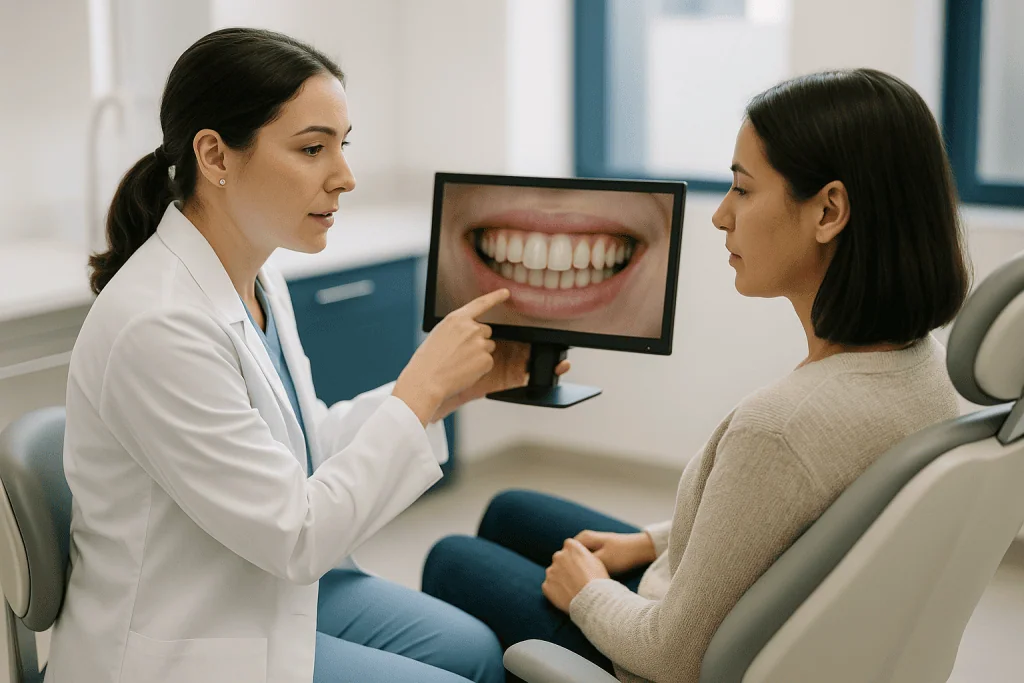
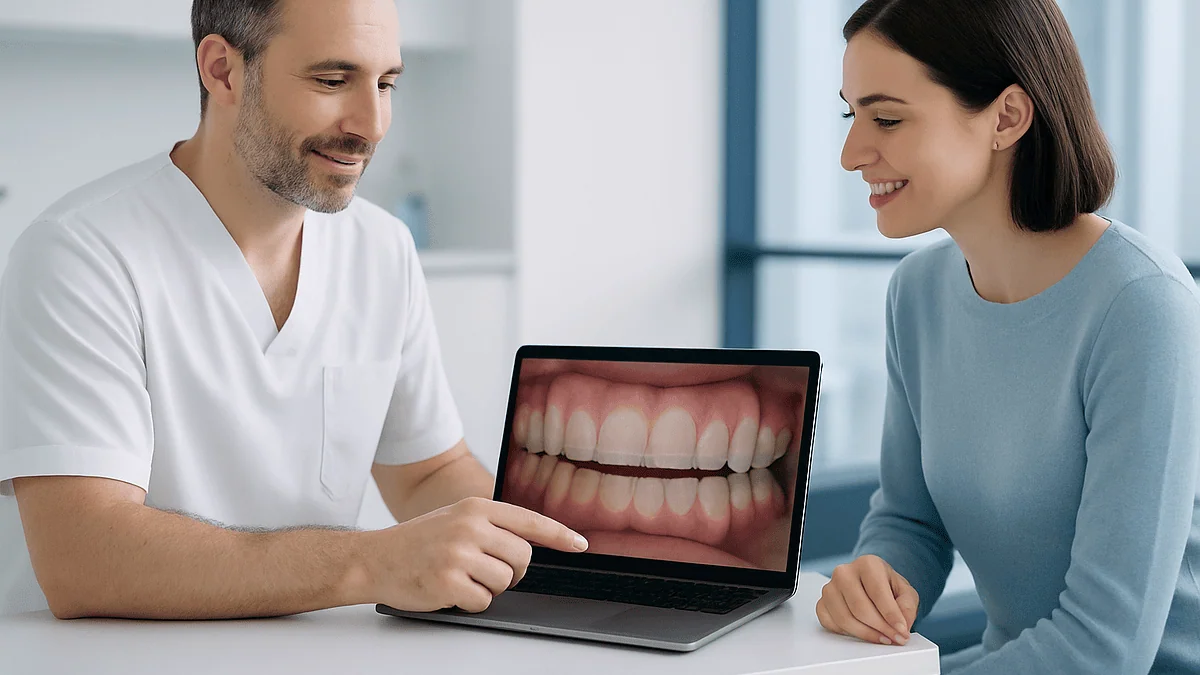
For a gummy smile specifically, the digital approach adds something that a mirror and a ruler cannot. A smile is a movement, not a still image. The lip rises, pauses, and settles differently when someone laughs than when they pose. Video captures the full range, so the team can see the lip at rest, in a gentle social smile and at full laugh, and measure how many millimeters it travels. That single measurement often separates a lip cause from a gum or bone cause.
The scan of the teeth, taken with a small intraoral camera rather than putty, gives the team exact tooth heights and widths. Software then overlays reference lines: the horizontal line between the pupils, the midline of the face, the curve of the lower lip. Against those lines, the team can test what would happen if the gumline were higher, if the teeth appeared longer, or if the lip simply rose less. The result is a series of on-screen mock-ups, sometimes transferred to a temporary resin trial in the mouth so the person can see it in their own face.
None of that reshapes anything. It is a rehearsal. The value lies in what it prevents: an irreversible procedure aimed at the wrong target.
How digital smile design planning actually works, step by step
The first appointment usually looks less like dentistry and more like a portrait session. Standardized photographs are taken from the front and side with the face relaxed, then smiling, then with lips retracted so the full gumline and tooth shape are visible. A short video follows, often of the person speaking a few phrases and laughing, because natural movement reveals lip behavior that posed smiles hide.
The intraoral scan comes next. It produces a digital model of the upper and lower teeth accurate to fractions of a millimeter, which is the working canvas for everything that follows. Many teams also take a periodontal chart, a routine probing of the gum around each tooth, and radiographs where indicated. Those two steps answer a question the camera cannot: how far below the visible gum edge does the bone sit, and is the gum healthy?
Back at the screen, the clinician aligns the photographs, video frames and scan into one model. Reference lines are drawn. Tooth proportions are compared with typical width-to-height ratios. The amount of gum showing at each smile position is measured. Only then does the design phase begin, where the team draws a proposed gumline and tooth outline and generates a simulation.
A well-run process ends with a conversation, not a sales moment. The person sees the simulation, often side by side with the current smile, and the team explains which procedures would be needed to reach it, which parts are reversible, and which are not. Some teams print the design and make a removable resin mock-up that clips over the real teeth for a few minutes. Seeing a change in your own reflection tends to make expectations more realistic, in both directions, and that is a feature rather than a side effect.
Why the planning stage spends so long on where the gum is coming from
Think of visible gum as the visible part of a stack: lip on top, then gum, then bone, then tooth root. The digital plan is essentially a way of inspecting each layer without cutting into any of them.
Lip mobility is measured on video. Some people’s upper lip travels an unusually long distance between rest and full smile because the muscles that lift it pull strongly. If that is the main driver, the gums and bone may be perfectly normal, and altering them would shorten healthy teeth without addressing the lip.
Tooth height is measured on the scan and compared with typical proportions. Short-looking upper front teeth with a gumline that sits well down on the crown often points to altered passive eruption, the developmental pattern in which the gum never migrated up to its adult position. Probing and radiographs confirm whether the bone edge sits close to the enamel boundary, which determines whether soft-tissue reshaping alone would be enough or whether bone would also need recontouring.
Facial proportions are measured on the photographs. A long lower third of the face, with upper teeth and gum both sitting low relative to the lip, suggests vertical maxillary excess, meaning the upper jaw itself is taller than average. This is skeletal, and no gum procedure changes it.
Gum health is assessed clinically. Swollen, bleeding or overgrown gum tissue is a periodontal issue. MedlinePlus describes gum inflammation as a treatable condition driven mainly by plaque, and it needs to be controlled before any cosmetic decision is made, because inflamed tissue can change shape considerably once it heals. Sorting these layers is the real work. The pretty simulation at the end is simply how the findings are communicated.
Gummy smile treatment options: what each one actually changes
Once the cause is mapped, the plan points toward one or more approaches. The table summarizes what each is aimed at and what it does not touch. Availability, suitability and sequencing are decisions for the treating team.
| Approach | Main cause it addresses | What changes | Reversible? |
|---|---|---|---|
| Gum contouring (gingivectomy) | Excess soft tissue over normal-length teeth | Gum edge is reshaped; more crown is exposed | No |
| Crown lengthening with bone recontouring | Altered passive eruption where bone sits high | Gum and a small amount of bone are reshaped | No |
| Lip repositioning surgery | Hyperactive upper lip | Inner lip lining is shortened to limit lift | Largely no |
| Botulinum toxin to lip elevators | Hyperactive upper lip | Muscle pull is temporarily weakened | Yes, wears off |
| Orthodontics | Teeth over-erupted or positioned low | Teeth and attached gum move upward | Partly |
| Orthognathic (jaw) surgery | Vertical maxillary excess | Upper jaw is repositioned | No |
Two patterns stand out. First, most durable options are irreversible, which is why the planning stage carries so much weight. Second, only one row addresses the skeleton. When the underlying issue is jaw height, everything above that row is either partial or beside the point, and a candid team will say so.
Combinations are common. A person might have mild altered passive eruption plus a mobile lip, and the plan may pair modest gum reshaping with a lip-focused option. The digital model lets the team simulate each in turn and show how much of the visible gum each would account for. That breakdown, in millimeters rather than adjectives, is what a good consultation should leave you with.
Gum contouring for a gummy smile: what the digital plan adds
Gum contouring, also called gingivectomy or gingivoplasty, removes and reshapes a small band of gum tissue along the front teeth so that more of the natural crown is visible. It is done under local anesthetic with a scalpel, an electrosurgery tip or a soft-tissue laser, and it is the procedure most people picture when they hear the phrase gummy smile treatment.
It is also the procedure most easily done in the wrong place or to the wrong depth. Gum is not a decorative layer. Beneath the visible edge there is a narrow zone of attached tissue and then bone, and the gum will only stay where it is placed if enough of that supporting architecture is left. Remove tissue too close to the bone and it tends to grow back toward its original position over the following months, undoing the result. Remove too much and the tooth can look long and the root may become exposed, which can bring sensitivity.
Here the digital plan earns its place. Because the design was drawn on a scan calibrated in millimeters, and because probing established how deep the bone sits, the new gumline can be transferred to the mouth as a physical guide. Many teams print a thin surgical guide that seats over the teeth and marks the intended edge, so the clinician cuts to the plan rather than to eye. Some also mark the guide with the bone distance at each tooth, flagging where soft-tissue reshaping alone is enough and where bone would also need attention.
The point is symmetry as much as amount. Human eyes are remarkably good at spotting a gumline that is half a millimeter higher on one side than the other. A drawn, measured plan is a defense against that kind of quietly disappointing outcome.
Crown lengthening versus gum contouring: when bone is part of the picture
Crown lengthening is a periodontal procedure that reshapes both gum and a small amount of the underlying bone to expose more of the tooth. The name is slightly misleading. The crown of the tooth does not grow; it is uncovered. The distinction from simple gum contouring is that bone is deliberately adjusted so the gum has a stable, lower resting place to heal against.
Why would bone need attention? In altered passive eruption, the bone edge often sits unusually close to the boundary between enamel and root. If only gum is trimmed in that situation, there is not enough room for the normal band of attached tissue to re-form, and the gum tends to rebound. Recontouring the bone by a small, measured amount creates that room. Radiographs and gentle probing during planning are how the team tells the two situations apart, and the digital scan lets them plot the intended bone line tooth by tooth.
This is a more involved procedure than contouring. It usually means lifting a small flap of gum, reshaping bone with fine instruments, and closing with sutures. It is still done under local anesthetic in most cases, and it is a well-established periodontal technique with decades of use in both functional and aesthetic contexts.
The trade-off is straightforward and worth saying plainly. Crown lengthening is the more predictable option when bone is the limiting factor, and the less appropriate one when it is not. Choosing between the two is not a matter of preference or of which sounds more thorough; it is a matter of where the bone sits, which is a measurement. If a team recommends either without having looked at radiographs or probed the gums, that is a reasonable moment to ask why.
Lip repositioning surgery and botulinum toxin: treating the lip, not the gum
When the video analysis shows that the upper lip travels an unusually long way during a smile, the gum and bone may be entirely normal. The two approaches that address this pattern work on the lip itself.
Lip repositioning surgery is a procedure in which a strip of the inner lining of the upper lip is removed and the remaining edge is stitched closer to the gumline, limiting how high the lip can lift. It is done under local anesthetic, the incision is inside the mouth, and it leaves no visible external scar. Because it changes soft tissue permanently, it belongs in the irreversible column of the table above, although some relapse of lip movement over time has been described in the literature, which is another reason honest teams frame results as expected ranges rather than guarantees.
Botulinum toxin is a purified protein that, when injected into a muscle, temporarily blocks the nerve signal that makes it contract. Placed in the small muscles that lift the upper lip, it reduces how far the lip rises. Mayo Clinic notes that the effect of botulinum toxin injections generally lasts about three to four months, after which the muscle recovers and the lip returns to its usual movement. That temporariness cuts both ways. It means the effect is reversible, which some people value as a trial before committing to surgery. It also means repeat treatment would be needed to maintain any change, and results depend heavily on the experience of the person placing it, since too much weakening can flatten the smile or affect speech and drinking.
Any decision about injections, including whether they are appropriate at all, sits with the prescribing clinician after a proper assessment. The role of the digital plan is simply to show whether the lip is the right target in the first place.
Who digital smile planning is usually for, and who is usually asked to wait
The planning stage suits anyone considering an irreversible change to their gumline, teeth or lip, precisely because it is the cheapest mistake to make. Nothing is cut in a simulation. People who benefit most are those with a specific concern they can describe, an interest in understanding the cause, and the patience to see the analysis before choosing a procedure.
Several groups are commonly asked to pause, and the reasons are protective rather than dismissive.
- People with active gum disease. Inflamed, bleeding or swollen gums change shape once the inflammation is controlled, so any design drawn on inflamed tissue is drawn on a moving target. NHS guidance describes gum disease as common and manageable with professional cleaning and daily care, and that comes first.
- Adolescents whose jaws are still growing. Lip position, tooth eruption and facial height all shift into the late teens, and gum that seems excessive at fifteen may look quite different at twenty.
- People part-way through orthodontic treatment, because tooth movement carries the gumline with it and the final position is not yet known.
- Anyone whose main hope is that a change in their smile will resolve a broader distress about appearance. Dentistry can change millimeters; it cannot change how someone feels about themselves, and a thoughtful team will say so kindly.
Medical factors matter too. Conditions or medicines that affect healing or bleeding, a history of gum overgrowth linked to a prescription, or pregnancy, where gum tissue is often more swollen, are all reasons a team may suggest planning now and treating later, or not at all. Waiting is not a refusal. In this field, it is frequently the most evidence-based recommendation available.
What the first days and weeks after gummy smile treatment usually look like
Because the planning stage involves no tissue change, there is nothing to recover from after it. The days that follow an actual procedure depend on which one was chosen, and your team’s written instructions override anything general written here.
After gum contouring alone, most people describe mild soreness and some sensitivity to temperature for a short period while the fresh gum edge heals. The tissue often looks slightly pale or uneven at first and settles as it matures. Soft foods, gentle brushing around the area and avoiding very hot, spicy or crunchy items are the usual advice.
Crown lengthening involves sutures and a small flap, so swelling and tenderness are more noticeable, and there is typically a follow-up visit for suture removal or checking. Cleveland Clinic notes that final gum position after this kind of periodontal surgery continues to settle over several months, which is why any planned veneers or crowns are usually delayed until the gumline has stabilized rather than placed straight away.
Lip repositioning brings swelling of the upper lip and a feeling of tightness when smiling widely, which is expected as the tissue adapts. Speech may feel slightly different for a short while.
After botulinum toxin to the lip muscles, there is usually little downtime. The effect builds over days rather than appearing immediately, and, as noted above, Mayo Clinic describes the typical duration as roughly three to four months before movement returns.
Across all of these, the quiet truth is that the smile you see in the first week is not the final one. Gum matures, swelling resolves, and muscles recover. Comparing the healed result with the digital plan at a follow-up appointment is the proper moment for judgment, and a good team will do that comparison with you.
Is digital smile design worth it? An honest look at the evidence
The question people type into search engines deserves a straight answer, and the straight answer is that it depends on what you are asking it to do.
As a communication and measurement tool, the case is strong on logical grounds. It replaces guesswork about cause with millimeter data, it lets the person see a simulation before committing, and it gives the clinician a physical guide so the surgery follows the plan. Those are the conditions under which irreversible procedures are least likely to be aimed at the wrong target. Published clinical literature on digital planning consists largely of case reports, technique descriptions and small series rather than large randomized trials, so it would be an overstatement to say it has been proven to improve outcomes in a controlled way. What can be said is that it makes the reasoning visible, and visible reasoning is easier to question.
As a treatment, the case is nonexistent, because it is not one. A simulation on a screen does not change a gumline. People who are told that digital planning will fix their gummy smile have been sold a word swap.
Then there is the cost question, which sits under almost every search on this topic. This article does not quote figures for planning or for any procedure, and would be doing readers a disservice if it did. Fees vary with the region, the number of teeth involved, whether bone is reshaped, whether restorations follow, and how the planning is billed. The useful version of the question is not how much, but what am I paying for. A planning fee that produces a measured diagnosis, a simulation and a surgical guide is buying something specific. Ask your team to itemize what the planning includes, and whether it is credited toward treatment if you proceed.
What people often get wrong about digital smile design and gummy smiles
The first misunderstanding is that a gummy smile is a gum problem. Often it is a lip problem or a jaw-height problem wearing a gum disguise. The tissue you see is the last layer in a stack, and treating the last layer for a first-layer cause is how people end up with shorter-looking gums and the same high lip.
The second is that the simulation is a promise. It is a target drawn by a person using software, and biology does not sign contracts. Gum heals along lines dictated by bone and blood supply, lips relax or tighten as they adapt, and small asymmetries in the face persist. Reputable teams present simulations as intended direction, not guaranteed destination, and are open about the ways real tissue can differ.
The third is that lasers make gum contouring risk-free. The instrument is only as good as the plan. A laser cutting to the wrong depth causes the same rebound or root exposure as a scalpel doing the same thing. The evidence does not support the idea that any single tool prevents recurrence.
The fourth is the belief that veneers alone solve a gummy smile. Veneers are thin shells bonded to the front of teeth, and they change tooth shape and color, not where the gum sits. Making teeth look longer with veneers when the gumline is the real issue often produces oversized-looking teeth.
The fifth is that gum removed for cosmetic reasons will grow back if you dislike the result. It generally does not, which is precisely why the planning stage exists.
The last is subtler. People sometimes assume that because their gum display bothers them, it must be abnormal. Showing gum when you smile is within the range of ordinary human faces. Wanting to change it is a valid preference; it is not evidence of a defect, and no one should be made to feel it is.
Questions to ask your care team before anything is reshaped
A consultation that ends with a procedure date but not with answers to these questions has skipped the part that protects you. Bring them written down.
- In your assessment, how much of my visible gum comes from lip movement, how much from gum position, and how much from jaw height? Can you show me the measurements?
- Have my gums been probed and have radiographs been taken to check where the bone sits? If bone is close to the enamel edge, would soft-tissue contouring alone hold?
- Which parts of the plan are reversible and which are not? If we started with a reversible option, what would it tell us?
- Will a surgical guide made from the digital plan be used during the procedure, and how will you check symmetry between the two sides?
- What are the realistic ways the healed result could differ from the simulation, and how often do you see tissue rebound or root sensitivity?
- Is my gum health good enough to proceed now, or should inflammation be controlled first? How would that change the design?
- If veneers or crowns are part of the plan, how long after gum surgery would you wait before placing them, and why?
- What exactly does the planning fee cover, and what happens to the plan and the scan if I decide not to go ahead?
- What would you recommend if I chose to do nothing?
That last question is a quiet test of a team’s honesty. Doing nothing is always an option in cosmetic care, and a clinician who can describe it neutrally, without pressure or countdown, is one whose other answers are easier to trust. The digital plan should make the decision clearer, not push it in one direction. If it feels like the latter, a second opinion from another qualified clinician is a reasonable step, and no one worth seeing will be offended by it.
When to call your doctor
Digital planning itself has no medical risks; it is photography, scanning and drawing. The signals below apply after any of the procedures the plan might lead to, and they should prompt a call to the treating clinician the same day rather than waiting for a scheduled review.
- Bleeding from the gum or lip that does not stop with firm, steady pressure from clean gauze after several minutes, or bleeding that restarts repeatedly.
- Swelling that keeps increasing after the first couple of days instead of easing, or swelling that spreads toward the eye, the neck or the floor of the mouth.
- Fever, chills, a foul taste or discharge from the surgical site, which can indicate infection.
- Pain that is worsening rather than settling, or pain not controlled by the plan your team gave you.
- Difficulty swallowing or breathing, or rapid swelling of the lip or tongue, which needs emergency care immediately.
- After botulinum toxin injections: difficulty speaking, swallowing or breathing, drooping of the lip or eyelid, muscle weakness away from the injected area, or blurred vision. NHS guidance lists these among the effects that need urgent medical attention.
- Numbness that persists well beyond the expected wearing-off of local anesthetic.
- A tooth that becomes loose, or sudden sharp sensitivity that makes eating difficult.
Outside the surgical context, gums that bleed when you brush, look red and swollen, or seem to be growing over the teeth are signs of gum inflammation and deserve a routine dental visit before any cosmetic discussion. MedlinePlus and the NHS both describe gum disease as common and manageable, but left untreated it can progress to loss of the bone that holds teeth in place, which no smile design can draw back.
If you are ever unsure whether something is normal healing, the right move is to ask. Teams expect those calls, and an early check is far easier than a late one.
Frequently asked questions
Is digital smile design worth it for a gummy smile?
It is worth it as a way of finding the cause and previewing a change before anything irreversible is done; it is not worth it if you expect it to treat anything by itself. The published evidence consists mostly of case reports and technique papers rather than large trials, so it has not been proven to improve outcomes in a controlled way. Its clearest value is making the clinical reasoning visible and measurable.
How do dentists get rid of a gummy smile?
They first identify the cause, then match the approach to it. Excess gum over normal teeth may be reshaped by gum contouring; gum plus high bone may need crown lengthening; a hyperactive lip may be addressed with lip repositioning surgery or temporary botulinum toxin; teeth positioned low may need orthodontics; a tall upper jaw would need jaw surgery. Combinations are common, and the choice belongs to the treating team after assessment.
How much does digital smile design cost, and why is no figure given here?
No figure is given because fees vary widely with region, the number of teeth involved, whether bone reshaping or restorations follow, and how a practice bills for planning. A more useful question for your consultation is what the planning fee includes: measurements, a simulation, a printed mock-up, a surgical guide, and whether it is credited toward treatment if you proceed.
How much does gummy smile surgery cost?
This article deliberately does not quote prices, because the cost depends on which procedure is needed, how many teeth are involved, whether bone is recontoured, whether a lip procedure is added, and whether veneers or crowns follow. Ask your care team for an itemized estimate after the diagnosis is clear, since a quote before the cause is known is a quote for the wrong thing.
What gummy smile treatment options are reversible?
Only botulinum toxin injections to the lip-lifting muscles are truly reversible, because the effect wears off, typically within about three to four months according to Mayo Clinic. Orthodontic tooth movement is partly reversible. Gum contouring, crown lengthening, lip repositioning surgery and jaw surgery permanently change tissue and cannot be undone, which is why the planning stage exists.
Does gum contouring for a gummy smile grow back?
Healthy gum removed for cosmetic reasons generally does not regrow to its previous height, but gum can rebound toward the bone if too little supporting tissue is left above it. That is the main technical reason probing and radiographs are done before gum contouring: if the bone sits close to the enamel edge, soft-tissue trimming alone tends to be unstable and crown lengthening with bone recontouring may be advised instead.
What is lip repositioning surgery and who is it for?
Lip repositioning surgery removes a strip of the inner lining of the upper lip and stitches the edge closer to the gumline so the lip cannot lift as high. It is aimed at people whose visible gum comes mainly from a hyperactive upper lip rather than from the gum or bone, which the video analysis in digital planning helps identify. Some relapse of lip movement over time has been described, so results are discussed as expected ranges.
Can veneers fix a gummy smile on their own?
Usually not. Veneers are thin shells bonded to the front of the teeth that change shape and color, but they do not move the gumline. Placing longer veneers over teeth whose gum sits low often produces oversized-looking teeth rather than a balanced smile. When restorations are part of a plan, they are typically done after gum surgery has healed and the gumline has stabilized.
Is a gummy smile a health problem?
Showing gum when you smile is within the range of normal human faces and is not itself a health problem. The exception is gum that is enlarged because of inflammation, gum disease or certain medicines, which is a periodontal issue that needs assessment regardless of appearance. Bleeding, redness, swelling or gum growing over the teeth warrant a routine dental visit before any cosmetic discussion.
How long does it take to see the final result after gummy smile treatment?
The healed result takes longer than the first week suggests. Swelling has to settle, fresh gum edges mature, and after crown lengthening Cleveland Clinic notes the gum position continues to change over several months, which is why any veneers or crowns are usually delayed until then. Your team will give a timeline specific to your procedure, and the fair comparison with the digital plan is made at follow-up, not on day two.
References
- Botulinum toxin injections: risks and what to expect (NHS)
- Gum disease (NHS)
- Gum Disease (MedlinePlus)
This article is for general information only and is not a substitute for professional medical advice. Please consult a qualified doctor about your individual situation.

More from the Blog

What Happens at a Composite Bonding Appointment: Shade Matching, Layering and Polishing
A composite bonding procedure usually takes 30 to 60 minutes per tooth and rarely needs an injection. The dentist selects a resin shade against…

Bleeding Gums and Blood Thinners: What Your Dentist Checks Before Gum Treatment
Blood thinners do not cause gum disease, but they can make inflamed gums bleed longer and more visibly. Before gum treatment, a dentist reviews…

Clear Aligner Problems to Watch: Tracking Issues, Sore Spots and Gum Irritation
Most clear aligner problems are minor and fixable: trays that stop fitting usually reflect too few hours of wear, sore spots come from pressure…
The First 48 Hours After Teeth Whitening: Foods, Drinks and Habits to Pause
For roughly the first 48 hours after teeth whitening, most dental teams advise pausing strongly colored or acidic foods and drinks such as coffee,…
What to Do With a Knocked-Out Tooth in the First Hour Before Emergency Dental Care
If a permanent tooth is knocked out, pick it up by the crown, not the root, rinse it briefly in milk or water without…
Preparing for a Tooth Extraction: Medication Lists, Eating and Arranging Your Ride Home
Preparing for a tooth extraction comes down to three practical steps: give your dentist a complete list of every medicine and supplement you take,…