

How Do Home Exercises Support Aphasia Therapy? Reading, Writing and Conversation Practice

Key Takeaways
- Aphasia affects language, not intelligence; the NIDCD estimates about 1 million people in the United States live with it, most after stroke.
- A 2016 Cochrane review found speech and language therapy improves functional communication, reading and writing after stroke, with higher total dose linked to larger gains but also higher dropout.
- Waiting silently for several seconds before offering a cue gives the brain the retrieval attempt it needs; finishing sentences removes that practice.
- Recovery is usually fastest in the first months after stroke, but the NHS notes that improvement can continue for years with ongoing therapy and practice.
- Naming, reading and writing tasks work best when built from personally relevant words such as family names, streets and favorite foods rather than generic vocabulary.
- Sudden worsening of speech or understanding is a stroke warning sign, not a bad practice day, and calls for emergency care.
Home exercises support aphasia therapy by adding practice repetitions between speech-language pathology sessions, which is how the brain gradually re-strengthens language pathways after a stroke or brain injury. Reading familiar words aloud, copying and composing short written messages, and structured conversation with a trained partner all reinforce clinic goals. Evidence favors regular, meaningful, therapist-guided practice over random drills, and progress is usually slow and uneven.
The newspaper is open at the sports page, the same page it has been open to for three mornings. A man in his sixties runs his finger under a headline, stops at the fourth word, and looks up at his daughter. She does not say the word for him. She waits, then points at the photograph beside it. He tries again. This time the word comes out, a little bent, but recognizable. They both exhale.
Scenes like this are what aphasia home exercises actually look like: not a workbook finished in one sitting, but small, repeated attempts woven into ordinary life. Aphasia is a language disorder caused by damage to the brain, most often from stroke, that affects speaking, understanding, reading or writing while leaving intelligence intact.
Families almost always ask the same question in the first weeks: what can we do at home that helps, and what might we be doing wrong? The honest answer is that home practice matters a great deal, but only when it follows the plan set by the speech-language pathologist, respects fatigue, and treats every conversation as therapy rather than a test.
What are aphasia home exercises, and why do therapists prescribe them?
Aphasia home exercises are structured language tasks that a speech-language pathologist, a clinician trained to assess and treat communication disorders, assigns for practice between formal sessions. They range from naming pictures and reading short passages aloud to writing a grocery list or rehearsing a phone call. What separates them from generic “brain games” is that each one targets a specific breakdown identified during assessment.
The reason therapists lean on them is arithmetic. In many health systems, a person recovering from stroke may see a therapist for a few hours a week at most. The 2016 Cochrane systematic review of speech and language therapy for aphasia after stroke found that higher-intensity, higher-dose therapy was associated with greater gains in functional communication, reading and writing than lower-intensity schedules, though more intensive programs also had higher dropout, a reminder that fatigue is real (PubMed reference below). Home practice is the most practical way to raise the total dose without exhausting clinic capacity.
Scale matters too. The National Institute on Deafness and Other Communication Disorders estimates that about 1 million people in the United States live with aphasia and roughly 180,000 acquire it each year, the majority after stroke. Very few of them can access daily one-to-one therapy indefinitely, so the home becomes the main practice room.
Home exercises are not a substitute for therapy and not a stand-alone program to download and self-administer. They are the between-session half of a single treatment plan. When the clinic goal is retrieving nouns, the kitchen goal is naming what goes into the soup. When the clinic goal is understanding two-step instructions, the living-room goal is following a recipe read aloud. The exercise only earns its place if it mirrors something the person needs to do in real life.
How does practice at home actually change the brain?
The mechanism behind aphasia recovery is neuroplasticity, the brain’s ability to reorganize connections in response to experience. After a stroke, tissue that has died does not regrow. What can change is how surviving networks share the work. Regions near the damage, and in some cases the corresponding regions on the opposite side of the brain, can take on language functions if they are repeatedly asked to.

Repetition is the currency. Each time a person retrieves the word “cup,” hears it, sees it written and says it, the network that links the object, the sound and the spelling fires together. Networks that fire together strengthen; networks that go unused weaken. This is why an exercise done once a week in a clinic and never again at home produces less change than the same exercise done briefly every day.
Two features of home practice make it especially useful for this rewiring. First, it is multimodal: a family member can pair a spoken word with a written label and a gesture, giving the brain several routes to the same meaning. Second, it happens in context. Naming a fork while setting the table links the word to a purpose, a location and a habit, which are all additional retrieval cues.
Timing also plays a role. The NHS notes that much of the natural recovery after stroke happens in the first weeks and months, when the brain is most changeable, but that people with aphasia can continue to improve for years with therapy. Home exercises during the early window ride that wave of spontaneous recovery; later on, they are the main driver of further progress. Neither phase produces guaranteed results, and the pattern of improvement is often two steps forward, one step back, particularly on tired days.
Who is home practice usually for, and who is usually asked to wait?
Most people with aphasia can do some form of home practice, but the shape of it depends on the type and severity of the language problem, medical stability and energy. Aphasia is not one condition. Some people speak fluently but struggle to understand or produce meaningful words; others understand well but speak in short, effortful phrases; a smaller group has severe difficulty in every modality. The speech-language pathologist matches exercises to that profile.
Home practice generally suits people who have completed initial assessment, have a written or pictured plan from their therapist, and have a communication partner willing to learn a few techniques. It suits people who are medically stable, sleeping reasonably well, and able to sustain attention for a short block of time. It suits anyone whose therapist has specifically said, “do this at home.”
Several groups are usually asked to wait or to modify. In the first days after a stroke, medical priorities such as blood pressure, swallowing safety and preventing a second stroke come first, and formal drills can add stress without benefit. People with significant fatigue, uncontrolled seizures or acute illness are typically told to pause structured practice and return to gentle conversation until cleared. Someone with severe depression or grief, which are common after stroke, may need those addressed before drills feel possible. And anyone with a sudden change in language ability should be evaluated urgently rather than practiced through, because worsening can signal a new event.
The Mayo Clinic describes aphasia recovery as usually slow and notes that few people regain their full previous communication level, which is why realistic pacing matters more than a burst of enthusiasm in week two. The decision about when to start, how much to do and when to rest belongs to the treating team, who know the medical picture that families cannot see.
What does the speech-language pathologist do that home practice cannot?
Families sometimes wonder whether daily home practice could replace clinic visits altogether. The evidence and clinical experience say no. The therapist provides three things that are hard to reproduce at the kitchen table.
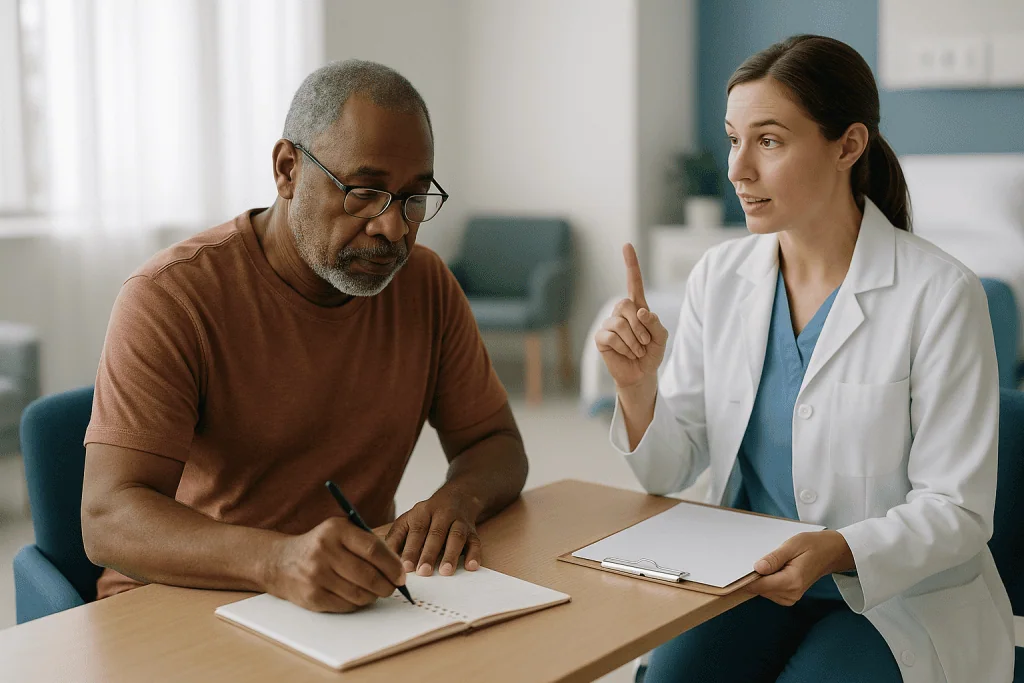
The first is diagnosis of the breakdown. When a person cannot say “telephone,” the reason could be difficulty retrieving the word, difficulty planning the movements to say it (a separate condition called apraxia of speech), or difficulty understanding the picture in the first place. Each needs a different exercise. A therapist tests these systematically; a family member usually cannot tell them apart.
The second is cueing. Cueing means giving just enough help to make a correct response possible without giving the answer away. Therapists use a hierarchy: a pause, a gesture, the first sound, a rhyming word, then a written cue. Part of what a home program teaches is which cues work for this particular person, so the partner is not repeatedly leaping to the answer.
The third is progression. Tasks must be hard enough to demand effort but not so hard that every attempt fails. A therapist adjusts difficulty week by week, swapping high-frequency words for less common ones or single sentences for paragraphs. Without that adjustment, home practice tends to drift toward tasks the person can already do, which feel pleasant but produce little change.
The therapist also monitors for problems that mimic slow progress, such as untreated hearing loss, visual field loss after stroke, or new medication effects on alertness. Cleveland Clinic and the NHS both describe speech and language therapy as the main treatment for aphasia, with home practice extending its reach. The relationship works best when the family reports back honestly about what was easy, what was impossible and what made the person cry.
Aphasia reading exercises: from single words to a paragraph
Reading difficulty after stroke, sometimes called alexia, can take several forms. Some people recognize letters but cannot assemble them into words; others read words but lose the thread of a sentence; some skip the left side of the page because of visual neglect, a condition where the brain ignores one side of space. The therapist identifies the pattern before recommending aphasia reading exercises for home, and the exercises below are examples of what commonly appears in such plans.
At the single-word level, matching is the usual starting point: a written word placed beside three pictures, or a spoken word matched to one of three written words. Success here rebuilds the link between print and meaning without demanding speech. Reading personally relevant words, the names of family members, streets, favorite foods, tends to work better than random vocabulary because emotion and familiarity aid retrieval.
At the phrase and sentence level, therapists often use functional text: a text message from a grandchild, a short recipe step, a headline. Reading aloud together in unison, with the partner’s voice fading as the person gains confidence, is a common technique; the therapist demonstrates how to fade so that the partner does not simply carry the reading.
At the paragraph level, comprehension checks matter more than perfect word-by-word accuracy. A partner might read a short paragraph, then ask one yes-or-no question about it, then a question with two written options. Large print, wide spacing, one paragraph per page and a card that isolates a single line reduce visual load.
What to avoid: timed reading tests, correcting every misread word, and jumping to novels. The NHS advises keeping reading material short and relevant and building up gradually. Fatigue after fifteen minutes is common and is a signal to stop, not to push.
Writing practice: what realistic goals look like at home
Writing is often the slowest language skill to return after stroke, partly because it stacks several tasks at once: retrieving the word, spelling it, planning the hand movement, and for many people doing all of that with a non-dominant hand because of weakness on one side. Realistic home goals reflect that load.
Copying comes first for most people. Writing a name, an address or a short list from a model rebuilds the motor pattern and the visual memory of spelling without requiring retrieval. Tracing over dotted letters is used only briefly; therapists generally move to copying real words as soon as possible because meaning drives recovery.
Next is writing to dictation of high-value words: family names, days of the week, common foods. Partners are taught to say the word, wait, then offer the first letter if nothing happens, then the first two. Anagram tasks, where the letters of a word are scrambled on cards and reassembled, are a common bridge because they test spelling knowledge without the motor demand.
Functional writing is the destination: a shopping list, a birthday card, a text message, signing a form. Even one or two legible words on a card to a grandchild can restore a sense of participation that matters more to many people than accuracy.
Technology helps here. Typing removes the motor barrier for people with hand weakness; predictive text and spell-check offer built-in cues. Some therapists encourage voice-to-text as a workaround for people whose speech is clearer than their handwriting, while others reserve it so that writing itself gets practiced. This is a judgment call for the treating team.
Common errors include perseveration, where the same letter or word keeps reappearing, and letter substitutions. Partners should note these for the therapist rather than drill them out, because the pattern itself is diagnostic information.
How to help someone with aphasia in everyday conversation
Conversation is both the goal of therapy and one of its most powerful tools, but only if the partner knows how to hold up their half. Supported conversation is the term for a set of techniques that make it possible for a person with aphasia to show what they know and to take a real turn.
The techniques are simple to describe and hard to do consistently. Speak in shorter sentences at a normal volume; aphasia is not deafness, and shouting adds stress. Ask one question at a time. Offer choices rather than open questions when open ones stall: “tea or coffee?” instead of “what would you like?” Write key words on a notepad as you talk, and keep a pen in reach so the person can write, draw or point. Use gesture freely. Confirm understanding by summarizing: “so, Saturday, the market, with Rosa?”
Waiting is the hardest part. Word retrieval in aphasia can take several seconds longer than normal, and partners tend to fill the silence. Therapists often teach families to count slowly to ten in their heads before offering a cue. Finishing the person’s sentence or speaking about them in their presence, both of which happen constantly, removes the very practice the brain needs.
Communication partner training, where the family member rather than the person with aphasia is the one being taught, is now a standard part of aphasia care described by the NHS and the NIDCD. Its logic is that a well-trained partner turns every meal into a therapy session with no worksheet in sight.
Group conversation can be harder than one-to-one because turns come fast. Small gatherings, a topic agreed in advance and a partner who quietly slows the pace help. Aphasia community groups, where everyone communicates at a similar pace, offer practice without the fear of being left behind.
How much practice is enough? What the evidence says about intensity
Families want a number, and the honest answer is that no single number fits everyone. The evidence supports two general principles: more total practice is associated with more gain, and practice must be tolerable to be sustained.
The 2016 Cochrane review cited above pooled dozens of randomized trials and found that people receiving speech and language therapy improved more in functional communication, reading, writing and expressive language than those receiving no therapy. Among treated groups, higher intensity and higher overall dose were linked to larger gains, but the high-intensity arms also lost more participants, presumably to fatigue and burden. The reviewers were cautious about defining an ideal schedule because trials varied widely in how they measured hours.
Translated into a household, this argues for short, frequent sessions rather than one long weekend push. Many therapists suggest daily blocks measured in minutes rather than hours, spaced across the day, with the exact amount set individually. The NHS describes therapy that may be delivered in intensive blocks and notes that recovery can continue for years, which means the schedule needs to be one a family can keep up for a long time.
Quality matters as much as minutes. Ten minutes of naming words the person actually needs, with correct cueing and a partner who waits, likely does more than an hour of flipping through cards that are either too easy or too hard.
Warning signs that the dose is too high include tears, refusal, worsening performance as the session goes on, and language that is noticeably worse the next morning. The Mayo Clinic notes that fatigue and depression commonly complicate stroke recovery; both blunt learning. When these appear, the correct response is to report to the therapist and reduce, not to persevere out of loyalty to a plan.
Aphasia speech therapy exercises at home: a comparison of common approaches
The table below summarizes exercise types that frequently appear in home programs. It is descriptive, not a menu to choose from independently; the therapist decides which fit a given person’s profile.
| Approach | What it targets | Typical home version | Partner’s main job |
|---|---|---|---|
| Naming practice | Word retrieval (anomia) | Naming household objects or photos of family | Wait, then cue in a set order |
| Reading aloud | Print-to-sound and comprehension | Headlines, recipe steps, cards from friends | Read in unison, then fade out |
| Copy and write | Spelling and functional writing | Shopping lists, names, short messages | Provide models, note error patterns |
| Script training | Fluent production of set phrases | Rehearsing a phone order or greeting | Play the other role consistently |
| Supported conversation | Real-world participation | Mealtime talk with pen and paper handy | Slow down, offer choices, confirm |
| Comprehension tasks | Understanding spoken language | Following two-step instructions in the kitchen | Keep sentences short, check back |
Script training deserves a note. It involves choosing a short, personally important exchange, such as ordering a coffee or answering the phone, and rehearsing it until it becomes semi-automatic. It does not generalize to every situation, but it restores confidence in the situations that matter most, and confidence drives more attempts.
Anomia, the difficulty finding words that nearly everyone with aphasia experiences, is why naming practice appears in almost every program. The crucial detail is the cueing order agreed with the therapist. A partner who always gives the whole word teaches dependence; one who never helps teaches frustration.
None of these approaches has been shown to help everyone, and the Cochrane review found no clear winner among therapy types. The strongest predictor of benefit appears to be doing something targeted, regularly, with feedback, rather than the label attached to the method.
What the first weeks and months of home practice usually look like
The rhythm of home practice changes as recovery unfolds, and knowing the typical arc helps families avoid both premature despair and unrealistic expectation. The ranges below are drawn from the NHS and Mayo Clinic descriptions of aphasia recovery and describe common patterns, not promises.
In the first weeks after a stroke, formal practice is usually light. The person may be exhausted, medical issues dominate, and the brain is already changing rapidly on its own. The therapist’s home advice at this stage is often about the environment: reduce background noise, keep conversation partners to one or two at a time, keep a communication notebook with photos and key words, and treat every interaction as gentle practice. Rapid gains during this period are largely spontaneous recovery, and families sometimes credit the exercises with more than they have yet done.
From roughly the first month onward, structured exercises typically begin in earnest: short daily blocks, a clear task list from the therapist, and regular review. This is when patterns emerge. Mornings may be better than evenings. Some words come back and others stubbornly refuse. Reading may outpace speaking, or the reverse.
Over the following months, the pace of change slows. The NHS notes that most spontaneous recovery happens in the early months, after which further progress is driven by therapy and practice and can continue for years. Plateaus are common and do not mean recovery has ended; they often precede a shift in strategy, such as moving from single words to phrases or from drills to conversation-based goals.
Emotionally, the early enthusiasm often gives way to fatigue for both the person and the partner. Therapists expect this and can rebalance the program. A plan that survives at a modest level for a year is worth more than an ambitious one abandoned after six weeks.
Apps, aphasia worksheets for adults and technology: what helps and what does not
The market for aphasia apps and printable aphasia worksheets for adults has grown quickly, and families often arrive at their first therapy appointment having already downloaded several. Technology can genuinely extend practice, but it also carries traps.
The useful side is straightforward. Tablet-based naming programs provide unlimited repetition with built-in cues, at any hour, without a partner. Text-to-speech lets a person hear what they have written; speech-to-text lets a person with clearer speech than handwriting produce messages. Video calling keeps conversation practice alive with distant relatives. Cleveland Clinic and the NIDCD both describe computer-assisted practice as a possible complement to therapist-led treatment.
The limits are equally real. The Cochrane review found insufficient evidence to say whether computer-delivered practice matches therapist-delivered treatment, and app quality varies enormously. Many apps are designed for children learning language rather than adults relearning it, and the childish imagery can feel humiliating. Some drill words the person will never use. Others offer no cueing, so every failure is simply a failure. And no app can distinguish between a retrieval problem and a speech-planning problem, so a person may drill the wrong skill for months.
Worksheets have similar strengths and weaknesses: cheap, portable, no screen, but only as good as the match to the person’s deficit. Generic word-search puzzles and crosswords, often recommended by well-meaning friends, are usually too hard or irrelevant.
The practical rule is to bring any app or worksheet to the therapist before relying on it. A good therapist will either integrate it into the program, adjust settings so it targets the right level, or explain why it does not fit. Technology chosen without that conversation tends to become a source of guilt sitting unused on a tablet. No specific product has been shown to outperform others in high-quality trials, so promotional claims deserve skepticism.
What people often get wrong about aphasia home exercises
Myths around aphasia are persistent, and several of them actively undermine home practice.
The first is that aphasia means lost intelligence. It does not. Aphasia is a language problem, not a thinking problem; the NIDCD is explicit that it does not affect intelligence. Talking to the person as if they were a child, simplifying to the point of condescension, or discussing them in the third person damages motivation and removes real practice.
The second is that recovery ends at six months. Older advice suggested a hard window after which nothing changed. Current NHS guidance describes improvement continuing for years with therapy. The pace slows, but the door does not shut.
The third is that more is always better. The Cochrane data on higher dropout in intensive programs shows that a plan the person cannot sustain produces less benefit than a moderate one they can. Pushing through tears is not dedication.
The fourth is that finishing sentences is kindness. It feels helpful and it is almost always counterproductive, because it removes the retrieval attempt that drives change. Waiting is the kindness.
The fifth is that speaking louder helps. Aphasia is not a hearing problem. Raised volume signals impatience and raises stress, which further impairs word-finding.
The sixth is that any language activity counts equally. Crosswords, television quiz shows and children’s spelling apps are not tailored to the person’s specific breakdown. They may be enjoyable, and enjoyment has value, but they are not a substitute for targeted practice.
The seventh is that if the person does not practice, they are not trying. Fatigue, depression, apraxia and the sheer humiliation of failing at something once effortless are all reasons practice stalls. The response is a conversation with the therapist about barriers, not blame. Recovery after stroke is hard enough without a household turning into a classroom where one person is always the one being graded.
Questions to ask your care team before starting home practice
The most useful thing a family can bring to the next therapy appointment is a short list of questions. The answers turn a vague instruction to “keep practicing” into a plan that everyone can follow.
- What type of aphasia does this person have, and which skills are most affected: speaking, understanding, reading or writing?
- Is there also apraxia of speech or dysarthria (weakness of the speech muscles), and how does that change what we do at home?
- Which two or three exercises should we focus on this week, and how will we know when to move on?
- What is the cueing order you want us to use when a word will not come?
- How many minutes a day is reasonable right now, and what are the signs we are doing too much?
- Are there any activities we should avoid, or that could make frustration worse?
- Can you show us, not just tell us, how to do supported conversation?
- Is there a communication partner training program we can join?
- Which apps or worksheets, if any, match this person’s level, and how should we set them up?
- Are hearing and vision being checked, since either can look like a language problem?
- How will we track progress, and how often will the home plan be reviewed?
- What should we do if the person refuses to practice or becomes very low in mood?
- Are there aphasia support groups, in person or online, that you would suggest?
- What changes in speech or understanding should make us call you or seek urgent care?
Write the answers down or ask permission to record them; the person with aphasia may not be able to take notes, and partners under stress forget. Bring a short log of what happened at home since the last visit: what was easy, what was hard, what caused distress. That log is often more valuable to the therapist than any test score, because it shows how language is working where it matters.
When to call your doctor: red-flag signs during aphasia recovery
Most of the ups and downs of home practice are normal. Some are not, and knowing the difference protects the person. The following situations warrant urgent medical attention, because they may signal a new stroke, a bleed, a seizure or another acute problem rather than an ordinary bad day.
Call emergency services immediately if language ability suddenly worsens, if speech that had been improving becomes abruptly slurred or absent, or if the person cannot understand simple requests they managed yesterday. Do the same for any new weakness or numbness of the face, arm or leg, a drooping face, sudden loss of vision or double vision, sudden severe headache, sudden confusion, trouble swallowing, or loss of balance. The CDC’s stroke warning signs include sudden trouble speaking or understanding as a core symptom, and a second stroke is a recognized risk after a first one. Time matters for stroke treatment, so the right response is to call rather than to wait and see.
Contact the treating team promptly, though not necessarily as an emergency, if you notice a steady decline in language over days rather than the usual fluctuation, new or worsening drowsiness, a possible seizure such as staring spells or jerking movements, a fall, signs of a chest or urinary infection such as fever or new confusion, or a marked change in mood including hopelessness, refusal to eat or talk of not wanting to live. Depression after stroke is common and treatable, and it directly affects the capacity to practice.
Also let the team know if choking or coughing occurs during meals, since swallowing problems and aphasia often coexist after stroke, or if a medication change seems to have made the person less alert.
When in doubt, call. Therapists and physicians expect these calls and would rather hear about a false alarm than miss a real one. Every decision about investigation and treatment sits with the treating team, but the family is usually the first to notice that something has shifted.
Frequently asked questions
What are the best aphasia speech therapy exercises at home?
The best home exercises are the ones your speech-language pathologist selects for the specific breakdown identified in assessment. Common examples include naming household objects with a set cueing order, reading personally relevant words and short passages aloud, copying and then composing short written messages, rehearsing scripted exchanges such as a phone greeting, and supported conversation at meals. No single exercise type has been shown to outperform others in trials; targeting and regularity matter more.
How to help someone with aphasia during conversation?
Slow down, use shorter sentences at normal volume, ask one question at a time, and offer choices when open questions stall. Keep a pen and paper handy so both of you can write key words or draw. Wait several seconds before offering a cue, and avoid finishing sentences. Confirm what you understood by summarizing. These supported conversation techniques are taught in communication partner training, which the NHS and NIDCD describe as part of standard aphasia care.
How long does it take to recover from aphasia with home practice?
There is no fixed timeline. The NHS notes that most spontaneous recovery happens in the first weeks and months after stroke, and that people can continue to improve for years with therapy and practice. The Mayo Clinic describes recovery as usually slow, with few people regaining their full previous level. Progress typically comes in uneven steps, with plateaus that do not mean recovery has stopped.
Are aphasia worksheets for adults useful, or are apps better?
Both can extend practice between sessions, and neither has been proven superior in high-quality trials. Worksheets are cheap, portable and screen-free but only help if matched to the person’s level and deficit. Apps offer unlimited repetition and built-in cues but vary widely in quality, and many were designed for children. Show any worksheet or app to your therapist first so it can be set to the right target and level.
Can aphasia reading exercises be done alone without a partner?
Some can. Matching written words to pictures, reading familiar words from a personal list, and using tablet programs with recorded audio can be done independently once the therapist has set the level. Reading aloud in unison, comprehension questions and fading support usually need a partner. Independent practice works best when the tasks are ones the person can succeed at most of the time, so that solo sessions build confidence rather than accumulate silent failures.
How many minutes a day should aphasia home exercises take?
Your therapist sets this individually. The evidence, including the 2016 Cochrane review, links higher total practice to greater gains but also shows that intensive programs lose more participants to fatigue. In practice this favors short daily blocks, measured in minutes rather than hours, spread across the day and adjusted to energy. Signs of too much include tears, refusal and performance that falls off as the session continues.
Does aphasia affect intelligence or memory?
Aphasia is a language disorder and does not by itself affect intelligence, according to the NIDCD. The person still knows what they want to say and understands the world; the difficulty lies in the language system that encodes and decodes words. Strokes can separately affect memory or attention, so some people have both, but the language problem should never be read as a loss of thinking or personhood.
What should we do if the person refuses to practice?
Tell the therapist rather than pushing. Refusal often reflects fatigue, depression, embarrassment at failing or a program pitched too hard. The Mayo Clinic notes that depression frequently complicates stroke recovery and directly reduces the capacity to learn. Shifting from drills to conversation-based goals, shortening sessions, choosing more meaningful words or addressing mood with the medical team usually helps more than insistence.
Can home practice replace speech and language therapy?
No. Home practice extends therapy but cannot replace the therapist’s assessment, cueing hierarchy and week-by-week adjustment of difficulty. A family member usually cannot tell a word-retrieval problem from a speech-planning problem, and drilling the wrong skill wastes months. The Cochrane review and the NHS both describe therapist-led speech and language therapy as the core treatment, with home practice as its between-session half.
When is worsening speech an emergency rather than a bad day?
Sudden worsening is an emergency. If speech or understanding abruptly declines, especially with new facial droop, arm or leg weakness, vision loss, severe headache or confusion, call emergency services; these are stroke warning signs listed by the CDC. Ordinary bad days involve slower, tired-sounding speech that recovers after rest. A steady decline over several days, new drowsiness or possible seizures should prompt a same-day call to the treating team.
References
- Aphasia (NIDCD, National Institutes of Health)
- Aphasia: Treatment (NHS)
- Aphasia (Cleveland Clinic)
- Speech and language therapy for aphasia following stroke (Cochrane review, PubMed)
This article is for general information only and is not a substitute for professional medical advice. Please consult a qualified doctor about your individual situation.

More from the Blog

Hereditary Spastic Paraplegia (HSP) Treatment: How Long-Term Care for Stiff Legs Is Planned
Hereditary spastic paraplegia treatment is long-term and symptom-focused, because no therapy has yet been shown to slow the underlying nerve degeneration. Care is planned…
Insomnia Myths a Sleep Specialist Would Correct: Weekend Catch-Up Sleep, Naps and Screens
Common insomnia myths include the ideas that weekend catch-up sleep fully repays lost sleep, that naps are always harmful, that everyone needs exactly eight…

Living With Tourette Syndrome as an Adult: Work, Driving and Daily Routines That Help
Living with Tourette syndrome as an adult usually means managing tics that wax and wane rather than eliminating them. Most adults work, drive and…
VP Shunt Recovery Timeline: Wound Checks, Lifting Limits and Getting Back to Routine
VP shunt recovery time is usually measured in weeks, not months. Most people spend a few days in the hospital, keep the head and…
Seeking a Second Opinion on a Brain Tumor Plan: What to Bring and Which Questions to Ask
A brain tumor second opinion is a review of your scans, pathology and proposed plan by a separate neuro-oncology team. Bring the actual imaging…

FND Recovery: How Movement Retraining Progresses From First Sessions to Daily Routines
There is no fixed FND recovery timeline. Movement retraining for functional neurological disorder usually begins with a clear explanation of the diagnosis, moves into…