

How Do You Prepare for a Day of Urology Tests? Full Bladder, Fasting and Medicines to Pause
Key Takeaways
- A full bladder helps ultrasound because urine pushes bowel gas aside and gives sound waves a clear window, while kidney-only scans do not need it.
- Flexible cystoscopy is usually done with numbing gel, starts with an empty bladder, and typically causes mild burning and a little blood for a day or two.
- Fasting is needed for anesthesia and sometimes before contrast CT, but not for urine tests, ultrasound, flexible cystoscopy or urodynamics.
- Blood thinners are often continued for flexible cystoscopy, and any pause for a biopsy or stone procedure must come as a written plan from the prescriber and urologist together.
- The NHS advises timing a PSA test at least six weeks after a urinary infection and 48 hours after ejaculation or vigorous exercise to avoid a falsely raised result.
- Radiology teams may ask for metformin to be held around iodine contrast in people with reduced kidney function, a decision based on kidney blood results, never on general advice.
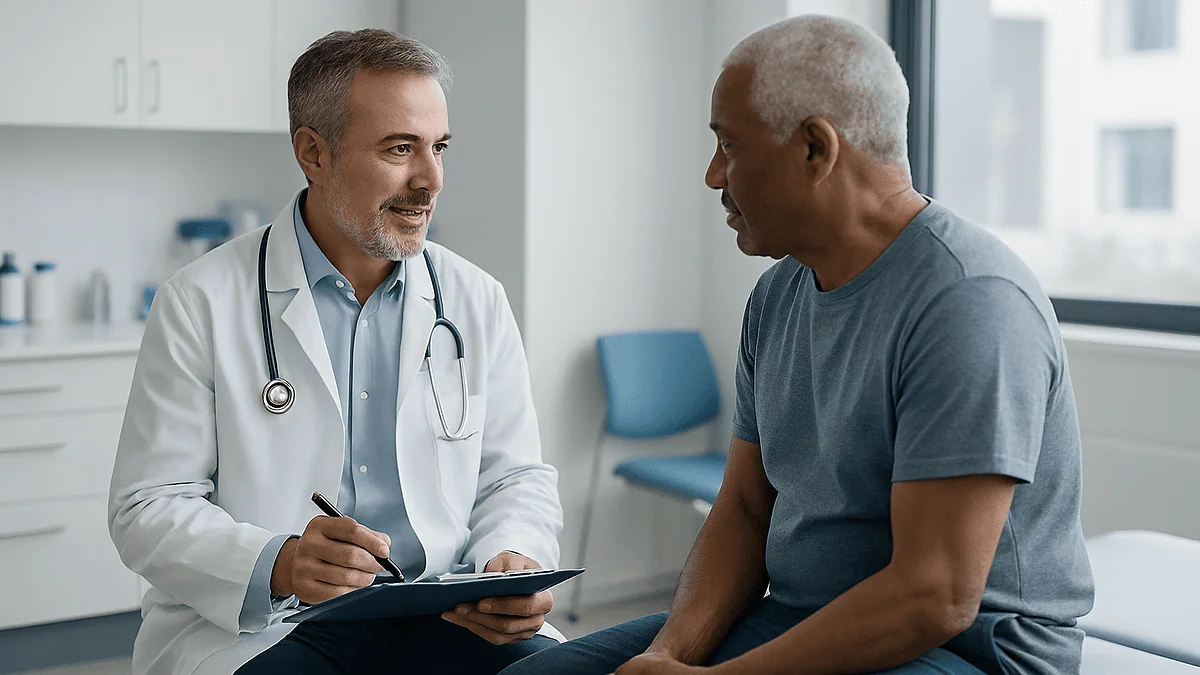
Preparing for urology tests usually means three things: arriving with a comfortably full bladder if an ultrasound or urodynamic study is planned, fasting for a few hours only if a contrast CT or certain blood tests are booked, and never pausing a prescribed medicine, especially a blood thinner or diabetes tablet, unless the team that prescribed it has agreed. Written instructions from the clinic override any general advice.
The appointment letter arrives, and it reads like a puzzle. One line says to drink water and hold it. Another says nothing to eat after midnight. A third asks whether you take a blood thinner, without saying what to do about it. You are standing in the kitchen at ten o’clock the night before, glass in one hand, pill organizer in the other, unsure which instruction wins.
Working out how to prepare for urology tests is harder than it should be, because a single morning can bundle four or five very different investigations. A urine sample wants one thing, a bladder ultrasound wants the opposite, and a contrast scan has its own rules about food and medicines.
This guide walks through what each test needs, why it needs it, and where the real decisions belong. The short version: the clinic’s written sheet always outranks anything you read here, including this article.
How to prepare for urology tests: what actually happens on the day
A urology test day is built around the urinary tract: the kidneys, the tubes that drain them (ureters), the bladder, and the outflow channel (urethra), plus the prostate in men. Most clinics sequence tests so that one preparation does not ruin the next.
The order usually runs from least to most invasive. You typically start at reception, then give a urine sample. Blood may be drawn next. An ultrasound follows, often with a measurement of how much urine stays behind after you empty. Only after these does anyone consider looking inside the bladder with a thin camera (cystoscopy) or running the pressure measurements known as urodynamics.
That order matters for you, because it explains the contradictory-looking instructions. A urine sample is best given when your bladder has held urine for a while, so a first-morning or mid-stream sample is often requested (MedlinePlus). An ultrasound of the bladder or pelvis needs the organ stretched with fluid so sound waves can pass through it cleanly (NHS). A camera examination needs the bladder empty at the start, then filled with sterile fluid by the team.
Nothing about the morning is a pass-or-fail exam. If you cannot hold water, say so; the sonographer can rescan later or shorten the study. If you forgot to fast, the team can reschedule a contrast scan rather than take a risk. Honesty at check-in saves far more time than a hidden mistake discovered halfway through.
Expect a mixture of waiting, undressing from the waist down, lying still, and a good deal of drinking. Bringing a book and loose clothing turns a stressful day into a merely long one.
Who is usually booked for these tests, and who is asked to wait
Urology test days are typically arranged after a family doctor or specialist has already seen something worth clarifying: blood in the urine, repeated urinary infections, difficulty emptying, leakage, kidney stones on an earlier scan, or a raised prostate-specific antigen (PSA) blood result, PSA being a protein made by the prostate that can rise for many reasons besides cancer.

Some people are asked to postpone rather than proceed, and the reasons are practical rather than dismissive:
- An active urinary infection can distort almost every result, and pushing instruments into an infected bladder raises the risk of spreading bacteria. MedlinePlus notes that cystoscopy is generally deferred while a urinary tract infection is being treated.
- A recent PSA-raising event. The NHS advises that PSA testing is usually delayed if you have had a urine infection in the past six weeks, or have ejaculated or exercised vigorously in the previous 48 hours, because each can push the number up temporarily.
- Menstruation can add blood cells to a urine sample; the lab may ask to repeat the test on another day rather than cancel the rest of the visit.
- Reduced kidney function or a previous reaction to iodine-based contrast means a CT scan with contrast may be swapped for an ultrasound or MRI, a decision that belongs to the radiology and urology teams together (Mayo Clinic).
- Pregnancy, known or possible, changes the plan for any X-ray or CT.
Being asked to wait is not a sign the problem is minor or being ignored. It usually means the team wants a clean answer rather than a muddy one that has to be repeated.
Why the urine sample comes first, and how to give a clean one
The humblest test on the list quietly carries the most weight. A urinalysis checks urine for blood, protein, sugar, white cells and signs of infection, and a poorly collected sample can send a whole investigation down the wrong road (MedlinePlus).
The standard request is a clean-catch, mid-stream sample. Clean-catch means wiping the area around the urethral opening with the wipe provided, starting to pass urine into the toilet, then moving the pot into the stream to collect the middle portion, and finishing in the toilet. The first part of the stream carries skin bacteria; the middle part reflects what is actually in the bladder.
A few things genuinely change the result:
- Very dilute urine from drinking heavily just beforehand can hide small amounts of protein or blood. If an ultrasound later in the morning needs a full bladder, ask whether to give the sample before you start drinking.
- Beetroot, blackberries and some food colorings can tint urine pink and cause alarm; mention them.
- Vitamin C in large amounts and certain antibiotics can interfere with some dipstick chemistry, so bring a list of supplements as well as prescriptions (MedlinePlus).
Do not try to “hold on for a better sample” to the point of discomfort. Most clinics only need a small volume, and a sample given after a normal interval between visits to the toilet is fine unless your letter specifies a first-morning sample.
If you have a catheter, the nurse will collect the sample from the port, not the bag, because bag urine grows bacteria that may not be in your bladder at all.
Do you need a full bladder for a urology ultrasound?
Usually yes, and for a mechanical reason. Ultrasound uses sound waves, and they travel poorly through gas-filled bowel but beautifully through fluid. A bladder full of urine acts like a window: it pushes bowel aside and lets the sonographer see the bladder wall, the lower ureters, the prostate or uterus behind it, and any stones or growths. An empty bladder collapses into folds that can hide small lesions.
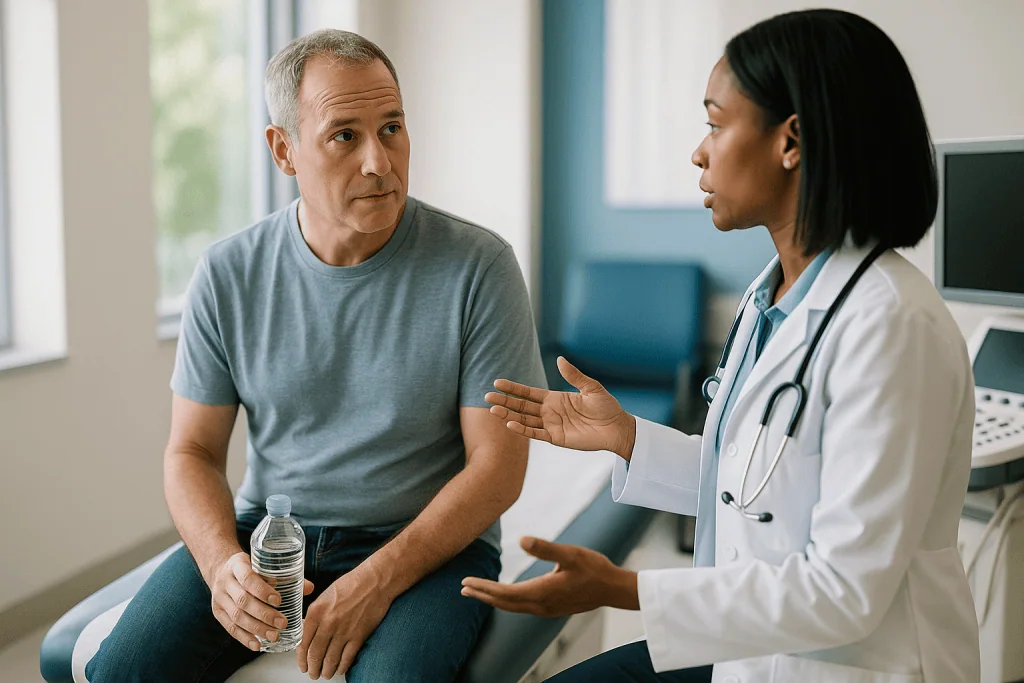
The NHS advises that for a pelvic or bladder scan you may be asked to drink water beforehand and to avoid going to the toilet until after the scan. Your appointment letter will state the amount and timing; follow that rather than a general figure, because clinics vary and some deliberately ask for less if they know a cystoscopy follows.
Three practical points make this easier:
- Drink steadily over the hour before, not all at once at the door. A slow fill is more comfortable and gives the kidneys time to move fluid into the bladder.
- Comfortably full is the target, not painful. If you are in genuine distress, tell reception; scanning an over-distended bladder is unpleasant and often no clearer.
- After the bladder view, the sonographer will typically ask you to empty and then rescan to measure post-void residual, the amount left behind. This number helps show whether the bladder is emptying properly, so try to pass urine as you normally would rather than straining.
Kidney ultrasound, by contrast, does not depend on a full bladder, since the kidneys sit high in the flanks. If only your kidneys are being scanned, the letter may say nothing about drinking at all. If unsure, a quick call to the department beats an uncomfortable guess.
How to prepare for a cystoscopy without dreading it
A cystoscopy is a look inside the urethra and bladder with a thin, lighted tube. Most outpatient examinations use a flexible scope about the width of a pencil, passed after a numbing gel is placed in the urethra (MedlinePlus). The procedure itself typically lasts only a few minutes.
Preparation is lighter than many people expect:
- Arrive with a bladder you can empty just before the test. The team fills the bladder with sterile fluid during the examination so the walls unfold; you do not need to arrive full.
- Eat and drink normally unless you are having a rigid cystoscopy under general anesthesia, in which case fasting instructions will be sent and must be followed exactly.
- Bring your medicine list. Blood thinners do not usually need to be stopped for a simple flexible look, but the decision sits with the urologist and the prescriber, never with you alone (NHS).
- A urine sample is often checked first to rule out infection; if one is found, the scope is generally postponed.
What it feels like is the question people most want answered honestly. Expect pressure and a strong urge to pass urine as the fluid goes in, and a brief stinging as the scope passes the sphincter. For most people this is uncomfortable rather than painful, and it passes quickly. Slow breathing and relaxing the pelvic floor, as if starting to pass urine, genuinely helps the scope slide past.
Afterwards, MedlinePlus describes mild burning on passing urine and a small amount of blood for a day or two as common. Drinking water in the hours afterwards dilutes the urine and eases the sting. You can usually drive yourself home after a flexible cystoscopy done with gel alone; after a general anesthetic you cannot.
Urodynamic testing: the bladder diary and arriving comfortably full
Urodynamics is the umbrella term for tests that measure how the bladder stores and releases urine, using thin pressure-sensing catheters and a flow meter (Cleveland Clinic). It is booked for leakage, urgency, difficulty emptying, or before certain operations, and it is the one test on the list where preparation directly shapes the quality of the answer.
Most clinics ask you to arrive with a comfortably full bladder, because the first measurement is often a natural void into a special toilet that records flow rate. A bladder emptied in the car park gives no data. If holding is impossible, tell the nurse; the study can start with the filling phase instead.
Many departments also ask for a bladder diary beforehand: a written record of what you drink, when you pass urine, roughly how much, and any leaks. Your letter will say how many days to record. The diary matters more than people realize. It shows the clinician your bladder on ordinary days, not just the artificial one in the test room, and it often explains findings that pressure traces alone cannot.
Other points worth knowing:
- You may be asked to stop bladder-relaxant medicines for a set period so the study sees your untreated bladder. Only stop if the urology team has explicitly asked, and confirm the exact instruction with them.
- An infection on the day usually means postponement, so mention any burning or fever before the catheters go in.
- Constipation can affect readings, since a loaded rectum presses on the bladder; mention it, and the team may advise on timing.
The catheters are fine and lubricated. The test is undignified rather than painful, and the staff who run it have seen every possible variation of nerves.
Is fasting before urology tests really necessary?
Only sometimes, and the confusion arises because “urology tests” covers two very different groups. Nothing about urine tests, ultrasound, flexible cystoscopy or urodynamics requires an empty stomach. Fasting enters the picture for two reasons: anesthesia and contrast.
Anesthesia is the strict one. If any procedure is planned under sedation or general anesthetic, the pre-assessment team will give exact times for your last meal and last clear fluid, and these are safety rules about the stomach being empty during unconsciousness, not suggestions. Follow them to the letter, and if you slip, tell the team; procedures are delayed rather than risked.
Contrast is the softer one. A CT urogram is a CT scan of the kidneys, ureters and bladder taken after iodine-based dye is injected into a vein so the urinary tract lights up. Mayo Clinic notes you may be asked not to eat or drink for a few hours beforehand, largely to reduce nausea if the dye causes it, and to drink extra fluid afterwards to help flush the contrast through the kidneys.
Blood tests occasionally need fasting, but PSA and kidney function tests do not. If your letter mentions fasting blood work, it is probably for lipids or glucose ordered alongside, and the letter should say so.
Two things worth separating from fasting:
- Fluids to fill the bladder are not the same as breaking a fast in the anesthetic sense, but only the pre-assessment team can tell you what counts as a clear fluid and when it must stop.
- Medicines are usually taken with a sip of water even on fasting days, unless told otherwise. Which medicines are the next question, and it is the most important one.
Which medicines are usually paused before urology tests, and who decides
This is where well-meaning improvisation causes real harm. The safest rule is blunt: you do not stop, skip or double any prescribed medicine for a urology test unless the team that prescribed it, or the urology team in agreement with them, has told you to in writing.
Three groups come up repeatedly, and it helps to understand why they are discussed rather than what to do, because what to do is individual.
Blood thinners. Anticoagulants and antiplatelet drugs reduce clotting. They protect against stroke and heart attack, and stopping them abruptly can be more dangerous than the bleeding they might cause during a test. A flexible cystoscopy carries little bleeding risk and these medicines are often continued (NHS). A biopsy or stone procedure is different. The urologist weighs the bleeding risk of the procedure; the cardiologist or prescriber weighs the clotting risk of pausing; together they give you a plan and a date. Your role is to make sure both know about the other.
Diabetes medicines. One widely used tablet, metformin, is cleared by the kidneys, and iodine contrast can briefly affect kidney function in some people. Radiology teams therefore sometimes ask for it to be held around a contrast scan, especially where kidney function is already reduced. Whether this applies to you, and for how long, depends on your kidney blood results; the radiology team decides (Mayo Clinic). Insulin and other diabetes medicines need adjusting on fasting days, and that adjustment must come from your diabetes team.
Diuretics. Water tablets make holding a full bladder miserable. Some clinics suggest timing the dose after the scan; ask, rather than skipping.
Bring every medicine, including over-the-counter painkillers, herbal products and supplements, or a current printed list. Anti-inflammatories and some supplements can affect bleeding and kidney function, and the team cannot factor in what it does not know.
Preparation at a glance: test by test
Because a single morning can include several of these, a side-by-side view is the quickest way to spot conflicts between instructions. Treat the table as a map of what to ask about; your clinic’s letter fills in the specifics.
| Test | Bladder state at arrival | Food and drink | Medicine questions to raise |
|---|---|---|---|
| Urinalysis and culture | Normal; mid-stream clean-catch sample | Eat normally; avoid over-hydrating just before | Antibiotics, vitamin C, anything coloring urine |
| Blood tests (PSA, kidney function) | Not relevant | No fasting unless lipids or glucose also ordered | None usually; report recent infection for PSA |
| Bladder and pelvic ultrasound | Comfortably full, then empty for residual measurement | Drink as instructed in the hour before | Diuretics (timing) |
| Kidney ultrasound alone | Not required full | Normal | None usually |
| Flexible cystoscopy (gel only) | Empty just before | Normal | Blood thinners: usually continued, confirm |
| Rigid cystoscopy or biopsy (anesthetic) | Empty | Strict fasting per pre-assessment | Blood thinners, diabetes medicines: written plan needed |
| Urodynamics | Comfortably full; bring bladder diary | Normal | Bladder-relaxant drugs: only if told |
| CT urogram with contrast | Not relevant | Possible short fast; extra fluids after | Metformin, kidney function, contrast allergy |
Two patterns jump out. First, the only test that wants you full is the one that may sit right before one that wants you empty, which is why sequencing and a word with the sonographer matter. Second, medicine questions cluster around bleeding and contrast, and both belong to prescribers rather than to you. The right move on the night before is to phone if anything in the letter conflicts, not to average the instructions.
What to expect at a urology appointment: what to bring and wear
Small logistics do more for a smooth day than any amount of worrying. Start with paper: the appointment letter, a current list of medicines and supplements with strengths as written on the boxes, any previous scan reports or letters from other hospitals, and your bladder diary if one was requested. A photograph of each medicine box on your phone works well if the list is long.
Wear clothes that come off and on quickly from the waist down, with an elastic waist rather than a belt and buttons. You will undress several times. Slip-on shoes save a surprising amount of time and dignity in a changing cubicle. Avoid metal fastenings if a CT is planned, though staff will provide a gown if needed.
Bring water in a bottle you can sip on schedule, and a snack for after any fasting. A sanitary pad or absorbent liner is sensible for anyone worried about leaking during the hold for ultrasound or afterwards from cystoscopy; nobody will blink.
Consider a companion. For a flexible cystoscopy with gel you can normally travel home alone. For anything under sedation or general anesthetic you need someone to take you home and, usually, to stay with you that evening; the pre-assessment team will confirm.
Allow more time than the letter suggests. Ultrasound queues run late when bladders fill at different speeds, and urodynamics is unhurried by design. Parking anxiety and a full bladder are a poor mix.
Finally, prepare a short list of what you want to leave knowing: when results will come, who will explain them, and whether anything today changes your medicines. Write the answers down before you leave; recall after an uncomfortable test is unreliable for everyone.
Prostate checks: timing the PSA and what the examination involves
For men, a urology test day often includes a PSA blood test and a physical examination of the prostate through the rectum. Neither requires fasting, but timing shapes the blood result more than most people are told.
PSA rises with anything that irritates or presses on the prostate. The NHS advises that a PSA test should usually be avoided if you have had a urinary infection in the past six weeks, and that you should not have ejaculated or exercised vigorously in the 48 hours beforehand, because each can produce a temporary rise. Cycling counts as vigorous exercise for this purpose. A recent catheter or biopsy also raises the value, so the clinic may deliberately draw blood before, not after, any instrument is used that day, and you can ask that it be scheduled that way.
The digital rectal examination is brief: a gloved, lubricated finger assesses the size, shape and texture of the gland through the rectal wall. It is awkward and takes seconds. Whether it nudges the PSA is debated; Mayo Clinic notes that some clinicians prefer to draw the blood first as a precaution.
It helps to know in advance that a raised PSA is a prompt for more questions, not a diagnosis. Benign enlargement, inflammation and infection all raise it, and the number is interpreted alongside your age, previous values, examination and often an MRI before anyone discusses biopsy (Mayo Clinic). If a biopsy is later proposed, it comes with its own preparation, including antibiotic and blood-thinner planning, and a separate appointment.
Tell the team about any bowel problems, hemorrhoids or previous pelvic surgery before the examination; adjustments can be made, and the information is clinically useful in itself.
What the following days usually look like
Most people are back to ordinary life the same afternoon. The exceptions are predictable, and knowing them removes the fear that something has gone wrong.
After a flexible cystoscopy, MedlinePlus describes mild burning when passing urine, needing to go more often, and a little blood, for a day or two. Drinking more water than usual over that period dilutes the urine and eases the sting. Sexual activity can resume when you feel comfortable, unless told otherwise.
After urodynamics, expect similar mild irritation from the catheters, typically settling within a day. A small amount of spotting is common.
After a CT urogram, Mayo Clinic advises drinking plenty of fluid to help the contrast leave through the kidneys. A warm flush during the injection and a metallic taste are normal and fade within minutes. If your metformin was held, you will have been told when to restart it, and you should not restart earlier or later on your own.
After any procedure under anesthetic, the day is a write-off: no driving, no alcohol, no important decisions, and someone at home with you.
Results arrive at different speeds. A urine dipstick is read on the spot; a culture takes the laboratory a few days to grow; PSA and kidney function usually return within days; scan and cystoscopy findings are often explained the same day in outline, with a formal report and letter following. The waiting is the hardest part of the timeline, and it is reasonable to ask at the end of the visit exactly how and when you will hear, and whom to call if you have not.
A result that leads to another test is the system working, not failing. Most urology pathways are a sequence of narrowing questions rather than a single verdict.
What people often get wrong about preparing for urology tests
“The fuller the bladder, the better the scan.” Up to a point, then it hurts and the images get no clearer. The NHS asks for a full bladder for pelvic scans, not a painful one. If you are in distress, the sonographer would rather you empty a little than suffer.
“I should stop my blood thinner to be safe.” The opposite is often true. Stopping anticoagulants without a plan can trigger the very clot they exist to prevent, and a flexible cystoscopy is usually done with them continued. The plan comes from your prescriber and urologist together.
“Fasting means no water at all.” Anesthetic fasting distinguishes between food and clear fluids, and often allows small sips with medicines. Only your pre-assessment instructions define this; general rules of thumb are where mistakes come from.
“A urine sample is a urine sample.” First-of-the-stream urine, a sample after two liters of water, or urine from a catheter bag can each mislead the lab. Mid-stream, clean-catch, at ordinary hydration is the standard (MedlinePlus).
“Blood after cystoscopy means something was damaged.” A small amount for a day or two is expected. Heavy bleeding, clots or fever are the signs to act on.
“My PSA is high, so it must be cancer.” Infection, recent ejaculation, exercise and benign enlargement all raise PSA. The NHS specifically asks patients to time the test to avoid these confounders.
“I can guess what the clinic meant.” When two instructions seem to conflict, they may simply apply to different tests on the same morning. Five minutes on the phone the day before beats a canceled scan.
“Cystoscopy is done under general anesthetic.” Most outpatient looks use gel only, take minutes, and let you drive home. The rigid version under anesthetic is a different booking with different rules.
Questions to ask your care team before the day
A short phone call or a note at pre-assessment settles most uncertainty. These are the questions that most often prevent a wasted morning, phrased so you can read them straight off the page.
- Which tests exactly am I having, and in what order? This tells you when to be full and when to be empty.
- For the ultrasound, how much should I drink and by what time? Can I give my urine sample before I start drinking?
- Is anything today being done under sedation or anesthetic? If so, what are my exact fasting times, and may I take my morning medicines with water?
- Do you need a bladder diary, and for how many days?
- I take a blood thinner (name it). Do I continue it? If not, who is giving me the stopping and restarting plan, and has my prescriber agreed?
- I take diabetes medicines or insulin. Does the fasting or the contrast change anything, and who confirms that?
- I take a water tablet. Should I time it differently on the day?
- I have had a reaction to contrast, iodine or latex before. Have you recorded it?
- Should the PSA blood be drawn before any examination or instrument?
- Will I be able to drive home? Do I need someone with me overnight?
- How and when will I get each result, and who explains them?
- Is there a number to call if I have bleeding, fever or cannot pass urine afterwards?
Write the answers next to the questions and bring the sheet. Staff appreciate a patient who has read the letter and asks precisely; it makes their day shorter too. If an answer is “it depends on your blood results,” that is a legitimate reply, and you can ask who will contact you once the results are in and by when.
When to call your doctor after urology tests
Mild burning, urgency and a trace of blood for a day or two after cystoscopy or urodynamics are expected (MedlinePlus). A warm flush and odd taste during contrast are normal. The signs below are different, and they warrant a same-day call to the urology department or, out of hours, urgent care or emergency services.
- You cannot pass urine at all several hours after a procedure, with a painful, swollen lower abdomen. Retention needs prompt relief.
- Heavy bleeding: urine that stays deep red rather than pink-tinged, or clots that block the flow.
- Fever, shaking chills, or feeling suddenly unwell after any instrument has been used. Infection after catheterization or cystoscopy is uncommon but needs treatment quickly.
- Severe or worsening pain in the lower abdomen, back or side, especially with nausea.
- After contrast: hives spreading over the body, swelling of the lips or face, wheezing or difficulty breathing. Seek emergency help immediately; delayed reactions can occur hours later.
- After an anesthetic: persistent vomiting, confusion, chest pain or breathlessness.
- Burning or bleeding that is not settling after the expected day or two, or that worsens after initially improving.
- A newly stopped blood thinner and any sign of stroke or heart attack, including sudden weakness, facial droop, speech difficulty or chest pain. Call emergency services.
Keep the department’s number and your discharge sheet within reach for 48 hours. When you call, say which test you had, when, and what has changed; that shorthand gets you the right advice fastest.
Every decision about continuing, pausing or restarting a medicine, repeating a test, or moving to the next step belongs to your treating team, who can see your results and history in full. This article can help you ask better questions; it cannot answer them for you.
Frequently asked questions
How do you prepare for a urology exam in general?
Read the appointment letter twice, then follow it exactly: drink water for an ultrasound, fast only if anesthesia or contrast is planned, and bring a full medicine list. Wear loose clothing that is easy to remove from the waist down, allow extra time, and phone the department the day before if any two instructions seem to contradict each other.
Do I need a full bladder for a urology ultrasound?
For a bladder or pelvic ultrasound, usually yes; the NHS advises drinking water beforehand and not emptying until after the scan so the fluid-filled bladder gives a clear view. A kidney-only scan does not need it. Comfortably full is the goal, not painful, and the sonographer will usually ask you to empty afterwards to measure what remains.
How do I prepare for a cystoscopy?
For a flexible cystoscopy with numbing gel, very little: eat normally, empty your bladder just before, and bring your medicine list. Blood thinners are often continued but confirm with the urologist. If a rigid cystoscopy under anesthetic is planned, strict fasting instructions apply and someone must take you home. Report any burning or fever beforehand, as infection usually delays the test.
Is fasting before urology tests always required?
No. Urine tests, ultrasound, flexible cystoscopy and urodynamics need no fasting. Fasting is required before any procedure under sedation or general anesthetic, and Mayo Clinic notes you may be asked not to eat or drink for a few hours before a contrast CT urogram. PSA and kidney blood tests do not require an empty stomach.
Should I stop my blood thinner before urology tests?
Never on your own. Stopping anticoagulants without a plan can cause a clot, and flexible cystoscopy is usually done with them continued. For biopsies or stone procedures, the urologist and the prescriber agree a written plan with exact stopping and restarting dates. Tell both teams about each other and follow only the instructions they give you.
What happens to diabetes medicines on a test day?
It depends on whether you are fasting and whether contrast is used. Insulin and other glucose-lowering medicines often need adjusting on a fasting morning, and radiology teams sometimes ask for metformin to be held around iodine contrast in people with reduced kidney function. Both decisions belong to your diabetes and radiology teams; ask before the day rather than guessing.
How long does a urology test take?
The flexible cystoscopy itself usually takes only a few minutes according to MedlinePlus, but the whole visit is longer because of check-in, undressing, urine sampling and waiting for the bladder to fill for ultrasound. Urodynamics is deliberately unhurried. Plan for a half day when several tests are combined, and avoid tight parking limits.
What should I expect at a urology appointment after the tests?
Mild burning, urgency and a little blood for a day or two are common after cystoscopy or urodynamics. Drinking extra water eases this and, after contrast, helps flush the dye. Ask before leaving how and when each result will reach you and whom to call. Results often lead to a follow-up conversation rather than an immediate verdict.
Can I have my PSA tested on the same day as a rectal examination?
Yes, but many clinicians prefer to draw the blood first as a precaution, and you can ask for that order. More important, the NHS advises avoiding the test within six weeks of a urinary infection or 48 hours of ejaculation or vigorous exercise, since each can temporarily raise PSA and prompt unnecessary worry or repeat testing.
What if I cannot hold my bladder for the ultrasound?
Tell the reception or sonographer straight away. Options include scanning sooner, letting you release a small amount and continuing to drink, or rescheduling the bladder view. An over-distended bladder is painful and does not give better pictures. Nobody is judged for this; it is one of the most common situations in any ultrasound department.
References
This article is for general information only and is not a substitute for professional medical advice. Please consult a qualified doctor about your individual situation.

More from the Blog

Inside a Hypospadias Repair: How Surgeons Rebuild the Urethra and Straighten Curvature
Hypospadias surgery is usually a single outpatient operation under general anesthesia, most often done when a child is between about 6 and 18 months…
Stress Incontinence After Pregnancy and Childbirth: When to Wait, Train or Consider Surgery
Stress incontinence after pregnancy is leaking urine when you cough, sneeze, laugh, lift or run, because pregnancy and birth stretch the pelvic floor and…
Ureteroscopy Myths Corrected: Stents, Scarring and Being Put to Sleep
Ureteroscopy is a scope procedure that reaches a stone or blockage through the urethra and bladder, with no skin incision. It is usually done…

Diabetes Medicines and Kidney-Protective Drugs: What Nephrologists Review at Each Visit
At each visit, a nephrologist reviewing diabetic nephropathy medications typically checks kidney filtration (eGFR), urine albumin, blood pressure, potassium and blood sugar, then confirms…

Can Diabetic Nephropathy Be Slowed? What Realistic Treatment Goals Look Like Over Time
Yes, in most people diabetic nephropathy can be slowed, though scarred kidney tissue does not regrow. Progression is slowed by controlling blood pressure and…
Reading a Neurogenic Bladder Treatment Plan: Questions to Ask About Medication and Catheters
A neurogenic bladder treatment plan usually combines three strands: medicines that calm or support the bladder muscle, a catheter method that empties the bladder…