

How Fat Transfer Works Step by Step: Harvesting, Purifying and Injecting Your Own Fat

Key Takeaways
- Fat transfer happens in three stages within one procedure: gentle liposuction to harvest fat, processing to separate living cells from fluid and oil, and injection in thin threads so each parcel can gain a blood supply.
- Published reviews report graft retention ranging from roughly a fifth to four fifths of injected volume, which is why surgeons overfill slightly and sometimes plan a second session.
- Surviving fat is long-lasting but not frozen in time; it grows and shrinks with body weight and ages with surrounding tissue, so a stable weight protects the result.
- Breast fat transfer typically adds no more than about one cup size per session and can create oil cysts or calcifications that appear on mammograms, so imaging teams should always be told about it.
- Buttock fat grafting carries a recognised risk of fat embolism, and current safety guidance calls for placing fat only in the tissue above the muscle, never into or beneath it.
- Final results are usually judged at three to six months, once swelling has resolved and reabsorption has largely finished; the puffiness of the first weeks is not the outcome.
Fat transfer, also called fat grafting, is done in three stages during one procedure. A surgeon removes fat from an area such as the abdomen or thighs using gentle liposuction, processes it to separate living fat cells from fluid, blood and oil, then injects the purified fat in many fine threads into the target area. Some of the transferred fat is reabsorbed over the following months, so results settle gradually and a repeat session is sometimes planned.
The consultation ends the way many do: a mirror, a pen, and a few dotted lines drawn just below the cheekbone. Then comes the question the patient has been turning over for weeks. If the plan is to move fat from one part of the body to another, what actually happens in that operating room? Where does the fat go between the thigh and the face, and why does the surgeon keep saying that not all of it will stay?
It is a fair question, and the honest answer is more interesting than the marketing version. Understanding how fat transfer is done, stage by stage, explains almost everything patients later wonder about: the bruising in two places, the slow reveal over several months, and the reason a second session is sometimes on the table from the start.
This explainer walks through harvesting, purifying and injecting in plain language, then covers pain, risks, recovery and the myths that tend to travel with this procedure. It is written to inform a conversation with a treating team, not to replace one.
How is fat transfer done? The three stages in plain language
Fat transfer is the movement of a person’s own fat from a place where it is plentiful to a place where volume is wanted. Surgeons call it autologous fat grafting; autologous simply means the tissue comes from the same person. Because nothing foreign is introduced, there is no risk of the immune system rejecting the material, which is one reason the technique has spread from small facial touch-ups to breast reconstruction and body contouring.
Every fat transfer, whatever the destination, follows the same skeleton. First, fat is harvested with a form of liposuction, the surgical removal of fat through a thin tube called a cannula. Second, the harvested mixture is processed so that intact fat cells are separated from the fluid, blood and broken cell contents that come out alongside them. Third, the cleaned fat is injected into the recipient site in very small amounts spread across many passes, rather than as one large deposit.
Why so much care over the third stage? Transplanted fat has no blood supply of its own. Each small parcel must be close enough to surrounding tissue to pick up oxygen and nutrients while new vessels grow toward it. Fat placed in a thick clump starves at its centre. Fat laid down in thin threads has a far better chance of surviving, according to the review of grafting techniques published in Plastic and Reconstructive Surgery and indexed on PubMed.
The whole sequence usually happens within a single session, under local anaesthetic with sedation for smaller areas or general anaesthetic for larger volumes, as the NHS describes for liposuction generally. Mayo Clinic notes that the choice of anaesthetic depends on how much fat is being moved and the areas involved, and that decision belongs to the surgical and anaesthetic team.
Step one: harvesting fat with gentle liposuction
The donor site is chosen partly for convenience and partly for anatomy. The lower abdomen, flanks and inner or outer thighs are common because they tend to hold fat that is stable and easy to reach. The patient is usually marked while standing, since fat pockets shift when someone lies down.
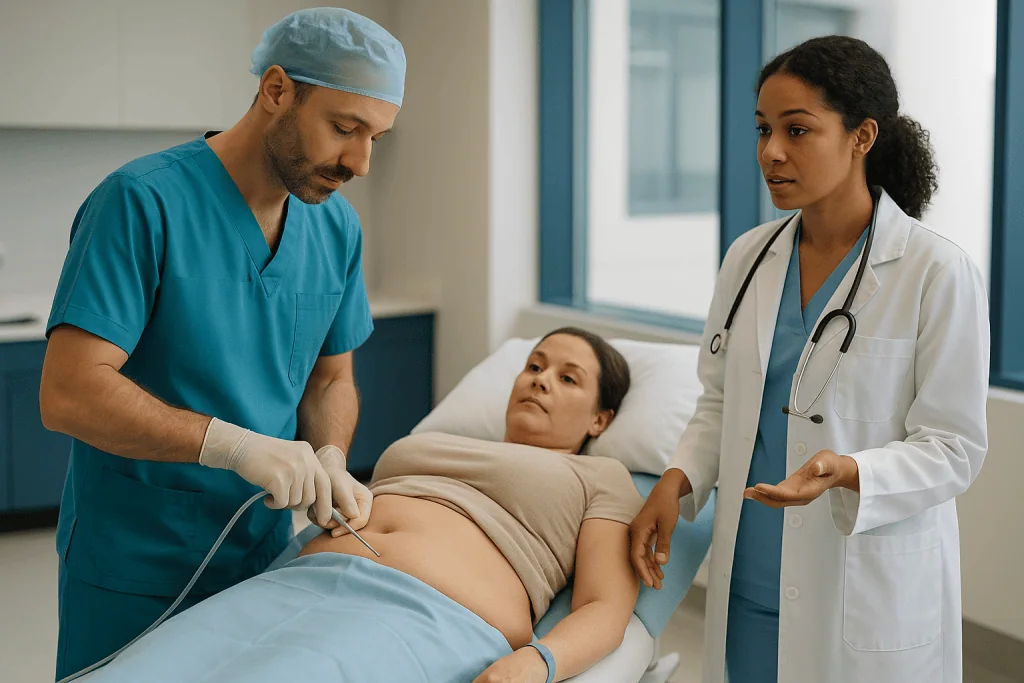
Once anaesthetic is working, the surgeon makes one or more small skin openings, typically a few millimetres long, and infuses the area with tumescent solution. Tumescent means swollen; the solution is a large volume of dilute salt water containing local anaesthetic and a medicine that narrows blood vessels. It firms the tissue, numbs it and reduces bleeding, which is why Mayo Clinic describes the tumescent approach as the most common form of liposuction.
The harvesting itself differs from liposuction done purely for contouring. When the goal is to throw the fat away, the surgeon can use higher suction and larger cannulas. When the fat is destined for reuse, gentler suction and smaller-bore cannulas are preferred to keep fat cells intact. The PubMed review of harvesting methods notes that excessive negative pressure damages cells, and most surgeons now use hand-held syringes or low-vacuum machines for this stage.
How much fat is taken depends entirely on how much is needed at the destination plus a margin for expected loss. A facial procedure may need only a small volume; a breast or buttock procedure needs considerably more, which is why not everyone has enough donor fat for the larger operations. The surgeon will also aim for an even harvest so that the donor area is not left with dents or ridges, a recognised complication of liposuction that the NHS lists among its risks.
Step two: purifying the fat and separating what will survive
What comes out of the cannula is not clean fat. It is a slurry of fat cells, tumescent fluid, blood, oil from ruptured cells and small fragments of connective tissue. Injecting that mixture unchanged would deliver less living tissue and more inflammation, so the surgeon processes it first. Patients rarely see this stage, but it shapes the result.
Three broad methods are in use, and the PubMed review compares them without declaring a single winner:
- Decanting and washing, where the syringe is left to stand so the oil floats up and fluid sinks, then the middle layer is rinsed with saline.
- Centrifugation, where syringes are spun at controlled speed for a short time so the layers separate more sharply.
- Filtration, where the harvest passes through a sterile membrane or gauze that lets fluid drain and retains fat.
Each has trade-offs. Vigorous spinning gives a compact, concentrated graft but can crush some cells if overdone. Gentle washing is kind to cells but leaves the graft more dilute, meaning more volume must be injected for the same eventual result. The review concludes that technique matters less than handling: minimising time outside the body, avoiding air exposure and keeping the fat at a stable temperature.
You may read about additives such as platelet-rich plasma or laboratory-expanded stem cells being mixed into grafts to improve survival. The evidence here is still developing; Cleveland Clinic and the published review describe these approaches as under investigation rather than standard, and results across studies are mixed. A treating team should be able to explain exactly what, if anything, is being added and why.
Once processed, the fat is loaded into small syringes, often one to three millilitres each for the face, ready for the stage that determines how natural the outcome looks.
Step three: injecting the fat in fine threads, layer by layer
The injection stage is where fat transfer becomes as much sculpture as surgery. The surgeon uses a blunt-tipped cannula narrower than a drinking straw, entering through tiny openings placed where scars will hide. Rather than pushing fat in and pulling out, the cannula moves back and forth in a fan pattern, depositing a thin ribbon of fat on each withdrawal.
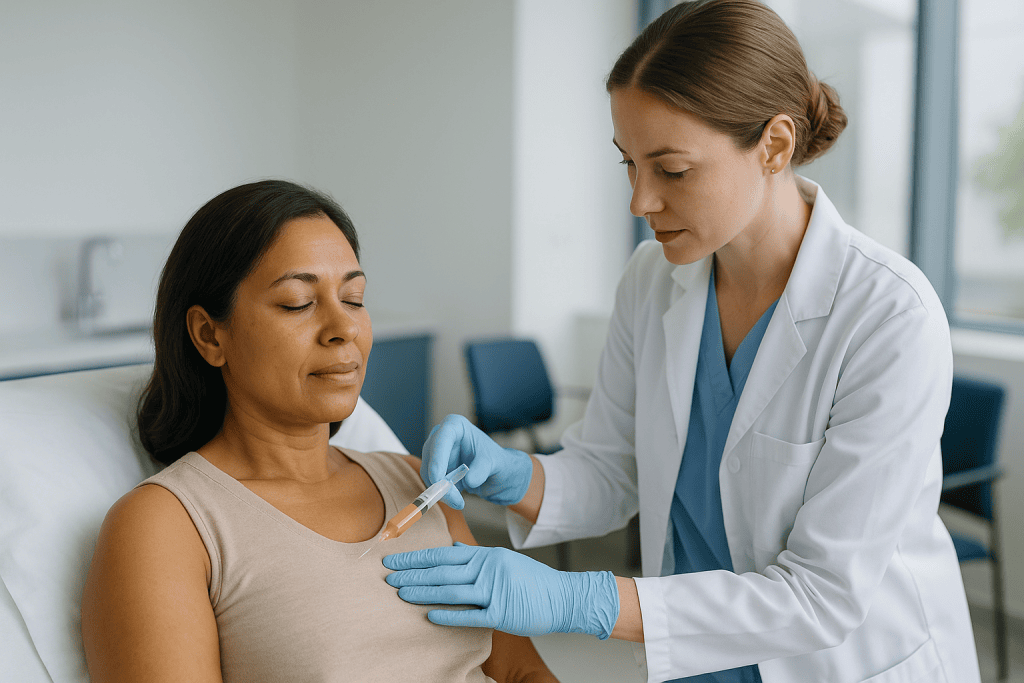
That ribbon technique is deliberate. Cleveland Clinic explains that grafted fat survives only if it can draw nourishment from surrounding tissue while new blood vessels grow in, a process called revascularisation. A thread of fat surrounded on all sides by living tissue is well positioned for this. A blob is not. Surgeons therefore build volume in multiple planes, deep against bone or muscle, in the middle fat layer and sometimes just under the skin, spreading the graft across as much healthy tissue as possible.
Overcorrection is common and intentional. Because a portion of the graft will be reabsorbed, the surgeon typically injects somewhat more than the final desired volume. Patients should expect to look fuller than intended in the first weeks and should not judge the result at that point, a message Mayo Clinic repeats for contouring procedures in general.
Placement is also a safety decision. In buttock fat grafting, professional safety guidance issued by surgical societies now emphasises injecting only into the fat above the muscle, never into or beneath it, because fat entering the large deep veins can travel to the lungs. This is discussed in the risks section below. In the face, the surgeon works around known vessel pathways and uses blunt cannulas to reduce the chance of injecting into an artery.
When finished, the small openings are closed with a stitch or left to seal on their own, and both the donor and recipient areas are dressed. The operation for a face may take one to two hours; larger areas take longer.
Why some fat does not survive, and how long does fat transfer last?
This is the question that separates realistic expectations from disappointment. The fat that survives the first few months is generally considered permanent, because it has become living tissue with its own blood supply. The fat that does not survive is broken down and absorbed by the body. The uncertainty lies in how much falls into each group.
Published reviews are candid about the range. The Plastic and Reconstructive Surgery review indexed on PubMed reports graft retention varying from roughly a fifth to four fifths of the injected volume across studies, with most experienced surgeons planning around the expectation that a substantial minority will be lost. Cleveland Clinic similarly tells patients that some of the transferred fat is reabsorbed and that a second session is sometimes needed to reach the intended result.
Several factors influence survival:
- Recipient tissue quality: well-vascularised areas such as the face tend to hold fat better than scarred or previously irradiated tissue.
- Graft handling: gentle harvest, minimal air exposure and prompt injection improve cell viability.
- Injection technique: thin, well-distributed threads outperform dense pockets.
- Pressure and movement: sitting directly on a freshly grafted buttock or sleeping face-down after facial grafting can compress and starve the graft.
- Smoking: nicotine narrows blood vessels and is consistently linked to poorer graft survival and wound healing, as the NHS notes for cosmetic surgery generally.
Surviving fat behaves like fat anywhere else. It enlarges with weight gain and shrinks with weight loss, so a stable weight protects the result. It also ages with the rest of the body; a facial graft does not stop the underlying bone and soft tissue from changing over the decades. Longevity, in other words, is best described as lasting rather than permanent, and no surgeon can promise a specific retention figure for an individual.
Where fat transfer is used: face, breasts, buttocks, hands and scars
The same three-stage process serves very different goals, and the destination changes the scale, the risks and the conversation a patient should have beforehand.
In the face, small volumes restore fullness lost with age in the temples, under the eyes, along the cheeks and around the mouth. Because facial fat pads deflate gradually, the graft is often distributed across several zones rather than placed in one fold. The result is meant to read as a rested version of the same face, not a different one.
In the breast, fat transfer is used in two settings. In reconstruction after cancer surgery, it smooths contour irregularities, softens the edges of an implant or fills defects left by lumpectomy. In cosmetic augmentation, it offers a modest increase in size without an implant; the NHS describes this option within its overview of breast enlargement and notes that the increase achievable per session is usually limited to around one cup size or less.
In the buttocks, larger volumes are grafted for shape and projection. This is the highest-risk application because of the fat embolism concern described later, and technique standards have tightened accordingly.
In the hands, small amounts soften the prominent tendons and veins that come with age. In scars and contour defects, including those from trauma, previous liposuction or radiotherapy, fat can improve texture and pliability; Cleveland Clinic lists scar improvement among recognised uses, though the evidence base for this application remains smaller than for volume restoration.
What unites these uses is that fat transfer adds volume; it does not lift, tighten or remove skin. A patient with significant skin laxity is typically counselled that grafting alone will not address it, and that a lift or another procedure may be discussed instead or alongside.
Who is fat transfer usually for, and who is usually asked to wait
Suitability is judged on the recipient area, the donor supply and overall health rather than on age alone. Surgeons generally consider fat transfer for adults who want a modest, natural-looking increase in volume and who have enough spare fat to harvest with a margin for loss. That second condition rules out more people than expected; very lean patients may simply not have sufficient donor tissue for a breast or buttock procedure, though they often have enough for the face.
Good candidates typically share a few features. Their weight has been stable for several months, because the graft will track future weight changes. They do not smoke, or they have stopped well before surgery. They have realistic expectations, understanding that the result settles over months and may require a second session. And they have no active infection or uncontrolled medical condition at the planned surgical sites.
Patients are commonly asked to wait, or are advised against the procedure, in several situations:
- Active smoking or nicotine use, given its effect on graft survival and healing.
- Pregnancy or breastfeeding, or plans to lose a significant amount of weight in the near future.
- Bleeding disorders or use of blood-thinning medicines that cannot be safely paused; that decision rests with the prescribing clinician.
- Poorly controlled diabetes or other conditions that impair wound healing.
- A recent or planned course of radiotherapy to the recipient area, where tissue may not yet be ready to accept a graft.
For anyone with a personal or family history of breast cancer considering breast fat transfer, most teams arrange baseline imaging and a discussion of surveillance beforehand, because grafted fat can produce changes on mammograms. Mayo Clinic and the NHS both emphasise that cosmetic procedures should follow a thorough consultation covering medical history and medicines, and that the final decision on timing and suitability sits with the treating team.
Is fat transfer painful? What the procedure and the days after actually feel like
During the operation itself, the patient should feel nothing beyond pressure or movement, depending on the anaesthetic used. Local anaesthetic with sedation is common for facial and small-volume procedures; larger harvests are more often done under general anaesthetic, as the NHS outlines for liposuction.
Afterwards, discomfort comes from two places, and patients are sometimes surprised that the donor site is the more troublesome. Liposuctioned areas typically feel bruised and tender, rather like a deep muscle strain, for the first week. The NHS describes pain, swelling and bruising as expected after liposuction, usually manageable with pain relief prescribed or advised by the surgical team; the type and duration are decisions for that team, not for a magazine.
The recipient site usually feels tight, swollen and numb rather than sharply painful. Facial grafting often produces striking puffiness for several days, particularly around the eyes, with sensation returning gradually over weeks. Breast grafting can produce a heavy, tender feeling. Buttock grafting brings the added challenge of avoiding sitting directly on the area for a period the surgeon specifies, which is more inconvenient than painful.
Compression garments, worn over the donor area to limit swelling and help the skin settle, add their own low-grade discomfort. Mayo Clinic notes that these are usually worn for a few weeks after liposuction.
Pain that escalates rather than easing after the first few days, or that concentrates in one hot, red, hard area, is not a normal part of recovery and falls under the red flags covered later. For most patients, though, the honest description is a week of soreness in two places, followed by weeks of swelling and tightness that gradually fades.
Fat grafting vs implants vs fillers: how the options compare
Fat transfer sits between two alternatives. Injectable fillers, usually gels based on hyaluronic acid, add volume without surgery but are temporary. Implants, whether silicone or saline, deliver predictable volume in one step but introduce a device with its own maintenance and complication profile. The table summarises how mainstream sources describe the trade-offs; none of these options is right for everyone, and the choice belongs to the patient and the treating team.
| Feature | Fat transfer | Implants | Injectable fillers |
|---|---|---|---|
| Material | Patient’s own fat | Silicone or saline device | Hyaluronic acid or similar gel |
| Anaesthetic | Local with sedation or general | Usually general | Topical or local |
| Volume per session | Modest; limited by donor fat and graft survival | Large and predictable | Small |
| Durability | Surviving fat is long-lasting; some reabsorbed | Long-lasting but devices may need replacement | Months to a year or two, then repeated |
| Recovery | Two sites; swelling settles over months | One site; weeks of healing | Minimal downtime |
| Key downsides | Unpredictable retention, possible second session, donor-site irregularity | Capsular contracture, rupture, device-related complications | Temporary, repeated cost of time, rare vascular occlusion |
A few points deserve emphasis. Fat transfer is the only option that leaves no foreign material in the body, which appeals to many patients, but it trades predictability for that advantage. Implants, as the NHS describes, are not lifetime devices and carry a small risk of a condition involving the surrounding scar tissue. Fillers are the least invasive and the most reversible, yet they demand repetition.
Some surgeons combine approaches, for example placing an implant and then grafting fat around its edges for a softer transition. Whether any combination is appropriate is an individual clinical judgement.
What is the downside of breast fat transfer? Risks explained without spin
Breast fat transfer is often presented as the natural alternative to implants, and in many respects it is. But it has specific downsides that deserve plain description before consent.
The first is modesty of result. As the NHS notes, the increase from one session is limited, and patients wanting a significant change in size usually need either implants or more than one grafting session. Each additional session means another harvest, another recovery and further reduction of donor fat.
The second is unpredictable retention. A proportion of the graft is reabsorbed, and the two breasts may not retain fat equally, which can produce asymmetry that needs correction.
The third concerns what happens to fat that does not survive. Dead fat cells can form oil cysts or become calcified. Cleveland Clinic lists cysts and calcification among recognised complications. These changes are benign, but they can appear on mammograms and may need additional imaging or, occasionally, biopsy to distinguish them from other findings. Experienced breast radiologists are generally able to tell grafting-related calcifications from suspicious ones, yet patients should tell every imaging team that they have had fat transfer.
Fourth, fat necrosis, the death of a pocket of grafted fat, can produce firm lumps that are sometimes tender. Many soften over time; some persist.
Fifth, breast fat transfer inherits every risk of liposuction at the donor site: bruising, contour irregularity, fluid collections and, rarely, infection or skin injury, all listed by the NHS and Mayo Clinic.
The question of breast cancer risk has been studied extensively in women who have had reconstruction after cancer, and mainstream reviews have not shown an increase in recurrence, though surveillance is still recommended. Any patient with a personal or family history should raise this specifically with the treating team.
Fat transfer recovery time: what the following days and weeks usually look like
Recovery unfolds on two timelines at once: the donor site healing from liposuction and the recipient site settling as swelling resolves and the graft establishes a blood supply. Typical ranges below are drawn from NHS and Mayo Clinic descriptions of liposuction and Cleveland Clinic’s overview of fat grafting; individual recovery varies and the surgical team’s instructions take priority.
In the first two to three days, both areas are swollen and bruised. Facial grafting can look dramatic at this stage, with puffiness that makes the result impossible to judge. Small openings may leak tinged fluid, which is expected. Compression is worn over the donor area, and patients are asked to move about gently to reduce clot risk.
Between roughly one and two weeks, most people return to desk work, in line with NHS guidance for liposuction recovery. Bruising begins to fade. Facial swelling reduces enough to look presentable, though fuller than the final result. Buttock patients are usually still avoiding direct sitting or using a modified cushion as instructed.
From about three to six weeks, strenuous exercise is typically reintroduced as the surgeon allows. Compression garments are usually discontinued around this point. Numbness at the donor site may persist.
Between three and six months, the picture clarifies. Mayo Clinic notes that final liposuction contours emerge over several months as swelling fully resolves, and Cleveland Clinic describes fat graft results as becoming apparent over a similar period once reabsorption has largely finished. This is the point at which a surgeon can assess retention and discuss whether a second session is warranted.
Habits during these months matter. Keeping weight stable, avoiding pressure on the grafted area, not smoking and protecting the face from sun exposure while bruised all support healing. Follow-up appointments should be kept even when everything feels fine.
What people often get wrong about fat transfer
Several beliefs circulate widely enough to deserve direct correction.
The first is that fat transfer is permanent in the way an implant is. It is not. The surviving portion is long-lasting, but a variable share is reabsorbed, and the survivors respond to weight change and ageing like any other fat. Published reviews describe retention as a range, not a guarantee.
The second is that harvesting fat from the abdomen gives a flat stomach as a bonus. Harvest for grafting prioritises fat quality and an even donor site over aggressive contouring; the volumes removed for a facial graft are far too small to change body shape, and even larger harvests are limited by what the recipient area can safely accept.
The third is that it can be done in a lunch break. Fat transfer is surgery involving two sites, anaesthetic and a recovery measured in weeks and months. Fillers fit the lunch-break description; fat does not.
The fourth is that more fat injected means a better result. The opposite tends to be true beyond a point. Overpacking starves the graft’s centre and increases the risk of oil cysts and lumps, which is why surgeons distribute fat thinly and sometimes stage large volumes across sessions.
The fifth is that stem cells in the fat perform some rejuvenating function on the overlying skin. Fat does contain progenitor cells, and this is an active research area, but Cleveland Clinic and published reviews describe claims of skin rejuvenation as not yet proven by robust trials. The established benefit of fat transfer is volume, full stop.
The sixth is that fat transfer to the buttocks is a low-risk cosmetic procedure. It carries a recognised risk of fat embolism, and technique standards exist precisely because of that risk. A surgeon who cannot explain where in the tissue the fat will be placed, and why, has not answered the most important safety question.
Questions to ask your care team before fat transfer
A good consultation should leave a patient able to describe their own procedure in plain terms. These questions help get there, and the answers should come without hesitation.
- Where will you harvest the fat from, and how did you decide that area is suitable?
- How will the fat be processed after harvest, and is anything being added to it?
- How much fat do you expect to inject, and how much of that do you anticipate will survive in someone with my tissue and health profile?
- Is a second session likely for the result I want, and how would that be planned?
- In which tissue plane will the fat be placed, and, for buttock grafting specifically, how do you avoid injecting into or below the muscle?
- What anaesthetic will be used, who will administer it and where will the procedure take place?
- What are the most common complications you see in your own patients, and how are they managed?
- For breast grafting, what imaging should I have beforehand and how will follow-up screening be handled?
- What should recovery look like week by week, and what exactly should prompt me to call?
- What is your training and experience in this specific procedure, and how do I verify it?
Two further conversations are worth having. The first covers medicines and supplements: anything that affects bleeding or healing should be disclosed, and any changes are for the prescribing clinician to direct, never for the patient to decide alone. The second covers alternatives, including doing nothing. A team confident in its recommendation will still describe the other options neutrally, as the NHS advises for all cosmetic procedures.
Write the answers down. Recovery is easier when the plan is on paper rather than in memory.
When to call your doctor after fat transfer
Most recovery symptoms are expected: swelling, bruising, soreness, mild fluid leakage from the small openings and numbness that fades over weeks. A short list of signs, however, should prompt an immediate call to the surgical team or emergency services, because they can indicate infection, bleeding, a fluid collection or, in rare cases, fat embolism or a blood clot. The NHS and Mayo Clinic describe these complications of liposuction, and fat grafting adds the embolism concern at its most serious.
Seek urgent care, calling emergency services if severe, for:
- Sudden shortness of breath, chest pain, a racing heart, confusion or coughing up blood, particularly in the first days after buttock or large-volume grafting.
- Pain, swelling or warmth in one calf, which can signal a deep vein clot.
- Fever with chills, or a wound that becomes increasingly red, hot, hard or discharges cloudy fluid.
- Rapidly increasing swelling or a tense, expanding bruise at either site, suggesting bleeding under the skin.
- Skin over the grafted or donor area turning dusky, pale, mottled or dark, which may indicate compromised blood supply.
- Sudden vision change or severe one-sided facial pain after facial grafting, a rare sign of fat entering a blood vessel.
- Persistent vomiting, fainting or inability to keep fluids down.
Contact the team promptly, though less urgently, for pain that increases after the first three days instead of easing, a new lump that is enlarging or tender several weeks in, or numbness that spreads rather than shrinks.
Keep the team’s out-of-hours number to hand from day one. Surgeons expect these calls and would far rather assess something that turns out to be normal than miss something that is not. Every decision about what to do next, including whether a return visit or further treatment is needed, rests with the treating team.
Frequently asked questions
How painful is a fat transfer?
Most patients describe a week of bruised, tender soreness at the liposuction donor site, which is often more uncomfortable than the grafted area, followed by weeks of swelling and tightness rather than sharp pain. The procedure itself is done under local anaesthetic with sedation or general anaesthetic, so nothing should be felt during it. Pain relief afterwards is directed by the surgical team. Pain that worsens after day three, or that concentrates in a hot, red area, should be reported promptly.
What is the downside of breast fat transfer?
The main downsides are a modest increase in size per session, unpredictable retention that can leave asymmetry, and the possibility of oil cysts, firm lumps or calcifications forming where grafted fat did not survive. Those changes are benign but can show on mammograms and occasionally need further imaging. Breast fat transfer also carries all the usual liposuction risks at the donor site. Anyone with a personal or family history of breast cancer should discuss imaging and surveillance with the treating team beforehand.
How much do fat transfers usually cost?
This magazine does not publish prices for any procedure, because costs vary widely with the areas treated, the anaesthetic used, the facility, follow-up care and whether a second session is needed. The most reliable answer comes from the treating team in the form of an itemised written quotation that spells out what is and is not included, such as compression garments, imaging, revision policy and after-hours support. Treat any price advertised without a consultation with caution.
How long does body fat transfer last?
Fat that survives the first few months is generally considered long-lasting because it has developed its own blood supply and behaves like fat anywhere else in the body. Published reviews report that a variable share, anywhere from a fifth to more than half of the injected volume in some studies, is reabsorbed during that early period. The surviving graft then changes with weight gain or loss and with normal ageing, so results are described as lasting rather than permanent.
How is fat transfer done under local anaesthetic?
For smaller procedures such as facial grafting, the donor area is infused with tumescent solution containing local anaesthetic, which numbs the tissue and reduces bleeding, and the recipient area is numbed with local injections. Sedation is often added so the patient is relaxed or lightly asleep. Larger harvests for breast or buttock grafting are more commonly done under general anaesthetic. The choice depends on volume, areas involved and patient health, and is made by the surgical and anaesthetic team.
What is the fat transfer recovery time before returning to work?
Many people return to desk-based work within one to two weeks, in line with NHS guidance for liposuction recovery, though facial swelling may still be visible and buttock patients may need seating modifications. Strenuous exercise is usually reintroduced around three to six weeks as the surgeon allows. Compression garments over the donor site are typically worn for a few weeks. Final results emerge over roughly three to six months as swelling settles and fat reabsorption completes.
Is fat grafting vs implants a straightforward choice?
No; the two suit different goals. Fat grafting uses the patient’s own tissue, avoids a device and gives a soft, natural feel, but offers modest volume with unpredictable retention and may need repeat sessions. Implants deliver larger, predictable volume in one step but introduce a device that can rupture, harden through capsular contracture or require replacement over time. Some surgeons combine both. The right option depends on anatomy, donor fat, goals and health, and is decided with the treating team.
Why does the surgeon inject more fat than I asked for?
Because a portion of every graft is reabsorbed in the first months, surgeons typically overcorrect slightly so that the remaining fat approximates the intended result. This means the treated area looks fuller than planned for several weeks, which can be alarming if unexpected. Overcorrection has limits, however; packing too much fat into one area starves its centre and increases the risk of lumps and oil cysts, so large volumes are often staged across more than one session.
Can fat transfer be reversed if I do not like the result?
Not easily. Surviving grafted fat becomes living tissue and cannot be dissolved the way a hyaluronic acid filler can. Small areas of excess can sometimes be reduced with careful liposuction or, for lumps, by removal of the affected pocket, but these are further procedures with their own healing. This is one reason surgeons prefer to build volume conservatively and stage treatment. Patients should discuss the revision policy and realistic correction options during the consultation.
Does smoking really affect fat transfer results?
Yes, and mainstream sources including the NHS are consistent on this point. Nicotine narrows blood vessels and reduces oxygen delivery to tissue, which impairs wound healing at both sites and starves the newly placed fat during the critical weeks when it depends on surrounding tissue for survival. Smokers tend to show lower graft retention and higher complication rates. Most surgical teams ask patients to stop all nicotine use well before surgery and throughout recovery.
References
This article is for general information only and is not a substitute for professional medical advice. Please consult a qualified doctor about your individual situation.

More from the Blog
Is Body Aesthetics Surgery Right for You? Weight Stability, Skin Quality and Overall Health
A body aesthetics surgery candidate is usually an adult whose weight has held steady for months, who does not smoke, whose long-term conditions are…

Does Hi Def Liposuction Build Muscle? Separating Fact From Marketing on Sculpted Abs
No. Hi def liposuction does not build muscle. It removes fat from the thin layer under the skin and sculpts what remains so that…
CoolSculpting vs Liposuction: What Each Can Remove, Downtime and Who Suits Which Approach
Cryolipolysis (the technique widely known by the trade name CoolSculpting) and liposuction both target pockets of fat under the skin, but they differ in…
Which Patients Suit Fat Grafting? Donor Areas, Skin Quality and Volume Goals Explained
A good fat grafting candidate is generally a healthy, non-smoking adult at a stable weight who has enough surplus fat in a donor area…

Does Laser Liposuction Hurt? Anesthesia Options and Managing Soreness in the First Days
Laser liposuction is usually done under local anesthesia, so most people feel pressure, warmth and tugging rather than sharp pain during the procedure. Soreness…
How Vaginoplasty Is Performed: Anesthesia, Tissue Repair and Time in the Operating Room
Vaginoplasty is performed under general anesthesia and takes several hours. In the most common technique, penile inversion, surgeons remove the testes, preserve the nerves…