

How Metal Braces Are Fitted: Bracket Bonding, Wires and the First Adjustment
Key Takeaways
- Fitting a full set of metal braces usually takes one to two hours and involves etching, bonding and light-curing rather than any drilling or injections.
- Brackets are only handles; the thin, flexible first archwire does the moving by applying light continuous force that remodels bone over months.
- Soreness after fitting and after each adjustment typically peaks within a day or two and eases over a few days to about a week.
- The first adjustment usually comes six to eight weeks after fitting and most often means swapping to a slightly stiffer wire, not cranking anything tighter.
- White spot lesions around brackets come from plaque, not from the braces themselves, so cleaning technique matters more than the appliance type.
- Retainers are needed after treatment, often long term, because teeth drift back without them regardless of how well the braces worked.
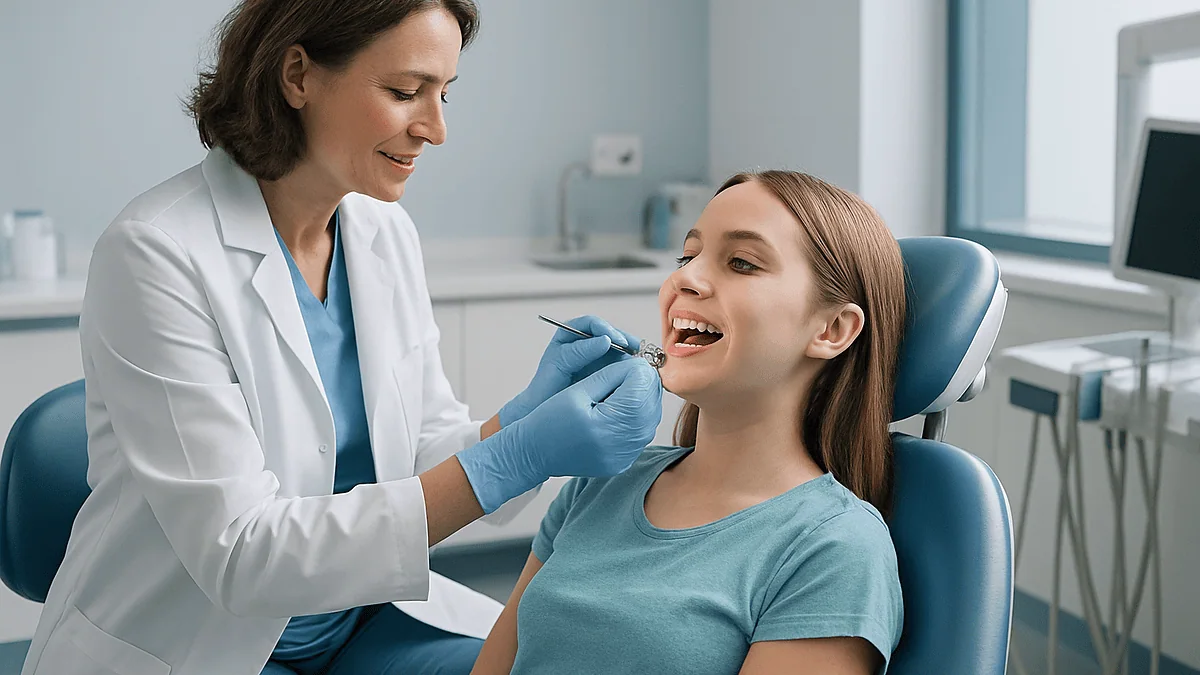
Getting metal braces fitted usually takes one to two hours in a single visit. The orthodontist cleans and lightly etches each tooth, glues a small metal bracket to it with a dental adhesive that sets under a blue curing light, then threads a thin, flexible archwire through the brackets and secures it with tiny elastic or wire ties. Soreness typically peaks over the next few days, and the first adjustment usually follows in about six to eight weeks.
The night before, most people run their tongue along their front teeth one last time, as if memorizing the smooth surface. By tomorrow afternoon there will be a row of small steel squares there, and a wire holding them in a line. It is a strange thing to look forward to and dread at the same time.
Anyone getting metal braces fitted tends to arrive with the same three questions, whether they are 13 or 43: how long will I be in the chair, will it hurt, and what exactly is being glued to me? The honest answers are more reassuring than the playground stories suggest, and more interesting than the brochure version.
This explainer walks through the fitting appointment in the order it actually happens, from the etching gel to the first archwire, then follows the first days at home and the first adjustment visit. Where there is a number, it comes from a mainstream clinical source rather than a forum thread.
What happens when you get metal braces fitted, step by step
The fitting visit, sometimes called the bonding appointment, follows a fairly fixed choreography. Knowing the order removes most of the mystery.
You lie back, and a cheek retractor (a soft plastic frame that holds the lips and cheeks away from the teeth) goes in. It feels odd rather than uncomfortable, and it keeps the tooth surfaces dry, which matters enormously for the glue. The teeth are polished with a gritty paste to strip away plaque and the thin film of protein that coats enamel.
Next comes the etching gel, a mild acid that is dabbed onto each tooth for a short time and rinsed off. It roughens the outermost enamel at a microscopic level so the adhesive can grip. A primer is painted on, then each bracket, already dotted with adhesive, is pressed into place. The orthodontist checks its height and angle, because a bracket sitting a fraction of a millimeter off will steer the tooth to the wrong spot over the coming months. A handheld blue light hardens the adhesive in seconds.
Once every bracket is set, the archwire, the thin metal wire that runs through all the brackets and does the actual pushing, is bent to a gentle horseshoe, threaded through the bracket slots and trimmed behind the last tooth. Small elastic rings or fine wire ties hold it in each slot. On molars the orthodontist may fit a metal band, a ring cemented around the whole tooth, instead of a bracket, because bands cope better with chewing forces.
Finally you sit up, bite gently, and check for anything sharp. Wax is handed over, brushing is demonstrated, and the next appointment is booked. According to the Cleveland Clinic, the whole process usually takes one to two hours.
How long does it take to have metal braces fitted?
The chair time is shorter than most people picture. The Cleveland Clinic gives a typical range of one to two hours for fitting a full set of braces, and an upper arch alone often sits at the lower end. Very little of that time is spent doing anything that feels like drilling or pulling; most of it is meticulous positioning and waiting for the light to set each bracket.
Several things stretch or shrink the visit. If molar bands are planned, small separators (tiny elastic doughnuts wedged between the back teeth) are usually placed a week or so earlier to open a sliver of space, so the band day itself is quicker. Some practices bond the upper and lower teeth on separate visits, either to let you adjust gradually or because the bite needs one arch moved first. Indirect bonding, where brackets are pre-positioned on a model and transferred in a custom tray, can shorten chair time but requires an earlier scan or impression appointment.
The fitting is only the first appointment of many. The NHS notes that treatment with fixed braces usually lasts around 18 months to two years, with review visits roughly every six to eight weeks. How long any individual course runs depends on how far the teeth need to travel, how the jaws relate to each other, and how consistently elastics or other instructions are followed. Your orthodontist can give you a personal estimate, but it is an estimate, not a promise, and it is normal for it to shift a little as the teeth respond.
A practical point: eat a proper meal beforehand. Your mouth will be propped open for a while, and the teeth will feel tender enough afterward that a big lunch is unappealing.
How bracket bonding actually works: etch, primer, adhesive
Bonding is the part of getting metal braces fitted that people understand least, and it deserves a plain explanation because it is genuinely clever.
Enamel is the hardest substance in the body, and it is smooth. Glue does not naturally stick to it. The etching gel, usually a phosphoric acid solution, dissolves a few micrometers of the surface and leaves behind a honeycomb of tiny pits. Rinsed and dried, the etched patch looks frosty white. That frost is the whole point: the adhesive flows into the pits, hardens there, and locks in like tree roots in soil. This is called micromechanical retention, and it is the same principle used for white fillings.
The primer is a thin resin that wets the etched surface and bridges between enamel and the thicker adhesive paste on the back of the bracket. Most modern orthodontic adhesives are light-cured, meaning they stay soft until a blue light at a specific wavelength triggers the hardening reaction. That gives the orthodontist time to nudge the bracket into its exact position before committing.
Two consequences follow. First, the bond is designed to be strong enough to hold through two years of chewing, yet weak enough to be popped off cleanly with special pliers when treatment ends. Second, the etched enamel around the bracket is sealed under adhesive, but the enamel just outside that footprint is not. If plaque collects along the bracket edge, the acid it produces can leach minerals from that unprotected rim, leaving pale marks called white spot lesions. Cleveland Clinic and NHS guidance both single out careful brushing around brackets for exactly this reason.
Bonding does not damage the tooth when done properly. The frosty etched layer that is exposed at removal remineralizes over the following weeks from saliva, and any leftover adhesive is polished away.
What the archwire does, and why the first one feels so light
Brackets do not move teeth. They are handles. The wire is the engine.
An archwire is a length of metal shaped to the ideal curve of your dental arch. When it is forced into brackets on crooked teeth, it bends out of shape, and its spring-back is what pushes and pulls each tooth toward the line. Teeth respond to sustained gentle pressure through a slow biological loop: the bone on the pressed side is resorbed by cells called osteoclasts, and new bone is laid down on the stretched side by osteoblasts. MedlinePlus describes this remodeling as the basis of how orthodontic appliances move teeth over months rather than days.
The first wire is deliberately thin and made of a highly flexible nickel-titanium alloy. It can be threaded into brackets that are far out of line without exerting a harsh force, and it returns toward its original shape slowly and steadily. That matters for comfort and for safety: heavy force can damage the root surface or the tiny blood vessels that keep a tooth alive, while light continuous force does the job with less risk.
As teeth straighten, the orthodontist steps up through progressively thicker or stiffer wires, eventually reaching stainless steel wires that can hold precise bends for fine-tuning. This is why the first adjustment often involves simply changing to the next wire size rather than anything dramatic.
Some people with a nickel allergy worry about nickel-titanium wires. Reactions inside the mouth are uncommon, but you should mention any metal allergy before fitting so alternative wire alloys and bracket materials can be considered. That decision sits with the orthodontist, who will weigh your history against what the case needs.
Bands, ligatures, hooks and elastics: what all the small parts are for
Once the mirror comes out, the hardware can look bewildering. Each piece has one job.
Brackets are the squares bonded to the front of each tooth. Each has a horizontal slot for the wire and small wings for the tie. Molar bands are the rings cemented around back teeth; they often carry a tube rather than a slot, and sometimes a hook. Ligatures are the tiny elastic rings, or occasionally fine twisted wires, that hold the archwire into each bracket slot. The colored versions are simply elastic ligatures dyed for choice; they do nothing different from grey ones. Hooks are small projections on certain brackets or bands that give inter-arch elastics something to attach to.
Elastics are the rubber bands you may be asked to wear yourself, stretching from an upper hook to a lower one. They correct how the two arches meet, for example bringing a lower jaw forward relative to the upper teeth in an overjet. The Cleveland Clinic notes that elastics only work when worn as instructed, and that irregular wear is a common reason treatment runs longer than planned. Springs, either coiled on the wire to open space or compressed to close it, and power chains, connected elastic loops that draw teeth together, may appear later.
Self-ligating brackets deserve a mention because they are often marketed as an upgrade. They use a small built-in clip instead of a ligature. They can speed up wire changes at appointments, but the balance of published evidence does not show they move teeth faster or produce better final results than conventional brackets. Your orthodontist may prefer one type for practical reasons; neither is inherently superior for the patient.
Knowing these names helps at appointments. “The ligature on my upper left canine snapped” gets a faster response than “a bit fell off.”
Who is usually offered metal braces, and who is asked to wait
Metal fixed braces remain the workhorse of orthodontics because they can handle almost any pattern of crowding, spacing or bite problem, including rotations and root positioning that removable aligners manage less predictably. The clinical term for teeth or jaws that do not fit together well is malocclusion, and MedlinePlus describes the range from mild crowding through to significant overbite, underbite and crossbite.
Children and teenagers are the largest group, usually once most of the permanent teeth have come through. The NHS explains that in the UK, treatment is generally offered when the misalignment is significant enough to affect dental health or function, and that timing is often chosen so the remaining growth can be used to help correct the bite. A smaller number of younger children receive a first phase of treatment for specific problems, such as a narrow upper jaw or a tooth that is being damaged by the bite, followed by a second phase later.
Adults are increasingly treated, and the Cleveland Clinic states there is no upper age limit provided the teeth and supporting gums are healthy. Adult bone remodels a little more slowly and jaw growth cannot be harnessed, so some bite corrections need different strategies, but crowding and spacing respond well.
Who is asked to wait? Anyone with active gum disease, untreated decay or a poor brushing record is usually asked to sort those out first, because braces make cleaning harder and can accelerate existing problems. Children whose key permanent teeth have not yet arrived may be reviewed rather than treated. People with certain medical conditions affecting bone, or taking medicines that alter bone turnover, need a discussion with both their physician and orthodontist about timing. In every case, the go-ahead is a judgment for the treating team after examination and X-rays.
Does getting braces put on hurt?
The fitting itself is not painful in the sense most people fear. Nothing is injected and nothing is drilled. The sensations are pressure from the cheek retractor, the sour taste of etching gel, and a slight tug as the wire is seated. Plenty of patients describe the appointment as boring rather than distressing.
The discomfort arrives afterward. Within a few hours the teeth start to feel tender, and by the next morning biting into anything firm can be surprisingly sore. This is the periodontal ligament, the thin cushion of fibers between root and bone, responding to being compressed and stretched for the first time. It releases inflammatory signals that sensitize nerve endings, which is why even a soft bread roll can feel like too much. The NHS describes this soreness as lasting a few days after fitting and after each adjustment, and the Cleveland Clinic gives a similar picture of a few days to about a week.
The second source of discomfort is the inside of the lips and cheeks, which have never met a bracket before. Small ulcers and raw patches are common in the first fortnight until the soft tissue toughens up. Orthodontic wax pressed over the offending bracket is the standard fix, and warm salt-water rinses are widely recommended by dental sources to soothe the area.
Many orthodontists suggest over-the-counter pain relief for the first day or two. Which product, whether it suits you, and how it is taken are matters for your care team or pharmacist, particularly if you have other health conditions or take regular medicines. What you can control yourself: soft foods, cold drinks, and keeping the brackets clean so inflamed gums do not add to the ache.
The first week: what the following days usually look like
Day one is mostly novelty. Your lips feel enormous, you talk with a faint lisp, and you cannot stop touching the brackets with your tongue. Eating dinner is manageable if it is soft: pasta, scrambled eggs, soup, yogurt.
Days two and three are usually the low point. Tenderness peaks, chewing is a negotiation, and any spot where a bracket rubs the cheek is starting to feel raw. This is normal and expected. It is also when the small routines get established. Brushing after every meal, angling the bristles above and below each bracket, takes longer than it ever did before; most dental sources suggest allowing several minutes. A small interdental brush cleans the gap between wire and tooth. Floss threaders or a water flosser make it possible to floss under the wire.
By day four or five, the ache is easing for most people, and the mouth ulcers are settling as the cheek lining adapts. Speech normalizes as the tongue learns the new landscape. You may notice a tooth that was very crooked already feels looser or slightly different in position. That early movement is real, because the first flexible wire acts fastest on the most displaced teeth.
By the end of the second week, most people describe the braces as simply part of the mouth. The soft-food phase relaxes into a sensible avoid list rather than a restriction. The NHS advises steering clear of hard, sticky and chewy foods for the whole course to protect the brackets from being knocked off.
Everyone’s version of this week differs a little. Some barely notice the tenderness; others find it lingers closer to seven days. Both are within the ranges the cited sources describe, and neither predicts how the rest of treatment will go.
What happens at the first braces adjustment, and how tightening really feels
Around six to eight weeks after fitting, according to the NHS timing for fixed-brace reviews, you return for the first adjustment. “Tightening” is the word everyone uses, but it is slightly misleading. Nothing is cranked down. The orthodontist assesses how far the teeth have moved, then decides what the next step of force should be.
Typically that means removing the ligatures, sliding out the first thin wire, and seating a slightly thicker or stiffer one. Fresh ligatures go on, often in new colors if you like that sort of thing. Sometimes a bracket is repositioned, a spring is added, or you are shown how to wear elastics for the first time. The visit usually takes well under half an hour.
How does it feel? For most people, similar to fitting day but milder and shorter. The new wire applies fresh pressure to teeth that had settled into their new positions, so the periodontal ligament goes through its inflammatory cycle again. Tenderness tends to peak the next day and fade over the following few days, mirroring the pattern the Cleveland Clinic describes after fitting. If elastics are introduced, the bite can feel unfamiliar for a while as the jaw muscles adjust.
The first adjustment is also when you find out whether your cleaning has been good enough. The orthodontist or hygienist will look for puffy gums along the brackets and early white marks on the enamel. It is a useful, low-stakes moment to ask for a brushing demonstration if you are unsure.
Adjustments continue at similar intervals through treatment, with each one bringing the teeth a little closer to the planned finish. Toward the end, appointments focus on fine detail: rotating a single tooth, closing a hairline gap, settling the bite.
Eating, brushing and daily life with new metal braces
Two habits determine how smoothly the two years go: what you bite into, and how well you clean.
The food rules exist to protect the hardware and the enamel. Hard items such as nuts, ice, hard candy and crusty bread can shear a bracket clean off. Sticky and chewy items such as caramel and chewing gum can pull ligatures off and bend wires. Whole apples and corn on the cob are fine if cut into pieces rather than bitten. The NHS and Cleveland Clinic both list these categories and also flag sugary drinks, which pool around brackets and feed the plaque that causes white spot lesions.
Cleaning is slower and more deliberate than before. A soft brush angled at 45 degrees along the gum line, then tilted to sweep above and below the bracket wings, is the standard technique. Interdental brushes clear the space between wire and tooth. Fluoride toothpaste is recommended by every mainstream dental source because fluoride helps enamel resist acid attack, and some orthodontists suggest a fluoride mouth rinse as well; whether that suits you is a conversation with your dental team.
Sports carry on as normal with one addition: a mouthguard designed for braces, which cushions the lips against the brackets during contact. Ordinary boil-and-bite guards can be used but should be fitted over the braces by someone who knows how.
Music and speech return to normal quickly. Wind and brass players sometimes need a few weeks to adapt their embouchure, and wax helps in the meantime. Kissing, a question people are often too shy to ask at the clinic, is fine once the initial tenderness has settled.
Keep the wax, a travel brush and a small mirror with you. A loose ligature or poking wire end is far less bothersome when you can deal with it on the spot.
Metal braces compared with other options: a neutral summary
Metal braces are not the only route, and it helps to understand why an orthodontist might recommend them over the alternatives, or the reverse. The table summarizes how the main appliance types differ in ways that matter to a patient. None is universally better; suitability depends on the specific bite problem, oral health, age and how reliably an appliance will be worn.
| Appliance | How it moves teeth | Removable? | Commonly suited to | Typical trade-offs |
|---|---|---|---|---|
| Metal fixed braces | Bonded brackets and archwire apply continuous force | No | Most types of crowding, spacing and bite correction, including complex cases | Visible; harder to clean; food restrictions |
| Ceramic fixed braces | Same mechanics with tooth-colored brackets | No | Similar range to metal, chosen mainly for appearance | Brackets bulkier and more brittle; ties can stain |
| Lingual fixed braces | Brackets bonded to the inside surface of teeth | No | People wanting hidden fixed treatment | Tongue irritation; speech adaptation; longer chair time |
| Clear removable aligners | Sequence of custom plastic trays | Yes | Mild to moderate crowding and spacing | Depends entirely on wear time; less predictable for rotations and some bite problems |
| Removable functional appliances | Plates that guide jaw growth or position | Yes | Growing children with specific jaw relationships | Only effective during growth; often followed by fixed braces |
The NHS describes fixed metal braces as the most common appliance and notes that removable options suit a narrower range of problems. What the table cannot show is the quality of the individual plan. A well-executed course with any suitable appliance beats a poorly planned one with the newest technology. The choice belongs to you and your orthodontist together, after the examination, photographs and X-rays that show what is actually going on beneath the gum line.
What people often get wrong about getting braces
Orthodontics attracts myths the way brackets attract spinach. A few are worth correcting because they change how people behave.
Myth: braces are tightened, and tighter means faster. Teeth move in response to light, continuous force. Heavier force does not speed things up; it can stall movement by crushing the blood supply in the ligament and it raises the risk of root shortening. Adjustments are about changing the direction and stiffness of force, not maximizing it.
Myth: the colored ties do something. They are ordinary elastic ligatures in different dyes. Pick whatever you like.
Myth: braces make teeth weak or cause decay. The brackets and adhesive do not harm enamel when properly placed and removed. Decay and white marks come from plaque that is allowed to sit around the brackets. The appliance makes cleaning harder; it does not cause the damage by itself.
Myth: you are too old once you are past your twenties. Cleveland Clinic guidance is explicit that healthy teeth and gums, not age, determine suitability. Adults do face a slightly slower biological response and cannot rely on jaw growth, which is why some adult bite corrections use different methods, but straightening itself works.
Myth: once the braces come off, the job is done. Teeth have a memory. Without a retainer, the fibers around the roots and the pressure of lips and tongue gradually pull them back. The NHS states plainly that retainers are needed after treatment, often on a long-term basis, to hold the result.
Myth: soreness after an adjustment means something is wrong. A few days of tenderness after each wire change is the expected response described by the cited sources. Sharp, one-sided, worsening pain, or a tooth that feels different in a new way, is the thing to report; general achiness is not.
Are braces worth it at 40? What adults should weigh up
The question comes up constantly, and it deserves more than a cheerful yes. The clinical answer is that adult orthodontics is routine and effective for the problems it targets. Whether it is worth it for you depends on what is bothering you and what the examination shows.
Adults usually seek treatment for one of three reasons: appearance, function, or protecting the teeth. Crowded lower front teeth are a common complaint in midlife because teeth drift forward slowly throughout adult life. Deep bites can wear down front teeth or traumatize the gum behind them. Spaces left by lost teeth can let neighbors tip and collapse, and orthodontics can upright them before a replacement is planned. MedlinePlus lists difficulty chewing, speech effects and abnormal tooth wear among the reasons malocclusion is treated at any age.
The differences from teenage treatment are practical. Gum health has to be secured first, because moving teeth through inflamed bone is risky; many adults see a periodontist before the orthodontist. Existing crowns, implants and fillings affect where brackets can be bonded, and implants cannot be moved at all, so plans are built around them. Adult bone remodels more slowly, so a course may run toward the longer end of the NHS 18-month-to-two-year range, though this varies widely.
Retention matters even more in adults because the periodontal fibers are more established and the drift that caused the crowding continues. Expect a long-term retainer plan.
What no honest source can tell you is how satisfied you will be. That depends on your goals matching what is achievable. A consultation with photographs and X-rays lets the orthodontist show you what can realistically change, and lets you decide whether that outcome is what you want at this stage of life.
Questions to ask your care team before and after fitting
A good consultation is a conversation, and arriving with specific questions gets you specific answers. These are the ones experienced orthodontic nurses say they wish more patients asked.
- What exactly is wrong with my bite, and which of those problems will this plan correct? Ask to see the X-rays and photographs with the explanation.
- Why metal braces rather than another appliance for my case, and what would the trade-offs be if I chose differently?
- Will any teeth need to be removed, and if so, why is that better than creating space another way?
- How long is treatment likely to take, what could make it longer, and how will I know if we are on schedule?
- Will both arches be fitted on the same day? Will I need separators or bands first?
- What should I do if a bracket comes off or a wire pokes, and how quickly should I come in?
- Which foods and habits do you want me to avoid, and is there anything specific about my mouth that raises the risk of white marks?
- I take these medicines and have these conditions; does anything need adjusting or coordinating with my physician?
- How will my gum health be monitored during treatment, and who should I see for routine check-ups and cleaning?
- What is the retention plan afterward, what type of retainer, and for how long?
After fitting, add three more. Show me exactly how to brush around these brackets. Is this rubbing spot normal or should the bracket be adjusted? And, if elastics are introduced: which hooks, how many hours, and what happens if I miss a day?
Write the answers down or ask for them in writing. Two years is long enough to forget what was agreed at the start, and a shared record keeps everyone aligned when plans need to change.
When to call your doctor or orthodontist
Most problems with new braces are nuisances, not emergencies, and most can wait for the next routine visit or a quick added appointment. A few signs warrant a prompt call.
Call your orthodontist during working hours for a bracket that has come off but is still on the wire, a poking wire end that wax cannot manage, a lost ligature, or a spring or band that has shifted. These need fixing to keep treatment on track but are not urgent. Generalized tenderness for a few days after fitting or an adjustment is expected, as the NHS and Cleveland Clinic describe, and does not need a call unless it is not easing after about a week.
Contact your orthodontist or dentist promptly, the same day if possible, for: severe or worsening pain in a single tooth rather than general achiness; pain that wakes you or is not touched by the measures your team suggested; a wire or bracket that has cut the cheek or tongue and is causing persistent bleeding; a bracket, band or piece of wire that has come loose and could be swallowed or inhaled; swelling of the gum or face; or a tooth that suddenly feels very loose, changes color, or is exquisitely tender to touch, which can indicate a problem with the tooth’s nerve or root rather than ordinary orthodontic soreness.
Seek urgent medical care through your usual emergency pathway if you have swallowed or breathed in a piece of appliance and are coughing, wheezing or struggling to breathe; if facial swelling is spreading toward the eye or neck; if you cannot fully open your mouth or swallow; or if you have a fever alongside dental pain. These are uncommon, but they are not situations to sleep on.
When in doubt, phone. Orthodontic teams would far rather reassure you about a minor rub than hear later about a problem that was left to develop.
Frequently asked questions
How are braces put on, in simple terms?
Braces are glued on, tooth by tooth. The orthodontist polishes the teeth, applies a mild etching gel that roughens the enamel surface at a microscopic level, rinses it, then presses a small bracket coated in dental adhesive onto each tooth and hardens the glue with a blue light. Once all brackets are set, a thin flexible wire is threaded through them and held with tiny elastic ties. Nothing is drilled and no injections are needed.
How long does it take to have metal braces fitted?
Typically one to two hours for a full set, according to the Cleveland Clinic. The time is spent positioning each bracket precisely and curing the adhesive rather than on anything uncomfortable. If molar bands are planned, small separators may be placed a week earlier, and some practices fit the upper and lower arches on separate visits, which shortens each appointment but adds one to the schedule.
Does getting braces hurt during the appointment?
The fitting itself is rarely described as painful. You feel pressure from the lip retractor, a sour taste from the etching gel and a slight tug when the wire is seated. The tenderness comes later, usually within a few hours, as the ligament around each tooth reacts to the first pressure. That soreness typically lasts a few days, per NHS and Cleveland Clinic guidance, and soft foods help.
How painful is getting your braces tightened?
Most people find adjustments milder than the initial fitting. Nothing is literally tightened; the orthodontist usually swaps in a slightly thicker or stiffer wire, which applies fresh pressure to teeth that had settled. Tenderness tends to peak the following day and fade over a few days, mirroring the pattern after fitting. If elastics are introduced, the bite can feel unfamiliar for a short while as the jaw muscles adapt.
What happens at the first braces adjustment?
The orthodontist checks how the teeth have moved, removes the small elastic ties and the first wire, and usually replaces it with the next wire in the sequence. A bracket may be repositioned, a spring added or elastics introduced. The visit is generally short. The NHS notes fixed-brace reviews are typically every six to eight weeks, so the first adjustment usually falls in that window after fitting.
How long do braces take from fitting to removal?
The NHS gives a typical range of around 18 months to two years for fixed braces, though individual courses vary with how far teeth need to move, how the jaws relate and how reliably elastics and other instructions are followed. Your orthodontist can offer a personal estimate based on your X-rays and examination, but it is an estimate that may shift as the teeth respond, not a fixed promise.
Are braces worth it at 40?
Adult orthodontics is routine, and Cleveland Clinic guidance states there is no upper age limit provided teeth and gums are healthy. Whether it is worth it for you depends on your goals: appearance, easier cleaning, protecting worn teeth or preparing for other dental work. Adults may need gum treatment first, existing crowns or implants shape the plan, and long-term retainers are essential. A consultation shows what is realistically achievable.
Can I eat normally after getting metal braces fitted?
For the first few days most people stick to soft foods such as soup, pasta, yogurt and scrambled eggs because the teeth are tender. After that, normal eating resumes with a permanent avoid list: hard foods like nuts and ice that can knock brackets off, sticky foods like caramel and gum that pull ties loose, and frequent sugary drinks that feed plaque around the brackets. Cut crunchy fruit into pieces rather than biting.
Why are my teeth so sore two days after braces?
Because the periodontal ligament, the thin cushion of fibers between each root and the bone, is being compressed and stretched for the first time. It releases inflammatory signals that sensitize nerve endings, so even soft foods feel like too much. This peak on days two and three is the expected pattern described by dental sources, and it eases over the following days. Sharp, single-tooth or worsening pain is different and should be reported.
Will the brackets damage my enamel?
Not when bonded and removed properly. The etching gel roughens only a few micrometers of surface enamel so the adhesive can grip, and that layer remineralizes from saliva after the brackets come off. The real risk is white spot lesions, pale marks caused by plaque acid on the enamel just outside the bracket. Careful brushing with fluoride toothpaste, interdental brushes and limiting sugary drinks are the protective measures dental sources emphasize.
References
- NHS: Orthodontics
- MedlinePlus Medical Encyclopedia: Malocclusion of teeth
- Cleveland Clinic: Malocclusion
This article is for general information only and is not a substitute for professional medical advice. Please consult a qualified doctor about your individual situation.

More from the Blog

Do Braces Hurt, and How Long Do They Take?
Braces are usually not painful to put on, but most people feel a dull ache and tender teeth for a few days after fitting…

Gingivectomy vs Crown Lengthening in Gingival Aesthetics: Which Reshapes What?
A gingivectomy removes excess gum tissue only, so it suits cases where the gum is thick or overgrown but the underlying bone sits at…
Composite vs Amalgam Dental Fillings: Appearance, Durability and How Dentists Choose
Composite fillings are tooth-colored resins bonded to the tooth; amalgam fillings are a silver-colored metal alloy packed into a prepared cavity. Composite blends in…
Questions to Ask Before Wisdom Teeth Removal: Nerve Risk, Sedation and Follow-Up
Before wisdom teeth removal, ask why the teeth need to come out now, how close the roots sit to the lower jaw nerve, which…

Realistic Smile Makeover Results: Natural Proportions Over a Single Bright Shade
Realistic smile makeover results mean teeth that look like they belong to your face: graduated widths, slight translucency at the edges, a shade close…

Which Tooth Decay Treatment Fits the Damage? Filling, Inlay, Crown or Root Canal
The right tooth decay treatment depends on how much healthy tooth is left, not on how much the cavity hurts. Small to moderate cavities…