

How Much Hair Loss Is Normal? The 50-to-100 Rule and the Pull Test

Key Takeaways
- Normal shedding of 50 to 100 hairs a day is simply arithmetic: about 10 percent of roughly 100,000 scalp hairs are resting and each resting hair falls after about three months.
- A correctly performed hair pull test uses a bundle of about 40 to 60 hairs and counts two or fewer released hairs as negative; results are similar whether or not you washed that morning.
- Shedding from a trigger such as fever, surgery, childbirth or crash dieting appears two to three months later, so the useful question is what happened about 12 weeks ago.
- Pattern hair loss often keeps daily shedding in the normal range and gives a negative pull test, which is why a widening part or receding temples matter more than drain counts.
- The 60-second comb test averaged over three days is the most reproducible home count; men without hair complaints collected about 10 hairs on average in the published study.
- Minoxidil and finasteride are the only hair loss treatments backed by randomized controlled trials, and that evidence applies to pattern hair loss, not to temporary shedding.
Shedding roughly 50 to 100 hairs a day is normal for most adults, because around 10 percent of scalp hair is always in its resting phase and due to fall. A gentle hair pull test that releases two or fewer hairs per pull is reassuring. Consistently higher shedding, a widening part, or patches of loss lasting longer than a few months should be assessed by a clinician.
The short video has a familiar script. Someone gathers a section of hair, tugs, counts what comes away on camera and announces a verdict. Millions of views later, the comment section fills with people doing the same thing in bathroom mirrors and arriving at the wrong conclusion in both directions: panic over a handful of strands, or shrugging off a change that deserves a proper look. As of March 2026, searches for how much hair loss is normal and for “hair pull test” have climbed alongside those clips.
The irony is that the two tools being filmed are genuinely useful. The 50-to-100 rule and the pull test both come from dermatology, and both have evidence behind them. What the videos skip is the part that makes them work: the conditions, the counting method and the context of the hair growth cycle.
So here is the version a clinician would give you, with the numbers, the mechanism and an honest grading of how solid each claim really is.
How much hair loss is normal? Where the 50-to-100 rule comes from
The figure appears in nearly every patient resource, from MedlinePlus to the NHS and Mayo Clinic: losing 50 to 100 hairs a day is normal. The number is not pulled from the air. It is arithmetic applied to the scalp.
An adult scalp carries roughly 100,000 hairs, give or take a few tens of thousands depending on hair color and genetics. At any moment, about 85 to 90 percent of those hairs are actively growing and around 10 percent are resting, waiting to be released. A resting hair stays attached for about three months before it sheds. Divide 10,000 resting hairs by 90 to 100 days and you land in the 100-a-day range. The lower bound of 50 reflects the natural variation in how many follicles are resting on a given day.
Two things follow from that math. First, the number scales with how much hair you have: someone with fine, sparse hair may normally shed closer to 50, while a person with a dense head of hair can lose 100 or more without anything being wrong. Second, the rule describes an average across days, not a daily quota. Shedding clusters around washing and brushing, so a wash day after two days without one can easily produce 200 or 300 strands in the drain while the weekly total stays entirely normal.
Evidence grade: the 50-to-100 range comes from observational counts and expert consensus, not from large randomized trials. It is a reliable rule of thumb, best read as “this is the zone where the average scalp sits,” not as a cutoff where 101 hairs means disease.
The hair growth cycle explained: why hair falls out on schedule
Every hair on your head is on its own timer. The hair growth cycle is the repeating sequence of growth, transition, rest and release that each follicle runs independently of its neighbors.

The growing phase, called anagen, lasts two to seven years and determines how long a hair can get before it leaves. A short transition phase, catagen, lasts around two to three weeks while the follicle shrinks and detaches from its blood supply. Then comes telogen, the resting phase, lasting about three months. At the end of telogen the old hair is pushed out, often by a new one forming underneath, in a release step some researchers call exogen.
Because follicles are not synchronized, the scalp never sheds all at once the way some animals molt seasonally. Instead a steady trickle of hairs reaches the end of telogen each day. That trickle is the 50 to 100.
The cycle also explains the delay that confuses so many people. Something that stresses the body, a high fever, major surgery, childbirth or rapid weight loss, can shift a large batch of follicles into telogen at the same time. Nothing visible happens immediately. Two to three months later, when those hairs reach the end of their rest, they fall together, and the shedding looks sudden and alarming even though the trigger is long past.
Understanding the timing matters more than memorizing the number. If shedding jumped, the useful question is not “what did I do this week?” but “what happened about three months ago?”
What changed recently, and why this is trending now
The medical advice has not shifted. What has changed, as of March 2026, is who is giving it and how it is being measured.
Short-form video has turned the hair pull test into a performance. Clips typically show a fistful of hair tugged from a dry, unwashed scalp and count whatever comes loose, often 10 or 20 strands, as proof of a problem. Dermatology guidance on the test is more specific: a small bundle of about 40 to 60 hairs, held near the root and pulled gently from the scalp outward, with two or fewer hairs released counting as a negative result. That standard comes from a 2017 evidence review in a major dermatology journal, which found that in a normal population the pull test released two or fewer hairs in about 97 percent of people whether they had washed that morning or five days earlier. The older advice to avoid washing for days before testing turned out to matter less than once thought.
A second shift is the popularity of daily hair counting. People photograph shower drains, tally brush contents and post weekly averages. There is nothing wrong with counting, and it can help a clinician, but the home counts circulating online rarely match the methods researchers use, and they ignore hair density, hair length and wash frequency.
The third change is the broader conversation around treatments. Minoxidil and finasteride are named openly in news coverage and in the comments of those videos, which has pushed more people to ask whether their shedding warrants any of them. The patient guidance on the sources cited at the end of this article still describes the same thresholds and the same reasons to seek assessment; it is the audience, not the evidence, that moved.
How to do the hair pull test the way a dermatologist does it
The hair pull test, sometimes called the Sabouraud test, is a bedside screening method for active shedding. It is quick, free and useful when done correctly, which is where the viral versions fall down.

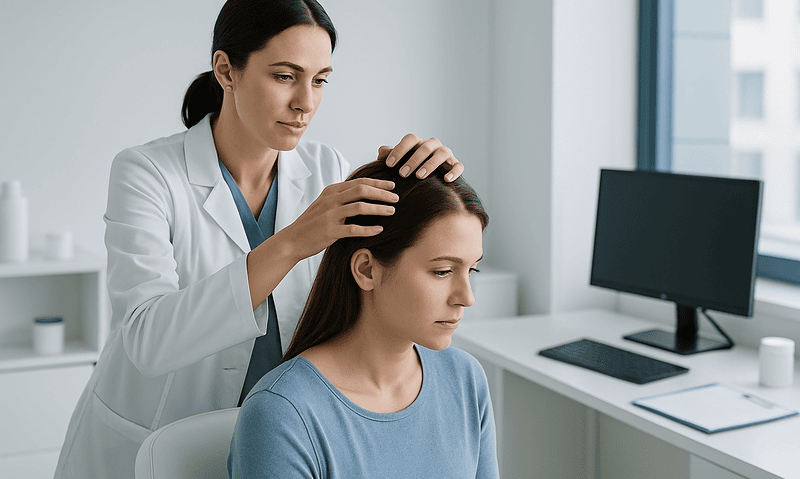
Here is the clinical version. Hair should be dry. Take a small group of about 40 to 60 hairs between your thumb, index and middle fingers, close to the scalp. Apply gentle, steady traction along the direction the hair grows, sliding your fingers from root to tip. Do not yank, twist or hold the hair at the ends. Repeat in three or four areas: the crown, both sides and the back of the head.
Count what comes away. Two or fewer hairs per pull is a negative test. Three to six hairs, especially if it happens in several areas, is considered positive and suggests increased shedding that a clinician would want to explain. More than that on repeated gentle pulls is clearly abnormal.
Look at the hairs you removed, too. A normal shed hair has a small white or clear bulb at the root end. That bulb is the dead, keratinized club of a telogen hair and is not the follicle itself; the follicle stays in the skin and will make a new hair. Hairs that come away with a tapered, pointed root, or that break mid-shaft with no root at all, point toward different problems and are worth mentioning to a doctor.
Evidence grade: the pull test is supported by observational studies and expert consensus. It has a known limitation, which is that a negative result does not rule out slow, gradual thinning, because pattern hair loss can progress for years with a perfectly normal pull test.
The 60-second comb test and other home counts that actually mean something
If you want a number rather than a feeling, the 60-second hair count is the home method with the best research behind it. It is simple enough to repeat and standardized enough to compare over time.
Before washing, comb your hair forward over a white sheet or pillowcase for exactly 60 seconds, from the back of the scalp to the front hairline, using the same comb each time. Count the hairs on the sheet and in the comb. Do this on three consecutive days at the same point in your wash routine, then average the result.
In the published study of this method, men with no hair complaint and ordinary wash habits collected around 10 hairs on average, with a range of roughly 0 to 78. Repeated over months, the test was reproducible, which is its real strength: a single count tells you little, but a steady rise over several months is meaningful.
Shower-drain counting is less reliable, though not useless. The problem is that the drain collects every hair you shed during the hours since the last wash, so people who wash daily see far fewer hairs per session than people who wash twice a week. If you want to track the drain, note how many days since the previous wash and keep the interval constant.
Whatever method you choose, write the numbers down. A clinician can do far more with “I averaged 14 hairs on the comb test in January and 48 in March” than with “it feels like a lot.” A dated photograph of your part line and crown, taken under the same light every few months, is the other record worth keeping.
Shedding versus thinning: the distinction that matters more than any count
Most people who search how much hair loss is normal are really asking one of two different questions, and the daily number only answers the first.
Shedding is about volume leaving the scalp today. It is what the 50-to-100 rule, the pull test and the comb count measure. Excess shedding is usually diffuse, meaning it comes from everywhere, and it is often temporary.
Thinning is about what grows back. In the most common form of hair loss, androgenetic alopecia or pattern hair loss, follicles gradually miniaturize: each successive hair they produce is finer, shorter and lighter in color, until some follicles stop producing visible hair at all. Daily shedding can stay entirely within the normal range during this process. Nothing dramatic appears in the drain. Yet over years the part line widens, the temples recede or the crown shows more scalp under bright light.
This is why a negative pull test and a normal shed count are not a clean bill of health. The clinically useful observation is a change in density, which you judge by comparing photographs over time or by noticing that a ponytail is noticeably narrower, a hat fits differently or scalp is visible where it was not before.
It also works the other way. Someone recovering from an illness may shed 300 hairs a day for two months and keep every bit of their density, because the follicles are resting rather than shrinking, and all of that hair returns. Heavy shedding can be benign; subtle thinning can be progressive. The number in the drain tells you which question to ask, not the answer.
Telogen effluvium: the most common reason normal shedding turns into too much
Telogen effluvium is a temporary condition in which a large number of follicles enter the resting phase at once, producing a wave of shedding two to three months later. It is the most frequent cause of a sudden jump in daily hair loss, and it is almost always reversible.
The triggers are varied but share a theme: the body experiences a shock and reallocates resources away from hair. Documented causes include high fever or significant infection, including COVID-19, major surgery, childbirth, rapid weight loss or crash dieting, severe emotional stress, thyroid disorders, iron deficiency, and starting or stopping certain medicines such as some blood pressure, acne, mood and hormonal treatments.
The pattern is distinctive. Shedding is diffuse across the whole scalp rather than concentrated at the temples or crown. The pull test is positive in multiple areas, and the hairs that come away carry the white club bulb of a resting hair. People often describe handfuls in the shower and hair on every surface. Despite that, overall density typically drops by a modest amount, because even a heavy effluvium rarely sheds more than half the scalp hair, and the follicles themselves are intact.
Timing is the reassuring part. Once the trigger has passed, shedding usually settles within three to six months, and visible regrowth follows as new anagen hairs lengthen. Short, fine new hairs along the hairline are a sign the cycle has restarted. When shedding continues beyond six months, clinicians consider chronic telogen effluvium or look again for an ongoing cause.
Evidence grade: the description, triggers and typical course are well established in observational studies and clinical reviews. There is no randomized trial evidence that any specific treatment speeds recovery beyond addressing the underlying trigger.
Pattern hair loss: when the daily count is normal but the part line widens
Androgenetic alopecia, usually called male or female pattern hair loss, is the most common cause of permanent thinning. It affects roughly half of men by age 50 and a substantial proportion of women after menopause, and it starts earlier than many people expect, sometimes in the late teens.
The mechanism is hormonal and genetic rather than a matter of shedding. Follicles in genetically sensitive areas of the scalp respond to dihydrotestosterone, a derivative of testosterone, by shortening their growth phase and shrinking. Each cycle produces a slightly smaller hair. The resting phase does not lengthen much, so daily shedding often stays near normal while the hairs being replaced become progressively finer.
Men typically see the hairline recede at the temples and the crown thin, with the sides and back largely spared. Women more often keep their frontal hairline but notice the central part widening, sometimes described as a “Christmas tree” pattern when viewed from above. Diffuse thinning over the top of the scalp with preserved density at the back is a strong clue in either sex.
Because the pull test is frequently negative in pattern hair loss, clinicians rely on other signs: miniaturized hairs visible under magnification, a difference in density between the top and the back of the head, and a family history on either side. A dermatoscope, a handheld magnifier with a light, makes the mix of thick and fine hairs easy to see.
Evidence grade: the hormonal mechanism and typical progression are supported by strong observational and genetic data, and the condition has the best randomized trial evidence of any hair loss diagnosis when it comes to treatment, which is discussed later in this article.
Normal shedding versus common causes of hair loss: a comparison
The table below summarizes how the main patterns differ on the measures discussed so far. It is a guide to what questions to ask, not a diagnostic tool; several of these conditions can coexist, and only a clinical assessment can tell them apart reliably.
| Pattern | Daily shedding | Pull test | Distribution | Typical course |
|---|---|---|---|---|
| Normal shedding | About 50 to 100, more on wash days | Two or fewer hairs per pull | Even across scalp | Stable density over years |
| Telogen effluvium | Often 150 to 300 or more | Positive in several areas, club-root hairs | Diffuse, whole scalp | Starts 2 to 3 months after a trigger, settles within about 6 months |
| Pattern hair loss | Usually within normal range | Often negative | Temples and crown in men; widening part in women; back spared | Gradual, progressive over years |
| Alopecia areata | Variable | Positive at the edge of patches | One or more round, smooth patches | Unpredictable; may regrow or spread |
| Traction or breakage | Hair fragments rather than full strands | Hairs break without a root | Along tension lines or where heat is applied | Improves when the cause is removed, if caught early |
Two columns deserve emphasis. Distribution is the one most people overlook and clinicians rely on most: diffuse loss and patterned loss have different causes almost by definition. The pull test column shows why a negative test is not reassurance against the most common permanent form of hair loss.
If your own observations line up with the top row, the most likely explanation is that nothing is wrong. If they match any other row, or you cannot tell, that is a reasonable moment to ask for an assessment.
What the evidence actually says about normal hair loss, graded
Hair shedding is a field where confident numbers rest on a surprisingly modest research base. Here is how the main claims in this article hold up.
The 50-to-100 daily range: supported by observational counts and the arithmetic of follicle cycling, repeated across major patient resources. There is no large modern population study that measured daily shedding in thousands of people. Treat the range as a reliable estimate with wide individual variation, not a precise threshold. Grade: expert consensus informed by observational data.
The hair pull test threshold of two or fewer hairs: supported by a 2017 evidence review that tested the method on people without hair complaints and found the result largely independent of how recently hair was washed. Sensitivity for slow pattern thinning is poor. Grade: good observational evidence for shedding disorders, limited for pattern loss.
The 60-second comb count: supported by a small but well-designed prospective study showing reproducibility over months. The published reference values come from men, so they translate imperfectly to women and to people with very long or very short hair. Grade: moderate observational evidence.
The two-to-three-month delay in telogen effluvium: well supported by follicle biology and consistent clinical reports, including postpartum and post-fever shedding. Grade: strong observational and mechanistic evidence.
Treatments for pattern hair loss: topical minoxidil and oral finasteride have randomized controlled trial evidence showing they slow loss and increase hair counts in many people; this is the strongest evidence tier in the whole topic. Supplements and most devices sit well below that, with small trials or none. Grade: randomized trials for the two named medicines; weak to absent for most alternatives.
What this adds up to is a simple hierarchy. The numbers are useful for noticing change. The biology is solid for explaining timing. The randomized trial evidence exists only for a narrow set of prescription and pharmacy medicines, and only for one diagnosis.
Common myths about how much hair loss is normal
Viral explanations tend to be confident where the evidence is soft and vague where it is strong. These are the claims most worth correcting.
Myth: more than 100 hairs in the shower means something is wrong. A wash day collects everything shed since the last wash, so 200 or 300 hairs after a two-day gap is ordinary. The weekly average, not the single drain, is what matters.
Myth: hairs with a white bulb mean the root is dead and will never grow back. The white club is the keratinized base of a normally shed telogen hair. The living follicle remains in the scalp and typically produces a new hair. A hair that comes out with the bulb is actually the expected finding in healthy shedding.
Myth: a pull test that releases 10 hairs from a big fistful is positive. The test is defined for a bundle of roughly 40 to 60 hairs, not a handful of several hundred. Grabbing more hair inflates the count and tells you nothing about the rate.
Myth: you must avoid washing for five days before the pull test. The 2017 evidence review found results were comparable whether people had washed that morning or not. Daily washing does not cause hair loss; it simply gathers hairs that were already due to shed.
Myth: wearing hats, frequent shampooing or standing on your head changes shedding. None of these alter the hair growth cycle. Tight hairstyles that pull on the roots for years are a different matter and can cause traction loss, but ordinary hats do not.
Myth: stress today means hair loss today. The delay built into the cycle means stress-related shedding appears about three months after the event, by which time the stress may have resolved.
Myth: hair loss is always permanent. Telogen effluvium, the most common cause of a sudden increase, usually resolves on its own. Permanence depends on the diagnosis, which is the entire reason assessment matters.
What a clinician checks when you ask whether your hair loss is normal
A good assessment takes about 15 minutes and rarely needs anything invasive. Knowing what will be asked lets you arrive with better answers.
The history comes first. Expect questions about when the change started, whether it was sudden or gradual, what happened in the three to four months before, any new or stopped medicines, recent illness or fever, pregnancy or menopause, weight change, diet, and whether relatives thinned early. For women, questions about periods, acne or excess facial hair help screen for hormonal causes.
Then the scalp examination. The clinician performs a pull test in several zones, looks at the part width on top compared with the back of the head, and usually uses a dermatoscope to check for miniaturized hairs, inflammation, scaling or scarring. Patches with smooth, hairless skin and short “exclamation mark” hairs at the edge point toward alopecia areata, an autoimmune condition where the immune system targets follicles. Redness, scale or lost follicle openings raise the possibility of scarring alopecia, which is treated urgently because lost follicles do not return.
Blood tests are common when shedding is diffuse: a full blood count, ferritin for iron stores, thyroid function, and sometimes vitamin D or hormone levels depending on the history. These look for correctable contributors rather than confirming a hair diagnosis.
A scalp biopsy, a small punch sample taken under local anesthetic, is reserved for cases where the pattern is unclear or scarring is suspected.
Bring your records. A dated series of photographs, your comb or drain counts with the wash interval noted, and a list of medicines with start dates will shorten the path to a diagnosis more than anything else you can do beforehand.
Minoxidil and finasteride: what the named treatments can and cannot do
These two medicines come up in almost every conversation about hair loss online, so it is worth stating plainly what the evidence supports and where it stops.
Minoxidil is a topical treatment, available in many countries without a prescription, that is thought to prolong the growth phase and enlarge miniaturized follicles. Randomized controlled trials in both men and women with pattern hair loss show it increases hair counts and slows further loss in a meaningful proportion of users, with effects visible after several months of consistent use. It does not treat the cause, and benefit is maintained only while use continues. A temporary increase in shedding during the first weeks is well documented and usually settles. Oral minoxidil for hair loss is widely discussed; in most countries this is off-label use, and the decision about whether it is appropriate belongs to the treating clinician.
Finasteride is a prescription tablet that lowers dihydrotestosterone, the hormone that drives follicle miniaturization in pattern hair loss. Randomized trials in men show it slows loss and increases hair counts over one to five years. It is not licensed for women of childbearing potential, and it carries recognized side effects, including sexual and mood-related effects in a minority of users, which a prescriber will discuss. Topical finasteride and use in postmenopausal women are areas of active research with smaller evidence bases.
Neither medicine is indicated for telogen effluvium, which usually resolves once the trigger is addressed, and neither is a treatment for alopecia areata or scarring alopecia, which have their own options.
Everything above is general information. Whether either medicine suits you, at what point, and for how long, is a decision for the clinician who has examined your scalp and knows your medical history. If you are already using one and have concerns, raise them with that prescriber rather than stopping on your own.
When to see a doctor about hair loss
Most shedding needs no appointment. These situations do.
Seek an assessment within a few weeks if shedding has stayed clearly above your usual level for more than two to three months, if your pull test releases three or more hairs in several areas on repeated gentle attempts, or if your part line, temples or crown look visibly thinner in photographs taken a few months apart. Early assessment matters most in pattern hair loss, because treatment preserves hair better than it restores it.
Ask for a prompt appointment, ideally with a dermatologist, if you notice any of the following red-flag signs:
- Smooth, round, completely bald patches, or loss of eyebrow or eyelash hair
- Scalp redness, scaling, pustules, pain, burning or itching alongside the loss
- Hair loss in a scarred or shiny area where the follicle openings seem to have vanished
- Sudden heavy shedding with other symptoms such as fatigue, weight change, palpitations, feeling cold or hot, or heavy periods
- Hair loss in women accompanied by new acne, deepening voice or increased facial and body hair
- Loss that began after starting a new medicine
- Hair loss in a child, which has different common causes and should always be checked
Scarring forms of hair loss and alopecia areata that is spreading quickly are the ones where waiting carries a real cost, since follicles destroyed by inflammation do not regrow.
If you are already using any hair loss treatment and something feels wrong, including scalp irritation, unexpected shedding beyond the first few months, mood changes or sexual side effects, contact the prescribing clinician. Do not adjust, pause or stop a prescribed medicine on your own; the right change depends on the diagnosis and on how far along treatment you are, and that judgment belongs to the person who prescribed it.
Frequently asked questions
How much hair loss is normal per day?
Around 50 to 100 hairs a day is normal for most adults, with the figure scaling to how much hair you have. Shedding bunches around washing and brushing, so a single wash day can produce two or three times that without anything being wrong. What matters is the weekly average and whether it has changed from your own usual level.
Is losing 150 or 200 hairs a day too much?
Not necessarily. A dense head of hair, long hair that is easier to notice, or a wash after a two-day gap can all push a single count to 200 without disease. Consistent counts in that range over several weeks, especially with a positive pull test in several scalp areas, suggest increased shedding worth discussing with a clinician.
What is a normal hair pull test result?
Two or fewer hairs released from a gentle pull on a bundle of about 40 to 60 hairs is a normal, negative result. Three to six hairs in several areas is considered positive. A negative test is reassuring for active shedding but does not rule out gradual pattern thinning, which often has a normal pull test.
How does the hair growth cycle affect how much hair I lose?
Each follicle cycles independently through growth lasting years, a brief transition, and a resting phase of about three months before the hair sheds. Because about 10 percent of hairs are resting at any time, a steady trickle falls daily. A shock to the body can push many follicles into rest together, producing a wave of shedding two to three months later.
Does washing hair every day cause more hair loss?
No. Washing collects hairs that were already at the end of their resting phase and due to fall. Daily washers see fewer hairs per session than weekly washers, but total shedding is the same. Research on the pull test also found results were comparable whether people had washed that morning or several days earlier.
Why do shed hairs have a white bulb at the end?
The white bulb is the keratinized club of a normally shed resting hair. It is not the follicle, which stays in the scalp and typically grows a new hair. Seeing the bulb is the expected finding in healthy shedding. Hairs that break without any root point to breakage rather than shedding from the follicle.
How long after stress or illness does hair loss start?
Usually two to three months after the trigger, because follicles pushed into the resting phase hold their hair for roughly that long before releasing it. This delayed shedding is called telogen effluvium. It typically settles within three to six months once the cause has resolved, and short new hairs along the hairline signal that regrowth is under way.
Can hair loss be normal and still mean I am going bald?
Yes. Pattern hair loss works by shrinking follicles so each new hair is finer, rather than by shedding more hairs per day. Daily counts often stay normal while the part widens or the temples recede over years. Comparing photographs of the same area under the same light every few months is a better test than counting.
Does the 50-to-100 rule apply to women as well as men?
The range applies to adults generally, since the underlying follicle math is the same. Women often notice shedding more because longer hair is more visible in brushes and drains, and events such as childbirth, menopause and iron deficiency are frequent triggers of temporary excess shedding. Diffuse thinning along the central part is the usual pattern of female pattern hair loss.
When should I see a dermatologist about hair shedding?
See a clinician if shedding has stayed clearly above your usual level for more than two to three months, if gentle pulls repeatedly release three or more hairs in several areas, or if your part or crown is visibly thinner in dated photographs. Seek a prompt appointment for bald patches, scalp redness, scaling, pain, scarring, or loss accompanied by other new symptoms.
References
- MedlinePlus: Hair loss
- NHS: Hair loss
- NIH National Library of Medicine (StatPearls): Telogen Effluvium
This article is for general information only and is not a substitute for professional medical advice. Please consult a qualified doctor about your individual situation.

More from the Blog

Saw Palmetto for Hair Loss: Supplement Claims vs Clinical Reality
Saw palmetto may modestly slow androgen-driven pattern hair loss for some people, but the evidence comes from a handful of small, short studies of…

Red Light and Laser Caps for Hair Growth: The FDA-Cleared Devices Examined
Red light and laser caps for hair growth are FDA-cleared low-level light devices intended for hereditary thinning (androgenetic alopecia). Several small sham-controlled randomized trials…

Scalp Massage for Hair Growth: The Small Study Everyone Cites
Scalp massage has only weak evidence for hair growth. The study most often shared tested nine men who massaged for four minutes daily over…
Microneedling for Hair Loss: The Evidence, the Protocols, the Caveats
Microneedling shows genuine promise for pattern hair loss, but the evidence is modest. Small randomized trials, mostly in men, found that adding weekly scalp…

Hair Loss in Women: The Patterns, the Hormones and the Tests Worth Asking For
Hair loss in women most often comes from one of two causes: a temporary shedding phase called telogen effluvium, triggered by illness, childbirth, rapid…

Hair Breakage vs Hair Loss: How to Tell Which One You Have
Hair breakage and hair loss differ at the root. Broken hairs are short fragments with no bulb at the end, snapped along the shaft…