Quick answer
Alopecia areata is an autoimmune condition that causes patchy hair loss when the immune system mistakenly attacks hair follicles. At Acibadem in Turkey, evaluation focuses on confirming the diagnosis and ruling out related causes, and treatment may include medical therapies to help control inflammation and support hair regrowth.
What is alopecia areata?
Alopecia areata is an autoimmune condition, which means the body’s immune system mistakenly attacks its own healthy tissue, in this case, the hair follicles, the small structures in the skin from which hairs grow. When the immune system targets the follicles, hair growth is interrupted and hair falls out, most often in small, round or oval patches on the scalp. The follicles themselves are usually not destroyed, which is why hair can and often does grow back, sometimes without any treatment at all.
If you are asking “what is alopecia areata” after noticing sudden bald patches, it may help to know that this is one of the most common causes of patchy hair loss worldwide. It affects people of all ages, all skin and hair types, and both sexes, although it frequently first appears in childhood, the teenage years, or early adulthood. It is not contagious, it is not caused by poor hygiene, and it is not a sign of cancer.
Alopecia areata exists on a spectrum. Doctors often describe three main patterns:
- Patchy alopecia areataone or more coin-sized bald patches, usually on the scalp but sometimes in the beard, eyebrows, or eyelashes. This is the most common form.
- Alopecia totalisloss of all or nearly all scalp hair.
- Alopecia universalisloss of hair over the entire body, including eyebrows, eyelashes, and body hair. This is the rarest and most extensive form.
The condition is unpredictable. Some people have a single episode that resolves on its own, others have hair loss that comes and goes over many years, and a smaller number progress to more extensive forms. This unpredictability is one of the most difficult aspects of living with the condition, and it is why an honest, individualized conversation with a dermatologist, a doctor who specializes in skin, hair, and nails, is so important.
Symptoms of alopecia areata
Alopecia areata symptoms usually appear suddenly, often over the course of days or a few weeks. Many people first notice a bald patch while brushing their hair, or a family member, friend, or hairdresser points it out. In most cases the hair loss itself is painless, though some people report tingling, itching, or a burning sensation in the affected area shortly before or as the hair falls out.
Common signs and symptoms include:
- Round or oval bald patches on the scalp, typically smooth and without redness, scaling, or scarring. The skin in the patch usually looks normal.
- Sudden onsetpatches often appear over a short period rather than gradually thinning over years.
- “Exclamation mark” hairsshort, broken hairs that are narrower at the base than at the tip, often found at the edges of a patch. These are a classic sign of active disease.
- Hair loss beyond the scalppatches may affect the beard (sometimes called alopecia barbae), eyebrows, eyelashes, or body hair.
- Nail changessmall dents or pits in the fingernails, ridging, or a rough, sandpaper-like texture. Nail involvement is more common in people with extensive hair loss.
- Regrowing hair that looks differentnew hair often comes in fine and white or gray at first, and usually regains its normal color and thickness over time.
Symptoms can differ depending on the stage and type of the condition. In the active phase, patches may enlarge, new patches may appear, and hairs at the edges of a patch may pull out easily with gentle traction. In the stable phase, existing patches stop growing and no new ones appear. In the regrowth phase, fine new hairs emerge within the patches. In more extensive forms such as alopecia totalis or universalis, hair loss is widespread rather than patchy, and loss of eyelashes and nasal hair can lead to more eye irritation or nasal sensitivity, since these hairs normally help keep out dust and debris.
Importantly, alopecia areata does not cause scarring. If the skin in a bald area looks red, scaly, blistered, or scarred, another condition may be responsible, and this is something a doctor should evaluate.
Causes and risk factors
The exact trigger of alopecia areata is not fully understood, but the underlying mechanism is well established: it is an autoimmune process in which immune cells attack the hair follicles, pushing them prematurely into a resting state so that hair stops growing and sheds. Because the follicles are usually preserved rather than destroyed, the condition is considered potentially reversible.
When people search for alopecia areata causes, they often worry that they did something wrong. They did not. The condition is not caused by hair products, washing habits, wearing hats, or diet in any proven way. Factors that appear to play a role include:
- Genetics. Alopecia areata tends to run in families. Having a close relative with the condition modestly increases your risk, though most people with an affected relative never develop it themselves.
- Other autoimmune conditions. People with alopecia areata have a somewhat higher rate of other autoimmune disorders, such as thyroid disease (problems with the gland in the neck that regulates metabolism), vitiligo (patchy loss of skin color), and type 1 diabetes. Atopic conditions such as eczema, asthma, and hay fever are also more common.
- Physical or emotional stress. Some people report a stressful life event before an episode. Stress may act as a trigger in people who are already predisposed, but it does not cause the condition on its own, and many episodes occur without any identifiable trigger.
- Age. The condition can start at any age but often begins before age 30.
It is worth repeating that alopecia areata is not contagious. You cannot catch it from someone else, and you cannot pass it on through touch, shared combs, or close contact.
Diagnosis
Alopecia areata diagnosis is usually clinical, meaning an experienced dermatologist can often confirm it by examining the scalp and hair without invasive tests. During the visit, the doctor will typically:
- Take a historyasking when the hair loss started, how quickly it progressed, whether it has happened before, and whether you or your family members have autoimmune or thyroid conditions.
- Examine the scalp and skinlooking at the shape, borders, and surface of the patches, and checking the eyebrows, eyelashes, beard area, and nails.
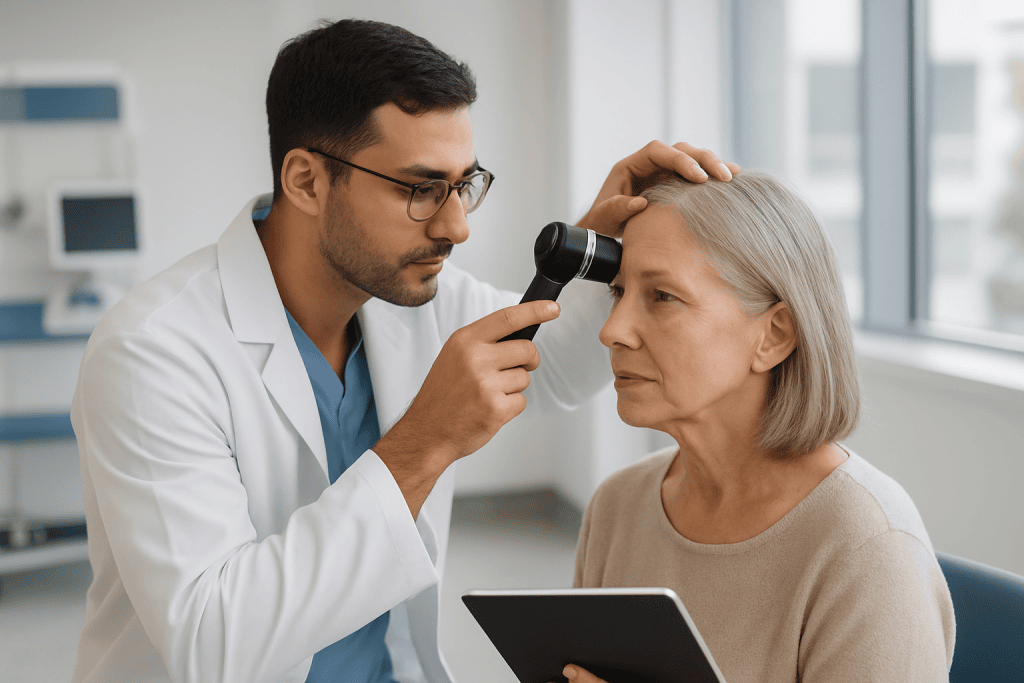
- Use dermoscopy (trichoscopy)a painless examination with a handheld magnifying device that lets the doctor see features such as exclamation mark hairs, “yellow dots” (empty follicle openings), and short broken hairs, all of which support the diagnosis.
- Perform a gentle hair pull testlightly tugging a small group of hairs at the edge of a patch. If several hairs come out easily, the disease is likely in an active phase.
Additional tests are used selectively. Your doctor may order blood tests, most commonly to check thyroid function, because thyroid disease is more frequent in people with alopecia areata; tests for iron levels or other autoimmune markers may be considered depending on your history. A scalp biopsyremoving a tiny sample of skin under local anesthetic for examination under a microscope, is rarely needed, but it can help when the picture is unclear, for example to rule out scarring forms of hair loss or fungal infection of the scalp. Imaging such as CT or MRI is not used to diagnose alopecia areata.
Getting an accurate diagnosis matters because several other conditions can mimic patchy hair loss, including fungal infections, traction alopecia (hair loss from tight hairstyles), trichotillomania (compulsive hair pulling), and scarring alopecias, each of which is treated very differently.
Treatment options
There is currently no cure for alopecia areata, but there are several ways to encourage regrowth and manage the condition. Alopecia areata treatment is individualized: the right approach depends on your age, how much hair is affected, how long you have had the condition, and how much it affects your daily life. Care for this condition is generally led by a dermatology department; at hospital groups such as Acibadem, dermatologists coordinate the diagnostic work-up and treatment plan, and a general overview of the condition is available on their alopecia areata information page.
Watchful waiting
Because hair often regrows on its own, particularly when there are only one or two small patches, doctors sometimes recommend simply monitoring the condition for a period of time. In many people with limited patchy disease, hair returns within a year without treatment. Watchful waiting does not mean nothing can be done; it means the potential benefits of treatment are weighed against side effects when spontaneous recovery is reasonably likely.
Medications
- Corticosteroidsanti-inflammatory medicines that calm the immune attack on follicles. They can be applied as creams or lotions, injected in small amounts directly into bald patches (intralesional injections, a common first-line option for adults with limited patches), or, in more severe or rapidly progressing cases, taken as tablets for a limited time under close supervision.
- Topical minoxidila liquid or foam applied to the scalp that can support regrowth, often used alongside other treatments rather than alone.
- Topical immunotherapyfor extensive or long-standing disease, a dermatologist may apply a substance (such as diphencyprone) that provokes a mild, controlled allergic reaction on the scalp, which can redirect the immune response and allow hair to regrow in some people. This is done only in specialized clinics.
- JAK inhibitorsa newer class of oral medicines that block specific immune signaling pathways (Janus kinases). Regulatory agencies in several countries have approved certain JAK inhibitors for severe alopecia areata. They can produce meaningful regrowth in some patients, but they require medical supervision, have potential side effects, and hair loss may return if the medicine is stopped. Whether they are appropriate for you is a decision to make with your doctor.
Procedures and adjunctive options
Some clinics offer PRP for hair loss (platelet-rich plasma), a procedure in which a small amount of your own blood is processed to concentrate platelets and then injected into the scalp. The evidence for PRP in alopecia areata is still limited and results vary, so it is generally considered a supportive or adjunctive option rather than a standard first-line therapy; discuss its realistic role with your dermatologist.
Is hair transplant surgery an option?
Hair transplantation is usually not recommended for active alopecia areata, because the autoimmune process can attack transplanted follicles just as it attacks the original ones. Surgery is generally reserved for other, stable causes of hair loss, and candidacy is assessed carefully, including for patients with specific needs, such as those considering a female hair transplant or an Afro hair transplant, where curl pattern and hair characteristics require particular surgical expertise. If your hair loss turns out to have a different, stable cause, a specialist can advise whether a transplant is realistic in your case.
Camouflage and supportive measures
Wigs, hairpieces, scalp micropigmentation, eyebrow makeup or microblading, and false eyelashes help many people feel comfortable while waiting for regrowth or when regrowth does not occur. Sunscreen or head coverings protect exposed scalp skin from sunburn, and glasses or sunglasses can help protect the eyes if eyelashes are lost.
Living with alopecia areata and outlook
The outlook for alopecia areata varies widely and is difficult to predict for any individual. Many people with limited patchy hair loss experience regrowth within months to a year, sometimes without treatment. However, relapses are common, new patches can appear even after complete regrowth, and some people cycle through episodes of loss and regrowth over many years. Features associated with a more challenging course include onset in early childhood, very extensive hair loss (totalis or universalis), long-standing disease, nail involvement, and a strong family or personal history of autoimmune or atopic conditions. Even so, none of these features makes regrowth impossible, and no doctor can promise a specific outcome.
Physically, alopecia areata is not painful and does not shorten life. Emotionally, it can be significant. Hair loss can affect self-image, confidence, and mood in adults and children alike, and anxiety or low mood are common and understandable reactions. Support from family, patient organizations, and, when needed, a mental health professional is a legitimate part of care, not an afterthought. Practical steps such as regular follow-up with your dermatologist, periodic thyroid checks if advised, and gentle hair care can help you stay in control of the aspects that can be managed.
Frequently asked questions
What is alopecia areata in simple terms?
Alopecia areata is a condition in which the immune system mistakenly attacks the hair follicles, causing hair to fall out, usually in smooth, round patches on the scalp. Because the follicles are typically preserved rather than destroyed, hair often regrows, although the condition can come back. It is not contagious and is not caused by anything you did.
Can alopecia areata heal on its own?
Yes, in many cases it can. People with one or a few small patches often see spontaneous regrowth within several months to a year. However, the course is unpredictable: some people relapse, and a smaller number progress to more extensive hair loss. A dermatologist can help you decide whether to wait, treat, or combine both approaches.
How serious is alopecia areata?
Medically, alopecia areata is not dangerous: it does not cause pain, spread to other organs, or shorten life expectancy. Its main impact is cosmetic and emotional, which can still be considerable. It is also associated with a somewhat higher chance of other autoimmune conditions, particularly thyroid disease, which is why your doctor may suggest occasional blood tests.
What are the first alopecia areata symptoms to watch for?
The most typical first sign is a sudden, smooth, round bald patch on the scalp or in the beard, with normal-looking skin and no scarring. Some people notice tingling or mild itching in the area first, short broken “exclamation mark” hairs at the edges of the patch, or small pits in the fingernails. Any sudden patchy hair loss deserves a medical evaluation to confirm the cause.
Which alopecia areata treatment works best?
There is no single best treatment for everyone. For limited patches, corticosteroid injections into the affected skin are a common first choice, often combined with topical minoxidil. For extensive disease, options include topical immunotherapy and, in selected patients, oral JAK inhibitor medicines. Each option has benefits and possible side effects, and none guarantees permanent regrowth, so the plan should be tailored with your dermatologist.
Does hair grow back the same after alopecia areata?
Regrowing hair often comes in fine and white or gray at first. In most cases it gradually thickens and returns to its usual color over time, although this can take months. Occasionally regrown hair keeps a lighter color or slightly different texture in the affected area.
Can stress cause alopecia areata?
Stress alone does not cause alopecia areata, but in people who are genetically predisposed, significant physical or emotional stress may act as a trigger for an episode. Many episodes, however, begin without any identifiable trigger, so patients should not blame themselves. Managing stress is sensible for overall health, but it is not a substitute for medical evaluation and treatment.
When to see a doctor
Any new or sudden patchy hair loss is worth a professional evaluation, both to confirm the diagnosis and to rule out conditions that need different treatment. Make an appointment with a doctor or dermatologist if you notice:
- One or more new bald patches appearing suddenly on the scalp, beard, eyebrows, or eyelashes.
- Rapidly spreading hair loss, or hairs that come out easily with gentle pulling over a wide area.
- Redness, scaling, crusting, blisters, pain, or pus in an area of hair loss: these suggest infection or a scarring condition rather than alopecia areata and need prompt assessment.
- Hair loss in a child, which should always be evaluated to exclude fungal scalp infection and other treatable causes.
- Nail changes such as widespread pitting, ridging, or crumbling alongside hair loss.
- Symptoms of thyroid problemssuch as unexplained weight change, persistent fatigue, palpitations, or feeling unusually hot or cold, in someone with alopecia areata.
- Significant emotional distress, anxiety, or low mood related to hair loss; this is a valid medical concern and support is available.
Early evaluation does not guarantee faster regrowth, but it does ensure the correct diagnosis, allows treatment to start while the disease is most responsive, and gives you a clear, realistic picture of your options.
Medically reviewed by the Acıbadem International Medical Board September 2, 2026
See our medical review board →
Update history
- PublishedJune 14, 2026
- Medical review approvedSeptember 2, 2026
- Last content updateSeptember 2, 2026
Treatments for This Condition
Care at Acibadem

Doctors Who Treat This Condition



Aesthetic Plastic & Reconstructive Surgery
Prof. Mehmet Veli Karaaltın, MD
Aesthetic Plastic & Reconstructive Surgery