Scalp Micropigmentation
Scalp micropigmentation is a non-surgical cosmetic procedure that deposits tiny pigment dots on the scalp to simulate hair follicles and improve the appearance of thinning hair or scars.
Quick answer
Scalp micropigmentation (SMP) is a non-surgical cosmetic procedure that places microscopic pigment deposits into the upper layers of the scalp to mimic tiny hair follicles. Performed with fine needles over several sessions, it can create a shaved-head look, make thinning hair appear denser, or camouflage scars. It does not grow hair, and the pigment softens gradually over time, so occasional touch-ups may be needed.
Scalp Micropigmentation: What It Is and What It Can Realistically Do
Scalp micropigmentation is a non-surgical cosmetic procedure in which microscopic deposits of pigment are placed into the superficial layers of the scalp to replicate the look of tiny hair follicles. It does not grow new hair and it does not treat the medical cause of hair loss. What it can do is change how the scalp reads to the eye: a closely shaven look across bald areas, the impression of greater density beneath thinning hair, or camouflage over scars, including scars left by previous hair transplant surgery.
Hair loss is rarely only a cosmetic concern. It changes how you see yourself in photographs, at work, in social settings, and in ordinary moments, looking in the mirror, standing under bright light. A receding hairline, a widening part, a visible crown, patchy density or a transplant scar can create a self-consciousness that is hard to explain to anyone who has not experienced it. Scalp micropigmentation exists for exactly this gap: the space between doing nothing and having surgery.
A well-planned result should be subtle. The aim is never a painted-on scalp. Pigment tone, dot size, spacing, hairline shape and density transitions are all chosen to suit your facial features, your age, your existing hair pattern and your likely future hair loss. For some people, scalp micropigmentation provides a defined close-shaven look across the whole scalp. For others, it quietly reduces the contrast between skin and hair so that existing hair appears fuller.
This page explains how the technique works, who it suits, how long it takes and lasts, what its downsides are, what drives the cost, and how it fits alongside surgical and medical alternatives, so you can weigh it up with clear eyes.
What Is Scalp Micropigmentation?
Scalp micropigmentation, widely abbreviated as SMP, is a form of cosmetic pigmentation in which very small, consistent deposits of pigment are placed into the superficial layers of the scalp using fine sterile needles. Each deposit is designed to resemble a hair follicle emerging through the skin. Placed in their thousands, with deliberate variation in spacing and density, these impressions can make the scalp appear less visible and the hair pattern more defined, both up close and at conversational distance.
The technique is layered by design. Pigment is built up gradually over more than one session, because the practitioner needs to see how your skin holds pigment before adding depth. A single heavy session risks a flat, saturated look; staged sessions create dimension. The practitioner must also account for how pigment settles, softens and fades over the years, choosing tone and depth so the result ages gracefully rather than shifting colour or spreading.
What does SMP mean?
SMP stands for scalp micropigmentation: the two terms describe exactly the same procedure. If you are asking what SMP is in practical terms: it is the placement of follicle-sized pigment dots into the scalp to imitate the shadow of shaved or very short hair. You may also come across the phrase micro scalp micropigmentation, along with names such as hair follicle replication or tricopigmentation; these all refer to the same family of techniques, sometimes with variations in pigment type or intended longevity. Whatever the label, the fundamentals are the same: fine needles, superficial placement, staged sessions and a design built around your own hair pattern rather than a template.
Is scalp micropigmentation the same as a hair tattoo?
Not exactly, although both involve needles and pigment, SMP is a specialised technique with different goals, needle configurations, pigments and placement depth. People often search for a hair tattoo or a hairline tattoo when they mean scalp micropigmentation, and the comparison is understandable. But conventional tattoo ink is placed deeper and formulated for permanence and colour vibrancy; over time it can migrate or drift towards blue or green tones, which looks obviously wrong on a scalp. SMP pigments are typically muted and matte, placed more superficially, and designed to soften into a natural follicle shadow rather than a solid block of colour. Dot size and consistency matter enormously: a follicle impression must be tiny and uniform, which demands equipment, technique and training that differ from conventional tattooing. So while hair tattoo is a reasonable shorthand, treating the scalp like a tattoo canvas is precisely what a competent SMP practitioner avoids.
How is SMP different from a hair transplant?
A hair transplant moves living hair follicles from a donor area to a thinning area; scalp micropigmentation moves nothing and grows nothing. SMP does not influence hormones, inflammation or the hair growth cycle, and it cannot give you hair that moves, grows or can be styled. Its purpose is purely visual. That distinction cuts both ways. For people who are not candidates for surgery, have limited donor hair, do not want an operation, or want to enhance the appearance of a previous transplant, SMP can be a practical option, sometimes on its own, sometimes alongside procedures such as FUE hair transplantation or medical hair loss management. For people who want genuine, styleable density where little hair remains, transplantation or medical therapy is usually the more appropriate conversation to have first.
Who Considers Scalp Micropigmentation?
People come to SMP from several directions. Some are in the early or moderate stages of thinning and want the scalp to be less visible under strong light. Some have advanced hair loss and prefer a shaved style without the appearance of complete baldness. Others have scars from previous procedures or injuries and want a non-surgical way to make those areas less noticeable.
Typical concerns include visible scalp under bright lighting, a widening part line, thinning at the crown, a receding hairline, reduced density after hair transplantation, or scars that show through short hair. Men most often seek scalp micropigmentation for androgenetic (pattern) hair loss, particularly when they already wear, or are willing to wear, a very short hairstyle. Women more often consider it for diffuse thinning, where the goal is to create the impression of density beneath existing hair rather than a shaved look.
Before any cosmetic camouflage, the cause of the hair loss deserves attention. Hair loss has many possible drivers: genetic pattern loss, thyroid disease, iron deficiency, autoimmune conditions, hormonal change, medication effects, stress-related shedding, traction from tight hairstyles, or inflammatory scalp disease. When shedding is active or unexplained, dermatological evaluation and laboratory testing may be recommended before any pigment is placed. Camouflaging a process that is still moving, or still treatable, is rarely the right first step.
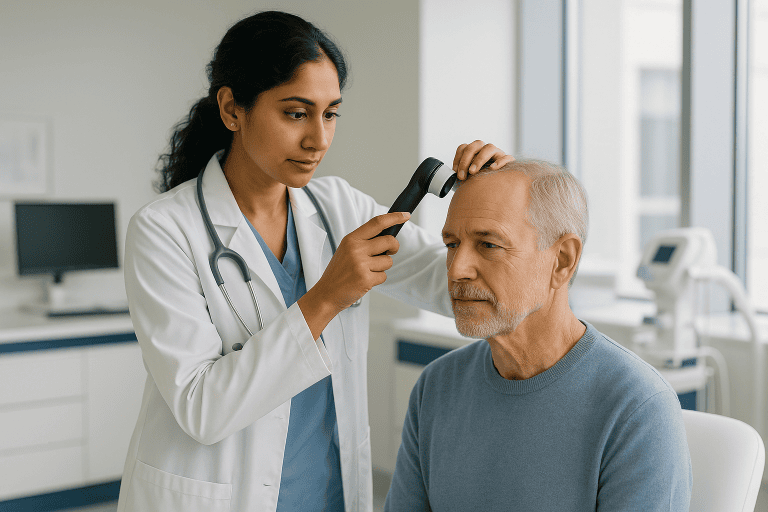
Assessment usually begins with a combined medical and aesthetic review. The clinical team examines the scalp, reviews the pattern and stability of the hair loss, discusses prior treatments, and evaluates skin type, scar texture and hair characteristics. Photographs are taken for planning and comparison, and magnified scalp examination can help assess density, miniaturisation, inflammation or scarring. If you have had a transplant, both the donor and recipient areas are assessed to determine how SMP might complement the earlier work.
Good candidates share a few traits. They have realistic expectations and understand that SMP improves appearance rather than restoring biological hair. They can attend more than one session and are willing to follow pre- and post-treatment instructions. Their scalp is healthy: no active infection, no uncontrolled inflammatory disease, no open wounds in the treatment area. A history of keloid scarring, pigment allergy, immune suppression, bleeding disorders or certain skin conditions does not automatically rule SMP out, but each of these requires individual medical review before proceeding.
SMP is not the best choice for everyone. If hair loss is progressing rapidly, the design may need to be conservative or deferred until the pattern is more predictable. If you want long, flowing density where little hair exists, transplantation or other non-surgical hair restoration approaches may be more appropriate. And if the scalp shows significant redness, scaling, psoriasis, dermatitis or scarring alopecia, those conditions need management first, both for your skin’s health and because pigment behaves unpredictably in inflamed tissue.
Conditions and Indications Scalp Micropigmentation Can Address
Male pattern hair loss is the most common indication. As the hairline, temples, crown or top of the scalp thin progressively, SMP can create a defined shaved-hair appearance across bald areas or reduce the visual contrast within thinning zones, depending on how you wear your hair.
Female pattern hair loss is a distinct scenario. Thinning is usually diffuse and the frontal hairline largely preserved, so SMP is used as a density effect beneath existing hair rather than to create a shaved look. Spacing and colour selection must be especially careful so the result stays soft and undetectable under a parting. Women weighing their options may also want to understand how SMP compares with a hair transplant for women, since the two address different aspects of the same concern.
Scars from hair transplant surgery are a frequent reason for seeking SMP. Older strip-method transplants can leave a linear scar across the back of the scalp; follicular unit extraction can leave many small dot-like scars that show when the hair is worn very short. Pigment placement blends the colour difference between scar tissue and surrounding skin, and can be planned alongside hair transplant repair when the earlier surgical result itself needs attention.
Scars from injury, burns, surgery or certain dermatological conditions may also respond, depending on scar maturity and skin quality. Mature, stable, flat scars generally take pigment more predictably than raised, thick, red or still-changing scars. Where scar tissue is uncertain, a small test area is a sensible step before committing to full camouflage.
Alopecia areata and other patchy hair loss disorders occupy more cautious ground. SMP may be considered when the condition is stable and the scalp is medically appropriate, but active autoimmune hair loss needs careful evaluation first, because patches can move, resolve or extend. Traction alopecia can be a reasonable indication once the loss is stable and the traction itself has stopped.
Finally, SMP often works best as one part of a broader restoration plan rather than a standalone answer. It can enhance the impression of density where transplanted hair alone cannot achieve full coverage, serve patients with limited donor hair, or offer a route for those who are not surgical candidates at all.
How Scalp Micropigmentation Is Performed
The process begins well before any needle touches skin, and the planning stage matters as much as the procedure itself.
Consultation and design. The clinician or trained SMP practitioner reviews your hair loss history, goals, lifestyle, hairstyle preferences, prior treatments and medical background. The scalp is examined for skin health, scars, sensitivity and hair pattern. If a medical concern surfaces, active inflammation, unexplained shedding, a dermatologist or hair restoration specialist is involved before planning continues. The intended hairline, density zones, crown transition and any scar camouflage areas are then mapped. A natural hairline is never a single straight line: it has subtle irregularity, age-appropriate placement and a gradual transition. For a shaved-look result, the design must flow into the temples and the sides of the scalp so treated and untreated areas blend. For density work under existing hair, the aim is to darken the background of the scalp without over-saturating the skin.
Pigment selection. Pigment is matched to your natural hair colour, skin tone, undertone and expected long-term appearance. Most SMP results are created with neutral tones designed to resemble the shadow of hair follicles rather than the colour of hair strands. This matters because a natural follicle shadow is softer and more muted than the visible colour of longer hair, choosing accordingly is one of the quiet marks of experienced work.
Preparation. You may be asked to avoid alcohol and scalp irritation before the appointment. Questions about blood-thinning medicines or supplements belong to your treating doctor, who decides whether anything should change before the procedure. The scalp should be clean, and any active infection, sunburn, dermatitis or open lesion must be resolved before treatment. Because the course is delivered in stages, the appointment schedule is planned as a whole from the start, with realistic spacing between sessions built in rather than improvised later.
On the day, a typical session follows a consistent sequence:
- The scalp is cleaned and the agreed design is reviewed against your hairline and pattern one final time.
- Hair is trimmed or shaved where a shaved-look result is intended; longer hair may instead be parted in sections so pigment can be placed between existing hairs.
- A topical numbing agent may be applied, depending on your sensitivity, the treatment area and the clinical protocol. Many patients describe the sensation as tolerable pressure or scratching rather than severe pain, though experience varies from person to person.
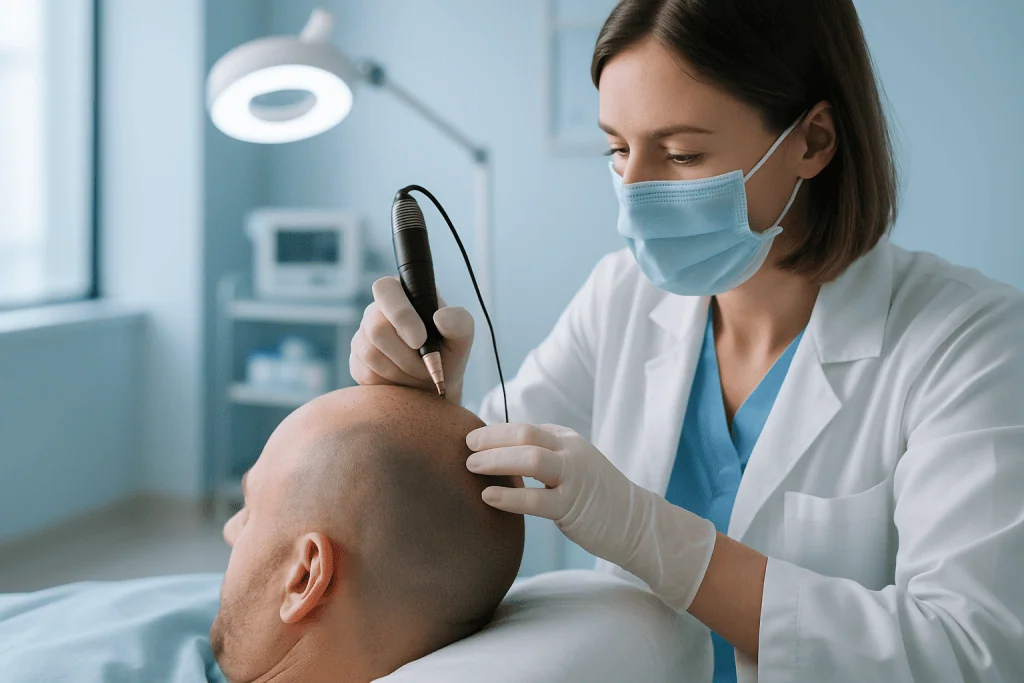
- Using a controlled micropigmentation device with fine sterile needles, the practitioner places tiny pigment impressions into the superficial scalp, one by one, varying spacing and density to mimic natural follicle distribution.
- The first session is deliberately conservative: it establishes the foundation, tests how your skin accepts pigment, and begins the intended pattern.
- Subsequent sessions add depth, refine the hairline, adjust density and improve blending, once the previous session has healed.
- After each session, the scalp is checked and you receive detailed aftercare instructions in writing.
Technology in SMP serves precision, hygiene, visualisation and planning. Digital imaging documents baseline hair loss and guides design decisions. Magnification and strong clinical lighting help the practitioner evaluate dot placement, scalp response and density transitions. Adjustable micropigmentation equipment allows control over needle speed, depth and pressure. Sterile single-use needle components and strict infection-prevention protocols are essential for safety, not optional extras. In medical settings, scalp assessment may also include dermoscopic evaluation or coordination with diagnostic services when the underlying hair loss needs further investigation.
How long does scalp micropigmentation take?
A single session commonly takes several hours, and most people need a series of sessions spaced several weeks apart. The size of the treated area and the complexity of the work set the session length: scar camouflage may be shorter, while full-scalp treatment requires longer appointments. The gaps between sessions are not padding: the scalp heals between treatments and pigment settles gradually, and this staged approach is exactly what prevents an overly dense or unnatural result. From first session to settled final appearance, it is realistic to think in terms of months rather than a single visit: a timeline worth building into your plans from the outset.
Immediately after a session, mild redness, tenderness, tightness or pinpoint swelling can occur; these usually improve over the first few days. The pigment often looks darker at first, then softens as the skin heals. Early aftercare typically includes keeping the scalp dry for an initial period and avoiding heavy sweating, swimming, steam rooms, direct sun exposure, scratching and harsh hair products until healing is adequate.
Recovery Timeline After Scalp Micropigmentation
Recovery varies with skin type, treatment area, pigment density and how closely aftercare is followed, but most people move through a predictable pattern.
| Time Period | What Patients Can Expect |
|---|---|
| Day 1 | The scalp may look red and the pigment may appear darker than the intended final result. Mild tenderness or tightness is common. |
| First Week | Redness usually settles, and tiny areas of dryness or flaking may occur. Patients typically avoid heavy sweating, swimming, steam, scratching, and direct sun. |
| First Month | The pigment softens as the skin heals. Follow-up sessions may be scheduled to build density, refine the hairline, or improve blending. |
| After Final Session | The result becomes more balanced after healing is complete. Long-term care includes sun protection and gentle scalp care. |
| Longer Term | Pigment gradually fades over time. Maintenance touch-ups may be considered to preserve definition and colour balance. |
Most people return to light daily activities quickly, although visible redness may influence social or work plans for a short time. Exercise and sun exposure are restricted temporarily because sweat, heat and ultraviolet light can affect healing and pigment retention. Once the initial dry-healing period has passed, gentle washing and light moisturising are usually reintroduced step by step, following the written aftercare plan, and shaving over the treated area waits until the skin has fully settled. Judge the result only after all planned sessions have healed, never after the first.
How Long Does Scalp Micropigmentation Last?
Scalp micropigmentation is long-lasting but not permanent in the way people usually mean the word: the pigment remains in the skin, but its appearance softens and lightens gradually over the years. Rather than disappearing on a fixed schedule, a result slowly loses crispness and depth, at a pace shaped by your skin type, sun exposure, pigment depth and lifestyle. Periodic touch-up sessions restore definition and colour balance when you and your practitioner judge them worthwhile, and a touch-up is typically a lighter, shorter undertaking than the original course, because it refreshes an existing design rather than building one from nothing.
Several factors accelerate fading. Ultraviolet exposure is the most significant: an outdoor lifestyle without consistent sun protection will soften a result noticeably faster. Oily skin, frequent exfoliation and pigment placed too superficially also shorten the interval before a refresh looks sensible. Conversely, careful placement depth, appropriate pigment selection and disciplined sun protection extend the life of the work. Because quality SMP pigments are formulated to lighten within the same tone rather than shift colour, gradual softening tends to read as natural lightening rather than an obvious cosmetic change, one of the deliberate design features separating SMP from a conventional tattoo.
Something else changes over time: you. Hair loss may progress, remaining hair may grey, and a hairline designed for a face in its thirties may need rebalancing decades later. Maintenance appointments are the natural point to adjust the design against these shifts, which is another reason a conservative initial plan serves you well.
What Are the Downsides of Scalp Micropigmentation?
SMP has real limitations, and understanding them before treatment is your best protection against disappointment.
- It is an illusion, not hair. The pigment has no texture, movement or length. It cannot be styled, and it will not change the feel of your scalp under your hand.
- Shaved-look results demand commitment. If pigment mimics stubble, your real hair must be kept correspondingly short, usually indefinitely, or the contrast between pigment and grown hair becomes visible.
- It fades and needs maintenance. The result softens over the years, and touch-up sessions are part of the long-term picture, with the time and cost they imply.
- Design errors are hard to undo. A hairline placed too low, too dark or too sharp is difficult to correct. Removal or adjustment is possible in some cases but demanding, which is why conservative design matters so much.
- Greying hair can create mismatch. As surrounding natural hair greys, pigment chosen years earlier may need rebalancing to keep the blend convincing.
- Scar tissue behaves unpredictably. Scars can absorb pigment unevenly and may need extra sessions, a test patch, or a more cautious approach.
- Skin reactions are possible. Redness, irritation and, rarely, pigment sensitivity can occur, which is one reason screening and sterile technique belong in the process.
None of these downsides makes SMP a poor option; they make it an option that rewards careful selection, honest expectations and experienced hands. Most of the disappointing results people share online trace back to aggressive hairline design, wrong pigment tone or poor candidate selection rather than to the technique itself.
Is it worth getting scalp micropigmentation?
It can be, for the right person with the right expectations. SMP tends to be worth it when your hair loss pattern is stable or well understood, when you are content with a short hairstyle or have enough existing hair to camouflage beneath, when you want a non-surgical route, and when you accept that maintenance is part of the arrangement. It tends not to be worth it when you expect hair that grows and moves, when your hair loss or scalp condition is still unstable, or when you are unwilling to keep the style the design depends on. The most useful question is not whether SMP is good in general, but whether the specific result it can deliver, a visual effect, honestly maintained, matches what you actually want to see in the mirror.
How Much Does Scalp Micropigmentation Cost?
There is no single honest number, because the cost of scalp micropigmentation depends on variables that differ from one person to the next. The main drivers are the size of the treated area, a hairline refinement is a different undertaking from full-scalp coverage, the number of sessions your skin and design require, the complexity of any scar work, the experience of the practitioner, and the setting in which the procedure is delivered. Treatment in a medical environment, with clinical screening, sterile single-use equipment and access to dermatological input, is priced differently from a walk-in studio, and for good reasons.
The sensible way to reach an accurate figure is an individual assessment leading to a personalised quote that covers the full planned course of sessions, not a single sitting. When you compare quotes, check what each one includes: all sessions in the initial course, aftercare guidance, follow-up review, and the policy on refinement work if pigment settles unevenly. A low headline figure that covers one session of a multi-session plan is not a low price.
It is also worth thinking about cost across the lifetime of the result rather than only the initial course. Because pigment softens gradually, periodic maintenance sessions are part of the long-term picture, and they carry their own time and expense. Corrective work is another quiet factor: poorly designed or poorly placed pigment is far more demanding to adjust than to place well the first time, which is one reason the experience and judgment of the team belong in any honest cost comparison alongside the headline figure.
Factors That Influence a Good Result
The quality of a scalp micropigmentation result depends on both medical and artistic factors, and it is worth understanding them before you choose where and whether to proceed.
Correct patient selection. SMP works best when the hair loss pattern is understood, the scalp is healthy, and your expectations match what pigment can achieve. If you expect the feel, movement or styling options of real hair, SMP alone will not meet that goal, and a responsible team will say so.
Hairline design. A natural hairline suits your age, facial structure, ethnic background, existing hair pattern and likely future loss. Overly straight, dark or low hairlines are the most common reason SMP looks artificial. A softer, slightly conservative design is almost always more durable aesthetically, because it still looks right as you age.
Pigment colour and depth. Pigment placed too deep can spread or change tone; pigment placed too superficially fades quickly. The shade must work with your skin tone and existing hair shadow. Building density gradually over several sessions gives the practitioner control and the chance to respond to how your scalp accepts pigment.
Skin type. Oily skin, very thick skin, sun-damaged skin, scar tissue and sensitive or inflamed skin all heal and hold pigment differently. Scar tissue in particular may absorb pigment unevenly and sometimes needs additional sessions or a more cautious approach. Anyone prone to keloids or hypertrophic scarring needs careful evaluation before any needle-based procedure.
Existing hair length. A shaved-look result requires you to maintain a short hairstyle so the pigmented impressions match nearby natural stubble; if surrounding hair grows out, the contrast weakens the illusion. Density treatments under longer hair, conversely, need sufficient existing hair to carry the camouflage effect.
Aftercare. Avoiding sun, sweat, swimming, friction and harsh products during early healing protects pigment retention and reduces irritation. Long-term sun protection matters too, because ultraviolet exposure accelerates fading and can alter pigment appearance. If you spend a lot of time outdoors, expect more regular maintenance.
The experience and judgment of the team. SMP is detail work. It requires knowledge of scalp anatomy, hair loss patterns, pigment behaviour, hygiene protocols and aesthetic proportion. In a hospital-based environment, access to dermatology, hair restoration expertise and medical evaluation adds particular value when the hair loss is complex or when SMP is one part of a broader care plan.
Potential Benefits of Scalp Micropigmentation
The benefits of SMP are best understood as visual, practical and confidence-related improvements, not medical hair regrowth.
| Benefit | What It Means for You |
|---|---|
| Non-surgical approach | No incisions, graft harvesting, or surgical recovery are required, making it suitable for many patients who prefer a less invasive option. |
| Improved appearance of density | Strategic pigment placement can reduce scalp visibility and make existing hair appear fuller, especially in thinning areas. |
| Defined shaved-hair look | For advanced hair loss, SMP can create the appearance of closely cropped follicles across the scalp when the hair is kept short. |
| Scar camouflage | Hair transplant scars, surgical scars, or selected trauma scars may become less noticeable when blended with surrounding scalp tones. |
| Complements other hair treatments | SMP may be combined with medical hair loss management or hair transplantation planning when appropriate. |
| Relatively quick return to routine | Most patients resume many normal activities soon, with temporary restrictions to protect healing and pigment retention. |
Why Acting Early Can Matter
Scalp micropigmentation is not an emergency procedure, and taking time over the decision is entirely reasonable. But early professional assessment still has value. Hair loss that is still active may be treatable, and identifying the cause can preserve existing hair or shape a better long-term aesthetic plan. When thinning is addressed only after advanced loss, the range of cosmetic options narrows.
Acting early does not mean having the procedure immediately. It means understanding the pattern and cause of your hair loss, learning whether medical treatment, hair transplantation, SMP or a combination fits best, and avoiding poorly planned cosmetic decisions. A hairline designed too low or too sharply at a young age, for example, can look increasingly unnatural as hair loss progresses. A conservative plan protects your future options.
Timing also matters where scars or scalp conditions are involved. Active dermatitis, psoriasis, folliculitis or scarring alopecia should be treated before micropigmentation; ignored, they make pigment retention unpredictable and can worsen irritation. Scars should generally be mature and stable before camouflage is attempted, and evaluation is what establishes whether the scalp is ready.
There is an emotional dimension too. Many people spend years avoiding certain hairstyles, lighting, photographs or social situations. SMP is not the right answer for everyone, but understanding what a natural result could realistically achieve, and what it cannot, tends to make the whole decision calmer, whichever way it goes.
Scalp Micropigmentation at Acibadem
At Acibadem, scalp micropigmentation is approached as a medical-aesthetic procedure rather than a purely cosmetic service. The work involves skin penetration, pigment placement and structured aftercare, so it sits within an environment built around clinical screening, sterile technique, clear consent and safe follow-up.
The clinical pathway can draw on multidisciplinary input when needed. Some patients arrive with straightforward cosmetic concerns; others bring complex hair loss, prior transplant surgery, autoimmune conditions, scarring or scalp inflammation. Access to dermatology, plastic surgery, hair restoration specialists and aesthetic medicine teams allows the plan to be individualised, and cases can be discussed among specialists so that SMP is considered in the context of your broader diagnosis and long-term goals rather than in isolation.
Assessment comes before cosmetic planning. This may include clinical examination, photographic documentation, magnified scalp evaluation, laboratory testing when hair loss is unexplained, or review of prior surgical records, so that suitability is established before any pigment plan takes shape.
Technology supports precision and safety throughout. Digital planning and medical photography document the baseline and communicate design choices. Magnification and controlled lighting help evaluate density and blending. Micropigmentation equipment is used with sterile components and careful control of placement. The specific technologies vary by hospital and indication, but the purpose is consistent: a measured, natural-looking result achieved without compromising skin health.
Treatment planning respects the staged nature of the procedure. The number of sessions, the spacing between them, expected redness, post-treatment restrictions and long-term maintenance should all be understood before the first appointment, and some patients combine SMP planning with evaluation for hair transplantation or medical hair loss treatment when the broader picture calls for it.
One more point, because it is where quality shows: experienced clinicians also help patients decide when not to proceed. If active scalp disease, unstable hair loss, unrealistic expectations or a genuinely better alternative is identified, the plan is adjusted or postponed. In aesthetic care, an honest recommendation protects both your safety and the final appearance, and it is just as important as technical skill.
What a Consultation Typically Covers
A scalp micropigmentation consultation is an assessment, not a commitment. Expect a review of your medical history, examination of your scalp or your photographs, discussion of alternatives, surgical, medical and non-surgical, and a realistic explanation of what SMP can and cannot achieve for your specific pattern of hair loss. You should also come away with a clear picture of session planning, recovery time, maintenance expectations, and whether further hair loss evaluation is advisable before any cosmetic work begins.
Use the consultation to test the thinking behind the plan, not just the plan itself. Ask why the proposed hairline sits where it does, how the design will hold up if your hair loss progresses, how pigment tone was chosen for your skin, and what the maintenance picture looks like years from now. Good answers are specific and slightly cautious; vague reassurance is a warning sign anywhere in aesthetic medicine.
A natural-looking SMP result should feel considered rather than rushed. It should respect your facial features, your age, your existing hair and your future hair loss possibilities. With careful planning and medical oversight, scalp micropigmentation can be a meaningful option for anyone who wants a non-surgical way to improve the appearance of hair density or to camouflage scalp scars, provided the expectations behind it are as well designed as the hairline.
Preparation
- Before scalp micropigmentation, a specialist assesses the scalp, hairline goals, skin type, and medical history. Patients may be advised to avoid alcohol, tanning, and blood-thinning medicines or supplements if medically appropriate. The scalp should be clean on the day of treatment, without styling products or heavy creams.
Aftercare
- After treatment, patients should avoid washing the scalp, heavy sweating, swimming, and direct sun exposure for the first few days. Mild redness or sensitivity can occur and usually settles quickly. Follow-up sessions may be scheduled to refine density, color, and hairline appearance.
Frequently Asked Questions
What affects the cost of scalp micropigmentation?
Cost is influenced by the size of the treatment area, the amount of density required, hairline design complexity, scar camouflage needs, practitioner experience, clinic setting, and follow-up plan. A consultation is needed to provide a personalised quote.
How can I get a personalised quote from Acibadem?
You can request a free consultation and share clear scalp photos, your hair loss history, previous procedures, and your goals. The specialist team can then assess suitability and explain what may be included in your treatment plan.
Does a scalp micropigmentation package usually include aftercare?
Many packages include consultation, design planning, the procedure plan, aftercare instructions, and follow-up coordination. Exact inclusions vary, so patients should confirm what is covered before travelling or booking.
Is scalp micropigmentation cheaper than a hair transplant?
Scalp micropigmentation is non-surgical and has different cost drivers than a hair transplant, but it also has a different purpose. It creates the appearance of follicles or density rather than growing new hair, so the best option depends on specialist assessment and patient expectations.
Will travel costs change my overall budget?
Yes. Flights, accommodation, local transport, translation support, and time away from home can affect the overall budget. International patient coordination can help clarify logistics and prepare a more complete estimate.
Medically reviewed by the Acıbadem International Medical Board August 31, 2026
See our medical review board →
Update history
- PublishedJune 8, 2026
- Medical review approvedAugust 31, 2026
- Last content updateAugust 31, 2026
Trusted care for international patients
From the Acibadem Blog
Scalp Micropigmentation Cost: Session Pricing and How It Compares to Surgery
A complete scalp micropigmentation treatment, typically delivered over three sessions, falls in our guide range of EUR 700–1,800 for international patients, compared with roughly…

After Scalp Micropigmentation: Sun, Sweat and Swimming Rules During the First Days of Healing
After scalp micropigmentation, most practitioners ask you to keep the scalp out of direct sun, avoid heavy sweating and stay out of pools, hot…