

How to Keep Teeth Clean During Orthodontics: Brushing Around Brackets and Aligners
Key Takeaways
- Plaque collects on the ledges above and below each bracket where saliva cannot reach, so brushing must be angled toward those edges rather than swept flat across the brackets.
- The NHS standard of two minutes of brushing twice a day with fluoride toothpaste applies during orthodontics, but most orthodontic teams treat two minutes as a minimum because of the extra surfaces.
- White spot lesions are areas of enamel mineral loss, not stains; they form within weeks where plaque and frequent sugar meet, and prevention is far more effective than any repair after braces come off.
- Aligners remove the flossing barrier but seal whatever is on the teeth under plastic for most of the day, so brushing before every reinsertion matters more than the twice-daily routine.
- Bleeding gums in the first weeks usually reflect gingivitis from plaque and improve with more thorough gumline cleaning, not less; bleeding beyond a couple of weeks warrants a check.
- Spitting out toothpaste without rinsing, and using fluoride mouthwash at a separate time of day, keeps fluoride on the enamel longer, which is where it does its protective work.
Cleaning teeth with braces means brushing for about two minutes twice a day with fluoride toothpaste, angling the brush above and below each bracket, and cleaning between teeth daily with floss threaders, interdental brushes or a water flosser. Aligner wearers brush before reinserting trays and rinse the trays themselves. Plaque left around brackets can cause permanent white marks and gum inflammation, so ask your orthodontic team to check your technique.
The first evening with braces has a particular soundtrack: the click of a toothbrush against metal, a long pause in front of the bathroom mirror, and the dawning realization that a job that used to take ninety seconds now feels like cleaning a picket fence with a paintbrush. Most people describe the same moment. The brush glides across the front of the brackets, the teeth look shiny, and yet the hygienist at the next visit points to a chalky line hugging the gum.
That gap between feeling clean and being clean is the whole story of cleaning teeth with braces. Brackets, wires, bands and even smooth plastic aligners create sheltered corners where plaque settles undisturbed. Saliva, which normally rinses tooth surfaces, cannot reach them. Sugar lingers. Bacteria multiply.
The good news is that the fix is not heroic. It is a small change in angle, an extra tool or two, and a routine you can actually keep for the eighteen months or more that treatment often takes.
What actually happens to plaque around brackets and wires
Plaque is a soft, sticky film of bacteria that forms on teeth within hours of brushing. On a bare tooth, it collects mostly along the gumline and in the grooves of molars, where a brush and floss can reach it. Add a bracket, and the geometry changes. Each bracket is glued to the enamel, leaving a small ledge above it, a ledge below it, and two narrow channels on either side. The archwire runs across the front like a clothesline, and the tiny elastic or metal ties that hold it create even more crevices.
Bacteria in plaque feed on sugars from food and drink and release acid. That acid pulls calcium and phosphate minerals out of the enamel, a process called demineralization. Saliva normally repairs this damage between meals by bathing the tooth in minerals, but saliva flows poorly around brackets, so the repair side of the equation falls behind. Over weeks, the enamel around a bracket can lose enough mineral to turn opaque and chalky. Those are the white spots that some people notice only when the braces come off, when the tooth beneath the bracket is bright and the ring around it is not (Cleveland Clinic).
The gums react too. Plaque sitting against gum tissue triggers inflammation, or gingivitis, which shows as redness, puffiness and bleeding when you brush. Gingivitis is reversible with thorough cleaning, which is why orthodontic teams care so much about technique rather than force (Cleveland Clinic).
Aligners behave differently but not innocently. A tray that fits snugly over the teeth also traps whatever is on them. Food debris, sugary drink residue or plaque sealed under plastic for hours has no saliva to dilute it. The underlying principle is identical: disturb the plaque before it has time to do harm, and give fluoride a chance to rebuild what acid takes away.
How to brush with braces: the two-angle method
The single most useful change is to stop brushing straight across the brackets and start brushing at them from above and below. Picture the bracket as a small shelf. Tilt the brush so the bristles point downward from the gum onto the top edge of the shelf, and sweep along the arch in short strokes. Then flip the angle so the bristles point upward into the underside of the bracket. Finish each section with the bristles at roughly a 45-degree angle to the gumline, which is the same angle dentists recommend for anyone (NHS).

Time matters as much as angle. The NHS advises brushing for about two minutes twice a day with fluoride toothpaste, and that guidance does not change with braces, though many orthodontists suggest the two minutes will feel like a minimum rather than a target. A practical way to pace it is to divide the mouth into four quadrants and spend around thirty seconds on each, covering the outer surfaces around the brackets, the inner surfaces next to the tongue and palate, and the chewing surfaces of the back teeth.
A soft-bristled brush is kinder to inflamed gums and less likely to snap a wire or loosen a bracket. Some people prefer a brush with a smaller head or a V-shaped orthodontic head, which dips around the wire. An electric brush can help if you find it hard to keep the right motion, but it does not replace the angles; you still need to tilt it toward the bracket edges and let it linger rather than scrubbing.
Two habits round out the routine. Spit out the toothpaste but skip the big rinse afterward, so fluoride stays on the enamel longer (NHS). And brush the last thing before bed, because saliva flow drops during sleep and whatever plaque remains has all night to work.
Flossing with braces: threaders, interdental brushes and water flossers
Ordinary floss hits a wall with braces, quite literally: the archwire blocks the floss from sliding down between the teeth. Three tools get around the problem, and most people settle on one or two after some trial and error.
A floss threader is a stiff plastic loop that carries the floss under the wire, a bit like threading a needle. Once the floss is beneath the wire, you clean between the teeth as usual, curving it in a C-shape against each tooth and gently sliding below the gumline. Some floss is sold with a built-in stiff end that does the same job without a separate threader. Expect the first few attempts to take a while; a full mouth can take ten minutes until the movement becomes automatic.
Interdental brushes are tiny bottle-brush heads on a handle. Slid between teeth and under the wire, they clean the sides of the brackets and the gaps that a toothbrush misses. Choose a size that fits snugly without forcing, and rinse the brush between teeth. Many orthodontic patients find these quicker than threading floss and use them daily, keeping traditional floss for a more thorough weekly session.
Water flossers direct a pulsing stream of water between the teeth and around the brackets. They are popular because they are fast and do not require dexterity, and they flush out food debris well. The evidence that they remove plaque as thoroughly as string floss is mixed, so most clinicians treat them as an addition rather than a replacement. If you have bleeding gums, a water flosser on a low setting can be a gentle way to build up to more thorough cleaning.
Whichever tool you choose, the goal is the same: disturb the plaque between every pair of teeth at least once a day, ideally in the evening before the bedtime brush (NHS).
Cleaning teeth with braces after meals and away from home
Braces turn every lunch into a small logistical question. Food catches in the brackets in a way it never did before, and a stray fleck of spinach on a front bracket is visible to everyone. More important than appearance, food stuck against enamel keeps feeding bacteria until it is removed. That does not mean a full brushing session after every snack, but a rinse and a quick clean make a real difference.
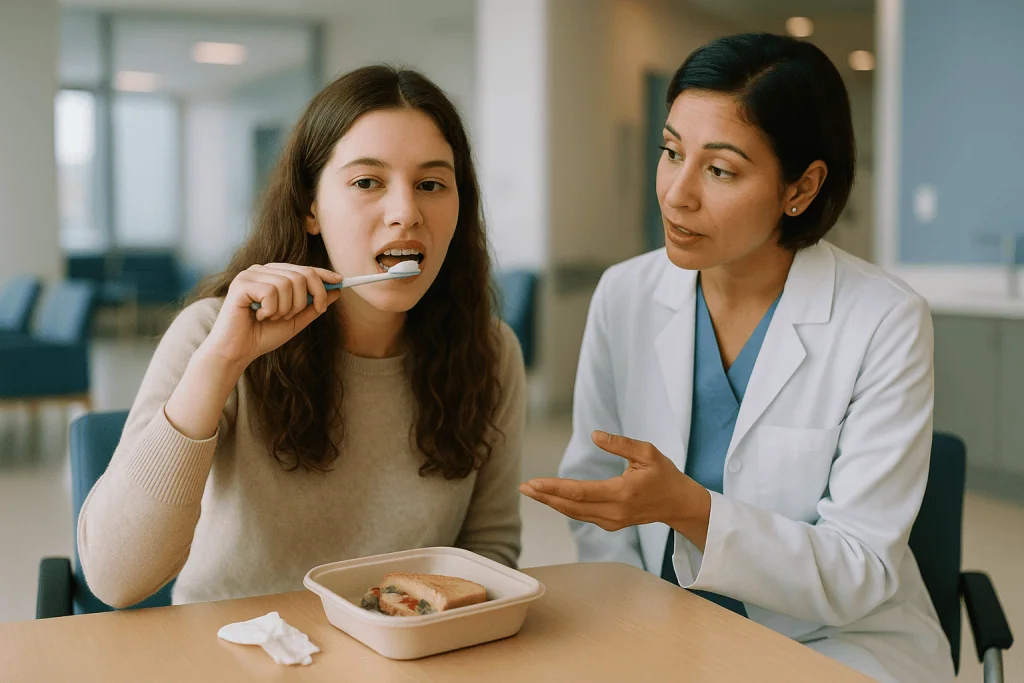
A travel kit that fits in a pocket or bag covers most situations: a compact toothbrush, a small tube of fluoride toothpaste, a few interdental brushes, and orthodontic wax for any wire that suddenly starts rubbing. Rinsing vigorously with plain water after eating dislodges the loose debris and dilutes the acid. If you can brush, do it; if you cannot, rinsing is far better than nothing.
Timing raises a common question. Because acid softens the outer layer of enamel for a while after eating or drinking anything sugary or acidic, brushing immediately afterward can scrub at that softened surface. The NHS suggests waiting before brushing after acidic foods and drinks and rinsing with water in the meantime. Roughly an hour is a common working figure clinicians use, though the more important habit is to keep acidic drinks to mealtimes rather than sipping through the day.
Meals at school or work are where routines slip. People who keep a dedicated brush at their desk or in a locker, rather than relying on remembering to pack one, tend to actually use it. Sugar-free gum after meals, for those without aligners and with their orthodontist’s approval, stimulates saliva and helps clear debris, though it does not replace brushing.
Travel deserves a specific note: pack spare interdental brushes and wax, and ask your orthodontist before a long trip what to do if a bracket loosens while you are away, so a minor problem does not become a treatment setback.
Cleaning aligners at home, and the teeth underneath them
Clear aligners look like they solve the hygiene problem: you take them out, brush normally, put them back. In practice they create a different discipline. Aligners are worn most of the day and night, removed only for eating, drinking anything other than water, and cleaning. Because they must be worn nearly all the time to move teeth on schedule, the temptation is to slip them back in after a snack without brushing. Whatever is on the teeth at that moment is then sealed against the enamel for hours.
The rule that most orthodontic teams give is simple: brush before every reinsertion. If a full brush is impossible, rinse the mouth thoroughly with water and rinse the tray before putting it back, then brush properly at the next opportunity. Sugary or acidic drinks with aligners in are a particular problem, since the liquid pools inside the tray and bathes the teeth.
The trays themselves need cleaning too. Rinse them in cool or lukewarm water every time you remove them, and brush them gently with a soft brush. Hot water can warp the plastic and change the fit. Toothpaste with abrasive particles can scratch the surface, leaving it cloudy and more likely to harbor plaque, so many clinicians suggest a mild soap or a cleaning tablet made for dental appliances rather than toothpaste. A cloudy or yellowing tray, or one that smells, usually signals plaque and bacteria building up on the plastic.
Store aligners in their case when they are out, never loose in a pocket or napkin, where they collect bacteria and get lost or thrown away. Because you change to a new set regularly, any single tray does not have long to accumulate deposits, but the attachments bonded to your teeth, the small tooth-colored bumps that grip the aligner, behave like miniature brackets and need the same angled brushing.
Do fluoride toothpaste and mouthwash matter more during orthodontics?
Fluoride is the mineral that helps enamel resist acid and rebuild after mild demineralization. It works by being present on the tooth surface when acid attacks happen, which is why the most reliable source is a fluoride toothpaste used twice a day (NHS). During orthodontic treatment, when plaque is harder to remove and enamel around brackets is under repeated acid stress, keeping fluoride on the teeth becomes more valuable, not less.
Standard fluoride toothpaste is what most orthodontic patients use. For people who are struggling with early white spots, a poor cleaning record or a dry mouth, a dentist may prescribe a higher-fluoride toothpaste or apply fluoride varnish in the clinic. Those are clinical decisions based on your individual risk; this article can describe that they exist, not who should have them.
Fluoride mouthwash is a common addition during braces. It adds another fluoride exposure at a different time of day, typically midday or after school, and reaches around brackets where bristles struggle. The NHS notes that mouthwash should be used at a separate time from brushing rather than immediately after, because rinsing right after brushing washes away the concentrated fluoride from the toothpaste. Mouthwash is a supplement to mechanical cleaning, not a substitute; it cannot remove the film of plaque that only a brush or interdental tool can disrupt.
Antiseptic mouthwashes that reduce bacteria are sometimes suggested for short periods when gums are very inflamed. Some of these can stain teeth and brackets brown with prolonged use, so they are usually a short-term measure directed by the dental team rather than a daily habit.
Whitening toothpastes deserve a word of caution. They do not lighten enamel under brackets, so a tooth whitened around a bracket may show a pattern when the braces come off. Most orthodontists suggest waiting until treatment is finished before any whitening.
Who is usually offered braces, and who is asked to wait?
Orthodontic treatment straightens teeth and corrects the way the upper and lower teeth meet. In the NHS, treatment is usually started once most of the adult teeth have come through, often around age twelve or thirteen, though the right moment depends on how the individual child’s face and teeth are developing (NHS). Adults can be treated at any age provided their teeth and gums are healthy, and adult orthodontics has become common.
Hygiene is one of the deciding factors in timing, and it is where this article’s topic meets the treatment decision. Braces are usually not fitted on teeth with active decay or on gums with untreated disease. Decay needs to be dealt with first, because a bracket bonded over or beside a cavity makes it harder to treat and the cavity can worsen during the months of treatment. Gum disease needs to be brought under control because moving teeth through inflamed, infected tissue can accelerate bone loss around the roots.
Orthodontists also watch how a patient looks after their teeth before treatment starts. Someone who arrives with heavy plaque and bleeding gums is often asked to improve their routine and return, not as a punishment but because braces will magnify whatever habits exist. A child who cannot yet manage a two-minute brush unaided is likely to struggle with brackets, and a period of coaching, sometimes with a hygienist, often comes first.
Other reasons to wait or reconsider include very high decay risk that cannot be controlled, certain medical conditions affecting bone healing, and, for aligners specifically, a realistic assessment of whether the person will wear them consistently. Alternatives to fixed braces include aligners, removable appliances for younger children, and, in some cases, accepting a mild irregularity rather than treating it. Which route suits you is a discussion for your orthodontic team, based on your teeth, your goals and your ability to keep everything clean.
Braces vs aligners: how the cleaning routine compares
People often choose between fixed braces and clear aligners for reasons of appearance and cost, but the daily cleaning burden is a real difference and worth understanding before you commit. Neither is easier in every respect. Braces demand better technique; aligners demand more self-discipline.
| Cleaning task | Fixed braces | Clear aligners |
|---|---|---|
| Brushing technique | Angled strokes above and below each bracket; two minutes is a minimum | Normal brushing, but before every reinsertion, not just twice a day |
| Between teeth | Floss threader, interdental brushes or water flosser, daily | Standard floss, daily; attachments need angled brushing |
| After snacks and drinks | Rinse with water; brush when possible; wire can trap food | Remove tray, rinse or brush, rinse tray, reinsert; no sugary drinks with trays in |
| Appliance care | None beyond brushing; wax for rubbing wires | Rinse and gently brush trays; avoid hot water and abrasive paste |
| Main hygiene risk | White spot lesions around brackets; gingivitis along gumline | Plaque and acid sealed under the tray; tray odor and discoloration |
| Where people slip | Skipping the angles; brushing across brackets only | Reinserting after eating without brushing; wearing trays too few hours |
A few points from the table deserve emphasis. Aligners remove the mechanical barrier to flossing, which is a genuine advantage for gum health, but they add a behavior problem that braces do not have: every snack becomes a decision. Braces, by contrast, are always working regardless of willpower, yet the brackets never come off for cleaning, so the technique has to be right every single day for the whole course of treatment, which the NHS describes as typically eighteen months to two years (NHS).
Both routes share the fundamentals: fluoride toothpaste twice daily, daily interdental cleaning, minimal sugar between meals, and regular check-ups with a dentist alongside orthodontic visits so that decay and gum problems are caught early.
What the first days and weeks with braces usually look like
The fitting appointment itself is painless, but the hours afterward bring a dull ache as the teeth begin to respond to pressure from the wire. Most people find the soreness peaks in the first day or two and settles within about a week (Mayo Clinic). Eating soft foods helps, and your orthodontist can advise on pain relief if needed. This is also the stage when the inside of the lips and cheeks meet metal for the first time, and small ulcers are common until the tissue toughens.
Cleaning feels awkward in week one. The brush catches, the angles feel unnatural, and flossing with a threader is slow. The most useful thing to do in these days is to brush in front of a mirror with the light on, watching the bristles reach above and below the brackets, and to check the result by running the tongue over the teeth and looking closely at the gumline. Plaque that has been missed for a few days often shows as a dull, matte band next to the gum, in contrast to the glossy enamel around it.
Bleeding when brushing is common in the first fortnight, especially if the gums were already a little inflamed. Counterintuitively, it usually improves with more thorough cleaning rather than gentler cleaning, because bleeding is a sign of inflammation caused by plaque. If bleeding persists beyond a couple of weeks of good technique, or the gums become swollen, mention it at your next visit.
Adjustment appointments follow at regular intervals, often every six to eight weeks (NHS). Each adjustment brings a day or two of renewed soreness. Those visits are also the moments when the team can see how cleaning is going. Rather than waiting for feedback, ask the hygienist or orthodontist to point out the areas being missed. Most people have a consistent blind spot, frequently the upper back teeth on their non-dominant side, and knowing where it is changes the routine more than any new gadget.
White spots after braces: what they are and how to lower the risk
White spot lesions are areas of enamel that have lost mineral beneath the surface and scatter light differently, so they appear chalky white against the surrounding tooth. They are the earliest visible stage of tooth decay, and they form in exactly the places plaque sits longest around brackets: the gumline side of the bracket and its edges (Cleveland Clinic). They are often invisible during treatment because the bracket hides part of the tooth, and they announce themselves on the day the braces come off.
The mechanism is straightforward. Plaque bacteria produce acid after every exposure to sugar, and each acid attack removes a little mineral. Between attacks, saliva and fluoride put mineral back. When attacks are frequent, because someone snacks or sips sweet drinks through the day, or when plaque is thick enough to shield the enamel from saliva, loss outpaces repair and a white spot develops. This can happen over a matter of weeks in someone with poor cleaning and a sugary diet.
Prevention rests on three legs. First, remove plaque from around every bracket every day, using the angled brushing described earlier. Second, keep fluoride in contact with the enamel with twice-daily fluoride toothpaste and, if your team suggests it, a fluoride mouthwash at a separate time. Third, limit how often sugar enters the mouth rather than fixating on the total amount; three sugary moments a day is far less damaging than the same sugar spread across ten.
Early white spots can partly recover. Once the bracket is removed, saliva reaches the surface and, with fluoride, some remineralization occurs over months, so the spots often fade somewhat. Established lesions may not disappear, and dentists have various options for improving their appearance, from resin infiltration to microabrasion, which are individual decisions with your dental team. The honest summary is that prevention during treatment is far more effective than any repair afterward, which is why orthodontists repeat themselves about cleaning.
Food, drink and habits that make cleaning harder
Orthodontists hand out food lists for two reasons: some foods break brackets and bend wires, and some make plaque control much harder. The two lists overlap but are not identical, and understanding why each item is there makes the advice easier to follow.
Hard and sticky foods are the appliance-breakers. Whole apples, crusty bread, hard candy, nuts, popcorn kernels, chewing gum and chewy sweets can pop a bracket off or bend the wire, which sets treatment back and often means an extra appointment. Cutting hard foods into small pieces and chewing with the back teeth avoids most of these accidents.
Sticky and sugary foods are the hygiene problem. Caramel, toffee, dried fruit and soft chewy bars cling to brackets and stay there, feeding bacteria long after the meal. Sugary and acidic drinks are arguably worse because they coat every surface, and sipping them slowly extends the acid exposure for as long as the drink lasts (NHS). Water is the only drink that is entirely safe to sip between meals. For aligner wearers, anything other than water while the trays are in is a problem, because the liquid pools inside the tray.
Some habits deserve mention because people rarely connect them to cleaning. Chewing on pens, fingernails or ice can damage brackets. Mouth breathing, common in people with nasal congestion, dries the front teeth and gums and reduces the protective effect of saliva around the upper front brackets. Vaping and smoking dry the mouth, stain brackets and aligners, and worsen gum inflammation.
Snacking frequency is the single dietary factor with the largest effect on white spots and decay. If you eat between meals, choose things that clear quickly, such as cheese, plain yogurt or vegetables, and rinse with water afterward. A routine that ends each day with a thorough clean and nothing but water after it gives the enamel the long, undisturbed recovery period it needs.
Sore gums, bleeding and mouth ulcers: what is normal and what is not
Gums that bleed a little when brushing in the first weeks after braces are fitted are common and usually reflect gingivitis that was already present or is developing around the new plaque traps. Gingivitis is inflammation of the gum without damage to the bone underneath, and it improves when plaque is removed consistently (Cleveland Clinic). The paradox that trips people up is that bleeding gums tempt you to brush more gently or avoid the area, which allows more plaque to build and more bleeding to follow. Gentle but thorough cleaning right along the gumline, with a soft brush, is the way out.
Swollen gums that puff up over the edges of brackets are a more advanced sign. Sometimes this is purely inflammatory and settles with better hygiene; sometimes the tissue has grown in response to persistent irritation, a change called gingival overgrowth, which may need attention from the dental team. Persistent bad breath, gums that look shiny and dark red, or teeth that seem to be loosening beyond the expected slight mobility of orthodontic movement all warrant a conversation with your dentist rather than waiting for the next orthodontic visit.
Mouth ulcers from brackets rubbing the lips and cheeks are a different problem. They are painful but not a hygiene failure. Orthodontic wax pressed over the offending bracket protects the tissue while it toughens, and warm salt water rinses can soothe. The dental team can also smooth or clip a wire that is poking. Ulcers that do not heal within about three weeks should always be checked by a dentist or doctor, braces or not (NHS).
Tooth sensitivity to cold during treatment is common and usually mild. Sensitivity that is sharp, lingering or focused on one tooth, or pain when biting on a particular tooth, may signal decay under or beside a bracket and should be assessed rather than assumed to be part of the process.
What people often get wrong about cleaning teeth with braces
Myth: brushing harder gets around the brackets better. Pressure does not reach the ledges above and below a bracket; angle does. Hard scrubbing wears the gum away, exposing sensitive root surfaces, and can loosen brackets. A soft brush tilted correctly and given time outperforms a stiff brush driven with force every time.
Myth: an electric toothbrush or a water flosser does the work for you. Both are useful tools, and some people clean better with them, but neither knows where your brackets are. An electric brush held flat against the brackets misses the same spots as a manual one. A water flosser flushes debris well but the evidence that it removes plaque as thoroughly as string floss or interdental brushes is limited, so it works best as an addition.
Myth: mouthwash replaces brushing when you are in a hurry. Mouthwash cannot dislodge the film of plaque; only mechanical cleaning does that. Fluoride mouthwash adds protection, but a mouthwash-only day is a day plaque wins.
Myth: rinsing well after brushing is cleaner. Rinsing washes the fluoride off the enamel just when you want it to stay. The NHS advice is to spit, not rinse (NHS).
Myth: aligners mean you can relax about hygiene. Aligners remove the flossing barrier but seal whatever is on your teeth against the enamel for most of the day. Snacking with trays in or reinserting without brushing is one of the fastest routes to decay during orthodontic treatment.
Myth: white spots are stains that will polish off. They are areas of mineral loss beneath the enamel surface. Some fade with time and fluoride after brackets are removed, but polishing does not remove them and aggressive whitening can make the contrast more obvious.
Myth: braces cause decay. Braces create places for plaque to hide; plaque and sugar cause decay. People who clean well and limit sugar frequency can finish treatment with healthy enamel. The appliance changes the difficulty, not the biology.
Questions to ask your orthodontic care team
Orthodontic appointments are short, and hygiene questions often get squeezed out by the mechanics of wires and elastics. Arriving with specific questions helps you get specific answers. These are the ones patients and parents tell hygienists they wish they had asked earlier.
- Which areas of my mouth am I missing most? Can you show me in the mirror where the plaque is building up?
- Would you recommend an interdental brush size, a floss threader, or both for the gaps I have, and can you demonstrate how to get under the wire?
- Should I be using a fluoride mouthwash, and at what time of day so it does not undo the toothpaste?
- Do you think I am at higher risk of white spots, and if so, are there additional fluoride measures you would consider for me?
- How should I handle brushing at school or work when a full clean is not possible?
- For aligners: what should I do if I cannot brush before reinserting, and how do you want me to clean the trays?
- How often should I see my general dentist during treatment, and who is responsible for checking for decay, you or them?
- What foods and drinks are the biggest problems for my particular appliance, and is sugar-free gum acceptable?
- If a bracket comes loose or a wire pokes, what should I do first and how quickly do you want to see me?
- What signs in my gums or teeth should prompt me to call between appointments?
A follow-up question worth asking at every adjustment is simply whether your cleaning has improved since last time. Hygienists can often see a change from one visit to the next, and hearing that a specific area has gotten better is more motivating than a general reminder to brush more. Parents of younger patients may also ask whether the team wants them to supervise or check brushing at home, and how they would know if the child is falling behind.
When to call your doctor or orthodontist
Most orthodontic hygiene problems are slow-moving and can wait for a scheduled visit, but some signs should prompt a call sooner. Contact your orthodontist promptly if a bracket comes loose, a wire is poking into the cheek and wax does not solve it, or an appliance is damaged in a way that stops you cleaning properly. These are not emergencies in the medical sense, but leaving them for weeks can affect both hygiene and treatment progress.
Call your dentist or orthodontist within a few days if you notice gums that are swollen and growing over the brackets, bleeding that continues for more than a couple of weeks despite thorough daily cleaning, persistent bad breath that brushing does not resolve, a new white or brown spot around a bracket, or a tooth that has become sharply sensitive or painful when biting. Each of these can indicate decay or gum disease that is easier to manage early.
Seek same-day dental or medical care if you have swelling of the face or jaw, a fever alongside tooth or gum pain, severe throbbing pain that keeps you awake or does not ease, a mouth ulcer that has not healed after about three weeks, or any bleeding from the mouth that does not stop with gentle pressure. Difficulty swallowing or breathing with facial swelling is an emergency and needs urgent medical attention (NHS).
For aligner wearers, add these to the list: trays that no longer fit after a break in wearing them, an attachment that has fallen off, or persistent pain in a single tooth that lasts more than a few days after changing to a new tray.
None of these signs means treatment has failed or that you have done something wrong. They are the cues that a trained team should look, and every decision about what happens next, from a fluoride application to a pause in tooth movement while gums recover, belongs to the clinicians who know your mouth.
Frequently asked questions
How long should I brush my teeth with braces?
Brush for at least two minutes twice a day, the same standard the NHS recommends for everyone, but many orthodontic patients find a thorough clean around brackets takes closer to three or four minutes. Dividing the mouth into four sections and spending equal time on each helps, and angling the brush above and below every bracket matters more than total time.
How to brush with braces if my gums bleed every time?
Keep brushing gently but thoroughly along the gumline with a soft brush rather than avoiding the bleeding areas. Bleeding usually means plaque is causing inflammation, and it improves as the plaque is cleared consistently over one to two weeks. If bleeding continues beyond that despite good technique, or the gums swell, ask your dentist or orthodontist to check.
Is flossing with braces really necessary if I use a water flosser?
A water flosser is a useful addition but the evidence that it removes plaque as thoroughly as string floss or interdental brushes is limited. Most clinicians suggest using floss with a threader or interdental brushes daily to clean between the teeth and around bracket edges, and treating the water flosser as extra help with debris and gum comfort.
What is the best way of cleaning aligners at home?
Rinse trays with cool or lukewarm water every time you remove them and brush them gently with a soft brush using mild soap or a cleaner made for dental appliances. Avoid hot water, which can warp them, and abrasive toothpaste, which scratches the plastic. Store them in their case, and always brush your teeth before putting them back in.
Can white spots after braces go away on their own?
Early white spots can partly fade over months once brackets are removed, because saliva and fluoride reach the surface and remineralize the enamel. Established spots often remain visible. Dentists have several options to improve their appearance, but these are individual decisions. Consistent cleaning and limiting sugar frequency during treatment prevent most of them from forming.
Should I brush right after eating with braces?
Rinse with water straight after eating to clear debris and dilute acid, then brush a little later, since brushing immediately after sugary or acidic food can scrub softened enamel. If brushing is not possible, rinsing is still worthwhile. Aligner wearers should brush or at least rinse thoroughly before putting trays back in after any food or drink other than water.
Do I need a special toothbrush for braces?
A soft-bristled brush with a small head is enough for most people. Orthodontic brushes with a V-shaped head are designed to dip around the wire, and some people find them easier. Electric brushes can help with consistency, but none of these replaces the technique of angling bristles above and below each bracket and cleaning along the gumline.
How often should I replace my toothbrush during orthodontics?
Replace it when the bristles start to splay or fray, which often happens faster with braces because the brackets wear them down. The NHS suggests changing a brush roughly every three months as a general guide, and orthodontic patients frequently need to do so sooner. A worn brush cleans the bracket edges poorly.
Is mouthwash with braces enough on days I cannot brush properly?
No. Mouthwash cannot remove the sticky film of plaque; only a brush or interdental tool does that. A fluoride mouthwash adds protection when used at a separate time from brushing, but it is a supplement. On a difficult day, rinsing with water and brushing as soon as possible afterward is better than relying on mouthwash alone.
Why do orthodontists insist on hygiene before fitting braces?
Braces are usually not fitted on teeth with untreated decay or gums with active disease, because moving teeth through inflamed tissue can damage the supporting bone and because brackets make existing cavities harder to treat. Orthodontists also want to see that a patient can maintain a good routine, since braces magnify whatever cleaning habits already exist.
References
This article is for general information only and is not a substitute for professional medical advice. Please consult a qualified doctor about your individual situation.

More from the Blog

Impacted Tooth Surgery Aftercare: Normal Soreness vs Numbness or Fever to Report
After impacted tooth surgery, dull soreness, swelling that peaks around the second or third day, mild bruising and a stiff jaw are usually part…
Teeth Whitening for Teens and Older Adults: How Age Changes the Advice
Teeth whitening for teenagers is usually postponed until all permanent teeth have fully come in and matured, typically the mid-to-late teens, because young teeth…
Wisdom Teeth Recovery: A Realistic Day-by-Day Healing Guide
Most people feel the worst of wisdom teeth recovery during the first two to three days, when swelling and soreness peak, then improve steadily.…

Clear Aligner Milestones: Tray Changes, Refinements and the Retainer Phase
Clear aligner treatment moves through predictable milestones: a digital scan and treatment plan, the first tray and an adjustment week, tray changes roughly every…

How TMJ Disorder Is Diagnosed: Jaw Movement Tests, Bite Checks and When Imaging Is Needed
TMJ disorder is diagnosed mainly by a clinical examination, not a scan. A dentist or doctor takes a detailed history, watches and measures how…

After Fluoride Application: Waiting to Eat, Drink and Brush So the Varnish Can Work
After fluoride varnish, most dental teams ask you to avoid all food and drink for about 30 minutes, then choose soft, cool or lukewarm…