

When Do Children Get Removable Appliances? How Jaw Growth Shapes the Timing

Key Takeaways
- The best time to widen a narrow upper jaw is before the midline suture of the palate matures, which is why palatal expansion is mostly a childhood and early-teen treatment.
- The Cochrane review of prominent upper front teeth found early functional-appliance treatment did not improve the final result compared with one course in adolescence, but it did reduce new injuries to those teeth.
- Functional appliances such as the twin block change the bite through a mixture of tooth tipping and a modest skeletal effect, and work best when worn through the pubertal growth spurt.
- A removable appliance moves nothing while it sits in a case; hours of wear set by the orthodontist are the single biggest predictor of whether it does its job.
- A gap opening between the front teeth during palatal expansion is expected and temporary, according to the Cleveland Clinic, and usually closes on its own in the following weeks.
- The NHS describes retainers as a required final stage of orthodontic treatment, often worn long term, because teeth drift back toward their original positions for years afterward.
Removable appliances for children are usually fitted during the mixed dentition years, when baby and adult teeth share the mouth and the jaws are still growing. Orthodontists time functional appliances to the adolescent growth spurt, expansion plates to before the upper jaw's midline suture matures, and space maintainers to whenever a baby tooth is lost early. An orthodontic assessment sets the individual timing for each child.
The school photo arrives and there it is: a nine-year-old grinning with two front teeth that lean out over the lower lip like awning windows. The dentist mentioned it last spring, said something about jaw growth, and suggested waiting a year before deciding anything. Waiting feels wrong when the child has already been teased once at swim practice.
This is where most families first hear about removable appliances for children: plastic plates, wire clasps, blocks that sit between the back teeth, devices that can be taken out at mealtimes and popped into a case. Compared with the fixed braces of a teenager, they sound gentle, even optional. In practice they are neither. They are precision tools with a narrow window of usefulness, and that window is set by the skeleton, not the calendar.
Understanding why an orthodontist says ‘now’ to one child and ‘not yet’ to another is the key to making sense of the whole conversation.
What are removable appliances for children, and how do they actually work?
An orthodontic appliance is any device designed to guide the position of teeth or the growth of the jaws. A removable one is simply a version the child can take out and put back in. Most consist of a thin acrylic plate molded to the roof of the mouth or the inside of the lower teeth, held in place by stainless steel clasps that grip the molars, with springs, wires or a small screw that does the actual work.
The mechanism is the same one that underlies every form of orthodontics. Teeth are not fused to bone; each sits in a socket cushioned by a ligament. When a light, steady force pushes a tooth, cells on the squeezed side dissolve a little bone while cells on the stretched side lay down new bone. The tooth drifts, the socket follows. This remodeling happens only while the force is applied, which is why a plate that spends the day in a jacket pocket achieves nothing. The NHS notes that removable braces are generally used for minor corrections and, in children, to guide growth or hold space rather than to align every tooth precisely.
A second group, called functional appliances, works less on the teeth than on posture. By holding the lower jaw forward or the bite open, they stretch the chewing muscles and soft tissues, and that altered posture appears to nudge the way the jaws grow relative to each other while growth is still active. A third group does no moving at all: space maintainers and retainers exist purely to stop things drifting.
Every one of these devices depends on two things the child controls and the orthodontist cannot: hours of wear, and careful cleaning. That reality shapes who is offered one, and when.
Why does jaw growth decide the timing of removable appliances?
Between roughly the first loose incisor and the last baby molar falling out, a child is in what dentists call the mixed dentition: a mouth holding both baby and adult teeth at once. It is a period of constant change, and MedlinePlus describes it as the stage when many bite problems, or malocclusions (the term for teeth and jaws that do not meet correctly), first become obvious.

Two growth events matter most. The upper jaw is built in two halves joined down the middle by a seam of cartilage and immature bone called the midpalatal suture. In young children this seam is pliable; through adolescence it knits together and eventually becomes solid bone. Widening a narrow upper jaw is therefore easier, and needs less force, before that seam matures, which is why the Cleveland Clinic describes palatal expansion as most straightforward in children and young teens.
The lower jaw follows a different clock. It grows longest and fastest during the pubertal growth spurt, which arrives at different ages in different children and, on average, earlier in girls than boys. A functional appliance intended to encourage the lower jaw forward is most likely to have an effect if it is worn while that spurt is under way, not years before or after.
Layered over these skeletal windows is the tooth timetable itself. There is little point tipping a baby tooth that will be shed in six months, and no point fitting a clasp to a molar that is about to loosen. So when an orthodontist recommends waiting, the advice usually means one of three things: the growth spurt has not started, the adult teeth needed to anchor the appliance are not yet in place, or the problem may resolve on its own as baby teeth are replaced. Patience here is a clinical judgment, not indifference.
Which children are usually offered removable appliances, and who is asked to wait?
Orthodontists tend to reach for a removable device in childhood when a specific, well-defined problem can be improved by a simple movement or by protecting growth. Common situations include upper front teeth that stick out well ahead of the lower ones (an increased overjet), a single upper tooth biting behind the lower teeth (a crossbite), a narrow upper jaw that leaves the back teeth biting inside the lower ones, a baby tooth lost early with the risk of neighbors drifting into the gap, and a thumb or finger habit that has persisted after the adult front teeth have come through.
Children are more often asked to wait when the issue is mild crowding. Much of it looks worse than it is during the mixed dentition, because adult teeth are larger than the baby teeth they replace and the jaw has not finished making room. The NHS points out that most orthodontic treatment begins around age 12 to 13, once most adult teeth are through, precisely because that is when the full picture is visible and one continuous course of treatment is possible.
Age alone is rarely the deciding factor. A seven-year-old with a persistent thumb habit may be fitted with a habit-breaking plate; an eleven-year-old with mild crowding may be told to return in a year. Readiness matters too. A child who cannot yet be relied on to wear a plate for most of the day, or to keep it clean, may do better with a fixed device or with a delay. Children with a very deep bite, severe jaw discrepancies or complex medical needs usually require a different plan altogether.
In every case the recommendation should come with a reason the family understands. If it does not, ask for one.
What is an example of a removable orthodontic appliance?
Families often picture one device, but ‘removable appliance’ covers a small family of tools with quite different jobs.
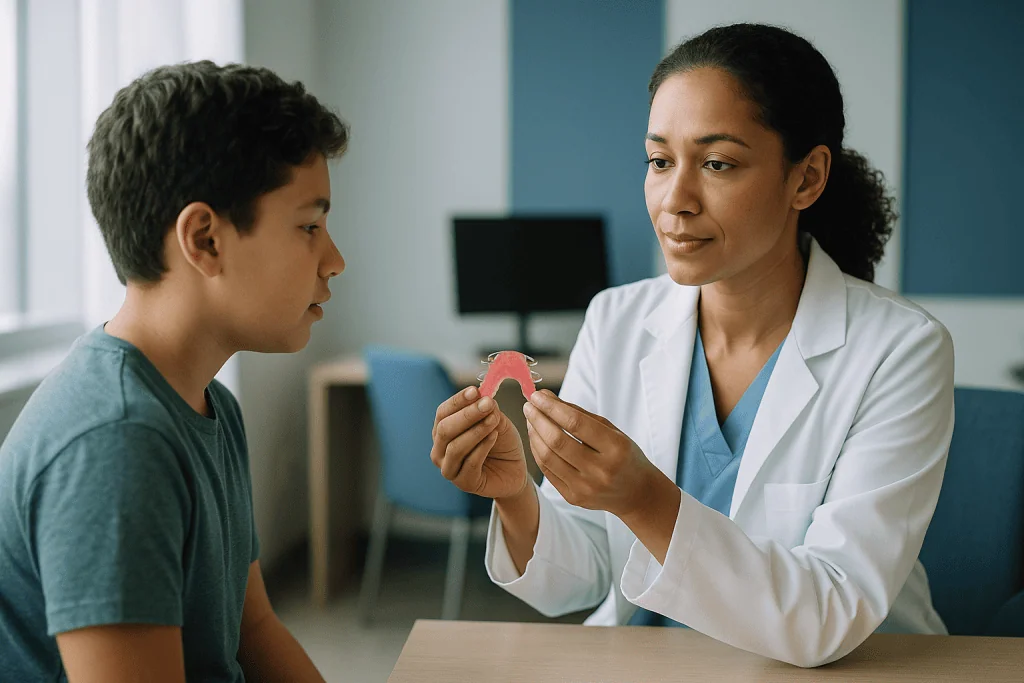
- Simple active plate. An acrylic plate with clasps and one or two finger springs, used to tip a single tooth or a small group, for example nudging an upper incisor forward out of a crossbite. It moves crowns, not roots, which limits what it can achieve.
- Removable expansion plate. The same acrylic base split down the middle with a small screw. Turning the screw at intervals set by the orthodontist gradually widens the plate, and with it the upper arch. It is a gentler, slower cousin of the fixed expanders discussed later.
- Functional appliance. Devices such as the twin block, activator or bionator that posture the lower jaw forward. These are the appliances most tightly tied to the growth spurt.
- Habit-breaking plate. A plate with a small wire cage or crib behind the front teeth that makes thumb sucking unsatisfying, usually combined with encouragement rather than punishment.
- Space maintainer. Some are fixed bands, but removable acrylic versions exist for children who have lost several baby teeth early.
- Retainer. The device worn after braces to hold the result, which the NHS describes as an essential final stage rather than an optional extra.
Clear aligners are technically removable too, and some practices use them in older children. The evidence base for aligners in growing children is thinner than for the appliances above, and they do not influence jaw growth in the way functional appliances aim to, so they belong in a different conversation about tooth alignment in the early teens.
Knowing which category a proposed device falls into tells you most of what to expect about wear time, discomfort and how long it will stay in the mouth.
How do functional appliances for children move the jaw forward?
The twin block is the functional appliance most families will meet. It is two separate plates, one upper and one lower, each carrying a thick acrylic block over the back teeth. The blocks are cut at an angle so that when the child closes, the slopes slide against each other and guide the lower jaw into a forward position. To bite comfortably, the child has to hold the jaw there. Over months, that new posture is repeated thousands of times a day.
What changes as a result is more nuanced than the word ‘growth’ suggests. Studies summarized in the Cochrane review of prominent upper front teeth in children found that functional appliances produce a mixture of effects: the upper front teeth tip back, the lower front teeth tip forward, the lower molars drift upward and forward, and there is a modest skeletal component, meaning a small change in how far forward the lower jaw sits relative to the upper. The skeletal share is real but smaller than early enthusiasts hoped, and it is most evident when the appliance is worn through the growth spurt.
A Herbst appliance, which people often ask about alongside the twin block, does a similar job but is usually cemented to the teeth with a telescoping metal arm on each side. Because it is fixed, it works around the clock without relying on the child, which is why some orthodontists prefer it for children who struggle with wear. The trade-off is that it cannot be removed for cleaning or sport.
Functional appliances are almost always a first phase. The NHS describes typical orthodontic treatment as lasting about 18 to 24 months in total, and a functional phase is commonly followed by fixed braces to refine tooth position once the bite relationship has improved. Families should expect two chapters, not one.
Removable braces for kids versus fixed braces: how do they compare?
The comparison below is not a scorecard. Each column suits different problems, and many children will use both at different stages.
| Feature | Removable appliance | Fixed appliance (braces, Herbst, bonded expander) |
|---|---|---|
| Typical job in childhood | Guide jaw growth, tip single teeth, widen the arch slowly, hold space, break a habit | Align and rotate many teeth, control root position, widen the arch quickly, hold the jaw forward without relying on wear |
| Depends on the child wearing it | Entirely; works only while in the mouth | No; works continuously |
| Cleaning | Taken out and brushed; teeth brushed normally | Brushing around brackets and wires takes more skill and time |
| Speech and eating at first | Lisp and extra saliva common for days; usually removed for meals in some designs | Cheek and lip rubbing; soft foods for the first days |
| Risk if lost or broken | Treatment pauses until replaced | Loose bracket or sharp wire needs prompt repair |
| Best age window | Mixed dentition and growth spurt | Once most adult teeth have erupted, per NHS guidance; some fixed growth appliances earlier |
Two honest caveats. First, ‘removable’ does not mean ‘part time’. Most active plates and functional appliances are prescribed for the large majority of the day and night, with the exact hours set by the treating orthodontist. Second, removable devices are limited in precision. They tip crowns; they cannot reliably move roots or close spaces neatly. That is why the NHS describes them as suitable for minor corrections and why a child who starts with a plate should not be surprised to be offered fixed braces later.
The right question is rarely ‘which is better’ but ‘which does this particular job at this particular stage of growth’.
What does the evidence say about starting early with removable appliances?
The most rigorous evidence on timing comes from the Cochrane systematic review of orthodontic treatment for prominent upper front teeth in children and adolescents, indexed on PubMed. It compared two strategies: an early phase of functional appliance treatment around age 7 to 11 followed by braces later (two-phase), against a single course of treatment in early adolescence (one-phase).
The findings are worth stating plainly, because they run against a common assumption. At the end of all treatment, the final position of the teeth and the jaw relationship were not meaningfully better in children who started early. Both routes arrived at a similar destination. The early route involved more appointments and a longer total time in appliances.
Early treatment did show one clear advantage. Children who began the functional phase early had a lower rate of new injuries to their upper front teeth during the years that followed, presumably because those teeth were no longer sticking out to meet playground floors and bicycle handlebars. The review graded this evidence as low to moderate quality, meaning the direction of the effect is reasonably trusted but the size of it is uncertain.
This reframes what early removable treatment is for. It is not a shortcut to a better smile at eighteen. It is a way of protecting vulnerable teeth and, in some children, easing distress about appearance during years when teasing bites hardest. Those are legitimate reasons, and for many families they are decisive. They are simply different from the reason most people assume.
For narrow upper jaws, crossbites and habit correction, the evidence base is smaller and consists mostly of clinical consensus and lower-quality studies rather than large randomized trials. Orthodontists act on that consensus every day, but an honest clinician will tell you where the trials run out.
Palate expander age: when is widening the upper jaw usually done?
A palate expander, sometimes called a palatal or maxillary expander, is a device that gradually widens the upper jaw. The Cleveland Clinic describes it as a treatment for a narrow upper arch, crossbites of the back teeth and crowding, and notes that it is most often used in children and young adolescents because the midline suture of the upper jaw has not yet fully fused.
Two broad designs exist. A fixed rapid expander is cemented to the upper molars, with a central screw that a parent turns according to the orthodontist’s schedule. Because it cannot be removed, it delivers force continuously and works quickly. A removable expansion plate carries a similar screw within an acrylic base held by clasps. It is slower, gentler and dependent on being worn, but some clinicians choose it for younger children or milder narrowing.
Whichever design is used, the pattern is the same: an active phase of turning that lasts weeks, then a holding phase of several months during which the appliance stays in place, unturned, so that new bone can fill and mature in the widened seam. Removing an expander too early risks the jaw narrowing again.
Parents are often startled by one side effect. As the two halves of the upper jaw separate, a gap can open between the front teeth. The Cleveland Clinic lists this as expected and temporary; the teeth usually drift back together over the following weeks, and any remaining space is addressed in later treatment. Pressure across the bridge of the nose or under the eyes for a few minutes after each turn is also commonly described.
Once the suture has matured, in later adolescence and adulthood, widening the jaw with a simple appliance becomes far less predictable, and surgical assistance may be needed. This, more than any other example, shows why timing is a biological question rather than a preference.
Habit plates, space maintainers and retainers: the quiet workhorses
Not every removable appliance for children is about moving something. Three of the most commonly used devices exist to stop a problem developing or to keep a result in place.
Habit-breaking plates. The Mayo Clinic notes that most children stop sucking a thumb or fingers on their own between ages 2 and 4, and that concern arises mainly if the habit continues once the permanent front teeth start to come through, because a persistent thumb can push the upper incisors forward and hold the bite open. Gentle encouragement, praise and identifying the triggers for the habit come first. An appliance with a small wire crib behind the front teeth is usually a later step, for the child who wants to stop but cannot break the reflex, particularly during sleep. It is not a punishment and should never be framed as one.
Space maintainers. Baby molars are placeholders. When one is lost early to decay or injury, the adult molar behind it can tip forward into the space, leaving too little room for the adult tooth that was meant to erupt there. A space maintainer holds the gap open. Many are small fixed bands and loops; removable acrylic versions are used when several teeth have been lost. The device is simply removed when the adult tooth begins to appear.
Retainers. The NHS is direct on this point: teeth tend to drift back toward their original positions after braces, and retainers are a necessary part of treatment, often worn long term. For a child, that usually means a clear or acrylic plate at night for years, not months. Skipping this stage is the single most common way a good result is lost.
These devices ask little in return except consistency, which for a child can be the hardest thing to give.
What do the first days and weeks with a removable appliance usually look like?
Day one is mostly about saliva and speech. A new acrylic plate takes up space the tongue is used to owning, so children lisp, swallow more and complain that it feels enormous. Both settle as the tongue learns to work around it, usually within days rather than weeks, though the NHS acknowledges that any brace can feel uncomfortable at first and that adjustment takes time.
Sore spots come next. A clasp or plate edge may rub a patch of gum or cheek raw. This is common, easily fixed with a small adjustment at the practice, and should be reported rather than endured. A dull pressure on the teeth being moved is expected after fitting and after each adjustment, and generally fades over a few days. Sharp pain, pain that worsens, or pain in a tooth that is not supposed to be moving is not expected and needs a call.
Eating depends on the device. Some plates are worn during meals to reach the hours prescribed; functional appliances often are, because chewing with the jaw postured forward is part of the effect. Others come out for eating. Whatever the instruction, softer foods for the first several days make the transition kinder.
Cleaning becomes a twice-daily ritual: the appliance brushed over a basin of water (so it survives being dropped), the teeth brushed as normal, the plate returned to a rigid case whenever it is out. Napkins at restaurants swallow more appliances than any other hazard.
Review appointments typically follow at intervals of several weeks, when springs are activated, screws checked and wear discussed honestly. Children who have kept an appliance in for most of the day tend to say so without prompting; those who have not tend to say so too, eventually. Progress, or its absence, is written in the teeth.
How painful is a Herbst appliance or twin block for a child?
Pain is the question parents ask most and clinicians answer least precisely, because the honest answer is a range.
A functional appliance changes how the jaw closes, and the muscles that move it notice immediately. For the first days most children describe an ache along the jaw and temples, similar to the tiredness after chewing gum for too long, along with tenderness in the teeth that carry the blocks. With a Herbst appliance, which is fixed, the cheeks also have to get used to the metal arms on each side, and rubbing is common until the tissue toughens and the orthodontist smooths any sharp edges. With a twin block, the acrylic blocks over the back teeth can feel bulky and make swallowing awkward until the muscles adapt.
The pattern generally follows what the NHS describes for braces in general: discomfort is greatest in the first days after fitting or adjustment, then eases. Most children are eating a near-normal diet within a week or two, though the first days call for soft foods and smaller bites. Persistent pain beyond that, or pain that builds rather than fades, is a reason to be seen, not a reason to tough it out.
Whether and how to ease discomfort is a decision for the child’s dentist, orthodontist or family doctor, who know the child’s history. This article deliberately gives no guidance on medicines; ask the care team what they suggest and follow their instructions.
One reassurance stands on solid ground. Discomfort is not a sign that the appliance is ‘working harder’. Light, steady forces move teeth and guide jaws; heavy forces damage them. A device that hurts continuously is a device that needs adjusting.
Is there an alternative to braces for kids?
Yes, in the sense that not every child with an imperfect bite needs fixed braces, and several of the appliances in this article are alternatives for specific problems. No, in the sense that no removable device can do everything braces do.
For a child with prominent upper front teeth and a growth spurt approaching, a functional appliance is a genuine alternative to starting braces immediately, though, as the Cochrane review makes clear, most such children will still have a phase of fixed braces later. For a narrow upper jaw, an expander is the alternative to letting the crossbite persist. For a single tooth in crossbite, a simple plate may resolve it without ever placing a bracket. For a thumb habit, a habit plate is an alternative to the malocclusion the habit would otherwise produce.
Clear aligners are marketed heavily as a brace alternative. In older children with most adult teeth present they can align teeth, but they do not aim to alter jaw growth, they depend entirely on wear, and the evidence for their use in growing children is more limited than for conventional appliances. An orthodontist can say whether a given child’s problem is within their reach.
Watchful waiting is also an alternative, and an underrated one. MedlinePlus notes that many bite variations are mild and cause no functional problems; treatment is a choice about appearance and long-term dental health rather than a necessity. An orthodontist who recommends monitoring rather than intervening is often giving the most evidence-based advice available.
What none of these can do is replace a full course of fixed braces for a child with significant crowding, rotated teeth or roots that need repositioning. Families who want to avoid braces altogether should ask, directly, whether the proposed removable plan is a complete treatment or a first phase. Both are legitimate; they are not the same promise.
What people often get wrong about removable appliances for children
‘Earlier is always better.’ The best available trial evidence, summarized by Cochrane, found that starting functional treatment early did not produce a better final result than one course in adolescence. It did reduce injuries to prominent front teeth and may help self-esteem. Those are the honest reasons to start early, and they do not apply to every child.
‘Removable means less effective.’ For the jobs they are designed for, guiding jaw posture, widening an arch slowly, holding space, removable devices are the standard tool. They are less effective only when asked to do fixed-appliance jobs such as rotating teeth or controlling roots.
‘It only needs to be worn at night.’ Some retainers are prescribed for nights only. Active plates and functional appliances usually are not. The hours are set by the orthodontist, and a device worn for a fraction of them achieves a fraction of the result, or none.
‘We can fix the jaw completely.’ Functional appliances produce a mixture of tooth movement and modest skeletal change. They improve the relationship between the jaws in many children; they do not rewrite a child’s growth pattern, and very large discrepancies may still need other approaches later.
‘Once the plate comes off, we’re done.’ The NHS is unambiguous that retention is part of treatment. Teeth drift for years after active movement, and a retainer abandoned in a drawer is the commonest reason a family ends up back in the chair.
‘Bite problems are only cosmetic.’ Some are. Others increase the risk of tooth injury, wear, gum problems or difficulty biting, as MedlinePlus outlines. Whether a particular child’s malocclusion matters functionally is a question for the examining clinician, not a general rule.
Each of these myths tends to push families toward either too much treatment or too little. The evidence points to a narrower, more deliberate middle.
Questions to ask your care team before starting
A good consultation leaves a family able to explain the plan in their own words. These questions help get there.
- What exactly is the problem you are trying to correct, and what would likely happen if we waited a year?
- Is this appliance the whole treatment, or the first phase of a longer plan that will probably include fixed braces?
- Why this timing for this child? Which growth or tooth-eruption milestone are you working around?
- How many hours a day does it need to be worn, and how will you judge whether it is being worn enough?
- What discomfort should we expect in the first week, what would be unusual, and whom do we call out of hours?
- What happens if the appliance is lost or broken? Does treatment pause, and for how long?
- How long do you expect this phase to last, and what does the evidence say about how much of the change will hold?
- What is the retention plan afterward, and for how many years?
- Are there alternatives, including monitoring without treatment, and what are the trade-offs of each?
- How will we keep the teeth and gums healthy around the appliance, and how often will you check for decay?
Bring the child into the conversation. A nine-year-old who understands that the blocks between her teeth are meant to protect the front ones she keeps knocking on the monkey bars will wear them more reliably than one who was simply told to. Ask the orthodontist to explain the mechanism at the child’s level; most are glad to.
Write the answers down or ask for them in writing. Orthodontic plans span years, and the reasoning that was clear in the first appointment tends to blur by the tenth.
Whatever the answers, the decision to start, adjust or stop rests with the treating team and the family together. No article, including this one, can substitute for an examination of a particular child’s mouth.
When to call your doctor or orthodontist
Most problems with removable appliances are minor and wait comfortably for the next appointment. A few do not.
Seek urgent care the same day, through emergency services if breathing is affected, if a child develops swelling of the lips, tongue or face, hives, or any difficulty breathing or swallowing after an appliance is fitted or adjusted. True allergy to appliance materials is uncommon but possible, and airway symptoms are never something to watch and wait on. Call urgently as well if part of an appliance has been swallowed or inhaled, especially with coughing, choking or chest discomfort, or if a fixed component has come loose and cannot be accounted for.
Contact the orthodontic practice promptly, within a day, if a wire or clasp has broken and is cutting the cheek, tongue or gum; if the child cannot remove a removable appliance or it feels wedged; if there is bleeding that does not stop with gentle pressure; if a tooth becomes noticeably loose or changes color; or if pain is severe, worsening after the first few days, or keeps the child from eating or sleeping.
Arrange a routine appointment for a mouth ulcer or sore patch under the plate that has not begun to heal within about two weeks, for an appliance that no longer fits after a tooth has been lost, for persistent bad breath or bleeding gums around the clasps, or for any lost appliance, since treatment pauses until it is replaced.
See a family doctor or dentist for fever with facial swelling, which may signal a dental infection unrelated to the appliance but needing assessment.
When in doubt, call. Practices expect questions in the early weeks, and a two-minute phone call is a far better outcome than a child quietly leaving a painful appliance in its case for a month.
Frequently asked questions
What is an example of a removable orthodontic appliance?
The twin block is the most familiar example: two acrylic plates with angled blocks over the back teeth that guide a child’s lower jaw forward when biting. Other common examples are a simple active plate with a spring to tip a single tooth, a removable expansion plate with a central screw, a habit-breaking plate with a wire crib behind the front teeth, a removable space maintainer and the retainer worn after braces.
At what age do children usually get removable braces for kids?
Most removable appliances are fitted during the mixed dentition, when baby and adult teeth are both present and the jaws are still growing. Functional appliances are timed to the adolescent growth spurt, expanders to before the palate suture matures, and habit plates or space maintainers whenever the need arises. The NHS notes that comprehensive treatment with fixed braces usually starts around 12 to 13, after most adult teeth have erupted.
How painful is a Herbst appliance?
A Herbst appliance typically causes jaw muscle aching, tender back teeth and cheek rubbing from the metal arms for the first days after fitting, with the discomfort easing over the following week or two as the muscles and tissues adapt. The NHS describes this early-then-fading pattern for braces generally. Pain that is severe, worsening, or continues beyond the first weeks is not expected and should prompt a call to the orthodontist.
How much do removable expanders cost?
Costs vary so widely by region, health system, insurance coverage and the length of the overall plan that any single figure would be misleading, and this magazine does not publish prices. Ask the orthodontic practice for a written treatment plan that sets out each phase, what it includes, how appliances that are lost or broken are handled and what retention involves afterward, so the full picture is clear before starting.
Is there an alternative to braces for kids?
For specific problems, yes: a functional appliance for prominent front teeth, an expander for a narrow upper jaw, a simple plate for a single tooth in crossbite, or a habit plate for thumb sucking. Watchful waiting is also a valid alternative for mild bite variations. None of these replaces fixed braces for significant crowding or rotated teeth, and many children who start with a removable device will still have braces later.
What is the usual palate expander age?
Palate expanders are used mostly in children and young adolescents, because the Cleveland Clinic explains that the midline suture of the upper jaw has not yet fully fused and can be widened with a simple appliance. Once the suture matures in later adolescence, expansion becomes less predictable and may require surgical assistance. The exact timing for a given child depends on the bite problem and which adult teeth are available to anchor the device.
Do functional appliances for children really make the jaw grow?
They produce a mixture of effects rather than pure growth. Trials summarized in the Cochrane review found that functional appliances tip the upper front teeth back, tip the lower ones forward and shift the molars, along with a modest change in how far forward the lower jaw sits. That skeletal component is real but smaller than often assumed, and it is most likely when the appliance is worn through the pubertal growth spurt.
How many hours a day does a removable appliance need to be worn?
The orthodontist sets the hours for each child and device, and families should follow that instruction rather than a general rule. Most active plates and functional appliances are prescribed for the large majority of the day and night, because teeth and jaws respond only while force is applied. Some retainers are worn at night only. A device worn for a fraction of the prescribed time achieves a fraction of the intended result.
Is it better to start orthodontic treatment early?
Not for the final result, according to the Cochrane review of prominent upper front teeth, which found that early two-phase treatment and a single course in adolescence ended in similar positions, with the early route taking longer overall. Early treatment did lower the rate of new injuries to protruding front teeth and may help with teasing. Those benefits justify early treatment for some children, not all, and the decision rests with the treating orthodontist.
What should I do if my child's removable appliance breaks or is lost?
Stop wearing a broken appliance if any part is sharp or loose, keep all the pieces, and contact the orthodontic practice the same day so it can be repaired or replaced. Treatment pauses while the appliance is out, and teeth can begin to drift back within days, so a quick call matters. If a piece has been swallowed or inhaled, or a wire is cutting the mouth and cannot be made safe, seek urgent care.
References
This article is for general information only and is not a substitute for professional medical advice. Please consult a qualified doctor about your individual situation.

More from the Blog

What Periodontal Measurements Reveal About Gum Recession: Pocket Depths and Bone Support
Periodontal measurements translate gum recession into numbers a dental team can track. A probe measures pocket depth, the gap between gum and tooth, and…
Why a Cleaning Comes Before Teeth Whitening: Checking Enamel, Gums and Old Fillings
A professional cleaning usually comes before teeth whitening because whitening gel works on clean enamel, not on plaque and tartar, and because the dentist…

How Fiber Application Works in One Visit: Bonding the Fiber Into Composite Resin
A fiber reinforced composite procedure adds a ribbon of glass or polyethylene fiber inside tooth-colored composite resin so the restoration resists bending and cracking.…

How Digital Planning Maps Tooth Movement Before Clear Aligners Are Made
Clear aligner digital planning starts with a 3D scan of the teeth, often alongside X-rays, from which software separates each tooth and lets the…
How Long Does Sensitivity Last After Restorative Dental Treatment? Numbness and Temporaries
Mild sensitivity after restorative dental work, such as a filling or crown, is common and usually eases over a few days to a few…

Flying After a Tooth Extraction: How Long to Wait and How to Protect the Clot
Most dental teams prefer that you avoid flying for at least 24 hours after a simple tooth extraction, and many suggest 48 to 72…