

Is CoolSculpting for Weight Loss? Why It Only Suits Pinchable Fat and a Stable Weight

Key Takeaways
- Cryolipolysis, sold under the CoolSculpting brand, reduces the thickness of one pinchable fat pocket by roughly 15–28 percent in published reviews and has essentially no effect on body weight.
- The device cannot reach visceral fat behind the abdominal muscle wall, which is the fat most strongly linked to diabetes and heart disease and the fat that lifestyle and medical weight management do address.
- Dying fat cells are cleared by immune cells and the lymphatic system over weeks, so nothing visible happens for about three weeks and the fullest change is assessed at one to three months.
- Removed fat cells do not regrow or migrate, but later weight gain enlarges the cells that remain everywhere, which is why clinicians require a stable weight before and after treatment.
- Cold-sensitivity blood disorders such as cryoglobulinemia, a hernia at the site, pregnancy and significantly loose skin are standard reasons to decline or defer treatment.
- Paradoxical adipose hyperplasia, an uncommon enlargement of the treated fat that typically needs liposuction to correct, is the complication every prospective patient should ask about by name.
No. CoolSculpting, the brand name for a technique called cryolipolysis, is not a weight loss treatment. It cools a small, pinchable pocket of fat under the skin so that some fat cells die and are cleared over several weeks. Published reviews report roughly a 20 percent reduction in the thickness of the treated fat layer, not a drop on the scale. It suits people already at a stable weight who want to reshape a specific area.
She stood sideways in front of the changing-room mirror, pinched the soft roll above her waistband and asked the question out loud: could a machine just freeze this off? She had read the advertisements. She had also, over the previous year, gained and lost the same fifteen pounds twice, and was hoping for something that would finally stick.
That hope is exactly where confusion begins. The search phrase “is coolsculpting for weight loss” gets typed thousands of times a month, and the honest answer disappoints people who want the scale to move. Fat freezing was never designed to do that. It was designed to thin a specific, grab-able layer of fat by a measurable but modest amount, in someone whose weight is already steady.
What follows is the version a seasoned clinician would give you across a desk: what the cold actually does, where the fat goes, who tends to benefit, who should wait, and what the evidence says about the gap between the marketing photos and the typical result.
Is CoolSculpting for weight loss? The short, honest answer
Fat freezing and weight loss sound like cousins. They are closer to strangers. Weight loss is a whole-body process: you take in less energy than you burn, and the body draws down stored fat everywhere, including the deep fat around the organs that drives most of the health risk linked to excess weight. Cryolipolysis, the clinical name for the technique sold under the CoolSculpting brand, does nothing of the sort. It targets one small cushion of fat sitting just beneath the skin and reduces its thickness.
The numbers make the point. A systematic review of cryolipolysis studies, published through the National Institutes of Health’s PubMed Central, reported average fat-layer reductions of roughly 15 to 28 percent measured by calipers, and 10 to 26 percent measured by ultrasound, in the treated area only. Translate that into weight and it is typically a fraction of a pound per treated zone. A person carrying 30 extra pounds will not look or weigh differently in any meaningful way after a single session on one flank.
So why do people conflate the two? Partly language. “Fat reduction” and “losing fat” sound interchangeable. Partly the before-and-after photography, which is shot in ideal lighting on carefully chosen bodies. And partly a very human wish to skip the slow part.
Here is the frame worth holding onto for the rest of this article: cryolipolysis is a contouring tool for a stable body, not a weight management strategy for a changing one. If your weight is still moving, up or down, the sensible clinical advice is to wait until it settles. If your main goal is health rather than shape, the evidence points firmly toward nutrition, activity, sleep and, where appropriate, medical weight management discussed with a doctor, as the NHS and CDC both outline.
How fat freezing actually works: the cold-then-clear mechanism
The science rests on one quirk of biology: fat cells are more sensitive to cold than the skin, nerves and blood vessels around them. Researchers noticed decades ago that children who sucked ice pops sometimes developed dimples of lost cheek fat, a phenomenon doctors called popsicle panniculitis. Cryolipolysis, which simply means “cold fat breakdown,” turned that observation into a device.
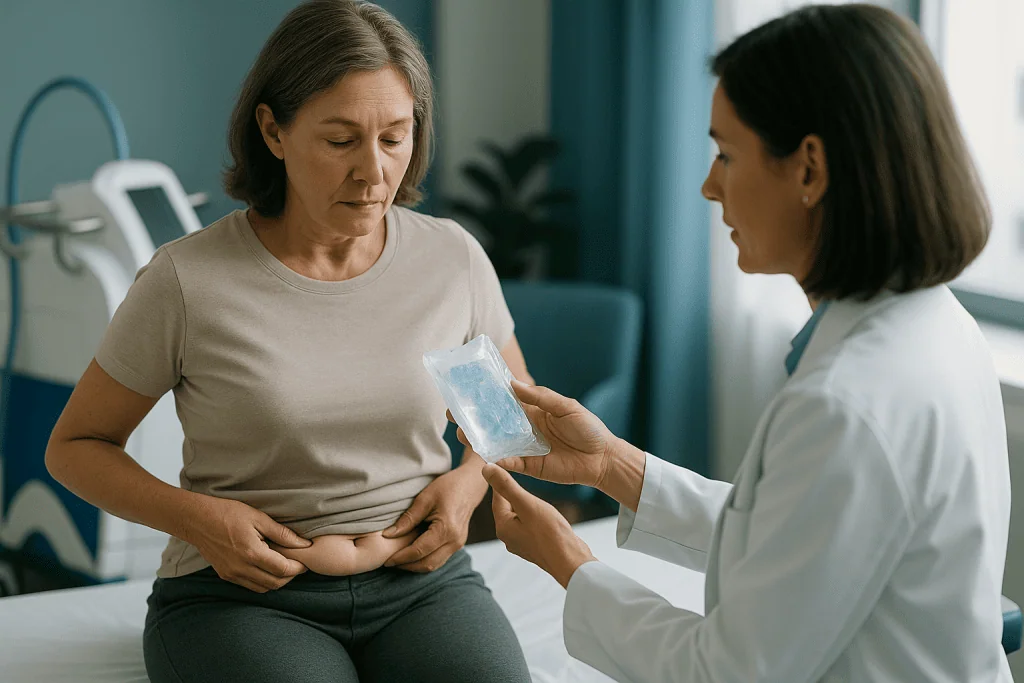
During a session, a clinician applies a gel pad to protect the skin, then places an applicator over the bulge. Most applicators use gentle suction to draw the tissue between two cooling panels; some flat versions sit on the surface. The panels chill the fat to a controlled temperature, cold enough to injure fat cells but not cold enough to freeze skin. A typical application lasts somewhere between about 35 minutes and an hour per area, according to Cleveland Clinic’s patient information, and several areas may be treated in one visit.
Inside the tissue, the cold triggers apoptosis, the body’s orderly, programmed form of cell death, in a proportion of the fat cells. They do not burst. They crystallize, become inflamed over the following days, and are then tagged for removal by immune cells. That slow clean-up is why results do not appear for weeks.
Two things are worth stating plainly. First, the treatment reduces the number of fat cells in that spot; it does not shrink the ones that remain. Second, the fat cells it leaves behind, which is most of them, can still enlarge if you gain weight later. The device changes the local headcount, not the body’s underlying energy balance. That distinction explains almost everything about who it suits and who it frustrates.
Does cryo slimming work? What the evidence actually shows
“Cryo slimming” is a marketing phrase that bundles medical cryolipolysis together with cheaper cold-wand treatments and whole-body cryotherapy chambers. They are not the same thing, and the evidence is not the same either.
For device-based cryolipolysis applied directly to a fat bulge, the published literature is reasonably consistent. The systematic review hosted on PubMed Central pooled studies measuring the treated fat layer before and after treatment and found reductions in the range of roughly 15 to 28 percent by caliper. Harvard Health, summarizing the same body of evidence, describes results as a modest but visible slimming of the treated spot, with the caveat that studies are mostly small, short-term and often manufacturer-sponsored.
Where the evidence thins out:
- Long-term durability beyond one to two years has been studied far less than the first few months.
- Independent, large randomized trials against sham treatment are scarce.
- Hand-held “cryo slimming” wands and spa cold therapies have no comparable evidence base; cold applied briefly to the skin surface does not reach the temperatures or durations used in clinical studies.
- Whole-body cryotherapy chambers have not been shown to reduce body fat, and no major guideline body endorses them for that purpose.
So the fair summary is this: medical cryolipolysis can reduce a localized fat layer by a measurable amount in the right person, and the effect appears to persist for at least many months because the removed cells do not regrow. It is not a slimming treatment in the everyday sense of making a person lighter or smaller overall, and the broader “cryo slimming” market is largely unproven. A clinician who has reviewed your individual anatomy and goals is the only person who can tell you whether the documented effect is likely to be worthwhile for you.
Where does the fat go after CoolSculpting?
This is one of the most searched questions about the procedure, and the answer is more interesting than “it melts away.”

Once a fat cell has been injured by cold, it goes through apoptosis over roughly the next two to three weeks. Immune cells called macrophages, the body’s clean-up crew, move into the area, engulf the dying cells and break down their contents. The fat inside, mostly triglyceride, is released gradually and enters the lymphatic system, the network of thin vessels that drains fluid and debris from tissues back into the bloodstream. From there it is processed by the liver and either used for energy or disposed of, exactly as dietary fat is.
Three practical consequences follow:
- Nothing is excreted as visible fat. People sometimes expect to see oily stools or lose inches on the scale within days. Neither happens.
- The process is slow by design. Cleveland Clinic notes that changes may be noticeable at around three weeks, with the fullest effect typically at one to three months, and some reports describe continued gradual change for several months beyond that.
- The liver handles the released fat without any special diet, detox or supplement, which is one reason clinicians are skeptical of add-on products sold to “flush” results.
A common follow-up question is whether the fat “moves” somewhere else. The cells removed from the treated area do not relocate. What can happen, and what the evidence supports, is that if a person gains weight afterward, the remaining fat cells throughout the body, including neighboring untreated areas, enlarge as they always would. That can make an untreated zone look relatively fuller next to a treated one. This is not the fat migrating; it is ordinary weight gain revealing the limits of a spot treatment, and it is the strongest argument for the stable-weight rule discussed below.
Pinchable fat versus deep fat: why the pinch test matters
Not all body fat is the same, and the difference decides whether cryolipolysis can touch it at all.
Subcutaneous fat is the layer directly under the skin. It is the fat you can grab between thumb and fingers on the belly, flank, upper arm or thigh. Visceral fat sits deeper, packed around the intestines and liver behind the abdominal muscle wall. Visceral fat is the type most strongly linked to type 2 diabetes, high blood pressure and heart disease, and it is the type that responds best to diet, exercise and medical weight management, as the American Heart Association and NHS both emphasize.
Cryolipolysis applicators can only cool what they can reach. Suction draws subcutaneous tissue into the cup; the cold penetrates a limited depth. Fat behind the muscle wall is out of range. That is why a person with a firm, rounded abdomen that does not pinch easily is usually told the treatment will do little, while a person with a soft fold that lifts away from the muscle may be a reasonable candidate.
A simple self-observation, which is not a diagnosis, helps frame the conversation before you ever book a consultation:
- Can you gather a fold of the area in your hand, and does it pull away from the underlying muscle? That suggests subcutaneous fat an applicator could capture.
- Is the area firm and does it push outward when you breathe in, without a fold to grab? That pattern points toward visceral fat, which the device cannot treat.
Clinicians go further than a pinch. They look at skin quality, because loose or crepey skin may look worse once the fat beneath it shrinks, and they check for hernias at the site, which are a contraindication. The headline, though, is the pinch. If it is not pinchable, it is not treatable this way, and the healthier target in that case is the deep fat that only whole-body change can reach.
Why a stable weight is the real entry ticket
Ask an experienced practitioner the single most common reason they turn people away, and the answer is rarely “too much fat.” It is “weight still moving.”
The logic comes straight from the mechanism. Cryolipolysis removes a percentage of the fat cells in one spot. The outcome you see at three months is the new, thinner layer relative to everything around it. If, during those months, you lose a further ten pounds through diet, the untreated areas shrink too and the treated spot may become almost indistinguishable from what dieting alone would have produced. If instead you gain ten pounds, the remaining cells in the treated area swell and the bulge returns, while the surrounding areas grow alongside it.
Either way, the person ends up asking whether the treatment “worked,” and the honest answer is that the weight change overwhelmed it. This is why guidance from sources such as Cleveland Clinic and Harvard Health consistently describes the ideal candidate as someone close to their goal weight whose weight has been steady, with stubborn pockets that have not responded to lifestyle change.
What “stable” means in practice is a conversation to have with your care team, but most clinicians look for weight that has stayed within a narrow band for several months rather than weeks. People in the middle of a structured weight loss program, those recently started on prescribed weight management medicines (a class that works by reducing appetite and slowing stomach emptying, with effects that build over months), and anyone planning pregnancy or recently postpartum are usually asked to wait until the body settles.
There is a quieter reason, too. Chasing a contour while weight is still shifting tends to produce repeat sessions, repeat disappointment and a growing sense that the body is the problem. Waiting until the foundation is steady protects both the result and the person.
Who is a good candidate for CoolSculpting, and who is usually asked to wait
Candidate requirements are not a checklist you can tick at home; they are a judgment the treating clinician makes after examining you. Still, the patterns are consistent across mainstream patient information.
People who are commonly considered suitable:
- Adults at or near a weight they have held steadily, with a body mass index (BMI, a weight-to-height ratio used as a rough screening tool) generally in the healthy or mildly overweight range.
- Those with discrete, pinchable bulges on areas the applicators were cleared for, such as the abdomen, flanks, inner and outer thighs, upper arms, under the chin and the fat beneath the buttock crease.
- Individuals with reasonable skin elasticity, so the skin tightens modestly as the layer thins.
- People with realistic expectations: a visible but modest change in one area, not a new body.
People who are usually asked to wait or advised against it:
- Anyone whose weight is actively changing, for any reason.
- People living with obesity (NHS defines this as a BMI of 30 or above) who are seeking overall weight reduction; the evidence base and the device simply do not address that need.
- Those with cold-sensitivity conditions, specifically cryoglobulinemia, cold agglutinin disease or paroxysmal cold hemoglobinuria, in which cold exposure can trigger abnormal blood reactions. These are firm contraindications.
- People with a hernia at or near the treatment site, active skin infection or open wounds there, or significantly loose skin that would look worse afterward.
- Pregnant or breastfeeding individuals, and those with known nerve conditions or Raynaud’s phenomenon in the treatment area.
Clinicians also weigh something less tangible: why you want it. Someone hoping to sharpen a flank before a stable, active life carries on is a different patient from someone hoping the device will deliver the health benefits of weight loss. The first may be well served. The second deserves a frank redirection to a weight management conversation, and a good practitioner will provide one rather than book the session.
Fat freezing vs weight loss: a side-by-side table
Laying the two approaches next to each other makes the difference hard to miss. The figures come from the systematic review on PubMed Central, Cleveland Clinic’s patient page and CDC guidance on healthy weight loss; none of them are promises for any individual.
| Question | Cryolipolysis (fat freezing) | Weight loss through lifestyle or medical care |
|---|---|---|
| What changes | Thickness of one subcutaneous fat pocket | Total body fat, including deep visceral fat |
| Typical measurable effect | About 15–28% thinner fat layer in the treated spot, by caliper | Gradual loss of roughly 1–2 pounds per week when done safely (CDC) |
| Effect on the scale | Usually negligible | Direct and cumulative |
| Effect on blood pressure, blood sugar, cholesterol | None demonstrated | Well documented improvements with modest sustained loss (NHS, AHA) |
| When results appear | Changes from about 3 weeks; fullest at 1–3 months (Cleveland Clinic) | Ongoing over months and years |
| What undoes it | Later weight gain enlarges remaining cells | Return to previous habits |
| Who it suits | Stable weight, pinchable bulge, good skin tone | Anyone carrying excess weight, with a plan tailored by a clinician |
| Who should wait | Changing weight, cold-sensitivity disorders, hernia at site, pregnancy | Rarely anyone; the approach is adapted rather than withheld |
Read down the right-hand column and you see health outcomes. Read down the left and you see shape. The two can coexist in one person’s plan, but only in that order: health and stability first, contouring afterward if a stubborn area remains. Reversing the sequence is where most disappointment originates.
What the following days and weeks usually look like
People are often surprised by how undramatic the day itself is, and then by how long the wait afterward feels.
During treatment, the first few minutes bring intense cold, pulling and some aching as the suction engages; most describe the sensation easing to numbness once the tissue cools. When the applicator comes off, the treated area is firm, raised and cold, and the clinician massages it for a couple of minutes, which can be uncomfortable but is thought to help the breakdown process. You walk out the same hour, and no anesthetic, stitches or bandages are involved.
Over the next several days, Cleveland Clinic and Harvard Health describe the common experiences as:
- Redness, swelling, bruising and tenderness over the site, generally settling within days to a couple of weeks.
- Numbness or altered sensation, sometimes lasting several weeks before returning to normal.
- A firm, sometimes lumpy feel in the treated fat as the inflammatory clean-up proceeds.
- Occasionally a deep, nagging ache or tingling, more often reported after abdominal treatment, that fades over a few weeks.
Normal activity, including exercise, usually resumes immediately; there is no clinical reason to rest. Some people choose compression garments for comfort, though evidence that they change the result is lacking.
Then comes the slow part. Nothing visible happens for roughly three weeks. Between one and three months the treated layer gradually thins, and the full effect is generally assessed at around three months, which is when a clinician will decide with you whether a second session on the same area is sensible. Photographs taken under identical lighting at each visit are far more reliable than the mirror, because day-to-day bloating and posture swamp a change of this size. Weighing yourself to track progress is pointless; the scale is not where this treatment shows up.
Risks and side effects, including paradoxical adipose hyperplasia
Non-invasive does not mean risk-free, and a treatment explainer that skipped the uncomfortable parts would not be worth your time.
The common effects are the ones already described: temporary redness, swelling, bruising, numbness, firmness and aching. These are expected consequences of the cold injury and resolve on their own in most people within days to weeks, according to Cleveland Clinic and Harvard Health.
Less common but documented problems include:
- Prolonged numbness or nerve-type pain lasting beyond two months, reported in a small minority of cases in the literature.
- Skin changes at the site, including rare reports of frostbite-like injury or pigment change, usually when protective pads were not used correctly.
- Uneven contour, where the applicator edge leaves a visible step or the treated area looks dented relative to its surroundings.
- Worsening of loose skin, because thinning the fat beneath a lax envelope reveals the laxity.
The complication that deserves its own paragraph is paradoxical adipose hyperplasia, abbreviated PAH. Instead of shrinking, the treated fat gradually enlarges over the following months into a firm, painless mass that mirrors the shape of the applicator. It does not go away on its own and typically needs surgical removal, often liposuction, once it has stabilized. Early manufacturer data described it as very rare; subsequent published series and regulatory updates have reported higher rates than first assumed, and the true incidence remains uncertain. Harvard Health flags it as the main reason to seek a practitioner who will discuss it honestly before treatment. Men and people with larger fat pockets appear to be somewhat more frequently affected in reported cases, though the evidence is still limited.
Finally, there is the risk that is easiest to overlook: a treatment that cannot affect visceral fat, blood pressure or blood sugar, delivered to someone who needed exactly those things to change. That is a risk of misdirected effort, and it is the one careful screening is designed to prevent.
How to lose weight naturally and keep it off: the honest version
Searches for “how to lose weight fast naturally and permanently” sit right alongside searches about fat freezing, which tells you what people are really hoping for. The fast and permanent parts pull in opposite directions, and mainstream guidance is unambiguous about which to prioritize.
The CDC describes healthy, sustainable loss as gradual, roughly one to two pounds per week, because weight lost at that pace is far more likely to stay off than weight lost through crash dieting. MedlinePlus notes that very rapid loss carries its own problems, including gallstones, muscle loss and nutritional gaps, and should be medically supervised when it is attempted at all.
What the evidence supports, in plain terms:
- An eating pattern built around vegetables, fruit, whole grains, legumes, lean protein and unsaturated fats, with fewer ultra-processed foods and sugary drinks, as outlined by the NHS and the American Heart Association.
- A modest, consistent energy deficit rather than extreme restriction, which the body counters with hunger and slowed metabolism.
- At least 150 minutes a week of moderate activity plus two sessions of muscle-strengthening work, the adult target shared by the CDC, NHS and AHA; activity protects muscle and improves the health markers that matter.
- Seven to nine hours of sleep and attention to stress, both of which influence appetite hormones.
- Regular self-monitoring, whether that is weighing weekly, keeping a food log or tracking steps, which repeatedly shows up in studies of people who maintain loss.
For people living with obesity, lifestyle change alone is often not enough, and that is not a personal failing; it reflects the biology of weight regulation. Prescribed weight management medicines and, for some, bariatric surgery are evidence-based options that a doctor can discuss, with decisions about whether, which and when resting entirely with the prescribing clinician.
Notice what is missing from the list: fat freezing. It has no place in weight loss itself, only, for some people, in refining the shape left behind once the work is done.
What people often get wrong about CoolSculpting
Years of reader questions have produced a fairly stable set of misconceptions. Correcting them up front saves people disappointment and sometimes money they were never going to be happy spending.
“It is a shortcut to losing weight.” It is not. The treated fat typically weighs a fraction of a pound. The scale will not notice, and neither will your blood pressure.
“The fat comes back somewhere else.” Removed cells do not migrate. What people observe is ordinary weight gain enlarging the cells that remain, everywhere. Keep your weight steady and the treated area keeps its relative shape.
“One session gives the photo result.” Published reductions average around a fifth of the treated layer. Many of the striking images reflect multiple sessions, multiple areas, careful posing or a person who was already lean. Your clinician should show you typical, not best-case, outcomes.
“Any cryo treatment works the same.” Spa cold wands and cryotherapy chambers are not cryolipolysis. The published fat-reduction data come from controlled-temperature devices applied to tissue for a defined duration.
“It tightens skin.” It thins fat. Skin with good elasticity adapts; loose skin can look looser. The device is not a skin-tightening treatment.
“It is painless and risk-free.” The first minutes are intensely cold and achy, numbness can linger for weeks, and paradoxical adipose hyperplasia, though uncommon, is real and needs surgery to correct.
“Results are instant.” Nothing visible for about three weeks, fullest change at one to three months. If a provider implies otherwise, that is a signal to look elsewhere.
“I can do it instead of exercising.” Activity changes visceral fat, muscle, mood and cardiovascular risk. Fat freezing changes one bulge. They are not substitutes, and the first is the one that lengthens life.
The thread running through all of these is the same: the treatment is modest, local and slow. Framed that way, it can be a reasonable choice for the right person. Framed as anything grander, it sets people up to feel cheated.
Alternatives: liposuction, other devices and doing nothing
Cryolipolysis sits in the middle of a spectrum of options, and seeing the whole spectrum makes any single choice clearer.
Liposuction. A surgical procedure in which a thin tube is inserted through small incisions to suction out subcutaneous fat. It removes substantially more fat per area than freezing and allows the surgeon to sculpt in three dimensions, which is why it remains the reference treatment for larger or more complex contouring. The trade-offs are anesthesia, incisions, a recovery period of days to weeks, compression garments and surgical risks including bleeding, infection, fluid imbalance, contour irregularity and, rarely, clots. Mayo Clinic and the NHS both stress that it, too, is not a weight loss method and that candidates should be near a stable, healthy weight. Liposuction is also the usual corrective treatment when paradoxical adipose hyperplasia occurs after freezing.
Other energy-based devices. Treatments using heat from radiofrequency, laser or high-intensity focused ultrasound aim to injure fat cells by warming rather than cooling them, and some also claim modest skin tightening. Evidence quality varies widely between devices and is generally weaker and less independent than for cryolipolysis. Injectable fat-dissolving treatments exist for the small pocket beneath the chin; they work by breaking down fat cell membranes, require a series of sessions, and are not approved for larger body areas in most jurisdictions.
Lifestyle and medical weight management. For anyone whose concern is overall size or health, this is the alternative with the strongest evidence, and it precedes rather than competes with contouring.
Doing nothing. Rarely offered, often sensible. A pinchable fold on a healthy, stable body is not a medical problem, and some people, once they understand how modest the achievable change is, decide the money, discomfort and uncertainty are not worth it. That is a legitimate outcome of a good consultation, and a clinician who respects it is one worth trusting.
Questions to ask your care team
A consultation is a two-way screening. The practitioner is assessing whether you are a suitable candidate; you are assessing whether they are honest about limits. Bring these questions, and pay as much attention to how they are answered as to what is said.
- Looking at my body and my weight history, do you think I am a candidate now, or should I wait until my weight has been stable longer?
- Is the fat in this area subcutaneous and pinchable enough for the applicator, or is part of it visceral fat the device cannot reach?
- How is my skin elasticity, and is there any chance the area will look looser afterward?
- What percentage reduction in the fat layer do you typically see in people like me, and what does that look like in photographs of typical, not best, results?
- How many sessions and which areas are you proposing, and why that number?
- What is your experience with paradoxical adipose hyperplasia, how do you screen for risk, and what is the plan if it happens to me?
- Have you checked for a hernia at the site, and have you asked about cold-related blood conditions, Raynaud’s phenomenon and nerve problems?
- Who performs the treatment, what are their qualifications, and who do I contact if something feels wrong afterward?
- What side effects should I expect in the first two weeks, and which ones would you want to hear about immediately?
- If I gain weight later, what happens to the result?
- Would you recommend addressing my overall weight first, and if so, who should I speak to about that?
Two further points. First, no reputable provider should pressure you to decide on the day; a cooling-off period of days or weeks is normal practice in cosmetic medicine, and the NHS specifically advises taking time before any cosmetic procedure. Second, if the answers lean on the words “weight loss,” “melt” or “instant,” treat that as information about the provider rather than the treatment, and consider a second opinion.
When to call your doctor
Most people experience nothing beyond the expected soreness, numbness and bruising after cryolipolysis, and those settle without any intervention. A small number develop problems that need review, and because the clean-up process unfolds over months, some of them appear long after the session.
Contact your treating clinician promptly if you notice any of the following:
- Pain that is severe, worsening after the first few days, or not controlled by the simple measures your care team suggested.
- Skin that blisters, turns dark, breaks down, or develops a wound at the treatment site; these can signal cold injury.
- Spreading redness, warmth, pus or fever, which may indicate infection.
- Numbness, tingling or burning sensations that are still present or getting worse beyond about two months.
- The treated area becoming firmer and larger rather than smaller in the weeks or months after treatment, particularly a hard, painless swelling shaped like the applicator; this pattern is characteristic of paradoxical adipose hyperplasia and should be assessed, since it does not resolve on its own.
- A noticeable dent, step or asymmetry that bothers you once swelling has settled.
Seek emergency care, rather than waiting for a clinic callback, if you develop chest pain, sudden shortness of breath, a swollen, painful calf, fainting, or signs of a severe allergic reaction such as facial swelling or difficulty breathing. These are not typical effects of fat freezing and need urgent assessment whatever their cause.
If your reason for considering the treatment was concern about your weight or health rather than a single bulge, that is itself a reason to book a routine appointment with your primary care doctor. Blood pressure, blood sugar, cholesterol and waist measurement tell you far more about risk than the shape of one area, and the options for changing them, from structured lifestyle programs to prescribed weight management medicines, are decisions for you and your treating team to make together.
Frequently asked questions
Is CoolSculpting for weight loss or just for shaping?
It is for shaping only. Cryolipolysis thins one localized subcutaneous fat pocket by a measurable but modest amount; the fat removed usually weighs a fraction of a pound. It does not change visceral fat, blood pressure, blood sugar or overall body size. People seeking weight loss are directed toward nutrition, activity and, where appropriate, medically supervised weight management discussed with their doctor.
Does cryo slimming work?
Medical cryolipolysis applied by a controlled-temperature device to a fat bulge has published evidence for reducing that fat layer by roughly 15–28 percent, though studies are mostly small and often industry-funded. Hand-held cold wands, spa cryo treatments and whole-body cryotherapy chambers marketed as cryo slimming have no comparable evidence and are not endorsed by any major health body for fat reduction.
Who is a good candidate for CoolSculpting?
Typically an adult at a steady, near-goal weight with a discrete, pinchable fat bulge, reasonable skin elasticity and realistic expectations of a modest local change. People whose weight is still changing, those living with obesity who want overall reduction, anyone with cold-sensitivity blood disorders, a hernia at the site, or who is pregnant are generally asked to wait or advised against it. The treating clinician makes the final call.
What are the CoolSculpting candidate requirements for weight?
There is no universal number. Patient information from major medical centers describes the ideal candidate as close to their goal weight, with a BMI usually in the healthy or mildly overweight range, and with weight that has been stable for months rather than weeks. The key requirement is stability, because losing or gaining weight after treatment can mask or reverse the local result.
Where does the fat go after CoolSculpting?
Cold-injured fat cells undergo programmed cell death over two to three weeks. Immune cells engulf them, the released fat enters the lymphatic system and bloodstream, and the liver processes it for energy or disposal, just as it handles dietary fat. Nothing is excreted as visible fat, no special diet is needed, and the removed cells do not relocate to other areas.
How much fat can you lose with fat freezing versus weight loss?
Fat freezing reduces the thickness of the treated layer by an average of roughly a fifth to a quarter per session, according to a systematic review, which rarely registers on the scale. Healthy weight loss, by contrast, is gradual, around one to two pounds per week per CDC guidance, draws down fat throughout the body including visceral fat, and improves cardiovascular and metabolic health markers.
How long does it take to see results from fat freezing?
Changes typically begin to show at around three weeks, with the fullest effect assessed at one to three months, according to Cleveland Clinic patient information. The delay reflects the slow immune clean-up of dead fat cells. Clinicians usually wait until the three-month mark before deciding whether a second session on the same area is worthwhile.
Does the fat come back after CoolSculpting?
The specific fat cells removed do not regrow. However, the remaining cells in the treated area and everywhere else can enlarge with later weight gain, which can restore the bulge and make untreated neighboring areas look fuller by comparison. Maintaining a stable weight afterward is the main factor in whether the local result lasts.
What is paradoxical adipose hyperplasia?
It is an uncommon complication in which the treated fat gradually enlarges over the following months into a firm, painless mass shaped like the applicator, instead of shrinking. It does not resolve on its own and usually requires surgical removal, typically liposuction, once stable. Reported incidence has risen above early estimates and remains uncertain, so it is worth asking your practitioner about directly.
How can I lose weight naturally and keep it off?
Mainstream guidance from the CDC, NHS and American Heart Association points to a gradual energy deficit built on vegetables, whole grains, legumes, lean protein and fewer ultra-processed foods, at least 150 minutes of moderate activity weekly plus strength work, adequate sleep and regular self-monitoring. Rapid loss tends to rebound. For people living with obesity, doctors may also discuss prescribed weight management options; those decisions rest with the prescribing clinician.
References
- Cryolipolysis for fat reduction and body contouring: safety and efficacy of current treatment paradigms (systematic review, PubMed Central)
- CDC: Steps for losing weight
- NHS: Liposuction
- MedlinePlus: Diet for rapid weight loss
This article is for general information only and is not a substitute for professional medical advice. Please consult a qualified doctor about your individual situation.

More from the Blog
J Plasma vs Tummy Tuck: When Skin Tightening Energy Is Enough and When It Is Not
Energy-based skin tightening, including helium plasma devices sold under the J Plasma name, heats the underside of the skin to shrink mild to moderate…

How a Buttock Lift Is Performed: Where the Incision Runs and How Tissue Is Lifted
A buttock lift is performed under general anesthesia. The surgeon marks and removes a crescent of loose skin and fat along the upper buttock,…

J Plasma Recovery Timeline: Tightness, Swelling and How Long Compression Continues
J plasma recovery time is usually described in stages rather than in days. Most people return to desk work within about one to two…

Preparing for Labiaplasty: Stopping Smoking, Pausing Blood Thinners and Planning Time Off
Preparing for labiaplasty usually means stopping smoking and nicotine several weeks ahead, reviewing every medicine and supplement with your surgeon so any blood-thinning drug…
How Long After Your Last Pregnancy Can You Have a Mommy Makeover? Timing Explained
Most surgeons suggest waiting at least 6 to 12 months after your last delivery before a mommy makeover, and longer if you are still…

Liposuction Recovery Time: Swelling, Compression and When Results Actually Show
Most people return to desk work within one to two weeks after liposuction, but complete recovery takes far longer than many expect. Swelling peaks…