

Keratosis Pilaris and Strawberry Legs: What They Are and What Smooths Them

Key Takeaways
- Keratosis pilaris affects roughly 40 percent of adults and up to 80 percent of adolescents, making it one of the most common skin findings a clinician sees.
- Each bump is a hair follicle plugged with keratin, often with a coiled hair trapped underneath, not dirt or a hygiene problem.
- Strawberry legs is a description rather than a diagnosis, and shaving, clogged pores, folliculitis and keratosis pilaris each produce the dotted look for different reasons.
- Moisturizers containing urea, lactic acid or salicylic acid have the best-supported track record for smoothing texture, typically over four to six weeks of daily use.
- Laser and light therapy have shown partial, short-term improvement only in tiny split-body trials, and results vary by device and skin tone.
- Most people notice keratosis pilaris fading by their late twenties or around age 30, with winter flares and summer improvement along the way.
Keratosis pilaris is a harmless, very common skin condition in which keratin plugs the hair follicles, creating small rough bumps on the upper arms, thighs, cheeks or buttocks. Strawberry legs is a nickname for dark, dotted-looking pores on the legs, most often caused by shaving, ingrown hairs, clogged follicles or keratosis pilaris itself. Neither is contagious. Regular moisturizing, gentle exfoliation and time usually smooth the skin, although the bumps tend to return.
Scroll for thirty seconds through any beauty feed this season and you will meet a close-up of a thigh, a bright light, and a promise: sugar scrub, dry brush, one at-home laser, and the dots vanish. The hashtag is strawberry legs. The condition underneath it, more often than not, is keratosis pilaris, and as of mid-2025 the search traffic for both has climbed in step with the videos.
Dermatologists have been quietly correcting the record. The bumps are not dirt. They are not a hygiene failure. And the most-shared hacks, especially aggressive scrubbing, can leave skin redder and more irritated than it started.
What follows is the version a careful clinician would give a patient in a ten-minute visit if the visit lasted an hour: what is actually happening in the follicle, why the legs look dotted after a shave, what the trials show, and which habits genuinely leave skin smoother by autumn.
What is keratosis pilaris, in plain terms?
Run a hand over the back of your upper arm. If it feels like fine-grain sandpaper, with dozens of tiny bumps that are skin-colored, pinkish or slightly brown, you have probably just found keratosis pilaris. The name is Latin shorthand: keratosis means a buildup of keratin, the tough protein that forms the outer layer of skin, hair and nails; pilaris means it involves the hair follicles.
Each bump is a follicle whose opening has become plugged with keratin. Sometimes a small coiled hair sits trapped beneath the plug. The surrounding skin may be faintly red, which is why the pattern is sometimes called chicken skin or, on the legs, strawberry legs.
This is one of the most common things a dermatologist sees. Cleveland Clinic estimates it affects roughly 50 to 80 percent of adolescents and around 40 percent of adults, with a tendency to run in families. It usually appears in childhood, peaks in the teenage years, and softens through the twenties and thirties, although plenty of adults carry it for life.
Favorite locations are the outer upper arms, the front of the thighs, the buttocks and, in children especially, the cheeks. It rarely appears on the palms, soles or scalp. Winter tends to make it worse because dry air stiffens the keratin plugs; humid summers often make it fade.
Two facts matter more than any product. Keratosis pilaris is not an infection, so it cannot spread to another person or another body part. And it causes no harm beyond texture, occasional itch and the self-consciousness that comes with a very visible arm. Treatment is about comfort and appearance, not about health risk, and that frames every decision that follows.
What is the main cause of keratosis pilaris?
Picture a hair follicle as a narrow chimney. Normally, dead skin cells inside it flake off in tiny, invisible pieces and float away. In keratosis pilaris the cells around the follicle opening do not shed cleanly. They pile up, bind together with keratin, and cork the chimney. The hair either grows through the cork, curls up underneath it, or is trapped as a fine coil.
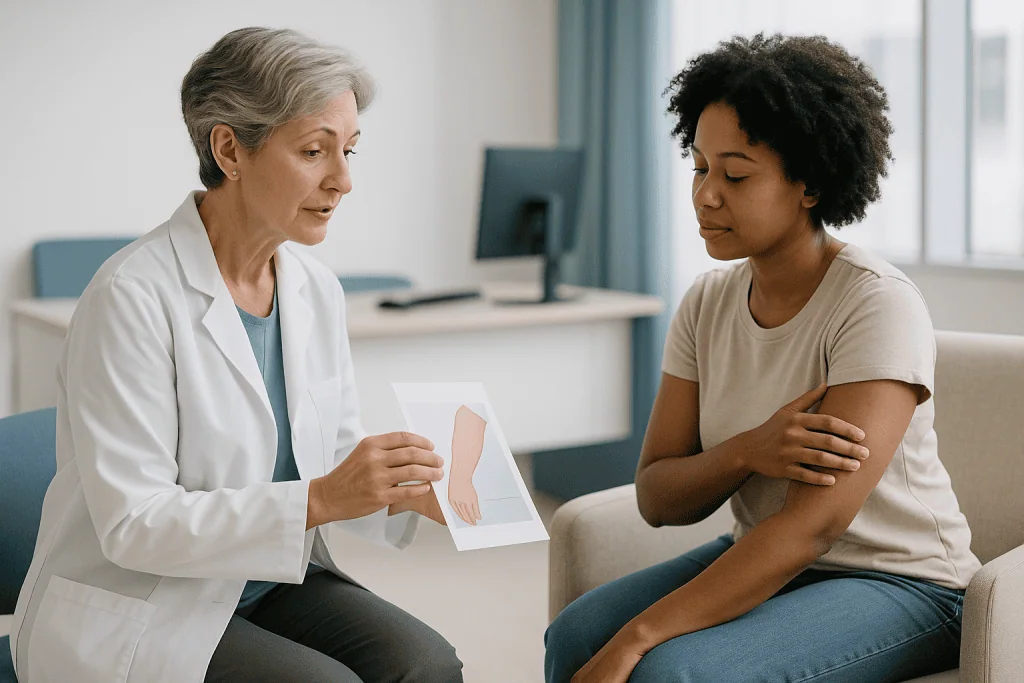
Why the cork forms is only partly understood. Mayo Clinic and the NHS describe it as a keratin buildup with a strong hereditary pattern: if one parent has it, a child very often does too. Several genes involved in skin barrier function have been implicated, but no single mutation explains most cases.
Dry skin is the great amplifier. When the outermost layer loses water, keratin becomes rigid and plugs harden, which is why bumps are rougher in January than in July. Anything that dries the skin, including hot showers, harsh soaps and low indoor humidity, tends to make the texture more noticeable.
There is also a follicle-shape theory. A dermoscopy study in the 2010s, a close examination of skin using a handheld magnifier with polarized light, found that many keratosis pilaris bumps contained coiled or looped hair shafts. The authors proposed that a hair growing in a circle irritates the follicle wall and triggers the excess keratin, rather than keratin trapping the hair. It is a small study, and expert opinion remains divided, but it explains why the bumps overlap so much with ingrown hairs.
Hormones may contribute, since the condition flares in puberty and sometimes in pregnancy. Diet, hygiene and cleanliness do not cause it. Nobody gives themselves keratosis pilaris by skipping a scrub.
Strawberry legs vs. keratosis pilaris: are they the same thing?
They overlap, but they are not identical, and the distinction changes what helps.
Strawberry legs is not a medical diagnosis. It is a description of how the skin looks: legs speckled with dark dots at each pore, like the seeds on a strawberry. Cleveland Clinic lists four common reasons legs take on that appearance, and keratosis pilaris is only one of them.
The first is shaving. A razor slices hair at or just below the surface, and the blunt cut end of a dark hair sitting in an open follicle reads as a black dot, especially against pale skin. The second is clogged pores. Oil, dead cells and debris darken when exposed to air, much like a blackhead on the nose, so open follicles on the legs can look dotted after a workout or a day in tight leggings. The third is folliculitis, an inflamed or infected hair follicle that appears as a small red or pus-topped bump. The fourth is keratosis pilaris, where the dot is a keratin plug rather than a hair stub.
Ingrown hairs, which are hairs that curl back and grow into the skin instead of out of it, straddle all four categories. They are common after shaving or waxing, they can trigger folliculitis, and they sit at the center of many keratosis pilaris bumps.
A useful home test: strawberry legs from shaving look worst in the first day or two after a shave and improve as hair grows out. Keratosis pilaris does not care about your razor schedule; it feels rough whether the leg is freshly shaved or not, and it usually has matching patches on the arms or thighs.
That difference is the whole reason exfoliating and moisturizing help one version, while changing shaving technique helps the other.
What changed recently
Nothing in the biology of keratosis pilaris has shifted this year. What changed is the conversation around it, and the volume.

Short-form video turned strawberry legs into a searchable, almost brandable condition. Clips demonstrating dry brushing, body scrubs, at-home intense pulsed light devices and vitamin A supplements have accumulated hundreds of millions of views. In response, mainstream patient-information pages, including those at Cleveland Clinic and Mayo Clinic, have been refreshed to address the nickname directly and to state plainly that scrubbing harder is not a solution.
On the evidence side, the notable development of the past decade has been a reframing of what a keratosis pilaris bump actually is. The 2010s dermoscopy work describing coiled hair shafts inside the plugs shifted some experts toward viewing the condition partly as a hair-shaft disorder rather than purely a keratin disorder. That idea feeds directly into laser hair removal research: if the trapped hair is the irritant, thinning the hair might calm the follicle.
Several small trials using long-pulsed laser and light devices followed, most with fewer than two dozen participants and follow-up measured in weeks. Some reported smoother texture and less redness on the treated side of the body compared with the untreated side. None showed permanent clearance, and none were large enough to change guidelines. Reviews published in the early 2020s continue to grade these as promising but preliminary.
The other quiet shift has been tone. Older texts sometimes called the condition cosmetically trivial. Newer patient guidance acknowledges that visible arms and legs carry real social weight, especially for teenagers, and treats the desire for smoother skin as a legitimate reason to seek care rather than a vanity.
So the science is steady, the spotlight is new, and the gap between the two is exactly where myths grow.
What the evidence actually says, graded honestly
Keratosis pilaris has never attracted large, well-funded trials. It is harmless, it improves on its own, and the treatments are mostly inexpensive creams. That leaves a body of evidence that is broad but shallow, and it is worth being candid about which advice rests on what.
Strong consensus, modest trial data: moisturizing. Every major guideline, from the NHS to Mayo Clinic to MedlinePlus, recommends regular emollients, particularly those containing urea, lactic acid or other alpha hydroxy acids, which loosen keratin and hold water in the skin. The support comes from decades of clinical experience, small comparative studies and the well-established physiology of dry skin. It works reliably for texture, less reliably for redness, and stops working when you stop applying it.
Moderate evidence: chemical exfoliants such as salicylic acid, glycolic acid and topical retinoids, which are prescription vitamin A derivatives that speed cell turnover. Small trials and case series show they smooth bumps over several weeks. Irritation is the main trade-off, and the choice of agent and strength belongs with a clinician.
Weak but interesting evidence: laser and light therapy. A handful of split-body randomized trials, where one side is treated and the other serves as control, reported improved texture and color. Sample sizes were tiny, follow-up short, and results varied by skin tone and device.
Expert opinion only: humidifiers, short lukewarm showers, avoiding tight clothing, and gentle physical exfoliation. Sensible, low-risk, unproven in trials.
No credible evidence: gluten-free diets, oral vitamin A supplements for otherwise well-nourished people, and coconut oil as a treatment. These circulate widely online and rest on anecdote.
The honest summary is that the best-supported strategy is also the least glamorous: consistent moisturizing with a keratin-loosening ingredient, patience, and realistic expectations.
Is keratosis pilaris a type of eczema?
No, but the two are neighbors, and the confusion is understandable.
Eczema, also called atopic dermatitis, is an inflammatory condition in which the skin barrier leaks moisture and reacts to irritants with itchy, red, scaly patches that come and go. Keratosis pilaris is a keratinization disorder: the problem is dead cells failing to shed from follicle openings, not an inflammatory flare. One is fundamentally about immune reactivity, the other about plumbing.
They keep company, though. Mayo Clinic and Cleveland Clinic both note that keratosis pilaris is more common in people who have eczema, dry skin, asthma or hay fever, the cluster clinicians call atopy. Some research points to shared genetic ground, including variants affecting filaggrin, a protein that helps skin cells flatten and bind into a strong outer barrier. When filaggrin is scarce, skin dries more easily, and dry skin makes keratin plugs harder and more visible. In that sense eczema does not cause keratosis pilaris, but the same dry, barrier-weak skin type invites both.
Ichthyosis vulgaris, an inherited condition producing fine fish-scale flaking, particularly on the shins, is another frequent companion for the same reason.
The practical consequence is encouraging. The daily habits that keep eczema calm, meaning fragrance-free moisturizers, gentle cleansers, lukewarm water and a humid bedroom, are exactly the habits that soften keratosis pilaris. A single routine serves both.
Where they differ is treatment of the flare. Steroid creams, the mainstay for an eczema patch, do little for the texture of keratosis pilaris. They may briefly reduce redness, but they do not clear plugs, and prolonged use thins skin. Someone with both conditions is usually advised to treat eczema flares as eczema and the bumps as bumps, with a clinician sorting out which is which when they overlap on the same arm.
What could be mistaken for keratosis pilaris?
Because the bumps are so common, keratosis pilaris tends to become the default label for any rough patch on an arm or thigh. Several other conditions imitate it closely enough that a second look pays off.
Folliculitis is inflammation or infection of a hair follicle, often from bacteria or yeast. It produces red bumps that may be tender or pus-filled, appears suddenly, favors areas that are shaved or sweaty, and often clears in days. Keratosis pilaris is chronic, painless and evenly distributed.
Ingrown hairs are single hairs curling back into the skin, typically after shaving, waxing or plucking. They create scattered, sometimes painful bumps that may show a visible trapped hair. A cluster on the bikini line or lower legs after hair removal is more likely ingrown hairs than keratosis pilaris.
Acne on the upper arms or back involves blackheads, whiteheads and larger inflamed lesions rather than uniform fine grit.
Keratosis pilaris rubra and atrophicans are less common relatives. The first adds a broad, lasting flush of redness around the bumps, especially on the cheeks. The second can leave tiny pitted scars or eyebrow hair loss and warrants specialist assessment.
Lichen spinulosus forms tight, rounded clusters of spiny follicular bumps, often in children, and looks like keratosis pilaris arranged into coins.
Milia are small white cysts of trapped keratin under the surface, usually on the face, and are not tied to hair follicles.
A dermatologist can usually tell these apart by eye, sometimes with a dermatoscope, and rarely needs a biopsy. The distinction is not academic: folliculitis may need an antimicrobial, ingrown hairs respond to changes in hair removal, and acne has its own treatment ladder. Treating any of them as keratosis pilaris with a moisturizer is harmless but slow, and delays the thing that would actually help.
How do you fix keratosis pilaris? Honest expectations first
The truthful answer to the most-searched question is that keratosis pilaris is managed rather than fixed. The follicles keep making keratin the way some scalps keep making dandruff. What treatment does is thin the plugs, soften the skin and fade the redness so that the texture is barely noticeable. Stop the routine and, within weeks, the sandpaper returns.
Within that limit, a lot is possible, and the sequence matters more than the products.
Start with water. Long hot showers strip the oils that keep keratin pliable. The NHS and Mayo Clinic both suggest shorter, lukewarm washes with a mild, fragrance-free cleanser. Pat rather than rub dry, and apply moisturizer while skin is still slightly damp, because the emollient traps that water in the outer layer where the plugs live.
Choose the moisturizer with a job to do. Plain creams help, but products containing urea, lactic acid, glycolic acid or salicylic acid do double duty: they hold moisture and gently dissolve the keratin binding cells together. Applied once or twice a day, they typically soften texture within four to six weeks. Some tingling is normal; stinging or redness that lasts means the product is too strong for that skin and a milder option is needed.
Add exfoliation with restraint. A soft washcloth or a mild exfoliating wash a few times a week is enough. Harsh scrubs and loofahs aggravate the follicles and can trigger folliculitis or darker post-inflammatory marks, especially on deeper skin tones.
If two months of that routine has not satisfied, a clinician may prescribe a topical retinoid or a stronger keratolytic, or discuss laser options. Those decisions, including which agent and for how long, rest with the prescriber, who can weigh irritation, pregnancy plans and skin tone.
Meanwhile, the most reliable treatment of all is time. Most people see the bumps thin markedly by their late twenties.
Treatment options for keratosis pilaris at a glance
Choosing among smoothing strategies is easier when the effort, the evidence and the trade-offs sit side by side. The table below reflects mainstream patient guidance from Mayo Clinic, Cleveland Clinic and the NHS, with evidence strength described in plain terms.
| Approach | How it works | Evidence strength | Typical time to notice change | Main trade-off |
|---|---|---|---|---|
| Bland, fragrance-free moisturizer | Holds water in the outer skin so keratin plugs stay soft | Strong consensus; long clinical experience | 2 to 4 weeks | Effect fades quickly if stopped |
| Moisturizer with urea or lactic acid | Hydrates and loosens the bonds between dead cells | Moderate; small comparative studies plus consensus | 4 to 6 weeks | Mild tingling; stinging on broken skin |
| Salicylic or glycolic acid wash or lotion | Chemically exfoliates the follicle opening | Moderate; small trials | 4 to 8 weeks | Irritation and sun sensitivity |
| Prescription topical retinoid | Speeds cell turnover so plugs do not accumulate | Moderate; case series and small trials | 8 to 12 weeks | Dryness, peeling; avoided in pregnancy |
| Laser or light therapy | Reduces hair, redness or follicle inflammation | Weak; tiny split-body trials | Several sessions over months | Variable results; pigment changes possible |
| Gentle physical exfoliation | Mechanically lifts loosened surface cells | Expert opinion | Immediate but temporary | Over-scrubbing worsens redness |
| Humidifier, shorter lukewarm showers | Limits water loss that hardens keratin | Expert opinion; sound physiology | Seasonal | None of note |
Two patterns stand out. Every row that works requires ongoing use, and every row that acts faster carries more irritation. Most dermatologists start at the top and move down only when the gentler steps have had a genuine six-to-eight-week trial. Which prescription option, if any, suits a particular person is a decision for the treating clinician.
Ingrown hairs and shaving: smoothing strawberry legs without making them worse
If your legs look dotted mainly in the day or two after shaving, the follicle is not the villain. The razor is.
A close shave cuts the hair slightly below the surface. As it regrows, the sharp tip can pierce the follicle wall or curl back under the skin, becoming an ingrown hair. Each one produces a small bump, sometimes with a visible dark loop of hair inside, sometimes with the redness and pus of folliculitis. Multiply that across two shins and the result reads as strawberry legs. People with coarse or tightly curled hair are most prone, because a curved hair reenters skin more easily.
Mayo Clinic’s guidance on ingrown hairs translates into a few razor habits. Shave after, not before, a warm shower, when hair is soft and skin is supple. Use a lubricating gel or cream rather than bar soap, which drags. Shave in the direction the hair grows, even if it means a slightly less close result. Rinse the blade between strokes and replace it often; a dull blade tugs hair and scrapes skin. Skip the second pass over the same patch. Moisturize afterward.
Exfoliating gently a day or two before shaving lifts dead cells that would otherwise trap regrowing hairs, and it helps keratosis pilaris texture at the same time, which is why the two routines pair well.
An electric trimmer that leaves a fraction of a millimeter of stubble almost eliminates ingrown hairs, at the cost of a less smooth feel. Waxing and epilating can cut both ways: they remove the hair root, so there is no blunt stub, but regrowth through a plugged follicle can still curl inward.
Squeezing or digging out an ingrown hair with tweezers or a pin invites infection and scarring. If one becomes hot, swollen or painful, that is a folliculitis question for a clinician rather than a bathroom project.
Do laser and light treatments actually help keratosis pilaris?
The most-viewed strawberry-legs videos this year end with a laser, and the claim is total clearance. The trials tell a quieter story.
Two different mechanisms have been tested. Long-pulsed hair-removal lasers target the pigment in the hair shaft, heating and thinning the hair. If coiled hairs are part of what irritates the follicle, fewer hairs might mean fewer plugs. Vascular lasers and intense pulsed light, by contrast, target the small blood vessels responsible for the pink or red halo around each bump, which is what many people actually find most noticeable.
Published randomized studies are mostly split-body designs, treating one arm or one side of the thigh and leaving the other as a control. Enrollment has typically been a dozen to two dozen people. Several reported that the treated side was smoother and less red by blinded assessment a few weeks after a course of sessions. A few noted no significant difference in texture but improved color, or the reverse. Follow-up rarely extended beyond three months, so nobody can say how long any benefit lasts.
There are real cautions. People with deeper skin tones face a higher risk of temporary or lasting pigment changes from certain wavelengths, and settings must be chosen by someone trained for that skin type. Multiple sessions are needed, and the bumps can return once hair regrows.
Home light devices are far less powerful than clinical lasers. They have not been tested for keratosis pilaris in published trials, and the dramatic before-and-after clips online are lit, filtered and uncontrolled.
The fair verdict is that lasers are a reasonable option for someone whose bumps or redness have not responded to months of topical care and who understands the results are partial and probably temporary. That is a conversation with a dermatologist, not a purchase.
Does keratosis pilaris go away on its own?
For most people, yes, at least mostly, and the timeline is more encouraging than the internet suggests.
Keratosis pilaris usually declares itself in early childhood or around puberty, when hormonal changes and oilier skin seem to accelerate keratin production. The teenage years are the peak. From there, Mayo Clinic notes that the condition commonly fades gradually, and many people find their upper arms noticeably smoother by their late twenties or around age 30. Some lose it completely; others keep a faint version that flares each winter and disappears each summer.
Why it improves is not fully explained. The leading guesses are that follicles enlarge slightly with age, making plugs less likely, and that skin oil production changes after adolescence. Whatever the mechanism, the pattern is consistent enough that pediatricians often reassure parents rather than treat a young child at all, unless itch or self-consciousness is significant.
Pregnancy is a frequent exception. Some people who thought they had outgrown the bumps see them return on the arms and thighs during pregnancy, presumably from hormonal shifts, then fade again afterward.
Season is the other reliable variable. Cold, dry air stiffens keratin and slows natural shedding, so bumps that are invisible in August can feel like grit by February. A bedroom humidifier and a heavier winter moisturizer address that directly, and for many adults that is the only treatment they ever need.
What does not happen is progression. Keratosis pilaris does not spread into a more serious condition, does not scar in its common form, and does not signal anything wrong internally. Redness sometimes lingers longer than texture, and post-inflammatory darkening from over-scrubbing or picking can outlast the bumps themselves, which is the strongest argument for treating the skin gently while the years do their work.
Common myths about keratosis pilaris and strawberry legs
The viral version of this topic is built on a few confident claims. Here is how each holds up against mainstream evidence.
Myth: The bumps are dirt or poor hygiene. They are keratin, produced inside the follicle regardless of how often you wash. Scrubbing harder removes surface cells but does not stop the follicle from making more, and it inflames the skin.
Myth: A gluten-free diet clears keratosis pilaris. No trial has tested this, and no major medical body recommends it. The claim seems to have grown from the overlap between keratosis pilaris and general dry skin, not from any demonstrated link to gluten. Removing gluten without a diagnosed reason risks nutritional gaps and does nothing for the follicle.
Myth: It is a vitamin A deficiency; take supplements. True vitamin A deficiency can cause follicular roughness, but it is uncommon in well-nourished populations, and the NIH Office of Dietary Supplements warns that excess vitamin A is toxic to the liver and harmful in pregnancy. Topical prescription retinoids are a different matter entirely and are prescribed, not self-selected.
Myth: Coconut oil dissolves the plugs. Oils soften skin and may reduce visible dryness, but they contain no keratin-loosening ingredient. They are a moisturizer, not a treatment.
Myth: Dry brushing exfoliates the bumps away. Stiff bristles abrade the follicle openings. Cleveland Clinic and others caution that aggressive physical exfoliation can trigger folliculitis and darker marks, especially on deeper skin tones.
Myth: Strawberry legs mean you shave wrong, full stop. Shaving explains some cases. Keratosis pilaris, clogged follicles and folliculitis explain the rest, and each needs a different response.
Myth: One laser session ends it. The trials show partial, temporary improvement after multiple sessions, in small groups, with short follow-up.
Every one of these myths shares a flaw: it promises to remove something that the skin will keep producing. The realistic goal is smoother, not permanent.
When to see a doctor about keratosis pilaris or strawberry legs
Most people never need an appointment for keratosis pilaris. The bumps are harmless, and the moisturizing routine described above is safe to start on your own. Still, there are moments when a clinician’s eye adds real value, and a few signs that call for one promptly.
Book a routine visit if bumps have not softened after eight weeks of consistent, gentle care, if itch is disrupting sleep, or if the appearance is affecting your confidence enough that you are avoiding short sleeves or shorts. That last reason is legitimate. A dermatologist can confirm the diagnosis, rule out look-alikes, and discuss prescription options or procedures with a clear picture of your skin type and history.
See a clinician sooner if you notice any of the following:
- Bumps that become painful, hot, swollen or filled with pus, which suggests folliculitis or an infected ingrown hair rather than keratosis pilaris.
- Rapid spread of red bumps over days, particularly with fever or feeling unwell.
- Pitted scarring, thinning of eyebrow hair or lasting deep redness on the cheeks, which can point to the less common atrophicans or rubra variants.
- A single bump that grows, bleeds, changes color or fails to heal over several weeks. Any persistent changing skin lesion deserves professional assessment regardless of what surrounds it.
- Severe burning, blistering or peeling after using an exfoliating product, which may indicate a chemical irritation or allergy.
- Bumps appearing alongside widespread dry, cracked skin in an infant or young child, where an inherited skin condition may need evaluation.
Bring your current products to the visit. What you are already using shapes what a clinician suggests next, and any change to a prescribed treatment, including starting, stopping or combining creams, should be made with the prescriber rather than on the strength of a video. If you are pregnant or planning to be, say so before any retinoid is discussed.
Frequently asked questions
What is the main cause of keratosis pilaris?
The main cause is a buildup of keratin, the protein in skin and hair, that plugs the openings of hair follicles. Why some follicles do this is only partly understood, but the tendency runs strongly in families and is amplified by dry skin, cold weather and hormonal changes around puberty. Some studies suggest coiled hair shafts irritate the follicle and trigger the excess keratin. Hygiene and diet are not causes.
How do you fix keratosis pilaris?
You manage it rather than fix it, because the follicles keep producing keratin. The most reliable routine is short lukewarm showers, a gentle cleanser, and daily use of a moisturizer containing urea, lactic acid or a similar keratin-loosening ingredient, applied to damp skin. Texture usually softens within four to six weeks and returns if you stop. Prescription retinoids or laser treatment are options a dermatologist may discuss if that fails.
What could be mistaken for keratosis pilaris?
Folliculitis, ingrown hairs, body acne, milia and lichen spinulosus are the usual look-alikes. Folliculitis and infected ingrown hairs tend to be red, tender or pus-topped and appear suddenly, while keratosis pilaris is painless, evenly scattered and chronic. Less common variants such as keratosis pilaris rubra or atrophicans add lasting redness or tiny scars. A dermatologist can usually tell these apart by examination without a biopsy.
Is keratosis pilaris a type of eczema?
No. Eczema is an inflammatory condition driven by immune reactivity and a leaky skin barrier, while keratosis pilaris is a keratinization disorder in which dead cells fail to shed from follicle openings. The two often occur together because both are more common in people with dry, barrier-weak skin, sometimes linked to filaggrin gene variants. Eczema care habits help both, but steroid creams do little for the bumps.
Are strawberry legs the same as ingrown hairs?
Not always. Ingrown hairs, which curl back into the skin after shaving or waxing, are one common cause of the dotted strawberry legs appearance, but dark hair stubs in open follicles, clogged pores, folliculitis and keratosis pilaris produce the same look. If the dots are worst right after shaving and improve as hair grows, hair removal is the likely culprit; if the legs feel rough regardless, keratosis pilaris is more likely.
Does keratosis pilaris go away with age?
Usually it fades. The condition peaks in adolescence and, according to Mayo Clinic, commonly improves gradually, with many people noticing much smoother skin by their late twenties or around age 30. Some keep a mild version that flares in winter and disappears in summer, and pregnancy can bring a temporary return. It does not progress into anything more serious.
Does exfoliating help keratosis pilaris or make it worse?
Gentle exfoliation helps; aggressive exfoliation makes it worse. Chemical exfoliants such as lactic, glycolic or salicylic acid in a lotion or wash loosen keratin plugs gradually and are supported by small trials. Harsh scrubs, loofahs and dry brushing abrade the follicle openings, which can cause folliculitis, redness and dark marks, especially on deeper skin tones. A soft washcloth a few times a week is plenty.
Can laser hair removal get rid of keratosis pilaris?
It can improve it partially and temporarily for some people, but it does not remove it permanently. Small split-body randomized trials of long-pulsed lasers and light devices reported smoother texture or less redness on the treated side after several sessions, with follow-up of only a few weeks to months. Results vary by skin tone and device, and pigment changes are a risk. It is a dermatologist-level decision.
Does a gluten-free diet or vitamin A supplement clear keratosis pilaris?
There is no credible evidence for either. No trial has shown gluten avoidance affects the bumps, and no major medical body recommends it. Vitamin A deficiency is rare in well-nourished people, and the NIH Office of Dietary Supplements warns that excess vitamin A can harm the liver and a developing pregnancy. Prescription topical retinoids are a different, clinician-directed treatment and are not a supplement.
Is keratosis pilaris contagious or harmful?
Neither. Keratosis pilaris is not an infection, so it cannot spread from person to person or from one part of the body to another, and it poses no threat to overall health. Its only effects are rough texture, occasional itch and, for many people, self-consciousness. Treatment is entirely about comfort and appearance, which is why gentle, sustained care is preferred over anything aggressive.
References
This article is for general information only and is not a substitute for professional medical advice. Please consult a qualified doctor about your individual situation.

More from the Blog

Acne Scars: Ice Pick, Boxcar, Rolling: Which Treatments Work for Which Type
Acne scars are treated according to their shape. Narrow, deep ice pick scars respond best to TCA CROSS or punch excision; wide, sharp-edged boxcar…
How Is Facial Seborrheic Dermatitis Treated? Beards, Eyebrows and the Cosmetics to Pause
Facial seborrheic dermatitis is usually treated with topical antifungal creams or shampoos that reduce Malassezia yeast, short courses of mild anti-inflammatory creams for flares,…

Are Hives Contagious? Causes, Triggers and When Urticaria Needs Treatment
No, hives are not contagious. Urticaria is an immune reaction inside your own skin: histamine released from mast cells makes small blood vessels leak,…

Benzoyl Peroxide: How It Works, the Concentration Question and the Bleaching Problem
Benzoyl peroxide is an over-the-counter acne treatment that releases oxygen into the pore, killing acne bacteria without breeding resistance and loosening the plugs that…
Sun Protection With Vitiligo: Why Depigmented Skin Burns Faster and How to Care for It Daily
People with vitiligo sunburn faster because depigmented patches have lost melanocytes, the cells that make melanin, the pigment that absorbs ultraviolet light before it…
Does Seborrheic Dermatitis Cause Hair Loss?
Seborrheic dermatitis does not usually destroy hair follicles, so it is not a classic cause of permanent hair loss. It can, however, trigger temporary…