

L-Theanine: What It Does With Caffeine, for Focus and for Sleep
Key Takeaways
- L-theanine was isolated from green tea in 1949 and is one of the main reasons tea tastes savory rather than purely bitter.
- In 2008 crossover trials, l-theanine plus caffeine improved attention-switching and reduced distraction more than caffeine alone, while l-theanine by itself did not sharpen attention.
- The most consistent human finding is reduced self-reported stress, backed by several small randomized trials and a 2019 systematic review.
- The only sleep trial with objective measurement was a 2011 study in boys with ADHD, so adult sleep claims rest mainly on questionnaires.
- Almost no trial has lasted longer than twelve weeks, so l-theanine is best described as well tolerated in short studies rather than proven safe long term.
- Rare liver injury linked to some blended products is attributed to concentrated green tea extract, not to l-theanine, which makes reading the full ingredient list essential.
L-theanine is an amino acid found naturally in tea leaves that appears to promote a calm, alert state. Small randomized trials suggest that pairing it with caffeine may modestly improve attention and reduce caffeine jitters, and that it may ease subjective stress. Evidence for sleep is weaker and mostly indirect. It is generally well tolerated, but anyone taking medicines or who is pregnant should ask a clinician first.
Scroll through a morning-routine video this spring and you will probably see the same small white capsule dropped beside a mug of coffee, captioned something like “the trick that makes caffeine feel smooth.” As of March 2026, searches for l-theanine have climbed sharply, pushed along by two overlapping crowds: people trying to focus at work without the shaky hands, and people stirring it into a bedtime mocktail hoping for deeper sleep. It has become the rare supplement that is marketed for opposite ends of the day.
The compound itself is not new. Japanese researchers isolated it from green tea leaves in 1949, and tea drinkers have been getting a modest dose of it with every pot for centuries. What is new is the volume of confident claims layered on top of a fairly thin, though genuinely interesting, body of research.
So let us do what the videos rarely do: separate the mechanism from the marketing, grade the trials by their strength, and be honest about the gaps. The story is more modest than the hype, and more useful for it.
What is L-theanine, and why is everyone suddenly taking it?
L-theanine is an amino acid, which is one of the small molecular building blocks the body uses to make proteins, though this particular one is not used for building anything. It occurs almost exclusively in the leaves of the tea plant, Camellia sinensis, and in one species of mushroom. Green, black and oolong teas all contain it. It is a large part of why a cup of tea tastes faintly savory and rounded rather than simply bitter; food scientists call that quality umami.
Chemically, it resembles glutamate, the most common excitatory messenger in the brain. That resemblance is the root of nearly every claim made about it, because a molecule that looks like a key can sometimes fit the same locks. Whether it actually turns them in a way that matters at the amounts people swallow is the real question, and one this article keeps returning to.
Why the surge now? Three currents converged. First, the “smart coffee” trend on short-video platforms, where creators describe adding l-theanine to caffeine for cleaner focus. Second, a broader appetite for non-prescription sleep aids among adults who feel wired at night. Third, a handful of placebo-controlled studies in healthy adults and middle-aged volunteers that are easy to summarize in a caption and hard to summarize accurately.
In the United States, l-theanine is sold as a dietary supplement. That status means the Food and Drug Administration does not review it for effectiveness before it reaches shelves, and manufacturers, not regulators, are responsible for label accuracy. The National Institutes of Health Office of Dietary Supplements explains this arrangement plainly, and it matters here because the gap between what a label promises and what a trial found can be wide.
What changed recently
Nothing about the molecule changed. What shifted is the size and confidence of the audience, and the way older research is being recirculated as if it were breaking news. A few dated anchors help keep the timeline straight.

The foundational human studies on l-theanine and caffeine date to 2008. A British crossover trial published in Nutritional Neuroscience that year found that the combination improved speed and accuracy on an attention-switching task and reduced susceptibility to distraction more than caffeine alone. A crossover trial is one in which every participant receives each treatment on different days, so people act as their own comparison. A second 2008 study from the same research community reported similar mood and attention findings. These trials involved roughly two dozen volunteers each, tested over a single afternoon.
In 2019, a Japanese randomized controlled trial published in Nutrients gave healthy adults l-theanine or placebo for four weeks and reported lower scores on stress questionnaires, fewer sleep complaints, and small improvements on some cognitive measures. In 2021, another Japanese group tested a single dose and then twelve weeks of use in middle-aged and older adults, finding a modest improvement in attention and reaction time on selected tasks. That paper’s title is now, tellingly, among the top search results.
What has changed as of early 2026 is context rather than data. Consumer health pages from major academic medical centers now carry dedicated l-theanine explainers, a sign that patients are asking their doctors about it. And the sleep framing, largely absent from the 2008 work, has become the dominant reason people say they buy it, even though it is the least studied use.
What does taking L-theanine actually do in the brain?
The honest answer begins with a caveat: most of what we know about mechanism comes from animal and cell studies, which tell us what is possible rather than what happens in a person sipping tea. With that framing, here is the working picture.
After it is swallowed, l-theanine is absorbed in the small intestine and appears in the blood within about an hour. It crosses the blood-brain barrier, the tightly sealed lining of the brain’s blood vessels that keeps most substances out. Once there, it seems to do several things at low intensity rather than one thing forcefully.
It nudges levels of GABA, the brain’s main calming messenger, and appears to influence dopamine and serotonin, which are involved in motivation and mood. Because it resembles glutamate, it may also sit loosely on some glutamate receptors and dampen overactivity, a bit like a chaperone lowering the volume in a loud room. None of these effects is dramatic on its own.
The most reproducible human finding involves brain waves. Several small electroencephalography studies, which use scalp sensors to record electrical activity, show that l-theanine increases alpha-wave activity. Alpha rhythms are the pattern seen when someone is awake, relaxed and not drowsy, the state many people describe during unhurried reading. This is the physiological basis for the phrase “calm alertness” that appears in nearly every article on the topic, including this one.
What it does not do is important too. It does not raise heart rate, it does not act as a sedative in the way sleep medicines do, and it does not produce a noticeable “hit.” People who expect to feel something the way they feel coffee are often disappointed, and that flatness is arguably the point.
L-theanine and caffeine: why the pairing became famous
Tea drinkers stumbled onto this combination long before anyone put it in a capsule. A cup of tea contains both caffeine and l-theanine, and the common observation that tea feels gentler than coffee is not entirely folklore. The supplement version simply tries to reproduce that ratio deliberately, and the 2008 crossover trials were designed to test whether the folklore held up.

Caffeine works mainly by blocking adenosine, a chemical that accumulates through the day and signals tiredness. Block it and you feel more awake, but you also get a rise in heart rate, a tightening of blood vessels and, in many people, a restless edge. L-theanine seems to act on a different set of circuits, so the two do not cancel each other out. Instead, the trials suggest a division of labor: caffeine supplies the alertness, l-theanine files down some of the rough edges.
In the studies, the combination outperformed caffeine alone on tasks that required switching attention quickly and ignoring distracting information. Participants also reported feeling less tense and, in some measures, less mentally fatigued. Headache and jitteriness, common with caffeine alone, were somewhat reduced. The effect sizes were small to moderate, measured in fractions of a second on computer tasks, not in transformed workdays.
Two cautions deserve emphasis. First, these were single-session laboratory experiments in young, healthy adults, so we do not know whether the benefit persists with daily use or applies to people who are sleep-deprived, older, or living with attention disorders. Second, l-theanine does not remove caffeine’s effects on blood pressure or sleep. If coffee after lunch keeps you up at midnight, adding l-theanine is unlikely to fix that, and the sensible move is still less caffeine, earlier.
Does L-theanine help with focus and attention on its own?
Without caffeine alongside it, the picture becomes murkier and, frankly, less impressive. This surprises people who assume the supplement is the active ingredient in the “focus stack.” In the 2008 experiments, l-theanine by itself produced little or no improvement in attention; some measures even drifted slightly toward slower reaction times, consistent with a mild relaxing effect. The magic, such as it was, appeared only when caffeine was in the room.
Later trials complicate that conclusion a little. The 2021 study in middle-aged and older adults reported that a single dose shortened reaction time and improved working memory on some tasks, and that twelve weeks of daily use was associated with better attention scores. The 2019 four-week trial in younger healthy adults noted small gains in verbal fluency and executive function, the mental skills used for planning and switching between tasks. These are real findings from randomized, placebo-controlled designs, which is the strongest type of evidence for a single intervention.
They are also small. Each study enrolled a few dozen participants, used many outcome measures, and found improvement on some while others did not budge. In research, the more outcomes you test, the greater the chance one will look positive by luck alone. Independent replication by groups without industry funding has been limited.
So where does that leave a reader wondering whether to take it before a long meeting? The most defensible statement is this: l-theanine alone is unlikely to make you sharper in a way you can notice, and it is not a stimulant. If it helps focus, it most plausibly does so indirectly, by lowering the background hum of stress that fragments attention, an effect people with anxious temperaments may recognize more than others.
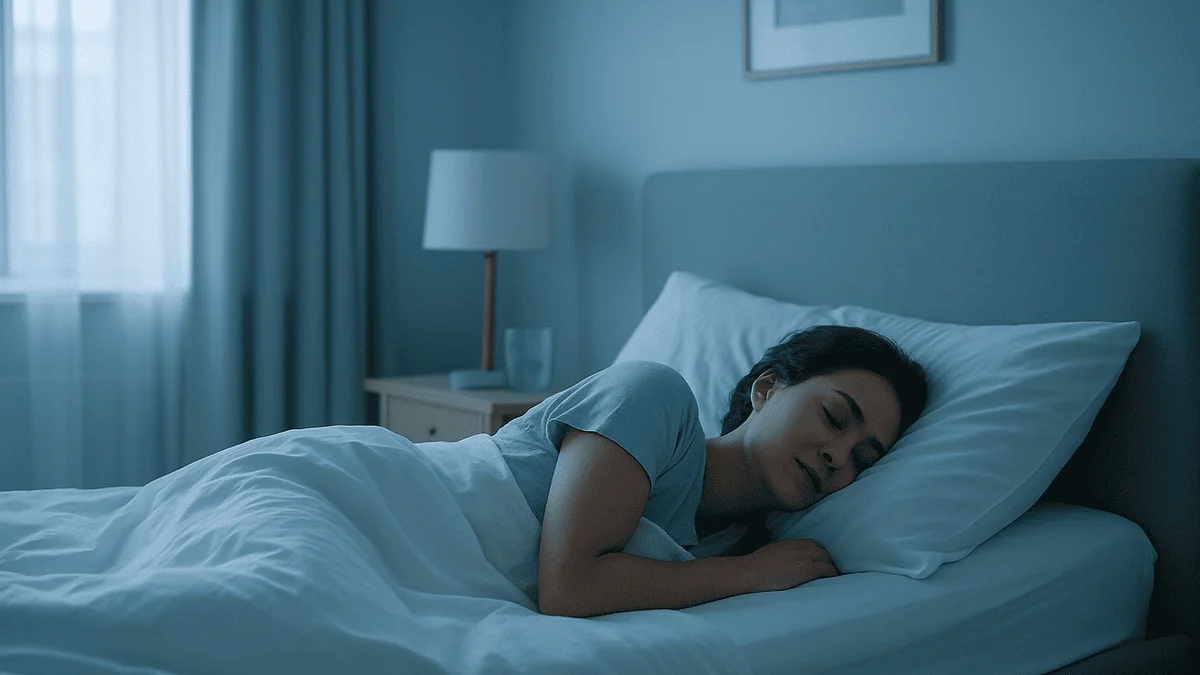
Can L-theanine help you sleep?
This is the claim with the widest gap between popularity and proof. The sleep videos are everywhere; the sleep trials are few, small, and mostly indirect.
Start with what l-theanine is not. It is not a sedative, meaning it does not slow the brain down enough to induce drowsiness the way prescription sleep medicines or antihistamines do. People who take it at bedtime expecting to feel heavy-lidded usually do not. What it may do, according to the 2019 four-week trial, is reduce sleep-related complaints on questionnaires, particularly the sense of taking a long time to fall asleep and feeling unrefreshed. Participants in that study were not sleep-disordered; they were ordinary adults under ordinary stress.
The most cited sleep study is a 2011 randomized, placebo-controlled trial in boys with attention-deficit/hyperactivity disorder, which used wrist-worn movement sensors and found higher sleep efficiency, the proportion of time in bed actually spent asleep, in the treatment group. That is a meaningful objective measure, but a single trial in one narrow population, and it should not be read as evidence for adults or for children without a clinician’s involvement.
The likeliest mechanism is not sedation but the same alpha-wave, GABA-nudging calm that shows up in the daytime studies. If racing thoughts are what keep you awake, something that lowers arousal could plausibly shorten the runway to sleep. If your sleep problem is pain, sleep apnea, shift work, or a bedroom lit up by screens, l-theanine is aimed at the wrong target.
Bottom line, graded honestly: for sleep, the evidence is preliminary and largely based on self-report. It may help a stressed sleeper feel more settled. It has not been shown to treat insomnia, and it should never replace an evaluation for a persistent sleep problem.
L-theanine for stress and anxiety: calm without drowsiness?
If l-theanine has a genuine strength, this is probably it. Across the small trials, the most consistent signal is a reduction in subjective stress, meaning how tense or anxious people say they feel, along with a few physiological markers that point the same direction.
In laboratory stress experiments, volunteers are typically asked to perform difficult mental arithmetic under time pressure while researchers track heart rate and, in some studies, the amount of salivary immunoglobulin A or cortisol, chemicals that shift with acute stress. Several such experiments found that people who had taken l-theanine beforehand showed a blunted heart-rate rise and reported feeling calmer than those given placebo. A 2019 systematic review, which is a study that pools and grades all available trials on a question, concluded that the pattern was consistent enough to be plausible, while noting that the studies were small and mostly short-term.
The four-week 2019 trial extended this beyond the lab, reporting lower scores on a standard stress-symptom inventory, including items on anxiety, sleep disturbance and depressed mood. Again, participants were healthy adults, not people with diagnosed anxiety disorders.
That last point deserves a plain statement. There is no good evidence that l-theanine treats generalized anxiety disorder, panic disorder or clinical depression. A small number of trials have tested it as an add-on in people with psychiatric diagnoses, with mixed and inconclusive results. Anyone with those conditions should not swap a prescribed treatment for a supplement, and any interest in adding one belongs in a conversation with the prescribing clinician.
What the evidence does support is narrower and still worth having: for everyday, non-clinical stress, l-theanine may take the edge off, without the fog that comes with many calming remedies.
What the evidence actually says, graded by strength
Readers deserve to know not just what studies found but how much weight each finding can bear. Medical evidence sits on a ladder. At the top are large randomized controlled trials, in which participants are assigned by chance to treatment or placebo, and systematic reviews that pool them. Below that come small randomized trials, then observational studies that watch what people already do, then laboratory and animal work, and at the bottom, expert opinion and anecdote. L-theanine research clusters in the middle rungs.
Combined with caffeine for attention: supported by several small randomized crossover trials in healthy young adults, mostly single-session. Consistent direction of effect, modest size. Grade: moderate-to-low certainty, because the studies are small and short.
Subjective stress reduction: supported by multiple small randomized trials and one systematic review. The most reproducible finding. Grade: moderate-to-low certainty.
Attention and cognition alone, without caffeine: a few small randomized trials with positive results on some measures and null results on others. Grade: low certainty.
Sleep quality: one small randomized trial with objective measurement in children with ADHD, plus self-report data from adult stress trials. Grade: low-to-very-low certainty.
Blood pressure, immunity, weight, long-term brain health: laboratory, animal or single-study data only. Grade: very low certainty; not a basis for use.
Two overarching limitations apply everywhere. Many studies were funded or supplied by manufacturers of a branded l-theanine ingredient, which does not invalidate them but does warrant caution. And almost no trial lasted longer than three months, so nothing is known about years of daily use. Reasonable clinicians reading this literature tend to land in the same place: probably safe for most healthy adults in the short term, possibly helpful for stress and caffeine smoothing, unproven for nearly everything else.
L-theanine claims versus evidence: a summary table
Marketing tends to flatten every finding into the same font size. The table below restores the proportions, matching each popular claim to the type of evidence behind it and a plain-language verdict.
| Popular claim | Strongest evidence available | Who was studied | Honest verdict |
|---|---|---|---|
| Smooths out caffeine jitters and sharpens focus | Small randomized crossover trials (2008) | Healthy young adults, single sessions | Plausible, modest effect |
| Reduces everyday stress and tension | Multiple small randomized trials; systematic review (2019) | Healthy adults under lab or daily stress | Most consistent finding; modest |
| Improves memory and attention on its own | Two small randomized trials (2019, 2021) | Healthy and middle-aged adults | Mixed; small gains on some tasks |
| Helps you fall asleep and sleep deeper | One randomized trial with movement sensors (2011); self-report data | Boys with ADHD; stressed adults | Preliminary; not a sleep aid |
| Treats anxiety disorders or depression | A few small add-on studies | People with psychiatric diagnoses | Inconclusive; not a treatment |
| Lowers blood pressure | Single small studies of stress-induced rises | Healthy adults | Unproven for hypertension |
| Boosts immunity or protects against dementia | Animal and cell studies | Not humans | No human evidence |
Notice the pattern. The claims with the best support are the quietest ones: a little less tension, a slightly steadier response to caffeine. The loudest claims, about immunity, brain protection and treating diagnosed conditions, rest on the thinnest ground. When a product page leads with the bottom rows of this table, that is a signal about the seller, not the science.
A final observation about the middle column: nearly every study lasted between one afternoon and twelve weeks. The absence of long-term trials is not proof of harm, but it is a reason to describe l-theanine as “generally well tolerated in short studies” rather than “proven safe.”
What are the negative side effects of L-theanine?
Few, and mostly mild, is the fair summary, with the usual asterisk that short studies cannot rule out rare or slow-developing problems. In the randomized trials, side effects reported by people taking l-theanine were essentially the same as those reported by people taking placebo. That is reassuring but not the same as saying nothing ever happens.
The complaints that do surface tend to be ordinary. Headache is the most common, and it is difficult to untangle from caffeine, since many people take the two together and caffeine itself causes and relieves headaches depending on timing. Some people describe feeling mildly drowsy or “flat” during the day, which makes sense given the compound’s relaxing profile. Stomach upset and nausea appear occasionally. A small number of users report vivid dreams when taking it at night, though this has not been studied systematically.
A theoretical concern involves blood pressure. Because l-theanine appears to blunt stress-induced rises in heart rate and blood pressure, it could in principle add to the effect of blood-pressure-lowering medicines, leading to light-headedness. This has not been demonstrated in trials, but it is the kind of interaction a prescriber would want to know about.
Green tea extracts, which some products blend with l-theanine, have been linked in rare cases to liver injury. That risk is attributed to concentrated catechins in the extract, not to l-theanine itself, but it is a reason to read the full ingredient list rather than the front of the bottle.
Consumer health resources from major academic medical centers describe l-theanine as generally well tolerated by healthy adults, while emphasizing that safety in pregnancy, breastfeeding and childhood has not been established. “Not established” is not code for dangerous; it means no one has done the studies, and the prudent response to an absence of data is caution rather than confidence.
What to avoid when taking L-theanine?
Supplements do not come with the interaction checks a pharmacist runs on a prescription, so the responsibility shifts to the person swallowing the capsule. A few categories deserve attention, and every one of them ends in the same place: tell the clinician who prescribes your medicines.
- Blood pressure medicines. Because l-theanine may modestly lower blood pressure, stacking it with antihypertensive drugs could theoretically produce dizziness, especially on standing. The evidence is thin, but the mechanism is plausible enough to mention.
- Stimulant medicines. People sometimes take l-theanine hoping to soften the side effects of prescription stimulants for ADHD. That is an off-label, unstudied combination in adults. Whether it is reasonable is a decision for the prescriber, not a video creator.
- Sedatives, sleep medicines and alcohol. Combining several substances that each lower arousal can add up to more drowsiness than any one alone. This is the standard caution for anything with a calming effect.
- Other calming supplements. The same additive logic applies to herbal sedatives and to products that combine several “relaxation” ingredients in one capsule. More ingredients mean more unknowns.
Beyond medicines, avoid using l-theanine as permission to drink more caffeine than you otherwise would. The trials studied the combination at tea-like proportions, not as an antidote to a fourth espresso. Caffeine’s effects on sleep, blood pressure and anxiety do not vanish because a second ingredient is present.
Pregnancy and breastfeeding call for a pause rather than a purchase, simply because no trials have looked. Children are in the same category outside of clinical supervision. And anyone with liver disease should be especially wary of blended products containing green tea extract.
One more thing to avoid: assuming that “natural” or “found in tea” means “harmless in any amount.” A cup of tea delivers a small quantity in a slow, dilute form. A concentrated supplement is a different exposure, and the research base for it is short.
Is L-theanine a stimulant, and how does it compare with prescription focus medicines?
People searching this question usually mean something specific: does l-theanine do what a prescription attention medicine does? The answer is no, and understanding why clarifies what l-theanine actually is.
Prescription stimulants used for attention-deficit/hyperactivity disorder work by substantially increasing the availability of dopamine and norepinephrine, two brain messengers that drive alertness, motivation and the ability to sustain effort on a task. Their effects are large, measurable within an hour, and, in people with ADHD, often life-changing. They are also controlled substances with meaningful side effects and a real potential for misuse, which is why they require diagnosis, prescription and monitoring.
L-theanine is not a stimulant. It does not raise heart rate, it does not sharply increase dopamine, and in the 2008 trials it produced no meaningful attention benefit on its own. Whatever effect it has on focus appears to come through the side door, by lowering stress and steadying the response to caffeine. The two substances are not on the same spectrum; comparing them is a bit like comparing a hallway dimmer switch to a floodlight because both involve electricity.
This distinction matters for a practical reason. Someone who struggles to concentrate, feels restless, loses track of tasks and has done so since childhood may have ADHD, a treatable condition. Reaching for a supplement can delay an evaluation that would actually help. Conversely, someone whose focus falters only when stressed or under-slept probably does not need a stimulant, and may find that the modest calming effect of l-theanine, or simply better sleep, is closer to what they are looking for.
Neither choice should be made from a comment section. If attention problems are interfering with work, school or relationships, that is a reason to see a clinician, who can sort out the cause before anyone reaches for a solution.
Common myths about L-theanine, corrected
Viral health claims tend to grow by repetition rather than evidence. These are the ones circulating most widely as of early 2026, each set beside what the research actually shows.
Myth: “L-theanine cancels out caffeine’s side effects.” It softens some of them, particularly jitteriness and the sense of being on edge, in small trials. It does not undo caffeine’s effect on sleep, blood pressure or heart rhythm. Coffee at 4 p.m. is still coffee at 4 p.m.
Myth: “It knocks you out at night.” L-theanine is not a sedative. The sleep data are preliminary and mostly about feeling calmer, not about being put to sleep. Anyone who feels heavily sedated after taking it should look at what else was in the product.
Myth: “You can feel it working in twenty minutes.” The compound reaches the bloodstream within roughly an hour, and its effects are subtle by design. Strong, immediate sensations usually come from caffeine or from expectation, which is a genuine and well-documented force in every placebo-controlled trial.
Myth: “It’s a natural alternative to anxiety medication.” There is no reliable evidence that it treats diagnosed anxiety disorders, and stopping a prescribed medicine in favor of a supplement can be harmful. Any change to a prescription belongs with the prescriber.
Myth: “Green tea gives you the same effect as a supplement.” Tea delivers a smaller amount, alongside caffeine and other compounds, in a slow and dilute form. That is arguably a gentler way to encounter it, but it is not equivalent to a concentrated capsule, and the trials did not study tea.
Myth: “More is better.” Almost every trial tested a single, modest amount. Nothing is known about higher intake, and the absence of reported harm at studied levels says nothing about untested ones.
None of these corrections makes l-theanine useless. They simply return it to its actual size.
When to see a doctor
L-theanine is a low-drama supplement, and for most healthy adults an occasional capsule with morning coffee is unlikely to cause trouble. Certain situations, though, call for a clinician’s judgment before, during or instead of taking it.
Talk to a doctor or pharmacist before starting if you:
- take any prescription medicine, particularly for blood pressure, heart rhythm, attention, anxiety, depression or sleep;
- are pregnant, trying to conceive, or breastfeeding, since safety data do not exist;
- want to give it to a child or teenager;
- have liver or kidney disease, especially if the product also contains green tea extract;
- are considering it as a substitute for, or addition to, a medicine you already take.
Stop taking it and seek care promptly if you notice red-flag signs:
- fainting, severe dizziness or a racing or irregular heartbeat, especially when combined with caffeine or blood pressure medicines;
- yellowing of the skin or eyes, dark urine, pale stools or pain in the upper right abdomen, which can indicate liver injury from blended products;
- a rash, swelling of the lips or face, or difficulty breathing, which can signal an allergic reaction;
- confusion, unusual drowsiness or slurred speech, particularly if other sedating substances were involved.
See a clinician about the underlying problem, not the supplement, if:
- poor sleep has lasted more than a few weeks, or you snore loudly, gasp at night or wake unrefreshed most days;
- anxiety or low mood is interfering with work, relationships or daily function;
- difficulty focusing has been present since childhood or is affecting your ability to hold down responsibilities.
These are conditions with proper evaluations and effective treatments. A supplement that takes the edge off stress may be a reasonable small addition to a healthy routine, but it is never a reason to postpone the conversation that might actually change things. Every decision about medicines, including whether to add or continue a supplement alongside them, belongs with the prescribing clinician.
Frequently asked questions
What does taking L-theanine do?
In small trials, l-theanine produces a state researchers describe as calm alertness: people report feeling less tense, and brain-wave recordings show more alpha activity, the pattern seen when someone is relaxed but awake. Paired with caffeine, it modestly improved attention and reduced jitteriness in single-session studies. Taken alone, its effect on focus is minimal. It is not a stimulant and does not produce a noticeable rush.
What are the negative side effects of L-theanine?
Side effects in randomized trials were about the same as placebo, so serious problems appear uncommon in the short term. Occasional reports include headache, mild daytime drowsiness, stomach upset and vivid dreams. Because it may slightly lower blood pressure, light-headedness is a theoretical concern for people on blood pressure medicines. Blended products containing green tea extract carry a separate, rare risk of liver injury unrelated to l-theanine itself.
What to avoid when taking L-theanine?
Avoid combining it with prescription medicines, especially for blood pressure, attention, anxiety or sleep, without telling your prescriber, since interactions have not been studied. Be cautious about stacking it with alcohol, sedatives or other calming supplements, which can add up to more drowsiness. Do not use it as an excuse to drink more caffeine, and skip it during pregnancy or breastfeeding because no safety data exist.
Is L-theanine like Adderall or other prescription stimulants?
No. Prescription stimulants for ADHD sharply increase dopamine and norepinephrine, producing large, fast effects on alertness and sustained attention, and they require diagnosis and monitoring. L-theanine is not a stimulant, does not raise heart rate, and showed little attention benefit on its own in trials. Any focus effect comes indirectly through reduced stress. Persistent attention problems deserve a clinical evaluation rather than a supplement.
Does the l-theanine and caffeine combination really work for focus?
Small randomized crossover trials from 2008 found that the combination improved speed and accuracy on attention-switching tasks and reduced distraction compared with caffeine alone, while also lowering reports of jitteriness. The effects were modest and measured in a laboratory over a single session in healthy young adults. Whether the benefit holds up with daily use, in older adults or in people with attention disorders has not been established.
Is L-theanine good for sleep?
The evidence is preliminary. Adults in a four-week trial reported fewer sleep complaints, and one 2011 study in boys with ADHD found higher sleep efficiency using movement sensors. L-theanine is not a sedative, so it will not knock you out; any benefit likely comes from lowering arousal in a stressed sleeper. It has not been shown to treat insomnia, and persistent sleep problems warrant a clinical evaluation.
Can L-theanine help with anxiety?
For everyday, non-clinical stress, several small randomized trials and a 2019 systematic review found that l-theanine reduced self-reported tension and blunted stress-related rises in heart rate. There is no reliable evidence that it treats diagnosed anxiety disorders or depression, and add-on studies in psychiatric patients have been inconclusive. It should never replace a prescribed treatment, and any interest in adding it belongs with the prescribing clinician.
How quickly does L-theanine work and how long does it last?
L-theanine appears in the bloodstream within roughly an hour of swallowing it, and laboratory studies measured its effects over the following few hours. The sensation is subtle by nature, so anyone feeling a strong, immediate effect is more likely responding to caffeine taken alongside it or to expectation, which is a genuine force in every placebo-controlled trial. Longer-term studies suggest stress benefits build over weeks of daily use.
Is drinking green tea the same as taking an L-theanine supplement?
Not quite. Tea delivers a smaller amount of l-theanine slowly, alongside caffeine and other plant compounds, which is arguably a gentler way to encounter it. Supplements provide a concentrated amount that tea would not match, and the published trials studied capsules, not cups. Tea has its own health research and decades of safe use; the supplement’s evidence base is shorter and narrower.
Is L-theanine safe to take every day?
Daily use for up to about twelve weeks was well tolerated in randomized trials, with side effects similar to placebo. No studies have followed people for years, so long-term safety is unknown rather than established. Healthy adults without medical conditions or medicines appear to face low risk in the short term. Anyone pregnant, breastfeeding, giving it to a child or taking prescription medicines should check with a clinician first.
This article is for general information only and is not a substitute for professional medical advice. Please consult a qualified doctor about your individual situation.

More from the Blog

Spermidine: The Autophagy Supplement: Evidence From Cells, Mice and (Few) Humans
Spermidine is a natural polyamine found in wheat germ, aged cheese, soybeans and mushrooms, and the body also makes it. In yeast, worms, flies…

Vitamin D3 and K2 Together: Why the Pairing Is Popular and What the Evidence Says
Vitamin D3 and K2 are sold together on the theory that D3 raises calcium absorption while K2 activates proteins that help deposit calcium in…
Reishi and Cordyceps: Functional Mushrooms Under the Evidence Lens
Reishi and cordyceps are edible fungi sold as supplements for immunity, sleep, stress and stamina. The research behind those claims is mostly small, short…

Reishi and Cordyceps: Functional Mushrooms Under the Evidence Lens
Reishi mushroom benefits are mostly supported by laboratory and small human studies, not by large randomized trials. Modest, uncertain effects have been reported on…

Lion’s Mane: What Human Trials Show for Memory and Focus, and the Side Effects Reported
Lion's mane benefits for memory and focus rest on a handful of small, short randomized trials: older adults with mild cognitive impairment scored better…

Iodine Supplements: Who Is Actually Deficient and Why More Is Not Better
Most people who eat iodized salt, dairy, eggs or seafood do not need an iodine supplement. Genuine deficiency is most likely in pregnancy and…