

Lipedema Liposuction Recovery: Fluid Leakage, Bruising and the Return to Gentle Walking

Key Takeaways
- The pale pink fluid soaking dressings in the first days is mostly tumescent solution draining through deliberately open incisions, not significant blood loss.
- Lipedema tissue bruises easily by nature, so extensive, gravity-driven bruising that migrates toward the ankles is expected and fades through green and yellow over several weeks.
- Short, frequent flat walks beginning on day one are a clot-prevention measure, because surgery and immobility are leading risk factors for deep vein thrombosis.
- Compression is worn for several weeks and usually needs refitting within the first month as tumescent fluid and swelling leave the tissue.
- Treated legs commonly look larger before they look smaller, and the final contour can take up to six months to appear.
- Lipedema is chronic and surgery is typically staged over multiple sessions, so compression, movement and lymphatic care continue afterward rather than ending.
Recovery after lipedema liposuction usually unfolds in stages: tinted fluid leaks from the small incisions for the first few days, bruising peaks in the first week and fades over several weeks, and gentle walking typically begins within a day to limit clot risk. Compression is worn for several weeks, swelling settles over months, and the final contour can take up to six months. Your surgical team sets your personal plan.
The first night home, most people are not thinking about contour. They are thinking about the towel. A pinkish, watery fluid is soaking through the dressings, the legs feel heavy and tight inside their compression garment, and the colour map of purple and yellow seems to spread while they watch. Nobody mentioned, or perhaps they did and it did not register, that this is what the first week looks like.
If you are weeks or days away from lipedema liposuction, or are lying in that garment right now, this guide walks through the lipedema surgery recovery timeline as the evidence actually describes it: what the leaking fluid is, why the bruising looks the way it does, when the first careful laps around the kitchen usually happen, and which signs mean you should stop reading and call someone.
One caveat runs through everything here. Lipedema surgery is a staged, specialist procedure, and your surgeon’s written instructions override anything a general article can say.
What is lipedema liposuction, and what actually happens in the operating room?
Lipedema is a chronic condition in which fat accumulates disproportionately in the legs, and often the arms, in a pattern that does not respond to diet or exercise in the way other body fat does. It affects up to 11 percent of women, according to the Cleveland Clinic, and the tissue is typically tender, bruises easily and spares the feet and hands. That sparing is one of the features that separates it from lymphedema, a swelling disorder of the lymphatic system (the network of vessels that drains excess fluid and immune cells from tissue back to the bloodstream).
Liposuction for lipedema aims to remove the abnormal fat while protecting those lymphatic vessels. Surgeons generally use a tumescent technique, in which a large volume of dilute saline mixed with a local anesthetic and a blood-vessel-constricting agent is infused into the tissue first. The fluid swells the fat layer, numbs it and narrows small blood vessels, which is why bleeding is lower than it was in older liposuction methods. Thin cannulas (hollow metal tubes) are then passed through incisions a few millimetres long, often with water-jet or gentle power assistance, to loosen and suction the fat.
Because lipedema fat is spread across large areas, most people need more than one session, spaced months apart, with each operation treating a region such as the outer thighs or the lower legs. The incisions are frequently left open, or only loosely closed, on purpose. That decision is the direct cause of the fluid you will see in the first days, and it is deliberate: letting tumescent fluid drain out reduces swelling and the chance of fluid pockets forming under the skin.
Lipedema surgery recovery timeline: the first 72 hours
The opening three days are about fluid, pressure and small movements. You will usually wake from the procedure already dressed in a compression garment over absorbent pads. The pads exist because the tumescent fluid that did not get suctioned out keeps seeping through the open incisions. Expect to change pads and protect bedding and seating; many surgical teams suggest towels or disposable sheets for exactly this reason.
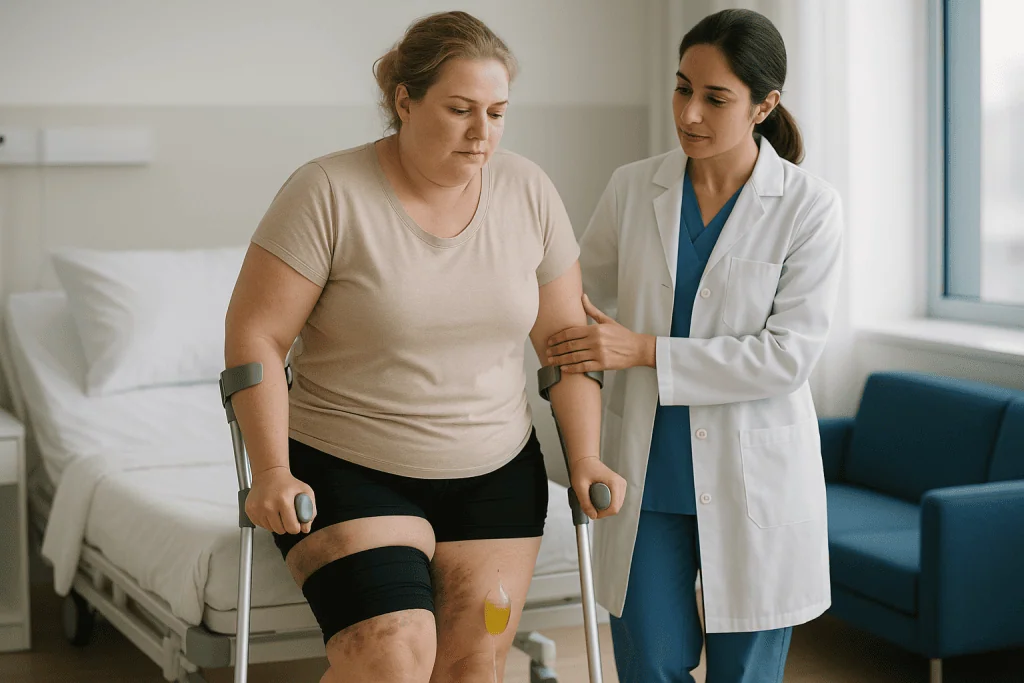
Pain in this phase is usually described as deep soreness and tightness rather than sharp pain, partly because the local anesthetic in the tumescent fluid continues to work for some hours. As it wears off, the legs often feel bruised through to the bone, and the first attempt to stand can bring a rush of heaviness and lightheadedness. Stand slowly, with someone nearby.
Walking starts early. Mayo Clinic guidance on liposuction recovery describes getting up and moving soon after surgery to lower the risk of blood clots, and most lipedema protocols ask for short, flat walks around the home from the first day, interspersed with rest and leg elevation. The goal is circulation, not distance.
Three other things usually happen in this window. The first follow-up call or visit checks the dressings and the colour of the drainage. The garment gets its first adjustment because the swelling shifts as fluid leaves. And you notice that the mirror is not useful yet: treated areas can look larger than before, because swelling has temporarily replaced the removed fat. That is expected and belongs to the normal lipedema surgery recovery timeline rather than to a complication.
Why does fluid leak from the incisions, and when does it stop?
The leak unsettles people more than almost anything else, so it deserves a plain explanation. During a tumescent procedure the surgeon infuses considerably more fluid than fat volume removed. Some of it leaves with the suction. The rest sits in the tissue and must exit either through the incisions or by slow absorption into the bloodstream and lymphatic system. Drainage through the incisions is the faster, safer route, which is why surgeons often leave them open and why Mayo Clinic notes that temporary drains are sometimes placed to encourage it.
The colour tells you what is in it. Pale pink or straw-coloured fluid is mostly tumescent solution tinged with a small amount of blood. It can look dramatic on white sheets while representing very little actual blood loss. A deeper red that soaks a pad quickly, or drainage that becomes cloudy, thick or foul-smelling later in the week, is different and should prompt a call.
How long does it last? Typically a few days, with the heaviest flow in the first 24 to 48 hours and a taper afterwards, though volume depends on how much fluid was used, how many areas were treated and whether incisions were closed. Your own surgeon will have given you a range specific to the technique used; treat that as the reference point.
Once the leaking stops, the incisions seal within days. A small firm lump or a spongy, fluid-filled area that appears later is a different phenomenon called a seroma, a pocket of clear fluid under the skin. Small ones often resolve on their own; larger ones may be drained in clinic with a needle. Neither is an emergency, but both belong in your next conversation with the team.
How much bruising is normal after lipedema liposuction?
Lipedema tissue bruises easily even without surgery, a point the NHS makes in its description of the condition, so it is no surprise that bruising after liposuction can be extensive. The cannula disrupts tiny blood vessels throughout the treated fat, and the blood that escapes spreads along tissue planes before it is broken down. Gravity pulls it downward, which is why thigh surgery can produce bruises that appear around the knee or even the ankle several days later, in areas that were never touched.
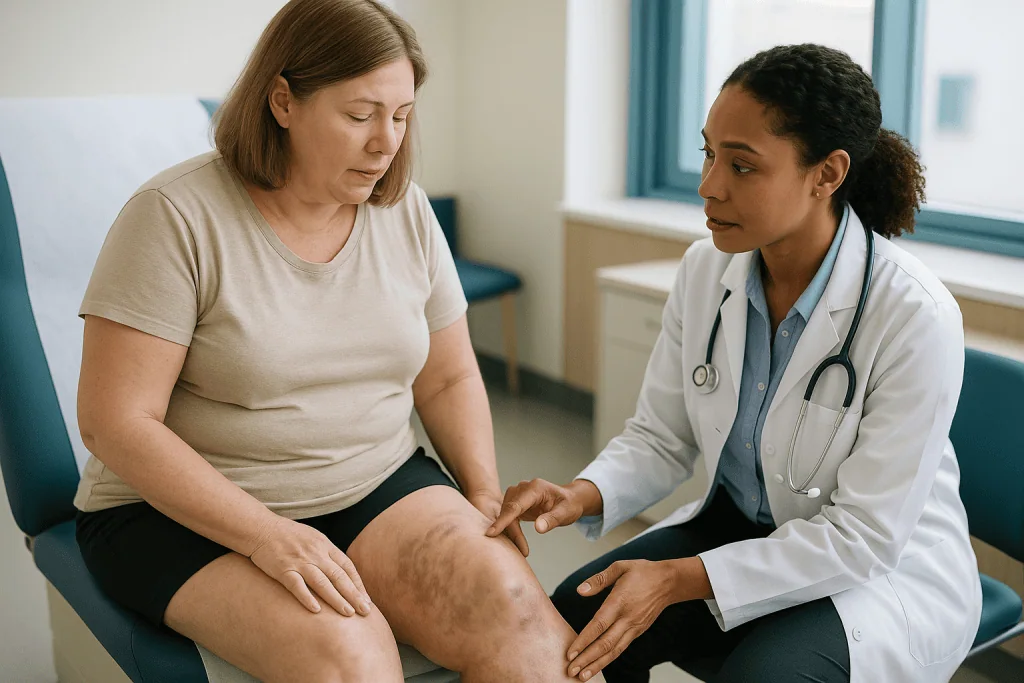
The colour sequence is the body’s clean-up process made visible. Fresh bruises are red or purple because of intact red blood cells under the skin. Over the first week, enzymes break the hemoglobin down into biliverdin (green) and then bilirubin (yellow), and the patch fades from the centre outward. Some people see the full progression within two weeks; in larger treated areas, faint yellow staining can linger for a month or more, and Mayo Clinic describes bruising as part of the normal picture that settles over several weeks.
Two features of lipedema bruising surprise people. First, the skin can feel hard and ropey underneath, a mix of swelling and early scar tissue that softens over months. Second, the bruise map is often strikingly symmetrical, a reminder that the surgeon treated both limbs in the same pattern.
What is not typical: a bruise that grows rapidly in a single spot, a tense, shiny, very painful area, or new bruising far from the surgical field after the first week. Those can signal ongoing bleeding or a clotting issue and are worth a same-day call.
Lipedema surgery recovery timeline week by week
Every recovery is individual, and multi-stage surgery means you may repeat parts of this timeline more than once. The ranges below are drawn from general liposuction guidance published by Mayo Clinic and the NHS and from the way lipedema programs commonly structure follow-up; your team’s instructions take precedence.
| Phase | What is commonly happening | Typical activity |
|---|---|---|
| Days 1–3 | Fluid drainage through incisions, peak heaviness, compression worn continuously | Short indoor walks every hour or two while awake, legs elevated at rest |
| Days 4–7 | Drainage tapers, bruising reaches its most colourful, incisions seal | Longer flat walks, light household tasks, no lifting or bending that strains |
| Weeks 2–3 | Bruises turn green and yellow, swelling fluctuates with the day, numbness and tingling are common | Many desk-based people return to work (Mayo Clinic: a few days to a few weeks); outdoor walking builds |
| Weeks 4–6 | Firmness and lumpiness under the skin, compression often still worn most of the day | Low-impact exercise usually reintroduced with team approval (Mayo Clinic: a few weeks for normal activity) |
| Months 2–6 | Swelling resolves gradually, skin softens and settles, contour becomes visible | Full activity; NHS notes it can take up to six months to see the final result |
Notice how little of the table is about appearance. The early weeks are measured in pads, steps and sleep quality, not in what the legs look like. People who understand that in advance tend to describe the lipedema surgery recovery timeline as tiring but manageable; those who expect a reveal in week two tend to describe it as disheartening. Same recovery, different expectation.
Who is usually offered lipedema liposuction, and who is asked to wait?
Surgery is rarely the first step. Guidance from the NHS and the Cleveland Clinic frames conservative management as the foundation: fitted compression, movement, skin care, managing weight-related conditions, and in many programs manual lymphatic drainage, a gentle massage technique that encourages fluid to move through lymphatic channels. Liposuction tends to be considered when symptoms such as pain, heaviness, easy bruising or impaired mobility persist despite a sustained trial of those measures.
Candidates are usually people with a confirmed diagnosis, since lipedema is still frequently mislabelled as simple obesity or lymphedema and the treatments differ. Teams also look for stable general health, reasonable control of conditions such as high blood pressure or diabetes, and an understanding that several staged operations may be needed over a year or more.
Who is commonly asked to wait? People with an active infection or skin breakdown in the treatment area, because open incisions and compromised skin invite complications. People with untreated clotting disorders or a recent blood clot, since liposuction carries a thromboembolic risk that the CDC describes for surgery in general. People whose weight is changing rapidly in either direction, because the result and the garment fit become unpredictable. And people who are smoking heavily, as nicotine constricts blood vessels and slows wound healing; most surgeons ask for a period of abstinence first.
Pregnancy and breastfeeding are usual reasons to defer, as is significant uncontrolled lymphedema layered on top of lipedema, which may need its own treatment first. None of these is a judgement. They are timing decisions, and the surgical team is the only one that can weigh them against your particular history.
When can I start walking after lipedema surgery, and how far?
Sooner than most people expect, and shorter than most people fear. The reason is blood clots. Surgery, reduced mobility and injury to blood vessels are the three classic triggers for deep vein thrombosis, a clot in the deep veins of the leg, and the CDC lists recent surgery and immobility among the leading risk factors. Lipedema liposuction involves all three in the legs themselves, which is why early, gentle walking is treated as a safety measure rather than an optional comfort.
In practice, walking after lipedema surgery usually begins the same day or the next morning: a few minutes of slow, flat walking around the home, repeated roughly every hour or two while you are awake, with the legs raised on pillows in between. The calf muscles act as a pump for venous blood and lymph, and each step squeezes fluid upward out of the treated tissue. People often notice that drainage increases briefly after a walk; that is the pump doing its job.
Distance grows over the first two weeks. Many programs encourage short outdoor walks by the end of week one and continuous walks of 20 to 30 minutes by weeks two to three, provided pain and swelling allow. Hills, stairs in volume, and anything that makes the legs throb afterwards are signals to step back for a day.
Two practical points. Wear the compression garment while walking, because it supports the tissue and limits the swelling that movement can provoke. And avoid standing still for long periods, which lets fluid pool in the lower legs; moving is better than standing, and sitting with legs up is better than standing too. Formal exercise beyond walking generally waits for the team’s go-ahead, typically a few weeks in according to Mayo Clinic’s liposuction guidance.
Compression after lipedema surgery: how long and why it matters
The compression garment is not a cosmetic accessory. After liposuction the fat layer is riddled with small tunnels and channels left by the cannula, and the skin above it has lost its scaffold. External pressure closes those channels, limits bleeding and fluid accumulation, and helps the skin re-adhere evenly to the tissue beneath. The NHS liposuction guidance describes wearing a compression garment for several weeks, and lipedema programs often extend that because the tissue was already prone to swelling before the operation.
A typical pattern has three stages. Continuous wear, day and night, removed only briefly for showering once incisions have sealed, for the first few weeks. Daytime wear with nights off for a further period, often guided by how much the legs swell overnight without it. And then a return to the long-term compression many people with lipedema already used before surgery, since the condition is chronic and compression remains part of ongoing management.
Fit is the frequent problem. The garment that was right on day one is often loose by day ten, because the tumescent fluid has drained and swelling has shifted. A loose garment does little; a garment so tight that it leaves deep ridges, causes numbness in the toes or rolls at the edges can create its own fluid dams. Many people need a second, smaller garment within the first month, and it is worth asking in advance how re-fitting is handled.
Skin under compression needs attention too. Wash and dry the skin fully at each change, moisturise once incisions have closed, and check skin folds and the backs of the knees for redness or chafing. A rash that spreads or a hot, painful patch of skin under the garment is a reason to call rather than to tolerate.
Pain, numbness and the strange skin sensations of recovery
The pain of lipedema liposuction recovery is usually described as a severe, generalised ache, as if the legs had done something enormous the day before. It is at its worst in the first few days, improves steadily over the first two weeks, and then gives way to a different set of sensations that catch people off guard.
Numbness is first. The cannula passes through the fine sensory nerve endings in the fat layer, and areas of skin can feel wooden or distant for weeks. Mayo Clinic lists temporary or, less often, permanent numbness among recognised liposuction effects. As nerves recover, numbness often turns into tingling, itching, electric zaps or hypersensitivity to the garment fabric. These are signs of nerves reconnecting, uncomfortable but usually reassuring.
Firmness and lumpiness come next. Around weeks three to six the treated tissue frequently feels hard, uneven or ropey, and some people worry that the surgery has made things worse. This is a combination of residual swelling and early scar tissue laid down in the tunnels left by the cannula. It softens over months; gentle movement, compression and in many programs manual lymphatic drainage are the tools used to encourage that.
Pain management is set by the team. Where medicines are involved, they are usually short courses of ordinary painkillers chosen with your other conditions in mind; some anti-inflammatory types are sometimes avoided early on because they can increase bruising, but that call belongs to your prescriber. Cold packs over the garment, elevation and pacing of activity tend to do a surprising amount of the work. Pain that escalates after the first week rather than easing, or pain concentrated in one calf, is not a normal part of this picture.
Lipedema liposuction swelling and manual lymphatic drainage: what the evidence shows
Swelling is the longest guest at this party. The tumescent fluid leaves within days, but inflammatory swelling, the body’s response to tissue injury, persists for weeks and resolves over months. The NHS notes that the full result of liposuction can take up to six months to appear, and in lipedema the lymphatic system was already working under strain, so fluid can clear more slowly than it would in someone without the condition.
Swelling also fluctuates. Legs are usually slimmest in the morning after a night elevated and tightest by evening, and they can balloon after a long car ride, a salty meal or a day of standing. These daily swings are expected and are not a sign that fat has returned.
Manual lymphatic drainage, or MLD, is a specialised, very light massage that follows the direction of lymph flow to encourage fluid out of swollen areas. It is widely used in lipedema care before and after surgery, and the Cleveland Clinic lists it among conservative treatments. What does the evidence say about its effect on surgical recovery specifically? Honestly, less than practice suggests. Small studies and clinical experience support its use for comfort and for speeding the resolution of swelling, but high-quality trials in post-liposuction lipedema patients are limited. It is reasonable to think of MLD as low-risk and plausibly helpful rather than proven essential.
Timing matters if you use it. Most teams prefer to wait until incisions have sealed and the heaviest bruising has passed, and they want it delivered by a therapist trained in lymphatic work, since firm or deep massage on freshly treated tissue can worsen bruising. Ask your team whether, when and with whom, and let their answer set the plan.
How soon can you return to work after lipedema surgery?
It depends far more on what your job asks of your legs than on the calendar. Mayo Clinic’s general liposuction guidance describes waiting a few days before returning to work and a few weeks before resuming normal activity including exercise. Lipedema surgery often treats larger areas and may involve both legs in full, so many surgeons quote the upper end of that range, and some people treated on the lower legs need longer than those treated on the thighs because gravity makes the shins and ankles swell more with sitting.
Return to work after lipedema surgery tends to follow three patterns. Desk-based roles with the option to elevate the legs and get up every hour are frequently resumed within one to two weeks, sometimes remotely at first. Jobs that involve prolonged standing, such as teaching, retail or healthcare, usually need two to four weeks, and a phased return with shorter shifts is often easier on the swelling than a full week back at once. Physically heavy work, lifting, climbing or driving for long hours, may need four to six weeks, matching the period in which strenuous activity is generally restricted.
A few practical questions help the planning. Can you wear the compression garment unobtrusively at work, and change pads if you are still draining in the first days? Is there somewhere to put your feet up at lunch? Can you avoid sitting with legs dependent for hours at a stretch, which encourages pooling? And have you planned around the fatigue, which many people report lingering for weeks after the visible healing has moved on?
Your surgeon can provide documentation for an employer. The timeline they give will reflect the areas treated and the volume removed, not a generic figure, and that is the number to use.
What not to do when you have lipedema, especially during recovery
The things to avoid after surgery overlap heavily with the things that make lipedema harder to manage in general, so this list serves double duty.
Do not abandon compression early because the garment is uncomfortable or because the legs look fine in the morning. The afternoon swelling you prevent today is tissue that heals more smoothly next month. If the garment hurts, the fix is a refit, not removal.
Do not stand still for long periods, whether at a kitchen counter or in a queue. Shift your weight, do calf raises, or sit with legs raised instead. Static standing pools fluid in the lower legs faster than almost any other activity.
Do not apply heat to treated areas in the first weeks: hot baths, saunas, heating pads and hot tubs all dilate blood vessels and increase swelling and bruising. Soaking also softens unsealed incisions. Showers, once permitted, are fine; immersion usually waits several weeks.
Do not lift heavy objects, do deep squats or start high-impact exercise before your team clears it. Swimming is often one of the earliest activities approved once incisions have fully closed, because water pressure supports the tissue, but that is a decision for the surgeon.
Do not smoke or vape nicotine. Nicotine narrows the small blood vessels that carry oxygen to healing skin and fat; it slows wound healing and raises infection risk in any surgery.
Do not chase quick weight loss through crash dieting. Lipedema fat does not respond to calorie restriction the way other fat does, the NHS notes, and rapid loss during recovery can leave skin loose and garments ill-fitting. Steady, nourishing eating with adequate protein supports healing better than restriction.
And do not compare your week-two legs to someone else’s month-six photographs online. Different stage, different surgeon, different body.
What people often get wrong about lipedema surgery recovery
Myth: the fluid leaking out is blood, and I am losing a dangerous amount. Most of it is tumescent solution, lightly tinged. Genuine bleeding is darker, faster and does not taper over the first days. Pale pink drainage that slows is the normal picture.
Myth: more bruising means the surgeon was rough. Lipedema tissue bruises easily by nature; the NHS lists easy bruising as a defining feature of the condition. Extensive bruising reflects the tissue, the size of the area treated and gravity, not technique.
Myth: if the legs look bigger after surgery, the operation failed. Swelling replaces the removed volume for weeks. The NHS puts the final appearance at up to six months. Judging at week two is judging the swelling, not the result.
Myth: rest is the safest thing I can do. Immobility after leg surgery is a recognised risk factor for blood clots, per the CDC. Short, frequent walks are protective. Rest with the legs elevated between walks is the right balance, not bed rest.
Myth: liposuction treats lipedema permanently, so compression and self-care can stop. Lipedema is chronic. Surgery removes abnormal fat and can reduce pain and heaviness, but it does not change the underlying tendency, and most teams continue conservative management afterward. The Cleveland Clinic describes it as a lifelong condition that is managed, not resolved.
Myth: a single operation is the whole treatment. Because the fat is distributed over large areas and there are safety limits on how much can be removed at once, staged sessions are the norm. Planning for one and getting three is a common source of frustration that good pre-operative counselling can prevent.
Myth: everyone with lipedema needs surgery. Many people manage well with compression, movement and lymphatic care. Surgery is one option, considered when conservative measures have not controlled symptoms, and the decision belongs to the person and their team.
Questions to ask your care team before and after lipedema liposuction
Written answers to these save a great deal of worry in the first week, when it is hard to remember what was said in clinic.
Before surgery, ask which technique will be used and whether incisions will be left open to drain, so you know what to expect on the sheets. Ask how many stages are anticipated and roughly how far apart. Ask what the plan is for clot prevention, whether that is early walking alone or also includes compression stockings or a medicine, and what the team wants you to do about any blood-thinning or hormone medicines you already take; never change those on your own. Ask whether you will have drains and who removes them.
About the garment, ask how many hours a day and for how many weeks, when it may come off for showering, and how re-fitting is handled when swelling drops. Ask whether a second garment is included or must be arranged.
About the days after, ask what colour and volume of drainage is normal and what is not, when you can shower, and when you may start manual lymphatic drainage, swimming and exercise. Ask what pain to expect and what signs of infection or clot you should watch for, so that this article’s red flags match the ones your team uses.
About the longer term, ask when the result can realistically be judged, how lipedema will be managed between stages and after the final one, and who to contact out of hours. Ask also how the team defines a good outcome, so that your expectations and theirs are the same before anything begins.
Finally, ask what would make them postpone. Knowing the reasons a surgeon might delay tells you a lot about how carefully the risks are being weighed on your behalf.
When to call your doctor after lipedema liposuction
Most of what you see in the first weeks is expected: leaking fluid, spreading bruises, swelling that comes and goes, tingling skin. A short list of signs falls outside that picture and needs prompt attention.
Call the same day for drainage that is bright red, heavy and not slowing after the first day or two; for a bruise or swollen area that enlarges quickly and becomes tense and very painful; for fever, chills, or drainage that turns cloudy, thick or foul-smelling; for spreading redness, heat or a hard, painful patch around an incision or under the garment; for new numbness or weakness that is spreading rather than patchy; or for pain that is getting worse after the first week instead of better.
Seek emergency care immediately for signs the CDC describes as possible blood clot: pain, swelling, warmth or redness concentrated in one calf or thigh that is different from the other side; or any sudden shortness of breath, chest pain that worsens with breathing, rapid heartbeat, coughing up blood or fainting, which can indicate a clot travelling to the lungs. A clot in the deep veins of the leg is harder to spot after leg surgery because both legs are already swollen and sore, so asymmetry and sudden change are the cues to trust.
Also call if you cannot keep fluids down, if you feel faint every time you stand, if urine output drops sharply, or if the garment is causing numb or dusky toes and loosening it does not help within minutes.
When in doubt, calling is the right choice. Surgical teams would rather hear about a pink pad that turned out to be normal than learn about a problem a day late. Every decision about treatment, including whether what you are seeing needs to be seen, sits with them.
Frequently asked questions
How long does fluid leak after lipedema liposuction?
Typically a few days, heaviest in the first 24 to 48 hours and tapering afterward. The fluid is mostly the saline-based tumescent solution infused during surgery, lightly tinged with blood, leaving through incisions that are often left open on purpose. Volume depends on how many areas were treated and whether incisions were closed, so your surgeon’s stated range is the one to rely on.
How long does lipedema liposuction swelling last?
Inflammatory swelling eases over weeks but can fluctuate for months, often worse in the evening and after sitting or standing for long periods. The NHS notes the full effect of liposuction can take up to six months to show. Because the lymphatic system in lipedema is already under strain, fluid may clear more slowly than in people without the condition.
When can I shower and bathe after lipedema surgery?
Showering is usually permitted once incisions have sealed and drainage has stopped, often within the first several days, with the garment removed briefly and the skin dried fully before it goes back on. Immersion in baths, pools, saunas or hot tubs generally waits several weeks because soaking softens incisions and heat increases swelling. Your team sets the exact timing.
Can magnesium help with lipedema?
There is no good evidence that magnesium treats lipedema or speeds recovery from lipedema surgery. Magnesium is an essential mineral involved in muscle and nerve function, and the NIH Office of Dietary Supplements notes most people can meet needs through diet. If you are considering a supplement, especially after surgery or alongside other medicines, discuss it with your care team first.
Is lipedema a disability?
Lipedema can be disabling when pain, heaviness or restricted mobility limit daily activities, but whether it is formally recognised as a disability depends on the laws and benefit systems where you live and on documented functional impact rather than the diagnosis alone. A clinician’s records of symptoms and limitations are usually what any assessment relies on, so keeping them is worthwhile.
Does dehydration make lipedema worse?
There is no evidence that dehydration causes lipedema or that drinking extra water removes lipedema fat. Adequate hydration does support wound healing, circulation and general recovery after surgery, and avoiding very salty meals can reduce daily swelling swings. Think of fluid intake as supporting the body’s normal processes rather than as a treatment for the condition itself.
How long is compression after lipedema surgery usually worn?
The NHS describes several weeks of compression after liposuction, and lipedema programs often extend this, moving from day-and-night wear to daytime-only and then to the long-term compression many people already used. Garments frequently need resizing within the first month as swelling drops. Your surgeon’s instructions on hours per day and total duration override any general figure.
How many lipedema liposuction sessions are usually needed?
Several, in most cases. Lipedema fat is spread across large areas such as both thighs and both lower legs, and there are safety limits on how much can be removed in one operation, so surgeons stage the work over months. The number depends on the extent of the condition and the regions involved, and only your treating team can estimate it for you.
Can lipedema come back after liposuction?
Lipedema is a chronic condition, so the underlying tendency remains even though the removed fat cells do not regrow in the same way. Weight gain, hormonal changes and abandoning compression can all increase symptoms afterward. Most programs continue conservative management after surgery for exactly this reason, and the Cleveland Clinic describes lipedema as lifelong and managed rather than resolved.
Is walking after lipedema surgery safe in the first week?
Short, slow, flat walking is encouraged from the first day because immobility after leg surgery raises the risk of blood clots, a risk the CDC highlights for surgery in general. Aim for a few minutes every hour or two while awake, wearing the compression garment, with legs elevated in between. Avoid hills, prolonged standing and anything that leaves the legs throbbing.
References
- Lipedema: Symptoms, Causes and Treatment (Cleveland Clinic)
- Lipoedema (NHS)
- Liposuction (NHS)
- About Venous Thromboembolism (Blood Clots) (CDC)
This article is for general information only and is not a substitute for professional medical advice. Please consult a qualified doctor about your individual situation.

More from the Blog

Mommy Makeover Complications Explained: Normal Healing vs When to Call Your Surgeon
Most mommy makeover complications are minor and treatable when caught early: fluid collections (seromas), bruising, delayed wound healing, and temporary numbness. Rarer but serious…

What Body Aesthetics Surgery Can and Cannot Change: An Honest Look at Its Limits
Body aesthetics surgery can reshape localized fat deposits, remove loose skin, tighten separated abdominal muscles and lift sagging tissue on the belly, arms, thighs…

Body Aesthetics Myths Corrected: Why Fat Removal Is Not Weight Loss
Fat removal procedures such as liposuction reshape specific areas by taking out subcutaneous fat, the layer just under the skin, but they are not…

Classic Liposuction vs Energy-Assisted Techniques: When the Traditional Method Still Fits
Classic liposuction removes fat with a thin tube and suction alone; energy-assisted techniques add ultrasound, laser, radiofrequency or a motorized cannula to loosen fat…

Life After HD Liposculpture: How Training and Weight Changes Affect the Sculpted Lines
Life after HD liposculpture depends on two things the operation does not control: your body weight and your muscle. The fat cells removed do…

BBL Recovery Time: Honest Milestones From Surgery to Final Shape
Most people return to desk work about one to two weeks after a Brazilian butt lift, sit normally again around six to eight weeks,…