

Orchiopexy Recovery for Children: Swelling, Incision Care and When Rough Play Can Resume

Key Takeaways
- Orchiopexy is usually day surgery, and most children are home within hours and walking comfortably within two to three days.
- Scrotal swelling and bruising typically peak around day two or three and fade over one to two weeks; a worsening trajectory, not the swelling itself, is the warning sign.
- Incisions are commonly closed with dissolvable stitches under skin glue, so nothing needs removing and the wound usually needs only gentle washing and prompt diaper changes.
- Straddle toys, bikes, trampolines and contact play are generally paused for a few weeks, with the exact window set by the surgical team rather than by how well the child seems.
- About 3 percent of full-term boys and up to 30 percent of premature boys are born with an undescended testicle, and most descend on their own within the first months of life.
- Guidelines favor surgery before the first birthday because testicular tissue kept at abdominal temperature shows progressive germ-cell changes in observational studies.
Most children recover from orchiopexy, the operation that moves an undescended testicle into the scrotum, over roughly two to four weeks. Expect scrotal swelling and bruising for several days, a small groin incision that usually needs only gentle washing, and a gradual return to normal activity. Rough play, straddle toys and bikes are usually paused for a few weeks, with the exact timing set by the surgical team.
The hardest part, many parents say later, was not the operation. It was the hour afterward, when a drowsy toddler surfaced from anesthesia with a surgical dressing in his diaper area and nobody in the room was quite sure how much he should be allowed to wiggle. Can he sit on your hip? Can he sit on a potty? Can he, by Saturday, go back to launching himself off the couch?
Orchiopexy recovery in a child raises exactly these small, practical questions, and the printed discharge sheet rarely answers all of them. This explainer walks through what the surgery does, why swelling looks worse than it is, how to care for the incision, and when the climbing, cycling and wrestling can come back. It also explains what the long-term evidence actually says about fertility and cancer risk, without inflating or minimizing it.
Every child heals on his own clock, and your surgical team will tailor the details. Think of what follows as the briefing that helps you ask them better questions.
What orchiopexy recovery in a child actually involves
Orchiopexy (also spelled orchidopexy) is an operation that brings a testicle that has not descended into the scrotum down into its normal position and secures it there. The word “undescended testicle,” or cryptorchidism, simply means a testicle that stayed in the abdomen or groin instead of completing its journey before birth.
Recovery is usually shorter than parents fear. Both the Mayo Clinic and MedlinePlus describe orchiopexy as an outpatient procedure in most cases, meaning the child goes home the same day. The visible healing happens in two places: a small incision in the groin fold, and often a second tiny incision on the scrotum where the testicle is anchored. Underneath, the body is also repairing a stretched spermatic cord and sometimes a small hernia sac that the surgeon closed at the same time.
The first three days are about comfort, swelling and keeping the wound clean. The following two weeks are about letting tissues knit while the child gradually resumes normal movement. The final step, usually a few weeks to a few months later, is a follow-up visit where the surgeon checks that the testicle has stayed where it was placed and feels healthy in size.
What recovery is not: it is not bed rest, it is not a sterile regimen, and it is not a period in which a normal, curious child needs to be kept still. The main parental job is to protect the groin from direct impact and straddling for a few weeks and to recognize the small number of warning signs covered later in this article.
How orchiopexy works: what happens in the operating room
Under general anesthesia, the surgeon makes an incision of a few centimeters in the groin crease, close to where a diaper edge sits. Through it, the undescended testicle is located along with its spermatic cord, the bundle containing the blood vessels and the vas deferens (the tube that will later carry sperm). The cord is gently freed from surrounding tissue so it has enough length to reach the scrotum.
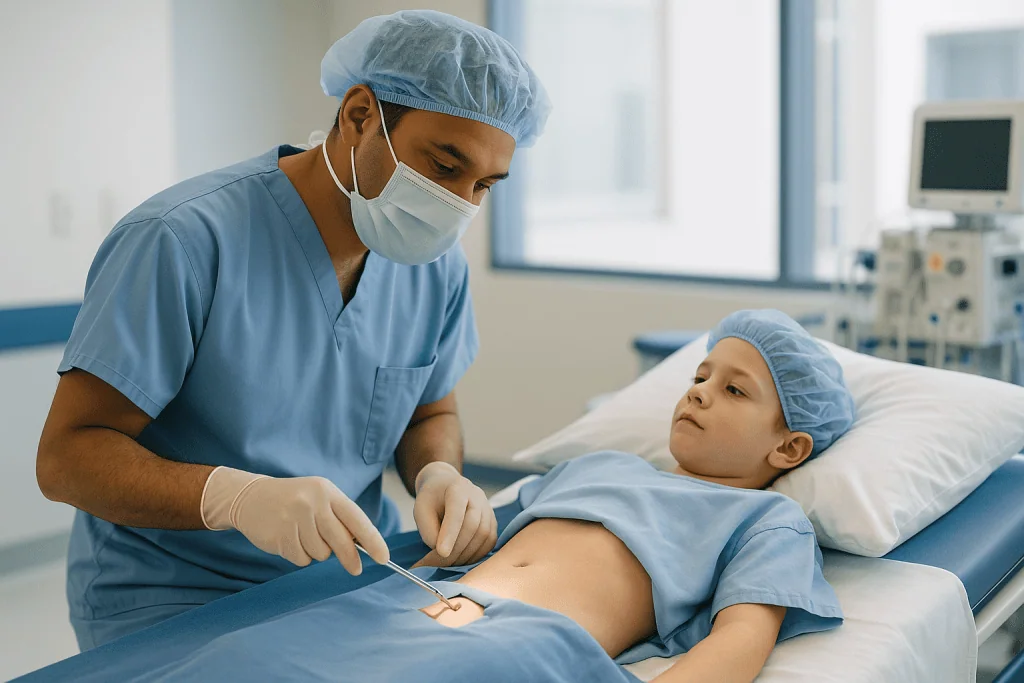
Very often there is also a patent processus vaginalis, a small open channel that should have sealed before birth. The surgeon ties it off, which is the same step used to repair an inguinal hernia. The testicle is then drawn down into a pouch created between the skin and muscle layer of the scrotum and held there with a stitch or by the snug fit of the pouch itself. MedlinePlus describes this sequence in plain terms in its guide to undescended testicle repair.
When the testicle cannot be felt on examination, the surgeon may begin with laparoscopy: a thin camera inserted through a small incision near the navel to look inside the abdomen. The Mayo Clinic notes that laparoscopy helps locate a hidden testicle, and the repair may follow in one or two stages depending on how high the testicle sits and how long its blood vessels are.
Anesthesia staff often add a local anesthetic block near the incision while the child is asleep, so he wakes with the area numb. Operating time is commonly under an hour per side, although parents should expect the whole visit, including recovery-room observation, to take most of a day.
Who is usually offered orchiopexy, and who is asked to wait
Undescended testicles are common. The Mayo Clinic cites a figure of about 3 percent of full-term boys and up to 30 percent of boys born prematurely, because descent normally completes in the final weeks of pregnancy. Most of these testicles finish descending on their own in the first months of life. The NHS notes that in roughly 1 in 100 boys the testicle has still not come down by 6 months, and spontaneous descent after that point is uncommon.
That is why surgery is rarely considered in the newborn period. A baby whose testicle is undescended at birth is usually reviewed again at around 3 to 6 months. If it has settled into the scrotum, no treatment is needed. If it has not, referral to a pediatric urologist or pediatric surgeon follows.
Children generally asked to wait include:
- Infants under about 6 months, who may still descend naturally.
- Boys with a retractile testicle, which sits in the scrotum but is pulled up by a brisk muscle reflex and can be coaxed down on examination. The NHS and Mayo Clinic both describe this as a normal variant that usually needs monitoring rather than surgery.
- Children with other significant medical conditions where anesthesia timing needs coordination.
Children typically offered surgery include those with a testicle that is persistently undescended after 6 months, an ascending testicle that was once in the scrotum and has moved up (sometimes noticed at school age), and older boys or adolescents in whom an undescended testicle was missed earlier. Hormone treatment with human chorionic gonadotropin has been used historically; the Mayo Clinic describes it as less effective than surgery and not commonly recommended.
Why timing matters: what the evidence says about early surgery
The Mayo Clinic recommends that orchiopexy take place before a boy’s first birthday where possible, and the NHS similarly advises that treatment is ideally done before 12 months of age. The reasoning rests on how testicular tissue behaves at body temperature. The scrotum keeps the testicles a degree or two cooler than the abdomen, and the cells that will eventually produce sperm appear to be sensitive to that difference.

Observational studies summarized by these sources suggest that testicles kept in the abdomen or groin through early childhood show progressive changes in the germ cells, the precursors of sperm. Moving the testicle down earlier is intended to give it a better environment for development. This is an evidence-informed rationale rather than a guarantee: the research shows an association between earlier surgery and more favorable tissue findings, not a promise about any individual boy’s future fertility.
There are practical reasons for the timing window as well. A testicle in the scrotum can be examined by hand, which matters for monitoring health throughout life. Hernia risk is addressed at the same operation. And anesthesia for a healthy infant over 6 months is routine for experienced pediatric anesthesia teams.
None of this means a boy diagnosed later has missed the chance for treatment. Orchiopexy is performed in toddlers, school-age children and adolescents, and the recovery steps described in this article apply to all of them, with older children typically able to describe their discomfort and follow activity instructions more precisely. If your child’s diagnosis came later than the ideal window, that is a conversation for the surgical team, not a reason for self-blame.
Orchiopexy swelling after surgery: what is normal in the first week
Few things alarm parents more than the first diaper change after surgery. The scrotum may look puffy, purple or asymmetric, and the groin fold can be firm to the touch. In most children this is expected. MedlinePlus lists swelling and bruising around the incision and scrotum among the ordinary effects of undescended testicle repair.
Why so much swelling from such a small operation? The scrotal skin is thin and loose, with very little fat beneath it, so fluid from healing tissue spreads easily and shows through. The surgeon also had to free the spermatic cord and create a pocket for the testicle, which disturbs small blood vessels. A degree of bruising is the visible result.
Typical pattern: swelling is often most noticeable on the second or third day, then settles over one to two weeks. Mild firmness at the incision line can linger longer as the deeper stitches dissolve. The testicle itself may feel slightly higher than its partner for a while before settling.
Simple measures help. A snug diaper or supportive underwear reduces movement and is usually more comfortable than loose clothing. Some teams suggest a cool pack wrapped in cloth against the groin for short periods in the first day or two; follow your team’s advice rather than improvising with ice directly on skin. Keeping the child from straddling your hip or sitting on hard edges limits pressure on the area.
Swelling that is rapidly increasing, hard and tense, spreading up into the abdomen or accompanied by a high fever is a different matter, covered in the red-flag section below.
Orchiopexy incision care: keeping the groin and scrotum clean
Most pediatric surgeons close the groin incision with dissolvable stitches placed under the skin, then cover it with skin glue, a thin adhesive strip or a small waterproof dressing. Dissolvable means the stitches break down over weeks and do not need removal. The scrotal incision, when present, is usually tiny and closed the same way.
The daily routine is simpler than parents expect. MedlinePlus advises keeping the area clean and dry and following the surgeon’s instructions on bathing. In practice that usually means:
- Leave skin glue or adhesive strips alone; they lift off on their own over one to two weeks.
- Wash gently with plain water or mild soap and pat dry. Avoid scrubbing, antiseptic wipes or ointments unless the team specifically recommends them.
- Change diapers promptly so urine and stool do not sit against the incision. Some teams suggest a barrier layer of petroleum jelly on the diaper itself, not on the wound, to reduce friction.
- Choose loose, soft trousers or shorts and avoid waistbands that cross the incision.
A little dried blood on the dressing or a faint pink tinge at the edges is common in the first days. Clear or slightly yellow fluid in small amounts can also appear as glue separates. Thick, cloudy drainage, a foul smell, redness spreading beyond the wound edge, or the incision pulling apart are signs to report promptly.
Children rarely pick at these wounds, because the groin crease is hard to reach and the glue feels like nothing. If a dressing falls off early, cover it loosely with a clean pad and ask the team whether it needs replacing; often it does not.
Managing comfort without guesswork
Pain after orchiopexy is usually described as moderate on the first day and mild afterward. The local anesthetic block placed during surgery typically wears off within the first evening, so the first night can be the most uncomfortable stretch. MedlinePlus notes that the surgeon will advise on pain relief and that most children need it only for a few days.
The medicines commonly recommended for children in this setting are acetaminophen and ibuprofen, both available without prescription. They work differently: acetaminophen acts centrally on pain signaling, while ibuprofen is an anti-inflammatory that reduces swelling at the tissue level. Many surgical teams suggest using them according to a schedule for the first day or two rather than waiting for distress to appear, because pain is easier to prevent than to chase. The amount, timing and whether to alternate or combine them are decisions for the prescribing clinician based on your child’s age and weight; this article deliberately gives no figures.
Comfort is more than medication. A warm, familiar caregiver, a favorite blanket and quiet play in a reclined position settle most toddlers. Older children often do well with a tablet or a book and a snack. Constipation can add to discomfort after anesthesia, so offer fluids and fiber-rich foods and mention to the team if there is no bowel movement within a couple of days.
Signs that pain is not under control include a child who refuses to walk when he was walking the evening before, cannot be comforted for long stretches, or guards the groin and screams with any touch. These should prompt a call to the surgical team rather than an increase in whatever you are already giving.
What the first two weeks of orchiopexy recovery usually look like
Timelines vary with the child’s age, whether one or both sides were repaired, and whether laparoscopy was involved. The ranges below reflect the typical outpatient course described by MedlinePlus and the Mayo Clinic, and your surgeon may adjust any of them.
| Period | What parents commonly see | Usual guidance |
|---|---|---|
| Day of surgery | Drowsy, possibly nauseated from anesthesia; groin numb from the block; dressing in place | Clear fluids first, then light food; quiet rest; comfort medicines as prescribed |
| Days 1–3 | Peak swelling and bruising; discomfort when moving legs; may walk with a wide stance | Gentle walking encouraged; supportive underwear; sponge bath or as instructed |
| Days 4–7 | Swelling easing; appetite and mood normalizing; incision edges pink | Short baths often allowed; return to daycare or school for calm activities as team advises |
| Week 2 | Bruising fading to yellow; glue or strips peeling; most children moving freely | Continue avoiding straddle toys, bikes, climbing frames and contact play |
| Weeks 3–4 | Incision flat and pale pink; scrotum near normal size | Gradual return to full activity when cleared by the surgeon |
| Follow-up visit | Surgeon checks testicle position and size | Typically weeks to a few months after surgery |
The pattern most parents describe is a sharp improvement between day two and day four, when the child who had been clinging and tearful suddenly wants to be put down. Watching that turn is reassuring. The groin may still look bruised for another week after the child feels fine, which is why activity limits outlast visible discomfort.
When can rough play, bikes and straddle toys resume?
This is the question in the title, and it deserves a direct answer. The concern is not the incision tearing open; glue and buried stitches handle ordinary movement well. The concern is force applied to the testicle in its new pocket before the surrounding tissue has firmly healed around it. A fall onto a bicycle crossbar, a sibling’s knee or a climbing-frame rung could, in theory, cause bleeding or displace the testicle upward.
MedlinePlus advises that children avoid activities that could strain or injure the groin, including straddle toys and bicycles, for a period set by the surgeon, often a few weeks. Many pediatric surgical teams quote a window in the range of two to four weeks, longer for older children in organized contact sports. Because practice varies, treat that range as context and your discharge sheet as the rule.
A practical way to think about the staging:
- Walking, floor play, stacking blocks and stroller rides: usually fine from the first or second day.
- Running and playground visits without climbing or straddling: often from around the end of the first week, if the child is comfortable.
- Tricycles, rocking horses, ride-on cars, bicycles, trampolines and gym class: usually paused until the surgeon clears them.
- Contact sports, martial arts and swimming lessons: typically wait until the follow-up visit confirms the incision is sealed and the testicle is settled.
Toddlers will not understand restrictions, so the burden falls on removing temptation: put the ride-on toys in a closet and reroute the day toward books, water play in a shallow basin and trips to the park where you can steer away from the frame. Older boys do better with a clear end date written on the calendar and a frank explanation of why.
Undescended testicle surgery recovery for babies: diapers, baths and sleep
Because the ideal operating window falls under 18 months, many families are managing orchiopexy recovery in a baby who cannot say what hurts. A few adjustments make the week easier.
Diapering: fasten diapers snugly rather than loosely; gentle pressure supports the scrotum and limits swelling. Change promptly after every wet or soiled diaper for the first week so the incision is not bathed in urine. Lift the baby by the hips and under the knees rather than by lifting a straightened leg, which stretches the groin.
Bathing: MedlinePlus and most surgical teams suggest sponge baths until the dressing comes off or for the first day or two, then short, shallow baths without soaking the glue. Pat the area dry with a soft cloth. Avoid bubble bath and lotions near the wound.
Feeding: anesthesia can cause brief nausea. Offer smaller, more frequent feeds on the first evening and expect appetite to return within a day or two. Breastfed and formula-fed babies alike may be slightly constipated afterward; mention to the team if stools do not resume within a couple of days.
Sleep: the first night is often disrupted. A baby carrier that spreads the legs wide (the frog position) can press on the groin, so a cradle hold or stroller is preferable for a few days. Co-sleeping arrangements should follow the same safe-sleep guidance as always.
Movement: crawlers and early walkers may pause for a day or two and then resume. That return is a good sign. The one thing to prevent is straddling: do not sit the baby astride a hip, a bouncy horse or a parent’s knee facing forward with legs spread wide until the team has cleared it.
Risks and what the follow-up visit checks
Orchiopexy is a common, well-established operation, and the Mayo Clinic describes serious complications as uncommon. Still, parents deserve a clear list of what can go wrong and how it would be noticed.
Short-term risks, per MedlinePlus, include bleeding, infection at the incision, reactions to anesthesia and swelling that is more pronounced than usual. Most of these appear within the first week and are covered by the red-flag signs later in this article.
Longer-term risks are the ones the follow-up visit is designed to catch:
- Testicular atrophy: shrinkage of the testicle because its blood supply was stretched or damaged when the cord was lengthened. The Mayo Clinic lists this among the recognized complications. It is more likely when the testicle sat very high and required a long mobilization.
- Re-ascent: the testicle slips back up toward the groin. This may call for a second operation.
- Injury to the vas deferens, the sperm-carrying tube, which runs alongside the vessels.
- Hernia recurrence at the site where the processus vaginalis was closed.
At the follow-up appointment, the surgeon feels both testicles for position and compares their size, inspects the incision and asks about recovery. Some teams repeat this check a year later and again around puberty, when the testicles grow and any size difference becomes clearer. An ultrasound is not routinely needed when the testicle can be felt in the scrotum.
Parents can help by noting, before the visit, whether the testicle seems to sit lower than it did, whether the scrotum looks even, and whether the child ever complains of groin pain. Bring those observations rather than trying to interpret them at home.
What people often get wrong about orchiopexy recovery
Several durable myths circulate on parenting forums and in family lore. Here is what the evidence actually supports.
“The swelling means something went wrong.” Scrotal swelling and bruising are expected after this operation, as MedlinePlus states plainly. The signal to watch is the trajectory: gradually improving is normal, rapidly worsening is not.
“He has to stay in bed for a week.” Bed rest is not recommended for children after outpatient groin surgery. Gentle movement helps circulation and mood. The restriction is on impact and straddling, not on walking.
“The stitches have to come out.” Most pediatric surgeons use dissolvable stitches beneath the skin and glue on top. Nothing needs to be removed, and the glue peels off on its own.
“If the testicle came down on its own in the newborn weeks, it can still go back up.” It can. Ascending or acquired undescended testicles exist, and the NHS advises that boys should continue to be examined at routine checks through childhood. A testicle that was clearly in the scrotum and later is not should be reviewed.
“Surgery guarantees normal fertility.” The Mayo Clinic frames the evidence more carefully: boys with a single undescended testicle treated in childhood have fertility rates that are near those of the general population, while those with both undescended, or late treatment, carry higher risk. No operation can promise a particular outcome.
“Once fixed, he never needs to think about it again.” A history of undescended testicle carries a modestly raised lifetime risk of testicular cancer regardless of surgery, which is one reason surgeons want the testicle in a position where it can be examined easily as an adult.
The longer view: fertility, cancer risk and what the evidence shows
Parents often save their most pressing question for the end of the consultation: will this affect him later? The honest answer has two parts.
On fertility, the Mayo Clinic reports that men who had one undescended testicle treated in childhood have fertility that is close to that of men without the condition, while those with both testicles undescended face a substantially higher likelihood of reduced fertility. The mechanism is the temperature effect on germ cells described earlier, together with any direct injury during surgery. Earlier orchiopexy is associated with more favorable germ-cell counts in biopsy studies, which underpins the current emphasis on operating before the first birthday. Association is not causation, and individual outcomes cannot be predicted from these studies.
On cancer, the Mayo Clinic and MedlinePlus both note that an undescended testicle carries an increased risk of testicular cancer in adulthood compared with a normally descended one. The absolute risk remains low, because testicular cancer itself is uncommon, and the relative increase appears smaller in boys treated earlier. Orchiopexy does not remove this risk entirely. Its practical benefit is that a testicle in the scrotum can be checked by hand, so any change is more likely to be noticed early.
What this means for families today: keep the follow-up appointments through childhood, make sure the history is recorded so future clinicians know about it, and, when the boy is old enough, let him know in plain terms that he had this surgery and that being familiar with how his testicles normally feel is sensible. That conversation is years away for a toddler, but it is the reason the surgeon will mention it now.
Questions to ask your care team before and after orchiopexy
A ten-minute discharge conversation is easier to use well when you arrive with specific questions. Consider asking:
Before surgery
- Is the testicle palpable, and do you expect to use laparoscopy? Is a staged operation possible?
- Will a hernia be repaired at the same time?
- What anesthesia and local block will be used, and how long will the numbness last?
- Should we expect one incision or two?
Before going home
- Exactly how is the incision closed, and when will the glue or strips come off?
- When can he have a full bath?
- Which comfort medicines do you recommend, on what schedule, and for how many days? (Ask for this in writing.)
- What activities are off limits, and until what date?
- What swelling pattern would you expect, and what would make you want to see him sooner?
- Who do we call after hours, and what is the number?
At follow-up
- Is the testicle where you placed it, and does it feel a normal size compared with the other side?
- Do you want to see him again, and at what age?
- Should his pediatrician check testicle position at routine visits?
- Is there anything about this history we should make sure appears in his permanent medical record?
Write down the answers. Discharge instructions vary between surgeons, and the version you were told applies to your child, not the one a friend’s child received elsewhere.
When to call your doctor: red-flag signs after orchiopexy
Most children recover from orchiopexy without a single phone call. The signs below are the exceptions that the surgical team wants to hear about, and MedlinePlus lists several of them as reasons to contact the surgeon after undescended testicle repair.
Call the surgical team the same day if you notice:
- Fever higher than the threshold your team specified, or any fever that persists beyond the first day.
- Redness spreading outward from the incision, warmth, or thick cloudy or foul-smelling drainage.
- Bleeding that soaks through a dressing or does not stop with gentle pressure.
- Swelling of the scrotum that is increasing rapidly, becoming hard and tense, or turning dark.
- Pain that is worsening after the second day rather than easing, or pain that cannot be managed with the plan you were given.
- Vomiting that prevents the child from keeping down fluids, or no urine for many hours.
- The incision edges separating.
- The testicle no longer felt in the scrotum, or sitting noticeably higher than at discharge.
Seek emergency care immediately if there is: sudden severe scrotal pain with swelling, a child who is pale, floppy or hard to rouse, difficulty breathing, or a rapidly spreading rash. Sudden severe pain in a testicle can indicate torsion, a twisting that cuts off blood supply, and is an emergency at any age.
None of these signs should be assessed by a parent alone or by waiting to see how the morning looks. Surgical teams would far rather examine a child who turns out to be fine than hear about a problem late. Every decision about further treatment rests with the team caring for your child.
Frequently asked questions
How long does it take to recover from orchiopexy?
Most children feel largely back to normal within about a week and are cleared for full activity within roughly two to four weeks. The outpatient course described by MedlinePlus and the Mayo Clinic involves peak swelling in the first few days, a return to walking and quiet play soon after, and a longer pause on bikes, straddle toys and rough play. The surgeon sets the exact dates based on the child’s age and the operation performed.
How long does it take for a baby to recover from undescended testicle surgery?
Babies often recover faster than parents expect, with fussiness easing within two to three days and feeding and sleep returning to baseline within a week. Swelling and bruising can remain visible for one to two weeks. The main precautions are snug diapers, prompt changes, sponge baths until the team clears full baths, and avoiding straddle positions on hips, carriers and ride-on toys until the follow-up guidance allows.
How long does orchiopexy take to heal on the inside?
The skin incision seals within days, but the tissue anchoring the testicle in its new scrotal pocket needs several weeks to firm up, which is why activity limits outlast visible discomfort. Dissolvable stitches break down over weeks. Surgeons typically check position and size at a follow-up visit weeks to a few months later, and some re-examine around puberty when the testicles grow.
What causes a child to have one testicle?
Usually the second testicle exists but has not descended into the scrotum, a condition called cryptorchidism that the Mayo Clinic links to premature birth, low birth weight, family history and conditions affecting fetal development. Less commonly a testicle is absent or has withered before birth because its blood supply twisted. Examination, and sometimes laparoscopy, distinguishes these possibilities; imaging alone is often not conclusive.
Is surgery necessary for an undescended testicle at age 30?
It depends on the individual, and the decision belongs with a urologist. In adults the testicle’s contribution to fertility is often limited, and the discussion usually weighs orchiopexy against removal, because an undescended testicle carries a raised risk of testicular cancer and cannot be examined easily where it sits. Imaging, hormone tests and the man’s priorities all feed into that choice.
Is orchiopexy swelling after surgery normal, and how long does it last?
Yes, scrotal swelling and bruising are expected after orchiopexy because the scrotal skin is thin and loose and the surgeon disturbed small vessels while freeing the cord. It is usually most noticeable on days two to three and settles over one to two weeks. Swelling that enlarges rapidly, becomes hard and tense, turns dark or is accompanied by fever should be reported to the surgical team promptly.
What does orchiopexy incision care involve at home?
Very little in most cases. The incision is usually closed with dissolvable stitches and skin glue or adhesive strips, which peel off on their own within one to two weeks. Keep the area clean and dry, wash gently with water or mild soap, pat dry, and avoid ointments or antiseptic wipes unless the team recommends them. Change diapers promptly and report spreading redness, cloudy drainage or separating edges.
When can my child ride a bike or go to the playground after orchiopexy?
Playground visits without climbing or straddling are often fine within about a week if the child is comfortable, while bikes, tricycles, rocking horses, trampolines and contact play are usually paused for a few weeks until the surgeon clears them. The concern is impact to the testicle before surrounding tissue has healed firmly around it. Follow your discharge instructions over any general range.
Does orchiopexy affect fertility later in life?
The Mayo Clinic reports that men treated in childhood for a single undescended testicle have fertility close to that of the general population, while those with both testicles undescended face a higher chance of reduced fertility. Earlier surgery is associated with more favorable testicular tissue in studies, which is why operating before the first birthday is encouraged. No procedure can promise an individual outcome.
Does an undescended testicle still raise cancer risk after surgery?
A history of undescended testicle carries a modestly increased lifetime risk of testicular cancer, and surgery does not remove that risk entirely, according to the Mayo Clinic and MedlinePlus. The absolute risk stays low because testicular cancer is uncommon. The practical benefit of orchiopexy is that a testicle in the scrotum can be examined easily, so any change is more likely to be noticed early in adulthood.
References
This article is for general information only and is not a substitute for professional medical advice. Please consult a qualified doctor about your individual situation.

More from the Blog

Shockwave Therapy or Endoscopic Removal: Which Kidney Stone Treatment Fits Your Stone?
Shock wave lithotripsy breaks a kidney stone from outside the body using focused sound waves, while ureteroscopy passes a thin scope up the urinary…

UTI Warning Signs: Fever, Flank Pain and the Moment to Seek Urgent Care
A UTI that brings fever, chills, or pain in the side or back (flank pain) may mean the infection has reached a kidney. Seek…

Who Is a Candidate for Robotic Urology? Prior Surgery, Body Weight and Heart Health Considered
A candidate for robotic urologic surgery is usually someone who needs an operation on the prostate, kidney, bladder or ureter, is fit enough for…

When Is VUR Surgery Considered? Watchful Waiting, Endoscopic Injection and Reimplantation
VUR surgery is usually considered when watchful waiting is no longer working or is unlikely to work: repeated febrile urinary infections despite preventive antibiotics,…

How Sling Surgery for Stress Incontinence Works: Anesthesia, the Procedure and Time in Hospital
A sling surgery procedure treats stress urinary incontinence by placing a narrow strip of synthetic mesh or the patient's own tissue under the urethra…

How Do a Bladder Diary and Urodynamic Testing Pinpoint Female Bladder Problems?
A bladder diary records, over roughly three days, what a woman drinks, when she passes urine, how much, and when leaks or urgency occur,…