

Orthodontics Across Borders: How Adjustment Visits Are Planned for International Patients

Key Takeaways
- The NHS describes fixed-brace check-ups as typically every 6 to 8 weeks and full treatment as commonly 18 to 24 months, so most travel can be fitted between visits rather than around them.
- Clear aligners are usually advised to be worn about 20 to 22 hours a day, which is why the informal 30 minute rule exists as a meal-time budget rather than a clinical threshold.
- Soreness after an adjustment tends to build over the first day and is often most noticeable on days two and three, fading across the week, because it is an inflammatory response rather than a mechanical one.
- A general dentist abroad can usually make a poking wire or loose bracket comfortable, but advancing the treatment plan remains the treating orthodontist's responsibility.
- A transfer between orthodontists commonly involves new records and a fresh diagnosis, and the receiving clinician may continue, modify or restart the plan.
- Teeth are least stable in the weeks immediately after braces are removed, so a lost retainer during travel in that window can allow visible movement within days.
Orthodontic treatment abroad visits are usually planned around the treatment's natural rhythm: fixed braces are typically checked every 4 to 8 weeks and clear aligners less often, so travel is scheduled between those checks. The treating orthodontist decides visit spacing, holds the records, and coordinates any transfer to a second clinician. Patients should never extend intervals on their own or change appliances without that team's approval.
A graduate student is standing at a check-in counter with a semester abroad ahead of her, a mouth full of brackets, and one question she forgot to ask: what happens to the wire in six weeks when she is 5,000 miles from the person who put it there? Her orthodontist is a phone call away, but the chair is not.
That scene plays out constantly. People relocate for work, study, family care or long contracts while their teeth are mid-journey. Orthodontic treatment abroad visits are not an exotic edge case; they are a scheduling problem with clinical consequences, because a wire left too long or an elastic pattern abandoned can quietly undo months of progress.
This explainer walks through how adjustment visits are actually spaced, what can safely wait, what cannot, how a transfer between clinicians works, and how to plan a calendar that keeps treatment on track. It does not suggest travelling for care. It assumes you are already going somewhere and want your teeth to arrive in good shape.
What actually happens at an orthodontic adjustment visit
An adjustment visit is short, often 15 to 30 minutes, but a great deal is decided in that chair. The orthodontist checks whether the teeth have moved as planned, then changes the forces that move them. With fixed braces, the force comes from an archwire, the thin metal wire that runs through small brackets glued to each tooth. Early wires are flexible and gentle; later wires are stiffer and shaped to fine-tune position. Swapping one for the next is the core of most visits.
Other tasks happen alongside. Elastic ties that hold the wire to the brackets are replaced. Rubber bands, the small elastics patients hook between upper and lower teeth to correct the bite, may be prescribed in a new pattern. Small bends or springs are added where a single tooth is lagging. The clinician also looks for loose brackets, gum inflammation and early signs of decalcification, the chalky white marks that form when plaque sits around brackets.
With clear aligners, the visit looks different. The patient is wearing a series of removable plastic trays, each moving teeth a fraction of a millimeter. The clinician checks that the current tray fits fully, hands over the next batch, and may place or adjust attachments, the tooth-colored bumps that give the plastic something to push against.
Why does any of this matter for travel? Because teeth move in response to continuous, gentle force, and that force decays. A wire that has done its work stops working; an aligner that has been worn out stops moving anything. The NHS describes orthodontic treatment as a process of regular visits and gradual adjustment rather than a single intervention, and that cadence is the thing international patients have to protect. The visit is not a formality; it is the engine.
How often are orthodontic treatment abroad visits usually spaced?
The honest answer is: as often as the treating orthodontist decides, and that decision is clinical, not administrative. Still, typical ranges exist. The NHS notes that people with fixed braces usually see their orthodontist every 6 to 8 weeks, and that a full course commonly runs 18 to 24 months, though it can be shorter or longer depending on the complexity of the problem. Mayo Clinic describes a similar pattern of regular check-ups throughout treatment.

Where in that range you fall depends on the mechanics. Early in treatment, when flexible wires are levelling crowded teeth, intervals are often shorter. Later, when a stiff working wire is simply holding space or closing gaps slowly, the orthodontist may be comfortable stretching the gap. Clear aligners usually permit longer intervals because the patient is handed several trays at once and changes them at home on a set schedule.
For someone planning orthodontic treatment abroad visits, the practical question is how much stretch a given phase can tolerate. Some phases tolerate very little: active space closure with power chains (connected elastic links that pull teeth together) can over-rotate or tip teeth if left unmonitored. Other phases are forgiving: a passive wire that is only holding alignment can often wait an extra few weeks.
Only the person reading your x-rays and models can say which phase you are in. What you can do is bring the travel calendar to the appointment early. Orthodontists routinely build treatment around predictable absences, choosing wire sequences and elastic patterns that are safe for the expected gap, and sometimes placing a stronger or more stable configuration just before a long trip. Ask, do not assume, and do not treat the 6 to 8 week figure as a rule you can double without consequence.
Who is usually suited to cross-border continuity, and who is asked to wait
Not every treatment plan travels equally well, and a careful orthodontist will say so before the first bracket goes on. Several factors tilt the decision.
Patients who tend to manage well across borders are those in a stable, predictable phase of treatment, those with reliable access to a second clinician who has agreed to see them, and those with good oral hygiene and a track record of following instructions. Clear aligner patients in a straightforward case often have the easiest time, because the sequence of trays can be planned months ahead and monitored with photographs. Adults with simple crowding and a stable bite are also commonly good candidates for longer intervals.
Patients who are often asked to wait before relocating, or to delay starting treatment until they are settled, include those in the middle of active bite correction with rubber bands, since compliance and monitoring are both critical; those with orthodontic work that is part of a larger plan involving jaw surgery or implants; children and teenagers whose growth is being actively guided with functional appliances; and anyone with gum disease that needs to be controlled before teeth are moved. The NHS highlights that treatment is only started when the mouth is healthy enough for it, and that principle does not change with geography.
There is also a category of people who are asked to wait simply because the timing is wrong. Starting fixed braces two weeks before a nine-month posting with no confirmed clinician at the destination is rarely sensible, and most orthodontists will say that plainly. The alternative is usually one of three things: delay the start, complete a phase first, or begin with a plan explicitly built for distance. The treating team makes that call, and it should be made with the full travel picture on the table.
Braces while traveling abroad versus aligners: a comparison for mobile patients
The two main appliance families behave differently when a patient is far from the chair. Neither is better in any absolute sense; each has a risk profile, and the table below sets them side by side on the points that matter to a mobile patient. Values are typical ranges from NHS and Mayo Clinic patient guidance, not promises.
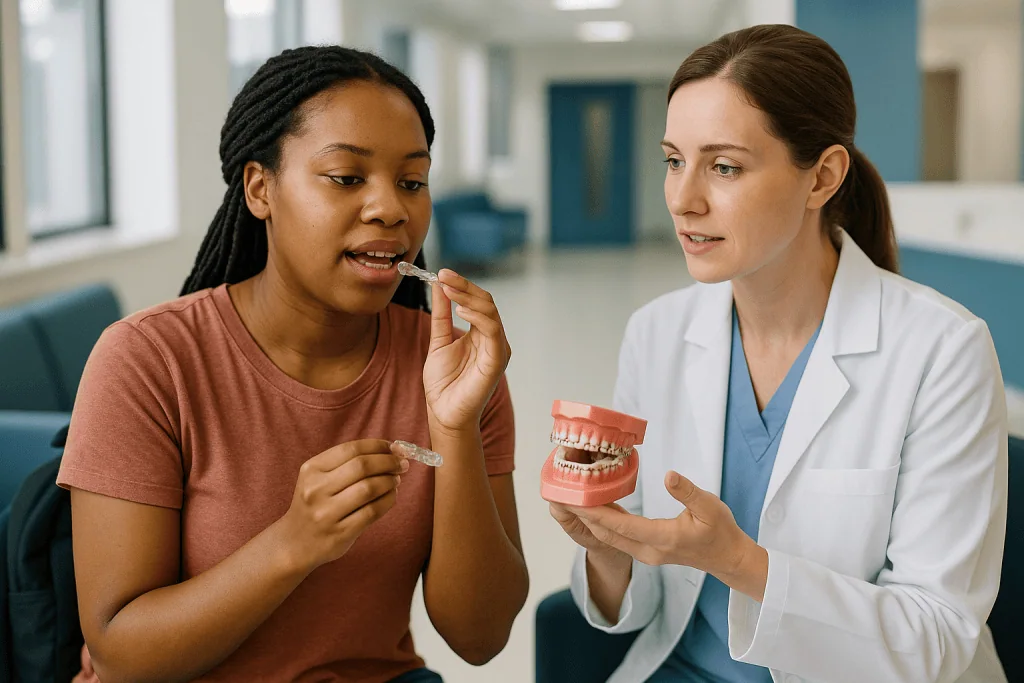
| Factor | Fixed braces | Clear aligners |
|---|---|---|
| Typical check interval | Every 6–8 weeks (NHS) | Often longer; trays changed at home on schedule |
| What goes wrong on the road | Loose bracket, poking wire, lost elastics | Lost or cracked tray, poor fit, low wear time |
| Can a general dentist help in an emergency? | Often, for comfort measures such as trimming a wire | Rarely; replacement trays come from the treating orthodontist |
| Depends on daily compliance | Partly (hygiene, elastics) | Heavily (20–22 hours of wear per day is commonly advised) |
| Remote monitoring | Limited; photos help but wires need hands | More feasible with photos and video calls |
| Risk if an interval is stretched | Wire stops working; possible unwanted tipping | Movement stalls if trays run out |
A few things stand out. Fixed braces fail in physical ways that a dentist anywhere can usually make comfortable, even if they cannot continue the plan. Aligners fail in quieter ways: a patient who runs out of trays, or who stops wearing them, loses momentum without any obvious event.
This is why braces while traveling abroad tends to be a logistics-and-emergency question, while aligners while traveling is a supply-and-discipline question. The treating orthodontist weighs these trade-offs against the clinical problem being corrected. Some bite problems simply need fixed appliances regardless of lifestyle, and that clinical need comes first.
Moving countries with braces: how transferring orthodontic treatment works
Transferring orthodontic treatment means one clinician formally hands an active case to another, with records, plan and responsibility moving together. It is a recognized process, but it is not automatic, and both ends have to agree.
The first step is the conversation with the current orthodontist. They will usually want to know where you are going, for how long, and whether you intend to return. If the move is permanent, they will prepare a transfer package. If it is temporary, they may instead arrange an interim care agreement, in which a second clinician monitors and maintains the appliance without changing the overall plan.
The second step is finding a receiving clinician willing to take the case. This can be harder than people expect. Orthodontists are generally cautious about inheriting someone else’s mechanics, because they did not choose the bracket system, the wire sequence or the end goals. Some will agree to maintain only; others will re-diagnose and restart with their own plan, which can mean new records and sometimes new appliances. Neither approach is wrong; they reflect professional responsibility for an outcome the receiving clinician will be answerable for.
The third step is reconciling the two plans. The receiving orthodontist will typically take their own photographs and x-rays, compare them against the original records, and decide whether to continue, modify or restart. MedlinePlus notes that orthodontic diagnosis rests on examination, x-rays and models of the teeth, and that same foundation is rebuilt at transfer.
Moving countries with braces goes most smoothly when it is planned months ahead, when the current clinician writes a clear summary rather than just sending files, and when the patient understands that the destination clinician’s judgment will govern from the day of the first visit. The relay only works if the baton is actually handed over.
Records, consent and the paperwork that should travel with you
Orthodontic records are the memory of your treatment, and without them a new clinician is working blind. Ask for a complete set before any long absence, even if you expect to return. A standard package includes the initial diagnosis and treatment plan; pre-treatment photographs of the face and teeth; panoramic and cephalometric x-rays (a cephalometric x-ray is a side-view image of the skull used to measure jaw and tooth angles); digital scans or plaster models of the teeth; a progress summary stating which wire or tray you are currently on and what the next steps were meant to be; and, for aligner patients, the remaining trays and the digital treatment file if the system allows export.
Consent matters as much as content. In many jurisdictions, your clinician needs your written permission to release records to another provider, and some will only send them directly, clinician to clinician. Request this early; it is not a same-day task in every practice.
Two practical notes. First, carry a printed summary letter in plain language on top of the technical files. An orthodontist in another country may not use the same software, and a one-page note that says which teeth are being moved and why is more useful than a folder of raw images. Second, keep your own copy. Files get lost, clinics change systems, and a patient with a complete record on a drive or a secure cloud folder is never stranded.
The CDC’s guidance for people receiving medical care outside their home country stresses carrying copies of medical records and knowing who will provide follow-up before departure. Orthodontics is low-risk compared with surgery, but the same principle applies: continuity lives in the paperwork, and the paperwork is your responsibility to request.
Planning a travel calendar around orthodontic treatment abroad visits
The most useful habit for a mobile patient is to treat the orthodontic calendar as fixed and the travel calendar as the thing that bends around it, at least where possible. In practice, this means a few concrete moves.
Book the next adjustment before leaving, not after returning. If the typical interval is 6 to 8 weeks and a trip lasts five, an appointment in the week before departure and another in the week after keeps you inside the range. If a trip is longer than the interval, raise it at least one visit ahead so the orthodontist can choose a configuration that tolerates the gap.
Avoid scheduling an adjustment the day before a long flight. Soreness after a wire change is normal for a few days, and chewing can be awkward; being on a plane with limited food choices during that window is unpleasant rather than dangerous, but it is avoidable.
For aligner patients, count trays against days. If you change every seven to fourteen days as directed, calculate how many you need for the whole absence and add a margin of two or three. Running out mid-trip is the single most common way aligner treatment stalls.
For patients with elastics, pack more bands than you think you need, in the exact size prescribed, and ask the orthodontist for the written pattern. Elastics are easy to lose and hard to replace with the correct force level away from home.
Identify, before leaving, who you would contact in the destination for a comfort emergency. This does not need to be a formal transfer; a general dentist can trim a wire or recement a bracket as a temporary measure. Orthodontic treatment abroad visits are easiest when the emergency plan already exists and never has to be used.
Braces while traveling abroad: what to pack and what to do with a loose bracket
Most orthodontic problems on the road are small, and most can be managed until a clinician can see you. The kit is short: orthodontic wax, a soft toothbrush, interdental brushes or floss threaders, spare elastics in the prescribed size, a small mirror, and the summary letter described earlier. Add any removable appliance case so a retainer or aligner never ends up wrapped in a napkin.
A poking wire is the most frequent complaint. The end of the archwire can slide out of the last bracket when a gap closes, or a tie can shift and expose a sharp point. Wax pressed over the point usually makes it tolerable. If the wire is clearly protruding, a general dentist can trim it in minutes. Do not try to cut it yourself with household tools.
A loose bracket is the second. If the bracket is still attached to the wire, leave it, cover it with wax if it irritates, and let the orthodontist know so they can decide whether to see you earlier or wait. If it comes off entirely, keep it in a bag; some can be re-bonded. A single loose bracket is rarely urgent, but it does mean that tooth has stopped moving, and a long gap before it is fixed can set that tooth behind the others.
Lost elastics are simply a reason to use the spares. Broken ligatures, the tiny rubber rings around each bracket, are also low priority unless the wire comes loose as a result.
What makes braces while traveling abroad genuinely difficult is not any of these events; it is hygiene. Different water, different food, long days and no routine make plaque build up fast, and decalcification marks are permanent. The NHS emphasises thorough brushing after every meal with a fixed appliance. On the road, that discipline matters more, not less.
Aligners while traveling: wear time and the so-called 30 minute rule
People often ask about a 30 minute rule for clear aligners. There is no such rule in any clinical guideline. The phrase circulates as shorthand for a reasonable habit: take the trays out for a meal, eat within about half an hour, brush, and put them back. The number is a practical target to keep total daily wear high, not a threshold below which something specific goes wrong.
The figure that does appear in mainstream patient guidance is total daily wear. Cleveland Clinic’s patient information, like most orthodontic advice, describes aligners as needing to be worn roughly 20 to 22 hours a day to work as planned. The arithmetic is simple: three meals plus snacks and brushing can easily consume two hours, so keeping each break short is how patients stay inside that window. The 30 minute idea is a budgeting device, nothing more.
Travel strains that budget. Long lunches, airport meals, tasting menus and jet lag all stretch tray-out time. The evidence-based advice is unglamorous: eat at defined times, keep the case in your pocket rather than a bag, carry a travel toothbrush, and put trays back in before leaving the table.
Two more aligner-specific points. First, trays can warp in heat. Leaving them on a car dashboard or in direct sun can distort the plastic enough to change the fit. Second, if a tray is lost or cracked, the usual advice is to move back to the previous tray or forward to the next one only as the orthodontist directs, and to contact them promptly. Guessing can stall or reverse movement.
Aligners while traveling reward patients who treat wear time as the actual treatment, which it is. The plastic only moves teeth while it is in the mouth.
Do braces hurt more on day 2 or 3? The soreness timeline after an adjustment
Discomfort after braces are fitted or adjusted is one of the most predictable parts of treatment, and it follows a recognisable curve. The NHS and Mayo Clinic both describe soreness or tenderness in the first few days after an appliance is placed or tightened, easing as the teeth and surrounding tissues adapt.
Within that few-day window, many patients report that the peak is not immediate. The first hours often feel merely tight. Soreness tends to build over the first 24 hours and is frequently at its most noticeable on the second and third day, then fades over the rest of the week. The mechanism is biological rather than mechanical: the force on the tooth sets off a controlled inflammatory response in the ligament that holds the tooth in its socket, and inflammation takes time to rise and fall. That is why the question of whether day two or three is worse has no single answer; the pattern is a hump rather than a spike, and its shape varies between people and between adjustments.
What usually helps is practical rather than pharmacological: soft foods for the first days, cold drinks, wax on any rubbing edges, and salt-water rinses if the cheeks are irritated. If a patient feels over-the-counter pain relief is needed, the choice and use of any medicine belongs with their dentist, orthodontist or pharmacist; this article does not recommend specific products or amounts.
Some reassurances. The first fitting is usually the sorest; later wire changes tend to be milder. Aligner patients often feel pressure for the first day or two of each new tray, then little. Sharp, localised, worsening pain that does not match this pattern, or pain in a single tooth that feels different from the general ache, is not typical soreness and is covered in the red-flag section later.
Flying, time zones and oral health on the move
Flying with braces or aligners carries no special medical risk. The appliances are not affected by cabin pressure, do not trigger airport security, and do not need to be removed for take-off. The challenges are indirect: dry mouth, disrupted routines, and the simple difficulty of brushing in a cramped lavatory.
Cabin air is dry, and a dry mouth means less saliva, which is the mouth’s natural rinse. Plaque around brackets accumulates faster when saliva is low. Drinking water through the flight, avoiding sugary drinks that sit against the teeth, and brushing or at least rinsing after each meal keep the risk down. Sugar-free gum is not advised with fixed braces because it sticks to brackets; aligner patients should not chew it with trays in.
Time zones matter most for aligner patients. The tray change schedule is counted in days of wear, not calendar dates, so a long eastward flight that compresses a day does not mean a tray was worn long enough. Count hours of actual wear and keep a note on your phone.
For long-haul travel in general, standard medical-travel safety applies regardless of dental work: move around the cabin periodically, stay hydrated, and arrange follow-up care before departure rather than after arrival. The CDC’s medical travel guidance also recommends confirming in advance who will manage any complications and how records will reach them.
One more practical note. Orthodontic appliances are not a reason to delay an urgent dental problem until you are home. A broken filling, an abscess or a cracked tooth under a bracket needs attention wherever you are, and a general dentist can usually treat it with the appliance in place or temporarily removed. Your orthodontist would rather be told afterwards than have you wait weeks in pain.
Retainers and the long tail: what the following months usually look like
The day the braces come off is not the end of orthodontic care; it is the start of retention, and retention is where international patients most often drift. A retainer is a removable or fixed device that holds teeth in their new positions while the bone and ligament around them settle, and the NHS states plainly that without it teeth tend to move back towards where they started.
Timelines are long. The NHS describes retainers as needing to be worn for a significant period after treatment, often at night for an extended time and sometimes indefinitely, because the tendency to relapse never fully disappears. Mayo Clinic gives similar guidance. The exact schedule is set by the treating orthodontist and typically tapers: full-time wear at first, then nights only.
The first weeks after debonding, the removal of brackets, are the most sensitive. Teeth are least stable immediately after active movement, so a lost retainer in that window can lead to visible shifting within days. Patients travelling during this period should carry the retainer in its case at all times, never wrap it in tissue, and ask for a spare before leaving if the orthodontist is willing to make one.
Fixed retainers, a thin wire bonded behind the front teeth, are convenient for travel because they cannot be lost, but they need checking. A detached section can let one tooth drift while the others stay put, and flossing around them takes a threader.
Follow-up visits during retention are usually spaced further apart than adjustment visits and are easier to fit around travel. The quiet risk is that they get skipped entirely. A retention check can confirm the retainer still fits, catch a broken fixed wire, and give the orthodontist a chance to adjust the plan. Months of active treatment are protected by a few short appointments; it is a good trade.
What people often get wrong about orthodontic care across borders
Several beliefs recur in conversations about treatment that crosses borders, and most of them cost patients time or teeth.
The first is that any dentist can do an adjustment. A general dentist can make you comfortable, trim a wire or recement a bracket, and that is valuable. Progressing the treatment, choosing the next wire or elastic pattern, is a different skill and a different responsibility. Most general dentists will decline to do it, correctly.
The second is that stretching an interval is harmless. Sometimes it is, if the orthodontist has planned for it. Unplanned, it can mean a wire that has finished working sits passively for weeks, or a space-closing mechanism keeps pulling without supervision. Treatment that is paused is not simply on hold; it may be moving in the wrong direction.
The third is that records are the clinic’s problem. In practice, nobody pursues your records as energetically as you will. Request them early and keep a copy.
The fourth is that aligners are maintenance-free. They are low-maintenance in terms of chair time, but they are the appliance most dependent on daily behaviour, and travel is where behaviour slips.
The fifth is that a new orthodontist will simply continue the old plan. Many will re-diagnose from scratch and some will change appliances. That is professional diligence, not obstruction, and it should be expected rather than resented.
The last is that treatment can be finished faster by combining visits or doubling up tray changes while away. Teeth move at a biological pace; the ligament and bone remodel at a rate that force cannot safely accelerate. Pushing harder tends to cause pain, root damage or unwanted movement rather than speed. The NHS and Mayo Clinic both frame orthodontics as gradual by design. Patience, not pressure, is the mechanism.
Questions to ask your care team before you go
A good pre-travel conversation is specific. Bring the dates, the duration and your best guess about return, and work through questions like these.
- Which phase of treatment am I in, and how long can this configuration safely go without a visit?
- Would you adjust the wire or tray plan before I leave to make the gap safer?
- How many aligners or elastics should I take, and what should I do if I lose one?
- If a bracket comes off or a wire pokes, what can a general dentist do, and what should they not do?
- Can you give me a one-page written summary of my treatment, plus my records, and a copy for my own files?
- Are you willing to review photographs by email or video while I am away, and how often?
- If I need to transfer, what would you want the receiving orthodontist to know, and would you speak with them directly?
- Is there any part of my treatment, such as elastic wear or growth guidance, that you would rather complete before I go?
- What signs should make me seek care locally rather than wait for my return?
- If treatment finishes while I am away, how will retention be managed?
Write the answers down. Memory is unreliable at six weeks and three time zones’ distance, and the answers to these questions are the practical difference between a plan that survives travel and one that quietly unravels.
Two further points are worth raising even if they feel awkward. Ask what the clinician considers the worst realistic outcome of your particular absence, and ask whether they would recommend delaying the trip or the treatment if the two genuinely conflict. Orthodontists are used to this question and usually have a clear view. The decision about how to proceed sits with that treating team, informed by what you tell them; the more complete your side of the picture, the more useful their advice will be.
When to call your doctor: red-flag signs that should not wait for your return
Most orthodontic discomfort is minor and self-limiting, and most appliance breakages can wait for a scheduled visit. A short list of signs should prompt a call to your orthodontist the same day and, if they are unreachable, a visit to a local dentist or, for the more serious items, urgent medical care.
Seek care promptly for severe or worsening pain in a single tooth that does not match the general soreness after an adjustment, especially with sensitivity to heat or pressure; swelling of the gum, face or jaw, which can signal infection; a fever alongside mouth or facial pain; a wire or appliance fragment that has been swallowed or inhaled, particularly if there is coughing, chest discomfort or breathing difficulty, which needs emergency assessment; bleeding from the gums that does not stop with gentle pressure; a tooth that feels suddenly loose or has moved visibly in a short period; a bracket or wire that has cut the cheek or tongue deeply, or an ulcer that is not healing after a week or more; and any allergic-type reaction such as a spreading rash, lip or tongue swelling, or difficulty breathing, which is an emergency.
Lower-urgency problems that still warrant a message to your orthodontist within a day or two include a lost or cracked aligner, a detached bracket, a broken fixed retainer, an elastic pattern you can no longer follow because the hooks have come loose, and a retainer that no longer fits comfortably.
For any of these, do not try to fix the appliance yourself beyond applying wax, and do not change tray sequences or elastic patterns without instruction. Give the orthodontist a clear description, a photograph if possible, and your location. They will decide whether the problem can wait, whether a local dentist should make you comfortable, or whether something more is needed. That judgment belongs to them.
Frequently asked questions
Can you get braces in another country and continue them at home?
It is possible, but continuity is the hard part. Orthodontic treatment depends on one clinician’s plan being carried through, and a second orthodontist may re-diagnose, modify or restart rather than simply continue. Before beginning any treatment that will span two countries, ask both clinicians whether they will coordinate, how records will be shared, and who holds responsibility for the final result. This article does not recommend travelling to obtain care.
Do braces hurt more on day 2 or 3 after an adjustment?
For many people, soreness is most noticeable on the second and third day rather than immediately. The NHS and Mayo Clinic both describe tenderness for a few days after fitting or tightening. The pattern is a gradual hump driven by inflammation in the ligament around each tooth, not a sudden spike. The first fitting is usually the sorest; later adjustments are often milder. Pain that is sharp, localised to one tooth, or worsening after the first week is not typical and should be reported.
What is the 30 minute rule for clear aligners?
There is no formal clinical rule by that name. The phrase describes a practical habit: take trays out to eat, finish within roughly half an hour, brush, and replace them. The figure that appears in mainstream patient guidance is total wear of about 20 to 22 hours a day. Keeping each meal break short is simply how patients stay within that window. Your orthodontist sets the actual wear instructions.
How long can I go without an orthodontic adjustment while abroad?
Only your treating orthodontist can answer this for your case. The NHS cites typical fixed-brace intervals of 6 to 8 weeks, but how far that can stretch depends on the phase of treatment. A passive holding wire tolerates a longer gap; active space closure or elastic-driven bite correction usually does not. Tell the orthodontist your dates well in advance so they can plan a configuration that is safe for the absence.
What should I do about braces while traveling abroad if a bracket comes off?
Leave it attached to the wire if it is still held there, cover any irritation with orthodontic wax, keep the bracket if it comes off completely, and tell your orthodontist with a photograph. A single loose bracket is rarely urgent, but that tooth has stopped moving, so the orthodontist may want to see you sooner or arrange for a local dentist to re-bond it temporarily. Do not attempt to glue it yourself.
Is transferring orthodontic treatment to a new orthodontist straightforward?
It is a recognised process but not automatic. The current orthodontist prepares records and a written summary, and the receiving orthodontist decides whether to continue, modify or restart. Many take their own x-rays and scans first. Both clinicians need to agree, and your written consent is usually needed to release records. Starting the conversation months ahead gives the best chance of a smooth handover.
How do I manage aligners while traveling across time zones?
Count hours of wear rather than calendar days. A long flight that shortens or lengthens the day does not change how long a tray has actually been in your mouth. Keep a note on your phone, carry enough trays for the whole trip plus a margin, keep the case in your pocket, and protect trays from heat. If you lose one, contact your orthodontist before moving forward or back in the sequence.
Can a general dentist abroad do my adjustment?
Usually not the adjustment itself. A general dentist can trim a poking wire, re-bond a loose bracket as a temporary measure, treat decay or an abscess, and generally make you comfortable. Changing wires, elastic patterns or tray sequences is the treating orthodontist’s responsibility, and most general dentists will decline to progress another clinician’s plan. That is appropriate professional caution rather than unhelpfulness.
What records should I carry when moving countries with braces?
Ask for the original diagnosis and plan, pre-treatment photographs, panoramic and cephalometric x-rays, scans or models, a current progress note stating which wire or tray you are on, and for aligners the remaining trays and any exportable digital file. Add a one-page plain-language summary letter. The CDC advises people receiving care across borders to carry copies of records and arrange follow-up before departure. Keep your own copy.
What happens if my braces come off while I am abroad and I need a retainer?
Retention should be arranged before travel if debonding is expected during the trip. Teeth are least stable immediately after braces are removed, and the NHS notes they tend to move back without a retainer. Ask whether a spare retainer can be made in advance and whether a local clinician can fit one if needed. Carry any retainer in its case and keep the retention schedule exactly as your orthodontist prescribes.
References
This article is for general information only and is not a substitute for professional medical advice. Please consult a qualified doctor about your individual situation.
Add us as a Preferred Source to see more of our trusted health content across Google Search, AI Overviews and Discover.

More from the Blog
Splint vs Physiotherapy for TMJ: How the Two Treatments Work Together
A TMJ splint and physiotherapy are not rivals; they address different parts of the same problem. A splint is a removable dental appliance that…

Halitosis Myths: Mouthwash Fixes Everything, Stomach Is Always to Blame and More
Most halitosis myths fall apart on inspection. Mouthwash mostly masks odor for a short time; it does not remove the bacterial tongue coating or…
How Bruxism Wears Teeth and Strains the Jaw: Grinding and Clenching Explained
Bruxism is the habit of grinding or clenching the teeth, awake or during sleep, usually without being aware of it. The repeated force flattens…
Does a Dental Microscope Change a Root Canal? What Magnification Means for Hidden Canals
A dental operating microscope does not change what a root canal treatment is; it changes how much of the tooth's interior the clinician can…
In-Office vs Take-Home Teeth Whitening: Speed, Sensitivity and How Even the Shade Comes Out
In-office whitening uses a higher-concentration peroxide gel applied by a dental professional and typically lightens teeth within a roughly one-hour visit, while dentist-made take-home…

When Is It Better to Wait Before Clear Aligners? Growth, Gum Health and Combined Plans
It is usually better to wait before clear aligners when the jaws are still growing, when gum disease or untreated cavities are present, when…