

Packing for a Kawasaki Disease Admission: Fever Records, History and Comfort Items
Key Takeaways
- The treatment window for Kawasaki disease is counted from the first day of fever, not from admission, so a dated fever diary is the most clinically useful thing you can pack.
- Untreated Kawasaki disease causes coronary artery aneurysms in roughly one in four children, and intravenous immunoglobulin given within the first ten days of fever substantially lowers that risk.
- Kawasaki disease is not contagious; a single room on the first day is about excluding look-alike infections such as measles or scarlet fever, not about protecting other children from your child.
- Many uncomplicated admissions last several days, but a child whose fever persists after the first infusion may need a second dose and a longer stay, so pack for five days and plan home life for seven.
- Peeling fingertips and toes two to three weeks after the fever are an expected phase of recovery, while a returning fever is the sign that should prompt a same-day call.
- Because IVIG contains donor antibodies, live vaccines such as measles and chickenpox are usually delayed for months afterward, so ask the team for the exact timing before discharge.
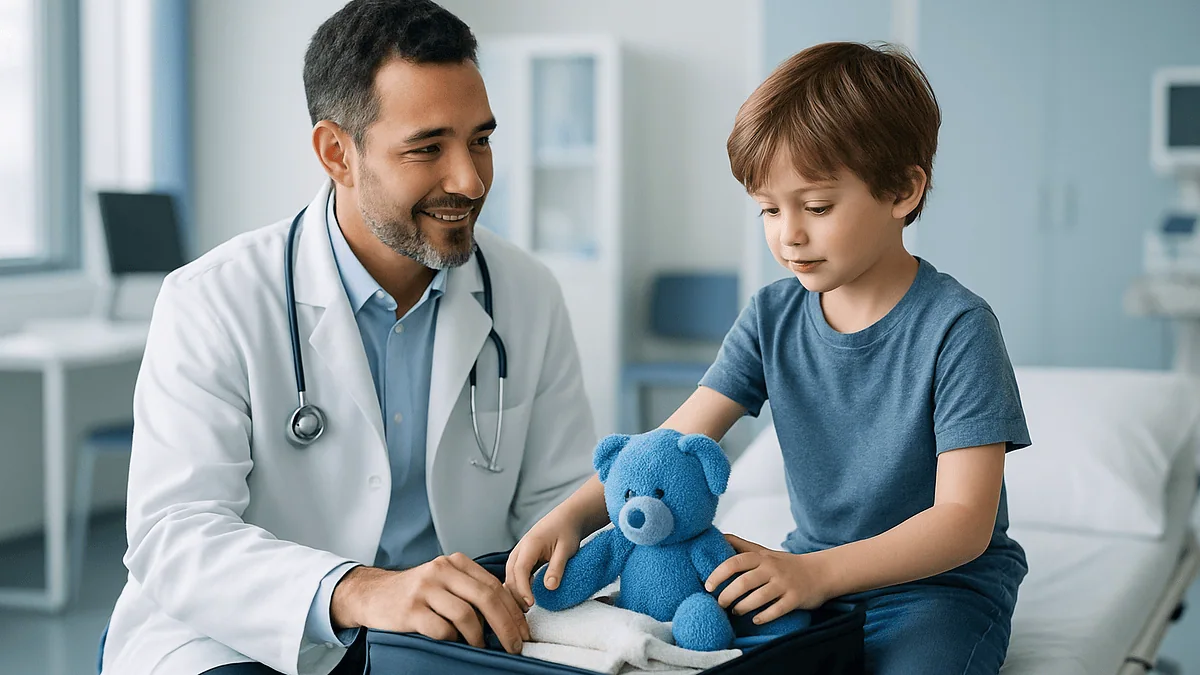
For a Kawasaki disease hospital admission, pack a written fever record (dates, times, readings, and what was given), a one-page medical history with allergies and current medicines, the child's immunization record, loose front-opening pajamas, a familiar comfort object, quiet entertainment, and basics for the caregiver. Most admissions last several days while intravenous immunoglobulin is given and the heart is checked by ultrasound.
It is usually the fifth day of fever when the word first gets said out loud. By then the thermometer has become a household ritual, the child’s eyes are pink without any crust, the lips have cracked, and someone in a clinic room says they want to admit your child to rule in, or rule out, Kawasaki disease. You are handed a slip of paper, told to go home and grab a few things, and come straight back.
That gap between the clinic and the ward is where most parents search for a Kawasaki disease hospital admission what to pack list. The honest answer has two halves. The first half is paperwork that genuinely changes how quickly your child can be assessed: the fever timeline, the medication record, the allergy list. The second half is the ordinary stuff of comfort, which matters more than it sounds for a feverish, irritable preschooler who will be in the same room for days.
This guide walks through both, in the order the ward will actually need them, and explains what happens once you arrive.
What actually happens during a Kawasaki disease hospital admission
Kawasaki disease is an inflammation of blood vessels throughout the body, most importantly the coronary arteries that supply the heart muscle. It affects mostly children under five, and nobody has yet pinned down a single cause, though an abnormal immune response to an infection is the leading theory according to the NHS. There is no single blood test that confirms it. Doctors diagnose it from the pattern: a fever lasting five or more days plus a cluster of signs such as a rash, red eyes, cracked lips, a swollen tongue, swollen hands and feet, and enlarged lymph nodes in the neck.
Admission therefore has three jobs. The first is confirmation, which means repeated examination, blood tests for inflammation markers and platelet counts, and sometimes tests to exclude look-alike illnesses such as scarlet fever or measles. The second is treatment, which in most cases means an intravenous infusion of immunoglobulin, often alongside aspirin, started as early as possible. The third is surveillance of the heart, usually by echocardiogram, an ultrasound scan that shows the size of the coronary arteries without needles or radiation.
Expect a steady rhythm rather than drama. A nurse will record temperature and vital signs every few hours, an intravenous line will be placed in a hand or arm, and a pediatrician or pediatric cardiologist will review the child at least daily. Because untreated Kawasaki disease causes coronary artery aneurysms (ballooned sections of artery wall) in roughly one in four children, and treatment within the first ten days of fever substantially reduces that risk, the team will not want to lose a day, as the Mayo Clinic explains. That urgency is why the fever record you bring is not a formality.
Kawasaki disease hospital admission: what to pack first, the fever record
If you pack only one thing, make it the fever diary. The diagnosis hinges on how many days the fever has lasted, and the treatment window is measured from the first day of fever, not from the day of admission. A parent who can say with confidence that the temperature first rose on Tuesday evening gives the team something a thermometer on the ward never can.
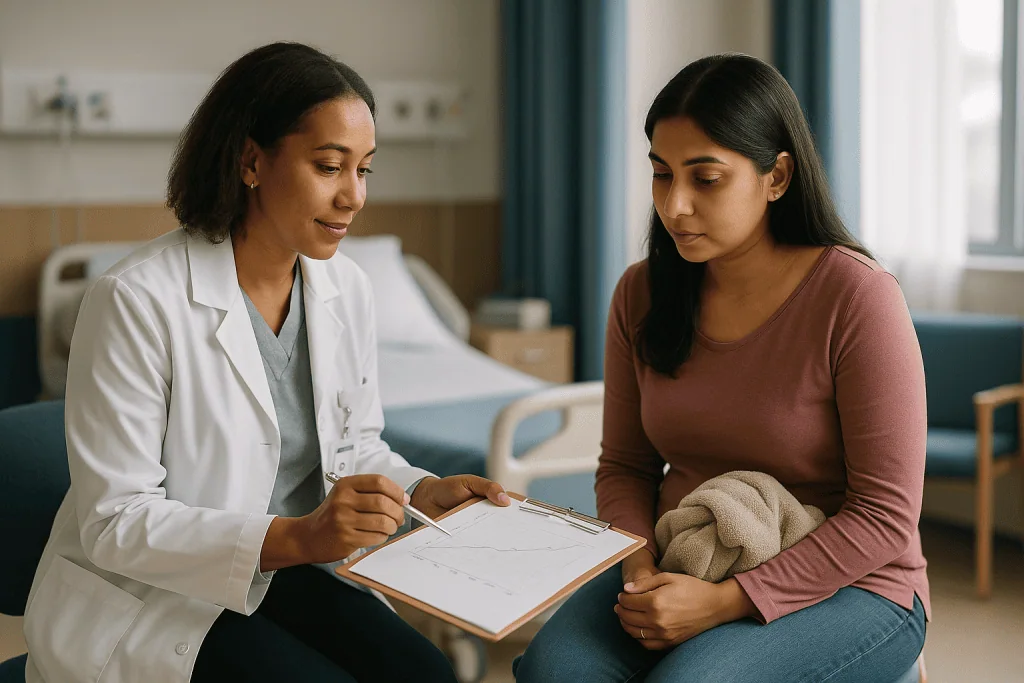
Write it out on paper or in a phone note, in a simple column format, and include:
- Date and time of each reading, with the number and the method (forehead, ear, armpit, or rectal).
- The highest reading each day and roughly how long it stayed up.
- Any fever-reducing medicine given, with the time, so the team can tell whether a dip was natural or medicated.
- The day each new sign appeared: rash, red eyes, cracked lips, swollen hands, a lump in the neck, peeling skin.
- Fluids and feeds, especially if your child has been refusing to drink.
- Wet diapers or trips to the toilet, which help the team judge hydration.
Photographs are worth bringing too. Rashes in Kawasaki disease change by the hour, and a picture of the trunk from day three, or of swollen red palms from day four, can document a sign that has already faded by the time a doctor looks. Keep the images in one album so you can scroll through them in order.
The thermometer itself is optional; the ward will have its own. What the ward cannot reproduce is your memory of the past week, and the more precisely it is written down, the less it depends on recall at midnight.
The medical history your team will ask for on arrival
Admission paperwork asks the same questions in several places, and the parent who has already written the answers on one sheet saves everyone time. Put the following on a single page and carry two copies, one for the chart and one for your own bag.
- Current medicines, including anything bought without a prescription, vitamins, and herbal products, with the time of the last dose of each.
- Allergies to medicines, foods, latex, or adhesive dressings, with what happened.
- Immunization record, because immunoglobulin treatment affects the timing of some vaccines, and because measles and chickenpox need to be excluded as alternative diagnoses.
- Past illnesses, hospital stays and surgeries, including any previous heart problems.
- Recent exposures: travel, sick contacts, new pets, and whether anyone at home currently has flu or chickenpox.
- Family history of heart disease, clotting disorders, or autoimmune conditions.
- Weight from the most recent well-child visit, since infusion volumes are weight-based.
- Your child’s usual routine: sleep times, feeding preferences, words used for pain or the toilet.
Insurance cards, a photo ID for each caregiver, and the name and phone number of your child’s regular pediatrician belong in the same folder. If your child has a separate specialist, list that clinician too.
One detail that catches people out: many hospitals need to know exactly which fever medicines were given and when, because Kawasaki disease treatment commonly involves aspirin, and the team needs a clear picture of everything already in the child’s system. Do not stop or add anything on the way in; simply write it down and hand it over. Decisions about what continues, pauses, or starts sit with the admitting team, and they will make them faster with an accurate list in front of them, as the MedlinePlus overview notes in its description of inpatient care.
Comfort items that actually help on a pediatric ward
Irritability is one of the recognized features of Kawasaki disease, not just a side effect of fever. Children with it are often extraordinarily cranky, and the Cleveland Clinic lists this fussiness among the common signs. Comfort packing is therefore clinical in its own quiet way: a calmer child sleeps more, tolerates examinations better, and keeps an intravenous line in place longer.
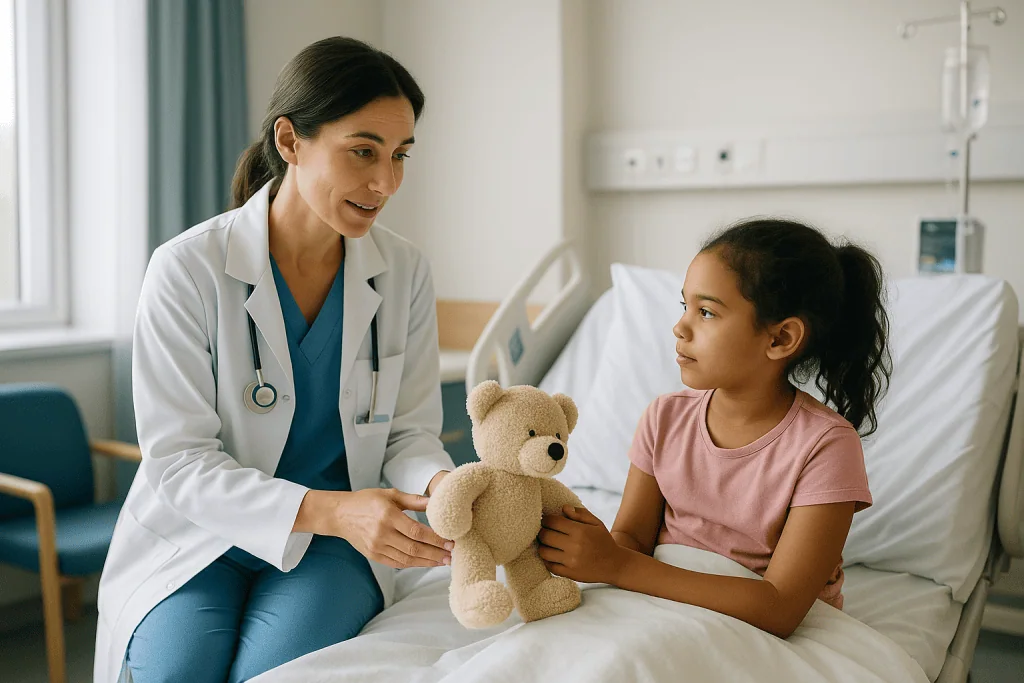
Pack with the intravenous line in mind. Choose pajamas with front snaps or buttons, or loose short sleeves, so the arm with the line can be dressed without threading anything over the hand. A zip-up sleep sack works for babies. Bring two sets; fevers mean sweating, and wards are warm.
Then the items that make a strange room feel familiar:
- The one blanket, stuffed animal, or pacifier your child reaches for at home, plus a backup if it exists.
- A bottle, sippy cup, or specific brand-free straw cup the child already uses, since drinking is often the hardest part of the stay.
- Soft socks or slippers, because feet can be swollen and tender.
- Lip balm, as cracked lips are one of the classic signs and sting with every drink.
- A small night light or a phone with a white-noise app, for a room that never fully goes dark or quiet.
- Two or three picture books, a tablet with downloaded shows, headphones, stickers, and crayons; keep it light, since attention spans shrink with fever.
Leave jewelry, glitter, and anything with small detachable parts at home. Photos of siblings or the family pet, printed and taped to the bed rail, give a toddler something to point at and give the nurses an easy conversation starter. Child life specialists, where available, can bring additional play materials, so you do not need to pack as if for a week in a cabin.
What to bring to a children's hospital for yourself
Parents routinely pack beautifully for the child and arrive with nothing for themselves, then spend day two wearing the same clothes and surviving on vending-machine crackers. Most pediatric units let one caregiver stay overnight on a fold-out chair or cot, and the stay for Kawasaki disease usually runs to several days, so plan for it.
Your own list is short but non-negotiable:
- Phone charger with a long cable, plus a portable battery; outlets are rarely near the chair.
- A refillable water bottle, snacks that do not need refrigeration, and change or a card for the cafeteria.
- Toothbrush, deodorant, a change of underwear and socks, a sweater or hoodie for a ward that runs cold at 3 a.m., and comfortable shoes you can slip on quickly.
- Reading glasses if you use them, so you can actually read consent forms.
- A notebook and pen for questions, names of staff, and the daily plan.
- Any medicines you take yourself, since you will not be able to run home.
Arrange the home side early. Decide who is collecting siblings from school, who is walking the dog, and whether a second adult can take a shift so you can shower and sleep. If both parents want to be present, check the unit’s visitor policy on the first evening rather than assuming.
One more thing, and it is the kind of thing an experienced ward nurse will tell you: ask on arrival where the parent kitchen, the shower, and the quiet room are. Hospitals vary, but most pediatric units have at least a microwave and a fridge for families. Knowing on day one saves a tired search on day three.
How long is a hospital stay for Kawasaki disease?
Parents ask this in the first hour, and the honest answer is a range, not a number. According to the NHS, children with Kawasaki disease are usually treated in hospital, and the first-line treatment, intravenous immunoglobulin, is given as a single infusion over several hours. The practical stay is built around that infusion and what follows it.
A typical sequence looks like this. Day one is assessment, bloods, an initial echocardiogram, and, if the picture fits, starting the infusion. The team then watches for the fever to settle. The Mayo Clinic notes that most children improve soon after immunoglobulin, with fever often resolving within a day or so of treatment, though a minority need a second dose or an additional anti-inflammatory medicine when the fever persists or returns. Those children stay longer.
Discharge usually depends on three things: the fever has been gone for a sustained period, the child is drinking enough, and the team is satisfied with the heart ultrasound. Put together, many uncomplicated admissions run around three to five days, but a child who needs a second infusion, who develops coronary changes, or who is very young and hard to assess can stay a week or more. Nobody can promise the shorter end on arrival, and a team that refuses to give a firm number on day one is being accurate rather than evasive.
What you can do is pack for five days and arrange home life for seven. That way an early discharge feels like a bonus, and a longer stay does not become a logistics emergency on top of a medical one.
Who is usually admitted and who is usually asked to wait
Not every feverish child with a rash is admitted, and the threshold is set by clinical judgment rather than a checklist you can run at home. Broadly, a child with a fever lasting five days or more and several of the classic features is admitted promptly, because treatment within the first ten days of illness is what protects the coronary arteries, as the Johns Hopkins Medicine overview emphasizes.
Some children are admitted earlier than day five. Infants under six months are a particular concern because their signs are often incomplete and their risk of coronary involvement is higher, so a pediatrician may admit a young baby with unexplained prolonged fever for observation and early echocardiography even before the picture is clear. Children already showing signs of heart strain, dehydration, or extreme irritability are also brought in without delay.
Who is asked to wait? A child on day two or three of fever with only one or two features, who is drinking, alert, and otherwise well, is sometimes sent home with a clear plan: keep the fever diary, return on a set day for review, and come back sooner if anything changes. That is not a dismissal. It reflects the fact that many common viral illnesses look similar in the first days, and the diagnosis is made over time. The fever record you keep in those waiting days is exactly what the admitting doctor will read later.
Children with a known heart condition, immune problem, or recent live vaccine may be handled differently, and that is a conversation for the treating team rather than something a general article can settle.
Kawasaki disease IVIG treatment timeline: what the infusion involves
Intravenous immunoglobulin, usually shortened to IVIG, is a purified preparation of antibodies pooled from many blood donors. In Kawasaki disease it works by damping the runaway inflammation attacking the blood vessel walls, though the exact mechanism is still being studied. It is given through the intravenous line as a slow infusion that takes many hours, often running overnight, with the nurse checking temperature, pulse, and blood pressure on a schedule because reactions, while uncommon, usually happen early in the infusion.
Alongside it, most children receive aspirin, a medicine that reduces inflammation and, at a later stage, reduces the stickiness of platelets so that clots are less likely to form inside any damaged artery. How the aspirin is given, for how long, and at what level is decided and adjusted by the treating team based on the fever response and the echocardiogram findings; the NHS describes the overall approach without parents needing to manage any of it.
The expected pattern after IVIG is that the fever falls within roughly a day and the child becomes noticeably less miserable. When the fever carries on for more than a day or two after the first infusion, or comes back after settling, doctors describe this as IVIG-resistant disease. The Mayo Clinic notes that a second dose of IVIG or a steroid medicine may then be used. The team decides this; it is not a sign that the first treatment was given wrongly.
A practical consequence for later: because IVIG contains donor antibodies, it can blunt the response to live vaccines such as measles and chickenpox. Those vaccines are therefore usually delayed for months afterward. Ask the team for the exact timing before you leave.
Is Kawasaki disease contagious, and will my child be in isolation?
Kawasaki disease is not contagious. It cannot pass from child to child, siblings do not need to stay away, and you did not bring it home from daycare, as the NHS states plainly. The current understanding is that something, probably an infection, triggers an abnormal immune reaction in a child who is genetically susceptible, but the reaction itself is not transmissible.
So why are some children placed in a single room with signs on the door? Two reasons, neither of which means your child is a risk to others. First, until the diagnosis is confirmed, the team has to consider illnesses that are contagious and look similar, such as measles, scarlet fever, or adenovirus. Standard infection-control practice is to isolate for those possibilities until tests come back. Second, pediatric wards often use single rooms for very irritable or very young children simply because it is quieter.
Once Kawasaki disease is the working diagnosis and infectious causes are excluded, isolation precautions are usually lifted and standard precautions apply: hand hygiene for everyone entering, and nothing more exotic. If a nurse asks you to wear a gown or mask on the first day, it is routine, and it is fair to ask when it will be reviewed.
There is one direction in which infection matters for your child rather than for others. Because aspirin is part of treatment, exposure to influenza or chickenpox during and after the stay is something the team will want to avoid. Mention any household illness, keep visitors with coughs or colds at home, and ask the team about flu vaccination timing for the family. That is protection for your child, not evidence that your child is contagious.
What the nurses will do first after admission
Parents searching for priority nursing interventions are often students, but the question is just as useful for families: knowing what the first hours look like takes away some of the dread. On a pediatric ward, a newly admitted child with suspected Kawasaki disease is assessed around a few clear priorities.
Vital signs come first and come often: temperature, heart rate, breathing rate, blood pressure, and oxygen saturation, repeated on a schedule that tightens during the IVIG infusion. The nurse will ask for your fever diary at this point, which is why it sits at the top of the packing list.
Hydration is the second priority. Cracked lips, a sore mouth, and misery make children refuse to drink, so the nurse will measure what goes in and what comes out, weigh wet diapers, and may offer frozen juice pops or flavored fluids. Intravenous fluids are started if oral intake is not enough. Bringing the cup your child already uses genuinely helps here.
The intravenous line itself is the third. It will be secured, often with a padded board for small arms, and checked regularly for redness or leakage. Keeping the child distracted while it is placed is where comfort items and, where available, a child life specialist earn their keep.
The fourth is skin and comfort care: cool cloths, soft bedding, lip balm, mild cleansers for the rash, and positioning to relieve swollen hands and feet. Nurses also watch for heart-related changes, such as a fast heart rate out of proportion to the fever, and escalate quickly if something shifts; the Cleveland Clinic describes this heart surveillance as central to inpatient care.
Finally, the nurse teaches. Expect explanations of the infusion, what reactions to mention, and how to help with the next blood draw. Ask questions; the first shift is the best time.
A packing table for a Kawasaki disease admission, by category
The table below pulls the earlier sections into one view you can screenshot. The “why it matters” column is there because packing is easier when each item has a job.
| Category | Pack this | Why it matters on the ward |
|---|---|---|
| Fever and symptom record | Dated readings, medicine times, dated photos of rash, eyes, lips, hands and feet | Sets day one of fever, which defines the treatment window |
| Medical history | One-page summary, allergy list, current medicines, immunization record, recent weight, pediatrician contact | Speeds assessment and safe prescribing; IVIG affects vaccine timing |
| Documents | Insurance cards, caregiver ID, any guardianship paperwork | Avoids admission desk delays at an already stressful moment |
| Child’s clothing | Two sets of front-opening pajamas, soft socks, zip sleep sack for babies | Works around the intravenous line; fevers mean frequent changes |
| Comfort | Familiar blanket or toy, pacifier, own cup or bottle, lip balm, night light or white noise | Irritability is part of the illness; familiar objects aid sleep and drinking |
| Entertainment | Picture books, tablet with downloaded content, headphones, stickers, crayons | Short, low-effort activities suit a feverish child |
| Caregiver kit | Charger and battery, water bottle, snacks, toiletries, warm layer, notebook, own medicines | Stays commonly last several days; a rested parent is a better advocate |
| Leave at home | Jewelry, small-part toys, heavily scented products, valuables | Safety around lines and shared rooms; nothing to lose |
Two notes on what is missing. There is no thermometer, because the ward’s readings become the official ones once you arrive. And there are no home medicines in the child’s bag beyond the written list, because the team will supply and record everything given in hospital. If you have already packed a bottle of something, hand it to the nurse rather than leaving it in a bedside drawer, so it can be documented and stored properly, in line with the admission advice summarized by MedlinePlus.
What the following days and weeks usually look like
Kawasaki disease unfolds in phases, and knowing them stops the second week from feeling like a relapse. The Mayo Clinic describes three.
The acute phase covers roughly the first two weeks: fever, rash, red eyes, swollen hands and feet, and the full force of irritability. This is the hospital phase. Treatment usually brings the fever down within a day or so, and most children go home once it has stayed down and the first heart checks are reassuring.
The subacute phase runs from about week two to week four. The fever is gone, but something new and alarming-looking appears: the skin on the fingertips and toes peels in sheets. This is expected and painless. Platelet counts rise during this window, which is one reason aspirin is often continued, and it is also the period when coronary artery changes, if they occur, are most likely to show on an echocardiogram. A repeat scan is therefore usually scheduled around this time; the Johns Hopkins Medicine page describes follow-up echocardiography in the weeks after diagnosis.
The convalescent phase, up to around six to eight weeks from onset, is the slow return to normal. Blood tests settle, energy comes back in uneven bursts, and a further echocardiogram is typically arranged near the end of it. If the coronary arteries have stayed normal on these scans, long-term follow-up is usually light. If changes were found, follow-up continues with a pediatric cardiologist, and the plan depends on the size of the changes and how they evolve.
Through all of this, keep the fever diary going. A temperature that returns after discharge is the single most important thing to report, and the habit you built before admission makes that easy.
What people often get wrong about Kawasaki disease and the hospital stay
“It is contagious, so the other children must stay away.” It is not. Siblings can visit if the unit allows, and no one needs to disinfect the house. Isolation on day one, when it happens, is about excluding other diagnoses, not about Kawasaki disease itself.
“The peeling skin means it is coming back.” Peeling fingertips and toes in the second and third week are a normal part of recovery, not a relapse. A returning fever is the sign that matters, not peeling.
“If the first infusion worked, the heart is fine.” Fever settling is a good sign, but coronary changes can develop over the following weeks even in children who respond well, which is why the follow-up echocardiograms are not optional extras. The NHS is clear that heart checks continue after discharge.
“Aspirin is dangerous for children, so I should not let them give it.” The general warning against aspirin in children exists because of a rare liver and brain complication called Reye’s syndrome, which is linked to aspirin use during viral illnesses such as flu and chickenpox. Kawasaki disease is one of the specific conditions in which aspirin is used deliberately, under supervision, with that risk managed. Whether, how, and for how long it is used is the prescribing team’s call, and the right response to worry is a question, not a refusal.
“A good hospital will give me an exact discharge date.” No one can, honestly. The course depends on fever response and heart findings, both of which reveal themselves over days.
“We could have caught it on day one.” The diagnosis requires time; the early days look like a dozen common viruses. Starting treatment within ten days of fever onset is the benchmark, and keeping a fever diary is the thing a parent can do to help meet it.
Questions to ask your care team while you are on the ward
Ward rounds are short and parents forget their questions the moment the door opens, so write these in the notebook you packed and tick them off over the stay.
- What day of fever are we on, by your count, and does that match my diary?
- What tests are planned today, and which results would change the plan?
- Has an echocardiogram been done yet, and when is the next one?
- What exactly is being given through the line, and what reactions should I report during the infusion?
- If the fever does not settle, what is the next step, and roughly when would you make that decision?
- What are you looking for before discharge?
- Which medicines will continue at home, for roughly how long, and who reviews that?
- Are there signs at home that mean call the clinic, and signs that mean go to the emergency department?
- When should the next heart scan happen, and who will book it?
- How does IVIG change the timing of my child’s vaccines, and should the rest of the family have flu vaccines?
- Can my child go back to daycare or school, and are there activity limits?
- Who do I call after hours if I am worried?
Two habits make these conversations better. Ask the nurse, not just the doctor; nurses see your child across a whole shift and often answer practical questions more directly. And ask for the discharge summary in writing before you leave, with the follow-up dates and the on-call number on it. The Cleveland Clinic notes that ongoing follow-up with the care team is part of management, and the written summary is what makes that follow-up actually happen once you are home and tired.
When to call your doctor: red-flag signs during and after a Kawasaki disease admission
Before admission, if your child has had a fever for five days or more, or has a fever with red eyes, a rash, cracked lips, swollen hands or feet, or a swollen neck gland, see a doctor the same day rather than waiting for the next appointment. A younger infant with a persistent unexplained fever should be seen promptly even without the other signs, because their picture is often incomplete.
After discharge, call the number on your discharge summary the same day if:
- The fever returns at any point in the weeks after treatment.
- Your child is unusually sleepy, floppy, or hard to wake.
- Drinking has dropped off and wet diapers or trips to the toilet are far fewer than usual.
- A new rash, red eyes, or swelling appears.
- Your child is on aspirin and develops persistent vomiting, unusual bruising, bleeding gums, or black stools.
- Anyone in the household develops flu or chickenpox.
Call emergency services or go to the nearest emergency department immediately if your child has difficulty breathing, turns pale or blue, has chest pain, faints, becomes very hard to rouse, has a seizure, or has a racing heartbeat that does not settle. These are rare, but the Mayo Clinic lists heart complications as the main reason Kawasaki disease is treated with such urgency, and they need assessment without delay.
Do not adjust, stop, or restart any medicine on your own judgment, including when the child seems fully well; aspirin, in particular, is continued for a reason tied to platelet changes you cannot see. When in doubt, call. Pediatric teams expect calls after a Kawasaki disease admission, and the fever diary you kept gives them exactly the information they need to tell you, with confidence, whether this is a watch-and-wait moment or a come-in-now one.
Frequently asked questions
How long is a hospital stay for Kawasaki disease?
Most uncomplicated admissions last a few days, built around one intravenous immunoglobulin infusion, a period of watching the fever settle, and an initial heart ultrasound. Children whose fever persists or returns after the first infusion, infants, and those with coronary changes on the scan typically stay longer, sometimes a week or more. The treating team will not give an exact date on arrival, because the course reveals itself over days.
What should be in a Kawasaki disease hospital admission what to pack list for a toddler?
Start with paper: a dated fever diary, a one-page medical history with allergies and current medicines, and the immunization record. Then pack front-opening pajamas to work around the intravenous line, the child’s own cup, a familiar blanket or toy, lip balm for cracked lips, a night light, and a few quiet activities. Add a caregiver kit with a charger, snacks, toiletries, and a notebook.
Is Kawasaki disease contagious?
No. Kawasaki disease is an inflammatory reaction, probably triggered by an infection in a susceptible child, but the condition itself does not spread between people. Siblings and visitors are not at risk. Some hospitals use a single room on the first day until contagious look-alikes such as measles or scarlet fever are excluded, after which standard hand-hygiene precautions are all that apply.
Which are the priority nursing interventions for a newly admitted child with Kawasaki disease?
The first priorities are frequent vital signs including temperature and heart rate, careful hydration monitoring with fluid intake and output, safe placement and care of the intravenous line, and close observation during the immunoglobulin infusion for reactions. Nurses also provide skin and comfort care for the rash, cracked lips, and swollen hands and feet, watch for heart-related changes, and teach families what to report.
What is given for Kawasaki disease in hospital?
The standard treatment is intravenous immunoglobulin, a purified antibody preparation given as a slow infusion that calms the inflammation in blood vessel walls, usually alongside aspirin for its anti-inflammatory and later anti-clotting effects. If the fever does not settle, the team may use a second infusion or a steroid medicine. All decisions about which medicines are used and for how long sit with the prescribing clinician.
What does the Kawasaki disease IVIG treatment timeline look like?
The infusion is given once, over many hours, often overnight, with regular vital-sign checks. Fever typically falls within about a day, and the child usually becomes noticeably less irritable. A minority of children have fever that continues or returns, which the team treats as resistant disease and manages with further therapy. Heart ultrasounds follow at diagnosis and again in the weeks after discharge.
Should I bring my child's home medicines to the hospital?
Bring a written list of everything your child takes, including over-the-counter products and supplements, with the time of each last dose. If you bring the actual bottles, hand them to the nurse on arrival rather than keeping them at the bedside, so they can be recorded and stored. Do not stop or add anything on your own before admission; the team will decide what continues.
Why is my child in an isolation room if Kawasaki disease is not contagious?
Early in the stay, the diagnosis is still being confirmed, and some illnesses that look similar, such as measles, scarlet fever, and certain viral infections, are contagious. Standard infection-control practice is to isolate until those are ruled out. Single rooms are also sometimes used simply because the child is very irritable or very young. Ask the nurse when the precautions will be reviewed.
What happens to vaccines after IVIG treatment?
IVIG contains antibodies from many donors, and these can interfere with how the body responds to live vaccines such as measles, mumps, rubella, and chickenpox. Those vaccines are therefore usually postponed for a number of months after treatment, while non-live vaccines are generally unaffected. Ask the treating team for the exact timing and have it written on the discharge summary.
What should I bring to a children's hospital for an overnight stay as a parent?
Pack as if you will not go home for several days: a phone charger with a long cable and a battery pack, a water bottle and non-perishable snacks, toiletries, a change of underwear and socks, a warm layer for the night, slip-on shoes, any medicines you take yourself, and a notebook for questions and staff names. Arrange care for siblings and pets before you leave.
References
This article is for general information only and is not a substitute for professional medical advice. Please consult a qualified doctor about your individual situation.

More from the Blog
Bronchiolitis in Babies: Why Small Airways Swell and How the Illness Usually Runs Its Course
Bronchiolitis in babies is caused by common respiratory viruses, most often respiratory syncytial virus (RSV), that infect the smallest airways in the lungs. The…
Neonatal Sepsis Treatment in the NICU: Blood Cultures, IV Lines and Round-the-Clock Monitoring
Neonatal sepsis treatment in the NICU usually begins the moment infection is suspected: a blood culture is drawn, intravenous antibiotics that cover the most…
Who Needs Medical Treatment for Chickenpox Beyond Comfort Care? Higher-Risk Groups Explained
Most healthy children with chickenpox need only comfort care at home, because the illness usually clears on its own within one to two weeks.…

Preparing for a First Pediatric Physical Therapy Visit: Reports, Braces and Loose Clothing
For a first pediatric physical therapy appointment, bring the referral, any recent medical or developmental reports, imaging results, and every brace, splint, orthotic, or…

Preparing Your Child for Sensory Integration Therapy: Reports to Bring and What to Wear
To prepare a child for sensory integration therapy, bring the referral letter, any developmental or diagnostic assessments, hearing and vision results, school reports, and…

Reinforcing Developmental Delay Therapy Between Sessions: Play-Based Activities Families Use
Between therapy sessions, families reinforce developmental delay therapy by folding short, playful versions of the therapist's current goals into everyday routines such as mealtimes,…