

Peyronie’s Disease Surgery Explained: Plication, Grafting and When an Implant Is Discussed
Key Takeaways
- Peyronie's disease is thought to affect at least 1 in 100 adult men in the United States, with many more undiagnosed, according to NIDDK.
- Mayo Clinic advises that surgery is usually deferred until curvature has stopped changing and erections have been pain-free for at least 9 to 12 months.
- Plication straightens by shortening the unscarred side and predictably reduces erect length, while leaving the plaque and natural erection intact.
- Grafting preserves length and corrects hourglass or complex curves but carries a higher risk of numbness and erectile weakening because the nerve bundle must be lifted.
- A penile implant is discussed when curvature coexists with erectile dysfunction that medicines have not resolved, since it addresses both problems at once.
- Cleveland Clinic advises waiting roughly six weeks after Peyronie's surgery before resuming sexual activity, with the surgeon setting the individual timeline.
Peyronie's disease surgery falls into three main types. Plication shortens the longer side of the penis with stitches to straighten a curve; grafting cuts or removes the scar plaque and patches the gap; a penile implant is discussed mainly when curvature is combined with erectile dysfunction that has not responded to other treatment. Surgery is usually considered only after the curve has been stable for months.
He has rehearsed the sentence in the car park. Something about the bend being worse than last year, about sex now being awkward or impossible, about the word his own search history keeps returning. Inside the urology clinic, the sentence comes out shorter than planned, and the urologist simply nods. She has heard versions of it many times.
What follows that first conversation is often a second, harder one about peyronie surgery types: whether to shorten the long side, patch the scarred side, or, for some men, place an implant. Each option straightens a curve. Each carries a different trade-off between length, sensation and erection quality. None of them is right for everyone.
This explainer walks through what each operation actually involves, who is usually offered it, who is usually asked to wait, and what the weeks afterward tend to look like, using guideline-level evidence rather than forum folklore.
What is Peyronie's disease, and why does surgery come up at all?
Peyronie’s disease is a condition in which scar tissue forms inside the penis, causing it to bend, narrow or shorten during an erection. The scar, called a plaque, develops in the tunica albuginea, the tough elastic sheath that wraps the two erectile chambers. Because the plaque does not stretch when the rest of the sheath does, the penis curves toward the scarred side when it fills with blood.
The condition is more common than most men assume. The National Institute of Diabetes and Digestive and Kidney Diseases estimates that roughly 1 in 100 adult men in the United States have been diagnosed, with the true figure likely higher because many never mention it. It is most often diagnosed in men in their 50s and 60s, though it can appear younger.
Why does surgery enter the picture? Because a plaque, once matured, is essentially permanent. Mayo Clinic notes that mild curvature without pain or sexual difficulty often needs no active treatment at all. The trouble comes when the bend, the narrowing or the associated erectile dysfunction makes penetrative sex painful, difficult or impossible for the patient or partner. At that point, surgery is the only approach that reliably changes the physical shape of the erect penis.
Two points frame everything that follows. First, surgery is a choice made about function and quality of life, not a medical emergency. Second, the plaque itself is not dangerous: it is not cancer, it does not spread, and it does not threaten urinary health. The decision is about restoring a working, comfortable erection, and that decision belongs to the man and his treating team together.
How do surgeons decide among peyronie surgery types?
Ask a urologist which operation is best and the honest answer is a question back: best for whom? The three peyronie surgery types answer different problems, and the choice hinges on a short list of measurable facts about the individual penis.

The first is the degree and direction of curvature, usually documented during an erection induced in clinic with an injected medicine or from photographs the patient brings. Mayo Clinic describes curves that still allow intercourse as generally managed without surgery, while more severe or complex deformities push the conversation toward an operation.
The second is erectile function. A man who achieves firm erections but simply cannot use them because of the angle is a candidate for a straightening procedure alone. A man whose erections are already unreliable, despite treatment, is more likely to hear about an implant, because straightening a penis that will not stay rigid solves only half the problem.
The third is penile length and the shape of the deformity. Plication trades a little length for a straight erection, so surgeons hesitate to offer it when the penis is already shortened or when there is an hourglass indentation, a narrow waist that plication cannot fill. Grafting handles those shapes better but asks more of the underlying erectile tissue.
The fourth is the man’s own priorities. Some care most about preserving length; others about the lowest possible risk to erection quality; others simply want the most predictable result. Guideline bodies consistently frame this as shared decision-making rather than a fixed algorithm. A good consultation ends with the patient understanding not only what will be done but what he is giving up in exchange.
Why the stable phase matters, and who is usually asked to wait
Peyronie’s disease moves through two phases, and timing surgery around them is one of the few points on which every major source agrees. The active or acute phase brings pain with erections, a plaque that is still forming and a curve that may change from month to month. Cleveland Clinic describes this phase as typically lasting several months, sometimes up to about 18. The chronic or stable phase follows: pain fades, the plaque hardens and the deformity stops changing.
Operating during the active phase is generally avoided. A surgeon can straighten a penis today only to have the plaque continue evolving and the curve return or shift. Mayo Clinic advises that surgery is usually not recommended until the curvature has stopped increasing and erections have been pain-free for at least 9 to 12 months. That waiting period is not bureaucratic caution; it is the difference between correcting a finished shape and correcting a moving target.
Who else is asked to wait, or steered elsewhere? Men whose curvature does not interfere with sex are often simply monitored. Men with uncontrolled diabetes, active infection or poorly managed heart disease may be asked to address those first, since they raise the risk of wound and healing problems with any operation. Men who have not yet tried non-surgical options may be encouraged to do so, particularly during the active phase when traction or injectable therapy is sometimes used.
The waiting can feel like being told to live with something unlivable. It helps to reframe it: the months of stability are gathering the information the surgeon needs, and they are also the window in which a man can weigh, without pressure, which trade-offs he can live with.
Peyronie's plication surgery: what actually happens in the operating room
Plication is the simplest of the three approaches, and for many men with adequate length and firm erections it is the first one discussed. The word means folding or pleating, and that is precisely what the surgeon does: places stitches in the tunica albuginea on the longer, unscarred side of the penis, gathering it so that both sides match and the erection points straight.
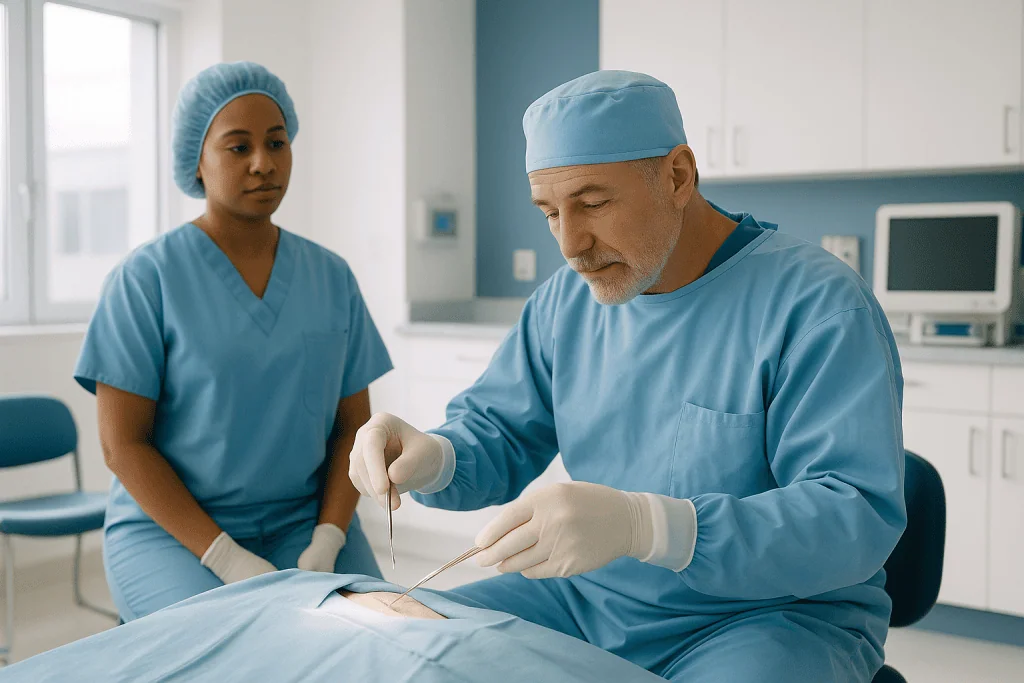
The operation is usually performed under general or regional anesthesia and typically takes about an hour to two hours, according to Cleveland Clinic. The surgeon makes an incision, often around the head of the penis so the skin can be drawn back like a sleeve, and induces an artificial erection with sterile saline to see the curve in real time. Sutures are placed opposite the plaque. The plaque itself is left alone. A second artificial erection confirms the correction before the skin is closed.
Several technical variants exist, and patients will hear names for them. Some techniques remove small wedges of tunica and close the gaps; others use permanent stitches placed in a series without removing any tissue. The differences matter to surgeons more than to outcomes most men notice, and the choice is usually a matter of surgical training and the geometry of the curve.
The defining feature of plication is what it costs: length. Because the long side is shortened to match the short side, the erect penis ends up slightly shorter than before. Mayo Clinic and NHS both list this as an expected effect rather than a complication. The degree depends on how severe the curve was; a sharper bend means more tissue gathered. Surgeons discuss this candidly beforehand, and men who feel they cannot accept any loss of length are usually steered toward grafting instead.
Grafting surgery for Peyronie's: how the plaque is cut and patched
Grafting takes the opposite approach to plication. Instead of shortening the long side, the surgeon lengthens the short side by cutting into or removing the plaque and filling the resulting gap with a patch of tissue, called a graft. Because the scarred side is released rather than the healthy side gathered, this method preserves length and can correct the hourglass indentations and complex multi-directional curves that plication handles poorly.
The procedure begins much like plication, with an incision, an artificial erection and careful mapping of the plaque. The surgeon then either makes relaxing incisions through the plaque, letting it spring open, or excises part of it entirely. The opened area is covered with graft material sewn to the surrounding tunica. Graft options include tissue taken from the patient, such as a vein from the leg or a section of the tough sheath from the thigh, or processed tissue from an animal or human donor. Mayo Clinic describes both approaches; the choice is a matter of surgeon preference, plaque size and patient factors.
The key anatomical challenge is that the nerves and blood vessels supplying the head of the penis run along its upper surface, directly over the most common plaque location. Grafting there requires the surgeon to lift this neurovascular bundle out of the way and replace it afterward. That is why grafting is a longer, more complex operation, and why it carries a higher risk of numbness and erectile difficulty than plication.
Grafting suits men with severe curvature, significant shortening or indentation, and reliable erections. Mayo Clinic notes it is generally reserved for men with good erectile function before surgery, since the erectile tissue must be healthy enough to tolerate the incision and graft. For a man whose erections are already borderline, grafting can tip them into dysfunction, which brings the third option into the room.
Penile implant for Peyronie's: when an implant enters the conversation
A penile implant, also called a penile prosthesis, is a device placed inside the two erectile chambers that allows a man to create an erection mechanically. Most modern implants are inflatable: two cylinders in the penis, a small pump in the scrotum and a fluid reservoir in the lower abdomen. Squeezing the pump moves fluid into the cylinders; a release valve returns it. Simpler malleable implants are semi-rigid rods that are bent into position by hand.
Implants are discussed in Peyronie’s disease when two problems coexist: a curve that prevents sex, and erectile dysfunction that has not improved enough with the oral medicines usually tried first. Mayo Clinic frames the implant as the option for men who have both Peyronie’s disease and erectile dysfunction, because a straightening operation alone leaves the erection problem untouched, and an implant addresses both at once.
The straightening comes from the implant itself. When the cylinders inflate, they push against the plaque and often flatten a moderate curve. If a residual bend remains once the device is in place, the surgeon may add manual modeling, bending the inflated penis against the plaque to crack it, or a small plication or incision at the same sitting. The plaque is not removed; the device simply overrides it.
The implant is a one-way door in a sense that plication and grafting are not. Placing the cylinders permanently replaces the natural erectile tissue, so a man who receives one will depend on the device for every future erection. That is a significant commitment, which is why it is reserved for men whose natural erections are already unreliable. For those men, however, it is the approach that addresses the whole problem rather than part of it, and the treating team will discuss durability, mechanical failure and infection risk in detail before any decision.
Peyronie surgery types compared: plication, grafting and implant side by side
The details above are easier to hold in mind when set against each other. The table below summarizes what each of the three peyronie surgery types is designed to do, who it usually suits, and the trade-off that most often shapes the decision. The descriptions follow Mayo Clinic and Cleveland Clinic patient information; individual surgeons vary in their thresholds and techniques.
| Feature | Plication | Grafting | Penile implant |
|---|---|---|---|
| What is done | Stitches gather the longer, unscarred side | Plaque is cut or removed and patched with graft tissue | Device placed in erectile chambers; plaque left in place |
| Usually suits | Mild to moderate curve, good erections, adequate length | Severe curve, hourglass or shortening, good erections | Curve plus erectile dysfunction not helped by medicines |
| Main trade-off | Some loss of erect length | Higher risk of numbness and erectile weakening | Dependence on device; mechanical and infection risks |
| Effect on natural erection | Preserved | Usually preserved but at higher risk | Replaced by the device |
| Typical complexity | Lower | Higher | Higher, with lifelong device considerations |
Reading across the rows, a pattern emerges. As you move from left to right, the operations address progressively more difficult anatomy and progressively less reliable erections, and they ask more of the patient in return. Plication is the least invasive but cannot fix everything. Grafting fixes more shapes but leans on the erectile tissue. The implant fixes both shape and function but replaces the natural mechanism entirely.
No column is universally superior. A man with a firm erection and a modest bend would gain nothing from an implant and would be taking on unnecessary risk. A man with failing erections and a severe curve would likely be disappointed by plication alone. The right row is the one that matches his anatomy and his priorities, which is why the pre-operative assessment matters as much as the surgery.
Peyronie's surgery risks, explained without spin
Every honest conversation about these operations includes the risks, and they are specific enough to be worth stating plainly. Mayo Clinic, NHS and Cleveland Clinic list a consistent set.
Shortening is the most predictable. It is an expected effect of plication and can also occur after grafting if the graft contracts during healing. Surgeons measure and document length beforehand so that expectations are realistic.
Numbness or altered sensation in the head of the penis can follow any of the three procedures, but the risk is highest with grafting because the nerve bundle must be lifted. It is often temporary as nerves recover over months, though it can be lasting in some men.
Erectile dysfunction is a particular concern with grafting, where the incised tunica and graft can allow blood to leak from the erectile chambers, softening erections. Mayo Clinic notes this risk when describing why grafting is offered mainly to men with strong pre-operative erections. With an implant, natural erectile function is deliberately replaced, so the concern shifts to device function.
Residual or recurrent curvature can happen with any technique, particularly if surgery is performed before the disease has fully stabilized. Palpable stitches or knots under the skin are a known nuisance after plication and sometimes need attention.
Implant-specific risks include infection, which can require removal of the device, mechanical failure over years of use, and erosion of the device through tissue. These are uncommon but serious, and they are the reason the implant decision is made carefully.
General surgical risks, bleeding, wound infection and reactions to anesthesia, apply to all three. None of these figures should be quoted as a personal probability; the treating surgeon will discuss what applies to the individual, and that discussion, not a magazine article, is where the decision rests.
What the first days after Peyronie's surgery usually look like
Most men go home the same day or after a single night, depending on the procedure and the anesthesia used; implant surgery more often involves an overnight stay. The penis is wrapped in a light compressive dressing, and a urinary catheter, a soft tube draining the bladder, may be left in place briefly, particularly after grafting or implant placement. Cleveland Clinic describes these as routine parts of early recovery.
Swelling and bruising are expected and can look alarming. The shaft and sometimes the scrotum can appear discolored for one to two weeks. Pain is usually managed with medicines the team prescribes, and the prescribing clinician sets the type and duration. Ice packs wrapped in cloth and applied for short periods in the first couple of days are commonly suggested to limit swelling; the care team will give specific instructions.
Erections happen whether a man wants them or not, especially at night, and in the early days they pull on healing stitches and can be sharply uncomfortable. Some surgeons prescribe a medicine to reduce nocturnal erections for a short period; others rely on positioning and reassurance. Neither approach is a decision the patient should make alone.
Walking is encouraged from the first day. Heavy lifting, cycling and any activity that puts pressure on the perineum are typically restricted for several weeks. Showering is usually permitted once the dressing is removed, with bathing delayed until the wound has sealed.
A follow-up visit within the first one to two weeks checks the wound, removes any remaining catheter and, for implant patients, may involve a first demonstration of the pump. Men often describe this first week as the hardest stretch, not because of severe pain but because the anatomy looks and feels unfamiliar. That impression fades as swelling settles.
Penile grafting surgery recovery and the weeks that follow any straightening operation
Recovery after grafting tends to run longer than after plication, because more tissue has been disturbed and the graft itself must integrate. The general shape of the timeline, however, is similar across all three approaches, and Cleveland Clinic and Mayo Clinic describe it in comparable terms.
During weeks two through four, swelling continues to recede and dissolvable stitches soften or fall away. Numbness in the head of the penis, if present, often begins to change character, from complete absence of feeling to tingling or hypersensitivity, which is a sign that nerves are recovering. Men are usually cleared for desk work within one to two weeks and for more physical jobs after three to four, though the surgeon sets the individual limit.
Sexual activity is the question most men want answered and most sources answer cautiously. Cleveland Clinic advises waiting around six weeks before resuming intercourse after Peyronie’s surgery, and grafting or implant surgeons sometimes extend that. The reason is mechanical: the tunica, graft or device anchoring needs time to heal before it is loaded by an erection and the movement of sex. Masturbation is usually restricted for a similar period.
Implant patients follow an additional schedule. The device is typically left deflated for the first weeks, then activated at a follow-up visit, after which the surgeon may ask the man to inflate and deflate it daily to stretch the healing tissue and become comfortable with the pump.
Traction or gentle stretching is sometimes recommended after grafting to counter contraction of the graft, and after plication to protect length. This is a surgeon-specific instruction rather than a universal rule.
By three months, most men have a clear sense of the final shape and sensation. Nerve recovery and softening of scar tissue can continue beyond that, which is why surgeons often reserve judgment on the outcome until six months or so, and why patience during this period is part of the treatment.
Non-surgical alternatives a care team may discuss first
Surgery is rarely the opening move. Guideline-level sources describe several non-surgical approaches, each with a specific place and a specific limit, and understanding them clarifies why surgery is offered when it is.
Watchful waiting is legitimate treatment for men whose curvature does not interfere with sex. Mayo Clinic notes that in a minority of men the deformity improves on its own, and in many more it stabilizes at a level they can live with.
Injectable collagenase is an enzyme that breaks down the collagen in the plaque, delivered directly into the scar over a series of visits combined with manual modeling. It is the only injectable approved for this use in the United States, and Mayo Clinic describes it as an option for men with a palpable plaque and a curve of a certain severity. It softens and partly reduces curvature; it does not straighten a penis completely, and it carries its own risks, including bruising and, rarely, injury to the erectile tissue. Whether it suits an individual is a decision for the prescribing clinician.
Traction therapy uses a device worn for extended periods daily to stretch the penis against the plaque. Evidence suggests it can help preserve or modestly recover length and reduce curvature in some men, particularly in the active phase, though results are variable and the commitment is substantial.
Oral medicines have been studied for decades with disappointing results. Mayo Clinic and NHS both note that no oral treatment has consistently been shown to reduce curvature. Some clinicians still discuss them in the early phase, but they are not a substitute for surgery in established disease.
Shockwave therapy has been studied mainly for pain rather than curvature, and the evidence for changing shape is weak. It is not a recommended straightening treatment.
Erectile dysfunction medicines, the phosphodiesterase type 5 inhibitor class, are often tried when Peyronie’s disease and erectile dysfunction coexist, because a firmer erection sometimes makes a curve usable. Their failure to help is part of what leads to the implant discussion.
What people often get wrong about Peyronie's disease surgery
Misconceptions about these operations are common, partly because the subject is rarely discussed openly and partly because online accounts skew toward extremes. A few deserve direct correction.
The first myth is that surgery removes the disease. It does not. Plication leaves the plaque untouched; implants override it; grafting removes part of it but the underlying tendency remains. Surgery corrects the shape of the erection, which is what matters functionally, but a man who expects the scar to vanish will be confused when he can still feel it.
The second is that plication always leaves a dramatically shorter penis. Shortening is real, but its degree depends on how severe the curve was, and the erect penis was already effectively shortened by the bend before surgery. Some men find the straightened, usable length exceeds the functional length they had with the curve.
The third is that an implant is a last resort offered only when everything else has failed. In truth, the implant is the first-line surgical option for the specific combination of curvature and erectile dysfunction, because it is the only operation that addresses both. Framing it as failure misreads the logic.
The fourth is that operating early prevents the curve from getting worse. The opposite is closer to the truth: surgery during the active phase risks a result that shifts as the plaque continues to change, which is why Mayo Clinic advises waiting for a stable, pain-free interval.
The fifth is that the condition is caused by sexual behavior or something the man did wrong. Peyronie’s disease is thought to arise from minor injury to the tunica during erection combined with an abnormal healing response, with genetic and connective-tissue factors contributing. It is not a consequence of frequency, technique or partner.
The last is that no one else has it. The NIDDK prevalence figure of roughly 1 in 100 men, and higher in older age groups, means most urologists see it every week.
Questions to ask your care team before Peyronie's surgery
A good pre-operative consultation is a two-way exchange, and men who arrive with specific questions leave with clearer expectations. The list below is a starting point, not a script; the answers belong to the treating surgeon, not to any article.
- Is my curvature stable, and how long has it been pain-free? What tells you it is safe to operate now rather than wait?
- Which of the three approaches do you recommend for my anatomy, and what specifically about my curve, length and erections led you there?
- How much shortening should I expect, and how do you measure and document length before and after?
- What is my personal risk of numbness or erectile weakening with the option you propose, and how does it compare with the alternatives?
- If you are recommending grafting, which graft material do you use and why? If an implant, which type, and what does long-term device care involve?
- What happens if the correction is incomplete, and how often do you need to combine techniques during the operation?
- What will the first two weeks look like day by day, and who do I call if something worries me?
- When can I return to work, exercise and sexual activity, and what signs tell me I am ready?
- Will you recommend traction or stretching afterward, and for how long?
- How many months should pass before we judge the final result?
Bring a partner if that feels right. Peyronie’s disease affects two people, and Cleveland Clinic and other sources note that partners often carry their own worries about pain, appearance and the future of the relationship. Hearing the plan together tends to reduce both partners’ anxiety and to align expectations. Write the answers down; the details are easy to lose in a stressful appointment.
When to call your doctor: red-flag signs during Peyronie's disease and after surgery
Most of the Peyronie’s journey unfolds at the pace of scheduled appointments. A few situations do not wait, and knowing them in advance removes the guesswork.
Before any surgery, contact your care team promptly if pain during erections becomes severe or persistent rather than mild and intermittent, if the curve changes rapidly over a few weeks, if you notice a new lump that is hard, fixed or growing quickly, or if you develop difficulty passing urine, blood in the urine, or an erection that will not subside after several hours. That last symptom, priapism, is a medical emergency and requires immediate care in an emergency department, according to MedlinePlus.
After surgery, seek same-day advice for fever or chills; spreading redness, warmth or increasing pain around the wound; pus or foul-smelling discharge; bleeding that soaks through a dressing; a rapidly enlarging, tense or purple swelling; inability to urinate after a catheter has been removed; or numbness or color change in the head of the penis that is new or worsening. Cleveland Clinic and Mayo Clinic list these as signs that need prompt assessment, because infection or a collection of blood can compromise the result if left untreated.
For men with an implant, additional warning signs include pain that increases rather than eases after the first week, the device becoming visible or palpable under thinning skin, difficulty inflating or deflating that was not present before, or an area of the scrotum or penis that feels hot and firm. Implant infection is uncommon but serious and is treated most successfully when caught early.
Emotional distress is also a reason to call. Low mood, anxiety about intimacy and strain in a relationship are common in this condition and after surgery, and NHS notes that psychological support is a legitimate part of care. No symptom is too small to mention; the treating team would rather hear about a false alarm than miss a real one.
Frequently asked questions
What are the main peyronie's surgery types?
There are three: plication, grafting and penile implant placement. Plication shortens the longer side of the penis with stitches to straighten it. Grafting cuts or removes the scar plaque and patches the gap with tissue. An implant places a device inside the erectile chambers and is used mainly when curvature is combined with erectile dysfunction. The choice depends on curve severity, penile length, erectile function and the patient’s priorities, decided with the treating urologist.
How does peyronie's plication surgery differ from grafting?
Plication gathers the healthy, longer side of the penis with stitches and leaves the plaque alone, which costs some erect length but preserves erectile function well. Grafting releases or removes the plaque on the short side and fills the gap with a graft, preserving length and correcting indentations, but with a higher risk of numbness and erectile weakening because more tissue and the nerve bundle are disturbed.
When is a penile implant for peyronie's disease recommended over straightening alone?
An implant is generally discussed when a man has both a curve that prevents sex and erectile dysfunction that has not responded adequately to oral medicines. Straightening alone would leave the erection problem unsolved, whereas the inflated implant both provides rigidity and often flattens the curve. Because the device permanently replaces natural erectile tissue, it is reserved for men whose erections are already unreliable, according to Mayo Clinic.
What are the most common peyronie's surgery risks?
The most frequently discussed risks are loss of erect length, particularly after plication; numbness or altered sensation in the head of the penis, most likely after grafting; weakening of erections, mainly a grafting concern; residual or recurrent curvature; and palpable stitches. Implants add device-specific risks including infection, mechanical failure and erosion. General surgical risks such as bleeding and wound infection apply to all. Individual risk is a conversation for the surgeon.
How long does penile grafting surgery recovery take?
Recovery is gradual. Swelling and bruising settle over one to two weeks, most men return to desk work within one to two weeks and to physical work after three to four, and Cleveland Clinic advises waiting about six weeks before sexual activity, with some surgeons extending this after grafting. Numbness may take months to resolve, and surgeons often reserve judgment on the final result until around six months as tissue softens.
Why do surgeons wait until Peyronie's disease is stable before operating?
Because the plaque continues to change during the active phase, which can last many months. Operating then risks a correction that shifts as the disease evolves, leading to recurrent curvature. Mayo Clinic advises waiting until the curve has stopped increasing and erections have been pain-free for at least 9 to 12 months. The stable phase gives the surgeon a fixed shape to correct and gives the patient time to weigh trade-offs.
Does Peyronie's surgery remove the plaque?
Usually not entirely. Plication leaves the plaque completely untouched and corrects the curve from the opposite side. Implants leave the plaque in place and override it mechanically. Grafting incises or removes part of the plaque, but the surrounding tunica and the underlying tendency remain. The goal of all three operations is a straight, functional erection rather than elimination of the scar, so it is normal to still feel the plaque afterward.
Will I lose length after plication surgery for Peyronie's disease?
Some loss of erect length is an expected effect of plication rather than a complication, because the longer side is shortened to match the scarred side. The amount depends on how severe the curve was; a sharper bend requires more tissue to be gathered. Many men find the straight, usable length compares reasonably with the functional length they had while curved. Surgeons measure and document length beforehand so expectations are realistic.
Can Peyronie's disease be treated without surgery?
Often, yes, depending on severity. Mild curvature that does not interfere with sex may simply be monitored, and Mayo Clinic notes some cases stabilize or improve on their own. Injectable collagenase, an enzyme that breaks down plaque collagen, and traction therapy are non-surgical options with evidence for reducing curvature in selected men. Oral medicines have not been consistently shown to help. Which option suits an individual is a decision for the treating clinician.
What should prompt an urgent call to the doctor after Peyronie's surgery?
Fever or chills, spreading redness or increasing pain around the wound, pus or foul-smelling discharge, bleeding soaking through a dressing, a rapidly enlarging tense swelling, inability to urinate, or new numbness or color change in the head of the penis all warrant same-day contact. An erection lasting several hours that will not subside is an emergency. Implant patients should also report worsening pain, visible device components or difficulty operating the pump.
References
- Cleveland Clinic: Peyronie's disease
- NHS: Peyronie's disease
- NIDDK (NIH): Penile curvature (Peyronie's disease)
- MedlinePlus: Peyronie disease
This article is for general information only and is not a substitute for professional medical advice. Please consult a qualified doctor about your individual situation.

More from the Blog

What Long-Term Monitoring Involves With Fabry Nephropathy: Kidneys, Heart and Nerves
Long-term monitoring for Fabry nephropathy usually means repeated blood tests of kidney filtering (eGFR), urine albumin checks and blood pressure readings at least once…

Packing for Urological Surgery: A Companion’s Checklist for the Ward and the Trip Home
What to pack for urology surgery comes down to three small bags: a document folder (medicine list, allergy card, consent and contact numbers), ward…

Is Minimally Invasive Urology Right for Your Case? What to Ask Before Agreeing to a Plan
Minimally invasive urology, which covers laparoscopic, robotic-assisted and scope-based procedures, suits many kidney, bladder and prostate conditions, but not every case. Whether it is…

Why Is Urodynamic Testing Done After Spinal Cord Injury or Stroke? Neurogenic Bladder Explained
Urodynamic testing is done after spinal cord injury or stroke because a bladder that has lost its normal nerve control can store urine at…

Why Low Testosterone Is Confirmed With Two Morning Blood Tests Before Treatment Begins
Low testosterone is confirmed with two separate morning blood tests because testosterone peaks early in the day, swings from hour to hour and day…

Bladder Scanner vs Catheter Measurement: Two Ways to Do a Post Void Residual Test Compared
A bladder scan and a catheter measurement both check post void residual, the urine left in the bladder right after urinating. The scanner estimates…