

Plant Milks Compared: Oat, Almond, Soy and Pea: Protein, Sugar and Fortification

Key Takeaways
- Soy and pea milk provide about 7 to 8 grams of protein per cup, matching cow's milk, while oat delivers 2 to 3 grams and almond about 1 gram.
- Plain oat milk contains 5 to 7 grams of sugar per cup because manufacturers use enzymes to break oat starch into maltose, roughly half the sugar in a cup of cow's milk.
- Added calcium in fortified plant milks settles to the bottom of the carton, so an unshaken first glass can contain far less than the label states.
- Vitamin B12 appears in plant milks only when added, and almond and oat products frequently omit it, while organic versions are often unfortified entirely.
- Randomized trials show soy protein lowers LDL cholesterol by about 3 to 5 percent and does not change men's testosterone or estrogen levels at normal intakes.
- The CDC considers fortified unsweetened soy milk the only plant alternative nutritionally comparable to cow's milk for toddlers aged one to two, and no plant milk is suitable as a main drink under 12 months.
Among plant milks, soy and pea milk offer the most protein (about 7 to 8 grams per cup, similar to cow's milk), while almond and oat milk provide roughly 1 and 3 grams. Oat milk tends to carry more sugar from its own starch, almond the fewest calories. Fortification with calcium, vitamin D and B12 varies by product, so the label matters more than the plant.
Order a latte in 2026 and the question is no longer whether you want milk, but which one. Oat, almond, soy, pea, a blend of three. The choice feels small until you notice how different the cartons are once you turn them around. One has as much protein as cow’s milk. Another has barely more than a glass of water. One has sugar listed under ingredients, another has sugar that nobody added yet still shows up on the panel.
The topic is trending again as of September 2026 because of a wave of viral posts claiming that oat milk raises blood sugar like soda and that soy milk disrupts hormones. Neither claim survives contact with the published evidence, but both touch on real differences that are worth understanding.
This explainer compares the four most popular plant milks on the three things that actually matter in daily use: protein, sugar and fortification. It grades how strong the evidence is for each claim, and it says plainly where the science is still thin.
What changed recently with plant milks
Nothing about the plants changed. What changed is the volume of claims circulating about them, and a steady tightening of how health agencies talk about what these drinks are and are not.
The National Institutes of Health Office of Dietary Supplements, in its current calcium fact sheet, lists fortified plant beverages among meaningful calcium sources but notes that the added calcium can settle to the bottom of the carton, which is why the shake-before-pouring advice has moved from a quirk to an official footnote. The same fact sheets for vitamin B12 and vitamin D state that plant milks only contain these nutrients when a manufacturer adds them, a point that matters more as fewer households keep cow’s milk in the fridge.
The NHS guidance on milk and dairy continues to describe unsweetened, calcium-fortified plant alternatives as acceptable for most adults and children over one year, with the specific caution that rice milk should not be given to children under five because of its arsenic content. The CDC’s infant and toddler feeding pages keep a firm line: no plant milk as a main drink before 12 months, and fortified soy as the only plant alternative considered nutritionally comparable to cow’s milk for toddlers.
On the viral side, the oat milk blood sugar posts gained traction over the summer of 2026. They rely on a true fact (oat milk contains maltose, a simple sugar created when the oat starch is broken down during manufacturing) and stretch it into a false conclusion. The soy and hormone posts recycle a concern that has been studied for two decades in both randomized trials and large cohort studies, with reassuring results. Both are addressed below with the evidence attached.
How plant milks are made, and why the process shapes the label
Every plant milk starts the same way: a plant ingredient is soaked, ground, blended with water and strained. The differences on the nutrition panel come from what the plant brings and what the manufacturer does next.
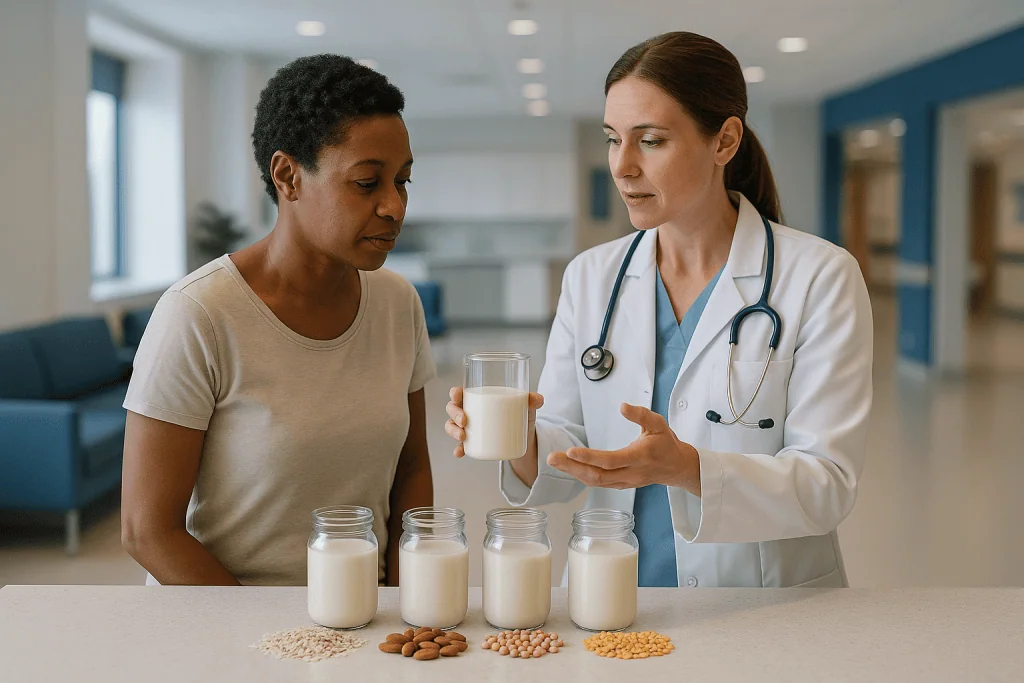
Soy milk is made from whole soybeans, which are naturally about 36 percent protein by dry weight. That protein survives the straining, which is why soy milk lands at roughly 7 grams per cup without any help. Pea milk is made from pea protein isolate, a concentrated powder extracted from yellow split peas, rather than from whole peas. The manufacturer essentially decides the protein level, and most set it at about 8 grams per cup to match dairy.
Almond milk is mostly water. A typical carton contains around 2 percent almonds, so the fiber, protein and healthy fats of a handful of nuts are largely left behind in the pulp. That is why unsweetened almond milk can have as few as 30 to 40 calories per cup, and about 1 gram of protein.
Oat milk needs an extra step. Oats are starchy, and raw oat slurry is thick and pasty. Manufacturers add enzymes that cut the starch into smaller sugars, mainly maltose, to make a drinkable liquid. Maltose is a simple sugar made of two glucose units joined together. This is why an oat milk labeled ‘no added sugar’ can still show 5 to 7 grams of sugar per cup. The sugar was not stirred in; it was created from the oat itself.
Fortification, which means adding nutrients that were not there to begin with, is the last stage. Calcium, vitamin D, vitamin B12, vitamin A and sometimes riboflavin are blended in, usually with a stabilizer such as gellan gum to help them stay suspended. Whether and how much a product is fortified is entirely a manufacturer decision.
Soy milk protein content and the best plant milk for protein
Protein is where plant milks separate most sharply, and it is the number worth reading first if you use milk as more than a splash in coffee.
Cow’s milk delivers about 8 grams of protein per 240 mL cup. Soy milk, unsweetened and unflavored, typically provides 7 grams. Pea milk is formulated to deliver 8 grams. Oat milk usually lands at 2 to 3 grams, and almond milk at about 1 gram. Rice and coconut milks, not covered in detail here, generally provide under 1 gram.
Quantity is only half the story. Protein quality describes how completely a food supplies the nine essential amino acids, the building blocks the body cannot make for itself. Soy protein is one of the few plant proteins that scores as a complete protein on standard quality scales, comparable to milk and egg. Pea protein is close behind, slightly lower in the amino acid methionine but still high quality, and particularly rich in leucine, the amino acid most closely linked to muscle protein building in randomized feeding studies. Oat and almond proteins are present in such small amounts that quality barely matters.
For whom does this matter? Anyone who replaced dairy with oat or almond milk without noticing that two cups a day quietly removed about 14 grams of protein from their intake. Older adults, who often struggle to reach the roughly 1.0 to 1.2 grams of protein per kilogram of body weight that many geriatric nutrition reviews suggest, are the group most likely to feel the gap. Children and teenagers growing fast, and people recovering from illness or surgery, are the others.
The practical read: if you want a plant milk that behaves like dairy on protein, soy and pea are the only two of the big four that do.
Is oat milk healthy? The sugar question, explained
Oat milk has become the default in many coffee shops because it foams well and tastes faintly sweet. That sweetness is the center of the current controversy, so it deserves a careful look.

A cup of plain oat milk contains roughly 5 to 7 grams of sugar, nearly all of it maltose produced during processing, plus about 2 grams of fiber and 2 to 3 grams of protein. For comparison, a cup of cow’s milk contains about 12 grams of lactose, a sugar the body also breaks down to glucose, and a 12-ounce can of regular soda contains around 39 grams of added sugar. Oat milk sits far closer to milk than to soda.
The glycemic index, a scale that ranks how quickly a food raises blood glucose relative to pure glucose, is sometimes cited to argue that oat milk is a problem. Maltose on its own does have a high glycemic index. But a food’s effect depends on the whole package, and oat milk also contains fat, protein and beta-glucan, a soluble fiber that slows digestion. The small number of published glycemic measurements on oat drinks suggest a moderate response, not a sugar spike. The evidence here is limited to a handful of small studies and manufacturer-sponsored tests, so the honest answer is that oat milk probably behaves like a modestly sweet drink, and that nobody has run a large independent trial.
Where oat milk does deserve credit is beta-glucan. Randomized trials show that about 3 grams a day of oat beta-glucan lowers LDL cholesterol modestly. A cup of oat milk provides somewhere between 0.5 and 1 gram, so it contributes without delivering the full studied dose.
For someone managing diabetes, the sugar in oat milk is worth counting alongside everything else in the cup, which usually means asking about the syrup before worrying about the milk.
Oat milk vs almond milk, soy and pea: a side-by-side comparison table
The table below uses typical values for unsweetened, fortified versions sold in the United States, per 240 mL cup. Individual products vary, sometimes widely, which is the whole reason to read the panel. Cow’s milk (2 percent) is included as a reference point.
| Milk | Calories | Protein (g) | Sugar (g) | Calcium (if fortified) | Notes |
|---|---|---|---|---|---|
| Soy, unsweetened | 80–100 | 7 | 1–2 | 300–450 mg | Complete protein; often has B12 and D added |
| Pea, unsweetened | 70–90 | 8 | 0–1 | 400–450 mg | Protein set by manufacturer; some add omega-3 (DHA) |
| Oat, plain | 100–130 | 2–3 | 5–7 (from oat starch) | 300–350 mg | Contains beta-glucan; check for certified gluten-free if needed |
| Almond, unsweetened | 30–60 | 1 | 0–1 | 300–450 mg | Very low calorie; often fortified with vitamin E |
| Cow’s milk, 2% | 120 | 8 | 12 (lactose) | 300 mg (natural) | Natural source of iodine, potassium, B12 |
Two patterns stand out. First, protein tracks the plant: beans and peas bring it, nuts and grains barely do. Second, sugar in unsweetened versions is close to zero everywhere except oat, where the manufacturing process creates it.
The ‘oat milk vs almond milk’ search usually comes down to one trade-off. Almond wins on calories and sugar, oat wins on fiber, creaminess and a little more protein. Neither wins on protein in any meaningful sense; for that, the comparison shifts to soy or pea.
Flavored and sweetened versions change everything above. A vanilla or chocolate plant milk can carry 10 to 20 grams of added sugar per cup, which is the same category as a sweetened iced tea. Barista blends often add oil and sugar to improve foam, and a few ‘extra creamy’ lines sit above 150 calories per cup.
Fortification: calcium, vitamin D and B12 in plant milks
Cow’s milk earned its reputation on calcium, and most plant milks copy that reputation through fortification. Whether they succeed depends on three things: what was added, how much, and whether it reaches your glass.
Calcium is the headline nutrient. Fortified plant milks typically contain 300 to 450 milligrams per cup, meeting or exceeding dairy’s roughly 300. The two common forms are calcium carbonate and tricalcium phosphate. Studies on absorption suggest both are reasonably well absorbed from fortified beverages, though a few older trials found that calcium from some fortified soy milks was absorbed somewhat less efficiently than from cow’s milk. The evidence is modest and dated, and the gap, where it exists, is small enough that a fortified plant milk still counts as a solid calcium source.
The settling problem is real. Added calcium is a mineral powder, not a dissolved salt, and it sinks. The NIH calcium fact sheet notes this directly. An unshaken carton can leave much of its calcium at the bottom, so the first glass may be far lower than the label claims and the last glass far higher.
Vitamin D is usually added at 2 to 3 micrograms (about 100 to 120 international units) per cup, matching fortified dairy. Most products use vitamin D2 from plant sources; a few use vegan vitamin D3 from lichen. Both raise blood vitamin D levels, though D3 appears somewhat more effective in head-to-head trials.
Vitamin B12 is the nutrient most often missing. Soy and pea milks frequently include it; almond and oat milks often do not. Since B12 occurs naturally only in animal foods, anyone eating a fully plant-based diet should check this line specifically rather than assume.
Organic plant milks are a trap for the unwary here: US organic standards restrict some fortificants, so organic versions are often unfortified.
What plant milks do not reliably replace
Fortification closes some gaps and leaves others open. Three nutrients deserve a specific mention because they rarely appear on plant milk labels and are easy to lose without noticing.
Iodine is the clearest example. Cow’s milk is a major iodine source in both the United States and the United Kingdom, partly because of iodine-containing disinfectants used in dairying and iodine in cattle feed. A cup of cow’s milk can supply a third or more of the daily requirement. Most plant milks contain almost none, and only a minority of brands fortify with it. Iodine is essential for thyroid hormone production, and the need rises during pregnancy. NHS and NIH guidance both flag plant milks as a reason people on dairy-free diets may need to think about iodine from other sources such as seafood, iodized salt or a supplement discussed with a clinician.
Potassium is the second. A cup of cow’s milk provides about 350 to 400 milligrams; most plant milks offer a fraction of that, though some pea milks are higher. Potassium matters for blood pressure, and the American Heart Association emphasizes food sources, which for dairy-free eaters means leaning harder on fruit, vegetables and legumes.
Protein quality, covered earlier, is the third. Almond and oat milk do not fail here so much as not participate.
None of this makes plant milks a poor choice. It makes them a different food, one that works best when the rest of the diet is doing its share. A person eating a varied diet with legumes, nuts, seafood or iodized salt will not notice the difference. A person relying on three cups of almond milk a day as a primary ‘nutrient drink’ probably will, eventually, in a blood test.
What the evidence actually says about plant milks and health
Grading the evidence matters more than listing it, because plant milk claims range from well-tested to purely theoretical.
Strong evidence (multiple randomized trials): soy protein lowers LDL cholesterol modestly, by roughly 3 to 5 percent at intakes of about 25 grams a day, which is three to four cups of soy milk. Oat beta-glucan lowers LDL cholesterol at about 3 grams a day. Fortified calcium and vitamin D raise blood levels and support bone mineral density. These are not plant-milk-specific trials, but the mechanisms transfer when the dose is matched.
Moderate evidence (large observational cohorts, consistent direction): populations consuming more soy foods show lower rates of breast cancer and prostate cancer, and no increase in cancer recurrence among survivors who eat soy. Replacing sugar-sweetened beverages with unsweetened milks of any kind is associated with better weight and metabolic markers. Observational data cannot prove cause, but the consistency across countries is notable.
Weak or absent evidence: direct trials comparing long-term bone, growth or heart outcomes between people drinking plant milks and people drinking dairy do not exist at meaningful scale. The glycemic effect of oat milk has been measured in a few small studies only. Claims that almond milk improves skin, that pea milk builds more muscle than soy, or that oat milk causes weight gain are not supported by controlled research in either direction.
Expert opinion fills the gaps. The NHS, CDC and major pediatric bodies agree on practical points: unsweetened and fortified versions are acceptable for adults and older children; soy is the closest dairy substitute for toddlers; babies under one need breast milk or formula.
The honest summary: plant milks are safe, useful and nutritionally uneven, and most strong claims for or against them, beyond the cholesterol and fortification points, rest on thin data.
Soy, hormones and health: what the studies show
The soy worry is older than the oat worry and has far more research behind it, which makes it the easier one to settle.
Soybeans contain isoflavones, plant compounds with a chemical shape loosely similar to the hormone estrogen. Because of that resemblance, they are sometimes called phytoestrogens, meaning plant-derived estrogen-like compounds. The resemblance is where the concern starts and, on the evidence, where it ends.
Isoflavones bind to estrogen receptors far more weakly than human estrogen does, and they prefer a receptor subtype that tends to oppose growth rather than promote it. In practice, that means they do not act like hormone therapy in the body.
Randomized trials in men have measured testosterone, estrogen and sperm parameters after weeks to months of soy protein or isoflavone supplementation. Pooled analyses find no meaningful change in testosterone or estrogen levels. The widely shared cases of men with hormonal symptoms involved extreme intakes, on the order of three quarts of soy milk a day, far outside normal eating.
In women, the breast cancer question has been studied in large cohorts in Asia and the United States. Mayo Clinic’s review of the evidence summarizes it plainly: moderate soy intake does not raise breast cancer risk, and among women diagnosed with breast cancer, soy food consumption is associated with similar or lower recurrence. This is observational evidence, so it cannot prove protection, but it strongly argues against harm.
Thyroid is the one area with a real caveat. Soy can interfere with the absorption of levothyroxine, a thyroid hormone medicine, if taken at the same time. People on thyroid medicine are generally advised to separate it from soy by several hours; the exact timing belongs to the prescribing clinician.
Two or three cups of soy milk a day falls comfortably within the intakes studied as safe.
Plant milks for babies, toddlers and pregnancy
Age changes the answer more than any other factor, and this is where guidance from public health bodies is clearest.
Under 12 months, no plant milk should be used as a main drink. Breast milk or infant formula provides the specific balance of protein, fat, iron and energy that a baby’s growth depends on. Plant milks, including soy milk sold in cartons, are not formulas and are far too low in fat and calories. Soy-based infant formula is a different, regulated product and is a separate conversation with a pediatrician. The CDC states this directly in its feeding guidance.
From one to two years, toddlers are usually moved to whole cow’s milk because fat supports brain development. The CDC and the American Academy of Pediatrics consider fortified, unsweetened soy milk the only plant alternative that is nutritionally comparable at this age. Almond, oat and rice milks are too low in protein and fat, and rice milk carries the additional arsenic concern noted by the NHS for children under five. Pea milk is newer and is increasingly discussed as a reasonable second option because of its protein and fat content, but the formal guidance has not caught up.
Children over two who drink plant milks instead of dairy do fine when the rest of the diet supplies protein and fat. The nutrients to watch are calcium (shake the carton), vitamin D, B12 and iodine.
During pregnancy, plant milks are safe and common. The specific flag is iodine, because requirements rise and plant milks rarely contain it. Prenatal vitamins vary in iodine content, which is worth a glance at the label and a word with the clinician managing the pregnancy. Protein needs also rise, which again favors soy or pea if milk is a regular part of the day.
Allergies, intolerances and oats with gluten
Plant milks are often chosen to avoid one allergen and can quietly introduce another. A short map of the risks helps.
Soy is one of the nine major food allergens recognized in US labeling law. Soy allergy is most common in young children and is often outgrown, but adults with a confirmed allergy need to avoid soy milk. Soy allergy is not related to lactose intolerance; a person can have one, both or neither.
Almond milk is a tree nut product, and tree nut allergy tends to be lifelong and can be severe. People with peanut allergy are not automatically allergic to tree nuts, but many are advised to be cautious. Cross-contamination, meaning accidental transfer of an allergen during manufacturing, is a concern with facilities that process several nut milks on shared lines.
Oats contain no gluten themselves, but they are frequently grown, harvested and processed alongside wheat, barley and rye. For someone with celiac disease, an autoimmune condition in which gluten damages the small intestine, only oat milk labeled certified gluten-free is considered safe. A small minority of people with celiac disease react even to pure oats, which is why specialist guidance usually recommends introducing oats under medical supervision.
Pea milk is the lowest-allergen option of the four. Pea allergy exists but is uncommon; it is more often seen in people who also react to peanuts, since both are legumes.
Added gums and emulsifiers, such as gellan gum and sunflower lecithin, are safe for the general population but can cause bloating in some people with irritable bowel syndrome. Switching brands, or choosing a product with a shorter ingredient list, often resolves it.
Lactose intolerance, the original reason many people switched, is fully addressed by any plant milk; none contain lactose.
Common myths about plant milks
Five claims recur across social feeds. Each has a sliver of truth attached to a wrong conclusion.
Myth: oat milk is liquid sugar. Plain oat milk carries 5 to 7 grams of sugar per cup, formed from oat starch during processing. That is about half the sugar in cow’s milk and a sixth of the sugar in a can of soda. The sweetened or flavored versions are a different matter and can rival soft drinks.
Myth: soy milk gives men feminine characteristics. Randomized trials measuring testosterone and estrogen after soy intake show no meaningful change. The isolated case reports involved extreme intakes, many times what anyone drinks normally.
Myth: almond milk is just as nutritious as almonds. A typical carton is about 2 percent almonds. The protein, fiber and most of the fat stay in the discarded pulp. Unsweetened almond milk is a low-calorie, low-nutrient drink that is useful mostly as a vehicle for fortified calcium and vitamin D.
Myth: plant milks are ‘ultra-processed’ and therefore harmful. Plant milks do meet common definitions of processed food because they are formulated and fortified. But the research linking ultra-processed foods to poor health is observational and dominated by snacks, sweets and processed meats; unsweetened fortified plant milks have not been shown to carry the same associations. Processing level is a weak guide to the nutritional value of any single product.
Myth: all plant milks are equal on calcium. Only fortified versions contain meaningful calcium, organic versions are often unfortified, and even fortified cartons deliver uneven amounts unless shaken. The claim on the front of the pack is only true for the carton as a whole, not for each glass.
Myth, with a grain of truth: plant milks are a complete replacement for dairy. For adults with a varied diet, close enough. For toddlers, only soy. For iodine, none.
Which plant milk fits which goal
Having read the panels, here is an evidence-based opinion on matching the drink to the purpose. The strongest view this writer holds is that the choice between oat and almond matters far less than the choice between sweetened and unsweetened, and that protein is the number most people forget to check.
For protein and a true dairy substitute: soy or pea. Both reach 7 to 8 grams per cup, both are usually well fortified, and soy has the deepest safety research behind it. Pea is the pick for anyone with soy allergy or a soy aversion.
For the fewest calories: unsweetened almond. At 30 to 40 calories per cup it is close to flavored water, which is fine for coffee or cereal and less fine as a nutrition source.
For creaminess in coffee and a little fiber: oat. Accept the small amount of natural sugar, choose a plain rather than barista version if calories matter, and look for certified gluten-free if celiac disease is in the picture.
For children one to two: fortified unsweetened soy, per CDC guidance, with pea as a reasonable discussion point for the pediatrician.
For managing blood sugar: any unsweetened version works; pea and soy have the lowest sugar and the most protein to blunt the rise from whatever else is in the cup.
For heart health: soy and oat both have randomized trial support for LDL lowering through soy protein and beta-glucan respectively, though a cup or two a day delivers only part of the studied amount.
For bone health: whichever fortified product you will actually drink, shaken. Calcium that stays at the bottom of the carton does nothing for anyone.
Rotating between two or three plant milks is a reasonable way to spread the strengths and dilute the gaps.
When to see a doctor
Plant milks are foods, not medicines, and most people never need medical input about them. A few situations do call for a clinician rather than a label.
Seek urgent care for any sign of a severe allergic reaction after drinking a plant milk, particularly soy or almond: swelling of the lips, tongue or throat, difficulty breathing, wheezing, a widespread rash with dizziness, or vomiting with faintness. These can indicate anaphylaxis, a life-threatening allergic reaction, and need emergency treatment.
Book a routine appointment if any of the following apply. A child under two is being given a plant milk other than fortified soy as a main drink, or any infant under 12 months is receiving a plant milk instead of breast milk or formula. A child or adolescent on a dairy-free diet has slowed growth, frequent fractures or persistent tiredness. An adult eating a fully plant-based diet has not had B12 checked and notices numbness, tingling, unexplained fatigue or memory changes, which can signal B12 deficiency. Someone is pregnant or planning pregnancy and relies on plant milks, so that iodine and protein can be reviewed. A person takes levothyroxine or another thyroid medicine and drinks soy milk regularly, because timing may need adjusting; any change belongs to the prescribing clinician, never self-managed. Digestive symptoms such as bloating, pain or changed bowel habits persist after switching milks and do not resolve with a different brand.
A registered dietitian is the right professional for building a dairy-free diet that covers calcium, vitamin D, B12, iodine and protein, especially for children, pregnancy, older adults and anyone with celiac disease, kidney disease or multiple food allergies.
No change to a prescribed medicine, supplement dose or medical diet should be made on the basis of this article. The evidence here is meant to inform the conversation, not replace it.
Frequently asked questions
What is the best plant milk for protein?
Pea milk and soy milk are the best plant milks for protein, with about 8 and 7 grams per cup respectively, roughly equal to cow’s milk. Both supply high-quality protein containing all essential amino acids. Oat milk provides only 2 to 3 grams and almond milk about 1 gram, so neither is a meaningful protein source.
Is oat milk healthy, or does it raise blood sugar?
Plain oat milk is a reasonable choice for most people. It contains 5 to 7 grams of naturally formed sugar per cup, less than cow’s milk, along with a little fiber and beta-glucan. Small studies suggest a moderate rather than sharp blood sugar response, though large independent trials are lacking. Sweetened and flavored versions can carry far more sugar.
Oat milk vs almond milk: which is better?
It depends on the goal. Unsweetened almond milk has fewer calories (about 30 to 60 per cup) and almost no sugar, while oat milk offers more creaminess, about 2 grams of fiber and slightly more protein. Neither provides much protein; for that, soy or pea milk is the better comparison. Both are useful when fortified and unsweetened.
How much protein is in soy milk compared with cow's milk?
Unsweetened soy milk typically contains about 7 grams of protein per cup, compared with 8 grams in cow’s milk. Soy protein is complete, meaning it supplies all nine essential amino acids, and randomized trials show about 25 grams a day modestly lowers LDL cholesterol. This makes soy the closest nutritional match to dairy among plant milks.
Does soy milk affect hormones in men or women?
Not at normal intakes, according to the evidence. Pooled randomized trials in men show no meaningful change in testosterone or estrogen after soy consumption. In women, large observational studies find moderate soy intake does not raise breast cancer risk. Soy isoflavones bind estrogen receptors only weakly. People taking thyroid medicine should discuss timing with their clinician.
Do plant milks have enough calcium?
Fortified plant milks usually contain 300 to 450 milligrams of calcium per cup, similar to or above cow’s milk. Unfortified and many organic versions contain very little. Because added calcium settles, shaking the carton before each pour is necessary to get the labeled amount. Absorption from fortified beverages is generally good, though some older studies found it slightly below dairy.
Which plant milk is best for toddlers?
For children aged one to two, the CDC and pediatric guidance consider fortified, unsweetened soy milk the only plant alternative nutritionally comparable to whole cow’s milk. Almond, oat and rice milks are too low in protein and fat, and rice milk is not advised under age five because of arsenic. No plant milk should replace breast milk or formula before 12 months.
Are plant milks safe during pregnancy?
Yes, plant milks are safe in pregnancy and widely used. The nutrient to watch is iodine, because requirements rise and most plant milks contain almost none, unlike cow’s milk. Protein needs also increase, which favors soy or pea milk. Reviewing iodine sources, including the prenatal vitamin, with the clinician managing the pregnancy is sensible.
Is oat milk gluten-free?
Oats are naturally free of gluten, but they are often grown and processed alongside wheat and barley, so ordinary oat milk may be contaminated. People with celiac disease should choose oat milk labeled certified gluten-free. A small minority of people with celiac disease react to pure oats as well, so specialist guidance usually recommends introducing oats under medical supervision.
Do plant milks contain vitamin B12?
Only when a manufacturer adds it. Vitamin B12 occurs naturally in animal foods, not plants. Soy and pea milks frequently include added B12; almond and oat milks often do not. People on fully plant-based diets should check the nutrition label for B12 specifically rather than assume, and discuss supplementation with a clinician if intake is low.
References
This article is for general information only and is not a substitute for professional medical advice. Please consult a qualified doctor about your individual situation.

More from the Blog

Green Tea Benefits: The Evidence Behind the World’s Calmest Drink
Green tea offers modest, well-documented benefits rather than miracles. Large population studies link regular drinking to lower rates of cardiovascular disease, and its natural…

Beet Juice: The Nitrate Effect Athletes Swear By
Beet juice is rich in dietary nitrate, which the body converts to nitric oxide, a molecule that relaxes blood vessel walls. In clinical studies,…

How Many Calories in a Pound? The 3,500-Calorie Rule and Its Limits
A pound of body fat stores roughly 3,500 calories, which is why the classic rule says a 3,500-calorie deficit should shed one pound. Real…

How Much Potassium in a Banana? And What Actually Beats It
A medium banana (about 7 to 8 inches long) contains roughly 420 milligrams of potassium, around 9 percent of the 4,700-milligram Daily Value. That…

Egg Whites vs Whole Eggs: What the Yolk Adds and When It Matters
Egg whites supply most of an egg's protein with almost no fat, cholesterol or calories, but the yolk carries nearly all of its vitamins…

Spearmint Tea: The Hormone-Curious Cup, Explained
Spearmint tea is a caffeine-free herbal infusion with modest evidence behind its hormone reputation: two small clinical trials found that drinking it twice daily…