

Poison Sumac Rash: What It Looks Like, Why It Blisters and How Long It Lasts

Key Takeaways
- Poison sumac, poison ivy and poison oak all contain urushiol, and the rash they cause is identical in mechanism, appearance and duration.
- The rash typically appears 12 to 72 hours after contact and resolves within one to three weeks, according to CDC NIOSH and MedlinePlus.
- Washing the skin with soap and water or rubbing alcohol within minutes of contact is the only step that meaningfully reduces the reaction.
- Blister fluid is sterile serum with no urushiol in it, so the rash cannot be spread by scratching or passed to another person.
- Urushiol persists on gloves, tools, clothing and pet fur, and contaminated objects are the usual explanation for a second rash weeks later.
- Breathing smoke from burning poison sumac can inflame the airway, and difficulty breathing after a brush fire is an emergency.
A poison sumac rash is an allergic skin reaction to urushiol, the oily resin in the plant's sap. It usually appears 12 to 72 hours after contact as itchy red streaks or patches that swell and form blisters, and most cases settle within one to three weeks without scarring. Seek urgent care for trouble breathing, swelling of the face or eyes, or a rash covering large areas of the body.
The Saturday job was simple: clear the soggy brush at the edge of the pond before the mosquitoes took over. By Monday evening the inner forearm had a faint pink line. By Wednesday it had become a ridge of tight, glassy blisters that itched hardest at two in the morning, when there was nothing to do but stare at it and type the question into a phone.
That sequence, a delay of a day or two followed by streaks that swell and bubble, is the signature of a poison sumac rash. It is the same reaction that poison ivy and poison oak cause, triggered by the same chemical, and it follows a timetable that is far more predictable than it feels while you are living through it.
This article explains what the rash looks like at each stage, why the skin blisters, what genuinely helps the itch, and the handful of signs that mean the reaction needs a clinician rather than a cool compress.
Poison sumac rash: the short answer on appearance and timing
A poison sumac rash is allergic contact dermatitis, which simply means the skin’s immune system has reacted to something it touched rather than to an infection. The trigger is urushiol, a colorless, oily resin found in the sap, leaves, stems and roots of poison sumac, poison ivy and poison oak.
The rash rarely shows up on the day you brush the plant. The CDC’s occupational health institute, NIOSH, puts the usual onset at 12 to 72 hours after contact. Early on you see redness and itching, often in lines where a stem dragged across the skin. Over the next day or two the area swells and raised bumps or fluid-filled blisters form. Most rashes peak within about a week, then dry, crust and fade. MedlinePlus and NIOSH both give a typical course of one to three weeks, with widespread or repeatedly exposed cases taking longer.
Three situations are emergencies and belong in an emergency department: difficulty breathing or swallowing, especially after breathing smoke from burning brush; swelling of the face, lips or eyes, or eyes swelling shut; and a rash spreading over a large part of the body. Those signs appear again in the final section, because they matter more than anything else here.
What is poison sumac and where does it grow?
Poison sumac, Toxicodendron vernix, is a woody shrub or small tree that favors wet ground: swamps, bogs, pond margins and flooded woodland. In the United States it is found mainly in the eastern and southeastern states, which is why people who clear ditches, work on golf courses or wade after a lost dog meet it more often than hikers on dry trails.
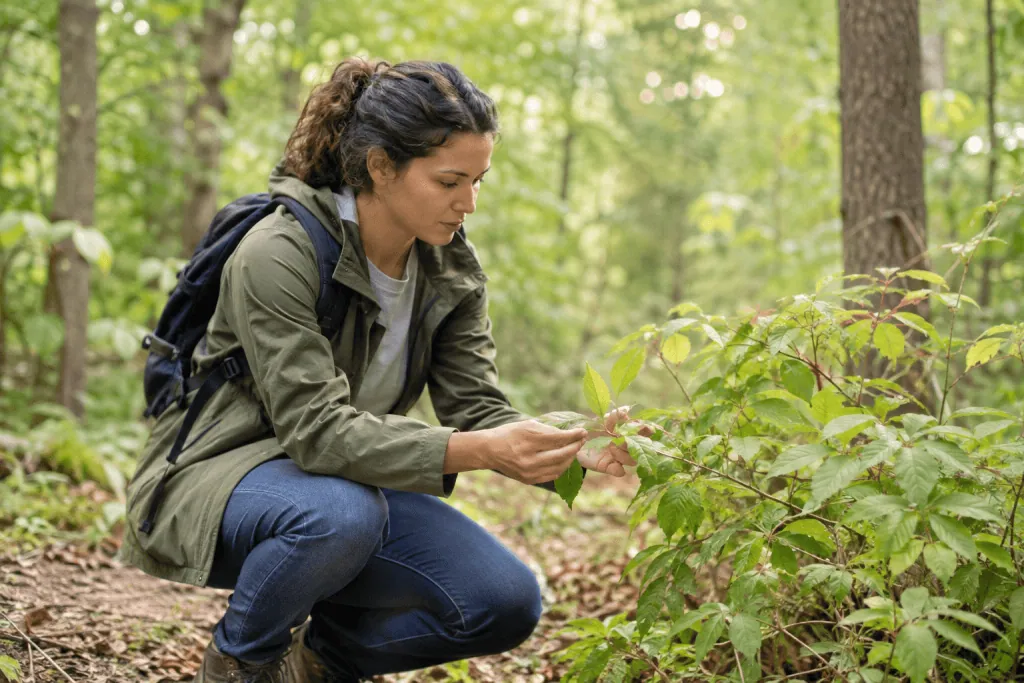
It looks nothing like poison ivy. Each leaf carries 7 to 13 smooth-edged leaflets arranged in pairs along a reddish stem, with a single leaflet at the tip. The leaflets are glossy, often turning orange-red in autumn, and the berries hang in loose, pale cream or grayish clusters. The harmless staghorn sumac that lines roadsides has toothed leaflets and upright, fuzzy red berry cones, a useful distinction when you are deciding whether to push through a thicket.
Every part of the plant carries urushiol, including bare winter stems. The oil also survives on surfaces. NIOSH warns that it can persist on tools, gloves, boots, clothing and pet fur, so a second rash weeks later sometimes traces back to a pair of unwashed work gloves rather than a new walk in the wetlands.
Why does poison sumac cause a rash? Urushiol and the immune system
Urushiol does not burn or poison the skin directly. It binds to proteins in the outer skin within minutes, and the combination looks foreign to the immune system. This is a delayed-type, or type IV, hypersensitivity: T cells, a kind of white blood cell, recognize the altered skin proteins and recruit an inflammatory response over the following days. The delay explains why the rash follows the exposure by one to three days rather than minutes, and why the hours right after contact are the only window in which washing can make a difference.
Sensitization comes first. The first time most people touch urushiol they develop no rash at all, or only a mild one that appears a week or more later; the immune system is learning. Later exposures produce the full reaction within the usual 12 to 72 hours. Sensitivity also varies. NIOSH notes that most people react, and the widely quoted estimate in US dermatology guidance is that roughly 85 percent of adults are sensitive. A minority never react, and sensitivity can change across a lifetime in either direction.
Because the reaction is an allergy and not a toxin, the blister fluid contains no urushiol. That single fact settles several of the myths covered later.
What does the rash from poison sumac look like?
The earliest sign is usually itch without much to see, then faint pink patches that darken to red over hours. The shape is the clue. Plant stems leave linear streaks, and a brushing hand leaves irregular smears, so a poison sumac rash often looks drawn on rather than scattered. On lighter skin the redness is obvious; on darker skin the inflamed areas may look deep brown, purple or gray, and the swelling and texture change are easier to spot than the color.

Within a day or two the patches become raised and bumpy. Small blisters, called vesicles, cluster along the streaks; larger ones, called bullae, can form where exposure was heavy. Blisters may weep clear or straw-colored fluid, then crust over as they dry. Swelling is common on loose-skinned areas such as the eyelids, lips and genitals, where even a little urushiol carried on a fingertip can cause dramatic puffiness.
One unusual variant deserves a mention. Urushiol darkens as it oxidizes in air, so heavy exposure occasionally leaves black, lacquer-like spots on the skin before the rash appears. Clinicians know this as black-spot dermatitis, and it is harmless in itself, though it signals a large dose of oil.
Online image searches for the rash show the full spectrum, from a few bumps to sheets of blisters, which is why the shape and history matter more than any single picture.
Why does poison sumac rash blister?
Blisters are the visible result of inflammation lifting the skin’s surface. When T cells arrive at the urushiol-bound skin, they release chemical messengers that make nearby blood vessels leaky. Fluid floods the epidermis, the thin outer layer, and pushes its cells apart in a process dermatologists call spongiosis. Where the fluid collects into pockets, a blister forms. Heavier exposure means more bound urushiol, a stronger local reaction and bigger pockets, which is why the thick, glassy bullae tend to appear exactly where a stem was gripped or a leaf was crushed against the skin.
Skin thickness changes the picture too. Palms and soles have a tough outer layer and often show only redness and itch, while the thin skin of the forearm, neck and eyelids blisters readily. This is also why the rash can seem to emerge in waves over several days: areas with less contact or thicker skin simply react later and more mildly than the first streaks.
The fluid itself is serum, the watery part of blood, and it is sterile and free of urushiol. Breaking blisters does not release anything harmful, but it does open the skin to bacteria and slows healing, so mainstream guidance, including MedlinePlus, advises leaving them intact and covering any that burst.
How long does poison sumac rash last? The typical timeline
Most people want a date, and the honest answer is a range. The table below pulls together the figures from CDC NIOSH and MedlinePlus, the two sources most clinicians lean on for this reaction.
| Stage | Typical timing after contact | What you see |
|---|---|---|
| Latent period | 12–72 hours (longer on a first exposure) | Nothing, or faint itch |
| Early rash | Days 1–3 | Red streaks or patches, itching, mild swelling |
| Peak | Roughly days 3–7 | Bumps and blisters, weeping, strongest itch |
| Drying | Second week | Crusting, flaking, fading color |
| Resolution | 1–3 weeks in total | Skin returns to normal, sometimes with temporary darker or lighter marks |
Several things stretch the timeline. A large dose of urushiol, re-exposure from contaminated clothing or tools, scratching that opens the skin, and a bacterial infection all prolong it. People with very high sensitivity, and those with a history of eczema, tend to run longer and more intense courses, though no study has pinned that to a precise number of extra days.
The review point is clear in both sources: a rash that is still worsening after a week, shows no improvement after two weeks, or lingers beyond three weeks warrants a clinician’s look, because something other than simple contact dermatitis may be going on.
Is poison sumac rash worse than poison ivy?
Poison sumac is often described in field guides and news reports as the most potent of the three Toxicodendron plants, and some people who have met all three agree. What the evidence actually shows is thinner than the reputation. The active chemical in all three plants is urushiol, with slightly different side chains, and no large controlled study has compared the severity of rashes caused by each species in the same people.
Severity in practice depends on three measurable things: how much oil reached the skin, how sensitive the person is, and how quickly the skin was washed. A fingertip touch of poison sumac will cause a milder rash than falling into a poison ivy patch. Poison sumac’s reputation may owe as much to its habitat as its chemistry; people meet it in wet, close quarters, often while cutting or pulling it, and that means heavy contact.
The clinical approach is identical. NIOSH and MedlinePlus give the same onset window, the same course and the same management for all three plants. If a clinician cannot tell from the rash which plant caused it, that is because the rash itself does not say.
What else could it be? Rashes that look like poison sumac
Clinicians rarely need a test for this rash; the history and the pattern usually do the work. The common look-alikes, and how they are told apart, are worth knowing because the plan differs.
- Other allergic contact dermatitis (nickel, fragrance, adhesive, rubber in gloves): itchy, sometimes blistered, but follows the shape of a watch, waistband or glove rather than linear streaks. Patch testing can identify the trigger if episodes recur.
- Irritant contact dermatitis from solvents, cement or harsh soaps: burning and dryness more than itch, appears within hours rather than days, on anyone exposed rather than only the sensitized.
- Insect bites: scattered single bumps, often grouped in threes, each with a central puncture, and no streaking.
- Shingles: a band of blisters on one side of the body, often painful or tingling before it appears, in a person who has had chickenpox. Pain rather than itch is the clue.
- Impetigo, a bacterial skin infection: honey-colored crusts, spreads to new sites, common in children. Often needs antibiotic treatment.
- Scabies: intense night itch with tiny burrows between fingers and at wrists, spreading to close contacts.
The examination is a careful look, sometimes with magnification, plus questions about outdoor work, gardening, pets and timing. Swabs are sent only if infection is suspected; blood tests play no role. If a rash recurs without plant contact, referral for patch testing is the usual next step, as the NHS contact dermatitis guidance describes.
How do you get rid of poison sumac rash fast? What home care actually does
Nothing shortens the rash dramatically once it has formed, and anyone promising otherwise is selling something. The one step that genuinely changes the course is early washing. NIOSH advises rinsing the skin immediately with plenty of water and soap, a degreasing dish detergent or rubbing alcohol, scrubbing under the nails, and washing clothing separately in hot water. The sooner the oil comes off, the less binds to the skin, and the smaller the reaction. After a few hours the oil is bound and washing no longer prevents the rash, though it still removes any residue that could spread to the eyes or genitals.
Once the rash is present, home care is about comfort and protecting the skin. The measures that mainstream guidance supports are simple:
- Cool, wet compresses for 15 to 30 minutes several times a day to calm itch and dry weeping areas.
- Lukewarm baths with colloidal oatmeal or a cool shower; hot water can intensify itch afterward.
- Calamine lotion or similar drying, soothing lotions on intact skin.
- Short, clean fingernails and loose cotton clothing to limit scratch damage.
- Leaving blisters intact and covering any that break with a clean, dry dressing.
Over-the-counter antihistamine tablets are often used; MedlinePlus notes they help mainly by easing itch and aiding sleep rather than by treating the rash. A pharmacist can advise on options, and any medicine decisions belong with them or a clinician.
What treatments might a clinician discuss?
For a localized rash, the mainstay is a topical corticosteroid, a cream or ointment that dampens the immune reaction in the skin. Clinicians match the strength to the body site, using milder preparations on the face and folds, and most courses run for a short, defined period while the rash settles. Hydrocortisone products sold without prescription are low strength; stronger options are prescribed.
When the rash is widespread, involves the face, eyelids or genitals, or is causing severe swelling, an oral corticosteroid is commonly offered. These work throughout the body and begin to reduce inflammation within a day or two. MedlinePlus and NIOSH both note that a course for poison plant dermatitis is typically given over a couple of weeks with a gradual taper, because stopping abruptly can let the rash flare back. The prescribing clinician decides whether it is appropriate, weighs conditions such as diabetes or high blood pressure, and sets the length of the course.
Antibiotics enter the picture only if the skin becomes infected, which shows as spreading redness, warmth, pus or fever. Antihistamines, as above, address itch more than inflammation. None of these choices should be started, stopped or altered without the prescriber’s input, and no treatment restores the skin faster than its own healing timetable of one to three weeks.
Does poison sumac rash spread, and is it contagious?
The rash cannot be passed from one person to another. It is an allergic reaction, not an infection, and the blister fluid contains no urushiol. A child with a weeping arm can share a sofa with a sibling without risk, and NIOSH and MedlinePlus are explicit on this point.
What does spread is the oil itself. Urushiol lingers on anything it touched: gloves, pruning shears, boot laces, a dog’s coat, a car steering wheel, a phone case. Touching those items days later can start a fresh rash, and this is the usual explanation when a second crop appears after someone swears they have not been near the plant. The same mechanism explains why the rash seems to travel across the body in the first days: areas with less oil or thicker skin simply react later. Scratching does not carry the reaction from one site to another once the oil has been washed off.
Sensible precautions are practical rather than anxious. Wash clothing and tools after any brush clearing, bathe pets that have been in wet woodland, and never burn Toxicodendron plants. Smoke carries urushiol particles that can inflame the airway and lungs, which is why NIOSH treats breathing difficulty after a brush fire as a reason for emergency care. Covering skin with long sleeves, gloves and boots, and applying a barrier cream before working, reduces exposure, though no method is fully reliable.
What people often get wrong about poison sumac rash
Popping blisters speeds things up. It does the opposite. The fluid is sterile and contains no oil; opening the roof invites bacteria and delays healing.
The rash is spreading because I scratched it. Once the oil is gone, scratching does not move the reaction. New patches reflect later-reacting skin or re-exposure from contaminated objects.
I’m immune, I’ve touched it before. A first exposure usually causes no rash because sensitization comes first. Immunity can also fade or appear over the years; a rash-free childhood is no promise for adulthood.
Hot water takes the itch away. It does, briefly, by overwhelming the nerves, and then the itch rebounds more intensely. Cool compresses are the better bargain.
Only the leaves are dangerous. Stems, roots and bare winter branches all carry urushiol. People clearing dormant brush in late winter are caught out every year.
Bleach, gasoline or scrubbing with abrasives will remove the oil. These damage the skin and worsen the reaction. Soap, water and, if needed, rubbing alcohol are what occupational guidance recommends.
Poison sumac causes a different rash from poison ivy. The reaction is identical in mechanism, appearance and course; the plants differ, the dermatitis does not.
When to see a doctor about a poison sumac rash
Most poison sumac rashes are miserable but safe, and settle at home within one to three weeks. A clinician should look at it sooner in the following situations, which MedlinePlus and NIOSH list as reasons for review:
- Rash on the face, eyelids, lips or genitals, or any swelling that threatens to close an eye.
- Rash covering a large portion of the body, or many blisters forming at once.
- Signs of infection: spreading redness, warmth, pus, yellow crusts, red streaks running from the rash, or fever.
- Itch that prevents sleep despite cool compresses and over-the-counter measures.
- No improvement after about a week, worsening after a week, or a rash still present at three weeks.
- Rashes that keep returning without obvious plant contact, which may need patch testing for another allergen.
Call emergency services or go to an emergency department for difficulty breathing or swallowing, particularly after exposure to smoke from burning brush; swelling of the face, tongue or throat; or a rapidly spreading reaction with dizziness or faintness. These are rare, but they are the reasons the plant deserves respect.
Children follow the same pathway: the same warning signs, with a lower threshold for a visit if the rash involves the face or genitals or the child cannot be settled. Pregnant readers can use the same home measures, but any medicine, including over-the-counter products, is a conversation with their midwife, obstetrician or pharmacist rather than a decision made in a pharmacy aisle.
Frequently asked questions
What does the rash from poison sumac look like?
It usually starts as itchy red streaks or patches where the plant touched the skin, often in lines. Within a day or two the area swells and develops bumps and fluid-filled blisters that may weep and then crust. On darker skin the color may be brown, purple or gray, with the swelling and texture change more obvious than the redness.
How long does poison sumac rash last?
Most cases last one to three weeks, according to MedlinePlus and CDC NIOSH. The rash tends to peak around days three to seven, then dries and fades over the second week. Heavy exposure, re-exposure from contaminated clothing, scratching and infection can prolong it, and a rash still present after three weeks should be reviewed by a clinician.
How do you get rid of poison sumac rash fast?
Nothing removes an established rash quickly; the skin heals on its own timetable of one to three weeks. The step that genuinely helps is washing off the oil within minutes of contact. After that, cool compresses, oatmeal baths, calamine lotion and clinician-prescribed corticosteroids reduce itch and inflammation while the rash runs its course.
Is poison sumac rash worse than poison ivy?
Poison sumac has a reputation as the most potent of the three plants, but no controlled study has compared them in the same people. All three contain urushiol, and the rash is the same. Severity depends far more on how much oil reached the skin, how sensitive the person is and how quickly it was washed off than on which plant was responsible.
How long does it take for sumac poisoning to go away?
The reaction is an allergy rather than a poisoning, and it typically clears in one to three weeks. There is a delay of 12 to 72 hours before anything appears, a peak of itch and blistering in the first week, and crusting and fading in the second. Temporary darker or lighter marks can remain for a few weeks longer on some skin types.
Why does poison sumac rash blister?
Immune cells responding to urushiol-bound skin proteins release chemicals that make blood vessels leaky. Fluid floods the outer skin layer and collects into pockets, which are the blisters. Heavier exposure and thinner skin, such as on the forearm or eyelids, produce bigger blisters; the tough skin of the palms often shows only redness and itch.
Is poison sumac rash contagious or does it spread?
No. The rash is an allergic reaction, and blister fluid contains no urushiol, so it cannot pass to another person or spread by scratching. What spreads is the oil on contaminated gloves, tools, clothing and pet fur, which can trigger a new rash days or weeks later if it is not washed off.
Should I pop poison sumac blisters?
No. The fluid is sterile and harmless, and breaking the blister roof opens the skin to bacteria and slows healing. Leave blisters intact, keep the area clean, and cover any that burst on their own with a clean, dry dressing. See a clinician if the skin becomes warm, red, crusted with pus or painful.
Can you get a poison sumac rash in winter?
Yes. Urushiol is present in the stems, roots and bare branches as well as the leaves, so clearing dormant brush in late winter can cause the same rash. The oil also survives for long periods on surfaces, which is why old gloves and tools stored since the previous season can trigger a reaction.
When should a poison sumac rash be seen by a doctor?
See a clinician if the rash involves the face, eyes or genitals, covers a large area, shows signs of infection such as pus or fever, keeps you from sleeping, or is not improving after about a week. Seek emergency care for trouble breathing or swallowing, swelling of the face or throat, or a rapidly spreading reaction with faintness.
References
- MedlinePlus Medical Encyclopedia: Poison ivy – oak – sumac rash
- MedlinePlus Health Topic: Poison Ivy, Oak, and Sumac
- CDC NIOSH: Poisonous Plants and Outdoor Workers
- CDC NIOSH Fast Facts: Protecting Yourself from Poisonous Plants
This article is for general information only and is not a substitute for professional medical advice. Please consult a qualified doctor about your individual situation.
Add us as a Preferred Source to see more of our trusted health content across Google Search, AI Overviews and Discover.

More from the Blog

Shingles Near the Eye or Ear: Warning Signs That Need Same-Day Medical Attention
Shingles on the forehead, eyelid, nose or inside the ear needs same-day medical review even before the eye or ear feels wrong. Warning signs…

Stinging Nettle Rash: What It Looks Like, How Long It Lasts and What Calms the Sting
A stinging nettle rash is a crop of small, pale, itchy bumps on reddened skin, raised by chemicals such as histamine injected through the…

Lump Under the Skin: Cysts, Lipomas and Hard Lumps Explained and When to Get One Checked
Most lumps under the skin are harmless. Epidermoid cysts, lipomas (soft fatty lumps) and swollen lymph nodes account for the large majority. A lump…

What to Record Before Your Urticaria Appointment: A Hives Diary Your Dermatologist Can Use
Before a hives appointment, keep a short daily diary for one to two weeks: dated photos with a coin or ruler for scale, when…

Brown Recluse Bite Stages: The Timeline Day by Day, How Serious It Can Get and When to Seek Care
A brown recluse bite typically passes through recognizable stages: a painless or barely noticed bite, then stinging, redness and swelling within about 2 to…

Skin Rash Types: How Common Rashes Look, What Causes Them and When to See a Doctor
Most skin rash types fall into a few groups: eczema and contact dermatitis (dry, itchy patches), hives (raised weals that move), viral rashes (flat…