

Shingles Near the Eye or Ear: Warning Signs That Need Same-Day Medical Attention
Key Takeaways
- A shingles rash on the forehead, eyelid or nose tip means the nerve that also supplies the eye is affected, so an eye examination is usually advised even when the eye looks normal.
- The CDC estimates that the ophthalmic branch is involved in about 10% to 20% of shingles cases, making it one of the most common sites for complications.
- Antiviral medicines block viral copying and work best when started within about 72 hours of the rash appearing, according to the CDC and NHS.
- Ramsay Hunt syndrome combines ear pain and blisters with one-sided facial weakness, and any new facial droop needs emergency assessment to rule out stroke.
- Eye inflammation and corneal numbness can appear one to three weeks after the rash, which is why follow-up visits are scheduled over weeks rather than a single all-clear.
- The CDC reports that roughly 10% to 18% of people with shingles develop postherpetic neuralgia, with risk rising with age and with eye involvement.
Shingles on the forehead, eyelid, nose or inside the ear needs same-day medical review even before the eye or ear feels wrong. Warning signs include a one-sided rash on the forehead or nose tip, eye redness or pain, light sensitivity, blurred vision, ear pain with blisters, facial drooping, hearing change or dizziness. Antiviral treatment works best when started within about 72 hours of the rash appearing.
It started as a headache that would not sit still. By the second morning the left side of his forehead felt sunburned under the skin, tender to the brush of a pillowcase. He put it down to a tense week. Then, shaving, he noticed three small blisters at the tip of his nose and a red patch creeping toward the eyelid. His first instinct was an antihistamine and a quiet weekend.
That instinct is understandable, and it is also the moment where shingles near eye warning signs are most often missed. A rash in that exact territory means the virus is traveling along the nerve that also supplies the surface and interior of the eye. The same is true of blisters inside the ear canal, which share a nerve with the muscles of the face and the balance organs.
This guide explains what is actually happening under the skin, which signs justify calling a clinician today rather than Monday, how treatment works, and what the weeks afterward tend to look like.
What happens if shingles is near the eye?
Shingles is a reactivation, not a new infection. After chickenpox, the varicella-zoster virus retreats into clusters of nerve cells near the spine and skull, called ganglia, and sleeps there for decades. When immunity dips, the virus wakes, multiplies and travels down a single nerve to the skin that nerve serves. That patch of skin is called a dermatome, which is why a shingles rash stays on one side and stops at the midline.
The face is supplied by the trigeminal nerve, which splits into three branches. The upper branch, the ophthalmic branch, serves the forehead, the upper eyelid, the bridge and tip of the nose, and the eye itself: the cornea (the clear front window), the iris and the structures behind it. So a rash on the forehead is not merely close to the eye. It is a sign that the nerve feeding the eye is already inflamed and carrying active virus.
The CDC estimates that roughly 1 in 3 people in the United States will develop shingles in their lifetime, and that the ophthalmic branch is involved in about 10% to 20% of cases. In that group, inflammation can reach the cornea, the inside of the eye, the drainage system that controls eye pressure, and, rarely, the retina or optic nerve. Each of those can damage vision if untreated.
What makes this location different from shingles on the trunk is timing. Eye complications do not always arrive with the rash. They can surface days or even weeks later, after the skin looks like it is healing, which is why the first appointment usually leads to scheduled follow-up rather than a single visit.
Shingles near eye warning signs that need same-day attention
Clinicians treat shingles in the ophthalmic territory as urgent by location alone. You do not need to prove the eye is involved before seeking care; the rash position does that for you. The signs below are prompts to call a clinician today, not a tool for diagnosing yourself at home.

- A one-sided rash, blisters or burning pain on the forehead, scalp line, upper eyelid or side of the nose.
- Blisters on the tip of the nose. This is known as Hutchinson’s sign and signals that the nasociliary nerve, which also supplies the eye, is affected.
- Eye redness, aching or a gritty, foreign-body feeling on the same side as the rash.
- Sensitivity to light, blurred vision, halos around lights or any change in how well you see.
- An eyelid swelling shut, or an eye that waters heavily or will not close fully.
- Fever, confusion or a rash spreading beyond one stripe, which can indicate wider infection.
The 72-hour point matters. Both the CDC and the NHS note that antiviral medicines are most effective when started within 72 hours of the rash appearing, because they work by stopping the virus from copying itself, and the greatest copying happens early. A forehead rash on Friday evening is a reason to use an urgent care service or an after-hours line, not to wait for a routine slot.
Any drop in vision, severe eye pain or a new facial droop is an emergency-department level problem rather than a same-day appointment. The NHS advises contacting urgent services if shingles affects the eye, because untreated eye involvement can lead to lasting sight loss. Harvard Health makes the same point: shingles of the eye can cause permanent vision impairment, and the gap between noticing and treating is where much of that risk lives.
What does a shingles rash look like, and why the face can fool you
Most shingles begins before anything is visible. Mayo Clinic describes pain, burning, tingling or numbness in one area, often a few days before the rash, sometimes with fever, headache and sensitivity to touch. On the face, that early phase is easily read as a sinus headache, a migraine or a tooth problem.
Then the skin changes. Red patches appear in the painful zone, usually within one to five days, followed by clusters of small fluid-filled blisters that look a little like a tight band of chickenpox. The blisters break, weep and crust over in about 7 to 10 days, and the whole episode typically clears in two to four weeks, according to the CDC. The NHS gives a similar window, noting it can take up to four weeks for the rash to heal.
The giveaway is geography. A shingles rash occupies one dermatome, so it sits on one side and respects the midline of the forehead, nose and lip. Eczema, contact dermatitis from a new face cream, an insect bite or a bacterial skin infection do not follow nerve maps. Cold sores, caused by a different herpes virus, cluster at the lip edge rather than tracking up the forehead.
Two variations trip people up. Sometimes the rash is only a few blisters, or a faint red patch, which looks too minor to matter. And in zoster sine herpete, the nerve pain occurs without any rash at all, a diagnosis clinicians make on pattern and history. A one-sided, burning forehead pain that persists for several days deserves mention to a clinician even if the skin stays clear.
If you want to compare what you see with reference images, MedlinePlus and the NHS both publish photographs of typical shingles rashes.
Herpes zoster ophthalmicus: the shingles in the eye symptoms an eye exam looks for
Herpes zoster ophthalmicus is the medical name for shingles affecting the ophthalmic branch of the trigeminal nerve, with or without visible eye disease. When a clinician suspects it, the next step is usually a detailed eye examination, often by an ophthalmologist, a doctor specializing in eye disease.
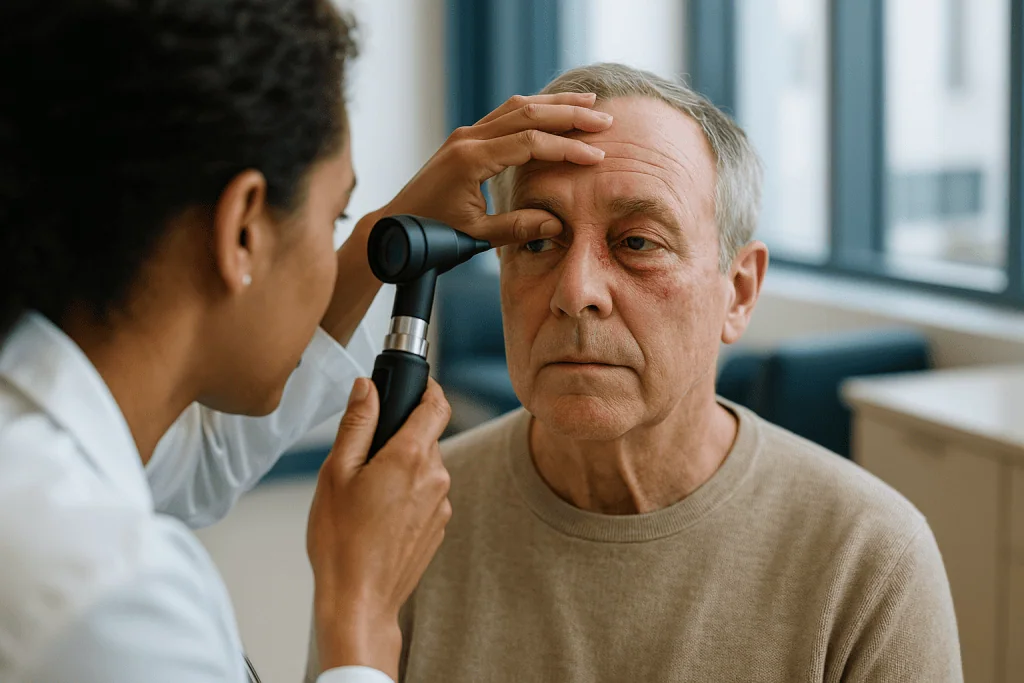
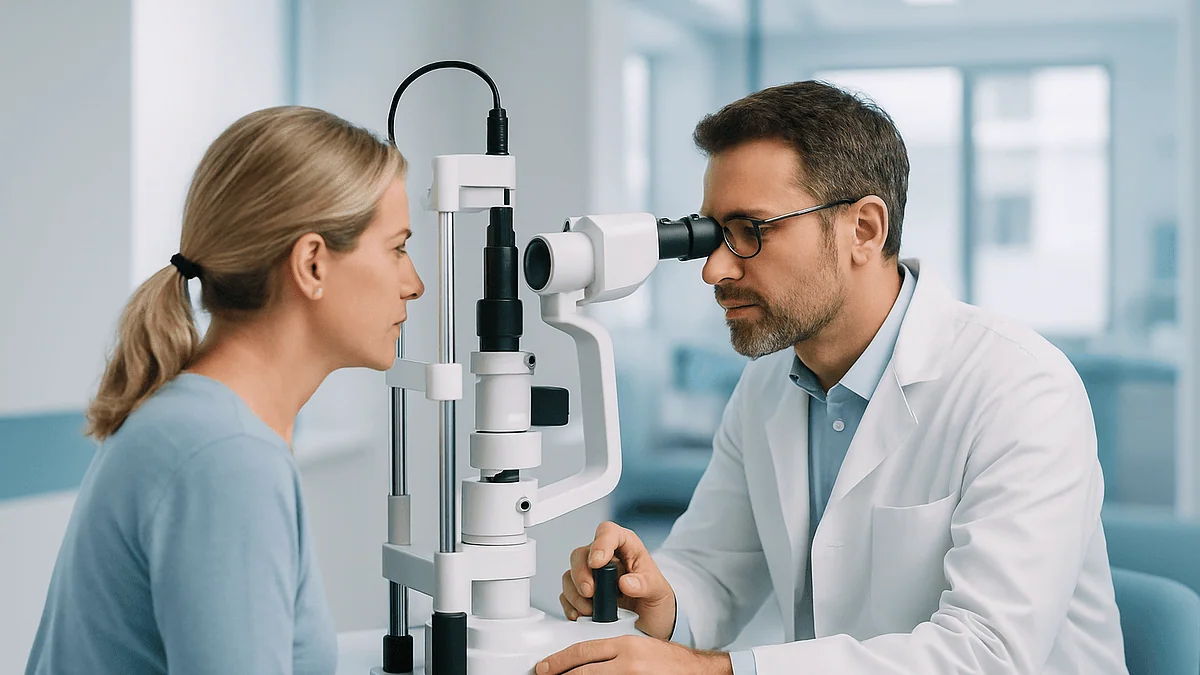
That examination has a checklist of its own. A slit lamp, which is a microscope with a bright slit of light, lets the doctor inspect the eye layer by layer. A drop of orange fluorescein dye highlights scratches or ulcers on the cornea, a condition called keratitis. The doctor looks inside the front chamber for floating inflammatory cells, the sign of uveitis or iritis, which is inflammation of the colored iris and the tissue around it. Eye pressure is measured, because inflammation can block the eye’s drainage channels and raise pressure into the glaucoma range. The pupil is dilated so the retina at the back can be checked; retinal inflammation from zoster is rare but sight-threatening.
One subtle test is corneal sensation. Zoster can damage the nerve fibers that let the cornea feel, leaving it numb. A numb cornea does not blink or tear properly, and can break down over months, a problem known as neurotrophic keratopathy. Patients often have no idea their cornea is numb, which is a strong argument for keeping follow-up appointments even when the eye feels fine.
Symptoms worth reporting at any point include redness, aching, light sensitivity, watering, blurred vision and a sense that the eyelid is heavy or not closing. Harvard Health notes that eye involvement can appear in the weeks after the rash and that some people develop recurring inflammation long afterward, so the care plan usually includes scheduled rechecks rather than a single all-clear.
Shingles in the ear: Ramsay Hunt syndrome and its warning signs
The ear has its own version of this story. The facial nerve, which drives the muscles of expression, passes through a cluster of nerve cells called the geniculate ganglion, just behind the ear. When zoster reactivates there, the result is Ramsay Hunt syndrome: shingles of the ear with weakness of the face on the same side.
The first symptom is often deep, aching ear pain, sometimes a day or two before anything is visible. Blisters then appear in the ear canal, on the outer ear, on the eardrum, or occasionally on the tongue or roof of the mouth, where the same nerve supplies taste. The face on that side may droop: the eyebrow stops lifting, the eye cannot fully close, the smile pulls to the other side. Because the facial nerve runs alongside the hearing and balance nerves inside the skull, people may also notice hearing loss, ringing in the ear, vertigo or a change in taste. Mayo Clinic lists facial paralysis and problems with hearing or balance among the recognized complications of shingles.
Ramsay Hunt is frequently mistaken for Bell’s palsy, the far more common facial weakness without a known cause. The distinguishing clues are pain and blisters, though the blisters can arrive after the weakness and can hide inside the ear canal where only an examination will find them. Any new one-sided facial weakness is an emergency-level symptom, partly because the same picture can be caused by stroke and that must be ruled out first.
There is an eye consequence here too. When the eyelid cannot close, the cornea dries and can be scratched. Protecting that eye, with lubrication and taping at night as advised by the care team, is part of standard management while the nerve recovers.
Who tends to get shingles near the eye, and who is usually asked to wait
Anyone who has had chickenpox carries the virus, which in the United States means most adults. Reactivation becomes more likely as the immune system ages; the CDC notes that risk rises sharply after about age 50, and that most shingles cases occur in older adults. Weakened immunity is the other major factor: HIV, cancer and its treatment, organ transplantation, and immune-suppressing medicines such as corticosteroids or biologic agents used for autoimmune disease all raise the chance of reactivation and of a more severe or widespread episode.
Why the eye rather than the trunk? The ophthalmic branch is simply one of the nerves where the virus most often sits, and the forehead is a common dermatome for reactivation. There is no reliable way to predict which nerve will wake.
Who is seen first? Triage in most health systems places facial, eye and ear shingles ahead of trunk shingles, and places people who are immunocompromised, pregnant, or showing signs of spread beyond one stripe ahead of everyone else. Those groups may be admitted for intravenous antiviral treatment and specialist review rather than sent home.
Who is usually asked to wait? Two groups, for different reasons. People with a healthy immune system and a small trunk rash that has already crusted are often managed by their primary clinician without urgent referral, because the window for antivirals has closed and complication risk is lower. And people with an active shingles episode are generally asked to wait until the rash has fully resolved before receiving the shingles vaccine, which the CDC recommends for adults 50 and older. Timing of that vaccination, and whether it is appropriate at all, is a decision for the treating clinician.
How treatment works: antivirals, eye care and the 72-hour window
Treatment for shingles near the eye or ear has three aims: slow the virus, protect the eye, and manage pain. Each decision sits with the prescribing clinician; what follows describes mechanism and typical timing, not a plan to follow.
The core medicines are antivirals in the nucleoside analogue class, with generic names such as acyclovir, valacyclovir and famciclovir. They mimic a building block of viral DNA, so when the virus tries to copy itself, the chain stops. That is why timing dominates: the CDC and NHS note they work best when started within 72 hours of rash onset, when viral replication peaks. For facial, eye and ear shingles many clinicians still prescribe beyond that window if new blisters are forming, because the stakes for the eye are higher. In severe cases, or in people with weakened immunity, the same medicines may be given intravenously in hospital.
Eye care is layered on when the examination shows involvement. Corticosteroid eye drops, which dampen inflammation, are used for uveitis or certain forms of keratitis, usually alongside the antiviral. Drops that lower eye pressure are added if pressure has climbed. Lubricating drops or ointment protect a dry or numb cornea. These are specialist decisions, and the ophthalmologist adjusts them visit by visit based on what the slit lamp shows.
For Ramsay Hunt syndrome, antiviral medicine is commonly combined with an oral corticosteroid to reduce swelling around the facial nerve. The evidence for that combination is moderate rather than conclusive, and clinicians weigh it against each person’s other conditions.
Pain is handled with ordinary analgesic classes early on, and with nerve-targeted classes if pain persists. Mayo Clinic notes that these choices depend on severity, age and other medicines, which is one more reason the plan belongs with the treating team.
Eye, ear or trunk: how shingles differs by where it strikes
The virus is the same wherever it reactivates. What changes is the neighborhood: which nerve carries it, what that nerve also serves, and how much is at stake if inflammation spreads. The table summarizes the practical differences clinicians weigh when deciding how urgently to act.
| Location | Nerve involved | Early clue | Main risk | Usual pathway |
|---|---|---|---|---|
| Forehead, eyelid, nose (ophthalmic) | Ophthalmic branch of trigeminal nerve | One-sided forehead pain, nose-tip blisters | Corneal damage, uveitis, raised eye pressure, lasting vision loss | Same-day review, antiviral, ophthalmology exam and follow-up |
| Ear canal, outer ear (Ramsay Hunt) | Facial nerve at the geniculate ganglion | Deep ear pain, blisters in canal, facial droop | Persistent facial weakness, hearing loss, vertigo, exposed cornea | Emergency-level review, antiviral often with corticosteroid, eye protection |
| Cheek, jaw, mouth | Middle or lower trigeminal branches | Tooth or jaw pain before rash, blisters on palate or gums | Dental misdiagnosis, postherpetic neuralgia | Prompt antiviral, dental and medical review |
| Chest, back, abdomen | Spinal nerve roots | Band of pain on one side of torso | Postherpetic neuralgia, skin infection | Antiviral if within window, home care, routine follow-up |
Two points stand out from the table. First, the trunk is the most common site and usually the lowest-risk one, which is where most people’s mental picture of shingles comes from. Second, the head is where misdiagnosis is most common and most costly: forehead pain is read as headache, jaw pain as toothache, ear pain as infection, facial droop as Bell’s palsy. The CDC’s clinical overview notes that complications cluster in ophthalmic and other cranial-nerve shingles, and that these cases warrant specialist involvement.
If you take one thing from the comparison, make it this: the rash does not have to look dramatic for the location to be serious.
What the following days and weeks usually look like
Timelines vary with age, immune health and how quickly treatment began, so treat these as typical ranges drawn from the CDC and NHS rather than a schedule to hold yourself to.
The first three to five days are usually the most uncomfortable. Pain often peaks before or just as blisters appear, and new blisters can keep forming for several days. Once antiviral medicine starts, new lesions typically slow within a few days, though existing ones must still run their course. Blisters crust over in roughly 7 to 10 days, and the skin usually heals within two to four weeks, sometimes leaving pink marks or small scars on the forehead or eyelid.
Eye involvement runs on its own clock. Some people have a red, sore eye from day one; others develop inflammation inside the eye one to three weeks later, or have a flare after the skin has healed. Ophthalmology follow-up is therefore scheduled over weeks, with eye drops adjusted at each visit. Corneal numbness, if present, may persist for months and requires ongoing lubrication and monitoring.
In Ramsay Hunt syndrome, facial movement typically begins to return over weeks, and continued improvement can stretch across several months. Recovery is variable: some people regain near-normal movement, others are left with weakness or involuntary movements, and the evidence suggests outcomes tend to be better when treatment starts early, without any guarantee for an individual.
Forehead skin may feel strange for a long while: numb, prickly, or oversensitive to wind and water. For most this fades. When pain outlasts the rash by three months, clinicians use the term postherpetic neuralgia, covered next.
Returning to work or school is generally considered once blisters have crusted, because that is when the CDC regards the rash as no longer contagious.
What is postherpetic neuralgia, and why the face is different
Postherpetic neuralgia, usually shortened to PHN, is nerve pain that persists in the area of a shingles rash after the skin has healed. Clinicians typically apply the term when pain lasts 90 days or more from rash onset. The CDC reports that about 10% to 18% of people who get shingles develop PHN, and that the likelihood climbs with age; it is uncommon under 40 and more frequent after 60.
The mechanism is damage rather than infection. During the acute episode, the virus inflames and partly destroys the sensory nerve it traveled along. Surviving fibers can misfire, sending pain signals with no trigger, or amplifying light touch into burning or stabbing sensations. That amplified-touch phenomenon is called allodynia, and it is the hallmark of PHN: a shirt collar, a breeze or a bedsheet becomes painful.
On the face, the practical burden is heavier. The ophthalmic dermatome is touched constantly: eyeglass frames, pillows, hats, washing, wind, rain, hairbrushes. Risk factors for PHN listed by the CDC and Mayo Clinic include older age, severe pain or rash during the acute phase, and ophthalmic involvement, so the group most likely to develop it is also the group living in the most-touched territory.
Management is usually layered. Topical agents, and medicine classes originally developed for epilepsy or depression that calm overactive nerve signaling, are the mainstays, chosen and adjusted by the treating clinician. Whether early antiviral treatment prevents PHN is genuinely uncertain; it shortens the acute illness, and studies disagree on how much it changes long-term pain. What is clearer is that PHN is more manageable when addressed early rather than endured. If pain is still present when the skin has healed, that is worth raising rather than waiting out.
Daily care: showering, covering the rash and protecting others
People often ask how often they should shower with shingles, as if water might spread it. It will not. Washing is encouraged. A daily shower or gentle wash in lukewarm water with a mild cleanser keeps blisters clean and lowers the chance of bacterial skin infection, which is one of the recognized complications. Avoid scrubbing the rash, pat rather than rub dry, and use a separate towel that goes straight to the laundry. Cool compresses between washes, which the NHS suggests, can ease the burning.
Covering matters more than frequency. The CDC advises keeping the rash covered with a loose, non-stick dressing, because shingles spreads only through direct contact with blister fluid, not through coughing or ordinary air. A person who has never had chickenpox or the chickenpox vaccine can catch chickenpox from that fluid, not shingles. The rash is not considered contagious before blisters form or after every blister has crusted.
The face is awkward to cover, which raises the stakes for who you spend time with. Until crusting, the CDC recommends avoiding contact with pregnant people who may not be immune, newborns and infants, and anyone with a weakened immune system. Hand washing after touching the rash or applying anything to it is the simplest safeguard.
Eye-specific habits: leave contact lenses out until the ophthalmologist confirms the cornea is healthy, and do not reach for leftover eye drops from a previous problem, since some drops can worsen a viral cornea. For an eyelid that will not close, the care team may suggest lubricating ointment and taping the lid at night.
Loose clothing, rest and ordinary hydration round out home care. None of it replaces antiviral treatment; it sits alongside it.
What people often get wrong about shingles near the eye
Facial shingles attracts myths, and a few of them actively delay care.
“If the eye isn’t red, the eye is fine.” Eye inflammation can begin one to three weeks after the rash, and corneal numbness produces no redness at all. The location of the rash, not the state of the eye, decides whether an eye examination is needed.
“I caught shingles from someone.” Shingles is a reactivation of a virus already inside you. You can pass chickenpox, not shingles, to a non-immune person through blister fluid.
“You only get shingles once.” Recurrence is less common than a first episode, but the CDC confirms it can happen, and sometimes in the same dermatome.
“It’s an older person’s problem.” Risk rises with age, but anyone who has had chickenpox can reactivate, particularly with immune suppression or illness.
“Antivirals are pointless after 72 hours.” They are most effective early, but for eye and ear shingles clinicians often still prescribe when blisters are still forming. Missing the window is a reason to call sooner, not to skip the call.
“Calamine or a home remedy will do the job.” Soothing lotions help itch. They do nothing to the virus, and no herbal or topical remedy has evidence of protecting the eye.
“When the rash goes, it’s over.” Pain that outlasts the rash is postherpetic neuralgia and is more manageable when raised early. Eye inflammation can flare months later.
“I’ve had shingles, so I don’t need the vaccine.” The CDC recommends the recombinant zoster vaccine for adults 50 and older, including those who have had shingles, once the acute episode has resolved. Suitability and timing belong to your clinician.
Questions to ask your care team
Appointments for shingles near the eye or ear are often rushed, partly because the priority is getting antiviral treatment started. A short list of questions helps you leave with a plan you understand rather than a prescription and a vague “come back if it gets worse.”
- Which nerve branch is affected, and does that mean the eye or ear is at risk even if it feels normal now?
- Do I need an eye examination, and if so, how soon and with whom?
- What signs should make me seek emergency care rather than wait for the next scheduled visit?
- When should I expect new blisters to stop, and what would an unusual course look like?
- How will my pain be managed now, and what is the plan if pain continues after the rash heals?
- Are any of my current medicines, especially immune-suppressing ones, relevant to how this is treated?
- Until when am I contagious, and who in my household or workplace should I avoid?
- Can I keep using my contact lenses, eye drops or hearing aids?
- If my eyelid does not close, how should I protect the eye at night?
- When is it appropriate to discuss shingles vaccination?
Write down the answers, or ask for them in the after-visit summary. If you are seen by more than one clinician, say a primary care doctor and an ophthalmologist, ask who is coordinating follow-up so nothing falls between the two. Bring a photograph of the rash from the day it appeared; it helps the team judge timing when the skin has already changed.
None of these questions second-guess the clinician. They make the shared plan explicit, which is exactly what the evidence on treatment adherence suggests improves outcomes in conditions that depend on timing and follow-up.
When to call your doctor: shingles near eye warning signs you should not sit on
Treat the list below as a set of triggers for contacting a clinician, not as a way to decide on your own what is wrong. Where a decision is needed, the treating team makes it.
Call a clinician the same day if you notice:
- A one-sided rash, blisters or burning pain on the forehead, eyelid, scalp line or nose, especially the nose tip.
- Blisters in or around the ear, or on the tongue or roof of the mouth, with ear pain.
- Eye redness, aching, grittiness, watering or sensitivity to light on the side of a rash.
- A rash anywhere if you are pregnant, have a weakened immune system or are over 50 and want to use the antiviral window.
- Pain in a shingles pattern that has lasted several days with no rash.
Seek emergency care without delay if you notice:
- Blurred, reduced or double vision, or severe eye pain.
- New weakness or drooping of one side of the face, which must be assessed urgently because stroke causes a similar picture.
- Sudden hearing loss, severe dizziness or vertigo.
- High fever, confusion, severe headache, stiff neck or drowsiness, which can point to the virus affecting the brain or its coverings.
- Rash spreading across the body rather than staying in one stripe, particularly if you are immunocompromised.
- Spreading redness, warmth, pus or worsening pain around the rash, suggesting bacterial infection.
After treatment begins, keep every scheduled eye or ear follow-up even if you feel well, and call between visits if the eye becomes red or painful again, if the rash is not crusting after about 10 days, or if pain is still present once the skin has healed. The NHS and Mayo Clinic both emphasize that eye complications and nerve pain are far easier to manage early.
Frequently asked questions
What happens if shingles is near the eye?
Shingles near the eye means the virus is traveling along the ophthalmic nerve branch, which also serves the cornea and the inside of the eye. Inflammation can cause keratitis, uveitis, raised eye pressure and, rarely, retinal damage, any of which can affect vision if untreated. Clinicians usually start antiviral treatment promptly and arrange an eye examination with follow-up over several weeks, because eye involvement can appear after the rash.
What is postherpetic neuralgia?
Postherpetic neuralgia is nerve pain that continues in the area of a shingles rash after the skin has healed, typically defined as lasting 90 days or more. It results from nerve damage during the acute infection, and light touch can feel burning or stabbing. The CDC reports it affects about 10% to 18% of people with shingles, more often with older age or eye involvement. Several medicine classes can help; the plan belongs with your clinician.
How often should you shower when you have shingles?
A daily gentle shower or wash is reasonable and does not spread shingles on your own skin. Use lukewarm water and a mild cleanser, avoid scrubbing blisters, pat dry and use a separate towel. Keeping the rash clean lowers the risk of bacterial skin infection. Cover the rash afterward with a loose, non-stick dressing where possible, and wash your hands after touching it, as the CDC advises.
What does a shingles rash look like?
A shingles rash is a one-sided band of red skin topped with clusters of small fluid-filled blisters, sitting in the area where pain or tingling began a few days earlier. It follows a nerve pathway and stops at the midline. Blisters crust over in about 7 to 10 days and the skin usually heals within two to four weeks. On the face it can be sparse or faint, so position matters more than appearance.
Is shingles on the face contagious?
The blister fluid can transmit chickenpox, not shingles, to someone who has never had chickenpox or the chickenpox vaccine. It does not spread through the air like chickenpox. The rash is not considered contagious before blisters form or after all blisters have crusted. Because facial rashes are hard to cover, the CDC advises avoiding pregnant people who may not be immune, newborns and anyone immunocompromised until crusting.
Can shingles near the eye cause blindness?
It can, though most people treated promptly do not lose sight. Harvard Health notes that eye shingles can cause lasting vision impairment through corneal scarring, inflammation inside the eye, raised eye pressure or, rarely, retinal damage. The risk rises when treatment is delayed or follow-up is missed. Early antiviral treatment and scheduled ophthalmology review are the standard safeguards; outcomes for any individual depend on the treating team’s assessment.
How long does herpes zoster ophthalmicus last?
The skin rash typically heals within two to four weeks, according to the CDC and NHS, but eye involvement runs on its own timeline. Inflammation can start one to three weeks after the rash and may flare months later, and corneal numbness can persist for months. Follow-up visits are usually spread over weeks, with eye drops adjusted at each visit by the ophthalmologist.
Can I wear contact lenses with shingles near my eye?
Not until the ophthalmologist confirms the cornea is healthy. Zoster can scratch, inflame or numb the cornea, and a lens over a damaged or numb cornea increases infection and ulcer risk. Switch to glasses for the duration, avoid leftover eye drops from previous problems, and ask the eye clinic when lenses are safe again. For many people this is after the rash has healed and the eye examination is clear.
Is facial drooping with ear pain a sign of shingles?
It can be a sign of Ramsay Hunt syndrome, which is shingles of the facial nerve, especially if blisters appear in the ear canal, on the outer ear or in the mouth. Hearing change, ringing, vertigo or altered taste may accompany it. New facial weakness always needs emergency assessment, because stroke and Bell’s palsy cause a similar picture and the treatments differ.
Should I get the shingles vaccine after having eye shingles?
The CDC recommends the recombinant zoster vaccine for adults 50 and older with a healthy immune system, including people who have had shingles, once the acute episode has resolved. CDC data show it is more than 90% effective at preventing shingles in that group. Whether and when it is appropriate for you, particularly if you take immune-suppressing medicines, is a decision for your clinician.
References
- CDC: About Shingles (Herpes Zoster)
- CDC: Clinical Overview of Shingles (Herpes Zoster)
- NHS: Shingles
- MedlinePlus: Shingles
This article is for general information only and is not a substitute for professional medical advice. Please consult a qualified doctor about your individual situation.
Add us as a Preferred Source to see more of our trusted health content across Google Search, AI Overviews and Discover.

More from the Blog

Stinging Nettle Rash: What It Looks Like, How Long It Lasts and What Calms the Sting
A stinging nettle rash is a crop of small, pale, itchy bumps on reddened skin, raised by chemicals such as histamine injected through the…

Lump Under the Skin: Cysts, Lipomas and Hard Lumps Explained and When to Get One Checked
Most lumps under the skin are harmless. Epidermoid cysts, lipomas (soft fatty lumps) and swollen lymph nodes account for the large majority. A lump…
What to Record Before Your Urticaria Appointment: A Hives Diary Your Dermatologist Can Use
Before a hives appointment, keep a short daily diary for one to two weeks: dated photos with a coin or ruler for scale, when…

Brown Recluse Bite Stages: The Timeline Day by Day, How Serious It Can Get and When to Seek Care
A brown recluse bite typically passes through recognizable stages: a painless or barely noticed bite, then stinging, redness and swelling within about 2 to…
Skin Rash Types: How Common Rashes Look, What Causes Them and When to See a Doctor
Most skin rash types fall into a few groups: eczema and contact dermatitis (dry, itchy patches), hives (raised weals that move), viral rashes (flat…

Preparing Your Child for Congenital Nevus Surgery: How Parents Can Support Each Step
Parents support a child through congenital nevus surgery by learning the planned approach (simple excision, staged removal or tissue expansion), preparing the child with…