

Postpartum Recovery: The Six-Week Myth and the Real Timeline for the Body

Key Takeaways
- The uterus shrinks from about 2.2 pounds at delivery to roughly 2 ounces by six weeks, which is the real origin of the six-week check.
- Lochia moves through three stages, rubra, serosa and alba, and typically lasts four to six weeks, with up to eight weeks still within normal.
- Urinary leakage affects about one in three women after birth, and randomized trials show pelvic floor muscle training reduces it.
- CDC data from 2017 to 2019 found more than half of pregnancy-related deaths occurred between one week and one year after birth, so warning signs matter all year.
- Baby blues resolve within about two weeks; postpartum depression affects roughly one in eight women and can begin at any point in the first year.
- Ovulation can return as early as three weeks after birth, before a first period, so contraception is a topic for the first postnatal visit.
Postpartum recovery is not finished at six weeks. The six-week mark is when bleeding usually stops, the uterus has returned to roughly its pre-pregnancy size and clinicians schedule a routine check. Pelvic floor strength, abdominal muscles, hormone levels, hair, sleep and mood commonly take 6 to 12 months to settle, and some changes last longer. Recovery varies widely, so concerns at any point deserve a conversation with a clinician.
The claim circulating through parenting feeds this spring is blunt: the six-week postpartum check is a myth, and honest postpartum recovery takes six to eighteen months. As of May 2025, that idea has pushed the topic back to the top of search trends, with new mothers typing questions about bleeding that will not stop, leaks that will not quit and night sweats that arrive at week three like an uninvited guest.
Both camps are partly right. Six weeks is a real milestone with real biology behind it. It is also a number that was never designed to describe the pelvic floor, the thyroid, the sleep-starved brain or the ligaments still softened by pregnancy hormones. Recent guidance from major health bodies has quietly moved past the single-visit model, even if the culture has not.
What follows is the timeline the evidence actually supports, organ by organ, with an honest grade on how strong that evidence is.
Why does postpartum recovery get a six-week deadline?
Six weeks is not a biological law. It is roughly the time the uterus takes to shrink back toward its pre-pregnancy size, a process clinicians call involution, and the point by which bleeding has usually stopped. Because those two changes are easy to measure, the six-week visit became the natural moment for a postnatal check. The NHS schedules it at 6 to 8 weeks; in the US it was, for decades, the single routine appointment after birth.
The uterus does put on a remarkable show in that window. At delivery it weighs about 2.2 pounds (1 kilogram) and reaches the navel. It drops roughly a finger-width a day, can no longer be felt above the pubic bone after about two weeks, and is back to around 2 ounces by week six. Stitches from a perineal tear have usually dissolved. A cesarean incision has closed on the surface. On paper, the acute phase is over.
What the number was never designed to capture is everything a measuring tape misses: ligaments still loosened by pregnancy hormones, a pelvic floor that was stretched to several times its resting length during a vaginal birth, abdominal muscles that drifted apart to make room, a brain running on fragmented sleep, and an endocrine system that lost its highest-ever estrogen levels within days of delivery.
So the six-week check marks the end of the first chapter, not the book. Treating it as a certificate of completion is where the frustration starts, and the guidance described next now says so in fairly plain language.
What changed recently in postpartum care
The shift away from a single six-week visit did not begin on social media. In March 2022 the World Health Organization published its recommendations for a positive postnatal experience, calling for at least four postnatal contacts: within the first 24 hours, at 48 to 72 hours, between days 7 and 14, and again around week six. The same document asks clinicians to screen for depression and anxiety, assess pelvic floor symptoms and support feeding, rather than confining the visit to a quick pelvic exam.
In England, the NHS formalized a dedicated 6- to 8-week maternal check in 2020, separate from the baby’s examination, with an explicit requirement to ask about mental health, bleeding, pelvic floor function and contraception. US obstetric guidance moved earlier still, in 2018, toward a first contact within three weeks and a comprehensive visit by twelve weeks, describing the period as a fourth trimester.
The most sobering data point came from the CDC. Its review of pregnancy-related deaths from 2017 to 2019 found that more than half occurred between one week and one year after birth, well outside the window most families associate with risk. That finding underpins the CDC’s Hear Her campaign, which lists urgent warning signs that should prompt a same-day call for up to a year postpartum.
Put together, these changes say something the viral clip gets right: postpartum recovery is a months-long process that deserves staged follow-up. They also say something the clip leaves out. The stretched timeline is not a reason for alarm; it is a reason for more contact with care, at the moments when problems actually surface.
The real postpartum recovery timeline, system by system
Different tissues heal on different clocks. The table below gathers the typical ranges reported by mainstream clinical sources, with a note on how solid each estimate is. Ranges are wide because births differ: a first vaginal birth with a small tear, a forceps delivery, and a cesarean after a long labor do not leave the same body behind.
| Body system | Typical timeline | Evidence strength |
|---|---|---|
| Uterus (involution) | Back to near pre-pregnancy size by 6 weeks | Strong, consistent clinical observation |
| Lochia (bleeding) | 4–6 weeks, occasionally up to 8 | Strong observational data |
| Perineal tear or episiotomy | Soreness eases over 2–6 weeks; deeper tears take months | Moderate; depends on tear grade |
| Cesarean incision | Skin closed by 6 weeks; numbness and deep healing 6–12 months | Moderate observational data |
| Pelvic floor and bladder control | Most improvement by 3–6 months; some symptoms persist at 12 months | Moderate; randomized trials support pelvic floor training |
| Abdominal separation (diastasis recti) | Narrows steadily to 6–12 months | Moderate observational cohorts |
| Hormones and hot flashes | Sharp fall in days; sweats common in first weeks, settling by ~3 months | Limited, small observational studies |
| Hair shedding | Peaks around 3–4 months, resolves by 6–12 months | Strong clinical consensus |
| Mood | Baby blues resolve within 2 weeks; depression can begin any time in year one | Strong epidemiological data |
Two patterns stand out. The visible, measurable changes largely finish by six weeks, which is why the old deadline felt right. The functional ones, meaning the things that decide whether a woman can run, laugh without leaking, sleep through a night or feel like herself, cluster at three to twelve months. That is the real timeline worth planning around.
What are the different stages of lochia?
Lochia is the vaginal discharge of blood, mucus and uterine tissue that follows every birth, including a cesarean. It is the lining of the uterus clearing out, and it moves through three recognizable stages.
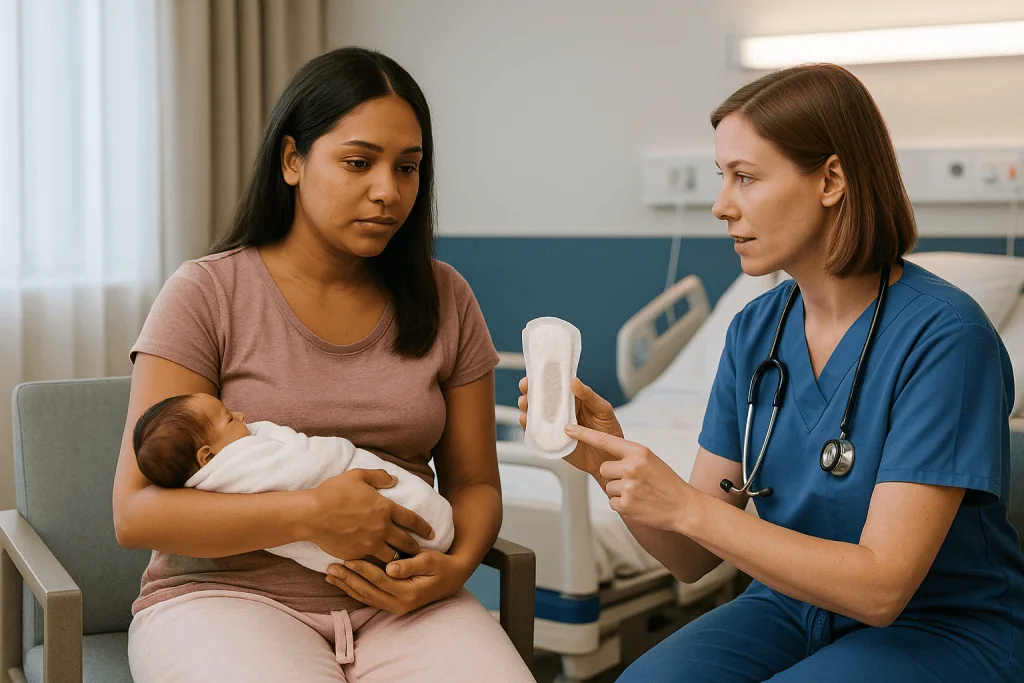
Lochia rubra is the first, lasting roughly days 1 to 4. The flow is bright to dark red and heavier than a period, with small clots. Clots up to about the size of a plum can be normal in the first day or two, especially after lying down, when blood pools. Getting up, feeding the baby or doing more than usual often brings a brief gush.
Lochia serosa follows, from about day 4 to day 10 or 12. The color shifts to pink or brownish, the volume drops, and clots should become rare. Breastfeeding can trigger cramping and a short increase in flow because the hormone oxytocin, released during feeding, contracts the uterus.
Lochia alba is the final stage, a creamy yellowish-white discharge that can continue, on and off, until week four, five or six. A few women bleed lightly for up to eight weeks. A small return of red spotting around days 7 to 14 is also common and usually reflects the scab over the placental site lifting.
Pads rather than tampons are advised throughout, because the cervix is still closed only loosely and the uterus is healing. The signs that something is wrong are specific: soaking a pad in an hour, clots larger than a golf ball after the first days, a foul smell, or bleeding that goes back to bright red and heavy after it had faded. Those belong in the same-day-call category covered below.
How the uterus, the perineum and a cesarean incision heal
Afterpains, the cramps that come in waves during the first week, are the uterus clamping down on the blood vessels where the placenta was attached. They are typically stronger with second or later babies and during feeding. For most women they fade within a week.
Perineal healing depends almost entirely on the degree of tear. A first-degree tear involves skin only and often needs no stitches. A second-degree tear reaches the muscle and is the most common type that is sutured; stitches dissolve on their own within a few weeks, and soreness usually eases over two to six weeks. Third- and fourth-degree tears extend into or through the anal sphincter, affect a small minority of vaginal births, and need dedicated follow-up because bowel control and pain can take months to settle. Cold packs in the first days, keeping the area clean and dry, and avoiding constipation all have clinician support.
A cesarean is major abdominal surgery, and the skin incision is the least of it. The surface usually knits within six weeks, but numbness or tingling around the scar can last for months as cut nerves regrow, and the uterine scar itself continues to strengthen over a year. That slow deep healing is one reason both WHO and clinicians advise waiting before another pregnancy; WHO suggests an interval of at least 24 months between a birth and the next conception. In the first weeks, lifting nothing heavier than the baby, and driving only when an emergency stop is painless, are standard advice.
The common thread is that visible healing runs ahead of structural healing in every one of these tissues, which is precisely why the six-week number flatters the body’s progress.
Why the pelvic floor needs months, not weeks
The pelvic floor is the hammock of muscle and connective tissue that supports the bladder, uterus and bowel. During a vaginal birth it stretches far beyond anything it does in daily life, and the nerves that run through it can be compressed. Even after a cesarean, nine months of carrying a growing uterus leaves its mark.
Urinary leakage, particularly with coughing, sneezing or lifting, affects roughly one in three women in the months after birth. Most see meaningful improvement by three to six months, but observational cohorts consistently find that a sizable minority still leak at twelve months, and leakage that persists at three months is a reasonable predictor of longer-term trouble. Fecal urgency and a sense of heaviness or bulging in the vagina, which can indicate pelvic organ prolapse, follow a similar slow curve.
This is one area where the evidence is genuinely strong. Systematic reviews of randomized trials show that structured pelvic floor muscle training, meaning supervised exercises that contract and relax these muscles, reduces postpartum incontinence compared with usual care. The effect is moderate, not magical, and it depends on doing the exercises correctly, which is why referral to a pelvic health physiotherapist is increasingly built into postnatal pathways.
Abdominal separation, or diastasis recti, is the widening of the gap between the two halves of the rectus muscle. It is almost universal in late pregnancy, present in around 60 percent of women at six weeks, and narrows steadily, with roughly a third still showing a measurable gap at a year. It rarely needs surgery; graded core work guided by a physiotherapist is the usual approach.
Returning to running or jumping before about twelve weeks is discouraged in expert consensus statements, though that timing rests on clinical opinion rather than trial data.
Are postpartum hot flashes and night sweats normal?
Waking soaked at 3 a.m. with a sleeping baby beside you is one of the least discussed parts of the first month, and it has a clear mechanism. Estrogen and progesterone, which rise to their highest-ever levels during pregnancy, fall to near-menopausal levels within days of the placenta being delivered. Estrogen helps the brain’s temperature thermostat stay steady; remove it abruptly and the body behaves much as it does at menopause, with flushes and sweats.
Breastfeeding extends the effect because the hormone prolactin, which drives milk production, keeps estrogen suppressed for as long as feeding continues. Early sweating also reflects the body shedding the extra fluid it carried in pregnancy, several liters of it, through skin and urine.
How common is it? Small observational studies suggest that a substantial minority of new mothers report hot flashes, typically peaking around two weeks after birth and tapering over roughly three months. The evidence here is thin, drawn from surveys rather than trials, so the figures should be read as rough. What is well established is the pattern: a flush that is worst early and improves is expected.
One condition deserves a mention because it mimics these symptoms. Postpartum thyroiditis, an inflammation of the thyroid gland, affects around 5 percent of women in the year after birth. It often brings an overactive phase one to four months postpartum, with sweating, palpitations, anxiety and weight loss, followed by an underactive phase with fatigue, feeling cold and low mood. A simple blood test distinguishes it from ordinary hormonal flux, which is why sweats that come with a racing heart, or that are still intense beyond three months, are worth raising with a clinician.
Is it normal to have vaginal or perineal itching four weeks after giving birth?
Mild itching around week four is one of the most searched postpartum questions, and it usually has an ordinary explanation. Healing skin itches. Dissolving stitches itch as the body absorbs them. Four weeks of pads, with lochia alba keeping the area damp, irritates skin that has already been through a lot.
Low estrogen matters here too. The same hormonal drop behind hot flashes thins and dries the vaginal and vulvar tissue, a change clinicians sometimes describe as temporary atrophy. It is more pronounced in women who are breastfeeding, and it can make the area feel itchy, tight or sore, particularly with the first attempts at intercourse. Water-based lubricants are generally considered safe, but any treatment for dryness, including hormone-based products, is a decision for the clinician who knows your history.
Yeast infections are the other frequent cause. Antibiotics given around birth, for a cesarean or a positive group B strep test, disrupt the normal vaginal bacteria and allow yeast to overgrow. The classic picture is intense itching with a thick, white, odorless discharge. Bacterial vaginosis, by contrast, tends to produce a thin grayish discharge with a fishy smell and little itching.
The distinction that matters is between irritation and infection of the wound itself. Itching alone, without other changes, is usually benign. Itching with increasing redness, warmth or swelling around stitches, discharge that turns green or yellow or smells foul, a fever, pain that is getting worse rather than better, or burning when passing urine points toward a wound or urinary infection that needs assessment. Self-treating with over-the-counter antifungals before the area has been examined can mask a wound problem, so a quick check is the better route.
Baby blues, postpartum depression and the brain's own timeline
Emotional recovery has stages as predictable as lochia, and conflating them causes harm in both directions: brushing off real depression as blues, or pathologizing a normal week of tears.
The baby blues affect most new mothers. They begin a few days after birth, as hormone levels plunge and sleep collapses, and bring weepiness, irritability, anxiety and mood swings that come and go through the day. The defining feature is that they resolve on their own within about two weeks. They need rest, support and reassurance, not treatment.
Postpartum depression is different in duration and depth. It affects roughly one in eight women in the US according to CDC survey data, can start any time in the first year, and does not lift by itself. Persistent low mood, loss of interest in things that used to matter, feeling unable to bond with the baby, intrusive worries, guilt, changes in appetite and sleep beyond what the baby demands, and thoughts of self-harm or that the family would be better off without you are the core features. Postpartum anxiety, with constant worry and physical tension, is at least as common and often travels with it.
The evidence base for treatment is solid. Randomized trials show that structured talking therapies, particularly cognitive behavioral therapy and interpersonal therapy, reduce symptoms. Antidepressant medicines are also effective and can be compatible with breastfeeding; which option fits, and whether medicine is needed at all, is a decision for the treating clinician based on severity and history.
Postpartum psychosis is rare, affecting about one or two in every thousand births, and usually starts within the first two weeks. Confusion, hallucinations, paranoia, extreme agitation or elation are a medical emergency.
How to help someone with postpartum depression
Most people who search this question are partners, mothers and friends watching someone they love go quiet. The most useful things they can do are practical and unglamorous.
Start by naming what you see without judgment. Saying that you have noticed she seems to be struggling, that it is common and treatable, and that you will help her get seen is more effective than asking whether she is depressed, which invites a reflexive no. Offer to book the appointment and go with her. Many new mothers minimize symptoms in a brief consultation; a companion who can describe what the last three weeks have looked like changes that conversation.
Protect sleep as if it were medicine, because for mood it functions like one. A single uninterrupted stretch of four to five hours, achieved by someone else taking a feed with expressed milk or formula, is one of the most consistent things families report helping. Take over tasks rather than asking what you can do; a person with depression often cannot generate the list.
Watch for the escalation signs: talk of hopelessness or of being a burden, not eating, not sleeping even when the baby does, or any statement about harming herself or the baby. Those need same-day contact with a clinician or emergency services, and the person should not be left alone.
Finally, know the limits of your role. You cannot talk someone out of depression, and you should not be the one deciding whether she needs medication or when to stop it. Your job is to keep her connected to care and to the ordinary rhythms of the day. Recovery is usual with treatment, and it is faster when the people around her treat the illness as the illness it is.
What the evidence actually says about how long postpartum recovery takes
The honest answer to how long postpartum recovery takes depends on which part of the body you ask, and the strength of the evidence varies just as much.
The strongest data concern anatomy and epidemiology. Uterine involution, the stages of lochia and the timing of baby blues have been described in large cohorts for decades and are not in dispute. The prevalence of postpartum depression comes from population surveys run repeatedly by the CDC, and the timing of pregnancy-related deaths comes from state maternal mortality review committees. These are high-quality observational data.
Treatment evidence is strongest where randomized controlled trials exist. Pelvic floor muscle training for incontinence, and both psychotherapy and antidepressants for postpartum depression, have been tested against control conditions and show benefit. The size of the benefit is moderate, and the trials are often short, but the direction is consistent.
Timelines for functional recovery sit a tier below. Studies following women for a year after birth repeatedly find that fatigue, back pain, incontinence, painful intercourse and low mood are still reported by a meaningful minority at twelve months. These are observational and self-reported, which means they describe what women experience but cannot say what caused it or what would have shortened it.
The viral claim that recovery takes six to eighteen months belongs to the lowest tier: expert synthesis. It is a reasonable reading of the cohort data, not the result of a trial, and no study defines a single endpoint called complete recovery. Said carefully, the evidence supports this: the acute phase ends around six weeks, most functional recovery happens between three and twelve months, and a minority of changes persist or become permanent. That is less quotable than a calendar with eighteen months circled, but it is what the data show.
When do periods, ovulation and fertility return?
The return of a menstrual cycle is one of the clearest signals that the hormonal phase of postpartum recovery is winding down, and its timing is governed almost entirely by feeding.
Women who are not breastfeeding usually see a first period six to twelve weeks after birth. Ovulation can precede that first bleed, which is why the NHS warns that pregnancy is possible as early as three weeks after delivery, before any period has appeared. The first few cycles are often irregular, heavier or lighter than before, and sometimes anovulatory, meaning no egg is released.
Exclusive breastfeeding delays the return because prolactin suppresses the hormones that trigger ovulation. Used deliberately, this is the lactational amenorrhea method of contraception. It is about 98 percent effective only while three conditions all hold: the baby is under six months old, feeds are exclusive and frequent day and night with no long gaps, and periods have not returned. Once any condition lapses, including introducing solids or sleeping through the night, protection falls quickly and unpredictably.
For the body’s sake, spacing matters. WHO recommends at least 24 months between a birth and the next conception, because shorter intervals are associated with higher rates of preterm birth and low birth weight, and after a cesarean the uterine scar benefits from the additional healing time. Contraception is one of the specific topics the 6- to 8-week check is meant to cover, and the right method, including whether a hormonal option fits alongside breastfeeding, is a conversation for that visit.
Painful intercourse, often from the dryness described earlier or from a healing perineum, is common for months and is worth mentioning at the same appointment rather than waiting it out.
Common myths about postpartum recovery
The viral discussion has surfaced several claims that deserve a correction, including a few that cut in the opposite direction from the six-week myth.
Myth: once the bleeding stops, the body has healed. Lochia ending signals that the uterine lining has cleared. It says nothing about the pelvic floor, abdominal wall or the deep layers of a cesarean scar, all of which are months from their final state.
Myth: the six-week check clears you for everything. The check screens for complications and opens a conversation about activity, contraception and mood. It is not a fitness test, and most clinicians will advise building back gradually rather than returning to pre-pregnancy intensity the next morning.
Myth: leaking after birth is just part of being a mother. Common is not the same as inevitable. Randomized trials show pelvic floor training reduces incontinence, and leaks persisting at three months are a reason to ask for a referral, not to buy more pads.
Myth: breastfeeding is reliable contraception. It is, but only under the strict three-part rule described above, and only for six months.
Myth: feeling low after week two is still the baby blues. Blues resolve within about two weeks. Persistent symptoms beyond that point are, by definition, something else and warrant screening.
Myth: if recovery takes eighteen months, nothing can be done until then. The newer timeline argues for more contact with care, earlier, not for waiting. Many of the problems that drag on for a year, from incontinence to depression, respond best when addressed in the first three months.
Myth: bodies that bounce back were doing something right. Genetics, tear grade, birth type, sleep and support explain far more of the variation than willpower does. Comparison with another person’s recovery is unhelpful at best.
When to see a doctor
A longer recovery is normal. A dangerous one announces itself with specific signs, and the CDC’s guidance is clear that these warrant urgent contact for up to a year after birth, not just the first six weeks. Say that you were recently pregnant when you call, because it changes how symptoms are interpreted.
Call emergency services or go to an emergency department for chest pain, difficulty breathing, seizures, fainting, thoughts of harming yourself or your baby, or bleeding that soaks a pad in an hour or passes clots larger than a golf ball.
Contact a clinician the same day for:
- A severe headache that does not ease, especially with vision changes, upper abdominal pain or sudden swelling of the face and hands; these can signal postpartum preeclampsia, a blood pressure complication that can appear up to six weeks after birth.
- Fever, or chills with sweats, which may indicate infection of the uterus, a wound, the breast or the urinary tract.
- Swelling, pain or redness in one leg, which can indicate a blood clot; the risk of clots is raised for about six weeks after birth.
- Foul-smelling discharge, or bleeding that returns to heavy and bright red after fading.
- A wound that is increasingly red, hot, swollen, leaking pus or opening up.
- Inability to pass urine, or loss of bowel control.
- Feeling sad, anxious or overwhelmed for more than two weeks, or any time the feelings interfere with caring for yourself or the baby.
- Confusion, hallucinations, or behavior that family members find alarming; postpartum psychosis is an emergency.
Every decision about treatment, including any medicine for pain, mood, infection or hormonal symptoms, belongs with the clinician who examines you. The purpose of knowing these signs is not to self-diagnose; it is to make the call without second-guessing whether it is worth bothering anyone. It always is.
Frequently asked questions
How long does postpartum recovery take?
Most of the visible changes finish by six weeks, but functional recovery takes longer. Observational studies following women for a year find pelvic floor strength, abdominal muscle separation, hormone levels and energy typically settle between three and twelve months, and a minority of changes persist beyond that. The widely shared figure of six to eighteen months is an expert summary of these data, not the result of a trial.
What are the different stages of lochia?
Lochia has three stages. Rubra, roughly days one to four, is bright red and heavy with small clots. Serosa, days four to about twelve, turns pink or brown and lighter. Alba, from around day twelve to week six, is creamy yellow-white. Total duration is usually four to six weeks, occasionally eight. Soaking a pad in an hour or a foul smell needs same-day attention.
Is it normal to experience hot flashes after giving birth?
Yes, in the first weeks. Estrogen falls to near-menopausal levels within days of delivery and stays low during breastfeeding, which disrupts the body’s temperature regulation. Small observational studies suggest flashes peak around two weeks and ease by about three months. Sweats with a racing heart, weight change or anxiety, or that persist beyond three months, may point to postpartum thyroiditis and deserve a blood test.
Is it normal to have vaginal itching four weeks after giving birth?
Mild itching at four weeks is common and usually reflects healing skin, dissolving stitches, pad irritation or low-estrogen dryness, which is more marked while breastfeeding. A yeast infection is also frequent after antibiotics given at birth. Itching with worsening redness, swelling, green or yellow discharge, a foul smell, fever or burning on urination suggests infection and should be examined rather than self-treated.
How can I help someone with postpartum depression?
Name what you have noticed without judgment, offer to book and attend the appointment, and describe to the clinician what recent weeks have looked like. Protect one uninterrupted stretch of sleep by taking a feed. Take over tasks rather than asking what to do. Seek same-day help if she talks about hopelessness or harming herself or the baby, and leave treatment decisions to her clinician.
When can I start exercising again after birth?
Gentle walking and pelvic floor exercises can usually begin within days of an uncomplicated vaginal birth, once you feel ready. Higher-impact activity such as running or jumping is generally deferred until after the postnatal check, and expert consensus suggests around twelve weeks, although that timing rests on clinical opinion rather than trials. After a cesarean, your surgical team’s advice at the check takes priority.
Does cesarean recovery take longer than vaginal recovery?
The skin incision usually closes within six weeks, similar to the timeline for a perineal tear, but a cesarean is abdominal surgery. Numbness around the scar can last months as nerves regrow, and the uterine scar continues strengthening for a year, which is one reason WHO advises at least 24 months before the next conception. Lifting restrictions and driving guidance apply in the early weeks.
When does ovulation return after giving birth?
If you are not breastfeeding, ovulation can return as early as three weeks after birth, and a first period typically follows at six to twelve weeks. Exclusive breastfeeding delays it, and the lactational amenorrhea method is about 98 percent effective only while the baby is under six months, feeds exclusively day and night, and periods have not returned. Discuss contraception at the first check.
Why am I losing so much hair three months after birth?
Pregnancy hormones keep hair in its growth phase longer than usual, so less falls out for nine months. After birth, those hairs shift together into the shedding phase, a pattern called telogen effluvium, with loss peaking around three to four months postpartum. It is temporary and almost always resolves by six to twelve months. Shedding that continues beyond a year, or comes with fatigue, is worth a thyroid check.
What is the postpartum recovery timeline for pelvic floor leaks?
Leakage affects roughly one in three women after birth and improves for most by three to six months. Leaks still present at three months are a reasonable predictor of longer-term problems and a good reason to ask for pelvic floor physiotherapy, which randomized trials show reduces incontinence. A sense of heaviness or bulging in the vagina, or loss of bowel control, should be assessed promptly.
References
- WHO recommendations on maternal and newborn care for a positive postnatal experience (2022)
- CDC Hear Her: Urgent Maternal Warning Signs
- NHS: Your 6-week postnatal check
- Cleveland Clinic: Lochia (Postpartum Bleeding)
This article is for general information only and is not a substitute for professional medical advice. Please consult a qualified doctor about your individual situation.

More from the Blog

Reading Your PGT-A and PGT-M Results: What the Report Can and Cannot Tell You Before Transfer
A PGT-A report classifies each embryo's biopsied cells as euploid (the expected chromosome count), aneuploid, mosaic, or no result, while a PGT-M report states…

Tubal Assessment in Female Infertility Treatment: What the Test Shows and How It Guides Care
Tubal assessment in infertility checks whether the fallopian tubes are open so an egg and sperm can meet. It is usually done with a…

Irregular Periods: The Ten Causes, From Stress to Thyroid to PCOS
Irregular periods usually mean cycles that keep changing length, arrive fewer than 21 or more than 35 days apart, or stop for three months…

Ahead of a Reproductive System Consultation: Cycle Timing, Records and Questions to Bring
To prepare for a gynecologist appointment, note the first day of your last period and your usual cycle length, bring a list of every…

When to See a Specialist About Reproductive System Concerns: Cycle Changes, Pain and Fertility
See a reproductive specialist if you have tried to conceive for 12 months without a pregnancy, or 6 months if you are 35 or…

Cycle Syncing and Seed Cycling: What the Trends Claim and What the Evidence Shows
Seed cycling (eating flax and pumpkin seeds in the first half of the menstrual cycle, then sesame and sunflower seeds in the second half)…