

Red Light and Laser Caps for Hair Growth: The FDA-Cleared Devices Examined

Key Takeaways
- The first laser comb for hair loss was FDA-cleared in 2007 for men and 2011 for women, and most caps since have been cleared by equivalence to earlier devices rather than by their own placebo-controlled trials.
- A pooled analysis of four sham-controlled trials in 128 men and 141 women found roughly 20 more terminal hairs per square centimetre after 26 weeks of laser comb use than with an inactive device.
- The devices were studied only in mild to moderate androgenetic alopecia, so they are designed to thicken thinning hair, not to regrow hair on long-bald, smooth scalp.
- Reported side effects in trials were mild, mainly scalp dryness, itching, warmth and a temporary early increase in shedding, with long-term safety of home devices still unstudied.
- Visible change, if it comes, takes four to six months, and monthly photographs under identical lighting are a far more reliable judge than memory.
- Minoxidil and, for men, finasteride have a deeper evidence base than light therapy, so a device is best treated as an adjunct within a clinician-guided plan rather than a replacement.
Red light and laser caps for hair growth are FDA-cleared low-level light devices intended for hereditary thinning (androgenetic alopecia). Several small sham-controlled randomized trials lasting 16 to 26 weeks found modest gains in hair density compared with inactive devices, though most studies were short and manufacturer-funded. Side effects are usually mild. They are best viewed as a supportive option discussed with a clinician, not a standalone fix.
Scroll through any hair-loss forum this month and you will meet the same image: a person in a dim bathroom wearing what looks like a bicycle helmet lined with glowing red dots. The caption usually promises a thicker crown in ninety days. As of September 2026, searches for red light hair growth have climbed again, pushed by a run of viral before-and-after videos and a crowded market of caps, bands and combs that all carry the same reassuring phrase: FDA-cleared.
That phrase deserves a closer look, because it does not mean what most buyers assume. The underlying science is older than the trend. The first laser comb was cleared in 2007, and the best controlled trials were published more than a decade ago. What has changed is volume, not evidence.
So here is the honest version: what these devices do to a follicle, what the trials measured, how strong that data really is, who stands to benefit, and when a glowing cap is the wrong answer to the question your scalp is asking.
What changed recently: why red light hair growth is trending now
The timeline matters, because the hype suggests a breakthrough and the record shows something slower. The first handheld laser comb received Food and Drug Administration 510(k) clearance in 2007 for men with androgenetic alopecia, with clearance extended to women in 2011. Since then, dozens of helmet, cap and headband devices have been cleared through the same pathway, each one judged “substantially equivalent” to an earlier device rather than tested fresh against a placebo.
The strongest clinical data arrived in 2014. A pooled analysis of four sham-controlled, double-blind trials, published in the American Journal of Clinical Dermatology, reported higher terminal hair density after 26 weeks of laser comb use than after use of an identical-looking inactive device. The same year, a widely cited review in Lasers in Surgery and Medicine laid out the proposed mechanism and summarised the small trials behind it. Mainstream references now reflect that position: Mayo Clinic lists low-level laser therapy among treatment options for hereditary hair loss and notes that a few small studies have shown improved hair density.
What has shifted since is mostly cultural. Cheaper light-emitting diode (LED) caps, subscription-style marketing and short-form video have turned a niche dermatology adjunct into a wellness staple. Pooled analyses published over the past few years have kept reaching the same modest conclusion: a real but small statistical benefit for hair counts, with low to moderate certainty.
To our knowledge, no large, independent, multi-year trial has been published that changes that picture, and no major hair-loss guideline has elevated light therapy above the established first-line options. The honest headline for 2026 is not “new evidence” but “old evidence, newly viral,” and that framing should shape how much weight you give any single dramatic clip.
What is androgenetic alopecia, and why does it matter for light therapy?
Androgenetic alopecia is the medical name for hereditary pattern hair loss, the gradual thinning most people picture when they think of balding. It is common: MedlinePlus estimates it affects roughly 50 million men and 30 million women in the United States, and about half of men show some degree of it by age 50.

The mechanism is not that hair falls out. Follicles shrink. In genetically susceptible people, scalp follicles are unusually sensitive to dihydrotestosterone (DHT), a hormone the body makes from testosterone. Under its influence, each growth cycle gets shorter and each new hair comes in finer, until a thick terminal hair is replaced by a near-invisible vellus hair. Dermatologists call this miniaturisation.
Timing is the key. A healthy scalp hair spends roughly 2–6 years in anagen, the active growth phase, then a few weeks in catagen (a transition phase) and about three months in telogen (a resting phase) before it sheds. Miniaturising follicles spend less time growing and more time resting.
Men typically thin at the temples and crown; women more often notice a widening part with a preserved frontal hairline. Both patterns share the same biology, which is why a device cleared for one is usually cleared for the other.
Why does this matter for a red light cap? Because every claimed benefit of light therapy depends on living, miniaturised follicles that can be nudged back toward a longer growth phase. A scalp that has been smooth and shiny for fifteen years has little for the light to act on. The devices are designed to treat thinning, not absence, and the trials were run on people in the early to moderate stages, not advanced ones.
How red light is supposed to work on a hair follicle
The field has a name: photobiomodulation, meaning the use of low-intensity light to change how cells behave without heating or cutting tissue. The story begins in 1967, when a Hungarian researcher testing a weak laser on shaved mice noticed the treated animals regrew fur faster than controls. That accidental observation is still the origin of every laser cap sold today.
Hair devices use red light in the 630–680 nanometre range, sometimes with near-infrared. At those wavelengths, light penetrates a few millimetres into skin, far enough to reach the bulb of a scalp follicle. The leading hypothesis, summarised in the 2014 review by Avci and colleagues, is that photons are absorbed by cytochrome c oxidase, an enzyme in mitochondria (the energy-producing structures inside cells). That absorption appears to increase production of adenosine triphosphate (ATP), the cell’s energy currency, release small amounts of nitric oxide that widen local blood vessels, and shift signalling molecules in ways that favour cell growth over cell rest.
Translated to hair, the proposal is that light pushes resting follicles into anagen sooner and keeps them there longer, producing thicker, longer-lived hairs from follicles that would otherwise keep shrinking.
Two caveats keep this honest. First, most of the mechanistic evidence comes from cell cultures and animals, not human scalps. Second, the laser-versus-LED debate is less settled than marketing suggests. Lasers emit coherent light, meaning the waves travel in step; LEDs do not. Whether coherence matters once light scatters through skin is unproven, and no rigorous head-to-head trial in hair loss has settled it. What the follicle probably cares about is wavelength, energy delivered and consistency, not the type of bulb.
What does FDA-cleared actually mean for a laser cap?
If one phrase sells these devices, it is “FDA-cleared.” It is accurate, and it is also routinely misunderstood.
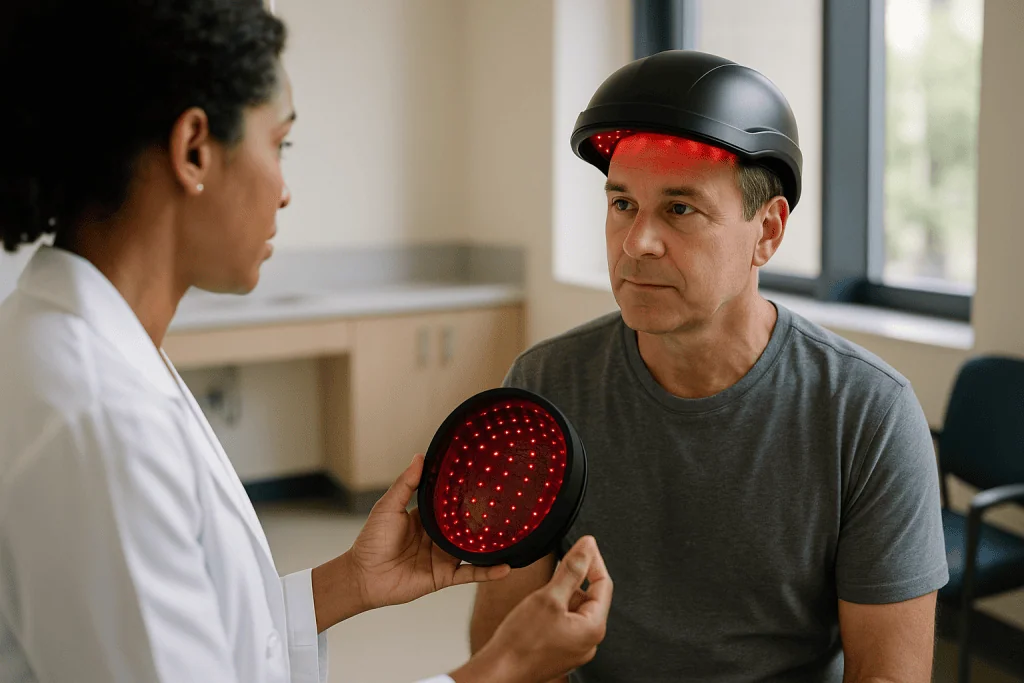
The FDA regulates devices in classes by risk. Hair-growth light devices sit in Class II and reach the market through the 510(k) pathway. Under 510(k), a manufacturer does not have to prove that its product works in its own placebo-controlled trial. It has to show that the device is substantially equivalent to a product already on the market, called a predicate, in intended use and technology. Once the original laser comb was cleared, later caps and helmets could point to it, or to each other, as predicates.
That is different from FDA approval. Approval, through the premarket approval route, applies to higher-risk devices and demands clinical evidence of safety and effectiveness for that specific product. Prescription medicines go through a separate, more demanding drug approval process. A cleared laser cap and an approved hair-loss drug have not met the same bar, even though both carry an official-sounding label.
Clearance also comes with fine print. The labelling typically specifies androgenetic alopecia only, a defined range of thinning (often described using the Norwood scale for men and the Ludwig scale for women) and particular skin tones, because the original trials enrolled mostly lighter skin types. Use outside those conditions has simply not been studied in the clearance file.
None of this means clearance is meaningless. It establishes that the device emits what it says, has reasonable safety features and matches a technology with some supporting data. It does not establish that the specific cap on your head has been shown, in its own trial, to grow hair. Keep the two ideas separate, and most of the marketing becomes easier to read.
What the evidence actually says about red light hair growth
Grade the evidence by type and the picture sharpens.
The best data are sham-controlled randomised trials, where participants are assigned by chance to a working device or an identical one that lights up but delivers no therapeutic energy. The pooled analysis by Jimenez and colleagues (2014) combined four such trials: 128 men and 141 women with pattern hair loss, treated at home for 26 weeks. Terminal hair density in a small tattooed target area rose significantly more in active groups than in sham groups, a difference on the order of 20 extra terminal hairs per square centimetre. Two earlier helmet-style trials in men and women reported hair-count increases of roughly 35 percent above sham after 16 weeks.
Systematic reviews that pool these and later studies agree on direction: light therapy beats sham for hair counts. The effect is consistent, statistically significant and modest.
Now the weaknesses, because they are real. Trials were short, most under seven months, in a condition that progresses over decades. Sample sizes were small. Manufacturers funded or ran nearly all of them. The primary outcome, hairs counted under magnification in a tiny patch, is a reasonable scientific measure but not the one patients care about, which is what the mirror shows. Patient-rated and investigator-rated photographic improvement was less consistent. Dropout was substantial in some studies, and independent replication is thin.
So, graded plainly: moderate-certainty evidence that these devices increase measured hair density over sham in mild to moderate androgenetic alopecia; low-certainty evidence that the change is cosmetically obvious; and expert opinion, not trial data, behind most claims about combining light with other treatments. That is a legitimate basis for trying one with realistic expectations. It is not a basis for expecting the transformation in the video.
Laser cap hair growth vs combs, bands and helmets: does the device type matter?
Walk the market and you will find four shapes. All claim the same biology; they differ in coverage, convenience and how closely they match the devices actually tested.
| Device type | How it is used | Coverage | Evidence base | Practical trade-off |
|---|---|---|---|---|
| Laser comb | Handheld, moved slowly across the scalp | Narrow strip per pass; relies on technique | Strongest: the pooled 2014 sham-controlled trials used combs | Requires attention and consistent movement; easy to under-treat the crown |
| Headband | Worn, repositioned to cover zones | Partial; several placements needed | Mostly cleared by equivalence to earlier devices | Hands-free but fiddly to cover a whole scalp |
| Cap or helmet (laser or LED) | Worn hands-free, often under a hat | Broad, even coverage | Helmet-style sham-controlled trials exist; many caps cleared by equivalence | Simplest to use consistently; emitter quality varies widely |
| Generic red LED panel | Pointed at the head | Uneven through hair | Not cleared or studied for hair loss | Hair blocks light; dose to the follicle is unknown |
What should drive the choice? Consistency beats theory. The device you will actually use several times a week for six months will outperform the technically superior one that lives in a drawer, and caps win on that measure for most people. Emitter count and the laser-versus-LED question matter less than whether the device emits in the studied wavelength range and whether its clearance covers your pattern of thinning.
One more realistic note on laser cap hair growth claims: a cap cleared by equivalence is borrowing evidence from a different product. That is acceptable regulatory practice, but it means the marketing phrase “clinically proven” often refers to someone else’s trial.
How long does red light therapy take to show results, and what do results look like?
Hair runs on a slow clock, and light therapy cannot speed it up. In the trials, participants were measured at 16 and 26 weeks, and that is where meaningful differences appeared. Nothing visible happens in the first month, and anyone promising otherwise is selling.
A plausible timeline, built from trial data and clinical experience, runs like this. During the first several weeks, some people notice a brief increase in shedding. This is usually interpreted as resting hairs being released early so follicles can re-enter the growth phase; it is unsettling but typically settles within a couple of months. Around month three or four, fine new hairs may become visible at the part line or crown under good light. By month six, existing hairs may feel thicker and the scalp may show through less. That is the realistic ceiling of what the studies measured.
Picture the result correctly. The trials found more terminal hairs per square centimetre, which translates in daily life to density rather than new territory. A thinning crown becomes less see-through. A widening part narrows slightly. A hairline that receded years ago, with smooth skin where follicles have been dormant for a long time, rarely changes.
Because androgenetic alopecia keeps progressing, benefits are generally thought to depend on continued use, much like other hair-loss treatments. Long-term stopping data do not exist, so this is expert reasoning rather than measured fact.
The most useful tool costs nothing: monthly photographs of the same spot, same lighting, same wet or dry state, same camera distance. Memory is a poor judge of hair. Photographs settle at six months whether the device earned its place on your shelf.
What are the side effects of red light therapy on the scalp?
Across the sham-controlled trials, adverse effects were few and mild, which is one of the stronger arguments for considering these devices at all. Reported problems included scalp dryness, itching, tenderness or a feeling of warmth during use, and occasional mild acne-like bumps. Headaches were uncommon and transient. Serious events were not reported in the published studies.
The early shedding described in the previous section is the complaint that worries people most. It is not a sign of damage in the trials’ interpretation, but it is a legitimate reason to check in with a clinician if it continues beyond a couple of months or becomes patchy.
Eye safety deserves respect. The lasers in these devices are low power, but direct viewing of the beams should be avoided, and manufacturers build in sensors or instructions for a reason. Follow the labelling on eye protection rather than assuming a red glow is harmless.
Then come the unknowns, which are as important as the knowns. Pregnancy and breastfeeding have not been studied. People taking medicines that increase light sensitivity, including some antibiotics, acne treatments and psychiatric drugs, should ask their prescriber before starting. Light should never be used over an undiagnosed scalp lesion, a changing mole, an active infection or an inflamed, scaling patch, because treating a symptom with a cap can delay the diagnosis that actually matters. People with a history of skin cancer on the scalp should talk to a dermatologist first. Children were not included in the trials.
Cleveland Clinic’s overview of red light therapy makes the broader point well: short-term use appears safe, while long-term safety data for home devices are limited. Low risk is not the same as no risk, and “natural light” is still a biologically active dose of energy.
Who is a realistic candidate for a laser cap, and who is not?
The devices were studied in a specific group, and the best results will come from people who resemble it. That group was adults with mild to moderate androgenetic alopecia: men with thinning at the temples and crown but not advanced baldness, women with a widening part but not near-complete loss, and mostly lighter skin tones, because darker skin was under-represented in the original trials. Earlier is better. A follicle that is thinning can be supported; one that stopped producing hair years ago generally cannot.
The device is a poor fit for several other situations, and these are common enough to spell out.
- Telogen effluvium, the diffuse shedding that follows illness, surgery, childbirth, crash dieting or severe stress, usually resolves on its own over months once the trigger passes. A cap will take the credit for recovery that would have happened anyway.
- Alopecia areata, an autoimmune condition causing smooth round patches, has only scattered small reports for light therapy and needs a different conversation entirely.
- Scarring alopecias, where inflammation has replaced follicles with fibrous tissue, cannot be treated by light because the target structure is gone.
- Hair loss driven by thyroid disease, iron deficiency, medication or hormonal conditions needs the cause addressed, not illuminated.
This is why the single most valuable step before buying anything is a diagnosis. Pattern hair loss can usually be identified by a clinician on examination, sometimes with a magnified look at the scalp and occasionally with blood tests to rule out mimics. The NHS and Mayo Clinic both describe hair loss as having many causes with different treatments, and that sentence does more for your hair than any device review. A cap bought for the wrong diagnosis is an expensive way to waste six months.
What are the big 3 for hair regrowth, and where does red light fit?
Ask a hair-loss forum about “the big 3” and you will get the same answer in slightly different orders: topical minoxidil, oral finasteride and a third slot that rotates between an anti-dandruff shampoo containing ketoconazole, low-level laser therapy and platelet-rich plasma injections. The phrase is internet shorthand, not a medical guideline, but it maps reasonably well onto the evidence.
Minoxidil, applied to the scalp, is FDA-approved over the counter for both men and women with pattern hair loss and has the longest track record. It is thought to lengthen the growth phase and widen blood vessels around the follicle. Finasteride, a prescription tablet, blocks the enzyme that converts testosterone to DHT, addressing the hormonal driver directly; it is approved for men, and any use in women is off-label and strictly a decision for the treating clinician after a discussion of risks, including in pregnancy. Both have known side effects that a prescriber will review, and neither should be started, stopped or adjusted on the basis of an article.
Where does light therapy sit? Reasonably, in the third slot or alongside the first two. The theoretical case for combination is appealing: minoxidil and light both act on the growth phase, finasteride on the hormone, so they target different parts of the problem. The trial evidence for combinations is thinner than enthusiasts imply, mostly small studies and clinical observation rather than large randomised comparisons, so grade it as expert opinion supported by plausible biology.
The practical takeaway is an ordering of priorities. A device is a sensible addition for someone who cannot tolerate, prefers to avoid or wants to supplement medicine. It is a weak substitute for a conversation with a clinician about the options with the stronger evidence base, and it works best as part of a plan rather than as the plan.
Common myths about red light and laser caps, corrected
The viral claims cluster into a handful of recurring mistakes. Each has a correction grounded in the trials.
“Red light brings dead follicles back.” Follicles that are miniaturised can be supported; follicles replaced by scar tissue or long dormant on a smooth scalp were not shown to recover in any controlled study. The devices were tested for thinning, not for bare skin.
“Longer sessions mean more growth.” Photobiomodulation appears to follow a biphasic pattern in laboratory work: too little energy does nothing and too much can blunt or reverse the effect. The trials used specific schedules, and manufacturers’ labelling reflects them. Doubling your time under the cap has no evidence behind it and may not be harmless.
“Any red bulb will do.” A red-tinted lamp or a generic panel aimed through a full head of hair delivers an unknown dose at an unknown wavelength to a follicle buried under a light-blocking layer. The studied devices sit close to the scalp and emit in a narrow band for a reason.
“FDA-cleared means proven, like a drug.” Clearance establishes equivalence to an earlier device and basic safety, not product-specific proof of effectiveness. It is a lower bar than drug approval.
“It works for every kind of hair loss.” The data cover androgenetic alopecia. Shedding from stress, illness, thyroid disease or iron deficiency has different causes and different fixes.
“Results are permanent once you stop.” Nobody has studied that, and the biology argues against it: the hormonal pressure on the follicle continues, so the benefit is generally expected to fade without continued use.
The pattern behind every myth is the same: taking a modest, specific finding and stretching it into a universal promise. Resist the stretch and the devices become easier to judge fairly.
What did Elon Musk use to regrow his hair? What celebrity stories can and cannot tell you
The question is one of the most searched phrases in this entire category, so it deserves a plain answer: nobody outside his private medical care knows, because he has never confirmed a treatment publicly. Photographs from the early 2000s show visible frontal thinning; later images show a fuller hairline. Commentators and surgeons who have never examined him widely assume a hair transplant, a surgical procedure that moves DHT-resistant follicles from the back of the scalp to the front, sometimes combined with medical treatment to protect the surrounding hair. That is informed speculation, not fact, and it is worth being precise about the difference.
What the question really reveals is how hair-loss decisions are made online. A dramatic transformation becomes a template, and the template is attached to whatever product the video happens to be selling. In the case of red light hair growth content, celebrity names appear in captions on caps that no public figure has ever credited.
Here is what a celebrity photograph can never tell you. It cannot show the diagnosis, the age at which treatment started, the combination of approaches used, the time elapsed, the lighting, the styling or the retouching. It cannot tell you whether surgery was involved, and surgery produces results that no non-surgical treatment, light included, has been shown to match in a bald area.
The useful lesson is the opposite of the headline. The people with the most striking, durable results in pattern hair loss usually started early, got an accurate diagnosis, used treatments with the strongest evidence consistently and, in some cases, had procedures. A device may be one piece of such a plan. It is rarely the whole story, and anyone implying that a single cap produced a famous head of hair is guessing at best.
How to use a home red light device sensibly
If you and your clinician decide a device is worth trying, a handful of habits separate a fair trial from a wasted one.
Start with the labelling. Each cleared device comes with the schedule used in its clearance file, and that schedule, not a forum’s suggestion, is the one with any data behind it. Treat the instructions as the protocol and resist the urge to improvise upward.
Prepare the scalp. Light has to reach skin, so use the device on a clean, dry scalp without thick styling products, oils or heavy leave-in treatments that can absorb or scatter the beam. If you also use a topical medicine, ask the prescriber how to sequence the two; many clinicians suggest applying topicals after a light session rather than before, but follow your own prescriber’s advice.
Be boring about consistency. The trials ran for 16 to 26 weeks of regular use. Three enthusiastic weeks followed by a month of neglect tells you nothing. Tie sessions to an existing routine, such as reading or an evening programme, because hands-free caps succeed on exactly this point.
Measure honestly. Take photographs of the same area every four weeks under the same light, and if possible have a clinician assess the scalp at the start and at six months. Expect a possible early shedding phase, note it, and let the six-month photographs decide.
Know when to stop. Persistent irritation, pain, scaling, patchy loss or any new scalp lesion means pausing and getting examined. So does an honest set of photographs at six months that show no change; at that point the device has had its fair trial, and the next conversation belongs with a clinician rather than with a different cap.
When to see a doctor about hair loss or a light device
Two moments call for an appointment: before you start, and whenever something does not fit the pattern of slow, symmetrical thinning.
Before starting matters because the entire evidence base for these devices rests on one diagnosis. A clinician can confirm androgenetic alopecia, rule out the conditions that mimic it and talk through the options with stronger evidence, so that a device is a considered choice rather than a hopeful purchase. Anyone taking prescribed medicines, anyone who is pregnant or breastfeeding and anyone with a history of skin cancer should have that conversation first.
Certain signs mean the device should wait and the doctor should come first.
- Sudden or rapid hair loss over weeks rather than years, or loss coming out in clumps
- Smooth, round, completely bald patches, or loss of eyebrow or body hair
- Scalp pain, burning, itching, scaling, pustules, crusting or areas that look shiny and scarred
- Hair loss alongside unexplained tiredness, weight change, feeling cold, or changes in nails or skin
- In women, thinning together with irregular periods, new acne or increased facial hair, which can point to a hormonal cause
- Hair loss that began after starting a new medicine
- Any hair loss in a child
Reasons to go back after starting include irritation that does not settle, shedding that continues beyond a couple of months or becomes patchy, a new or changing spot on the scalp, and six months of consistent use with no photographic change.
Every treatment decision in this article, from whether to add a device to whether to begin or adjust minoxidil or finasteride, belongs with the prescribing clinician who can examine your scalp and knows your medical history. The NHS and Mayo Clinic both describe hair loss as a symptom with many causes, and a diagnosis is the one step no cap can replace.
The bottom line on red light and laser caps for hair
Strip away the glow and the verdict is undramatic, which is usually a sign it is accurate.
Red light and laser devices are a legitimate, low-risk option for hereditary thinning, supported by small sham-controlled trials that found modestly higher hair density after four to six months. The effect is real on a hair count and subtle in a mirror. The safety record over short periods is reassuring, with mild and uncommon side effects. FDA clearance confirms the device is equivalent to tested technology and reasonably safe; it does not certify that your particular cap has proven itself.
Three things matter most, in this order. Diagnosis first, because the devices only make sense for androgenetic alopecia, and much hair loss is something else. Established treatments second, because minoxidil and, for men, finasteride have deeper evidence and a device works best as a companion to a plan built with a clinician, never as a reason to start, stop or change a prescribed medicine on your own. Expectation third, because the person who treats a cap as a six-month experiment, photographs it honestly and measures density rather than miracles will be satisfied far more often than the person chasing a viral transformation.
The trend will move on, as trends do, to the next device or the next ingredient. The biology of a shrinking follicle will not. Red light has earned a modest place in that story, and modest places, used well and early, are how most people keep the hair they have.
Frequently asked questions
Does red light therapy really work for hair growth?
Modestly, yes, for hereditary thinning. Several sham-controlled randomized trials lasting 16 to 26 weeks found higher hair density in people using active devices than in those using identical inactive ones. The studies were small, short and mostly manufacturer-funded, and the gains were measured as hair counts in a small area rather than dramatic visible change. Evidence is moderate for density and low for cosmetic transformation, so expectations should stay realistic.
Is a laser cap better than a laser comb for hair growth?
Not on the evidence available. The strongest trials used handheld combs, while most caps were cleared by equivalence to earlier devices. Caps cover the scalp more evenly and are hands-free, which makes consistent use far more likely, and consistency over months is what the trials relied on. For laser cap hair growth, the practical advantage is adherence rather than proven superiority, and no rigorous head-to-head comparison has settled the question.
What are the big 3 for hair regrowth?
The phrase is internet shorthand for topical minoxidil, oral finasteride and a rotating third option, commonly ketoconazole shampoo, low-level light therapy or platelet-rich plasma. Minoxidil is approved for men and women; finasteride is a prescription medicine approved for men, and any use in women is an off-label decision for a clinician. Light therapy sits reasonably in the third slot as a supportive option, with weaker evidence than the first two.
What is androgenetic alopecia?
Androgenetic alopecia is hereditary pattern hair loss, the gradual thinning that affects about half of men by age 50 and millions of women. Genetically sensitive follicles respond to dihydrotestosterone, a hormone made from testosterone, by shrinking over successive growth cycles until thick hairs are replaced by fine, barely visible ones. Men typically thin at the temples and crown, women along a widening part. It is the only diagnosis the light devices were tested for.
What did Elon Musk use to regrow his hair?
There is no verified public answer, because he has never confirmed any treatment. Older photographs show frontal thinning and later ones a fuller hairline, and most commentators assume a hair transplant, which surgically moves hormone-resistant follicles to the front of the scalp. That remains speculation. No public figure has credited a red light cap for such a change, and a bald area filling in is not something light therapy has been shown to achieve.
What are the side effects of red light therapy on the scalp?
In controlled trials, side effects were mild and uncommon: scalp dryness, itching, tenderness, a feeling of warmth, occasional acne-like bumps and rare headaches. Some people notice a temporary increase in shedding in the first weeks. Eyes should be protected from direct beams. Safety in pregnancy, in children and alongside light-sensitizing medicines has not been studied, and devices should never be used over an undiagnosed scalp lesion or inflamed, scaling skin.
How long does it take for a laser cap to show results?
Plan on four to six months. The trials measured outcomes at 16 and 26 weeks, which is where differences from sham devices appeared. Nothing visible happens in the first month, early shedding can occur, and fine new hairs may become noticeable around month three or four. Because pattern hair loss keeps progressing, benefits are expected to depend on continued use. Monthly photographs under the same lighting are the fairest way to judge.
Can I use red light therapy with minoxidil or finasteride?
Many clinicians combine them, on the reasoning that the treatments act on different parts of the problem: minoxidil and light on the growth phase, finasteride on the hormonal driver. Evidence for the combination is mostly small studies and clinical experience rather than large randomized trials, so grade it as plausible rather than proven. Any decision to add a device to a prescribed medicine, or to change that medicine, belongs with your prescriber.
Does red light help a receding hairline or a bald crown?
It helps thinning more than absence. Trials enrolled people with mild to moderate pattern loss and measured increased density in areas that still had miniaturized follicles. A crown that is see-through may become denser; a hairline that receded years ago and now shows smooth skin has few living follicles for light to act on and rarely changes. Advanced loss is generally a conversation about other options with a clinician.
Can women use red light hair growth devices?
Yes, for female pattern hair loss. Devices have been cleared for women since 2011, and the pooled trials included 141 women, with density gains similar to those seen in men. Women should first have thyroid disease, iron deficiency and hormonal causes considered, because these are common mimics with different treatments. Pregnancy and breastfeeding have not been studied, so use during those times should be discussed with a clinician beforehand.
References
This article is for general information only and is not a substitute for professional medical advice. Please consult a qualified doctor about your individual situation.

More from the Blog

Saw Palmetto for Hair Loss: Supplement Claims vs Clinical Reality
Saw palmetto may modestly slow androgen-driven pattern hair loss for some people, but the evidence comes from a handful of small, short studies of…
Scalp Massage for Hair Growth: The Small Study Everyone Cites
Scalp massage has only weak evidence for hair growth. The study most often shared tested nine men who massaged for four minutes daily over…
Microneedling for Hair Loss: The Evidence, the Protocols, the Caveats
Microneedling shows genuine promise for pattern hair loss, but the evidence is modest. Small randomized trials, mostly in men, found that adding weekly scalp…

Hair Loss in Women: The Patterns, the Hormones and the Tests Worth Asking For
Hair loss in women most often comes from one of two causes: a temporary shedding phase called telogen effluvium, triggered by illness, childbirth, rapid…
Hair Breakage vs Hair Loss: How to Tell Which One You Have
Hair breakage and hair loss differ at the root. Broken hairs are short fragments with no bulb at the end, snapped along the shaft…

Minoxidil for Women: What to Expect, the Shedding Phase and Realistic Results
Minoxidil is the only topical medicine with regulatory approval for female pattern hair loss, and it works by prolonging the growth phase of thinning…