

Returning to Sport After a Fracture: How Surgeons and Physios Judge When Bone Is Ready

Key Takeaways
- Bone union and return to play are different milestones; most adult fractures knit in roughly 6 to 12 weeks, but clearance for impact or contact sport usually follows further weeks of strength and balance work.
- An X-ray can underestimate healing early and overestimate readiness late, which is why surgeons combine imaging with palpation and physiotherapists add hop, balance and strength tests.
- Fractures in low blood-supply zones such as the scaphoid, talus, femoral neck and fifth metatarsal base heal more slowly and carry a higher nonunion risk, so caution there is evidence-based rather than excessive.
- Plates, screws and nails restore alignment and stability but do not make bone heal faster; their main return-to-sport benefit is allowing earlier movement that limits stiffness and muscle loss.
- Pain is an unreliable guide to union: many fractures become comfortable weeks before the bridging bone is strong enough to resist twisting or impact.
- Smoking is the most consistently cited modifiable factor that slows bone healing, while extra calcium or vitamin D beyond adequate intake does not speed it up.
Returning to sport after a fracture is usually judged on three things together: imaging that shows bridging bone, a pain-free examination of the healed site, and functional tests of strength, balance and sport-specific movement. Many adult fractures take roughly 6 to 12 weeks to knit, but clearance for contact or high-impact sport often comes later and is always an individual decision made by the treating surgeon and physiotherapist.
The cast came off on a Tuesday. By Wednesday a 34-year-old recreational footballer was standing in a physiotherapy gym, flexing a wrist that looked thinner and paler than the other, asking the only question that mattered to him: “So when can I play?” The physio did not look at the calendar. She asked him to put weight through the heel of his hand, then watched his face.
That small moment captures how returning to sport after fracture really works. The date on a discharge letter is a starting point, not a finish line. Surgeons read X-rays, physiotherapists read movement, and both are trying to answer a harder question than “is the bone fixed?” They want to know whether the whole limb, and the person attached to it, can tolerate the specific loads a sport throws at it.
This explainer walks through how that judgement is made, why timelines differ so much from bone to bone, and which shortcuts tend to end in a second injury.
Why "the X-ray looks fine" is only the first checkpoint
An X-ray is a shadow picture of mineral. It shows where calcium has been laid down, which is why early callus, the soft bridge of new tissue that forms across a break, can be nearly invisible for the first few weeks even when healing is going well. Cleveland Clinic notes that most fractures in adults heal over roughly 6 to 8 weeks, yet a film taken at week six can still look worryingly incomplete while the bone is already stable enough to bear ordinary loads.
The reverse is also true. A radiograph can show a tidy, bridged fracture line while the joint next to it remains stiff, the muscle around it has shrunk, and the person’s sense of where the limb is in space, called proprioception, has not recovered. None of those problems appear on an X-ray, and all of them raise the risk of a fall, a twist or a second break on the first day back.
This is the core reason sports medicine teams separate two ideas that patients often merge: fracture union, meaning the bone has knitted, and return to play, meaning the athlete can meet the demands of the sport safely. Union is a biological milestone. Return to play is a performance milestone layered on top of it.
Surgeons tend to own the first judgement. They look at imaging, press on the site to check for tenderness, and sometimes stress the limb gently to feel for movement at the fracture. Physiotherapists tend to own the second. They measure range of motion against the other side, test strength with hand-held dynamometers or simple repetition counts, and watch how the person lands, cuts and decelerates. When both say yes, and the athlete reports no pain during sport-specific drills, the conversation about dates finally becomes realistic.
How bone actually heals: the four stages in plain language
Bone is one of the few tissues in the body that repairs itself with the same material it started with, rather than scar. That is why a well-healed fracture can be as strong as it was before. The process runs in overlapping stages, and each one explains a different rule your team gives you.
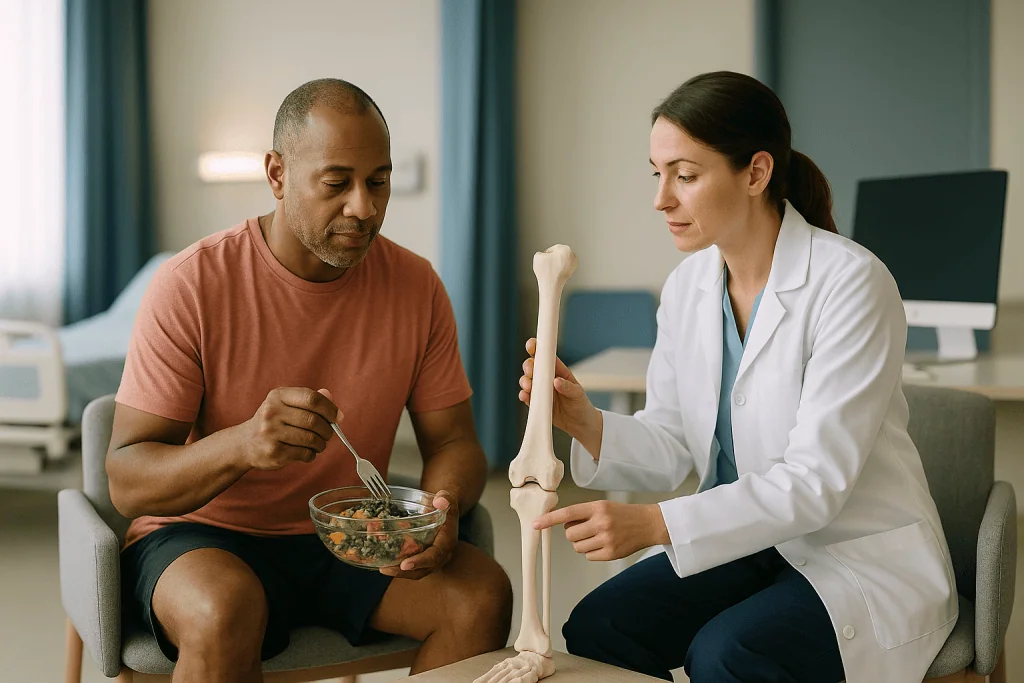
Stage one is bleeding and inflammation. Within hours, blood pools at the break and forms a clot. Immune cells arrive to clear debris and release signals that recruit repair cells. This is the swollen, hot, throbbing phase, and it is why rest, elevation and protection matter most in the first days.
Stage two is soft callus. Over the next couple of weeks, cells lay down a rubbery scaffold of cartilage and fibrous tissue across the gap. It holds the ends together but cannot take much bending force. A twist in this window can tear the scaffold and set the clock back.
Stage three is hard callus. Mineral is deposited into the scaffold, converting it to woven bone. This is what eventually appears as a cloudy bridge on X-ray. MedlinePlus and Cleveland Clinic describe this consolidation phase as the point where most adult fractures become clinically stable, commonly in the 6 to 8 week range for many bones.
Stage four is remodeling. Over months, the bulky woven bone is reshaped along the lines of stress into dense, organized bone. Remodeling needs load to guide it, which is why controlled exercise is part of treatment rather than a reward at the end.
Knowing these stages makes the surgeon’s caution easier to accept. Returning to sport too early does not just risk pain; it risks interrupting stage three before the bridge is complete, which is one route to delayed union, a fracture that heals slower than expected, or nonunion, one that stops healing altogether.
Returning to sport after fracture: the three questions your team is really asking
Strip away the jargon and the clearance decision comes down to three questions asked in sequence. The first is biological, the second is mechanical, and the third is about the person.
Has the bone united? The surgeon wants evidence of bridging callus on imaging, no tenderness when the fracture site is pressed, and no pain when the limb is gently stressed. For fractures treated with a plate or screws, the hardware adds stability, but the team still wants to see biological healing before trusting the bone with impact.
Can the limb do the job? Physiotherapists compare the injured side to the uninjured side. A common working target is that strength and range of motion reach a high proportion of the other limb before sport-specific drills begin, though the exact threshold varies by sport and by clinic protocol. They also test the chain above and below the fracture: a healed ankle still needs a strong hip and calf to protect it on landing.
Is the person ready? Fear of reinjury is real and measurable. Someone who hesitates before planting the healed foot is more likely to land awkwardly. Many teams build confidence deliberately, moving from closed drills, where the movement is predictable, to open drills with an opponent or an unpredictable ball, before full training.
The order matters. Returning to sport after fracture goes wrong most often when question two is skipped because question one has been answered. A bone can be solid while the leg around it is not, and the first contested header or awkward tackle finds the weak link.
Your team may describe this as a graded return: non-contact training first, then controlled contact, then full competition. Each step is a test of the next step’s safety, and a flare of pain or swelling at any stage is information, not failure.
Fracture healing time by bone: typical ranges and why they differ
People ask for one number. Bone does not offer one. Healing speed depends on blood supply, how much load the bone carries, whether the break is clean or shattered, and the age of the person. Children heal faster because their periosteum, the living membrane around bone, is thicker and more active.
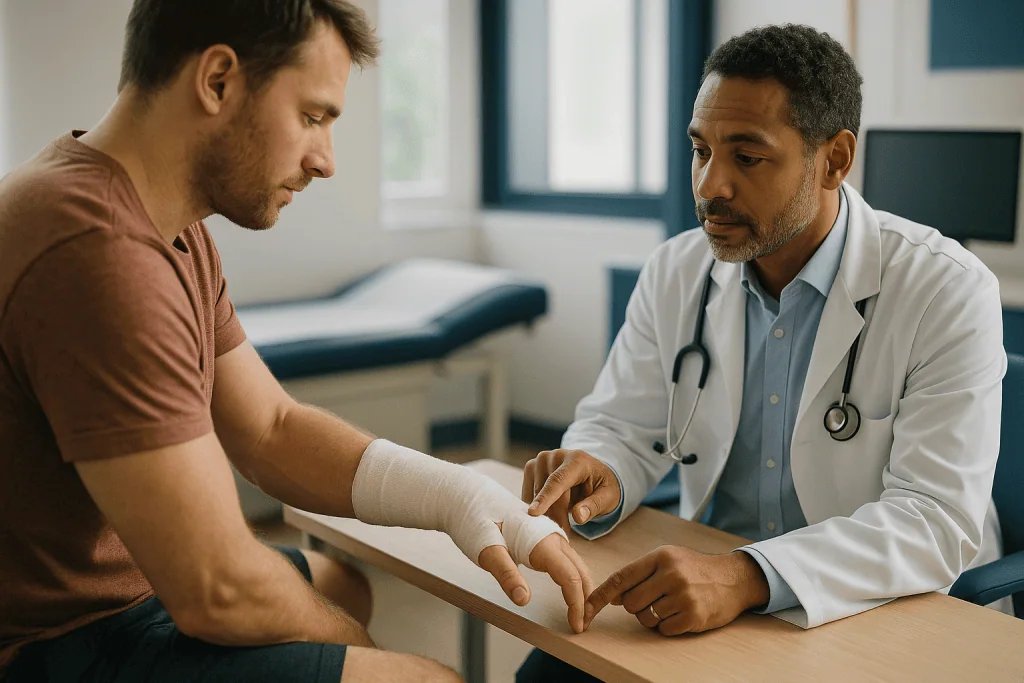
The table below gives typical ranges quoted by mainstream sources for bone union, which is not the same as clearance for sport. Treat them as orientation, not a schedule.
| Fracture site | Typical time for union | What usually extends the wait for sport |
|---|---|---|
| Wrist or forearm (adult) | About 6 to 8 weeks (NHS) | Grip strength, weight-bearing through the hand, fall risk in contact sport |
| Collarbone (adult) | About 6 to 8 weeks; children often 3 to 6 weeks (NHS) | Overhead strength, tolerance of shoulder contact |
| Ankle | About 6 to 12 weeks (NHS) | Balance, calf strength, cutting and landing control |
| Stress fracture (low-risk site) | Often 6 to 8 weeks (Mayo Clinic) | Correcting the training error that caused it |
| Tibia, femur, scaphoid, fifth metatarsal base | Longer and more variable; your team will give a site-specific estimate | Poorer blood supply or high load; higher nonunion risk |
Notice the spread. A collarbone in a nine-year-old and an ankle in a 45-year-old distance runner are different projects. Notice, too, that the right-hand column is where most of the extra weeks live. Union of a wrist at eight weeks does not mean a judo player is ready to be thrown on it at week nine.
When your surgeon gives you a range, ask whether it refers to bone union or to return to play. The honest answer is often two different numbers.
Who is usually cleared earlier, and who is usually asked to wait
Clearance is individual, but patterns are consistent enough across guidelines and clinical practice to describe.
Those often cleared sooner include children and adolescents with simple, well-aligned fractures, because their healing biology is faster and their bones remodel aggressively. People returning to non-contact, non-impact activity such as swimming, stationary cycling or rowing may also progress earlier, since those sports load the healed bone gently and predictably. A fracture that was stabilized surgically with a plate or intramedullary nail, a metal rod placed inside the bone, is sometimes allowed earlier movement because the hardware shares the load, although the bone itself still has to heal before impact is safe.
Those usually asked to wait longer include adults with fractures in low blood-supply zones such as the scaphoid in the wrist or the base of the fifth metatarsal in the foot, people with comminuted fractures where the bone broke into several pieces, and anyone whose fracture extended into a joint surface, because the cartilage lining needs protection as well as the bone. Cleveland Clinic lists smoking, diabetes, poor nutrition and certain medicines among factors that slow bone healing, and teams factor these into timelines.
Sport itself is a variable. A healed clavicle may be fine for a tennis serve weeks before it is fine for a rugby tackle. Teams usually ask: what is the worst thing this sport will do to this bone, and can the bone take it today?
Age cuts both ways. Older adults heal more slowly and may have lower underlying bone density, so the team may want to understand why the bone broke at all. A fracture from a modest fall can prompt a conversation about bone health that runs alongside the return-to-sport plan rather than after it.
None of these categories is a verdict. They describe where the caution usually sits, so you understand why your neighbor’s timeline looked different from yours.
What the weeks after a fracture usually look like
Most people experience recovery as a series of plateaus rather than a smooth slope. Knowing the shape in advance makes the flat stretches easier to tolerate.
The first two weeks are about protection and swelling control. Whether the limb is in a cast, a removable splint or a surgical dressing, the aims are the same: keep the fracture ends still, keep the limb elevated, and keep the joints that are not immobilized moving. A person with a broken wrist should still be bending and straightening the elbow and shoulder and wiggling the fingers. NHS guidance on broken arms and wrists emphasizes exactly this early movement of uninvolved joints to prevent stiffness.
Weeks two to six are often the frustrating middle. The pain has settled, the bone is quietly building soft and then hard callus, and there is little visible progress. Physiotherapy at this stage may focus on the rest of the body: cardiovascular fitness on a bike or in a pool if the fracture allows, core work, and strength in the opposite limb.
Weeks six to twelve usually bring the first imaging review that shows bridging bone and the removal of rigid protection. Range of motion work begins in earnest, followed by progressive strengthening. For many lower-limb fractures, this is when weight-bearing moves from partial to full under guidance.
Beyond three months is the return-to-play phase for many adult fractures: running progressions, jumping and landing drills, sport-specific skills, then graded contact. Full remodeling of the bone continues in the background for months after the person is back on the field.
These phases blur, overlap and stretch. A delayed union pushes everything to the right. A straightforward pediatric buckle fracture may compress the whole sequence into a few weeks. The map is useful precisely because it shows how much of the journey happens after the X-ray says yes.
Return to play after fracture: how physios test readiness without a scanner
A physiotherapist’s clinic room holds no X-ray machine, yet it is where most return to play after fracture decisions are finalized. The tools are low-tech and deliberately so, because they mimic what the sport will actually demand.
Range of motion is measured with a goniometer, a protractor for joints, and compared side to side. A wrist that cannot extend enough to push up from the floor is not ready for gymnastics regardless of the film.
Strength is tested with resisted movements, hand-held dynamometers for grip or isolated muscles, and repetition tests such as single-leg calf raises for an ankle. The uninjured side is the benchmark, and the gap between the two is tracked week to week.
Balance and proprioception matter most for lower-limb fractures. Single-leg stance with eyes closed, standing on a foam pad, and reach tests show whether the nervous system has re-learned to trust the limb.
Hop and jump tests are the bridge to impact. A single-leg hop for distance, a triple hop and a timed hop course are common. The physio watches not only how far but how well: a knee collapsing inward on landing or a foot that avoids full weight tells its own story.
Sport-specific drills come last. A footballer might progress from jogging to striding, then to changes of direction at increasing speed, then to kicking, then to contested situations. A climber might progress hang times and grip positions. The drill is the test.
Throughout, the physio watches two warning signs: pain at the fracture site during or after loading, and swelling the next morning. Either one means the load exceeded what the tissue could handle, and the plan steps back a stage. Pain elsewhere, in a stiff muscle for example, is interpreted differently and often means more work rather than less.
Does surgery with a plate or screws mean a faster return to play?
This is one of the most common questions in a fracture clinic, and the honest answer is: sometimes, for some fractures, but not in the way people imagine.
Internal fixation, the surgical placement of plates, screws, wires or a nail to hold the bone fragments in position, does two things. It restores alignment precisely, which matters for fractures that enter a joint or that have shifted. And it provides mechanical stability from day one, which can allow earlier movement of nearby joints and, in some cases, earlier protected weight-bearing. Earlier movement means less stiffness and less muscle loss, which shortens the rehabilitation phase that follows union.
What fixation does not do is make bone heal faster. The biological stages described earlier run on their own clock. Metal holds the pieces still while that happens; it does not accelerate callus. For many fractures, the surgical route also adds a wound to heal, a small infection risk, and the possibility of hardware irritation later, particularly where a plate sits just under the skin as on the collarbone or outer ankle.
Surgeons therefore weigh fixation against conservative treatment, meaning a cast or brace without surgery, on the merits of the fracture rather than the athlete’s impatience. A displaced ankle fracture that would heal crooked is a strong candidate for surgery. A stable, well-aligned wrist fracture may do just as well in a cast, and NHS guidance describes both pathways as routine depending on the pattern.
If surgery is proposed, reasonable questions include why this fracture needs it, what the alternatives are, whether the hardware is likely to stay in permanently, and how the fixation changes the expected rehabilitation path. If a cast is proposed instead, it is fair to ask what would change the plan if follow-up imaging shows the bone shifting.
Either way, the decision belongs to the surgeon in conversation with you, and the rehabilitation that follows is remarkably similar in its goals.
Exercise after a broken bone: what you can safely do while you wait
The instinct to rest everything is understandable and usually wrong. Exercise after a broken bone, done within the limits your team sets, protects fitness, preserves muscle and keeps the uninjured joints supple. It also helps with mood during a long wait, which is not a trivial benefit.
The guiding principle is to load everything the fracture does not involve, and to load the fracture only as your team directs. In practice that often looks like this.
- Cardiovascular work on a stationary bike with the arm resting, or in a pool once wounds are sealed and the team agrees, keeps the heart and lungs conditioned.
- Strength training on the opposite limb is worth doing for its own sake. There is a well-described cross-education effect in which training one side produces modest strength gains in the untrained side through the nervous system.
- Movement of neighboring joints is actively encouraged by NHS fracture guidance: fingers, elbow and shoulder with a wrist fracture; toes, knee and hip with an ankle fracture.
- Core and trunk work rarely conflicts with a limb fracture and sets up the kinetic chain the limb will depend on later.
What to avoid is equally concrete: any activity that risks a fall onto the healing limb, any exercise that produces pain at the fracture site, and any temptation to “test” the bone by loading it ahead of the plan. Swelling that is worse the next morning is a reliable sign the previous day was too much.
Nutrition belongs in this section too. Bone building draws on protein, calcium and vitamin D. The NIH Office of Dietary Supplements provides evidence-based intake guidance for both nutrients; whether you need a supplement rather than dietary sources is a question for your clinician, and taking more than you need does not speed healing.
Smoking is the single modifiable factor most consistently linked with slower bone healing in mainstream guidance, including Cleveland Clinic’s fracture overview. If you smoke, the fracture is a reason to ask for help stopping.
What is the hardest fracture to heal? Blood supply, location and load
Ask orthopedic surgeons this question and you will hear the same handful of names: the scaphoid in the wrist, the neck of the femur in the hip, the talus in the ankle, and the base of the fifth metatarsal on the outer foot. They share a biological problem rather than a mechanical one.
Bone heals from its blood supply. Repair cells, oxygen and nutrients all arrive through small vessels that enter the bone at predictable points. In most long bones those vessels enter along the shaft and spread in both directions, so a break anywhere along it is well supplied from both sides. In the scaphoid, the talus and the femoral neck, the blood enters mainly at one end and flows backward toward the other. A fracture across that path can leave the far fragment starved. The result may be delayed union, nonunion, or avascular necrosis, the death of bone tissue from lack of blood.
The fifth metatarsal base is a different story: it sits in a zone of relatively poor supply and is also loaded with every step, so the fracture ends are repeatedly disturbed. Mayo Clinic’s stress fracture guidance singles out this region, along with the navicular and the front of the tibia, as higher-risk sites that often need longer protection and closer follow-up than a typical stress fracture.
Why does this matter for return to sport? Because the usual reassurances do not apply. Pain may be mild from the start, X-rays may look unremarkable for weeks, and the temptation to resume activity is strong. These are the fractures where surgeons rely most heavily on advanced imaging such as CT or MRI to confirm union, and where physiotherapists are most conservative about impact.
If your fracture is in one of these zones, the extra caution is not excess. It reflects where the evidence says the risk lives.
Can professional athletes really come back from a broken ankle? What their path teaches everyone
Fans see a player carried off with a fractured ankle in autumn and running out again by spring, and the inference is that elite bodies heal faster. They do not. Bone biology in a professional athlete runs on the same timetable as in anyone else. What differs is everything around the bone.
Professional athletes are typically assessed within hours, imaged thoroughly, and, where indicated, operated on quickly so that rehabilitation starts early. They then spend several hours a day with physiotherapists and conditioning staff, have immediate access to pools, anti-gravity treadmills and gym equipment, and are monitored daily for swelling and pain. The six to twelve weeks that NHS guidance gives for ankle fracture union is not shortened; the weeks after it are compressed because the strength, balance and sport-specific phases run in parallel and at high intensity.
Two lessons carry over to ordinary life. First, early, structured rehabilitation of everything that is not the fracture makes the later phase much shorter. Second, the decision to return is made on function, not on the fixture list. Even in professional sport, clearance follows hop tests, strength symmetry and training tolerance, and athletes who return before meeting those markers are the ones who appear on the injury list again.
It is also worth saying what the highlight reel leaves out. Some athletes return at a lower level for a season while remodeling completes. Some need hardware removed later. Some develop persistent stiffness or early joint wear in the ankle, particularly after fractures that involved the joint surface. These outcomes are discussed honestly in the clinic even when they are absent from the broadcast.
So the answer to the search question is yes, people in demanding sports do return after ankle fractures, often fully. They do so by respecting the same biology and applying far more rehabilitation to it, not by skipping steps.
What people often get wrong about returning to sport after fracture
Fracture clinics hear the same misconceptions week after week. Correcting them is part of the treatment.
“A bone can heal in two weeks.” Only in the loosest sense. In a very young child, a minor buckle fracture may be comfortable and protected enough to leave the splint within a few weeks. In an adult, two weeks is the soft callus stage: a rubbery scaffold that cannot resist twisting. NHS and Cleveland Clinic guidance places adult union for common fractures around 6 to 8 weeks at the earliest, and sport clearance comes after that.
“No pain means it has healed.” Pain fades well before bone is strong. Many stress fractures and scaphoid fractures are nearly painless at rest while still unbridged. Pain is a poor proxy for union, which is why your team checks imaging and palpates the site rather than taking your word for it.
“Cast off means cleared.” Cast removal marks the end of protection, not the end of recovery. The joint is stiff, the muscle has shrunk and the skin is fragile. The rehabilitation that follows is often longer than the time spent in the cast.
“Calcium tablets will speed it up.” Adequate calcium and vitamin D are necessary for normal healing, but intake above adequacy does not accelerate it. NIH Office of Dietary Supplements guidance is clear that more is not better and that excess has its own risks.
“Rehab is optional if the X-ray is good.” Skipping rehabilitation is the most common avoidable route to a second injury. The bone is one link in a chain; the rest of the chain has been idle for weeks.
“Once healed, that bone is weaker forever.” After full remodeling, healed bone is generally as strong as the original. Lasting weakness usually reflects the joint, muscle or balance deficits that were never addressed, not the bone itself.
Questions to ask your care team
A good clinic conversation about returning to sport after fracture is specific. Vague questions get vague answers; the ones below tend to produce a plan you can act on. Take them in written form, and write down the replies.
- Is this fracture stable, and does it involve a joint surface? That single answer shapes almost everything else.
- Is the estimate you are giving me for bone union or for return to my sport? If they differ, what is the gap and why?
- What exactly can I do this week: which joints should I be moving, how much weight can I put through the limb, and what should I avoid?
- What signs would tell you the bone is healing more slowly than expected, and when is my next imaging review?
- Will I need advanced imaging such as CT or MRI to confirm union, given where the fracture is?
- Which functional tests will you use to decide I am ready for impact, and how far from passing them am I now?
- If I was treated with hardware, is it likely to stay in, and does it change what I can do in contact sport?
- Is there anything about my general health, bone density, nutrition or smoking that we should address alongside the fracture?
- What is the plan if I get pain or swelling after a training session during the graded return?
- Who is my point of contact between appointments if something changes?
Notice that none of these questions asks for a date. Dates arrive on their own once the milestones are met. Asking for the milestones instead gives you something to work toward and gives your team a shared language for the weeks ahead. If an answer involves a trade-off, for example an earlier return at the cost of a higher reinjury risk, ask for the trade-off to be spelled out. The decision remains with your treating team, but it should be a decision you understand.
When to call your doctor
Most fracture recoveries are uneventful, and most setbacks announce themselves clearly if you know what to listen for. Contact your treating team promptly, or seek urgent care if the symptom is severe, if you notice any of the following.
- Pain that is increasing rather than settling, or pain that returns at the fracture site after it had faded, particularly after loading.
- New or worsening swelling, especially swelling that does not improve with elevation overnight.
- A cast or splint that feels too tight, with numbness, tingling, pale or bluish fingers or toes, or difficulty moving them. These can signal pressure on nerves or blood vessels and need same-day assessment.
- Fever, spreading redness, warmth, discharge or an unpleasant smell around a surgical wound or under a cast, which may indicate infection.
- Calf pain, swelling or tenderness in the immobilized leg, or sudden breathlessness or chest pain. Immobility raises the risk of a blood clot, and these symptoms need emergency assessment.
- A sensation of movement, grinding or a visible change in shape at the fracture site, or a new injury to the same limb.
- Numbness or weakness that develops after cast removal and does not improve over a few days.
- Any fall onto the healing limb, even if it feels fine afterward.
During the graded return to sport, a separate set of signals matters. Pain at the fracture site during a drill, swelling the next morning, or a sense that the limb is giving way should prompt a conversation with your physiotherapist before the next session rather than after the next injury. Stepping back a stage early is a far smaller setback than a refracture.
If you are ever unsure whether a symptom is part of normal healing, ask. Fracture clinics expect these calls, and the question is never a nuisance.
Frequently asked questions
How long after a fracture can I play sports?
For many adult fractures, bone union takes about 6 to 12 weeks according to NHS guidance, and return to sport typically comes some weeks after that once strength, range of motion and balance have recovered. Children often heal faster. Contact and high-impact sports usually wait longest. Your surgeon and physiotherapist will set the timeline based on imaging, examination and functional tests rather than a fixed calendar.
Can a fractured bone heal in 2 weeks?
Not in adults in any meaningful sense. At two weeks the fracture is bridged only by soft callus, a rubbery scaffold that cannot resist twisting or impact. Mineralized, load-bearing bone typically forms over 6 to 8 weeks or longer. Very young children with minor buckle fractures may be comfortable and protected enough to leave a splint sooner, but that reflects their biology, not a general rule.
What is the hardest fracture to heal?
Fractures in bones with a limited blood supply are the most difficult: the scaphoid in the wrist, the talus in the ankle, the femoral neck in the hip and the base of the fifth metatarsal in the foot. Blood enters these bones mainly from one direction, so a break can starve the far fragment. They carry higher risks of delayed union and nonunion and usually need longer protection and closer imaging follow-up.
Can professional players really come back from a broken ankle?
Yes, many do, including in demanding contact sports. Their bones heal on the same 6 to 12 week timeline as anyone else’s, but intensive daily rehabilitation compresses the strength, balance and sport-specific phases that follow union. The decision to return is still made on functional tests, not the fixture list, and some athletes play at a reduced level for a period while remodeling completes.
How do I get back into a sport after a break?
Work through a graded return under your team’s guidance: restore range of motion first, then strength compared with the uninjured side, then balance and proprioception, then impact drills such as hopping, then sport-specific skills, and finally controlled contact before full competition. Each stage tests whether the next is safe. Pain at the fracture site or next-morning swelling means stepping back a stage.
Is exercise after a broken bone safe while I am still in a cast?
Usually yes, within limits set by your team. NHS fracture guidance encourages moving the joints that are not immobilized, such as fingers and shoulder with a wrist fracture, to prevent stiffness. Cardiovascular work that does not load the fracture, strength training on the opposite limb and core work are commonly allowed. Avoid anything that risks a fall onto the healing limb or causes pain at the fracture site.
Does a plate or screws mean I can return to play sooner?
Sometimes, but not because the bone heals faster. Internal fixation restores alignment and provides immediate stability, which can allow earlier joint movement and protected weight-bearing and so shortens the stiffness and muscle-loss phase. The biological healing still takes its usual weeks, and surgery adds wound and hardware considerations. Surgeons choose fixation on the fracture pattern, not on urgency to return.
Why does my physio keep testing my other leg?
The uninjured side is the benchmark for your recovery. Physiotherapists compare range of motion, strength, single-leg balance and hop distance between limbs because a large gap predicts awkward landings and reinjury. Training the uninjured side also produces modest strength gains in the injured side through the nervous system, an effect called cross-education, so it is useful work rather than a distraction.
Will my bone be weaker forever after a fracture?
Generally no. Bone repairs itself with bone rather than scar, and after full remodeling, which continues for months after you return to sport, the healed site is usually as strong as the original. Persistent weakness after a fracture more often reflects joint stiffness, muscle loss or balance deficits that were not fully rehabilitated, which is why the rehabilitation phase matters as much as the healing phase.
What is the fracture healing time by bone for common sports injuries?
NHS guidance gives about 6 to 8 weeks for adult wrist, forearm and collarbone fractures and about 6 to 12 weeks for ankle fractures, with children often faster. Mayo Clinic cites 6 to 8 weeks for many stress fractures. Tibia, femur, scaphoid and fifth metatarsal base fractures are longer and more variable. These figures describe union; clearance for sport usually comes later.
References
This article is for general information only and is not a substitute for professional medical advice. Please consult a qualified doctor about your individual situation.

More from the Blog

What a Walking Assessment and Weight-Bearing X-Rays Reveal Before Foot Deformity Treatment
A walking assessment and weight-bearing X-rays together show how a foot deformity behaves under real load. The walking exam reveals whether the shape is…

Bunion Surgery Cost in the UK: Private Pricing and the Abroad Comparison
Private bunion (hallux valgus) surgery in the UK typically costs £4,200–£8,000 per foot, depending on the technique, type of anaesthesia and hospital location. In…
After Trauma Surgery: Circulation and Nerve Checks, Infection Signs and When to Call
After trauma surgery, the complications most worth watching are poor circulation or nerve function in the operated limb, compartment syndrome, surgical site infection, blood…

Clubfoot Treatment Timeline: Weekly Casts, the Tendon Release and the Bracing Years
The clubfoot treatment timeline usually begins in the first one to two weeks of life with the Ponseti method: gentle weekly manipulation and plaster…

Preparing for Hip Replacement: Blood Tests, Imaging and the Medicine Review That Comes First
To prepare for hip replacement surgery, most people attend a pre-operative assessment a few weeks beforehand that includes blood tests (blood count, kidney function,…

Deformity Correction in Children vs Adults: Why Growth Plates Change the Surgical Plan
Deformity correction in children and adults differs mainly because children still have open growth plates, the soft cartilage zones near the ends of long…