

Rhodiola Rosea: Fatigue, Stress and Performance: What Trials Show

Key Takeaways
- Rhodiola's best-supported use is short-term stress-related fatigue, where small randomized trials of up to four weeks found modest improvements over placebo.
- In the only trial comparing rhodiola directly with a prescription antidepressant, rhodiola was less effective and not significantly better than placebo on the main depression measure.
- The NIH Office of Dietary Supplements concludes that evidence does not support rhodiola as a meaningful aid to exercise performance.
- Rosavins occur only in Rhodiola rosea, and independent product testing has found commercial supplements with none, indicating substitution with cheaper related species.
- Rhodiola rosea was added to CITES Appendix II in February 2023 because wild harvesting outpaced regrowth, which has tightened the supply of authentic material.
- People who are pregnant or breastfeeding, have bipolar disorder, or take antidepressants, blood thinners, blood pressure or diabetes medicines should not use rhodiola without clinician guidance.
Rhodiola rosea is an herbal supplement studied mainly for stress-related fatigue, mood and physical or mental performance. Small randomized trials suggest modest, short-term improvements in fatigue and burnout symptoms, while evidence for exercise performance and depression is mixed and weaker. It is generally well tolerated for short periods, but product quality varies and safety data are limited, so discuss use with a clinician.
The clip has a familiar rhythm: a creator holds up a bottle, promises that one root will “fix your cortisol,” and the comments fill with people asking where to start. Rhodiola, a yellow-flowered plant that clings to cliffs in Siberia and Scandinavia, has become the latest adaptogen to ride that wave. As of June 2025, search interest has climbed alongside the “cortisol face” trend and a steady stream of videos pairing rhodiola with claims about burnout, focus and gym performance.
The irony is that rhodiola is not new. Scandinavian folk medicine used it for centuries, Soviet researchers studied it in the 1960s, and the European medicines regulator has recognized it as a traditional remedy for stress-related fatigue since 2012. What is new is the volume of the claims, and the gap between them and the trials.
So this piece does something the videos do not: it reads the randomized studies, grades how strong they are, and tells you plainly where rhodiola looks promising, where it looks like noise, and who should leave it on the shelf.
What changed recently with rhodiola
Three developments explain why a plant with a long history is suddenly everywhere. The first is cultural. Since 2024, social media has run hot with “cortisol” content, and adaptogens, a loose term for plants claimed to help the body resist stress, became the natural product category to attach to it. Rhodiola, already sold as an energy and focus aid, slotted neatly into that story.
The second is regulatory and ecological. In February 2023, Rhodiola rosea was added to Appendix II of CITES, the international treaty governing trade in wild species. That listing does not ban sales, but it signals that wild populations have been overharvested to meet demand, and it tightens paperwork for raw material crossing borders. For readers, the practical consequence is a market under pressure, which historically increases the risk of substitution with cheaper related species.
The third is scientific, and it is quieter than the headlines. Systematic reviews published over the last decade, including the widely cited 2012 review in BMC Complementary and Alternative Medicine that pooled eleven randomized trials, reached a consistent verdict: encouraging signals for fatigue and mental performance under stress, undermined by small samples, short follow-up and inconsistent extracts. More recent reviews of fatigue outcomes have added studies without fundamentally changing that conclusion.
In other words, the evidence base has not shifted dramatically. The attention has. That matters, because a trend can make a modest, uncertain finding sound like settled science. The sections that follow keep those two things separate.
What is rhodiola, and what does rhodiola do to your body?
Rhodiola rosea, also called golden root or arctic root, is a succulent that grows in cold, high-altitude regions of Europe, Asia and North America. The supplement comes from its thick rhizome, the underground stem, which is dried and extracted.
Two families of compounds get most of the attention. Rosavins are a group of molecules found specifically in R. rosea, which is why they serve as a fingerprint for authentic material. Salidroside is a phenolic compound shared with other Rhodiola species. Most clinical trials used extracts standardized to both, meaning the manufacturer measured and fixed the content of these markers from batch to batch. Many retail products do not disclose either.
What rhodiola actually does inside the human body is less settled than the marketing suggests. Laboratory and animal work points to several candidate mechanisms: modulation of the hypothalamic-pituitary-adrenal axis, the hormonal circuit that governs cortisol release; mild inhibition of monoamine oxidase, an enzyme that breaks down mood-related neurotransmitters such as serotonin and dopamine; and effects on cellular stress proteins and energy metabolism. Each of these is biologically plausible, and each is mostly demonstrated in cells or rodents rather than people.
Human data on mechanism are thin. One 2009 trial measured the cortisol awakening response, the normal spike in cortisol shortly after waking, and found it was lower in the rhodiola group than in the placebo group after four weeks. That is a single small study, not a physiological law. The honest short answer to “what does rhodiola do to your body” is that it appears to nudge stress and fatigue perception in some people over weeks, through pathways researchers are still mapping.
What the evidence actually says, graded by strength
Not all evidence weighs the same, so it helps to sort rhodiola research into tiers before looking at any single claim.
Randomized controlled trials. These are the strongest design, because participants are assigned by chance to rhodiola or placebo, which cancels out expectation and selection effects. For rhodiola, roughly a dozen such trials exist across fatigue, mental performance, mood and exercise. Most enrolled between 40 and 120 people and lasted two to twelve weeks. Several reported benefits; several did not. Independent reviewers have repeatedly flagged risk of bias from unclear randomization, incomplete reporting and manufacturer involvement.
Open-label and observational studies. Here everyone knows they are taking rhodiola and there is no placebo arm. Burnout studies of this type have reported large improvements, but without a comparison group it is impossible to separate the herb from the placebo response, the natural easing of stress over time, or the effect of being monitored.
Laboratory and animal research. Dozens of papers describe effects on rodent swimming endurance, nerve cells in dishes and stress hormone pathways. These generate hypotheses. They cannot tell you what a capsule does for a tired office worker.
Traditional use and expert opinion. The European Medicines Agency’s 2012 monograph accepted rhodiola as a traditional herbal medicine for temporary relief of stress symptoms such as fatigue and weakness. That status rests on documented historical use, not on proof of efficacy, and the agency said so explicitly.
Put together, the fair grade is this: low-to-moderate certainty evidence for a modest effect on stress-related fatigue; low certainty for mental performance under pressure; very low certainty for depression and exercise performance. The NIH’s complementary health center summarizes it even more briefly: there is not enough reliable research to draw firm conclusions.
Rhodiola for fatigue and burnout: what the trials found
Fatigue is where rhodiola has its best case, and it is worth being specific about why.

The most frequently cited study, published in Planta Medica in 2009, randomized 60 adults who met criteria for stress-related fatigue to a standardized rhodiola extract or placebo for 28 days. The rhodiola group improved more on a validated burnout questionnaire and on tests of sustained attention, and their morning cortisol response was lower. The effect sizes were modest, the trial was short, and the extract was supplied by its manufacturer, three caveats that appear in nearly every independent summary of the paper.
Earlier trials from the early 2000s, conducted in physicians on night duty and students during exam periods, reported less mental fatigue and better performance on tasks requiring concentration. Those studies were small, sometimes crossover in design, and used fatigue measures that have since been superseded. Reviewers rated them as suggestive rather than conclusive.
A 2022 systematic review focused specifically on fatigue gathered 36 studies of various designs and concluded that rhodiola “may” help with physical and mental fatigue, while noting substantial heterogeneity and quality limitations. That hedged language is appropriate. When different trials use different extracts, different fatigue scales and different populations, pooling them produces a blurry picture.
What the data do not show is equally important. There are no long-term trials, so nobody knows whether any benefit persists beyond a few months or fades. There are no trials in people whose fatigue has a medical cause such as anemia, thyroid disease or sleep apnea, and rhodiola should never substitute for finding that cause. The reasonable interpretation is that rhodiola might take a modest edge off stress-related tiredness in the short term for some adults, and that the honest confidence interval around that statement is wide.
Rhodiola and stress: the cortisol story, examined
If you have seen rhodiola online, you have seen the word cortisol. The claim usually runs: stress raises cortisol, high cortisol causes weight gain and puffiness, rhodiola lowers cortisol, therefore rhodiola fixes stress. Each link in that chain deserves scrutiny.
Cortisol is a hormone released by the adrenal glands that helps regulate energy, blood pressure and the body’s response to threat. It is supposed to rise in the morning and under acute demand; that is healthy physiology, not a malfunction. Persistently elevated cortisol from a medical condition such as Cushing’s syndrome does cause recognizable physical changes, but that is a specific disease, not the everyday stress most viewers are experiencing. The “cortisol face” of social media is not a clinical diagnosis.
What has rhodiola actually been shown to do to cortisol in humans? The 2009 fatigue trial found a smaller cortisol awakening response in the rhodiola group. A handful of other small studies measured salivary or blood cortisol with inconsistent results, some finding no difference. No trial has demonstrated that rhodiola changes body composition, facial appearance or any downstream health outcome by altering cortisol.
Where the stress evidence is somewhat better is in self-reported symptoms. Open-label studies of adults with life-stress symptoms or burnout have reported improvements in exhaustion, irritability and concentration within one to two weeks. Because these studies lacked placebo groups, the placebo response, which can be large for subjective stress, cannot be excluded. The European traditional-use designation rests on exactly this kind of symptomatic, time-limited relief rather than on hormone measurements.
The responsible framing: rhodiola may ease how stressed and tired people feel over several weeks, with low-certainty evidence; the cortisol mechanism is plausible but unproven as the explanation.
Does rhodiola improve exercise or mental performance?
Athletes and students are two of rhodiola’s most enthusiastic audiences, and the research for each group tells a different story.
For physical performance, the NIH Office of Dietary Supplements, which reviews ergogenic aids in its fact sheet on exercise and athletic performance, summarizes rhodiola studies as small, short and inconsistent. A few trials found slightly lower perceived exertion or marginally longer time to exhaustion on a cycle test after a single dose; others found no effect on endurance, strength, oxygen uptake or recovery markers. The office concludes that the evidence does not support a meaningful performance benefit. A plausible reading is that any effect is on how hard exercise feels rather than on what muscles can do, and even that signal is faint.
Mental performance under stress is somewhat more supported, with the same caveats about scale. Trials in sleep-deprived physicians, students in exam week and military cadets on night duty reported better scores on tests of attention, short-term memory and speed of mental work compared with placebo. These studies were conducted mostly in the early 2000s, enrolled a few dozen participants each, and have not been replicated at scale. A 2012 review judged the cognitive findings as the most consistent in the rhodiola literature while still rating overall quality as low.
A distinction worth keeping: these were studies of performance under fatigue or pressure, not of enhancing cognition in rested people. Nothing in the literature supports rhodiola as a general “nootropic” that sharpens a well-slept brain, and no trial has examined effects on academic grades, work output or long-term cognitive health.
For performance claims, then, the grade is low certainty for mental tasks during fatigue and very low for athletic outcomes.
Rhodiola for mood: what the antidepressant comparison showed
Depression is where the gap between online enthusiasm and trial data is widest, and where caution matters most.
Two randomized trials anchor the discussion. A 2007 Swedish study randomized 89 adults with mild-to-moderate depression to a standardized extract or placebo for six weeks and reported greater improvements in depression scores, insomnia and emotional stability in the rhodiola groups. It was small and short, and its outcome measures were partly self-rated.
The more informative study came in 2015 from a university research group in the United States. Fifty-seven adults with mild-to-moderate major depressive disorder were randomized to rhodiola, the prescription antidepressant sertraline, or placebo for twelve weeks. Sertraline produced a larger drop in depression ratings than rhodiola. Rhodiola’s improvement over placebo did not reach statistical significance on the primary outcome. Rhodiola did cause fewer side effects: about 30 percent of participants reported adverse events compared with roughly 63 percent on sertraline. The authors described rhodiola as possibly having a more favorable risk-to-benefit ratio for mild depression, while being clear that it was less effective and that larger trials were needed. None have followed.
That is the sum of the controlled human evidence: one positive small trial and one trial that was, on its main measure, negative. On that basis, no mainstream body recommends rhodiola to treat depression, and the laboratory finding that it inhibits monoamine oxidase raises a theoretical interaction concern with antidepressant medicines rather than an argument for combining them.
Depression is a medical condition with effective, evidence-based treatments. Someone experiencing persistent low mood deserves an assessment, not an experiment with a supplement, and any thought of adding or substituting rhodiola belongs in a conversation with the prescribing clinician.
Rhodiola benefits at a glance: an evidence summary table
The table below condenses the sections above into one view. “Certainty” follows the everyday logic of evidence grading: how many randomized trials exist, how large and consistent they are, and whether independent reviewers have raised bias concerns.
| Claimed use | Best human evidence | Direction of findings | Certainty |
|---|---|---|---|
| Stress-related fatigue and burnout symptoms | Several small RCTs, one 28-day placebo-controlled trial of 60 adults, plus open-label studies | Modest improvement in fatigue scores over 2–4 weeks | Low to moderate |
| Mental performance during fatigue | Small RCTs in physicians, students and cadets, mostly early 2000s | Better attention and speed on tests under stress | Low |
| Mild-to-moderate depression | One 6-week RCT (89 people), one 12-week three-arm RCT (57 people) | Mixed; not superior to placebo on primary outcome in the larger-design trial | Very low |
| Exercise endurance or strength | Handful of small trials, single or short-course | Inconsistent; small effects on perceived exertion at most | Very low |
| Anxiety | Pilot and open-label studies only | Reported symptom reduction without placebo control | Very low |
| Weight, “cortisol face,” longevity, immunity | No controlled human trials | Unsupported | None |
Two patterns stand out. The strongest claims online, about body shape and hormones, sit in the row with no human evidence at all. And the one area with a reasonable signal, short-term stress fatigue, is also the area where a placebo response is most likely to be large, which is exactly why independent replication would matter so much.
Rhodiola side effects: what is the downside?
Across clinical trials lasting up to twelve weeks, rhodiola has generally been well tolerated, and that is a fair thing to say. It is not the same as saying it is free of effects.
The most commonly reported side effects are dizziness, dry mouth, and in some people an unusual increase in saliva. Because rhodiola tends to be mildly stimulating, headache, jitteriness, restlessness and difficulty sleeping also appear in trial reports and case series, particularly when it is taken later in the day. A few participants describe irritability or a wired feeling similar to too much coffee. Mild stomach upset is possible, as with most botanical extracts.
In the 2015 depression trial, 30 percent of the rhodiola group reported at least one adverse event, which sounds high until you notice that the placebo group’s rate was similar, and the sertraline group’s was double. That pattern, side effects comparable to placebo in short trials, recurs across the literature.
The real downside is what the trials cannot tell us. No study has followed people on rhodiola for a year or more, so long-term safety is unknown. Trials excluded pregnant and breastfeeding participants, children, and people with significant medical conditions, so there is no safety data in those groups. Case reports, which are the weakest form of evidence but still a warning signal, have described episodes of mania or agitation in people with bipolar disorder and rare allergic reactions.
Finally, there is the downside shared by all supplements in the United States: they are regulated as foods, not medicines. Manufacturers do not have to prove safety or efficacy before sale, and independent laboratory analyses have found rhodiola products with far less of the marker compounds than labeled, or with a different species altogether. A side effect from a mislabeled bottle is still a side effect.
Who cannot take rhodiola? Interactions and cautions
Because rhodiola acts on stress hormones and neurotransmitter enzymes, the list of people who should avoid it or ask first is longer than its “natural” image suggests. None of this replaces advice from the clinician who knows your history and prescriptions.
Pregnancy and breastfeeding. There are no human safety data. Mainstream references advise avoidance on that basis alone.
Bipolar disorder. Rhodiola’s stimulant-like and possible monoamine effects, combined with case reports of mania, make it a poor candidate for anyone with a history of manic or hypomanic episodes.
Anyone taking antidepressants. Laboratory evidence that rhodiola inhibits monoamine oxidase raises a theoretical risk of additive serotonergic effects when combined with SSRIs, SNRIs, tricyclics or MAO inhibitor medicines. The risk is unquantified, which is a reason for caution, not reassurance.
People on medicines for blood pressure or diabetes. Small studies and animal work suggest rhodiola may lower blood pressure and blood glucose slightly; stacked with prescription drugs that do the same, the combination could overshoot.
People on medicines processed by liver enzymes. Rhodiola extracts affect cytochrome P450 enzymes in laboratory tests, and a small human study suggested altered handling of a common blood thinner. Anyone on anticoagulants, immunosuppressants, certain heart or transplant medicines or other narrow-margin drugs should not add rhodiola without checking.
Autoimmune conditions. Rhodiola is often described as immune-modulating. The clinical meaning of that is unclear, and expert sources advise caution for people with conditions such as lupus, rheumatoid arthritis or multiple sclerosis, and for transplant recipients.
Before surgery. As with most botanicals, stopping ahead of a procedure is commonly recommended, with timing set by the surgical team.
Children and adolescents. No trials exist in this group.
Rhodiola vs ashwagandha: which is better?
This is one of the most searched comparisons in the supplement world, and the honest answer is that the two herbs are studied for overlapping but not identical purposes, and neither has strong evidence.
Ashwagandha, Withania somnifera, is a root from Ayurvedic tradition. Its trials cluster around perceived stress, anxiety and sleep, and several small randomized studies report reductions in stress questionnaire scores and, in some, lower cortisol. It is usually described as calming. Rhodiola’s trials cluster around fatigue, burnout and mental performance under pressure, and it is usually described as mildly energizing. The folk shorthand, ashwagandha to wind down and rhodiola to push through, roughly matches where the studies were done, though neither herb has been tested head-to-head against the other in a controlled trial.
Evidence quality is comparable: small samples, short durations, frequent manufacturer funding and inconsistent extracts in both literatures. Neither has long-term safety data.
Safety profiles differ in ways that matter. Ashwagandha has been linked in case reports and regulatory reviews to liver injury, and some countries have issued cautions about it; it may also affect thyroid hormone levels. Rhodiola’s concerns center on stimulation, sleep disruption, mania in susceptible people and theoretical drug interactions. Both are advised against in pregnancy and both warrant caution with autoimmune disease.
So “which is better” has no evidence-based answer. The better question is whether a supplement is the right tool at all for the problem you are trying to solve. Persistent exhaustion, anxiety or poor sleep usually has an identifiable cause, and the sleep, workload, mood or medical factors behind it respond far more reliably to targeted care than to either root. If a clinician agrees a trial of one makes sense, choosing it based on your main symptom and your medication list is more rational than ranking them.
Common myths about rhodiola, corrected
Viral claims tend to be repeated until they feel true. Here are the ones circulating most, held up against the evidence.
“Rhodiola resets your cortisol.” One small trial found a lower morning cortisol spike after four weeks. Others found no change. No study links rhodiola to any health outcome through cortisol, and healthy cortisol is not something to be “reset.”
“It works in a few days.” Single-dose studies in exercise settings found at most tiny changes in perceived effort. The fatigue and mood trials ran for four to twelve weeks. Anyone feeling dramatically different within 48 hours is most likely experiencing expectation, which is real but not pharmacology.
“It is a natural antidepressant.” In the only trial to compare it directly with a prescription antidepressant, rhodiola was less effective and not clearly better than placebo. Depression deserves proper treatment.
“Adaptogen means it is safe for everyone.” Adaptogen is a marketing and research term, not a safety category. Rhodiola carries real cautions in pregnancy, bipolar disorder, autoimmune disease and alongside several drug classes.
“More is better” and “stack it with other adaptogens.” No trial has tested escalating amounts for added benefit, and none has tested combinations. Stacking multiplies unknowns, including interactions.
“It burns fat” or “fixes cortisol face.” There are no controlled human trials on weight, body composition or facial appearance. These claims originate in rodent studies and influencer extrapolation.
“If the label says rhodiola, it is rhodiola.” Independent testing has repeatedly found products with little or no rosavin content, and substitution with other Rhodiola species is well documented. Since the plant’s 2023 CITES listing tightened supply, that pressure has not eased.
What to know about rhodiola quality and labels
Even a reader convinced by the fatigue evidence faces a practical problem: the trials used specific, standardized extracts, and the retail market mostly does not.
The United States regulates rhodiola as a dietary supplement under a 1994 law that treats it like food. The Food and Drug Administration does not review products before they are sold, does not verify that the bottle contains what the label claims, and cannot approve any supplement to diagnose, treat or prevent disease. That is why rhodiola labels carry the standard disclaimer and why words like “clinically proven” on packaging should prompt skepticism rather than confidence.
Species identity is the first quality issue. Rhodiola rosea is distinguished chemically by rosavins; its relatives, including R. crenulata which is widely harvested in Asia, contain salidroside but not rosavins. Several published analyses of commercial products have found samples with no detectable rosavins, pointing to substitution or exhausted material. Since raw R. rosea became more expensive and tightly regulated after the 2023 CITES listing, incentives for substitution increased.
Standardization is the second. Clinical trials generally used extracts standardized to a declared rosavin and salidroside content. A label that lists neither, or lists only “rhodiola root powder,” tells you nothing about whether it resembles what was studied.
Third-party verification is the third. Independent testing programs exist that check identity and contamination; their marks on a label indicate that a sample matched its contents, not that the product works. Absence of such a mark is not proof of a problem, but presence is the only external quality signal most consumers can see.
None of this is a recommendation to buy. It is context for a conversation with a pharmacist or clinician, who can also check your medication list against the interaction concerns described earlier.
When to see a doctor
Rhodiola is marketed for symptoms, and symptoms have causes. The most important thing a doctor can do is find the cause before a supplement masks it.
Make an appointment, rather than starting rhodiola, if fatigue has lasted more than a few weeks without an obvious reason, if it is worsening, or if it comes with any of the following: unexplained weight loss or gain, shortness of breath, chest pain, palpitations, fainting, persistent fever or night sweats, swollen glands, new or heavy bleeding, pale skin, intolerance of cold or heat, excessive thirst or urination, loud snoring or pauses in breathing during sleep, or muscle weakness. Each of these points toward conditions such as anemia, thyroid disease, diabetes, heart or lung disease, sleep apnea, infection or, rarely, cancer, all of which have specific tests and treatments.
Seek help for mood changes too. Low mood lasting most days for two weeks or more, loss of interest in things you used to enjoy, marked changes in sleep or appetite, or feelings of hopelessness are signs of depression, which is treatable. Any thoughts of self-harm or suicide warrant immediate contact with emergency services or a crisis line.
If you already take rhodiola, stop and seek urgent care for signs of an allergic reaction (facial swelling, hives, trouble breathing), severe dizziness or fainting, a racing or irregular heartbeat, severe agitation, confusion, unusually elevated mood with reduced need for sleep, high fever with muscle stiffness or tremor (possible signs of serotonin toxicity when combined with antidepressants), or yellowing of the skin or eyes.
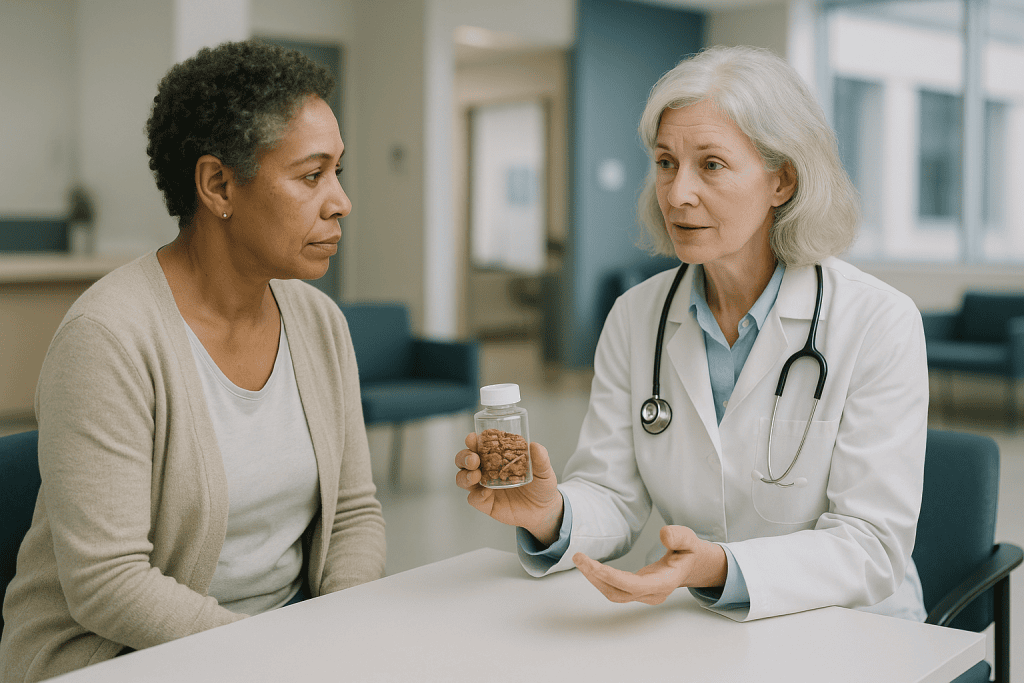
Tell your doctor and pharmacist about rhodiola at every visit, exactly as you would a prescription. Decisions about whether to try it, continue it, or combine it with any medicine belong to the clinician who prescribes for you, not to a label or a video.
Frequently asked questions
What does rhodiola do to your body?
In short trials, rhodiola modestly reduced self-reported fatigue and improved attention under stress over two to twelve weeks. Laboratory research suggests it influences the cortisol-regulating stress axis and enzymes that break down mood neurotransmitters, but these mechanisms are mostly shown in cells and animals. One small human study found a smaller morning cortisol spike after four weeks; others found no change.
What is the downside of rhodiola?
The main downsides are mild stimulant-type effects such as dizziness, dry mouth, headache, jitteriness and trouble sleeping, plus significant unknowns: there are no long-term safety studies, no data in pregnancy or children, case reports of mania in people with bipolar disorder, and theoretical interactions with antidepressants and other medicines. Product quality is also inconsistent because supplements are not pre-approved.
Which is better, ashwagandha or rhodiola?
Neither has strong evidence, and they have never been compared head-to-head in a controlled trial. Ashwagandha has mostly been studied for perceived stress, anxiety and sleep; rhodiola for fatigue and mental performance under pressure. Their safety concerns differ, with liver and thyroid signals for ashwagandha and stimulation, mania and drug interactions for rhodiola. The choice, if any, should fit your main symptom and medication list.
Who cannot take rhodiola?
Rhodiola is generally advised against during pregnancy and breastfeeding, in people with bipolar disorder, and in children, because safety data do not exist or case reports raise concern. People taking antidepressants, blood thinners, immunosuppressants, blood pressure or diabetes medicines, and those with autoimmune conditions should only consider it after discussing it with their prescribing clinician.
What are the proven rhodiola benefits?
Strictly speaking, none are proven. The most consistent finding, from several small randomized trials, is a modest short-term reduction in stress-related fatigue and burnout symptoms. Weaker evidence suggests better performance on attention tests during fatigue. Claims about depression, athletic performance, weight loss, immunity or longevity are either contradicted by trials or have no controlled human evidence behind them.
What are the most common rhodiola side effects?
Dizziness, dry mouth and excess saliva are the side effects most often listed by health authorities. Trial participants have also reported headache, restlessness, irritability and insomnia, consistent with mild stimulation. In controlled studies the rate of adverse events on rhodiola was similar to placebo and well below that of a prescription antidepressant, but the trials were short.
How long does rhodiola take to work?
The trials that reported benefits for fatigue and mood lasted four to twelve weeks, with some open-label stress studies noting changes within one to two weeks. Single-dose studies in exercise settings found at most tiny differences in perceived effort. A dramatic change within a day or two is more likely expectation than pharmacology, and long-term effects beyond three months have not been studied.
Can rhodiola be taken with antidepressants?
That decision belongs to the prescribing clinician, and the default is caution. Laboratory studies show rhodiola inhibits monoamine oxidase, raising a theoretical risk of excessive serotonergic effects when combined with SSRIs, SNRIs, tricyclics or MAO inhibitors. The risk has not been measured in trials, which is a reason to ask first rather than assume it is safe.
Does rhodiola help with anxiety?
The evidence is very weak. Only pilot and open-label studies have examined anxiety, and without placebo groups they cannot separate rhodiola’s effect from expectation. Because rhodiola is mildly stimulating, some people report feeling more jittery rather than calmer. Anxiety that interferes with daily life has effective, evidence-based treatments and deserves a clinical assessment.
Is rhodiola safe to take every day?
Daily use has only been studied for up to about twelve weeks, during which it was generally well tolerated in healthy adults. No research has examined use for a year or longer, so long-term safety is unknown. Many clinicians suggest periodic breaks and regular review, and anyone with a medical condition or on prescription medicines should check with their doctor before daily use.
This article is for general information only and is not a substitute for professional medical advice. Please consult a qualified doctor about your individual situation.

More from the Blog

CoQ10: Heart, Statins and Fertility: What the Trials Show
CoQ10 benefits are best supported in chronic heart failure, where one randomized trial and a low-certainty Cochrane review suggest fewer cardiovascular events when it…

Melatonin Side Effects: Next-Day Grogginess, Vivid Dreams and the Long-Term Questions
Melatonin side effects are usually mild and short-lived: next-day drowsiness, headache, dizziness, nausea and unusually vivid dreams are the most reported. Serious harm is…

Selenium: The Trace Mineral With a Narrow Sweet Spot
Selenium supports thyroid hormone production, immune defense, antioxidant protection, and fertility. Most adults need about 55 micrograms a day, an amount food alone easily…

Iodine Deficiency: The Quiet Return of an Old Problem
Iodine deficiency is re-emerging in some groups because most salt in processed foods is not iodized, gourmet salts like sea and Himalayan salt contain…

Glycine: The Tiny Amino Acid With Sleep Data
Glycine is the body's smallest amino acid and a building block of collagen, creatine, and glutathione. Small placebo-controlled trials suggest that taking glycine before…

Berberine: Nature’s Ozempic? What Trials Show and What They Do Not
Berberine is a plant compound that modestly lowered blood sugar, cholesterol, and body weight in small, short clinical trials, typically a few pounds over…