

Sebaceous Filaments vs Blackheads: The Difference and Why Squeezing Backfires

Key Takeaways
- Sebaceous filaments are the normal lining of open pores, while blackheads are plugged pores classified by Mayo Clinic and the NHS as mild acne.
- The dark color of a blackhead comes from oxidation and melanin inside the plug, not from dirt, which is why scrubbing never lightens it.
- Pattern is the best home clue: filaments appear as dozens of uniform gray dots, blackheads as scattered, darker, raised outliers.
- An extracted filament regrows to its previous length within about a month, so squeezing, strips and vacuums buy days of change at the cost of stretched pores and inflammation.
- Topical retinoids carry the strongest trial evidence for comedones; salicylic acid is moderate; oil cleansing, strips and pore vacuums are essentially unstudied.
- Visible improvement from a retinoid or salicylic acid routine typically takes two to three months, matching the skin's cell turnover cycle, and reverses over a similar period if stopped.
Sebaceous filaments are the normal, thread-like columns of oil and skin cells that line every pore, most visibly on the nose; blackheads are blocked pores whose contents darken on contact with air. Filaments are not a skin condition and refill within weeks of extraction, so squeezing mostly stretches the pore and invites inflammation. Gentle salicylic acid or retinoid routines can make both less noticeable.
Hold a phone camera an inch from your nose under bathroom lighting and the picture is unflattering: a field of tiny gray dots, each one looking like a job to be done. That image, filmed and magnified, is why sebaceous filaments are trending. As of May 2026, short-form videos tagged with ‘sebum plugs’ and ‘gritting’ have racked up hundreds of millions of views, most of them showing waxy threads being pressed, peeled or vacuumed out of pores to a soundtrack of satisfaction.
The comments underneath split into two camps. One camp calls the dots blackheads and recommends strips and tools. The other says they are ‘just’ sebaceous filaments and nothing can be done. Both are partly right and mostly wrong.
What follows is the version a dermatology textbook would give if it were written for a magazine: what those dots actually are, how they differ from blackheads, why the extraction videos are so misleading, and what the evidence says will make a visible difference.
What are sebaceous filaments, exactly?
Start with sebum, the oily, waxy substance produced by sebaceous glands to keep skin and hair supple and water-resistant. Each gland empties into a hair follicle, the narrow channel that opens at the surface as what we call a pore. Lining that channel, in every oil-rich area of the body, is a soft column made of sebum, shed skin cells and a few of the bacteria that normally live on skin. That column is a sebaceous filament.
Think of it as a wick. It helps carry oil from the gland up to the surface, where the oil spreads out as a protective film. Because the wick is doing a job, it sits in a pore that is open, not blocked, and it is continuously replenished from below.
Under a magnifying mirror a filament appears as a flat or very slightly raised dot, usually gray, tan or pale yellow, and the dots tend to be uniform in size and evenly spaced across the nose, chin and inner cheeks. Pressed hard enough, a pore gives up a fine thread of waxy material, which is the moment the viral videos capture. Within days the column begins to rebuild, and within a few weeks it is back to its previous length.
How prominent filaments look depends mainly on how active the sebaceous glands are. Gland activity is driven by androgens, the group of hormones that rise sharply in adolescence in all sexes, which is why filaments become noticeable in the teenage years and often soften with age. Oily skin types, larger pores and genetics all play a part. None of this is disease. A sebaceous filament is as normal a piece of skin anatomy as an eyelash.
What is a blackhead, and why is it dark?
A blackhead is a different object altogether, even when it lives next door. In medical language it is an open comedone: a pore in which the mix of sebum and keratin, the tough protein that makes up dead skin cells, has stopped flowing and formed a plug. The plug stretches the pore opening and sits exposed to the air.
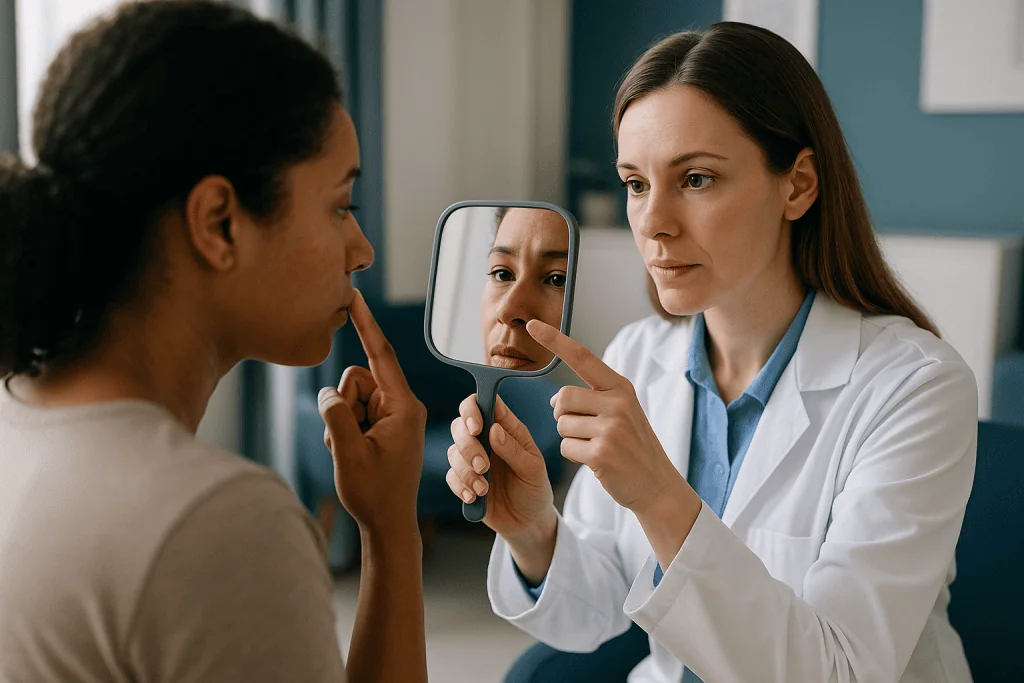
The color is not dirt. The outer surface of the plug darkens through oxidation, the same chemical reaction that browns a cut apple, and from melanin, the skin’s natural pigment, which collects in the shed cells. That is why scrubbing a blackhead harder does nothing to lighten it; the color sits inside the plug, not on top of it.
Mayo Clinic and the NHS both classify blackheads as a form of mild acne. Acne, in turn, is the condition in which follicles become clogged with oil and dead cells, sometimes with inflammation on top. A blackhead is therefore a lesion, something that has gone slightly wrong in one pore. When the same plug forms under a closed surface, it appears as a small flesh-colored bump and is called a whitehead or closed comedone.
Blackheads tend to be scattered rather than carpeting an area, noticeably darker than their neighbors, raised enough to feel under a fingertip, and variable in size. They can appear anywhere oil glands are dense: the nose and forehead, yes, but also the back, shoulders and chest. Left alone, a blackhead may persist for weeks or months, may resolve, or may become inflamed if the follicle wall gives way and the contents leak into surrounding tissue. That last outcome, a tender red spot, is what most people are trying to avoid when they reach for a strip or a tool.
Sebaceous filaments vs blackheads: how to tell them apart at home
In good daylight, without magnification, the distinction is easier than the videos suggest. The single most useful clue is pattern. Filaments come as a crowd; blackheads come as individuals. If your nose shows dozens of near-identical gray dots arranged like the holes of a salt shaker, you are looking at normal pore architecture. If a few darker, slightly domed spots stand out from that background, those are more likely to be comedones.
| Feature | Sebaceous filaments | Blackheads |
|---|---|---|
| What they are | Normal lining of an open pore | Plug blocking a pore (open comedone) |
| Color | Gray, tan or yellowish | Dark brown to black at the surface |
| Texture | Flat or barely raised; smooth to touch | Raised, firm; felt as a small bump |
| Pattern | Many, uniform, evenly spaced | Fewer, scattered, variable size |
| Favorite sites | Nose, chin, inner cheeks | Face, back, chest, shoulders |
| If pressed | Thin waxy thread, pore stays open | Dense plug with dark cap, often painful |
| After extraction | Refills within weeks | May not return in that pore for some time |
| Medical status | Not a condition | Mild acne |
The table hides one honest complication: the two can overlap. A pore with an unusually long filament can oxidize at its tip and look slightly dark, and an early blackhead can be small enough to blend into the crowd. When you cannot decide, the safest assumption is that the uniform dots are filaments and that only the outliers deserve attention. Treating a whole nose as if it were covered in blackheads is how most people end up with irritated, flaking skin and no visible gain.
Why are sebaceous filaments on the nose so visible?
The nose is the oiliest real estate on the face. Sebaceous glands cluster most densely across the T-zone, the strip running across the forehead and down the nose to the chin, and the glands on the nose are among the largest anywhere on the body. Big, busy glands need wide channels, so nasal pores are larger to begin with, and a larger pore shows its lining more plainly.

Lighting makes it worse. Overhead bathroom bulbs cast tiny shadows into each pore, and the gray column inside catches the light differently from the surrounding skin. Magnifying mirrors and phone macro modes, both now standard household objects, turn a texture nobody notices at conversational distance into a landscape.
Age shifts the picture too. In the teens and twenties, high sebum output makes filaments plump and prominent. Later, the collagen and elastin fibers that hold the pore walls taut gradually weaken, so pores can look wider even as oil production falls; sun exposure speeds that loosening. Skin that produces more oil, which is more common in men and in people with a family history of oily skin, shows filaments at every age.
None of this means the nose is unclean. Washing more often does not shrink the glands or the channels, and a pore cannot be emptied permanently any more than a tear duct can. The practical message is that sebaceous filaments on the nose are a feature of the territory, visible in proportion to how closely you look, and that the goal of any routine is to make them less noticeable rather than to make them disappear.
What changed recently
Nothing about the biology has changed. What has changed is the volume of footage. Over roughly the past two years, pore vacuums, handheld skin microscopes and adhesive extraction strips have moved from specialist catalogues to mainstream shopping feeds, and each device generates the kind of before-and-after clip that algorithms reward. The phrase ‘sebum plugs’, which barely existed in search a few years ago, now rivals ‘blackheads’ in some regions.
Mainstream medical publishers have responded by clarifying rather than revising. Cleveland Clinic’s current patient page on blackheads explains that the dark color comes from oxidation and that squeezing can push material deeper and cause scarring. Mayo Clinic’s acne overview continues to list blackheads as open plugged pores and advises against picking or squeezing. The NHS acne guidance repeats the same advice and adds that over-washing can make things worse. These positions have been stable across recent updates, which is itself the news: the medical consensus has not moved toward home extraction.
What the evidence base still lacks is also worth stating plainly. As of this writing there are no randomized controlled trials, the gold-standard design in which participants are randomly assigned to one approach or another, comparing extraction methods for sebaceous filaments. Nor is there trial evidence that oil cleansing, pore strips or vacuum devices change pore size or filament length beyond a few days. The viral claims are running ahead of the data, and the data that exist come from acne research, where the targets are comedones rather than filaments.
So the honest summary of what changed recently is this: the cameras got closer, the devices got cheaper, and the medical advice stayed exactly where it was.
Can I squeeze my sebaceous filaments? Why squeezing backfires
You can, in the sense that pressure will produce a thread of wax and a brief feeling of accomplishment. The question is what you get for it, and the answer is a short-lived change bought with real risks.
Consider the mechanics. A filament sits in a channel that is open and functioning. Squeezing compresses the surrounding skin and forces the contents upward, but it also forces some sideways and downward against the follicle wall. If that wall tears, sebum and bacteria leak into the dermis, the living layer beneath the surface, and the immune system treats the leak as an injury. The result is inflammation: a red, sometimes tender bump where there was previously a flat gray dot. In other words, squeezing can convert a non-problem into a pimple.
Repeated squeezing has a slower cost. Each episode stretches the pore opening, and the elastic fibers that normally pull it back lose some recoil with every cycle. Over months, pores that were simply visible can become permanently enlarged. Fingernails add bacteria and micro-cuts to the picture. In people with medium to deep skin tones especially, any inflammation can leave post-inflammatory hyperpigmentation, a flat dark mark that outlasts the original blemish by months.
Against all that, the benefit is measured in days. The column that was extracted begins rebuilding immediately, and most clinicians describe a return to baseline within about a month. You are, quite literally, pulling a wick out of a lamp that refills itself.
Blackheads are not an exception to the rule. Both Mayo Clinic and the NHS advise against squeezing comedones for the same reasons: deeper spread, inflammation and scarring. If a blackhead genuinely needs removing, the right hands are those of a dermatology professional with sterile tools and training in how much pressure a follicle can take.
Is it okay to pull out sebum plugs? Strips, tools and pore vacuums
Pulling achieves the same thing as squeezing by a different route, and the trade-offs are similar. A pore strip is an adhesive sheet that bonds to whatever protrudes from the pore opening and tears it away as the strip is peeled. It takes the top of each filament and the cap of some blackheads. What it leaves behind is the base of the filament, still attached to its gland and ready to regrow.
Strips also take the uppermost layer of skin cells with them, which is why the area looks pink and feels tight afterward. For skin that is already using a retinoid, the vitamin A-derived treatments discussed later, or that has rosacea, eczema or broken capillaries, that extra stripping can trigger a flare. The published support for strips consists mainly of small manufacturer-funded studies measuring short-term appearance; there is no independent trial evidence that they change pore size over time.
Pore vacuums apply suction rather than adhesion. The marketing shows plugs lifting cleanly out; the clinical concern is bruising and broken blood vessels, since the suction strong enough to move a plug is also strong enough to rupture fragile capillaries just under the surface. The nose and cheeks, where people most want to use them, are exactly where those vessels are closest to the skin.
Metal comedone extractors, the small looped tools, were designed for professionals who can judge whether a lesion is ready to come out, apply even pressure around it rather than on it, and stop when it resists. Used at home on filaments, the loop presses down a wide ring of skin to extract a thread that was never a problem.
If a specific blackhead bothers you, asking a dermatology clinic to extract it is a reasonable, low-risk choice. Treating a whole nose as a plug-pulling project is not.
Can you actually get rid of sebaceous filaments?
Permanently, no. This is the point at which most articles hedge, so it is worth being direct. A sebaceous filament is produced by a functioning gland emptying through a functioning channel. The only ways to stop production are to shut down the gland, which happens naturally and only partially with age, or to block the channel, which is the definition of a blackhead. Neither is a goal.
What you can change is how much they show. Three levers matter, and they map onto the biology. First, the amount of oil feeding the column: lower sebum output means thinner, shorter filaments. Second, the amount of keratin mixed in: when dead cells shed smoothly rather than clumping, the column stays soft and pale instead of dense and gray. Third, the condition of the pore wall: firm, hydrated, sun-protected skin keeps openings tighter and shadows smaller.
The treatments covered in the next section act on those levers, and their effect is real but gradual. People using a retinoid or salicylic acid consistently generally report smoother texture and less visible dots within two to three months, which is roughly how long it takes for the skin’s cell turnover cycle to run through a few times. Stop, and the filaments return to their baseline over a similar period, because the glands never stopped working.
A fair comparison is body hair. You can trim it, soften it or slow it, and you can decide it does not bother you, but it belongs to the system. The people who seem happiest with their skin in the long run are the ones who switched the goal from ‘gone’ to ‘less noticeable, less often inspected’.
How to get rid of sebaceous filaments: what helps day to day
The useful routine is short and dull, which is precisely why it works. Each element below has evidence behind it from acne and comedone research, and each targets one of the three levers described above. Use products according to their labels and, where a prescription is involved, according to the prescribing clinician.
- A gentle cleanser twice daily. Enough to remove surface oil and sunscreen; not so much that the skin feels tight. The NHS specifically warns that scrubbing or washing more often can irritate and worsen things.
- Salicylic acid. A beta hydroxy acid, meaning an exfoliating acid that dissolves in oil, so it can travel into the pore and loosen the keratin that stiffens a filament. Mayo Clinic lists it among the main nonprescription acne ingredients. Mild dryness is common at first.
- A topical retinoid. Retinoids are vitamin A derivatives that normalize how cells shed inside the follicle, keeping the channel from clogging. Adapalene is available without prescription in many countries; tretinoin and other retinoids are prescription-only. Expect several weeks of adjustment, with dryness and sometimes a temporary increase in visible spots, before improvement.
- Niacinamide. A form of vitamin B3; small trials suggest it can modestly reduce sebum and support the skin barrier. Evidence is thinner than for retinoids.
- A non-comedogenic moisturizer and daily sunscreen. Non-comedogenic means formulated to be less likely to block pores. Moisture keeps the retinoid tolerable; sun protection preserves the collagen that holds pores tight.
Clay masks once or twice a week can absorb surface oil and temporarily flatten the look of filaments. They do not empty pores, and daily use dries the skin enough to prompt more oil production in some people. Combining several exfoliating products at once is the most common mistake; irritated skin looks worse, not better, and often sheds in clumps that make pores more visible. One active, used patiently, beats three used aggressively.
How do Koreans deal with sebaceous filaments? Oil cleansing and 'gritting'
Much of the current interest traces to skincare routines popularized in South Korea and spread worldwide online. Two practices get the most attention: double cleansing, in which an oil-based cleanser is massaged in first and followed by a water-based one, and ‘gritting’, an extended oil massage after which tiny gray grains appear on the fingertips, presented as plugs loosened from the pores.
The mechanism is chemically plausible. Oil dissolves oil, so an oil cleanser can soften the sebum at the top of a filament more effectively than water alone, and a long massage can roll the softened tips out of the pore openings. The grits people see are a mixture of those tips, shed skin cells and the cleanser itself. What the videos do not show is the same pores two weeks later, when the columns have regrown.
What the evidence supports is modest. There are no clinical trials comparing oil cleansing with ordinary cleansing for pore appearance; the support is anecdotal and expert opinion. Double cleansing is reasonable for removing sunscreen and heavy makeup, and many people with oily skin tolerate it well. Gritting sessions that run for many minutes carry the same risk as any prolonged rubbing: friction, redness and, in acne-prone skin, new inflamed spots. Oil cleansers can also leave a film that itself feels pore-clogging if not fully removed.
The quieter parts of those routines deserve more credit than the dramatic ones. Daily sunscreen, consistent gentle hydration, and leave-on salicylic acid toners used sparingly are the elements with a plausible path to smaller-looking pores, and they are the elements that overlap with what dermatology guidance in any country recommends. The grains on the fingertips are theater; the sunscreen is the plot.
What the evidence actually says, graded
Readers deserve to know not just what is recommended but how solid the ground is. Here is the honest hierarchy, from strongest to weakest, as it applies to filaments and blackheads.
Strong (multiple randomized trials, consistent results): topical retinoids reduce comedones in acne; this is settled across decades of trials and is why adapalene and tretinoin sit at the center of acne guidelines. Benzoyl peroxide, an antibacterial and mildly exfoliating agent, reduces inflammatory acne and, to a lesser degree, comedones. These findings apply directly to blackheads. They apply to sebaceous filaments by extension, since the same ingredients soften keratin and improve flow, but the trials did not measure filaments as an outcome.
Moderate (smaller trials, some inconsistency): salicylic acid improves comedonal acne and skin texture. Niacinamide modestly reduces sebum and redness in small studies.
Low (observational data, manufacturer studies, mechanistic reasoning): pore strips remove visible material short term; oil cleansing and double cleansing improve the feel of oily skin; clay masks reduce surface shine for hours.
Expert opinion backed by physiology: squeezing and picking cause inflammation, enlarge pores and risk scarring. No one has run a trial in which volunteers are asked to squeeze one side of the nose for a year, and no one will, but the mechanism is well understood and the advice is uniform across Mayo Clinic, Cleveland Clinic and the NHS.
Essentially unstudied: pore vacuums, skin microscopes as a guide to home extraction, and any claim that filaments can be eliminated. On diet, the acne literature links high-glycemic eating and, in some studies, dairy with more acne; the data are observational and say nothing specific about filaments.
The pattern is clear. The dull, slow interventions carry the strong evidence; the fast, satisfying ones carry almost none.
Common myths about sebaceous filaments
The viral clips travel with a set of claims that sound like common sense and are not. Correcting them is the single most useful thing a routine can do, because most of the damage people do to their noses comes from believing one of these.
- ‘They are dirt.’ They are oil and skin cells produced from inside. No amount of washing reaches a gland, and over-washing dries the surface enough that some glands respond with more oil.
- ‘They are blackheads.’ Blackheads are blocked pores; filaments are open ones doing their job. Treating a carpet of filaments with blackhead-strength extraction is how a nose ends up red and still dotted.
- ‘Pores open and close.’ Pores have no muscle. Warm water and steam soften the contents and slightly swell the surrounding skin, which can make extraction easier for a professional, but nothing ‘opens’ and cold water does not ‘close’ anything.
- ‘One strip, gone for good.’ A strip takes the tips. The gland below keeps producing, and the columns are back within weeks.
- ‘Vacuums shrink pores.’ No published evidence supports this; the documented effect of strong suction on facial skin is bruising and broken capillaries.
- ‘Scrubbing harder helps.’ Physical scrubs work on the surface. Filaments sit in the channel. Hard scrubbing inflames the pore rim, which makes the opening look larger.
- ‘Toothpaste or baking soda dries them out.’ Both are alkaline and irritating; neither is formulated for skin, and both can leave burns or dark marks, particularly on deeper skin tones.
- ‘Only teenagers get them.’ Everyone with sebaceous glands has them for life. Visibility peaks in adolescence and with oily skin, but filaments are present at every age.
The thread connecting these myths is a mental picture of pores as little pipes clogged with grime. Replace that with the truer picture, a gland continuously feeding a wick, and most of the aggressive tactics stop making sense.
Blackhead care: how it differs from filament care
Because blackheads are genuine lesions, the goals and the toolkit shift slightly. The aim is to clear existing plugs, prevent new ones and avoid inflammation, and this is firmly within acne management, where the evidence is strongest.
Topical retinoids remain the backbone. By normalizing shedding inside the follicle they both loosen existing comedones and reduce how many form, which is why Mayo Clinic describes them as a first-line choice for comedonal acne. Benzoyl peroxide adds antibacterial action and is often paired with a retinoid when some spots are inflamed. Salicylic acid is a reasonable starting point for mild cases or for skin that finds retinoids too drying. Prescription options, including stronger retinoids and, for persistent or widespread acne, oral treatments, are decisions for a clinician based on severity, skin type and medical history.
Professional extraction has a legitimate role for blackheads that it lacks for filaments. A trained dermatology professional can remove a stubborn open comedone with a sterile extractor and minimal trauma, and that extraction can genuinely clear the pore for a period rather than for days. The same procedure done at home with fingernails or a tool bought online tends to leave the deep part of the plug behind while tearing the rim.
Patience is the hardest part. Comedonal acne responds over eight to twelve weeks, not overnight, and the early weeks on a retinoid can look worse as plugs loosen and surface. Stopping at week three because nothing has happened is the most common reason the treatment ‘didn’t work’. The second most common is piling on extra exfoliants to speed things up and triggering irritation that shuts the whole plan down. One active, applied consistently, with moisturizer and sunscreen alongside, is the regimen that the trials actually tested.
When to see a doctor
Sebaceous filaments never need medical treatment. Blackheads often do not either. But the same stretch of nose can host things that do, and a few patterns are worth a professional look rather than another strip.
Book an appointment with a primary care clinician or dermatology professional if you notice any of the following:
- Painful, deep or cystic lumps, or acne spreading to the chest and back, which usually needs prescription treatment to prevent scarring.
- Blackheads and spots that have not improved after roughly twelve weeks of a consistent over-the-counter routine, or that keep returning as soon as you stop.
- Any scarring, pitting or persistent dark marks developing where spots have been; early treatment protects skin far better than late treatment.
- Acne that begins or worsens abruptly in adulthood, especially alongside irregular periods, new hair growth on the face or body, or hair thinning on the scalp. These combinations can point to a hormonal condition that deserves evaluation.
- A single ‘blackhead’ that behaves unlike the others: growing, bleeding, crusting, failing to heal, or sitting in a bump with a pearly or translucent edge. Rarely, a dark spot in a pore is something other than a comedone, and a clinician can tell the difference in minutes.
- Signs of infection after squeezing or extraction: spreading redness, warmth, swelling, pus, or fever.
- Persistent flushing, visible blood vessels or sensitivity across the nose and cheeks, which may indicate rosacea rather than acne and calls for a different approach.
- Acne that started after beginning a new medicine or supplement; do not stop the medicine on your own, but do raise it with the prescriber.
Every decision about prescription retinoids, oral treatments, procedures or changes to any medicine you already take belongs with the clinician who knows your history. A consumer article can explain the landscape; it cannot see your skin.
Frequently asked questions
Can you actually get rid of sebaceous filaments?
Not permanently, because they are produced by working oil glands and refill within weeks of any extraction. What you can do is make them smaller and paler by reducing oil and keratin buildup with a retinoid or salicylic acid, protecting the skin from sun so pores stay tighter, and avoiding the squeezing that enlarges openings. Most people notice smoother texture within two to three months of a consistent routine.
What is the real difference between sebaceous filaments vs blackheads?
A sebaceous filament is the normal column of oil and skin cells lining an open pore; a blackhead is a pore blocked by a plug whose surface has darkened through oxidation. Filaments are many, uniform and grayish, and they are not a skin condition. Blackheads are fewer, darker and raised, and they count as mild acne. The two can sit side by side, but only the blackhead is something that has gone wrong.
Can I squeeze my sebaceous filaments?
You can, but it works against you. Pressure can rupture the follicle wall and turn a harmless gray dot into an inflamed red spot, and repeated squeezing stretches the pore opening over time. The extracted thread regrows within about a month, so the change lasts days. Mainstream guidance from Mayo Clinic, Cleveland Clinic and the NHS advises against squeezing both filaments and blackheads.
Is it okay to pull out sebum plugs with strips or tools?
Occasional use of a pore strip is unlikely to cause lasting harm in resilient skin, but it removes only the tips of filaments, strips a layer of surface cells, and can flare rosacea, eczema or retinoid-treated skin. Pore vacuums risk bruising and broken capillaries, and home extractor tools tend to tear the pore rim. For a genuinely stubborn blackhead, professional extraction is the safer route.
How do Koreans deal with sebaceous filaments?
Routines popularized in South Korea lean on double cleansing with an oil cleanser followed by a water-based one, salicylic acid toners, clay masks and daily sunscreen. Oil cleansing can soften and roll out filament tips, which is what ‘gritting’ videos show, but no trials demonstrate lasting change and the columns regrow. The evidence-backed parts of those routines are the gentle, consistent ones, not the dramatic massage sessions.
Why do sebaceous filaments on the nose look worse than elsewhere?
The nose has the largest and most densely packed sebaceous glands on the face, so its pores are wider and their linings more visible. Overhead lighting casts shadows into each pore, and magnifying mirrors and phone cameras exaggerate texture that is invisible at normal distance. Oil output peaks in adolescence and in naturally oily skin, and pores can appear larger with age as collagen support loosens.
What is the fastest way to get rid of sebaceous filaments before an event?
There is no safe fast way, but a clay mask the night before can absorb surface oil and temporarily flatten the look of pores, and a mattifying primer or sunscreen can blur them on the day. Avoid strips, vacuums and squeezing within a few days of the event; any redness or inflammation they cause will be far more visible than the filaments were.
Do sebaceous filaments turn into blackheads?
Not automatically. A filament lines an open, flowing pore, while a blackhead forms when flow stops and a plug builds. Conditions that favor plugging, such as heavy oil production, slow cell shedding and pore-clogging products, can tip an individual pore from one state to the other, but most filaments stay filaments indefinitely. Keeping shedding smooth with a retinoid or salicylic acid lowers the chance of that transition.
Does oil cleansing make sebaceous filaments worse?
For most people it neither worsens nor removes them. Oil dissolves oil, so an oil cleanser can soften filament tips and help remove sunscreen and makeup, and it is generally well tolerated. Problems arise when the oil is not fully rinsed, leaving a film that feels congesting, or when prolonged rubbing irritates the skin. Evidence either way is anecdotal; no trials have compared oil cleansing with ordinary cleansing for pore appearance.
Which skincare ingredient works best for sebaceous filaments?
Topical retinoids have the strongest evidence for keeping pores clear, drawn from decades of acne trials, with salicylic acid a well-supported second choice and niacinamide a gentler add-on with modest sebum-reducing data. Choose one active, pair it with a non-comedogenic moisturizer and daily sunscreen, and give it eight to twelve weeks. Prescription-strength retinoids are a decision for a clinician based on your skin and history.
References
This article is for general information only and is not a substitute for professional medical advice. Please consult a qualified doctor about your individual situation.

More from the Blog
Skincare Alongside Rosacea Treatment: Gentle Cleansers, Daily Sunscreen and Tracking Triggers
A rosacea skincare routine works alongside prescribed treatment, not instead of it. Guidance from the NHS and Mayo Clinic centers on three habits: washing…
How to Get Clear Skin: The Dermatology Basics
Clear skin comes from consistency, not quick fixes. Wash your face gently no more than twice a day, use a non-comedogenic moisturizer and broad-spectrum…

What to Bring to a Contact Dermatitis Appointment: Products, Exposures and a Rash Timeline
For a contact dermatitis appointment, bring the actual products that touch the affected skin (or clear photos of their ingredient labels), a dated timeline…

What Folliculitis Looks Like, and Does It Go Away on Its Own?
Folliculitis usually looks like clusters of small red, pink, or skin-colored bumps, each centered on a hair, sometimes with a white or yellow pus-filled…
Is It Dandruff, Dry Scalp or Scalp Psoriasis? How Dermatologists Tell Flaking Causes Apart
Dandruff, dry scalp and scalp psoriasis all cause flaking but differ in how the flakes look and where they appear. Dandruff produces oily, yellowish…
CO2 Laser and IPL: How Resurfacing and Light Treatments Differ and Who They Suit
A CO2 laser resurfaces skin by vaporizing thin layers and heating the tissue beneath, so it treats deeper wrinkles, acne scars and sun damage…