

Shortness of Breath or Rising Blood Pressure With Scleroderma: Why to Report It Promptly

Key Takeaways
- Lung involvement, through interstitial lung disease or pulmonary arterial hypertension, is now the leading cause of death in systemic sclerosis, which is why new breathlessness is never treated as background noise.
- Scleroderma renal crisis is driven by a self-reinforcing loop in which reduced kidney blood flow releases renin, raising blood pressure and further injuring the kidney, and it is interrupted by medicines that block that cascade.
- A blood pressure rise from your personal baseline matters more than whether a reading crosses a general-population category, because renal crisis can strike people whose pressure was previously normal or low.
- Renal crisis clusters in the early years of the diffuse cutaneous form and in people with anti-RNA polymerase III antibodies, so a fresh diagnosis is a reason for more vigilance, not less.
- Pulmonary function tests and echocardiograms are typically repeated yearly because both lung scarring and pulmonary hypertension can progress measurably before any symptom is felt.
- Readings above 180 systolic or 120 diastolic meet the American Heart Association definition of hypertensive crisis and, with headache, vision change, or breathlessness, call for emergency care rather than a clinic message.
With scleroderma, new or worsening shortness of breath and a blood pressure reading that climbs above your usual baseline are among the most urgent warning signs to report, because they can signal interstitial lung disease, pulmonary hypertension, or scleroderma renal crisis. These complications are treatable but time-sensitive, so same-day contact with your rheumatology team, or emergency care for severe symptoms, is generally advised.
The stairs to her apartment had not changed. Fourteen steps, the same chipped paint on the railing. What changed was that she now paused on the landing, one hand on the wall, waiting for her breath to catch up. She blamed the humidity, then a poor night’s sleep, then the groceries. Her fingers had been stiff and puffy for two years and a rheumatologist had used the word scleroderma, but nobody had told her that a flight of stairs might one day become the most useful diagnostic test she owned.
Scleroderma warning signs to report are not always dramatic. Some arrive as a number on a home blood pressure cuff that is twenty points higher than last month. Others arrive as a cough that will not settle, or ankles that look a little fuller by evening.
This explainer is about the two signals clinicians most want to hear about early, why they matter so much in this particular disease, and what usually happens after you pick up the phone.
Why shortness of breath and rising blood pressure lead the scleroderma warning signs to report
Scleroderma, also called systemic sclerosis, is an autoimmune disease in which the body lays down too much collagen, the protein that gives skin and connective tissue their structure, and in which small blood vessels become narrowed and fragile. The skin is where most people first notice it. The organs are where it does its most serious damage.
Two organs deserve particular vigilance. The lungs can develop scarring or high pressure in their blood vessels, and lung involvement is now the leading cause of death in systemic sclerosis, according to the Johns Hopkins and Cleveland Clinic patient resources. The kidneys can suffer an abrupt event called scleroderma renal crisis, in which blood pressure rises steeply and kidney function deteriorates over days.
What links these complications is that both announce themselves through symptoms that are easy to explain away. Breathlessness gets blamed on deconditioning, anemia, anxiety, or age. A higher blood pressure reading gets blamed on the salty dinner or the stress of the clinic waiting room. In a person without scleroderma, those explanations are often correct. In a person with scleroderma, they are the wrong default.
The opinion this article takes, grounded in what guideline groups and major medical centers consistently say, is simple: when you live with this disease, the threshold for reporting breathlessness or a blood pressure change should be lower than for almost anyone else you know. Not because panic helps, but because the window in which these problems respond best to treatment is measured in days for the kidneys and in months for the lungs. Early reporting is the single behavior most within a patient’s control.
What actually happens inside the body when scleroderma reaches the lungs and kidneys
Picture the disease as two overlapping processes. The first is fibrosis, the medical word for scar-like thickening of tissue. The second is vasculopathy, meaning damage to blood vessels, especially the tiny arteries that feed organs.
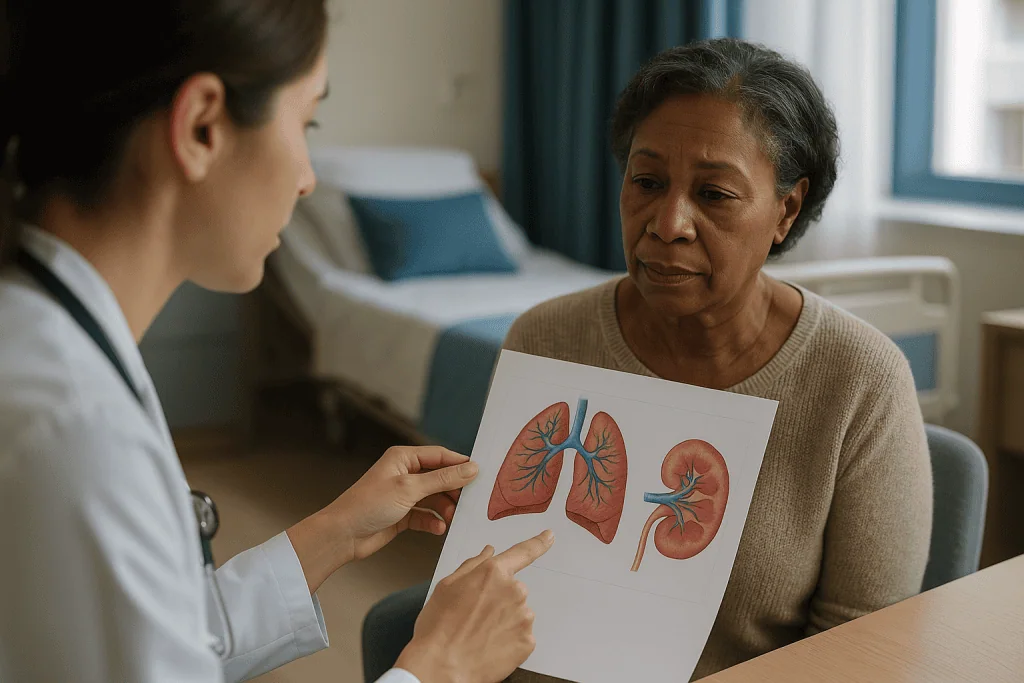
In the lungs, fibrosis settles into the interstitium, the delicate scaffolding between air sacs and capillaries where oxygen crosses into the blood. When that scaffolding thickens, oxygen has a harder journey, and the lungs themselves become stiffer, so each breath takes more effort. This is interstitial lung disease, often shortened to ILD. Vasculopathy, meanwhile, can narrow the pulmonary arteries, the vessels carrying blood from the heart to the lungs. Pushing blood through narrowed pipes raises the pressure inside them, a condition called pulmonary arterial hypertension, or PAH. The right side of the heart, which does that pushing, can gradually tire.
In the kidneys, the story is more sudden. Small renal arteries narrow and spasm, kidney tissue senses reduced blood flow, and the kidney responds the way it evolved to respond to blood loss: by releasing renin, a hormone that triggers a cascade raising blood pressure throughout the body. In scleroderma, that cascade can run out of control, driving pressure higher, which further injures the kidney’s vessels, which releases more renin. Mayo Clinic and the NHS both describe this loop as scleroderma renal crisis.
The elegance of understanding the mechanism is that it explains the treatment logic without any need for doses. Renal crisis is treated with medicines that interrupt the renin cascade, classically ACE inhibitors, which is why rapid recognition matters so much. PAH is treated with medicines that relax pulmonary vessels. ILD is treated with medicines that dampen immune-driven scarring. Each approach depends on knowing which process is at work, and that knowledge starts with a reported symptom.
What are the early signs of scleroderma, and what does it look like when it first starts?
Most people’s first encounter with scleroderma is not the skin at all. It is their fingers turning white, then blue, then red in the cold or under stress. This is Raynaud’s phenomenon, a spasm of the small arteries in the fingers and toes. The NHS notes that Raynaud’s is very common on its own and usually harmless, yet in the minority of cases where it is the opening act of scleroderma, it can precede other features by months or years.
The next stage often looks like swelling rather than hardening. Fingers feel sausage-like, rings stop fitting, and hands are stiff in the morning. Over time that puffiness gives way to tightness. Skin becomes shiny and hard to pinch, and the creases on the knuckles can smooth out. Mayo Clinic describes skin changes that may be confined to the fingers, hands, and face in the limited form, or spread to the forearms, upper arms, trunk, and thighs in the diffuse form.
Other early clues are quieter. Heartburn that appears without an obvious dietary cause reflects the esophagus losing some of its muscular squeeze. Small dilated vessels called telangiectasias appear as red dots on the face and hands. Joint aches, fatigue, and tiny painful sores at the fingertips round out the picture.
What is worth stating plainly, since it is the point of this article, is that early does not mean safe. Lung and kidney involvement can develop while the skin picture is still evolving, and renal crisis in particular clusters in the early years of the diffuse form, according to Johns Hopkins. Someone whose diagnosis is fresh has more reason, not less, to take breathlessness or a blood pressure change seriously.
What triggers scleroderma onset? The honest state of the evidence
Nobody knows what causes scleroderma, and any source that tells you otherwise is overreaching. What the evidence supports is a combination of genetic susceptibility and some environmental push that sets the immune system against the body’s own connective tissue.

The genetic component is real but modest. Having a relative with scleroderma or another autoimmune condition slightly raises risk, yet the disease rarely runs strongly in families. Mayo Clinic and MedlinePlus both describe it as more common in women than men and most often beginning between the ages of 30 and 50, patterns that hint at hormonal and immune influences without explaining them.
Environmental exposures have been studied for decades. Silica dust, encountered in mining, stone cutting, and some construction work, has the most consistent association. Certain industrial solvents have also been linked in occupational studies. These exposures account for a small fraction of cases, and most people diagnosed have no identifiable exposure at all.
Infections have been proposed as triggers, on the theory that an immune response to a virus might cross-react with the body’s tissues. This remains hypothesis rather than established fact. The same is true of stress, which people frequently identify in hindsight. Stress can worsen Raynaud’s attacks because it constricts blood vessels, but there is no good evidence that it causes the disease itself.
Why does this matter for a piece about warning signs? Because understanding that onset is largely unpredictable helps dismantle a corrosive idea many patients carry: that they did something to bring this on, or that a flare is a personal failure. Reporting a symptom promptly is not an admission of having done something wrong. It is the disease behaving as the disease does, and you responding well.
How do you rule out scleroderma, and how is organ involvement confirmed?
Ruling scleroderma in or out is a process of pattern recognition supported by blood tests and a few specialized examinations, not a single definitive result.
The physical examination carries surprising weight. A rheumatologist assesses how much skin is thickened and where, looks for puffy fingers, fingertip ulcers, and telangiectasias, and examines the nail beds. Nailfold capillaroscopy, which uses a magnifier to view the tiny vessels at the base of the fingernail, can reveal enlarged and dropout capillaries that distinguish scleroderma-related Raynaud’s from the common benign kind. The NHS and Cleveland Clinic both describe this as part of a standard workup.
Blood tests look for autoantibodies, proteins the immune system makes against the body’s own components. Antinuclear antibody is positive in most people with scleroderma but is also positive in many other conditions and some healthy people, so it screens rather than confirms. More specific antibodies, including anti-centromere, anti-topoisomerase I, and anti-RNA polymerase III, help define the subtype and, importantly, the risk profile. Anti-RNA polymerase III, for example, is associated with a higher likelihood of renal crisis, according to Johns Hopkins, which is one reason the result changes how closely blood pressure is watched.
Once scleroderma is established, organ assessment follows a fairly standard path. Pulmonary function tests measure how much air the lungs move and how well gas crosses into the blood. A high-resolution CT scan of the chest can show early interstitial changes before symptoms appear. An echocardiogram, an ultrasound of the heart, estimates pressures in the pulmonary arteries; if it raises suspicion of PAH, a right heart catheterization, in which a thin tube measures pressure directly, is the confirmatory test. Kidney function is tracked through blood creatinine and urine protein.
A negative antibody panel does not fully exclude the disease, and a positive one does not confirm it. The diagnosis rests with the treating rheumatologist weighing the whole picture.
Two different reasons for breathlessness: scleroderma symptoms in the lungs explained
Breathlessness in scleroderma has two principal lung causes, and they feel similar from the inside while being quite different in mechanism, testing, and treatment. Knowing the distinction helps you describe symptoms in ways that speed up evaluation.
Interstitial lung disease tends to build slowly. The earliest symptom is often a dry cough or a sense that exertion costs more than it used to. People describe cutting a walk short, avoiding hills, or noticing they cannot sing through a phrase. The Cleveland Clinic patient guide notes that ILD may be present on imaging before any symptom is felt, which is why routine lung function testing is recommended regardless of how you feel.
Pulmonary arterial hypertension can also creep in but has its own signature. Because the right heart is straining against high pressure, symptoms include breathlessness on exertion, lightheadedness or fainting during effort, chest discomfort, and swelling of the ankles and abdomen as fluid backs up. Mayo Clinic lists these among the features that distinguish PAH from lung scarring. PAH is more common in the limited cutaneous form and often develops later in the disease course, whereas ILD is more frequent in the diffuse form, according to Johns Hopkins.
Other causes deserve mention because your team will consider them. Anemia from chronic disease or from gastrointestinal bleeding can cause breathlessness. Reflux-related aspiration can irritate the lungs. Heart muscle involvement, though less common, can reduce pumping strength. Deconditioning is real too, but it should be the explanation of last resort, arrived at after the others are excluded.
When you report breathlessness, specifics help: what activity triggers it, how it compares with three months ago, whether there is cough, swelling, or dizziness, and whether lying flat makes it worse. Those details let your team choose the right test first.
Scleroderma renal crisis symptoms: why a blood pressure reading can be an emergency
Scleroderma renal crisis is uncommon, and it is also the complication for which hours genuinely matter. Before medicines that block the renin cascade became standard, it was frequently fatal within weeks. Today, according to Johns Hopkins and Cleveland Clinic, prompt recognition and treatment have transformed its course, though kidney damage can still be permanent when treatment is delayed. That transformation depends entirely on someone noticing early.
The defining feature is a sudden rise in blood pressure above the person’s usual level, often accompanied by evidence that the kidneys are struggling: rising creatinine on blood tests, protein or blood in the urine, and falling urine output. Because the pressure rise can be steep, it may cause symptoms of its own. Headache, particularly a new or unusually severe one, blurred or disturbed vision, confusion, nausea, and breathlessness from fluid accumulation are all described in the Mayo Clinic and NHS resources. Seizures can occur in severe cases.
A few points deserve emphasis. First, renal crisis can occur in someone whose blood pressure has always been normal or even low, so the change from baseline matters more than whether a reading crosses a textbook threshold. Second, it clusters in the first few years after diffuse skin thickening begins, in people with rapidly progressing skin disease, and in those with anti-RNA polymerase III antibodies. Third, exposure to higher-dose corticosteroids has been associated with increased risk in observational studies, which is why rheumatologists weigh that class of medicine carefully in this population; that decision belongs to the prescribing clinician, not to the patient acting alone.
Treatment centers on ACE inhibitors, which work by blocking the enzyme that converts angiotensin into its active, vessel-constricting form, thereby breaking the loop between kidney ischemia and rising pressure. Temporary dialysis is sometimes needed while the kidneys recover. None of that can begin until the reading is reported.
Who is usually watched most closely, and who is usually asked to wait and observe
Not everyone with scleroderma carries the same risk of lung or kidney complications, and clinicians tailor how intensely they monitor to the individual profile. Understanding where you sit helps make sense of the advice you receive.
People generally monitored most closely for renal crisis include those with the diffuse cutaneous form, especially within the first few years of skin involvement; those whose skin is thickening quickly; those with anti-RNA polymerase III antibodies; and those with new anemia or a recent need for higher-dose corticosteroids. For this group, many rheumatology teams recommend regular home blood pressure checks and a low threshold for same-day contact if readings rise.
People generally monitored most closely for ILD include those with diffuse disease, anti-topoisomerase I antibodies, or early reductions on pulmonary function testing. Those watched closely for PAH include people with long-standing limited disease, anti-centromere antibodies, many telangiectasias, or a falling diffusing capacity on lung tests even when lung volumes look preserved.
Who is usually asked to wait and observe? A person with stable limited disease, normal antibody-based risk markers, unremarkable annual echocardiogram and lung function results, and mild breathlessness clearly linked to a chest infection or a period of inactivity may reasonably be advised to recheck in a few weeks rather than pursue urgent imaging. That is a legitimate clinical judgment, not neglect.
The crucial caveat is that risk stratification lowers the odds of a complication; it does not eliminate them. Renal crisis has been documented in people with limited disease and PAH in people with diffuse disease. So the advice to report breathlessness or a blood pressure rise applies across the board. What changes with risk category is how quickly the team acts and which tests come first, and those choices rest with them.
Blood pressure numbers at a glance: what counts as rising when you have scleroderma
Home blood pressure monitoring is one of the few pieces of self-care in scleroderma that can directly change an outcome, and it costs almost nothing in time. The American Heart Association’s categories, shown below, are the general population framework. For someone with scleroderma, the more useful question is how far a reading has moved from your personal baseline, because a jump from 105 to 140 can be more alarming than a stable 135.
| Category (AHA) | Systolic (upper number) | Diastolic (lower number) | Relevance in scleroderma |
|---|---|---|---|
| Normal | Less than 120 | Less than 80 | Baseline for many; know your usual range |
| Elevated | 120 to 129 | Less than 80 | Worth noting if new for you |
| Hypertension stage 1 | 130 to 139 | 80 to 89 | Report if a clear change from baseline |
| Hypertension stage 2 | 140 or higher | 90 or higher | Report promptly, same day, if new |
| Hypertensive crisis | Higher than 180 | Higher than 120 | Emergency care, especially with headache, vision change, or breathlessness |
A few practical points follow from AHA guidance. Measure seated, after five minutes of rest, with your arm supported at heart level and the cuff on bare skin. Take two readings a minute apart and record both. Avoid caffeine, exercise, and smoking for thirty minutes beforehand.
Ask your team what reporting threshold they want you to use. Many scleroderma clinics ask patients at elevated renal-crisis risk to call about any sustained reading above a specific personal cutoff, or about a rise of a certain magnitude over baseline, and that threshold is individual. A single odd reading is worth rechecking after resting; a pattern over a day or two, or any reading accompanied by symptoms, is worth a call. Writing the numbers down, with date and time, makes the conversation with your team faster and more precise.
What the following days and weeks usually look like after you report a symptom
People often hesitate to call because they imagine a cascade of alarming tests and hospital stays. The reality is usually more measured, and knowing the typical path makes the call easier to make.
For a blood pressure rise reported to a rheumatology team, the first step is typically same-day or next-day blood and urine tests to check kidney function and look for protein or blood. If those are normal and the pressure settles, the plan may simply be closer home monitoring for a period. If creatinine has risen or the pressure keeps climbing, evaluation moves quickly, often within hours, because the Johns Hopkins and Cleveland Clinic resources emphasize that renal crisis outcomes depend on how early treatment begins. Hospital admission for monitoring while medicines are adjusted is common in that scenario; the duration varies with how the kidneys respond and is decided by the treating team.
For new or worsening breathlessness, the initial steps are usually a clinical assessment, an oxygen saturation check, blood tests including a blood count, and a chest X-ray or pulmonary function tests. A high-resolution CT scan and an echocardiogram often follow within days to weeks depending on urgency. If the echocardiogram suggests PAH, a right heart catheterization is scheduled to confirm it, since echocardiography estimates rather than measures pressure directly.
What happens after diagnosis is beyond the scope of this piece, but the general shape is worth knowing. ILD treatment aims to slow progression, and lung function is rechecked at intervals of months to judge response. PAH treatment is adjusted over weeks to months based on symptoms, exercise capacity, and repeat testing. Neither promises restoration of lost function, which is precisely the argument for catching change early. The realistic hope is stabilization, and stabilization is far easier to achieve from a higher starting point.
Routine monitoring: the tests that catch trouble before you feel it
Symptom reporting is one half of early detection. The other half is scheduled surveillance, because both ILD and PAH can progress for a considerable time before they cause breathlessness, and by the time a person feels short of breath, measurable function may already be reduced.
Most scleroderma specialists follow a pattern broadly consistent across the Cleveland Clinic, Johns Hopkins, and NHS resources. Pulmonary function tests are usually performed at diagnosis and then at regular intervals, often yearly, with the diffusing capacity for carbon monoxide watched especially closely since it can fall early in both ILD and PAH. An echocardiogram is typically repeated yearly to screen for rising pulmonary pressures, even in people who feel well. A baseline high-resolution CT scan is common, with repeats guided by symptoms and lung function trends rather than on a fixed calendar.
Kidney surveillance is simpler. Blood creatinine and urinalysis are checked at routine visits, and home blood pressure monitoring fills the gaps between them. For people in the highest-risk window for renal crisis, some teams suggest checking pressure several times a week; for others, less often. The frequency is a clinical decision.
Why does this matter for a piece about reporting symptoms? Because surveillance and symptom reporting reinforce each other. A stable echocardiogram six months ago makes a new episode of exertional dizziness more, not less, worth reporting, since it suggests something has changed. Conversely, a borderline lung function result makes your team more receptive when you mention a new cough.
Keeping your own record helps. Note the dates of your last lung function test and echocardiogram, your usual blood pressure range, and your antibody profile if you know it. Patients who arrive at a visit with that information tend to get faster, more targeted answers, because the conversation can start from data rather than from reconstruction.
What people often get wrong about scleroderma warning signs to report
Myths cluster around this disease, and several of them directly delay reporting. Correcting them is part of good care.
The first myth is that scleroderma is a skin disease. The name, from Greek roots meaning hard skin, encourages this. In truth the skin is the visible edge of a systemic process, and the organs that determine long-term health are the lungs, heart, and kidneys. People who think of their condition as dermatological are slower to connect breathlessness to it.
The second is that high blood pressure always causes symptoms. It usually does not, which the American Heart Association has spent decades emphasizing. In scleroderma this cuts both ways: renal crisis may announce itself only through a cuff reading, while the headache and vision changes that sometimes accompany it can be mistaken for migraine or eye strain.
The third is that breathlessness is expected with a chronic illness and not worth mentioning. Fatigue is common in scleroderma, and some reduction in stamina is real, but breathlessness that is new, progressive, or out of proportion to effort is a signal, not background noise.
The fourth is that a normal test last year settles the question. Both ILD and PAH can develop between annual checks, and renal crisis develops over days.
The fifth is that calling the clinic for a number on a cuff is overreacting. Scleroderma teams want these calls. The one patient who phones about a sustained rise and turns out to have early renal crisis justifies every reassuring call that came before.
The sixth is that a mild course so far predicts a mild course ahead. It is reassuring evidence, and risk markers do help, but the disease is heterogeneous. Vigilance is not pessimism. It is respect for a condition that has earned it.
Questions to ask your care team about breathlessness and blood pressure
Good questions turn a rushed appointment into a plan. These are the ones experienced patients and clinicians tend to consider most useful, grouped by theme. Bring the answers home in writing.
On your personal risk profile: Which form of scleroderma do I have, limited or diffuse? Which autoantibodies were found, and what do they suggest about my risk of lung or kidney involvement? Am I currently in a higher-risk window for renal crisis?
On blood pressure: What is my usual baseline, and at what reading, or what rise from baseline, do you want me to call? How often should I check at home, and should I check more often during any period when my medicines are changing? Should I be checking more often if I develop a headache or feel unwell?
On breathing: What are my most recent lung function and echocardiogram results, and what would count as a meaningful change? What symptoms would make you want to see me sooner than the next scheduled test? Is there anything in my current treatment that could affect my lungs or blood pressure that I should be aware of?
On logistics, which matter more than people admit: Who do I call during clinic hours, and who after hours or at weekends? If I go to an emergency department, what should I tell them about scleroderma renal crisis so it is considered promptly? Is there a written summary of my condition and medicines I can carry?
On the future: How often will my lung and heart tests be repeated? What would prompt a referral to a pulmonologist, cardiologist, or nephrologist? What is the plan if a test result changes but I feel fine?
None of these questions second-guess your team. They are the questions that let your team do its job with your full participation.
When to call your doctor
Some symptoms in scleroderma warrant same-day contact with your rheumatology team; a smaller set warrants emergency care without waiting for a callback. The distinction matters, so here it is in plain terms.
Call your team the same day, or the next working day at the latest, if you notice:
- A blood pressure reading clearly above your usual baseline on repeat measurement, even without symptoms.
- New or worsening breathlessness on exertion, a persistent dry cough, or needing to stop for breath during activities you managed comfortably a few months ago.
- New swelling of the ankles, legs, or abdomen.
- Lightheadedness during effort, or a racing or irregular heartbeat.
- A noticeable fall in how much urine you pass, or urine that looks dark or frothy.
- A new or unusually severe headache, especially alongside a higher blood pressure reading.
Seek emergency care immediately, and tell the staff you have scleroderma and that renal crisis or pulmonary hypertension should be considered, if you experience:
- A blood pressure reading higher than 180 systolic or 120 diastolic, particularly with headache, blurred or lost vision, confusion, or breathlessness, which the American Heart Association classifies as a hypertensive crisis.
- Severe breathlessness at rest, or breathlessness with chest pain, fainting, or blue-tinged lips.
- A seizure, sudden confusion, or difficulty speaking.
- Coughing up blood.
If you are unsure which category you fall into, call. Scleroderma teams would far rather hear about a symptom that turns out to be nothing than learn about one after the fact. Every decision about testing and treatment rests with the clinicians caring for you; your part is to make sure they have the information as early as you do.
Frequently asked questions
What are the early signs of scleroderma before it affects the lungs or kidneys?
The earliest sign for most people is Raynaud’s phenomenon, in which fingers turn white, blue, then red in cold or stress. Puffy, stiff fingers often follow, then skin that becomes tight and shiny on the hands and face. Unexplained heartburn, small red spots called telangiectasias, joint aches, fatigue, and fingertip sores are other early clues described by the NHS and Mayo Clinic. Organ involvement can develop alongside these features rather than only after them.
What triggers scleroderma onset?
The cause is unknown. Evidence points to a combination of genetic susceptibility and environmental factors that prompt the immune system to overproduce collagen and damage small blood vessels. Silica dust and certain solvents have the strongest occupational associations, but most people have no identifiable exposure. It is more common in women and most often begins between ages 30 and 50, according to Mayo Clinic and MedlinePlus. Stress and infections have been proposed as triggers without solid proof.
How do you rule out scleroderma?
A rheumatologist combines physical examination, nailfold capillaroscopy to inspect tiny vessels at the nail base, and blood tests for autoantibodies such as antinuclear antibody, anti-centromere, anti-topoisomerase I, and anti-RNA polymerase III. No single test settles it. Negative antibodies make the diagnosis less likely but do not exclude it, and a positive antinuclear antibody alone does not confirm it. The diagnosis rests on the whole pattern as judged by the treating clinician.
What are the main scleroderma renal crisis symptoms to watch for?
The defining feature is a sudden rise in blood pressure above your usual level, often with signs the kidneys are struggling, such as reduced urine output. Because the pressure rise can be steep, it may cause a new or severe headache, blurred or disturbed vision, confusion, nausea, and breathlessness from fluid retention. Seizures can occur in severe cases. Some people have no symptoms beyond the cuff reading, which is why home monitoring matters.
Why does shortness of breath matter so much in scleroderma?
Because it can be the first felt symptom of interstitial lung disease or pulmonary arterial hypertension, the complications now responsible for most scleroderma-related deaths according to Johns Hopkins and Cleveland Clinic. Both can progress before symptoms appear, so by the time breathlessness is noticed, measurable function may already be reduced. Treatments aim to slow progression rather than restore lost function, which makes early reporting the most effective lever a patient holds.
How high does blood pressure need to be before I call?
Ask your team for a personal threshold, since the change from your baseline matters more than a fixed number. As a general framework, the American Heart Association defines stage 2 hypertension as 140 or higher systolic or 90 or higher diastolic, and hypertensive crisis as above 180 or above 120. In scleroderma, a sustained rise of any size from your usual reading warrants a same-day call, and crisis-level readings with symptoms warrant emergency care.
Can scleroderma renal crisis happen if my blood pressure has always been low?
Yes. Renal crisis is defined by an abrupt rise relative to the individual’s baseline, not by crossing a population cutoff, so someone whose usual reading is low can develop it while still registering numbers that look unremarkable on a chart. This is precisely why teams ask higher-risk patients to know their normal range and report change rather than waiting for a reading that looks high in absolute terms.
What is the difference between interstitial lung disease and pulmonary hypertension in scleroderma?
Interstitial lung disease is scarring of the tissue between air sacs and capillaries, making lungs stiff and oxygen transfer harder; it usually causes a dry cough and slowly worsening exertional breathlessness. Pulmonary arterial hypertension is high pressure in the arteries from heart to lungs, straining the right heart; it tends to cause breathlessness with exertional lightheadedness, chest discomfort, and ankle swelling. They are diagnosed with different tests and treated with different medicine classes.
How often are lung and heart tests repeated in scleroderma?
Most specialist teams repeat pulmonary function tests and an echocardiogram roughly yearly, even in people who feel well, because both interstitial lung disease and pulmonary hypertension can progress silently between visits. High-resolution CT scans are repeated when symptoms or lung function results change rather than on a fixed schedule. The exact frequency depends on your disease subtype, antibody profile, and previous results, and is set by your treating team.
Does a mild course so far mean I can worry less about breathlessness or blood pressure?
It is reassuring evidence, and stable limited disease with normal tests does lower the odds of serious complications. It does not remove them. Pulmonary hypertension often appears late in long-standing limited disease, and renal crisis, though concentrated in early diffuse disease, has been documented in other groups. The advice to report new breathlessness or a blood pressure rise applies to everyone with scleroderma; what varies is how quickly the team investigates.
References
This article is for general information only and is not a substitute for professional medical advice. Please consult a qualified doctor about your individual situation.

More from the Blog

Vasculitis Treatment Timeline: From First Weeks of Improvement to Months of Follow-Up
A vasculitis treatment timeline usually has two phases. Induction treatment, often with glucocorticoids, commonly eases symptoms within days to a few weeks. Maintenance treatment…

What Does a Rheumatoid Arthritis Treatment Plan Include? Questions for Your Rheumatologist
A rheumatoid arthritis treatment plan usually combines disease-modifying medicines that calm the immune attack on joints, short-term relief for pain and swelling, regular blood…

How Rheumatologists Confirm Fibromyalgia When Blood Tests and Scans Look Normal
A rheumatologist confirms fibromyalgia by pattern, not by a single test. They take a detailed pain and symptom history, examine joints and muscles, order…

Why Weight Control and Regular Movement Are Central to Osteoarthritis Treatment
Weight control and regular movement are central to osteoarthritis treatment because they act on the two things that drive knee pain: mechanical load and…

Caring for a Child With Rheumatic Fever: Rest, Medicines on Schedule and Cardiology Visits
Caring for a child with rheumatic fever usually means three things working together: rest while the heart and joints are inflamed, antibiotic and anti-inflammatory…

Anti-Inflammatories vs Biologics for Ankylosing Spondylitis: How the Choice Is Made
For ankylosing spondylitis, non-steroidal anti-inflammatory drugs (NSAIDs) are usually tried first because they ease pain and stiffness quickly and are taken as tablets. Biologics,…