

Sliding Genioplasty vs Chin Implant: Which Option Fits a Receding or Long Chin?

Key Takeaways
- A sliding genioplasty moves the chin bone forward, back, up, or down through an incision inside the mouth, while a chin implant only adds forward projection over the bone.
- A long chin can be shortened only by removing bone in a genioplasty; no implant can make a chin shorter.
- The mental nerve, which supplies feeling to the lower lip and chin, sits near both operative fields, so temporary numbness is possible with either procedure and more common after bone surgery.
- Corrective jaw and chin surgery is usually deferred until jaw growth has stopped, which the Mayo Clinic places at roughly 14 to 16 in females and 17 to 21 in males.
- Imaging studies have reported gradual thinning of bone beneath solid chin implants over years, one reason some surgeons favor bone surgery in younger adults.
- If the teeth do not meet correctly, a receding chin may reflect a receding jaw, and orthognathic surgery rather than chin surgery alone becomes the first conversation.
Sliding genioplasty moves the patient's own chin bone forward, back, up, or down and fixes it with small plates, so it can treat both a receding and a long chin. A chin implant adds shaped material over the bone and mainly increases projection, so it suits a modestly receding chin but cannot shorten one. The right choice depends on the direction and size of the change, jaw alignment, and the surgeon's assessment.
She had never thought much about her chin until a colleague sent a photo from a side table at a wedding. In profile, her lower lip seemed to tuck back, and the line from lip to neck looked shorter than she remembered. The face she saw in the mirror every morning had never shown her that angle.
Searching that night, she found two names repeated on almost every page: sliding genioplasty vs chin implant. One page called implants the simple option. Another said moving the bone was the only real fix. Nobody explained why two surgeons might look at the same face and reach different answers.
The honest explanation is that these two operations are not competing versions of the same thing. They change the chin in different ways, and a receding chin and a long chin are different anatomical problems. Understanding that difference is most of the decision.
Sliding genioplasty vs chin implant: what actually happens in each operation
A genioplasty is any surgery that reshapes the chin. A sliding genioplasty is the version in which the surgeon cuts through the front of the lower jawbone, below the tooth roots, and slides the freed segment into a new position. The cut is called an osteotomy, a planned surgical cut through bone. The moved piece is held with a small titanium plate and screws, and the incision sits inside the mouth, along the lower lip, so nothing shows on the skin.
Because the segment is free, it can travel in more than one direction. Sliding it forward adds projection for a receding chin. Removing a thin wedge of bone before fixing it shortens a chin that is too tall. Small rotations can nudge a chin toward the midline. The bone heals to the jaw much as a fracture heals.
A chin implant works on the surface rather than inside the bone. The surgeon creates a snug pocket over the front of the jaw, either through an incision under the chin or inside the mouth, and slips in a preshaped piece of medical-grade solid silicone or a porous polymer. The implant is sized to add a set amount of forward projection and is sometimes fixed with a screw or stitch.
Both procedures are often done under general anesthesia, though implants are sometimes placed under local anesthesia with sedation. Genioplasty usually takes longer in the operating room because bone must be cut, moved, and plated. The visible result of either can be similar from the front for a straightforward receding chin, which is why the comparison is so common. The differences show up in what each can correct, how the body responds over years, and how recovery feels.
Is genioplasty the same as a chin implant?
No, and the confusion is understandable because both fall under the umbrella of chin augmentation. Surgeons sometimes separate them as osseous genioplasty, meaning bone-based, and alloplastic augmentation, meaning augmentation with an implanted synthetic material. A chin implant is one technique for making the chin more prominent; a sliding genioplasty is a way of reshaping the chin skeleton itself.
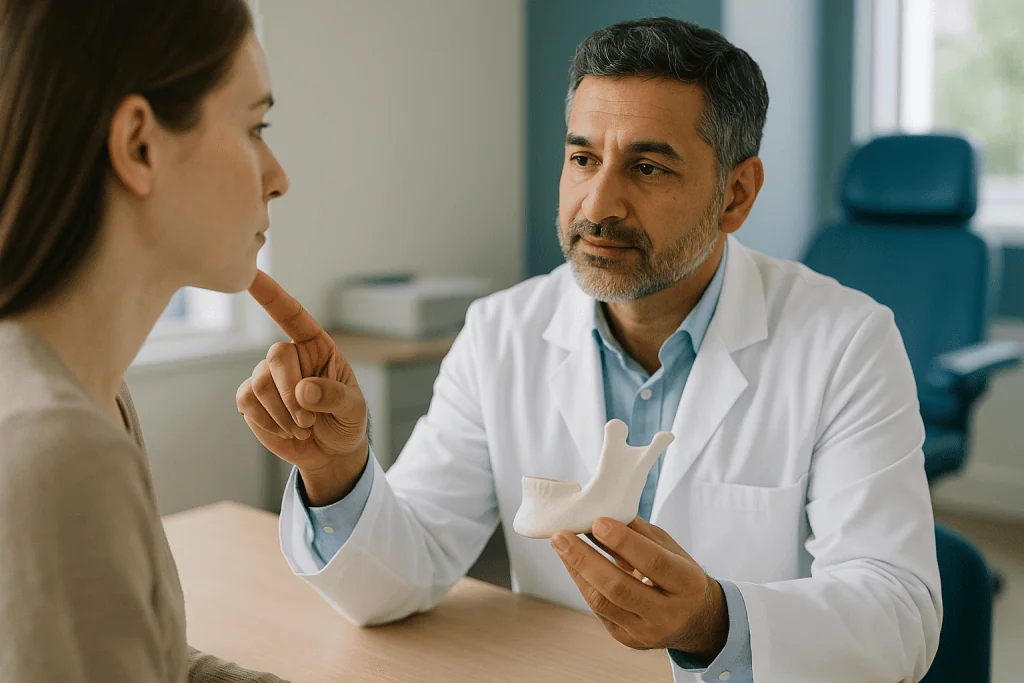
The difference matters most in three situations. First, direction. An implant can only add. It cannot shorten a tall chin, lift a chin that hangs low, or set back a chin that projects too far. A sliding genioplasty can do all of those.
Second, the soft tissue. The chin is covered by the mentalis muscle, the paired muscle that lets you push your lower lip up. In a genioplasty the muscle and soft tissue move forward with the bone, which is why surgeons describe the result as bringing the whole chin unit forward. An implant pushes the soft tissue outward from beneath, which can look excellent for modest gains but tends to flatten and broaden the chin when large implants are used to chase big changes.
Third, what lives in the body afterward. A genioplasty leaves a small plate and screws that become buried in healed bone and are usually never noticed. An implant remains a foreign object for life, surrounded by a thin capsule of scar tissue. That has advantages, since it can be removed or swapped, and disadvantages, since it can shift or become infected years later.
Both are legitimate operations with long track records, according to general guidance on cosmetic procedures from the NHS. The question is never which is real surgery; both are. The question is which mechanism matches the problem.
Why a receding chin and a long chin are different problems
The words people use online, weak chin, recessed chin, long chin, describe what they see. Surgeons translate them into measurements along two axes.
A receding chin, sometimes called retrogenia or microgenia, sits too far back relative to the lips and nose. It is a horizontal shortfall. Imagine a vertical line dropped from the lower lip; in many balanced profiles the chin sits close to that line. When the chin falls well behind it, the lower lip can appear to pout and the neck angle can look soft.
A long chin is a vertical excess. The distance from the lower lip to the bottom of the chin is greater than the rest of the face suggests, so the lower third looks stretched. Some people have both problems at once: a chin that is tall and set back. Others have a chin that projects enough but is too short, giving a compressed lower face.
This is where the choice starts to answer itself. An implant treats one axis, the horizontal one, and only in the forward direction. A sliding genioplasty treats both axes and can combine movements in a single operation, forward and shorter, forward and taller, or back and shorter. For a purely receding chin of modest degree with a normal bite and normal vertical height, either option can work. For a long chin, a short chin, or a chin that needs more than a modest advance, the bone operation is the one with the tools to do the job.
The Mayo Clinic notes that chin surgery is frequently planned alongside or after assessment of the whole jaw, because a chin that looks receded is sometimes the visible edge of a lower jaw that sits back as a whole. That distinction is covered later, but it is worth holding onto now: the chin is rarely judged alone.
Who is usually a candidate, and who is usually asked to wait
Surgeons consider a person a reasonable candidate for either procedure when the chin is out of proportion with the rest of the face, the teeth fit together normally or the bite is already being managed, general health is good, and expectations are specific and realistic. Someone who can say what bothers them in profile and understands that the nose, lips, and neck will still be the same nose, lips, and neck tends to do well.

Several groups are commonly asked to wait or to take a different route first.
- Adolescents whose jaw is still growing. Moving or covering bone before growth finishes risks an outcome that shifts as the face keeps changing. The Mayo Clinic describes waiting for growth to stop before corrective jaw surgery.
- People whose chin appearance comes from a misaligned bite. If the upper and lower teeth do not meet correctly, a condition called malocclusion, chin surgery alone can hide the cause without treating it, and an orthodontic and jaw surgery assessment usually comes first.
- Anyone with an active infection in the mouth, untreated gum disease, or dental work that is unfinished, because an intraoral incision heals next to that environment.
- People who smoke, since nicotine reduces blood flow to healing tissue and raises infection and wound-healing risk in surgery generally.
- Those with bleeding disorders or on medicines that affect clotting, who need a plan agreed with the prescribing clinician before any elective surgery.
The NHS also advises that cosmetic surgery is not a good option for people whose distress about their appearance is out of proportion to what others can see, or who hope surgery will fix a relationship, a job, or a mood. A surgeon who asks about these things is not gatekeeping; that assessment is part of good care. The decision about candidacy rests with the treating team after examination and imaging.
What is the best age for genioplasty?
There is no single ideal birthday, but there is a clear principle: the lower jaw should have finished growing. The Mayo Clinic, describing corrective jaw surgery in general, gives the typical window for completed growth as roughly ages 14 to 16 for females and 17 to 21 for males. Individual timing varies, and surgeons often use hand or jaw X-rays, or serial measurements over several months, to confirm that growth has plateaued before operating.
Why so strict? A sliding genioplasty repositions bone that is then expected to stay put as the reference point for the rest of the face. If the jaw continues to lengthen afterward, the carefully chosen chin position drifts. An implant placed on a growing jaw can end up sitting in the wrong spot for the adult face, and implants have been associated with pressure changes in the underlying bone over time, which is a poor combination with a skeleton still remodeling.
At the other end of life, age itself is rarely the barrier. What changes is the soft tissue. Older skin has less elastic recoil, so a sizable forward move of bone or implant may leave slightly more laxity along the jawline rather than the tight, redraped contour a younger patient sees. Some surgeons discuss combining chin surgery with neck procedures in this group; that is a conversation about goals, not a requirement.
Medical fitness matters more than the number. Well-controlled blood pressure, stable diabetes, and the absence of active gum disease carry more weight in a preoperative assessment than whether someone is 28 or 58.
People who ask this question are often parents of teenagers or adults in their twenties who have felt self-conscious for years. For the teenager, the honest answer is usually that waiting protects the result. For the adult, the window is open, and the more useful question becomes which procedure fits the chin in front of the surgeon.
Sliding genioplasty vs chin implant at a glance
Tables flatten nuance, and every row below has exceptions that a surgeon will explain for an individual face. Used carefully, though, a side-by-side view makes the pattern obvious: one operation is versatile and permanent, the other is simpler and adjustable.
| Feature | Sliding genioplasty | Chin implant |
|---|---|---|
| What is changed | The chin bone itself is cut and repositioned | Synthetic material is placed over the bone |
| Directions of correction | Forward, backward, shorter, taller, midline rotation | Forward projection only |
| Suits a receding chin | Yes, including larger advances | Yes, for modest advances |
| Suits a long chin | Yes, by removing a bone wedge | No |
| Incision | Inside the mouth | Inside the mouth or under the chin |
| Anesthesia | Usually general | General, or local with sedation |
| Permanent foreign material | Small plate and screws buried in bone | Implant remains for life unless removed |
| Reversibility | Difficult; bone has healed in new position | Implant can be removed or exchanged |
| Main nerve concern | Mental nerve stretch; lower lip and chin numbness, usually temporary | Mental nerve irritation; less common but possible |
| Bone response over years | Bone heals; some settling of the segment edge | Bone beneath the implant can slowly thin |
| Typical early recovery | Longer; more swelling, soft diet while bone heals | Shorter; swelling and tightness for days to weeks |
The mental nerve, named for the Latin word for chin rather than the mind, exits the jawbone just below the roots of the lower premolars and supplies feeling to the lower lip and chin. It sits close to both operative fields, which is why numbness appears in both columns. Timelines in the last row are described in more detail in the recovery section, with the source that supports them.
Is sliding genioplasty better than implants? What the evidence actually shows
The truthful answer is that neither is better in the abstract, and the research base does not allow a stronger claim. There are no large randomized trials comparing the two; people are not assigned a chin operation by coin toss. What exists are surgical series, single-institution follow-up studies, and narrative reviews. These consistently describe the same trade-offs rather than a winner.
On versatility, genioplasty is clearly ahead. It is the only option that treats vertical excess, vertical deficiency, asymmetry, and large horizontal deficits. Published reviews of chin surgery routinely reserve implants for mild to moderate forward deficiency with normal chin height.
On invasiveness and recovery, implants are ahead. The procedure is shorter, avoids cutting bone, and lets people return to normal eating sooner. It is also the only reversible option, which matters to someone uncertain about how much change they want.
On long-term behavior, the picture is mixed and worth stating plainly. Case series and reviews have reported gradual thinning of the bone under solid chin implants, sometimes visible on X-rays years later. In most reports this is modest and without symptoms, but it is one reason some surgeons prefer bone surgery in younger patients who will carry the result for decades. Genioplasty avoids that problem yet introduces its own: the moved segment can show slight resorption at its edges, hardware can occasionally become palpable, and reversal is impractical.
Nerve numbness has been reported with both, more often after genioplasty because the bone cut passes near the nerve. In most series it resolves over months; in a minority it lingers. Any surgeon who says one option has no nerve risk is oversimplifying.
So the better operation is the one whose limitations fit the person. For a long chin, the debate is over before it starts. For a modestly receding chin in a healthy adult with a normal bite, both are reasonable, and the choice comes down to attitudes toward permanence, recovery time, and foreign material.
What are the downsides of a genioplasty procedure?
Cutting and moving bone is a bigger undertaking than placing an implant, and the disadvantages follow from that.
The first is recovery. Swelling of the chin and lower lip is expected and can be considerable in the first week. Because the incision is inside the mouth and the bone is knitting, a soft diet and careful oral hygiene are usually advised for several weeks, following the surgeon’s specific instructions. The Mayo Clinic describes initial healing after jaw surgery in the range of six weeks, with complete bone healing taking up to about twelve weeks; genioplasty is a smaller operation than full jaw surgery, but the biology of bone healing is the same.
The second is nerve sensation. The mental nerve is stretched during the operation and can be bruised. Numbness or tingling of the lower lip and chin is common early on and usually fades over weeks to months. A small proportion of people report longer-lasting altered sensation. Feeling in the lower lip affects everyday things like knowing whether there is food on your chin, so this deserves an honest discussion beforehand.
The third is permanence. Once the bone heals in its new position, undoing the change means another osteotomy. If the advance turns out to be more than a person wanted, there is no simple removal.
Other downsides are less common but real: infection at the incision or around the plate, bleeding, a plate or screw that can be felt through the skin and occasionally needs removal, chin asymmetry if the segment sets slightly off midline, a visible step at the lower border of the jaw in thin patients, and lower lip droop if the mentalis muscle is not repaired carefully. Tooth roots near the cut can very rarely be injured.
None of these is a reason to avoid genioplasty. They are the things to weigh, in a conversation with the surgeon, against its unique ability to reshape the chin in three dimensions.
Chin implant risks: what can go wrong with an implant
An implant avoids the bone cut, but it introduces a permanent foreign object into a space that opens to the mouth or to skin under the chin. Its risks cluster around that fact.
Infection is the most discussed. It can appear in the first weeks or, less often, years later, and an infected implant frequently has to be removed and the area allowed to settle before any replacement is considered. Surgeons weigh this when choosing between an incision inside the mouth, which leaves no visible scar, and one under the chin, which some believe carries a lower contamination risk. Guidance from the CDC on surgical site infections stresses that any implanted device raises the stakes of a wound infection, which is why antibiotic use and sterile technique are handled carefully around implants.
Displacement and malposition come next. If the pocket is slightly too large, or if swelling and healing pull unevenly, the implant can drift sideways or rotate, producing an asymmetric or off-center chin. Some surgeons secure the implant with a screw to reduce this.
Bone changes beneath the implant have been reported in imaging studies over long follow-up. The mechanism is thought to be steady pressure from the implant against the bone surface, more marked when the implant sits high on the front of the jaw near the tooth roots. In most reports the effect is small and painless, but it is one reason placement low on the bony chin is favored.
Other possibilities include capsular tightening that makes the implant feel firm, extrusion where the implant works toward the incision, palpable edges in thin-skinned patients, and the same mental nerve irritation described for genioplasty, though less often.
The counterweight is reversibility. If any of these occur, or if a person simply dislikes the look, the implant can be removed, often in a shorter procedure than the original. That safety valve is the strongest argument for implants and should be part of any balanced conversation about chin implant risks.
Genioplasty recovery time and the first days and weeks after a chin implant
Recovery is where the two operations feel most different, even when the final profile is similar.
After a sliding genioplasty, the first three to five days are dominated by swelling and a stretched, heavy sensation in the lower lip. Ice, head elevation, and a prescribed pain plan from the surgical team manage most of this. Speaking and smiling feel stiff. Because the incision is inside the mouth, rinsing after meals and keeping to soft foods protect the wound. Many people describe the second week as the point when swelling starts to recede noticeably, though the chin can remain puffy and firm for longer. The Mayo Clinic’s guidance on jaw surgery describes initial healing taking about six weeks and full bone healing extending to around twelve weeks; during that window, surgeons often limit contact sports and hard foods. Numbness, if present, follows its own slower curve, typically improving over weeks to months.
After a chin implant, the early days involve swelling and tightness too, but without a healing bone cut the diet restrictions are usually lighter and the return to routine activity quicker. If the incision is under the chin, the small skin wound needs to be kept clean and dry as the surgeon instructs; MedlinePlus offers general surgical wound care steps that apply to any external incision. A supportive chin dressing or tape is sometimes used for the first week to hold the implant pocket steady.
For both procedures, the final contour takes time to show. Residual swelling can make the chin look larger than intended for several weeks, which worries people who have not been warned. Photographs at three months are far more representative than photographs at three weeks.
These are typical ranges drawn from general guidance, not promises. Individual healing varies with age, health, smoking status, and the extent of the change, and the surgical team’s follow-up schedule is the authority on when it is safe to eat normally, exercise, or travel.
Chin implant vs jaw surgery: when the bite is the real issue
Online forums are full of a third option, jaw surgery, and it belongs in this conversation because a receding chin is sometimes the tip of a receding jaw.
Orthognathic surgery, the formal name for corrective jaw surgery, moves the upper jaw, lower jaw, or both to align the teeth and jaws. When the entire lower jaw sits back, the chin looks small, the lower teeth sit behind the upper teeth more than they should, and the lips may not close easily at rest. Advancing the whole lower jaw brings the chin forward as a consequence and fixes the bite at the same time. The Mayo Clinic describes this surgery as typically planned with an orthodontist, with braces or aligners before and after.
A chin implant or an isolated genioplasty in that situation improves the profile but leaves the bite alone. That can be an acceptable trade for someone whose teeth meet well enough and who does not want a year of orthodontics. It is a poor trade for someone with chewing difficulty, jaw joint symptoms, or a bite that is wearing the teeth unevenly, because the functional problem persists under a cosmetically better chin.
Surgeons who see the whole face often screen for this with a simple question: do the teeth fit together normally? If the answer is yes, the discussion stays with genioplasty and implants. If the answer is no, a dental and orthodontic assessment usually comes before any decision about the chin. Genioplasty is frequently added to jaw surgery as a finishing step, because moving the jaw as a unit sometimes leaves the chin itself still slightly short or tall.
The takeaway for a reader weighing sliding genioplasty vs chin implant is that both assume the jaw is in the right place. If it is not, neither is the first conversation to have.
What people often get wrong about chin surgery
Some of the most common beliefs about these procedures are half true, and the half that is wrong shapes decisions.
Implants are fake and genioplasty is natural. Both produce a chin that is not the one a person was born with. The bone operation uses your own tissue, which appeals to many people, but a well-placed implant is not detectable by anyone looking at a face. Natural is a description of how a result looks, not of what is under the skin.
Implants always slip or get infected. These complications are real and were discussed above, but they are the exception rather than the rule in published series. Most implants stay where they were placed. The point is that they can fail in ways bone cannot, not that they usually do.
Chin surgery fixes a double chin. It does not remove fat or tighten skin. A more projected chin can improve the angle between chin and neck, which sometimes makes fullness under the jaw less noticeable, but a heavy neck remains a heavy neck. People with that concern are usually assessed for neck procedures separately.
A bigger chin always balances a large nose. Chin projection does change how the nose reads in profile, and surgeons do consider the two together. But treating the chin to compensate for the nose can produce a strong lower face that looks heavy from the front. Balance is judged in three dimensions, not one photograph.
Reversible means risk-free. An implant can be removed, which is valuable. Removal is still a second operation, and the skin and muscle that stretched over the implant do not always return to exactly where they started.
Bone surgery leaves visible scars. A sliding genioplasty is done entirely through the mouth. The most visible reminder for most people is temporary swelling, not a scar.
Correcting these beliefs does not point toward one option. It points toward a better conversation.
Questions to ask your care team before choosing
A good consultation answers most of these unprompted. Bringing the list anyway keeps the conversation anchored on the things that change outcomes rather than on photographs of other people’s chins.
- Is my chin receding, too long, too short, or a combination, and how many millimeters of change in each direction are you planning?
- Do my teeth fit together normally, and would you want an orthodontic or jaw surgery opinion before operating on the chin alone?
- Has my jaw finished growing, and how do you know?
- Why do you recommend genioplasty or an implant for my anatomy specifically, and what would make you choose the other?
- Which incision will you use, and why?
- What happens to the mental nerve during the operation, how often do your patients have lasting numbness, and how do you manage it?
- If you are recommending an implant, what material and shape, how will it be secured, and what is your approach if it becomes infected or shifts?
- If you are recommending genioplasty, what fixation will you use, and how often does hardware need to be removed later?
- What will the first two weeks look like for eating, talking, work, and exercise, and when is the next follow-up?
- What does a result you would consider imperfect look like, and how would it be revised?
- How will the change affect the way my nose, lips, and neck read in profile?
- Who do I call, at any hour, if something worries me after the operation?
The NHS advises checking that a surgeon is appropriately registered and trained for the specific procedure, and that the facility is set up to handle complications, before agreeing to any cosmetic operation. Those questions are not awkward; a competent team expects them. The final recommendation belongs to the surgeon who has examined you and reviewed your imaging, and it is reasonable to seek a second opinion if two options are on the table and the reasoning for one over the other is not clear.
When to call your doctor after chin surgery
Swelling, bruising, tightness, and some numbness of the lower lip and chin are expected in the first days after either operation, and the surgical team will have given a plan for pain and wound care. Certain signs fall outside that expected picture and should prompt a call to the surgeon or the after-hours number provided, or a visit to emergency care if severe.
- Fever, or a wound that becomes increasingly red, warm, or tender after the first couple of days rather than settling.
- Pus, foul-smelling discharge, or an opening of the incision inside the mouth or under the chin.
- Pain that is escalating rather than easing, or that is not controlled by the plan you were given.
- Swelling that grows quickly on one side, or a firm, expanding lump, which can signal bleeding under the skin.
- Any difficulty breathing or swallowing, or swelling that involves the floor of the mouth or tongue. Treat this as an emergency.
- Bleeding from the mouth or wound that does not stop with gentle pressure.
- A chin that suddenly looks lopsided, or an implant that you can feel has moved.
- Numbness that worsens after initially improving, or new weakness of the lower lip.
- Calf pain, leg swelling, chest pain, or sudden shortness of breath after any operation under general anesthesia, which can indicate a blood clot and needs urgent assessment.
The CDC lists redness, delayed healing, fever, pain, tenderness, warmth, and drainage as the hallmarks of a surgical site infection, and notes that infections involving implanted material are treated more aggressively because the device can harbor bacteria. Early contact with the team gives the widest range of options, including antibiotics or a simple drainage procedure before anything more is needed.
Nobody should feel they are bothering the surgeon. Chin operations are elective, and the teams that perform them build follow-up around the expectation that questions will come up. When in doubt, call.
Frequently asked questions
Is sliding genioplasty better than implants?
Neither is better in every case; the evidence shows different trade-offs rather than a winner. Genioplasty is more versatile, correcting chins that are too long, too short, asymmetric, or markedly receding, and it uses your own bone. Implants involve a shorter operation, lighter recovery, and can be removed if you change your mind. For a modestly receding chin with a normal bite, both are reasonable, and your surgeon’s assessment decides.
Is genioplasty the same as a chin implant?
No. Both make the chin more prominent, but a genioplasty cuts and repositions the chin bone itself, whereas a chin implant places a shaped piece of synthetic material over the bone. Genioplasty can move the chin in several directions; an implant only adds forward projection. Surgeons sometimes call them osseous, meaning bone-based, and alloplastic, meaning implant-based, chin augmentation to make the distinction clear.
What are the downsides of a genioplasty procedure?
The main downsides are a longer recovery than an implant, more early swelling, a soft diet while the bone heals, and the possibility of lower lip and chin numbness that is usually temporary but occasionally lasting. The result is essentially permanent, so reversing it requires another bone operation. Less common issues include infection, hardware that can be felt through the skin, minor asymmetry, and lower lip droop if the muscle is not repaired carefully.
What is the best age for genioplasty?
The main requirement is that the jaw has finished growing, which the Mayo Clinic places at about 14 to 16 in females and 17 to 21 in males, with individual variation confirmed by X-rays or serial measurements. There is no upper age limit as such; general health and the elasticity of the skin matter more than the number. Teenagers are generally asked to wait so the result does not shift as the face develops.
How long is genioplasty recovery time?
Most swelling is worst in the first several days and improves noticeably over two to three weeks, though the chin can stay puffy for longer. Because bone has been cut, the Mayo Clinic’s guidance on jaw surgery describes initial healing around six weeks and full bone healing up to about twelve weeks, with hard foods and contact sports usually restricted during that window. Numbness, if present, may take weeks to months to settle.
What are the main chin implant risks?
The chief risks are infection, which can occur early or years later and often means removing the implant; shifting or rotation that leaves the chin off-center; palpable edges in thin-skinned people; and gradual thinning of the bone beneath the implant reported in long-term imaging studies. Nerve irritation causing lower lip numbness is possible but less common than after bone surgery. The offsetting advantage is that an implant can be removed or exchanged.
Can a chin implant fix a long chin?
No. An implant adds material to the front of the chin and can only increase forward projection; it cannot reduce the vertical height of the chin. A long chin is shortened by a sliding genioplasty in which a thin wedge of bone is removed before the segment is fixed in its new position. If your concern is that the lower third of your face looks stretched, the bone operation is the relevant discussion.
Does a sliding genioplasty leave a visible scar?
Usually not, because the incision is made inside the mouth along the inner lower lip, so there is no cut on the skin. The plate and screws that hold the moved bone are buried under healed bone and soft tissue and are rarely noticed. Chin implants can be placed through the mouth as well, or through a small incision under the chin, which leaves a short scar in a natural crease.
Will chin surgery help a double chin or a weak jawline?
Only indirectly. Neither procedure removes fat or tightens skin. Bringing the chin forward can sharpen the angle between chin and neck, which sometimes makes fullness under the jaw less obvious in profile, but a heavy neck remains. People bothered mainly by neck fullness or loose skin are usually assessed for neck-focused procedures, and a surgeon may discuss combining approaches depending on goals and anatomy.
When should I choose jaw surgery instead of chin surgery?
When the teeth do not meet correctly. If the whole lower jaw sits back, the chin looks small and the bite is off; advancing the jaw with orthognathic surgery corrects both, usually alongside orthodontic treatment. Chin surgery alone would improve the profile but leave the functional problem. Surgeons often screen for this by asking whether the teeth fit together normally before recommending an isolated genioplasty or implant.
References
- NHS – Cosmetic procedures
- MedlinePlus – Plastic and Cosmetic Surgery
- MedlinePlus – Surgical wound care – open
- CDC – About Surgical Site Infections
This article is for general information only and is not a substitute for professional medical advice. Please consult a qualified doctor about your individual situation.

More from the Blog

Liquid Facelift or Surgical Facelift: Which One Addresses Jowls and Loose Skin?
A surgical facelift repositions the deeper tissue layer and removes excess skin, so it is the option designed to address true jowls and loose…

What Happens at a Liquid Rhinoplasty Appointment? Numbing, Injection Points and First Swelling
A liquid rhinoplasty procedure is a nonsurgical treatment in which small amounts of dermal filler, usually hyaluronic acid, are injected along the bridge or…

How to Compare Two Facial Aesthetic Surgery Plans: Technique, Scars and Recovery Weighed
To compare two facial aesthetic surgery plans, line them up on the same four points: what each technique changes beneath the skin, where every…

What Does Lip Lift Recovery Look Like Day by Day? Swelling, Sutures and Smiling Again
Lip lift recovery usually unfolds in stages: swelling and tightness are most noticeable in the first few days, sutures beneath the nose are typically…

Buccal Fat Removal Myths: Instant Cheekbones, Gaunt Faces and What the Evidence Says
Buccal fat removal is a surgery that takes out part of a deep fat pad in the cheek to make the lower face look…

Buccal Fat Removal Risks: Asymmetry, Nerve Injury and Salivary Duct Problems Explained
Buccal fat removal risks include facial asymmetry, injury to the buccal branches of the facial nerve (causing temporary or occasionally lasting weakness of the…