

Strength Training for Women: Why Lifting Heavy Does Not Make You Bulky, and What It Does for Bone
Key Takeaways
- Women circulate roughly 10 to 20 times less testosterone than men, which is the main reason heavy lifting makes women stronger and firmer rather than visibly bulky.
- In the LIFTMOR trial, postmenopausal women who lifted heavy twice a week for eight months gained about 2.9 percent lumbar spine density while the control group lost about 1.2 percent.
- Adults who do not train lose roughly 3 to 8 percent of muscle mass per decade after age 30, and progressive resistance training is the only intervention shown to reverse that loss.
- Bone responds to unfamiliar strain, so walking maintains bone, swimming and cycling do little for it, and heavy loads or impact are what stimulate gains.
- Loads of about 80 to 85 percent of one-repetition maximum, roughly five hard repetitions, were used in bone trials, but beginners should spend their first month on lighter loads learning technique.
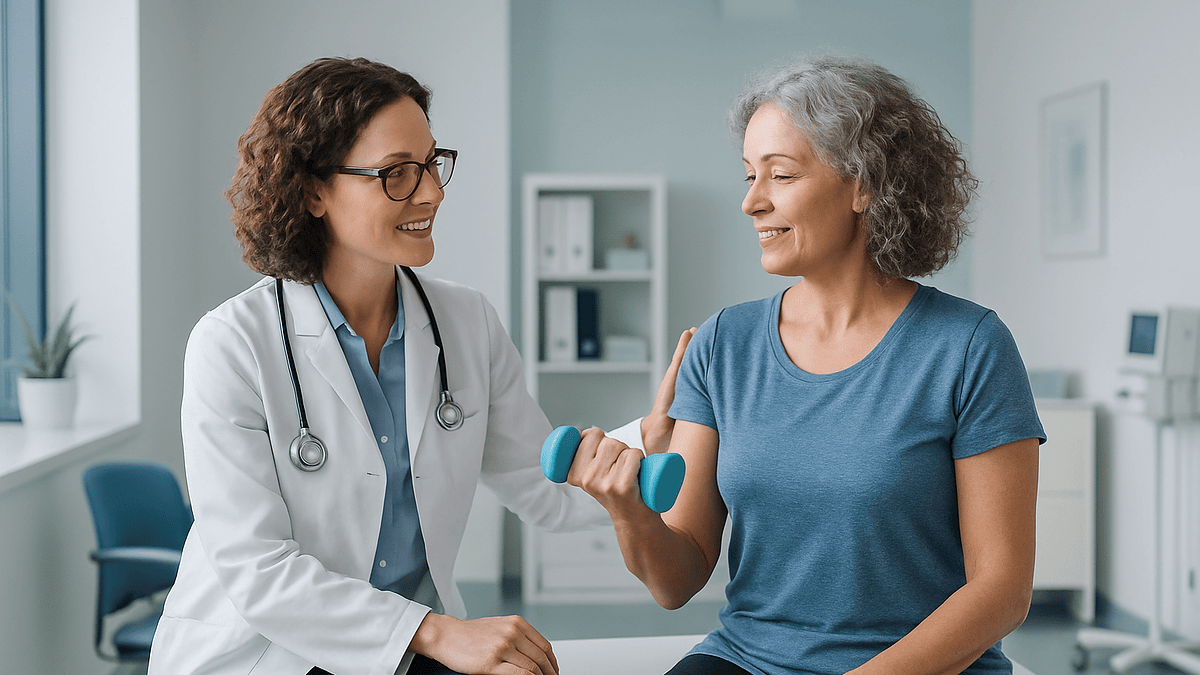
- Women with osteoporosis can lift under supervision but should avoid loaded forward bending of the spine, and sudden severe back pain after lifting warrants a prompt medical visit.
Strength training for women does not cause bulky muscle because women produce far less testosterone than men, and visible size requires years of deliberate high-volume training plus a calorie surplus. What lifting heavy reliably does is build strength, preserve muscle after age 30 and stimulate bone, with randomized trials showing modest gains in bone mineral density in postmenopausal women. Anyone with osteoporosis or health conditions should check with a clinician first.
The clip that keeps surfacing shows a woman in her sixties pulling a loaded barbell off the floor, then grinning at the camera while a caption promises she “reversed” her bone loss. As of March 2026, variations of that video, and the inevitable replies warning that she will “get bulky,” have pushed strength training for women into the top tier of fitness searches, alongside a wave of menopause conversations that finally treat muscle and bone as health issues rather than vanity ones.
Both halves of the argument deserve a closer look. The bulk fear is older than the barbell, and it has never matched the physiology. The bone promise, meanwhile, is real but easy to overstate: a well-run trial in Australia showed spine density nudging upward in women who lifted heavy twice a week, not skeletons rebuilt from scratch.
So here is what the evidence supports, what it does not, and how a woman who has never touched a dumbbell can start without hurting herself.
Why strength training for women is trending right now
Three currents met at once. The first is the menopause conversation, which moved out of whispered clinic rooms and onto podcasts and social feeds. Once women started hearing that the five to seven years after their final period can strip away up to 20 percent of bone density, the obvious next question was what to do about it. Lifting, it turns out, is one of the few answers with trial data behind it.
The second current is generational. Gym floors that were once segregated by unspoken rule, with cardio machines for women and racks for men, now look different. Women in their twenties grew up with powerlifting and CrossFit content, and women in their fifties are following them onto the platform. Search engines register that shift as a surge of beginner questions: how heavy, how often, will it hurt.
The third is the pushback. For every viral deadlift there is a reply insisting that heavy weights will make a woman look like a bodybuilder, wreck her joints or raise her risk of injury. Those replies are confident and mostly wrong, which is why a sober, evidence-first explainer is worth reading.
One definition before we go further. Strength training, also called resistance training, means working muscles against an external load: a barbell, dumbbell, machine, resistance band or your own body weight. “Lifting heavy” has a narrower meaning. It refers to loads you can move only a handful of times before form breaks down, typically in the range of one to eight repetitions. That distinction matters for bone, as the next sections show.
What changed recently
The guideline picture settled before the hashtags did. In November 2020 the World Health Organization released updated global physical activity guidelines that, for the first time, gave muscle-strengthening activity equal billing with aerobic exercise, recommending it on two or more days a week for all adults, with balance and strength work emphasized for people over 65. The CDC’s adult guidance mirrors that: 150 minutes of moderate aerobic activity plus muscle-strengthening work on at least two days.
The NHS went a step further in tone. Its adult guidance now states plainly that people should do “strengthening activities that work all the major muscle groups” on at least two days, and lists lifting weights alongside yoga and carrying heavy shopping. That is a long way from the older message that women should “tone” with light dumbbells.
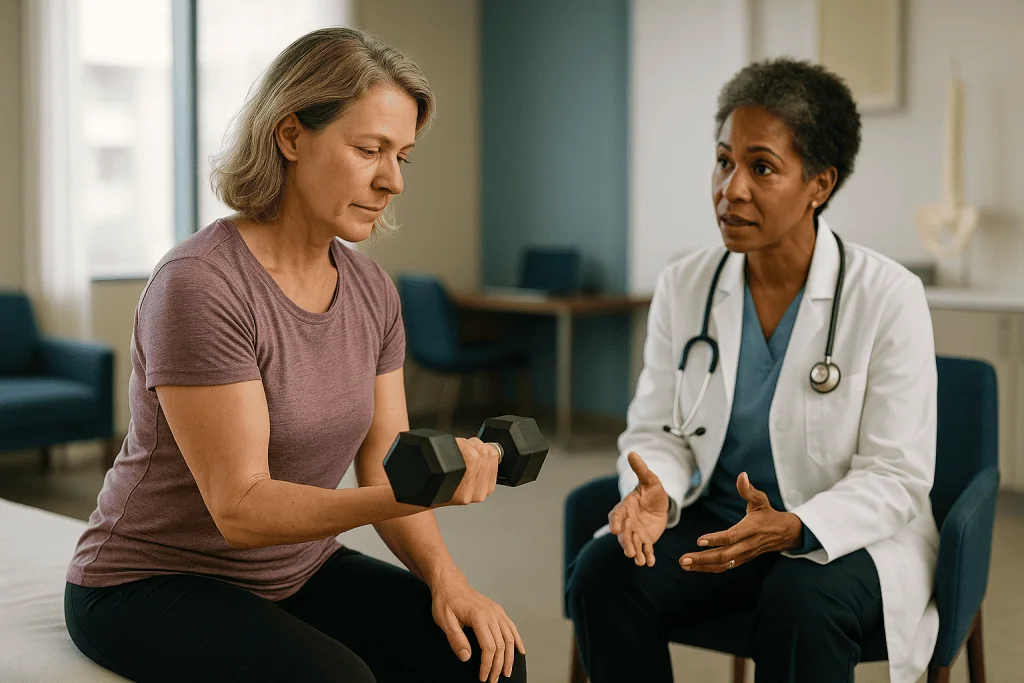
Research also matured. The LIFTMOR trial, published in the Journal of Bone and Mineral Research in 2018, randomized 101 postmenopausal women with low bone mass to either eight months of supervised heavy lifting and impact training or a low-intensity home program. The lifting group gained about 2.9 percent lumbar spine density while the control group lost about 1.2 percent. The trial was small and used specialist supervision, but it answered a question many clinicians had been hedging on: can older women with fragile bones lift heavy safely? With coaching, they did, and no fractures occurred in the program.
Since then, Harvard Health, the Mayo Clinic and the Cleveland Clinic have each published consumer pieces placing resistance training among the core strategies for bone health. What has not changed is the hormone biology that makes the “bulky” fear implausible, and that is where we turn next.
Why lifting heavy does not make women bulky: the hormone math
Muscle growth, which physiologists call hypertrophy, is the process of muscle fibers enlarging after they have been loaded, repaired and fed. Testosterone is the main hormonal driver of that process. Healthy adult men typically circulate roughly 10 to 20 times more testosterone than women. That single number explains most of the gap in muscle mass between the sexes and why a woman following the same program as her brother will not end up with his shoulders.
Consider what it actually takes to look “bulky.” Competitive female bodybuilders train with high volume five or six days a week for years, eat in a deliberate calorie surplus, and often reach their stage look only with extreme dieting that temporarily strips body fat to reveal muscle underneath. Some also use anabolic steroids, which are prescription medicines that are illegal to use for performance without a prescription and carry serious cardiovascular and liver risks. Nothing about a twice-weekly program of squats, rows and presses resembles that pathway.
What a woman will notice after a few months is different. Muscles feel firmer. Clothes may fit more snugly at the thighs and more loosely at the waist, because muscle is denser than fat and takes up less space per pound. Strength climbs quickly at first, mostly because the nervous system learns to recruit more muscle fibers, a change that adds no size at all.
Women do build muscle; relative to their starting point, research shows they gain at a similar percentage rate to men. The absolute amount is smaller, and the visible result is a stronger, more defined body, not a larger one. If a woman feels she is getting bigger than she wants, the lever is nutrition and training volume, not abandoning the weights.
How to build muscle: what women actually need
Searches for how to build muscle as a woman turn up a lot of noise, so here is the signal. Muscle responds to three things: mechanical tension, progressive overload and adequate protein and energy. Progressive overload is the practice of gradually increasing the demand on a muscle, by adding weight, repetitions or sets over weeks. Without it, the body has no reason to adapt.
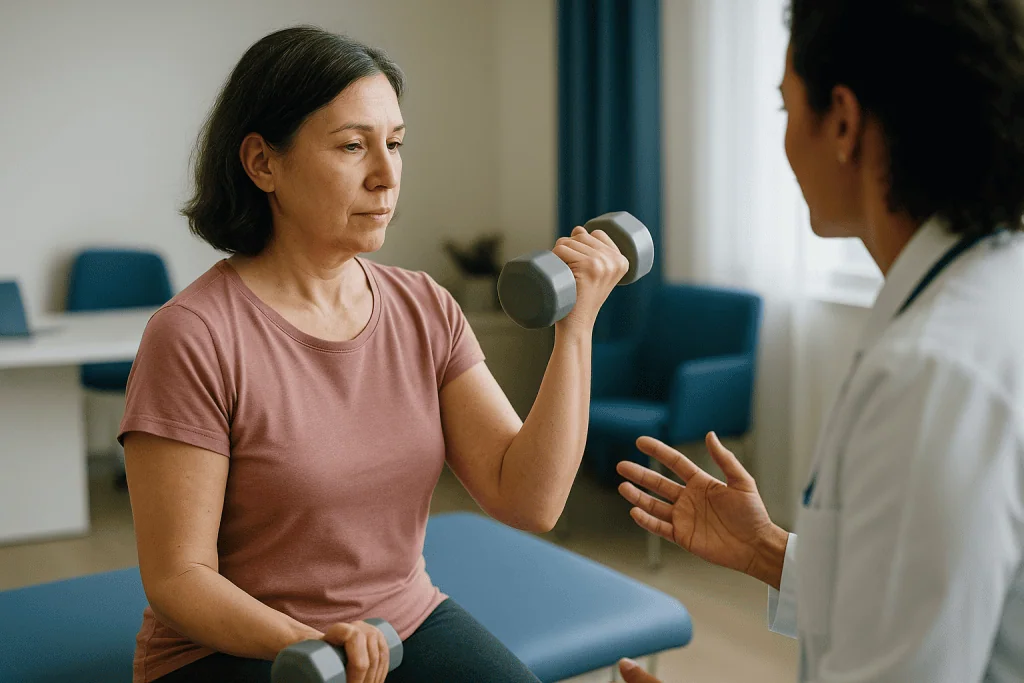
Tension comes from working a muscle close to the point where it cannot complete another repetition with good form. Research reviewed by Harvard Health suggests that sets in a broad range of roughly 6 to 20 repetitions all build muscle, provided the last few repetitions are genuinely hard. Lighter loads work for size if taken near failure; heavier loads are more efficient for strength and, as we will see, for bone.
Frequency matters less than many assume. Two full-body sessions a week, each hitting the legs, hips, back, chest and shoulders with two or three working sets per movement, is enough for a beginner to make steady progress for a year or more. Three sessions let you spread the volume and recover better, but they are not required.
Protein is the raw material. Muscle protein synthesis, the process of building new muscle tissue, is stimulated by both training and eating protein, and the two together produce the biggest effect. Most adults who eat a varied diet with protein at each meal cover their needs; women who restrict calories, eat little animal protein or are over 65 may fall short and benefit from a conversation with a registered dietitian.
Sleep is the overlooked variable. Growth hormone and tissue repair peak during deep sleep, and chronically short nights blunt the response to training. Seven hours is a fair target for most adults.
What strength training does for bone
Bone is living tissue that remodels itself constantly. Cells called osteoclasts break down old bone and cells called osteoblasts lay down new bone, and the balance between them determines bone mineral density, the amount of mineral packed into a given volume of bone, measured by a low-dose X-ray scan known as DXA.
Bone responds to strain. When a muscle contracts hard against a load, it tugs on the bone it attaches to, and the resulting bend, measured in microstrain, signals osteocytes buried in the bone to call for reinforcement. Walking produces small strains and maintains bone; it rarely builds it. Heavy lifting and impact activities such as jumping produce larger, less familiar strains, and bone adapts to those.
This is why the type of exercise matters. Swimming and cycling are excellent for the heart, yet they load the skeleton so little that competitive cyclists can have lower bone density than sedentary peers. The NIH’s National Institute of Arthritis and Musculoskeletal and Skin Diseases groups bone-building exercise into two categories: weight-bearing activity, where your feet and legs support your body weight, and resistance training, where muscles pull against a load.
Timing shapes the payoff. Peak bone mass is reached around age 30; lifting in the teens and twenties banks bone for later. After menopause, estrogen falls and the remodeling balance tips toward loss. Lifting at that stage can slow the decline and, as LIFTMOR showed, produce small gains at the spine and hip in women who train heavy under supervision.
The numbers deserve context. A 2 to 3 percent gain in spine density over eight months is meaningful because the alternative was a 1 to 2 percent loss, but it does not move a woman from osteoporosis to normal bone. Strength training protects; it does not rebuild a skeleton.
What the evidence actually says, graded by strength
Clinicians grade evidence by how it was gathered. Randomized controlled trials, where people are assigned by chance to a treatment or comparison group, sit at the top. Observational studies that follow groups over time come next, and expert opinion sits below both. Here is how the claims about strength training for women line up.
Strength and muscle mass increase with resistance training. Strong evidence. Dozens of randomized trials across ages, including women in their eighties, show consistent gains. Harvard Health notes that adults who do not train lose roughly 3 to 8 percent of muscle mass per decade after 30, and that resistance training reverses much of that loss.
Heavy lifting improves bone density in postmenopausal women. Moderate evidence. LIFTMOR and several smaller trials show gains of about 1 to 3 percent at the spine and hip over 8 to 12 months. Trials are small and supervised, so results in an unsupervised gym may be smaller.
Strength training reduces fractures. Limited direct evidence. Fracture trials require thousands of participants over years, and few exist. The link is inferred from stronger bone, better balance and fewer falls, which observational data and fall-prevention trials support.
Strength training reduces falls in older adults. Strong evidence. The CDC and NHS both cite trials showing that strength and balance programs reduce falls by roughly a quarter in people over 65.
Lifting makes women bulky. No supporting evidence. Body composition trials show women gain lean mass and lose fat mass, with modest changes in limb circumference.
The honest summary: lifting makes women stronger with near certainty, denser in bone with reasonable confidence, and bulkier essentially never.
How heavy is heavy? Loads, reps and effort explained
Two terms let you read any training program. The one-repetition maximum, or 1RM, is the heaviest weight you could lift once with good form; researchers describe loads as a percentage of it. Rate of perceived exertion, or RPE, is a self-rating of effort on a scale of 1 to 10, where 10 means no more repetitions were possible.
Bone trials have mostly used loads around 80 to 85 percent of 1RM, which translates to sets of about five repetitions. You never need to test a true maximum to train there. Choose a weight you can lift five times with the last repetition feeling like an 8 or 9 on the RPE scale, and you are in the right range. If you could easily do ten, the weight is too light to be “heavy.”
Beginners should not start there. The first four to six weeks exist to learn movement patterns: how to brace the trunk, hinge at the hips and keep the spine neutral under load. Light weights, 10 to 15 repetitions and an RPE of 6 or 7 teach those skills without punishing mistakes. Loads climb once technique is reliable.
Which movements? Bone responds to strain where it occurs, so exercises that load the spine and hips matter most: squats, deadlifts, overhead presses and loaded carries. Machines such as the leg press are useful substitutes for people who are new, nervous or recovering from injury. Impact work, such as hopping or skipping, adds a separate stimulus and was part of the LIFTMOR protocol, but it is not appropriate for everyone with low bone mass and belongs in a conversation with a clinician first.
Rest between heavy sets should be generous, two to three minutes, so each set is genuinely strong rather than a tired half-effort.
Training styles compared: what each does for strength, size and bone
The table below summarizes how common approaches stack up. It is a guide, not a prescription, and the “bone” column draws on trial evidence in postmenopausal women; effects in younger women are likely similar but less studied.
| Training style | Typical loads | Strength | Muscle size | Bone density | Best suited to |
|---|---|---|---|---|---|
| Heavy resistance (1–6 reps) | 80–90% of 1RM | Large gains | Moderate | Modest gains in trials | Experienced lifters; supervised beginners |
| Moderate resistance (8–12 reps) | 65–80% of 1RM | Good gains | Good gains | Maintains, small gains | Most beginners and intermediates |
| Light resistance (15–25 reps) | Under 60% of 1RM | Small gains | Moderate if near failure | Little effect | Rehabilitation; very deconditioned adults |
| Body-weight circuits | Body weight | Small to moderate | Small | Little effect once adapted | Getting started; travel; no equipment |
| Impact (jumping, hopping) | Body weight with landing force | Minimal | Minimal | Modest gains, especially hip | Healthy adults; cleared by clinician if low bone mass |
| Walking, swimming, cycling | None or minimal | Minimal | Minimal | Maintains (walking); little (swimming, cycling) | Cardiovascular health; recovery days |
Two patterns stand out. Heavier loads deliver more strength and more bone per minute of training, which is why the guideline language has shifted toward “heavy enough to be hard.” At the same time, the moderate zone produces most of the muscle benefit with a lower skill requirement, making it the sensible home for most women during their first year. Mixing the two across a week, one heavier day and one moderate day, is a common and well-supported structure.
Strength training for women at every life stage
Teens and twenties. This is the bone-banking decade. Skeletons are still adding mineral, and loading now raises the peak that everything later is measured against. Teenage girls who lift with supervision show no evidence of harm to growth plates, a concern that has not held up in studies. The main risks are poor technique and overtraining in sport, both coachable.
Pregnancy and after. The CDC and NHS both say that women who were lifting before pregnancy can generally continue with modifications, avoiding breath-holding under heavy load, lying flat on the back after the first trimester, and exercises with a fall risk. New lifters can start with light loads. Pelvic floor and core recovery after birth deserve attention before returning to heavy lifting; a pelvic health physiotherapist can guide that.
Perimenopause and menopause. Falling estrogen accelerates both bone and muscle loss, and many women notice body composition shifting toward the waist. Resistance training counters all three. Hormone therapy is a separate decision with its own evidence base and belongs entirely with a woman’s own clinician; lifting is not a substitute for it, nor the reverse.
Sixties and beyond. The evidence here is arguably the strongest of all. Trials in nursing-home residents in their nineties have shown doubling of leg strength within ten weeks. Sarcopenia, the age-related loss of muscle mass and function, is a major driver of falls, hospital stays and loss of independence, and progressive resistance training is the only intervention shown to reverse it. Programs for older adults start lighter, progress slower and add balance work, but the principle of progressive overload does not retire.
Across every stage, the common thread is that it is never too early and never too late. The woman in that viral deadlift video was not an outlier; she was following the data.
A realistic first 12 weeks for a beginner
Most women who quit lifting do so in the first month, usually because they started too hard or had no plan. A gentle structure fixes both. What follows is a general template consistent with Mayo Clinic and NHS guidance, not a personalized prescription; women with health conditions, recent surgery or diagnosed osteoporosis should get individual advice first.
Weeks 1 to 4: learn the patterns. Train twice a week, 30 to 40 minutes. Pick one exercise from each of five families: a squat (goblet squat or leg press), a hinge (Romanian deadlift with light dumbbells), a push (dumbbell press), a pull (seated row) and a carry (farmer’s walk). Do two sets of 10 to 12 repetitions at an effort of 6 to 7 out of 10. The goal is confidence and clean form, not fatigue.
Weeks 5 to 8: add load. Increase the weight when all repetitions feel controlled, typically by the smallest increment available. Move to three sets. Effort should rise to 7 or 8 on the last set. Expect noticeable strength jumps here; they are mostly neural and entirely normal.
Weeks 9 to 12: introduce a heavier day. On one session, drop to six to eight repetitions with a correspondingly heavier load on the squat and hinge. Keep the second session moderate. Add two minutes of balance work, such as single-leg stands, at the end.
Throughout, warm up with five minutes of easy movement and a lighter set of each exercise. Record what you lifted; progress you cannot see is progress you will not sustain. A session or two with a qualified coach early on is worth more than any app, mainly for feedback on the hinge, which is the movement people most often get wrong.
Common myths about strength training for women, corrected
“Heavy weights make women bulky.” Covered above, but worth repeating: women lack the testosterone to add large muscle mass without years of extreme, deliberate effort. Trials show lean mass up, fat mass down, waist circumference down.
“Light weights and high reps tone; heavy weights build.” There is no physiological process called toning. A muscle either grows, shrinks or stays the same, and the “toned” look is simply muscle with less fat over it. Both light and heavy loads build muscle if the sets are hard; heavy loads are better for strength and bone.
“Lifting is dangerous for older women’s joints.” The reverse is closer to the truth. Stronger muscles stabilize joints, and resistance training is a recommended treatment for knee and hip osteoarthritis in Cleveland Clinic and NHS guidance. Injury rates in supervised resistance training are lower than in running or team sports.
“Cardio is enough for bone.” Walking maintains bone; it rarely builds it. Swimming and cycling do neither. Bone needs strain it is not used to, which means load or impact.
“Lifting reverses osteoporosis.” Trials show gains of a few percent in density, which slow or partly offset loss. That is valuable and should not be oversold. Osteoporosis is a diagnosis managed by a clinician, often with medicines that have far larger effects on fracture risk, and lifting sits alongside that treatment rather than replacing it.
“You need supplements to see results.” A diet with protein at each meal covers most women. Creatine has reasonable trial evidence for small additional strength gains, but it is not required, and anyone with kidney disease should speak with a clinician before using it.
“Muscle turns to fat if you stop.” Muscle and fat are different tissues; one cannot become the other. Muscle shrinks if unused, and fat can accumulate if intake stays high, but that is two changes, not one.
Protein, calcium and vitamin D: feeding muscle and bone
Training is the signal; nutrition is the supply. Three nutrients do most of the work, and the mainstream guidance on each is clearer than social media suggests.
Protein provides amino acids for muscle repair. Needs rise with training and with age, because older muscle responds less sharply to each meal, a phenomenon called anabolic resistance. Spreading protein across three or four meals, rather than loading it into dinner, appears to support muscle synthesis better. Good sources include eggs, dairy, fish, poultry, legumes, tofu and whole grains. Women on restrictive diets, those with kidney disease and those over 65 should ask a dietitian or clinician about individual targets.
Calcium is the mineral bone is built from. Dairy, calcium-set tofu, canned fish with bones, leafy greens and fortified plant milks are the main sources. The NIH Office of Dietary Supplements sets recommended intakes by age and sex, and notes that food sources are preferred; supplements fill gaps rather than replace meals, and very high supplemental intake has been linked in some studies to kidney stones.
Vitamin D allows the gut to absorb calcium. Skin makes it from sunlight, which is why levels dip in winter and in people who cover up or stay indoors. The NHS advises everyone in the UK to consider a supplement in autumn and winter; US guidance from the ODS gives age-based recommendations. A blood test can confirm deficiency, and a clinician should set any supplement plan.
Energy balance ties it together. Women who chronically under-eat, whether from dieting or heavy training, can suppress estrogen and lose bone even while lifting. Persistent loss of periods in a premenopausal woman is a warning sign, not a badge of fitness, and warrants a medical visit.
Soreness, injuries and training with osteoporosis or other conditions
Delayed onset muscle soreness, the stiffness that peaks a day or two after a new or hard session, is normal and fades as muscles adapt. It is not a sign of damage requiring rest. Gentle movement, sleep and patience resolve it; the second time you do an exercise, soreness is usually far milder.
Sharp pain during a lift is different. Pain in a joint, pain that radiates down a limb, or pain that worsens with each repetition means stop, lower the load and reassess form. Most lifting injuries come from technique failures under fatigue, which is why heavy sets are kept short and rest is generous.
Women with diagnosed osteoporosis can and should lift, but with adjustments. Forward bending of the spine under load, such as toe-touch stretches or sit-ups, raises the risk of vertebral compression fractures and is generally avoided. Trial protocols for low bone mass used hinge movements with a neutral spine, supervised closely. Impact work is individually assessed. A physiotherapist or exercise physiologist experienced in bone health is the right guide, and the treating clinician should know the plan.
Other conditions call for tailoring rather than avoidance. Resistance training is recommended for people with type 2 diabetes, high blood pressure, heart disease that is stable, arthritis and after many cancer treatments, with the American Heart Association endorsing it for cardiovascular health. The common caveats are to avoid breath-holding, which spikes blood pressure, and to progress slowly. Anyone on blood thinners, with a recent fracture, with uncontrolled blood pressure, or with a condition affecting balance should get specific clearance.
Finally, listen for the signs of doing too much: persistent fatigue, falling performance, disrupted sleep and, in premenopausal women, missed periods. Those are cues to pull back, not push through.
When to see a doctor
Strength training is among the safest forms of exercise, but certain situations call for a medical conversation before, during or after starting. The decisions that follow, including any change to medicines or hormone therapy, belong with the treating clinician.
Before starting, see a doctor if you have diagnosed osteoporosis or a previous low-trauma fracture; heart disease, uncontrolled high blood pressure or a history of fainting; a recent surgery, hernia or pregnancy complication; or a condition such as a neurological disorder that affects balance. A DXA scan is generally recommended for women from age 65, and earlier for those with risk factors such as early menopause, long-term steroid use or a parent with a hip fracture.
Stop and seek urgent care if you experience chest pain, pressure or tightness during exercise; sudden shortness of breath out of proportion to effort; dizziness, fainting or a racing, irregular heartbeat; or a severe headache that comes on abruptly during a lift.
Book a prompt appointment for sudden, severe back pain after lifting, especially in a woman with low bone mass, which can signal a vertebral fracture; numbness, tingling or weakness in an arm or leg; a joint that swells, locks or gives way; or pain that persists beyond two weeks despite rest.
Raise it at your next visit if your periods stop for three months or more and you are not pregnant or menopausal; you lose height, which can indicate spinal bone loss; you notice unexplained weight loss; or fatigue and poor recovery persist for weeks.
Women already prescribed osteoporosis medicines should keep taking them exactly as directed; training complements that treatment and is never a reason to stop or alter it without medical advice.
Frequently asked questions
Does strength training for women make you bulky?
No. Women lack the testosterone needed to add large muscle mass without years of high-volume training and a deliberate calorie surplus. Body composition studies consistently show women who lift gain modest lean mass, lose fat mass and reduce waist circumference. The firmer, more defined look people describe as “toned” is simply muscle with less fat covering it, and that is exactly what resistance training produces.
How do women build muscle most effectively?
Muscle grows in response to progressive overload, meaning loads that gradually increase over weeks, combined with sets taken close to the point where another good repetition is not possible. Two or three full-body sessions a week, protein at each meal and seven hours of sleep cover the essentials. Both heavy and moderate loads build muscle; heavier loads add more strength and bone benefit per session.
How heavy should a woman lift for bone density?
Trials that improved bone density in postmenopausal women used loads around 80 to 85 percent of one-repetition maximum, which works out to sets of about five repetitions that feel hard by the last one. That intensity is for people who have already learned good technique. Beginners should start lighter and build up over a few months, ideally with coaching, especially if they have low bone mass.
Can lifting weights reverse osteoporosis?
Not on its own. Randomized trials show heavy resistance training can produce gains of roughly 1 to 3 percent in spine and hip density over 8 to 12 months, which slows or partly offsets the loss that would otherwise occur. Osteoporosis is managed by a clinician, often with prescribed medicines that have larger effects on fracture risk. Lifting is a valuable addition to that care, never a replacement for it.
Is it safe to start strength training after menopause?
For most women, yes, and the evidence for benefit is strongest in this group. Resistance training counters the accelerated muscle and bone loss that follows the drop in estrogen and improves balance. Women with diagnosed osteoporosis, heart disease, uncontrolled blood pressure or balance problems should get medical clearance first and work with a qualified coach or physiotherapist who can adapt exercises to their situation.
How many days a week should women lift weights?
Guidelines from the CDC, NHS and WHO recommend muscle-strengthening activity on at least two days a week for all adults. Two well-planned full-body sessions are enough for beginners to progress for a year or more. Three sessions allow volume to be spread out with better recovery. More than four is rarely necessary outside of sport and raises the risk of overtraining without adding much benefit.
Do women need protein supplements to build muscle?
Usually not. A diet with a protein source at each of three or four meals meets most women’s needs, and spreading intake across the day supports muscle repair better than one large serving. Protein powders are a convenient food, not a requirement. Women over 65, those eating very little, and those with kidney disease should discuss their individual protein targets with a dietitian or clinician.
Will lifting heavy weights damage my joints or back?
With sound technique and sensible progression, lifting strengthens the muscles that stabilize joints and is recommended in mainstream guidance for knee and hip osteoarthritis. Injury rates in supervised resistance training are lower than in running or team sports. Most lifting injuries come from technique breakdown under fatigue, which is why heavy sets stay short, rest is generous, and early coaching on the hip hinge pays off.
What is the difference between weight-bearing and resistance exercise for bone?
Weight-bearing exercise means activity where your feet and legs carry your body weight, such as walking, jogging or stair climbing; it maintains bone and, with impact, can build it. Resistance exercise means muscles working against an external load, such as a barbell or band, which pulls on bone and stimulates growth where the strain occurs. Both help; swimming and cycling, which load bone little, do not.
Can teenage girls lift weights safely?
Yes, with supervision. Older concerns that resistance training damages growth plates have not been supported by research, and the teens and twenties are the years when skeletons add the most mineral, making this the ideal time to build peak bone mass. The priorities are learning technique before adding load, avoiding maximal lifts until coordination is reliable, and eating enough to support both growth and training.
References
- CDC: Adult Activity: An Overview (Physical Activity Guidelines)
- NHS: Physical activity guidelines for adults aged 19 to 64
- NIH NIAMS: Exercise for Your Bone Health
This article is for general information only and is not a substitute for professional medical advice. Please consult a qualified doctor about your individual situation.

More from the Blog
Morning Stretches: A 10-Minute Routine Built From Physiology, Not Instagram
Gentle morning stretching is safe for most people and helps ease overnight stiffness, which comes from cooled muscles, thickened joint fluid, and fluid absorbed…

Muscle Memory Is Real: The Cell Biology Behind Getting Strong Again Faster
Muscle memory is real, and it works on two levels. In the brain, practiced movements are stored as procedural memory, so skills like a…
Kettlebell Swings: Form, Benefits and the Back-Pain Mistake
A kettlebell swing is a hip-hinge exercise that trains the glutes, hamstrings and back muscles while raising heart rate, and small trials show it…

How Long Does It Take to Walk a Mile? Pace, Age and What It Says About Fitness
Most adults walk a mile in about 15 to 22 minutes, which works out to roughly 3 miles per hour. A brisk pace covers…

The Post-Workout Meal: The Anabolic Window, Revisited
A post workout meal still matters, but the strict 30-minute anabolic window does not hold up in randomized trials. Evidence suggests eating 20–40 grams…
Static Stretching: When It Helps, When It Hurts Performance and How Long to Hold
Static stretching, holding a muscle at mild tension without moving, reliably improves flexibility when each stretch is held for 15–30 seconds, repeated two to…