

Stress and Blood Pressure: How Much Stress Raises It and Whether It Lasts

Key Takeaways
- Acute stress typically raises systolic blood pressure by 10 to 30 mmHg within seconds and the rise reverses within 5 to 20 minutes once the trigger ends.
- The clinic visit itself commonly adds 10 to 20 mmHg to a systolic reading, which is why guidelines now lean on averaged home measurements for diagnosis.
- Chronic job strain is associated with a 10 to 30 percent higher rate of new hypertension in cohort studies, but this is observational evidence that cannot fully separate stress from sleep, diet and alcohol.
- Stress-reduction practices such as paced breathing and meditation lower systolic pressure by about 3 to 6 mmHg in trials, smaller than the 5 to 8 mmHg seen with regular aerobic exercise.
- A full bladder, crossed legs or an unsupported arm can each add 5 to 10 mmHg to a reading, the same size as many stress effects.
- A reading of 180/120 mmHg or higher with chest pain, breathlessness, severe headache or neurological symptoms is a hypertensive emergency, not a panic attack, until proven otherwise.
Stress raises blood pressure quickly but usually briefly. During a stressful moment, adrenaline and cortisol can lift systolic pressure by roughly 10 to 30 mmHg within seconds, and readings normally settle within minutes to an hour once the trigger passes. Long term, evidence that stress alone causes sustained hypertension is weaker and mostly observational; stress more often raises blood pressure indirectly through poor sleep, alcohol, salt and inactivity.
A reader wrote to us in late August with a screenshot: her smartwatch had flagged a “high stress” morning, and a clip she had watched that week claimed that one bad month at work can “reset” blood pressure for life. She wanted to know whether to be worried, or whether to be annoyed with the watch. As of September 2026, that question is being typed into search engines more than at any point in the past five years, pushed along by wearable stress scores, a wave of viral videos, and the first major American hypertension guideline update since 2017, published in August 2025.
The link between stress and blood pressure is real, measurable and surprisingly well mapped in the laboratory. What is far less settled is how much of a stressful season survives in your arteries once calm returns. That gap between a sharp, short rise and a lasting change is where most of the online confusion lives, and it is exactly what this piece sets out to untangle, number by number.
What actually happens to blood pressure in the first minute of stress
Picture the moment a car swerves into your lane. Before you have consciously registered fear, your brain has already sent a signal down the sympathetic nervous system, the “fight or flight” branch of the nerves that run on autopilot. Within two to three seconds the adrenal glands release adrenaline, a hormone that makes the heart beat faster and harder, and the small arteries in your skin and gut tighten to divert blood toward muscle.
Blood pressure is simply the force of blood against artery walls, written as two numbers in millimetres of mercury (mmHg). The top number, systolic, is the pressure when the heart contracts; the bottom number, diastolic, is the pressure between beats. A faster, stronger pump combined with narrower pipes pushes both numbers up, systolic more than diastolic, because the heart’s output changes faster than vessel tone does.
Cortisol, the slower stress hormone, arrives over the next 15 to 30 minutes. It nudges the kidneys to hold onto sodium and water and makes blood vessels more responsive to adrenaline, which is one reason a long, grinding stressor feels different from a short fright. Harvard Health describes this two-stage response well: an immediate nerve-driven surge, then a hormonal follow-through that keeps the system primed.
Crucially, the body also has a brake. Pressure sensors in the neck arteries and the aorta, called baroreceptors, detect the rise and tell the brain to slow the heart and relax vessels. In a healthy adult that feedback loop begins working within seconds, which is why a startle produces a spike and not a plateau. Understanding this brake matters for everything that follows, because much of the long-term question about stress and blood pressure comes down to whether repeated stress wears the brake down.
How much does stress raise blood pressure? The real numbers
Laboratory stress tests give the cleanest answers because researchers control the trigger and measure continuously. The classic protocols are mental arithmetic under time pressure, a short public-speaking task in front of a stern panel, and the cold pressor test, in which a hand is held in near-freezing water. Across decades of these studies, the typical healthy adult shows a systolic rise of about 10 to 30 mmHg and a diastolic rise of roughly 5 to 15 mmHg while the task is running. A reading of 118/76 at rest becoming 140/88 during the task is ordinary, not alarming.
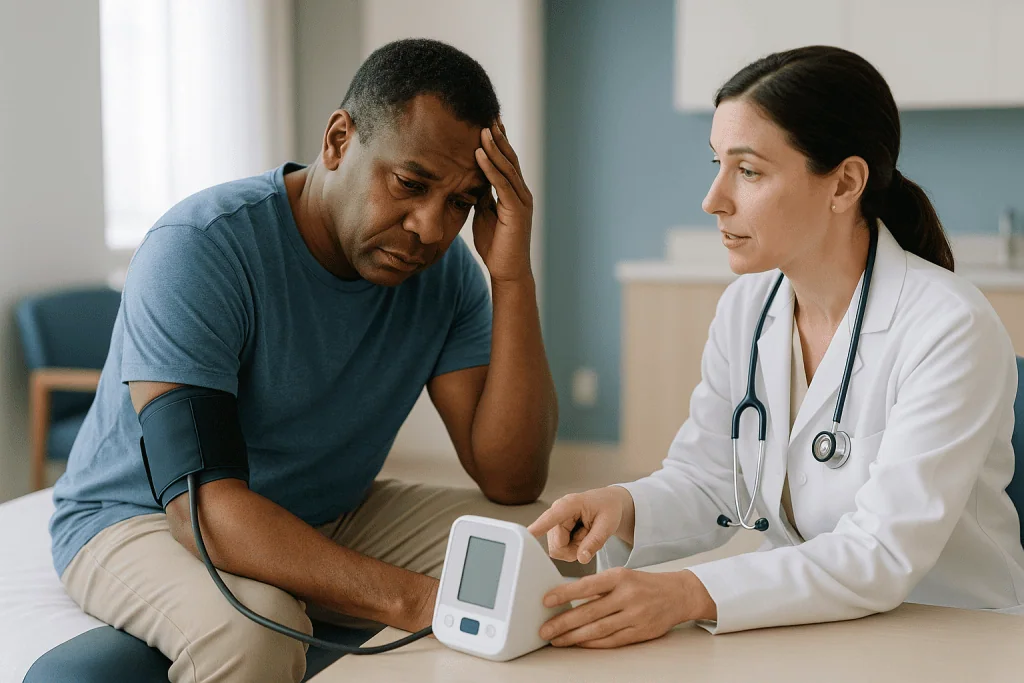
Some people respond far more. Researchers call them “high reactors”, and their systolic pressure can climb 40 mmHg or more during the same task. Reactivity tends to be stable within a person over years, and observational cohorts have found that high reactors are somewhat more likely to develop hypertension later. That association is consistent but modest, and it does not prove the spikes themselves are the cause.
Outside the lab, the best-studied everyday stressor is the clinic visit itself. The white coat effect, a rise in blood pressure measured in a medical setting compared with home, commonly adds 10 to 20 mmHg to the systolic number, and sometimes more. Cleveland Clinic notes it is one of the most frequent reasons a single office reading overstates a person’s true pressure.
Emotional stressors produce similar magnitudes. Heated arguments, bad news and panic attacks have all been captured on ambulatory monitors (wearable cuffs that record every 15 to 30 minutes across a day) with systolic rises in the 20 to 40 mmHg range. Caffeine, often consumed as a stress response rather than a stressor, adds its own layer: the Mayo Clinic reports it can raise blood pressure by up to 10 mmHg in people who do not drink it regularly, an effect that fades within about three hours.
Does stress-related blood pressure last? Minutes, hours or years
The honest answer has three timescales, and they behave very differently.
Over minutes, the rise is almost entirely reversible. In the laboratory studies described above, blood pressure returns to within a few mmHg of baseline inside 5 to 20 minutes after the task ends. Slower recovery is itself a research signal: people whose pressure takes longer to settle appear, in observational work, to carry slightly higher future risk, possibly because their baroreceptor brake is less sensitive.
Over hours and days, stress leaves a footprint mostly through what it does to behaviour and sleep. A night of four hours’ sleep raises the next day’s average blood pressure by several mmHg in small controlled studies. A week of deadlines tends to mean more salt, more alcohol, less movement and more caffeine, each of which carries its own measured effect. The pressure in these weeks is often genuinely higher, but it is higher because of the cascade, not because the arteries have been permanently altered.
Over years, the picture is where certainty drops. The Mayo Clinic’s position is careful and worth quoting in spirit: there is no proof that stress by itself causes long-term high blood pressure, but repeated stress-related spikes and the unhealthy habits that often accompany them may contribute. Long cohort studies following tens of thousands of workers have linked sustained job strain, defined as high demands with low control, to a higher rate of new hypertension diagnoses, typically a relative increase in the range of 10 to 30 percent. That is a real but modest signal, from observational data that cannot fully separate stress from the sleep, diet and smoking that travel with it.
So the title question splits cleanly. The spike does not last. The habits can. Whether the stress itself rewires pressure regulation remains plausible but unproven.
What changed recently in stress and blood pressure guidance
Three developments explain why this topic is being searched so heavily right now, and each carries a date.

In September 2023, the World Health Organization published its first global report dedicated to hypertension. Its fact sheet puts the scale plainly: an estimated 1.28 billion adults aged 30 to 79 live with high blood pressure, nearly half of them do not know it, and only about one in five has it under control. The report framed stress as one of several modifiable contributors alongside salt, alcohol, inactivity and tobacco, deliberately not ranking it above the better-proven factors.
In August 2025, the American Heart Association and American College of Cardiology released their updated hypertension guideline, the first full revision since 2017. It kept the diagnostic threshold of 130/80 mmHg, strengthened the emphasis on home and out-of-office measurement to unmask white coat and masked patterns, and continued to list stress management techniques such as controlled breathing, meditation and yoga as reasonable additions for people who want them, while grading the supporting evidence as limited rather than strong. The AHA’s consumer guidance on managing stress to control blood pressure reflects that same cautious framing.
The third change is cultural rather than clinical. Since 2024, mainstream smartwatches have added “stress” and, in some regions, cuffless blood pressure estimation features. As of September 2026, no major guideline body accepts cuffless wearable estimates for diagnosing or managing hypertension; the AHA and NHS both point readers toward validated upper-arm cuffs. The watches are good at starting a conversation and poor at finishing it, and much of the viral content circulating this year treats a stress score as if it were a pressure reading. It is not.
What the evidence actually says, graded by strength
Medical evidence comes in tiers, and the tiers matter more than the headlines. Randomised controlled trials, where people are assigned by chance to one approach or another, can show cause. Observational studies, which follow people without intervening, show association. Expert opinion fills the gaps where neither exists.
Strong evidence (many controlled experiments): acute stress raises blood pressure within seconds, by roughly 10 to 30 mmHg systolic in most adults, and the rise reverses within minutes once the stressor stops. This is about as settled as physiology gets.
Moderate evidence (large, consistent observational cohorts): chronic stressors such as job strain, caregiving burden and financial insecurity are associated with a modestly higher rate of hypertension over 5 to 15 years. The associations persist after adjusting for weight, smoking and alcohol, but adjustment is never complete, and sleep is often poorly measured. Reasonable people read this as “probably contributes, size uncertain”.
Moderate evidence (randomised trials, small and short): structured stress-reduction programmes, including mindfulness-based courses, transcendental meditation and slow-breathing training, lower systolic blood pressure by about 3 to 6 mmHg on average compared with control groups. The trials are mostly under a year long, with a few hundred participants each, and effects shrink when the comparison group gets an equally attentive placebo activity. The AHA’s 2013 scientific statement on alternative approaches reached a similar verdict and little has overturned it.
Weak evidence (expert opinion, small case series): the idea that a single intense stressor permanently “resets” blood pressure; the claim that stress alone, in the absence of lifestyle change, is a leading cause of hypertension; and the notion that a wearable stress score predicts blood pressure risk. None of these have trial or robust cohort support.
The pattern is instructive. The sharper and shorter the claim, the stronger the evidence. The grander and longer the claim, the thinner it gets.
Can stress cause high blood pressure permanently?
This is the question behind most searches on stress and blood pressure, so it deserves a careful, three-part answer.
First, the mechanism is plausible. Repeated sympathetic surges may, over years, make the baroreceptor brake less sensitive, encourage the kidneys to retain more sodium, and stiffen arteries through chronic low-grade inflammation. Animal studies and small human studies of stress reactivity support each of these steps individually. What is missing is a long human trial showing the whole chain in action, and such a trial is close to impossible to run ethically.
Second, the human data are suggestive but confounded. People under sustained strain sleep less, drink more, move less and eat more processed food. Each of those has a measured effect on blood pressure that is often larger than any effect attributed to stress itself. Johns Hopkins and the Mayo Clinic both describe stress as an indirect contributor for exactly this reason: it loads the dice without being the dice.
Third, individual variation is large. Some people live through extraordinary strain with unchanged readings; others develop hypertension in their thirties with little obvious stress. Genetics, salt sensitivity, kidney function and age dominate the long-term picture. Hypertension affects roughly half of American adults by the CDC’s definition, and the great majority of those cases are not explained by any single cause, stress included.
The practical upshot is reassuring and demanding at once. A stressful year has not permanently damaged a healthy person’s blood pressure regulation, as far as evidence can tell. But a stressful year that erodes sleep, movement and diet may well leave readings higher at its end, and those readings deserve the same attention as readings raised by any other route.
Stress-induced high blood pressure: white coat, masked and labile patterns
Clinicians recognise several patterns in which stress and measurement interact, and naming them helps readers interpret their own numbers.
White coat hypertension is high pressure in the clinic with normal pressure at home. The trigger is the setting itself: the wait, the unfamiliar room, the sense of being judged. It affects roughly 15 to 30 percent of people with raised office readings, according to the Cleveland Clinic and others. For years it was dismissed as harmless. Long observational follow-up has since shown a small increase in cardiovascular risk compared with people whose pressure is normal everywhere, so most guidelines now recommend monitoring it rather than ignoring it.
Masked hypertension is the mirror image: normal in the clinic, high in daily life. Work stress, smoking, alcohol and poor sleep are the usual drivers, and it is only detectable with home or ambulatory monitoring. It carries risk similar to sustained hypertension, which is one reason the 2025 American guideline leaned so hard on out-of-office measurement.
Labile hypertension describes readings that swing widely over a day, often tracking mood. Whether lability itself adds risk beyond the average pressure is debated; the evidence is observational and mixed.
A rarer and more dramatic pattern involves surges of 50 mmHg or more with headache, sweating and palpitations. Occasionally this reflects an adrenaline-producing tumour rather than stress, and it is one of the reasons recurrent severe spikes warrant medical evaluation rather than a breathing app.
What unites these patterns is a single lesson. One reading, taken at one moment, in one emotional state, cannot classify anyone. Averages across days, measured properly, can.
Anxiety and high blood pressure: which comes first?
Anxiety and hypertension travel together often enough that people assume one causes the other. The relationship runs in both directions, and the strength differs.
Anxiety raising blood pressure acutely is well established. A panic attack, an episode of intense fear with racing heart, breathlessness and sometimes chest tightness, routinely pushes systolic pressure into the 150s or 160s for 10 to 30 minutes. Chronic generalised anxiety keeps the sympathetic nervous system more active at rest, and small studies show slightly higher average daytime readings in anxious adults. Observational cohorts following people with anxiety disorders over years find a modestly higher rate of later hypertension, in the same range as job strain, with the same difficulty separating anxiety from sleep and lifestyle.
The reverse direction is subtler. Hypertension itself has no reliable symptoms, which is why the NHS calls it a silent condition. People do not feel their blood pressure. What they do feel is the worry that follows a high reading, and that worry can raise the next reading, creating a loop in which the cuff becomes a stressor. Anyone who has watched their numbers climb across three consecutive attempts has lived this.
One important distinction: anxiety symptoms and hypertensive emergency symptoms overlap. Headache, pounding heart and a sense of dread can belong to either. The number separates them. Panic typically lifts pressure well below the 180/120 mmHg level that the AHA defines as a hypertensive crisis; readings at or above that level, with symptoms, are not panic until proven otherwise.
For people managing both conditions, the evidence favours treating the anxiety on its own merits, with psychological therapies that have strong trial support, and measuring blood pressure in calm conditions rather than during episodes. Whether anxiety treatment lowers long-term blood pressure remains, in evidence terms, an open question.
Stress triggers compared: how far readings rise and for how long
The table below pulls together typical figures from laboratory and ambulatory studies. They describe averages in adults without existing hypertension; individual responses vary widely, and people already living with high blood pressure often start higher and swing further.
| Trigger | Typical systolic change | How long it lasts | Evidence strength |
|---|---|---|---|
| Mental arithmetic or public-speaking task (lab) | +10 to +30 mmHg | Minutes; recovery within 5–20 minutes | Strong: many controlled experiments |
| Cold pressor test (hand in ice water) | +15 to +25 mmHg | 2–5 minutes after hand is removed | Strong: controlled experiments |
| Clinic visit (white coat effect) | +10 to +20 mmHg, sometimes more | Duration of the visit | Moderate: large, consistent observational data |
| Panic attack or acute argument | +20 to +40 mmHg | 10–30 minutes | Moderate: ambulatory monitoring studies |
| One night of short sleep | +3 to +8 mmHg next-day average | About a day | Moderate: small trials and cohorts |
| Caffeine in non-habitual users | Up to +10 mmHg | Up to about 3 hours | Moderate: controlled studies |
| Chronic job strain over years | Associated with 10–30% higher rate of new hypertension | Years; reversibility unclear | Moderate: observational only |
| Single traumatic event causing permanent hypertension | Not demonstrated | Not demonstrated | Weak: case reports and opinion |
Two features stand out. Every short trigger produces a rise that is large enough to alarm and brief enough to disappear before most people would think to measure it. The only entry with a time horizon of years is the one with the weakest kind of evidence, which is exactly where caution about causal claims belongs.
The indirect route: how stress raises blood pressure through sleep, salt and alcohol
If stress does lasting harm to blood pressure, the most likely route is not through the arteries directly but through the kitchen, the sofa and the bedroom. Each link in this chain has stronger evidence than the direct effect.
Sleep comes first. Blood pressure normally falls 10 to 20 percent overnight, a pattern called nocturnal dipping. Stress fragments sleep and shortens it, and people who lose that nightly dip show higher 24-hour averages and, in cohort studies, higher cardiovascular risk. Short sleep is one of the few stress-linked factors with controlled trial support for a direct pressure effect.
Salt follows. Stress eating skews toward processed, salty convenience food, and sodium’s effect on blood pressure is among the best-proven in nutrition, confirmed in randomised feeding trials. The WHO’s fact sheet lists excess salt as a leading modifiable driver of hypertension worldwide.
Alcohol is a double hit. Many people drink to unwind, and alcohol raises blood pressure in a dose-dependent way confirmed by trials; it also worsens sleep quality, feeding back into the first link. The NHS and AHA both list cutting alcohol among the most effective lifestyle levers for blood pressure.
Movement declines under strain, and the evidence that regular aerobic activity lowers systolic pressure by roughly 5 to 8 mmHg in people with hypertension comes from numerous randomised trials, a stronger base than any stress-reduction technique can claim.
Smoking, for those who smoke more under pressure, adds acute spikes with every cigarette and stiffens arteries over time.
Seen this way, “stress raised my blood pressure” is often shorthand for “stress changed five things I do every day”. The good news hidden inside that sentence is that each of the five is measurable, and each responds to change on a timescale of weeks, not years.
How to lower blood pressure from stress: what the trials support
Readers searching for how to lower blood pressure from stress usually want one technique. The evidence offers a hierarchy instead, and the order may surprise people who expect meditation at the top.
The strongest trial evidence belongs to the general levers: regular aerobic exercise, less sodium, a diet built around vegetables, fruit, legumes and low-fat dairy, less alcohol and healthy weight. Each has randomised trials showing systolic reductions in the 3 to 10 mmHg range, and they stack. For someone whose blood pressure crept up during a stressful year, restoring these is likely to do more than any relaxation app.
Next come the stress-specific practices. Slow, paced breathing at around six breaths per minute lowers blood pressure during the session by several mmHg and, with daily practice over weeks, produces small sustained reductions in trials. Mindfulness-based programmes and transcendental meditation show average systolic reductions of roughly 3 to 6 mmHg across pooled trials; effects are real but modest and depend on consistent practice. Yoga trials show similar magnitudes, with the breathing and relaxation components appearing to matter more than the postures. The AHA describes these as reasonable options to add, not substitutes for proven measures.
Sleep repair sits in between. Cognitive behavioural therapy for insomnia, a structured programme that retrains sleep habits and thoughts, has strong trial evidence for sleep and emerging evidence for blood pressure.
Social connection, time outdoors and reducing work hours have observational support but few trials; they are sensible, not proven.
Whatever the route, two rules hold. Judge success by averaged home readings over weeks, not by how calm one session felt. And never adjust or stop prescribed blood pressure medicine because a stressful period has ended; that decision belongs to the prescribing clinician, who will want to see the readings first.
How to measure blood pressure when you feel stressed
Most stress-related blood pressure alarms are, at root, measurement problems. Fixing the measurement often fixes the alarm.
Use a validated upper-arm cuff. Wrist devices and watch-based estimates are more sensitive to position and movement, and no guideline body currently accepts cuffless wearable readings for diagnosis. The NHS and AHA both recommend upper-arm monitors checked against a validated-device list.
Prepare the body before the number. Sit quietly for five minutes, back supported, feet flat, arm resting at heart level, bladder empty, no caffeine, exercise or smoking in the previous 30 minutes. The AHA notes that a full bladder, crossed legs or an unsupported arm can each add 5 to 10 mmHg, which is the same size as many stress effects.
Take two or three readings a minute apart and record the average, discarding the first if it is clearly higher. Measure morning and evening for seven days before drawing conclusions. A single reading taken mid-argument is data about the argument, not about your baseline.
Do not chase a spike. If a reading is high and you feel wound up, note it, wait 15 to 30 minutes, breathe slowly, and measure again. If the second reading is near your usual range, the first was almost certainly a stress response. If both are high and you have symptoms, the next section applies.
Keep a simple log with context: slept badly, had an argument, drank coffee. Over a month, patterns emerge that a clinician can read far more usefully than a scatter of unexplained numbers. Ambulatory 24-hour monitoring, arranged through a clinician, remains the gold standard for separating white coat and masked patterns from true sustained hypertension.
Measured this way, blood pressure becomes a trend line rather than a verdict, which is how it is meant to be read.
Common myths about stress and blood pressure
The viral claims circulating this year share a pattern: a true fact about acute stress stretched into an untrue claim about permanence. Here are the ones most often raised, corrected.
“One terrible month resets your blood pressure for life.” No evidence supports this. Acute stress effects reverse within minutes to hours; chronic stress is associated with modestly higher hypertension rates over years, mostly through behaviour. There is no documented mechanism by which a single period of strain permanently fixes pressure at a new level.
“If I feel calm, my blood pressure is fine.” Hypertension produces no reliable symptoms. Masked hypertension, normal in clinic and high in daily life, is common precisely among people who feel fine.
“My watch says my stress is high, so my blood pressure must be high.” Wearable stress scores estimate nervous-system activity from heart-rate variability. They are not blood pressure measurements, and as of 2026 no guideline accepts cuffless estimates for diagnosis.
“Meditation can replace blood pressure medicine.” Trials show stress-reduction practices lower systolic pressure by about 3 to 6 mmHg on average. That is useful alongside treatment, not a substitute, and any change to prescribed medicine is a decision for the treating clinician.
“White coat hypertension is harmless.” Long follow-up shows a small but real increase in risk compared with normal pressure everywhere, which is why monitoring rather than dismissal is now recommended.
“Stress is the main cause of high blood pressure.” Age, genetics, salt, weight, alcohol and inactivity have stronger and larger measured effects. Stress contributes, probably mostly through those same factors.
“A high reading during an argument means I have hypertension.” Diagnosis requires averaged readings across days under standard conditions. One agitated number is not a diagnosis.
When to see a doctor
Most stress-related blood pressure rises need patience and proper measurement, not urgent care. Some situations do need a clinician, and a few need one immediately.
Seek emergency care now if a reading is 180/120 mmHg or higher and you have any of the following: chest pain or pressure, shortness of breath, severe headache unlike your usual headaches, sudden confusion, trouble speaking, weakness or numbness on one side, vision changes, or blood in the urine. The AHA defines this combination as a hypertensive emergency. Do not wait to see whether calming down helps.
If a reading is 180/120 mmHg or higher without those symptoms, rest for five minutes and measure again. If it stays at that level, contact a clinician the same day.
Book a routine appointment if your averaged home readings over a week sit at or above 130/80 mmHg (the American threshold) or 135/85 mmHg (the NHS home-monitoring threshold); if you notice recurrent sudden surges with sweating, pounding heart and headache, which occasionally point to a hormonal cause rather than stress; if your pressure swings widely without an obvious trigger; if you are pregnant and readings have risen; or if anxiety, panic or insomnia is persistent enough to affect daily life, since those conditions have effective treatments in their own right.
Bring your log. A week of averaged readings with context notes is worth more to a clinician than a description of how stressed you have felt.
Finally, if you already take blood pressure medicine and a stressful period has passed, do not reduce or stop it on your own, however normal the numbers look. Any adjustment belongs with the prescribing clinician, who will weigh your readings, your history and your other risks together.
Frequently asked questions
Can stress cause high blood pressure on its own?
Stress alone has not been proven to cause sustained hypertension, though it reliably raises blood pressure for minutes at a time. Long cohort studies link chronic strain to a modestly higher rate of hypertension over years, but that evidence is observational and tangled with poor sleep, alcohol, salt and inactivity. Most experts describe stress as an indirect contributor that acts mainly through those habits rather than as a primary cause in itself.
How long does stress induced high blood pressure last?
A stress-related rise usually settles within 5 to 20 minutes after the trigger passes, and almost always within an hour. A panic attack or heated argument may keep readings elevated for 10 to 30 minutes. Pressure that stays high for days after a stressful event is more likely to reflect disrupted sleep, alcohol or diet than the stress itself, and persistent readings above threshold should be averaged over a week and discussed with a clinician.
How to lower blood pressure from stress quickly?
The quickest reliable step is to sit down, support your back and arm, and breathe slowly at around six breaths per minute for five minutes; trials show this lowers pressure by several mmHg during the session. Then measure again. For lasting change, the strongest evidence belongs to regular aerobic exercise, less salt, less alcohol and better sleep, each of which outperforms relaxation techniques alone in randomised trials. Never adjust prescribed medicine without your clinician.
Is anxiety and high blood pressure the same problem?
No, though they overlap. Anxiety raises blood pressure acutely during episodes and keeps the nervous system slightly more active at rest, and people with anxiety disorders show a modestly higher rate of later hypertension in cohort studies. Hypertension itself causes no reliable symptoms, so the worry people feel is usually about the reading, not from the pressure. Both conditions deserve treatment on their own merits, with blood pressure measured in calm conditions.
Can I ignore a reading of 150/95 taken during an argument?
Not ignore, but not panic either. A reading taken mid-argument reflects the argument. Wait 15 to 30 minutes, breathe slowly and measure again; if the second reading is near your usual range, the first was a stress response. If you see 150/95 repeatedly in calm conditions across a week of morning and evening readings, that average meets the threshold for hypertension and warrants a clinician’s review.
Does a panic attack raise blood pressure dangerously?
Usually not to a dangerous level. Panic attacks commonly push systolic pressure into the 150s or 160s for 10 to 30 minutes, which feels alarming but is well below the 180/120 mmHg hypertensive crisis threshold defined by the American Heart Association. The exception is a reading at or above that level with chest pain, breathlessness, severe headache or neurological symptoms, which needs emergency care regardless of how anxious you feel.
Should I take my blood pressure when I am stressed?
It can be informative but should not be used for diagnosis. A stressed reading tells you how high your pressure can spike; it does not tell you your baseline. For decisions, guidelines rely on readings taken after five minutes of quiet sitting, morning and evening, averaged over seven days. If you do measure while stressed, note the context in your log so the number is read correctly later.
Does meditation really lower blood pressure?
Modestly, yes. Pooled randomised trials of mindfulness programmes and transcendental meditation show average systolic reductions of roughly 3 to 6 mmHg, with effects depending on regular practice and shrinking when the control group receives an equally attentive activity. The American Heart Association considers these reasonable additions for people who want them, not replacements for exercise, diet, alcohol reduction or prescribed treatment.
Can stress raise diastolic blood pressure too?
Yes, though less than systolic. Laboratory stress tasks typically lift diastolic pressure by 5 to 15 mmHg alongside a 10 to 30 mmHg systolic rise, because the heart’s output changes faster than vessel tone does. Both numbers return toward baseline within minutes after the stressor ends. A persistently raised diastolic reading in calm conditions is not explained by stress and should be reviewed.
Is white coat hypertension harmless?
Not entirely. White coat hypertension, high in the clinic and normal at home, was long dismissed, but longer observational follow-up shows a small increase in cardiovascular risk compared with people whose pressure is normal in every setting. Current guidance recommends confirming the pattern with home or 24-hour ambulatory monitoring and then keeping it under periodic review rather than ignoring it, because some people progress to sustained hypertension over time.
References
- World Health Organization: Hypertension fact sheet
- NHS: High blood pressure (hypertension)
- CDC: About High Blood Pressure
This article is for general information only and is not a substitute for professional medical advice. Please consult a qualified doctor about your individual situation.

More from the Blog

Stress and Hair Loss: Telogen Effluvium, Timing and Regrowth
Stress can cause hair loss through telogen effluvium, a temporary shedding in which a physical or emotional shock pushes a large share of hair…
Stress Belly: Is Cortisol Really Storing Fat Around Your Middle?
Stress belly is a popular name for fat that gathers around the waist during long stretches of stress. Cortisol does make this more likely:…
Cortisol and Sleep: The 24-Hour Rhythm, the 3 am Wake-Up and the Awakening Response
Cortisol and sleep run on the same 24-hour clock. Cortisol falls to its lowest point around midnight, climbs through the second half of the…

Forest Bathing: What Time Among Trees Measurably Changes
Forest bathing, slow, sensory time among trees, produces measurable short-term changes in controlled studies: lower salivary cortisol, modestly reduced blood pressure and pulse rate,…

Anxiety and Dizziness: Why It Happens, How to Stop It and When It Is Something Else
Yes, anxiety can cause dizziness, and it is one of the most common physical symptoms of both panic attacks and generalized anxiety. Rapid shallow…

Do I Have OCD? How OCD Is Diagnosed, Common Signs and Where to Get Help
OCD is more than being tidy or particular. It involves unwanted, intrusive thoughts or urges that cause real distress, plus repetitive behaviors or mental…