

Supporting Someone After Diabetic Ketoacidosis: Ketone Checks, Hydration and Follow-Up

Key Takeaways
- DKA happens when insulin is too low for the body's needs, so the body burns fat and releases acidic ketones; fluids help, but only insulin stops ketone production.
- CDC guidance is to test ketones whenever blood glucose is above 240 mg/dL, during any illness, and whenever nausea, vomiting or stomach pain appear, regardless of the glucose number.
- NHS thresholds for blood ketones are: below 0.6 mmol/L normal, 0.6 to 1.5 slightly raised, 1.6 to 2.9 increased risk, and 3.0 or above a medical emergency.
- Urine ketone strips lag behind blood levels by hours and can stay positive while things improve, so blood ketone testing is the more reliable home method where available.
- Insulin is never stopped during illness even if the person is not eating, because stress hormones raise insulin needs; the amount is always set by the prescribing clinician.
- Ketoacidosis can occur with near-normal glucose, notably in pregnancy and in people taking SGLT2 inhibitors, so symptoms plus ketones matter even when the glucose meter looks fine.
After diabetic ketoacidosis (DKA), the most useful family support is practical: help the person check blood or urine ketones whenever glucose runs high or they feel unwell, keep them sipping fluids steadily, make sure insulin is never skipped even when they are not eating, and attend the follow-up where the care team reviews what triggered the episode. Rising ketones, repeated vomiting or drowsiness mean urgent medical help, not watchful waiting.
The discharge papers are on the kitchen table, next to a new ketone meter still in its box. Your sister came home from the hospital this afternoon, pale and quieter than usual, and the nurse’s parting words keep replaying: check ketones, keep her drinking, do not miss a dose. It sounds simple until you are standing in the kitchen at 11 p.m. wondering whether a reading of 0.8 is a problem.
Good dka aftercare family support is mostly about ordinary, repeatable habits: a meter within reach, a glass that keeps getting refilled, a calm question rather than an accusation when a number looks high. Diabetic ketoacidosis is a serious complication of diabetes, but the weeks after an episode are also the moment when the cause usually becomes clear and the plan gets fixed.
This explainer walks through what the body has just been through, what to watch, what to ask, and when ordinary watching has to become a phone call.
What actually happens during diabetic ketoacidosis
Insulin is the hormone that lets glucose move from the bloodstream into cells. When there is too little of it, cells are starved even though blood glucose is high, and the body switches to burning fat for fuel. That fat breakdown releases ketones, acidic chemicals that are harmless in small amounts but dangerous when they pile up. Ketoacidosis is the point at which ketones make the blood itself acidic.
Two things then go wrong at once. High glucose pulls water out through the kidneys, so the person urinates far more than usual and becomes dehydrated, often losing potassium and other salts with it. The acid load triggers nausea, vomiting, deep rapid breathing and a fruity smell on the breath, which is acetone leaving through the lungs. Left untreated, this spiral leads to confusion, loss of consciousness and, in some cases, death, which is why the Centers for Disease Control and Prevention (CDC) describes DKA as a medical emergency.
Hospital treatment reverses each piece in turn: intravenous fluids to restore volume, insulin by infusion to shut off ketone production, and careful replacement of potassium while glucose comes down. Medical teams typically watch the blood chemistry closely because correcting things too fast carries its own risks.
DKA is most often linked with type 1 diabetes, where the pancreas makes little or no insulin, but it can occur in type 2 diabetes as well, particularly during severe illness. Understanding this mechanism matters for aftercare because every piece of home support, from ketone checks to fluids to never skipping insulin, targets one link in that chain.
What causes diabetic ketoacidosis, and why finding the trigger matters
Most episodes have a reason, and the follow-up visit is largely about naming it. The common triggers, drawn from Mayo Clinic and NHS guidance, fall into a few groups.

- Not enough insulin reaching the body: missed or reduced doses, a pump cannula that kinked or pulled out, insulin that lost potency after being left in heat, or a first presentation of type 1 diabetes in someone not yet diagnosed.
- Illness: infections such as pneumonia, urinary tract infections or stomach bugs raise stress hormones that work against insulin, so the usual amount is no longer enough.
- Other physical stresses: heart attack, stroke, surgery, trauma or pregnancy.
- Certain medicines: corticosteroids and some diuretics raise glucose, while a class of type 2 diabetes drugs called SGLT2 inhibitors, which make the kidneys pass glucose into the urine, has been associated with DKA at near-normal glucose levels. Any change to these is a decision for the prescribing clinician, not something to make at home.
- Alcohol or drug use, which can disrupt eating, insulin timing and judgment.
Families sometimes hear only the first category and assume the person was careless. The reality is often more tangled. A teenager who ran out of supplies, an adult whose insulin was rationed for cost, a person with a vomiting bug who stopped injecting because they were not eating: each is a system problem with a system fix. The honest question is not “what did you do wrong” but “what got in the way”.
If no trigger is found, the care team may look at pump technique, injection sites with scar tissue that absorbs insulin poorly, or whether a type 2 diagnosis was actually type 1 all along.
DKA aftercare and family support in the first 48 hours at home
The first two days are mostly about rest, routine and reassurance. The person will likely feel wrung out: muscles ache from dehydration and salt shifts, the stomach is unsettled, and sleep is broken by frequent bathroom trips as the body rebalances. None of that is a sign the episode is returning, but it does mean someone else should be paying attention to the numbers.
Set up a small station: ketone meter or strips, glucose meter, a notebook or app, the written sick-day plan, and the phone number for the diabetes team. Keep it where the person actually sits, not in a bathroom cabinet. Read the discharge instructions together while they are fresh, and highlight anything that changed, such as a new insulin type or a revised correction plan.
Meals can be small and plain. Appetite often lags behind the rest of the recovery, and that is fine as long as insulin continues according to the plan and fluids keep going in. Many teams ask for glucose and ketone checks more frequently than usual during this window; follow the specific schedule you were given rather than a general rule.
Watch for a direction of travel. A single ketone reading in the “slightly raised” range after a hospital stay is not unusual; a reading that is higher than the one before it, especially alongside nausea, is a signal to call. The NHS advises that anyone recently treated for DKA who develops symptoms again should seek urgent help rather than wait to see.
Finally, let them sleep, but check in. A gentle “how are you feeling, want to do a check together?” every few hours is support. Hovering with a strip in hand is not.
How to check ketones at home after DKA
A ketone check takes about a minute and answers the most important question in aftercare: is the body making acid again?
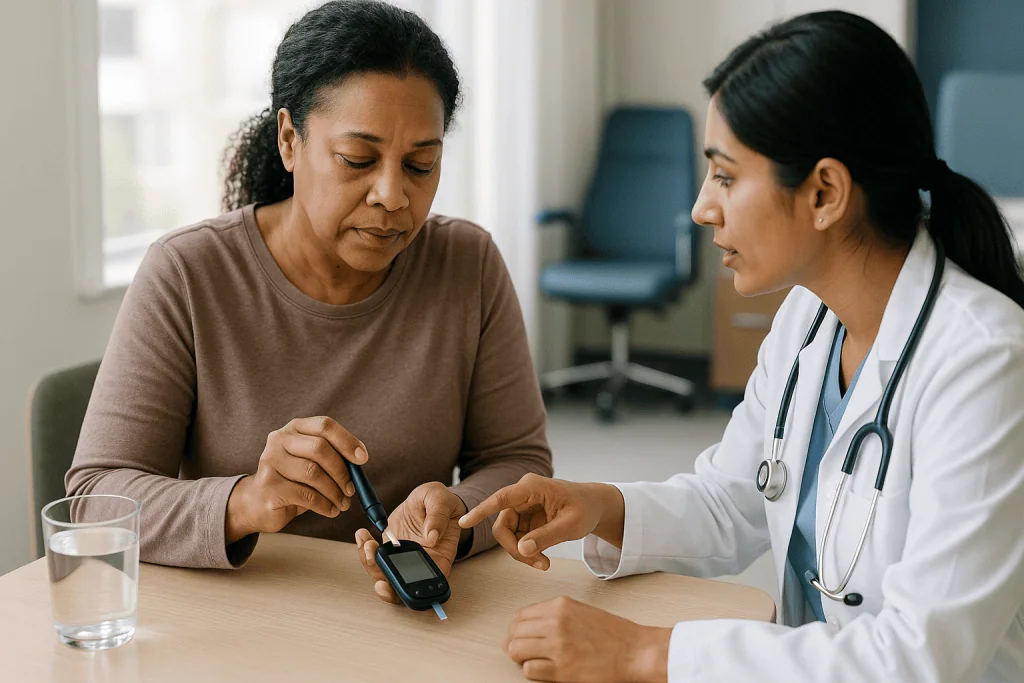
There are two methods. Blood ketone meters use a finger-prick drop, like a glucose meter, and measure beta-hydroxybutyrate, the main ketone in DKA, in millimoles per liter (mmol/L). Urine strips change color in response to acetoacetate, a different ketone, and report a range from negative to large. Blood testing is more accurate and more current; urine results lag behind what is happening in the blood by several hours, because urine collects in the bladder over time, and can stay positive while things are actually improving. The CDC and Cleveland Clinic both describe blood ketone testing as the preferred method where available.
When to test, according to CDC guidance: whenever blood glucose is above 240 mg/dL (13.3 mmol/L), during any illness, and whenever the person has symptoms such as nausea, vomiting, stomach pain or unusual tiredness, regardless of the glucose reading. People taking an SGLT2 inhibitor are often asked to test even at normal glucose because of the euglycemic pattern described earlier; the prescribing team sets that rule.
A few practical points families can own:
- Check the expiry date on strips; expired strips give unreliable results.
- Keep the container tightly closed and dry; urine strips in particular degrade with humidity.
- Wash and dry hands before a blood test, so sugar or lotion on the skin does not skew the result.
- Record the number, the time and what was going on, such as a missed dose or a fever.
Teach a second person in the household to run the test. If the person with diabetes is vomiting or drowsy, someone else needs to be able to get a number quickly.
What the ketone and glucose numbers mean
Numbers only help if everyone in the house reads them the same way. The thresholds below come from NHS guidance on blood ketone levels; the action column reflects general guideline advice and should be replaced by whatever your care team has written in the personal sick-day plan.
| Blood ketone reading (mmol/L) | What it usually means | Typical guidance |
|---|---|---|
| Below 0.6 | Normal | Continue usual routine; recheck if symptoms or high glucose persist |
| 0.6 to 1.5 | Slightly raised; may be an early sign of a problem | Follow the sick-day plan; drink fluids; recheck within a couple of hours; contact the diabetes team if not falling |
| 1.6 to 2.9 | Increased risk of DKA | Contact the diabetes team or urgent care now |
| 3.0 or above | Very high risk of DKA | Emergency medical help immediately |
Urine strips map roughly as follows: “trace” or “small” is a prompt to recheck and hydrate; “moderate” or “large” is a call for medical advice, particularly with high glucose or symptoms.
Glucose numbers need context. A high reading with no ketones is usually a hyperglycemia problem to be corrected under the plan. A high reading with ketones is a DKA warning. A normal or only mildly raised reading with ketones can still be dangerous, especially in pregnancy, in people on SGLT2 inhibitors, or when someone has not eaten for a long time and is vomiting.
Trend beats snapshot. Write the time next to each result. A reading of 1.0 that was 0.6 two hours earlier tells a different story from a 1.0 that was 1.8. If the numbers are rising, or the person is vomiting and cannot keep fluids down, the table stops being a guide and becomes a reason to call.
Hydration after DKA: what helps and what quietly makes things worse
Dehydration is both a cause and a consequence of DKA. High glucose drags water out through the kidneys; vomiting adds to the loss; and a dry body concentrates ketones further. Hospital fluids reverse the crisis, but the body often keeps losing more than usual for a day or two afterward as glucose settles.
The principle at home is steady, small volumes rather than large gulps that trigger nausea. Water is the default. Clear broths add some salt, which matters because sodium and potassium were part of what was lost. Sugar-free drinks are appropriate when glucose is high; drinks containing carbohydrate have a place when glucose is normal or low and the person cannot manage solid food, because the body still needs some glucose to use insulin safely. The sick-day plan from the care team should spell out which situation calls for which, and families should follow that rather than guessing.
Things that undermine hydration: alcohol, which increases urine output and clouds judgment about doses; very sweet drinks when glucose is already high; and trying to “catch up” by downing a liter at once, which usually comes straight back.
Signs the person is still behind on fluids include a dry mouth, dark urine, dizziness on standing, a headache and a fast heartbeat. Signs that go beyond what home fluids can fix include being unable to keep anything down for several hours, very little urine, or increasing drowsiness. Mayo Clinic lists persistent vomiting and inability to tolerate fluids among the reasons to seek emergency care during a suspected DKA episode, and the same logic applies in recovery.
One practical habit helps more than any product: a refilled glass that is always within reach of wherever the person is resting.
Sick day rules for diabetes: the version families can actually follow
Most DKA episodes that follow an infection happen because the usual rules of thumb break down when someone feels dreadful. “Sick day rules” are a short written plan from the diabetes team for exactly those days. The NHS and CDC versions share the same backbone.
Never stop insulin. This is the rule people get wrong most often. When a person is not eating, it feels logical to skip injections, but illness raises stress hormones that push glucose up and ketones along with it. Insulin requirements often go up during illness, not down. How much to adjust, and when, is set by the prescribing clinician and the written plan, never improvised.
Check more often. Glucose and ketones both, at the intervals written in the plan, and more frequently if readings are climbing.
Keep fluids going, following the sugar-free versus carbohydrate guidance above. If solid food is impossible, carbohydrate in liquid form, in the amounts the plan describes, keeps the body from tipping into starvation ketones.
Treat the illness. Fever, a chest infection or a urinary infection may need its own assessment; do not assume “it is just the diabetes”.
Know who to call, and when. The plan should name a daytime contact and an out-of-hours route.
A family’s role is logistics: keeping the plan visible, fetching supplies, timing checks, writing numbers down, and making the call when the plan says to. The person with diabetes remains in charge of their own body, but on a bad day a second set of eyes on the clock is genuinely protective. Rehearse the plan on a well day so no one is reading it for the first time at 2 a.m.
Insulin after DKA: why the plan may change, and why that is not a setback
People are often sent home on a different insulin regimen from the one they arrived with, and that can feel like a demotion. It is usually the opposite: the episode revealed where the old plan failed, and the team adjusted.
Insulin comes in broad functional classes. Long-acting (basal) insulin provides a steady background level to suppress ketone production between meals and overnight. Rapid-acting (bolus) insulin covers meals and corrects high readings. Insulin pumps deliver rapid-acting insulin continuously through a small cannula under the skin and replace the basal injection; if the cannula fails, there is no long-acting reserve, which is why pump users can develop DKA within hours of a blockage and are often asked to keep injectable insulin as a backup.
Common changes after an episode include switching to a different basal insulin, adding a correction scale for high readings, replacing a pump set more frequently, or moving from a pump to injections for a period. For someone newly diagnosed, the first weeks are about learning the basics and letting doses settle as the team sees real-world numbers.
What families can help with: storing unopened insulin in the refrigerator and in-use pens at room temperature out of direct heat, since heat-damaged insulin loses potency; rotating injection sites so lumpy, scarred tissue does not absorb insulin unpredictably; and keeping enough supply that running out is never the reason for a missed dose.
What families should not do is suggest skipping, reducing or doubling a dose based on a reading. Every adjustment, including the correction rules for high glucose, belongs to the prescribing clinician. If a number is worrying, the right move is a call, not a change.
DKA recovery time: what the following days and weeks usually look like
Recovery is rarely a straight line. The acid balance is corrected in hospital, but the body spent hours or days running on fat and losing salts, and it takes time to feel normal again.
In the first days, expect fatigue, achy muscles, thirst, and a touch of brain fog. Appetite returns gradually. Glucose readings often swing more than usual as the team’s new plan settles and as the stress hormones from the illness fade. Weight that dropped during the episode, mostly fluid, comes back quickly.
Over the following week or two, energy improves and the person can usually return to school or work in stages, a decision the care team makes with them. If an infection triggered the episode, its own course sets the pace. Mood can dip. Many people describe a mix of relief, embarrassment and fear of it happening again, and that is worth naming out loud.
The follow-up appointment typically covers the trigger, the revised insulin plan, a review of equipment and technique, a check of kidney function and electrolytes if needed, and education or re-education on sick-day rules. For someone newly diagnosed, several visits are usually scheduled close together.
What makes recovery stall: skipping the follow-up, resuming heavy exercise while ketones are still present (the CDC advises against exercising with ketones because activity can raise them further), alcohol in the first days, and going back to the same supply gaps or routines that caused the episode.
The honest answer to “how long” is that it varies with age, how severe the episode was, what caused it and what else is going on. Instead of a fixed number, ask the team what milestones they expect and what would make them want to see the person sooner.
Who needs the closest aftercare, and who is usually asked to wait
Everyone who has had DKA needs follow-up, but some situations call for more support, and some activities are routinely put on hold.
Groups who usually need a closer watch:
- People newly diagnosed with type 1 diabetes, who are learning everything at once while still unwell.
- Teenagers and young adults, where school, independence and social pressures collide with a demanding routine.
- Insulin pump users, because set failures can cause DKA fast.
- People living alone, older adults, and anyone with memory or vision problems that make checks harder.
- Anyone who has had more than one episode, where the team will look hard at what the pattern is telling them.
- People in whom insulin omission is linked to disordered eating or distress. This is a recognized problem that needs a compassionate, specialist response rather than monitoring from relatives.
- Pregnant women, where DKA can develop at lower glucose levels and carries risks for both mother and baby.
Things people are usually asked to wait on until the team clears them:
- Strenuous exercise or sport, until ketones are clear and glucose is stable.
- Driving, if hypoglycemia awareness is uncertain or readings are swinging; licensing rules for drivers with diabetes vary by jurisdiction and should be checked.
- Alcohol, because it masks symptoms and interferes with eating and timing.
- Long trips or anywhere far from supplies and care while the plan is still being adjusted.
For families, this list is a useful way to turn vague anxiety into specific support: a ride to the follow-up, a check-in text at dose times for someone living alone, or simply making sure the teenager’s backpack has strips and a spare pen.
Supporting without policing: the emotional side of DKA aftercare and family support
Numbers are easy to count. Feelings are harder, and they decide whether the next episode happens.
Diabetes distress, the exhaustion and resentment that come from managing a condition every hour of every day, is common and is one of the main reasons people skip doses or checks. An episode of DKA tends to make it worse: the person may feel they failed, or feel watched, or feel frightened of their own body. A family that responds with surveillance, however loving, can push someone into hiding readings rather than sharing them.
A few principles hold up well.
Ask, do not audit. “What would help today?” lands differently from “Did you check?” If you do need to see numbers, agree in advance how and when.
Separate the person from the reading. A high number is information, not a verdict. Comments about weight, willpower or eating are not helpful and can be harmful.
Keep the decisions theirs. For adults, the person with diabetes owns their plan; families support it. For children and teens, parents share the work, but the care team usually encourages a gradual hand-over of responsibility rather than a sudden one.
Watch for the quieter signs of struggle: missing supplies that are never reordered, readings that stop being logged, secrecy around food, unexplained high results. These are prompts to involve the care team, which often includes a psychologist or counselor, not to confront.
Take care of yourself too. Caregivers of people with a chronic condition often carry their own fear, and a frightened family member is less steady at 2 a.m. than a rested one. Many diabetes services offer family education sessions; asking about one at the follow-up is a reasonable request.
What people often get wrong about DKA aftercare
Correcting a handful of myths does more for safety than any gadget.
“Only people with type 1 get DKA.” It is far more common in type 1, but it can happen in type 2 diabetes during severe illness or with certain medicines, and it can be the first sign of undiagnosed diabetes in anyone, as Mayo Clinic notes.
“If glucose is normal, there is no DKA.” Ketoacidosis with near-normal glucose is a recognized pattern, particularly with SGLT2 inhibitors and in pregnancy. Symptoms plus ketones matter even when the glucose meter looks reassuring.
“Stop insulin when you are not eating.” This is the single most dangerous misunderstanding. Illness raises insulin needs. The amount is for the clinician to set, but the answer to “should I skip it?” is never yes without medical advice.
“A negative urine strip means all clear.” Urine ketones lag behind blood ketones. A blood test, where available, is the better guide, and symptoms override a reassuring strip.
“Drinking lots of water will flush the ketones out.” Fluids are essential, but ketones are produced because insulin is lacking. Water cannot replace insulin.
“Exercise will bring the sugar down.” With ketones present, exercise can raise them further and worsen the situation; the CDC advises against it.
“Once home, the danger is over.” The riskiest period for a repeat episode is when the trigger has not yet been fixed, which is exactly the stretch between discharge and follow-up.
“The hospital stay means the person was careless.” Supply gaps, pump failures, infections and undiagnosed type 1 account for a great many episodes. Blame makes the next one more likely, not less.
Questions to ask your care team at the follow-up
Follow-up appointments are short, and the person who was in hospital may still be foggy. Going in with a list, and a relative who can take notes, turns a rushed visit into a useful one. Reasonable questions include:
- What do you think triggered this episode, and what has been changed to address it?
- Which insulin or insulins am I on now, how does each one work, and what has changed from before?
- What is my personal sick-day plan, in writing, including when to check ketones, how to adjust fluids, and whom to call at night and on weekends?
- At what ketone and glucose readings should I call, and at what readings should I go straight to emergency care?
- Should I be using blood ketone testing, and can my family be shown how to do it?
- If I use a pump, what is my backup plan if a set fails, and how quickly should I switch to injections?
- Are any of my other medicines, including the ones for blood pressure or other conditions, relevant to DKA risk?
- When can I return to work or school, exercise, and drive?
- Are there any blood tests you want repeated, and when?
- Is there a diabetes educator, dietitian or psychologist I can see, and can a family member attend?
- How do I make sure I never run out of insulin or strips, and what should I do if I do?
- When is the next appointment, and what would make you want to see me sooner?
Write the answers down in the same notebook as the readings. One document, in one place, read by everyone involved, is worth more than a dozen half-remembered instructions.
When to call your doctor: red-flag signs after DKA
Most recovery days are uneventful. The point of family support is to recognize the day that is not.
Contact the diabetes team or an urgent care line the same day if:
- Blood ketones are in the slightly raised range and not falling after following the sick-day plan.
- Glucose stays above the level named in the plan despite correction.
- The person has a fever, a new cough, burning on urination or another sign of infection.
- They are unsure about a dose, have missed one, or suspect insulin was damaged by heat.
- A pump has alarmed, a set has failed, or the person is unsure it is delivering.
- They are struggling emotionally, or you are concerned about skipped doses.
Call emergency services or go to the emergency department immediately if any of the following appear, in line with NHS, CDC and Mayo Clinic guidance:
- Blood ketones at 3.0 mmol/L or above, or “large” on a urine strip, particularly with high glucose or symptoms.
- Repeated vomiting, or inability to keep fluids down for several hours.
- Stomach pain that is severe or getting worse.
- Deep, rapid or labored breathing, or a fruity smell on the breath.
- Confusion, unusual drowsiness, difficulty waking, or fainting.
- Severe dehydration: very little urine, extreme thirst, a racing heart.
- Any return of the symptoms that led to the original hospital admission.
Do not wait for a second reading to confirm a high ketone result when symptoms are present. Do not give extra insulin or withhold it on your own judgment; tell the emergency team what has been taken and when. Bring the meter, the notebook, the insulin pens or pump, and the discharge letter.
Every one of these decisions sits with the treating team. The family’s job is to notice early and make the call.
Frequently asked questions
What is the most useful thing a family can do after someone has had DKA?
Make the routine easy to keep. Put the ketone and glucose meters, strips, the written sick-day plan and the care team’s number in one visible place, help with checks at the agreed times, keep fluids within reach, and attend the follow-up with a list of questions. Calm, practical help works better than monitoring every reading.
How do I check ketones at home, and which test is better?
A blood ketone meter uses a finger-prick drop and gives a current reading in mmol/L; urine strips change color but lag behind blood levels by hours. Guidance from the CDC and Cleveland Clinic favors blood testing where available. Test whenever glucose is high, during illness, or whenever nausea or stomach pain appear.
What blood ketone level means we should go to the emergency department?
NHS guidance treats a blood ketone reading of 3.0 mmol/L or above as very high risk requiring emergency help, and 1.6 to 2.9 as a reason to contact the care team urgently. With vomiting, confusion, deep rapid breathing or inability to keep fluids down, seek emergency care regardless of the exact number.
How long does DKA recovery time usually take?
It varies. Fatigue, aching muscles and swinging glucose readings are common in the first days, and energy returns gradually over the following week or two, depending on age, severity and what triggered the episode. The care team sets the pace for returning to work, school, exercise and driving, and can say what milestones they expect.
What causes diabetic ketoacidosis to come back after a hospital stay?
Usually an unfixed trigger: missed or reduced insulin, a failed pump set, heat-damaged insulin, an infection that has not cleared, or running out of supplies. Certain medicines, including SGLT2 inhibitors, and pregnancy also raise the risk. The follow-up visit exists to identify the trigger and change the plan accordingly.
Should someone skip insulin if they are vomiting and not eating?
No. Illness raises stress hormones that increase insulin needs, so stopping insulin during vomiting is one of the most common routes into DKA. How much to take, and whether to adjust, is set by the prescribing clinician in the written sick-day plan. If the person cannot keep fluids down, that is a reason to seek urgent care.
What are the sick day rules for diabetes that families should know?
Never stop insulin; check glucose and ketones more often, at the intervals in the written plan; keep fluids going, using sugar-free drinks when glucose is high and carbohydrate-containing drinks when it is not and food is impossible; treat the underlying illness; and know whom to call at any hour. Rehearse the plan on a well day.
What should the person drink after DKA?
Small, frequent sips of water are the default, with clear broth adding some of the salt that was lost. Which drinks are appropriate at a given glucose level is spelled out in the sick-day plan. Alcohol and large sweet drinks when glucose is high both work against recovery. Inability to keep fluids down needs medical attention.
Can DKA happen when blood sugar is normal?
Yes. Ketoacidosis with near-normal glucose is a recognized pattern, particularly in people taking SGLT2 inhibitors, in pregnancy, and after long periods without food while unwell. Nausea, stomach pain, deep breathing or a fruity breath smell with ketones present should prompt a call even if the glucose meter looks reassuring.
Is it safe to exercise while recovering from DKA?
Not while ketones are present. The CDC advises against exercising with ketones because activity can raise them further and worsen the situation. Once ketones are clear and glucose is stable, the care team can advise on returning to activity in stages, which is usually a gradual process rather than a single date.
References
- NHS: Diabetic ketoacidosis
- CDC: Diabetic Ketoacidosis
- MedlinePlus: Diabetic ketoacidosis
- Cleveland Clinic: Diabetic Ketoacidosis (DKA)
This article is for general information only and is not a substitute for professional medical advice. Please consult a qualified doctor about your individual situation.
Add us as a Preferred Source to see more of our trusted health content across Google Search, AI Overviews and Discover.

More from the Blog

How Do Doctors Find the Cause of Hyperthyroidism? Antibody Tests, Ultrasound and Imaging
Doctors find the cause of hyperthyroidism in layers. A blood test showing low TSH with raised free T4 or T3 confirms the thyroid is…

Thyroid Medication and Supplements in Hashimoto Thyroiditis: Why Timing and Absorption Matter
In Hashimoto thyroiditis, thyroid hormone replacement (usually levothyroxine) works best when taken consistently on an empty stomach, and common supplements such as iron, calcium,…

Pituitary Surgery for Gigantism: How the Adenoma Is Reached Through the Nose
Pituitary surgery for gigantism removes the growth hormone-producing adenoma through the nose, using a thin camera passed along the nasal passage and through the…

What Do Continuous Glucose Monitors and Insulin Pumps Change in Type 1 Diabetes Care?
Continuous glucose monitors and insulin pumps change type 1 diabetes care mainly by replacing guesswork with trend data and replacing manual injections with programmable,…

Why Does Your Endocrinologist Want to Know Early About Pregnancy Plans With Hashimoto?
Your endocrinologist asks about pregnancy plans early because a developing baby depends entirely on the mother's thyroid hormone until roughly week 12, and the…

When Does Medication Come Before or After Acromegaly Surgery? How the Sequence Is Decided
In acromegaly, surgery to remove the pituitary tumor is usually the first treatment, and medication typically follows only if growth hormone remains high afterward.…