

Pituitary Surgery for Gigantism: How the Adenoma Is Reached Through the Nose

Key Takeaways
- Gigantism and acromegaly are the same growth hormone-secreting adenoma at different ages: before the growth plates close it lengthens bones; afterward it thickens them.
- The pituitary sits directly above the sphenoid sinus behind the nose, which is why surgeons can reach the tumor through a nostril without entering the brain or leaving a visible scar.
- IGF-1, the liver hormone driven by growth hormone, is the main blood marker used both to confirm the diagnosis and to judge whether treatment has worked.
- Tumor that has grown into the cavernous sinuses beside the gland usually cannot be fully removed, so medicines and monitoring are often planned alongside surgery from the outset.
- The most common early complications are cerebrospinal fluid leak and temporary loss of water balance, both recognizable at home by clear nasal drip or extreme thirst with heavy urination.
- Surgery cannot reverse height already gained; its purpose is to stop further excess growth and remove the long-term cardiovascular and metabolic strain of the hormone.
Pituitary surgery for gigantism removes the growth hormone-producing adenoma through the nose, using a thin camera passed along the nasal passage and through the sphenoid sinus to the gland, so no incision is made on the face or skull. It is usually considered when the tumor is causing excess growth in a child or teenager. Recovery typically takes weeks, and hormone levels are rechecked over months. The treating team decides timing and suitability.
The pediatrician’s tape measure ran out before the boy did. He was eleven, a head taller than anyone in his class, and his shoes had gone up two sizes since the spring. What his parents had put down to a lucky growth spurt turned out, after a blood test and an MRI, to be a small tumor pressing on a gland the size of a pea at the base of his brain. The next word they heard was surgery.
That conversation is where this article begins. Pituitary surgery for gigantism sounds alarming, partly because the tumor sits so close to the brain and partly because the route the surgeon takes, through the nose, is hard to picture. Families arrive with two questions: how does anyone reach a tumor there without opening the skull, and how serious is it?
Both questions have clear, evidence-based answers. What follows explains the anatomy, the operation itself, the days and months afterward, and the honest limits of what surgery can and cannot do.
What is pituitary surgery for gigantism, in plain words?
The pituitary is a small gland that hangs from the underside of the brain and releases the hormones that run growth, metabolism, stress response and reproduction. In gigantism, a benign tumor called an adenoma grows inside this gland and pumps out far too much growth hormone, the chemical signal that tells bones and tissues to lengthen. Because the child’s growth plates, the soft cartilage zones at the ends of long bones, have not yet closed, the excess hormone drives the whole skeleton upward. MedlinePlus describes gigantism as abnormally large growth caused by excess growth hormone in childhood, before the plates fuse.
Pituitary surgery for gigantism is the operation that removes that adenoma. The aim is twofold: to take away the source of the hormone and to relieve any pressure the tumor is putting on nearby structures, especially the optic nerves that run just above the gland. Surgeons reach the tumor by passing instruments through a nostril, along the back of the nasal cavity and through a hollow bone chamber called the sphenoid sinus, which sits directly beneath the pituitary. The technique is known as transsphenoidal surgery, literally “across the sphenoid.”
It matters to say early what this operation is not. It is not brain surgery in the sense most people imagine; the brain itself is not entered. Nor is it a guarantee that hormone levels will fall to normal. Whether the whole tumor can be removed depends on its size and on whether it has spread sideways into the veins that flank the gland. Those details, visible on MRI, shape every decision the treating team makes, and they are the reason two children with the same diagnosis may be offered different plans.
Gigantism vs acromegaly: why the same tumor causes different problems
Gigantism and acromegaly are the same disease arriving at different ages. Both are caused, in the great majority of cases, by a growth hormone-secreting pituitary adenoma. The difference lies in timing. If the tumor appears before puberty finishes and the growth plates seal, the excess hormone lengthens the long bones and the child grows unusually tall: gigantism. If it appears in adulthood, when the plates have already fused, bones can no longer lengthen but they can thicken, so hands, feet, jaw and brow enlarge instead: acromegaly. The NHS and Mayo Clinic both describe acromegaly as a condition typically diagnosed in middle age, which is exactly why height is not part of its picture.

The mechanism is worth understanding because it explains what surgeons and endocrinologists are chasing. Growth hormone from the pituitary travels to the liver, which responds by releasing insulin-like growth factor 1, or IGF-1, the hormone that actually instructs tissues to grow. When a child is tested for gigantism, it is usually IGF-1 that is measured first, because it stays steady through the day while growth hormone rises and falls in pulses.
Excess growth hormone does more than change height. Over years it enlarges the heart, thickens soft tissues in the airway, raises blood sugar and stresses joints. That is the reason clinicians treat gigantism as a hormone disorder with long-term consequences rather than as a question of stature alone, and it is why removing or shrinking the source is considered so important. A teenager who has stopped growing taller still carries the same tumor and the same metabolic strain, which is why the surgical conversation does not end when the growth plates close.
How rare is gigantism, and why does that shape the surgical plan?
Pituitary gigantism is genuinely rare. MedlinePlus lists it as a very rare condition, and Cleveland Clinic notes that reported cases in the medical literature run to the low hundreds rather than the thousands. Its adult counterpart, acromegaly, is uncommon too; the NHS describes it as rare and usually recognized only after years of slow change. Set those numbers against the roughly one in ten adults who carry a small, silent pituitary adenoma found incidentally on scans, and the picture becomes clearer: pituitary tumors are common, but growth hormone-secreting tumors that start in childhood are exceptional.
Rarity has practical consequences. Few surgeons operate on children with gigantism often, so pediatric cases are usually managed by teams that combine a pituitary surgeon, a pediatric endocrinologist, an ophthalmologist and, where genetic causes are suspected, a genetics service. Cleveland Clinic points out that a proportion of childhood cases have an inherited component, and some run in families alongside other hormone-producing tumors. Genetic testing can change follow-up plans for siblings and for the child’s own future.
Rarity also means the evidence base is thinner than for adult acromegaly. Most of what is known about surgical technique, complication rates and long-term hormone control comes from adult series. When you see a figure quoted for outcomes in gigantism, ask whether it came from children or from adults, because the two groups differ in tumor size at diagnosis, in the frequency of genetic drivers, and in how the tumor behaves. Honest clinicians will say when they are extrapolating. That is not a weakness in the team; it is the state of the science for a condition this uncommon.
How is the adenoma reached through the nose?
The geography is the key to understanding the operation. The pituitary sits in a shallow bony cup at the base of the skull called the sella turcica, Latin for “Turkish saddle.” Directly below that cup, separated only by a thin plate of bone, is the sphenoid sinus, one of the air-filled chambers behind the nose. Anyone who has felt pressure deep behind the eyes during a heavy cold has felt the sphenoid sinus. Because the pituitary essentially rests on the ceiling of that sinus, the nose offers a natural corridor to the gland that avoids the brain entirely.
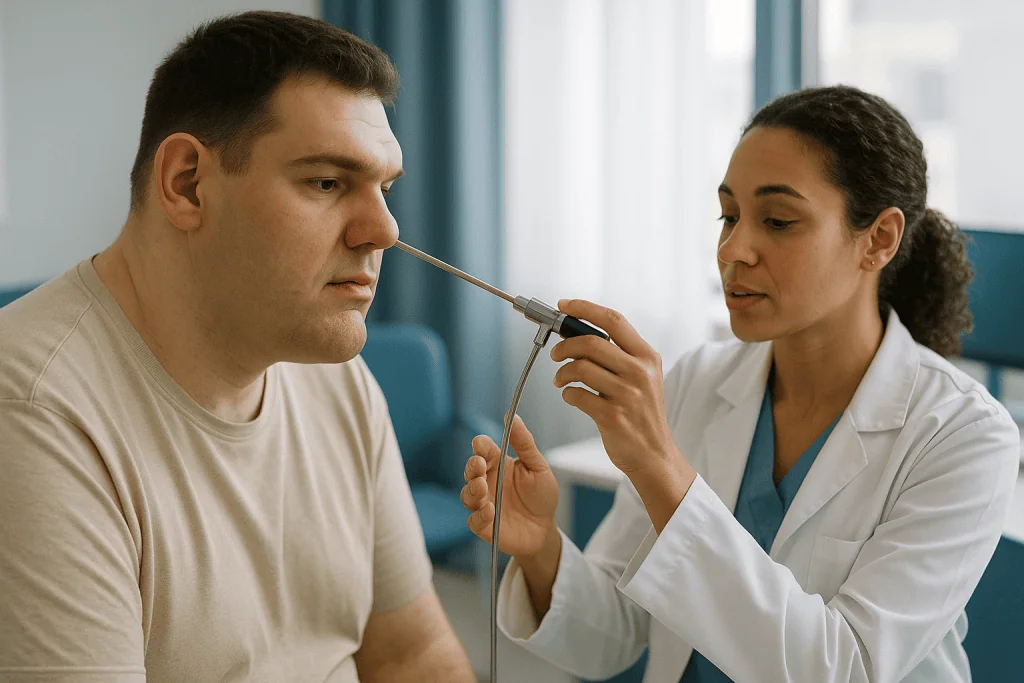
In modern practice the surgeon uses an endoscope, a slender rod with a light and a high-definition camera at its tip, passed through one or both nostrils. The image appears on a screen in the operating room, magnified many times. Working alongside the endoscope, long fine instruments travel the same route. The surgeon opens the back wall of the nasal cavity, enters the sphenoid sinus, then removes the thin bone floor of the sella to expose the dura, the tough membrane that wraps the pituitary.
Mayo Clinic and the NHS both describe this transsphenoidal approach as the standard way of removing pituitary tumors, replacing the older method of reaching the gland from above through an opening in the skull. The endoscopic version has largely replaced the microscope-based version because the camera can look around corners, letting the surgeon see the sides of the tumor cavity. In some centers an ear, nose and throat surgeon and a neurosurgeon operate together, one managing the nasal corridor and the other the tumor. The route leaves no external scar, and the nasal tissues that are moved aside are repositioned at the end.
What actually happens in the operating room, step by step
The child is put fully to sleep under general anesthesia and positioned with the head gently tilted. A navigation system, which works rather like satellite mapping using the preoperative MRI, is often registered to the head so the surgeon can confirm position at any moment. The first stage is the nasal corridor: the mucosa lining the nose is moved aside, the sphenoid sinus is opened, and its septum, a thin internal wall, is cleared to give a straight view of the sella floor.
Next comes exposure. The bone over the pituitary is thinned and lifted away, and the dura is opened with a small cut. Growth hormone adenomas are usually softer and paler than the normal gland, which helps the surgeon distinguish tumor from healthy tissue. Using small curettes and suction, the surgeon removes the adenoma piece by piece, working from the center outward and checking the cavity walls with the angled endoscope. The goal is to remove all visible tumor while leaving as much normal pituitary as possible, since the child will rely on that gland for the rest of their life.
Closure is a craft in itself. If the thin membrane above the gland has been breached and cerebrospinal fluid, the clear liquid that cushions the brain, has leaked, the surgeon seals the opening with the child’s own tissue, sometimes a small piece of fat from the abdomen or a flap of nasal lining, plus synthetic sealant. Nasal packing may or may not be used. Operating time varies with tumor size and complexity; the team will give a typical range for the specific case rather than a fixed number. The child then wakes in recovery with a nose that feels blocked, a mild headache, and no visible wound.
Who is pituitary surgery for gigantism usually offered to, and who is asked to wait?
Surgery is generally the first-line treatment when a growth hormone adenoma is confirmed by blood tests and MRI, and the NHS and Mayo Clinic both list it as the primary option for acromegaly, the adult form of the same disease. The case for operating is strongest when the tumor is confined to the sella, when it presses on the optic nerves and threatens vision, or when its hormone output is driving rapid growth and metabolic strain. In those situations, removing the tumor addresses both the mass and the hormone in one step.
Some children are asked to wait, or are offered medicine first. The most common reason is tumor extension into the cavernous sinuses, the pairs of large veins on either side of the pituitary that also carry the nerves controlling eye movement. Tumor that has grown into these spaces cannot be removed completely without unacceptable risk, so the team may aim to reduce hormone levels with medication, shrink what can be shrunk, and then decide whether an operation would remove enough tumor to be worthwhile. Very large tumors are sometimes treated in stages.
Medical reasons can also delay surgery. Uncontrolled high blood sugar, an enlarged heart under strain, or significant airway thickening all raise anesthetic risk, and anesthetists prefer to bring those under control first. A child who is acutely unwell with another illness will usually be rescheduled. None of these delays means surgery is off the table; they mean the team is sequencing treatments to make the operation as safe as it can be. The decision, and its timing, rests with the treating team after weighing the scan, the hormone results and the child’s overall health.
How is a child prepared for pituitary surgery?
Preparation begins with a full picture of the pituitary. Blood tests check not only growth hormone and IGF-1 but every other hormone the gland controls: thyroid, cortisol from the adrenal glands, and the sex hormones that drive puberty. A tumor can suppress these by crowding out normal tissue, and low cortisol in particular must be corrected before anesthesia because the body needs it to cope with surgical stress. An eye examination maps the visual fields, giving a baseline to compare against afterward. An ear, nose and throat review looks at the nasal passages the surgeon will use.
Children are prepared differently from adults. Most pediatric teams use a child-life or play specialist who explains the hospital in age-appropriate language, shows the child the mask used for anesthesia, and sometimes offers a tour of the ward. Younger children may be given a small toy or picture book about hospitals; teenagers usually want straight answers and a say in the plan. Parents are often invited into the anesthetic room until the child is asleep.
Practical steps in the last days are simple. Fasting instructions are given for the night before, and the anesthetist will explain exactly when eating and drinking must stop. Any medicines the child already takes are reviewed by the prescribing clinician, who decides what continues and what pauses; families should not change anything on their own. Packing a familiar pillowcase, a favorite blanket and headphones helps the first night on the ward, when the nose feels stuffy and sleep is light. Ask the team who will be the single point of contact after discharge, and write down that name and number before the day of surgery.
Surgery, medicines or radiation: how the options compare
Surgery is rarely the only tool, and for many children it is one step in a longer plan. The NHS and Mayo Clinic describe three broad approaches for growth hormone excess, each with a different job. The table below sets them side by side; the right combination is decided by the treating team based on the scan, the hormone levels and how the child responds.
| Approach | What it does | Typical role | Main considerations |
|---|---|---|---|
| Transsphenoidal surgery | Physically removes the adenoma through the nose | First-line for most confined tumors and for tumors pressing on vision | Immediate reduction in tumor mass; may leave residual tumor if it extends into the cavernous sinuses |
| Medicines (somatostatin analogs, growth hormone receptor blockers, dopamine agonists) | Reduce hormone release or block its effect at the tissues | Before surgery to lower risk, after surgery for residual disease, or when surgery is not possible | Ongoing treatment; effect on tumor size varies by class; monitored by blood tests |
| Radiation therapy | Slowly damages remaining tumor cells over years | Residual or regrowing tumor not controlled by surgery and medicine | Delayed effect; risk of later loss of normal pituitary function |
A few points deserve emphasis. Somatostatin analogs mimic a natural brake hormone and reduce growth hormone output; growth hormone receptor blockers act downstream, stopping the hormone from working at the liver and tissues; dopamine agonists are older drugs with a modest effect in this setting. All are prescribed and adjusted only by the endocrinologist. Radiation is used sparingly in children because its effects build over years and can reduce other pituitary hormones, which then need replacing. Whichever path is followed, the endpoint is the same: bringing IGF-1 into the normal range for the child’s age and keeping it there.
What the first days and weeks after surgery usually look like
The first night is about watching. Nurses check fluid balance closely, because the operated gland can briefly lose control of the hormone that tells the kidneys to hold onto water. If that happens, the child produces large volumes of dilute urine and becomes very thirsty, a condition traditionally called diabetes insipidus and now often termed arginine vasopressin deficiency. It is usually temporary and is treated by the medical team; the point for parents is that constant thirst and frequent bathroom trips are reported, not ignored. Blood sodium is measured regularly for the same reason.
Hospital stays after transsphenoidal surgery are typically measured in days rather than weeks, according to Cleveland Clinic’s description of pituitary tumor care, though the exact length depends on how the child is doing and whether a cerebrospinal fluid leak needed repair. Headache and nasal congestion are expected; a feeling of pressure behind the eyes eases over the first week. Children are asked not to blow their nose, sneeze with an open mouth if they can, and avoid bending, heavy lifting and straining for several weeks so the repair at the back of the nose can knit.
Once home, the pattern is gradual. Saline nasal rinses, if the team prescribes them, keep the healing lining moist and clear crusting. School return is usually a matter of weeks and is decided case by case. Fatigue is common and is partly hormonal: cortisol levels may be checked in the days after surgery, and some children need short-term replacement while the gland recovers, adjusted only by the endocrinologist. The first follow-up visit typically includes a nasal examination and a review of hormone results, and the team will say when an MRI is worth repeating, usually not before the operated area has settled.
How serious is pituitary surgery? The risks, stated plainly
Any operation near the base of the skull carries risk, and the honest answer is that transsphenoidal surgery is serious but well-established, with a complication profile that is understood and, in most cases, manageable. Mayo Clinic, the NHS and MedlinePlus describe the same core list, which is worth walking through without either alarm or minimization.
The most frequent early problem is a cerebrospinal fluid leak, recognized as clear, watery fluid dripping from the nose, especially when leaning forward. Small leaks are repaired at the time of surgery; a leak that appears afterward may need a return to theater or a temporary drain. Meningitis, infection of the membranes around the brain, is the reason leaks are taken seriously. Bleeding in the nose is usually minor but occasionally heavy. Temporary disturbance of water balance, described above, is common and typically resolves.
Longer-term risks concern the gland itself. Removing tumor can damage normal pituitary tissue, leaving the child short of one or more hormones, a state called hypopituitarism. Thyroid, cortisol, growth hormone and sex hormones can each be affected and replaced under an endocrinologist’s care, but replacement is lifelong for some children. Vision can worsen rather than improve if the optic nerves or their blood supply are disturbed, though the far more common experience is that pressure on the nerves is relieved. Injury to the large carotid arteries running through the cavernous sinuses is rare but is the reason surgeons stop short of tumor that wraps around them. Loss of sense of smell and nasal crusting are quality-of-life issues that deserve a mention.
The final risk is one of expectation: the tumor may not be fully removed, and hormone levels may stay high. That outcome is not a failure of care. It is the reason surgery sits within a plan that includes medicine and monitoring rather than standing alone.
Pituitary macroadenoma life expectancy and long-term outlook
A macroadenoma is simply a pituitary adenoma larger than a centimeter, roughly the width of a fingernail; a microadenoma is smaller. Growth hormone tumors in children are often macroadenomas at diagnosis, because they have usually been growing for years before the height difference is noticed. Size alone does not decide the outlook. What matters is whether the tumor presses on vision, whether it can be removed, and above all whether growth hormone and IGF-1 can be brought into the normal range.
The question families ask most is about life expectancy, and the evidence gives a two-part answer. Untreated or uncontrolled growth hormone excess shortens life; the NHS notes that acromegaly, if not treated, can lead to serious complications including heart disease, high blood pressure, diabetes and sleep apnea, and Mayo Clinic lists the same cardiovascular and metabolic risks. Those complications, rather than the tumor itself, are what historically reduced survival. When hormone levels are controlled, whether by surgery, medicine or both, the excess risk falls substantially, and the NHS describes treated acromegaly as a condition most people live with for a normal length of time. No source gives a reliable life-expectancy figure specific to pituitary gigantism, because the condition is too rare for large studies; clinicians extrapolate from adult acromegaly data.
Long-term follow-up is therefore not optional. Even after apparently complete removal, tumors can regrow, sometimes years later, so periodic IGF-1 testing and interval MRI scans continue into adulthood. Heart function, blood pressure, glucose, sleep quality and joint health are reviewed alongside the hormone results. Height, once gained, does not reverse, and some adults who had gigantism live with joint strain and the practical challenges of very tall stature. Those are real, and a good team plans for them, but they are separate from the question of survival, which turns on hormone control.
What people often get wrong about pituitary surgery for gigantism
The first misconception is that the surgeon goes “through the brain.” In the transsphenoidal approach the brain is never entered; the pituitary sits below it, outside the brain’s own membranes, and the nose provides a direct route beneath. Parents who understand this usually sleep better the night before.
The second is that surgery reverses height. It does not. Bone that has lengthened stays lengthened. What surgery aims to do is stop further excess growth and remove the metabolic and cardiovascular strain of the hormone. A child operated on before the growth plates close will still reach an adult height above what they would otherwise have had, and honesty about that from the start avoids disappointment later.
Third, many assume that a benign tumor is harmless. Pituitary adenomas are almost never cancerous and do not spread to other organs, but a benign tumor that makes hormone and presses on the optic nerves can cause serious harm. “Benign” describes what the cells are, not what they do.
Fourth, families sometimes believe that once the tumor is out, the story ends. Hormone levels can remain high if tumor has been left in the cavernous sinuses, and even complete-looking removal needs years of monitoring for regrowth. Equally, the gland may need time to recover, and some children require hormone replacement afterward. Lifelong endocrine follow-up is the norm, not a sign that something went wrong.
Finally, there is the belief that medicines are a lesser alternative chosen only when surgery is refused. In reality, medication is often part of the plan by design, given before surgery to reduce anesthetic risk or after it to control residual disease. The choice between approaches is not a hierarchy; it is a sequence tailored to the scan and the numbers, and it belongs to the treating team.
Questions to ask your care team before pituitary surgery
Consultations move fast, and the questions that matter most are easy to forget in the room. Writing them down beforehand, and asking one person on the team to walk through the answers, changes the experience. The list below is a starting point rather than a script; the team may raise others specific to the scan.
- How large is the tumor, and does the MRI show extension into the cavernous sinuses or upward toward the optic nerves?
- Is complete removal the goal, or is the plan to remove as much as is safe and treat the rest with medicine?
- Which of the other pituitary hormones are already affected, and will any need replacing before or after surgery?
- What is the plan for the child’s vision, and who will examine the eyes before and after the operation?
- Has genetic testing been considered, and what would a positive result mean for siblings?
- Who will be operating, how is the team organized, and will an ear, nose and throat surgeon be involved?
- What are the typical hospital stay and time off school for a case like this one?
- What signs at home should prompt an immediate call, and to which number?
- When will hormone levels first be rechecked, and when is the first follow-up MRI expected?
- If hormone levels remain high after surgery, what would the next step be?
Two further questions are worth asking directly. First, what is the plan if the surgeon finds during the operation that the tumor is more extensive than the MRI suggested? Teams have a strategy for this, and hearing it in advance is reassuring. Second, what does the team consider a good result for this particular child? The answer will often be framed in terms of IGF-1 in the normal range and stable vision rather than in terms of the tumor alone, and knowing the target helps families read the numbers that follow.
When to call your doctor: red-flag signs after surgery
Most recoveries are uneventful, and most of what a child feels in the first weeks, congestion, mild headache and tiredness, is expected. A small number of signs are different in kind and need same-day contact with the surgical team or, if that is not possible, emergency care. Knowing them in advance turns anxiety into a checklist.
Seek care urgently for any of the following. Clear, watery fluid dripping from the nose, particularly when leaning forward or first thing in the morning, or a salty taste at the back of the throat, may indicate a cerebrospinal fluid leak. A severe headache that is new or rapidly worsening, especially with a stiff neck, fever, confusion or sensitivity to light, raises the possibility of meningitis. Any change in vision, such as blurring, double vision, a shadow at the edge of sight or a drooping eyelid, needs prompt assessment. Heavy or persistent bleeding from the nose that does not settle with gentle pressure is a reason to be seen.
Watch fluid balance closely. Extreme thirst with frequent passing of large volumes of pale urine can signal a disturbance of water regulation; so can the opposite pattern of nausea, headache, unusual drowsiness or a seizure, which may indicate low blood sodium in the first one to two weeks after surgery. Profound weakness, dizziness on standing, vomiting or collapse can point to low cortisol and is an emergency. Fever with worsening nasal pain or foul discharge suggests infection.
Families are also right to call about anything that simply feels wrong, even without a name for it. Teams would far rather field an unnecessary call than miss an early leak or a sodium problem. The number given at discharge should be within reach for the first month, and any decision about tests, medicines or a return to the hospital belongs to the treating team.
Frequently asked questions
How serious is pituitary surgery for gigantism?
It is a serious operation near the base of the skull, but it is well-established and its risks are well understood. The brain itself is not entered. The main complications are cerebrospinal fluid leak, temporary disturbance of water balance, bleeding, infection and loss of normal pituitary hormone function, each of which the team monitors for and manages. The overall risk depends on tumor size and position, and the treating team will discuss what applies to a specific case.
How rare is pituitary gigantism?
Very rare. MedlinePlus describes it as a very rare condition, and Cleveland Clinic notes that reported cases in the medical literature number in the low hundreds. Its adult equivalent, acromegaly, is also uncommon. Because so few children are affected, most evidence about surgery and long-term outcomes comes from adult acromegaly, and clinicians extrapolate from it while acknowledging that children often present with larger tumors and more frequent genetic causes.
What is the life expectancy of someone with pituitary gigantism?
No reliable figure exists specific to gigantism, because the condition is too rare for large studies. Evidence from acromegaly, the same disease in adults, shows that uncontrolled growth hormone excess shortens life mainly through heart disease, high blood pressure and diabetes, while controlled hormone levels bring the risk much closer to normal. The outlook therefore depends far more on whether IGF-1 can be kept in the normal range than on the diagnosis itself.
What is the life expectancy of someone with a pituitary macroadenoma?
A macroadenoma is simply an adenoma over one centimeter across, and size alone does not determine survival. What matters is what the tumor does: whether it presses on vision, whether it produces hormone, and whether that hormone can be controlled. Most pituitary adenomas are benign and do not spread. With treatment and long-term follow-up, the NHS describes treated acromegaly as a condition most people live with for a normal length of time.
What is the difference between gigantism vs acromegaly?
They are the same disease at different ages. Both are usually caused by a pituitary adenoma making too much growth hormone. In gigantism the tumor appears before the growth plates in the long bones close, so the child grows unusually tall. In acromegaly it appears in adulthood, when bones can no longer lengthen but can thicken, enlarging the hands, feet, jaw and brow. Treatment principles for both are the same.
What is the transsphenoidal surgery recovery time?
Hospital stays are typically a few days, and most children are back to school within weeks, though timing is individual and set by the team. Nasal congestion and mild headache ease over the first week or two. Bending, lifting, straining and nose-blowing are restricted for several weeks to protect the repair at the back of the nose. Hormone levels are rechecked over the following weeks and months, and a follow-up MRI is usually delayed until the area has settled.
Does pituitary surgery reverse the height gained in gigantism?
No. Bone that has already lengthened stays lengthened, and surgery does not make anyone shorter. Its purpose is to remove the source of excess growth hormone so that further abnormal growth stops and the long-term strain on the heart, joints, airway and metabolism is reduced. A child treated before the growth plates close may still end up taller than they otherwise would have been, which is why early diagnosis matters.
Can gigantism be treated without surgery?
Sometimes, and medicine is often part of the plan even when surgery is performed. Somatostatin analogs reduce growth hormone release, growth hormone receptor blockers stop the hormone acting at the tissues, and radiation therapy is reserved for residual tumor not controlled by other means. Medicine may be used before surgery to lower anesthetic risk or after it for tumor left behind. Which approach is used, and in what order, is decided by the treating team.
Will my child need hormone replacement after pituitary surgery?
Some children do, either temporarily while the gland recovers or long term if normal pituitary tissue was affected by the tumor or its removal. The hormones most often involved are cortisol, thyroid hormone, growth hormone and the sex hormones that drive puberty. Blood tests in the days and weeks after surgery show what is needed, and any replacement is prescribed and adjusted only by the endocrinologist, with regular monitoring into adulthood.
Why does the surgeon go through the nose instead of the skull?
Because the pituitary sits directly on top of the sphenoid sinus, an air chamber behind the nose, the nostril provides a straight corridor to the gland that avoids the brain entirely. Using an endoscope, a thin lighted camera, the surgeon can see the tumor magnified on a screen and remove it with fine instruments. This transsphenoidal approach leaves no external scar and has largely replaced older operations that opened the skull from above.
References
- MedlinePlus Medical Encyclopedia: Gigantism
- NHS: Acromegaly
- Cleveland Clinic: Gigantism
- MedlinePlus Medical Encyclopedia: Pituitary Tumor
This article is for general information only and is not a substitute for professional medical advice. Please consult a qualified doctor about your individual situation.

More from the Blog

What Do Continuous Glucose Monitors and Insulin Pumps Change in Type 1 Diabetes Care?
Continuous glucose monitors and insulin pumps change type 1 diabetes care mainly by replacing guesswork with trend data and replacing manual injections with programmable,…

Why Does Your Endocrinologist Want to Know Early About Pregnancy Plans With Hashimoto?
Your endocrinologist asks about pregnancy plans early because a developing baby depends entirely on the mother's thyroid hormone until roughly week 12, and the…

When Does Medication Come Before or After Acromegaly Surgery? How the Sequence Is Decided
In acromegaly, surgery to remove the pituitary tumor is usually the first treatment, and medication typically follows only if growth hormone remains high afterward.…
Reading Your Thyroid Treatment Plan: Questions to Ask Before Choosing Medication or Surgery
Before choosing thyroid medication or surgery, ask your doctor what your exact diagnosis is, what each option does to the gland, how long results…

How Type 1 Diabetes Care Is Planned From Diagnosis: Monitoring, Education and Follow-Up
A type 1 diabetes care plan is a written, individualized agreement between the person and their diabetes team covering four pillars: insulin replacement, glucose…

Watchful Waiting, Medication or Surgery for a Pituitary Tumor: How Do Specialists Decide?
Specialists choose between watchful waiting, medication and surgery for a pituitary tumor by weighing three things: whether the tumor secretes excess hormone, how large…