

Surgical vs Non-Surgical Cosmetic Gynecology: What Each Approach Can and Cannot Address

Key Takeaways
- Labiaplasty changes the labia, vaginoplasty narrows the canal and perineoplasty rebuilds the perineum; none of them treats hormonal dryness or prolapse.
- Sham-controlled trials of fractional CO2 laser for menopausal vaginal symptoms have largely found no difference from sham treatment, and the FDA has issued a safety communication about energy-based vaginal devices.
- The sensation of looseness after childbirth is mostly reduced voluntary pelvic floor contraction, which is what supervised pelvic floor training rebuilds.
- Genitourinary syndrome of menopause explains a large share of dryness and painful-sex complaints and has an established first-line pathway of moisturizers, lubricants and, when prescribed, vaginal estrogen.
- NHS guidance describes labiaplasty recovery as roughly a week or two off work, about six weeks without sex or vigorous exercise, and up to two months to full healing.
- A bulge, heaviness, new incontinence or bleeding after menopause needs a gynecological diagnosis first, because these are not cosmetic problems and procedures aimed at appearance can mask them.
Surgical vaginal rejuvenation (labiaplasty, vaginoplasty, perineoplasty) physically removes or repairs tissue and can change anatomy that non-surgical methods cannot. Non-surgical options such as lasers, radiofrequency, pelvic floor training and vaginal estrogen may ease dryness, discomfort or mild laxity, but trial evidence for energy-based devices is mixed. Neither approach treats prolapse or improves sexual function on its own; a gynecologist should assess symptoms first.
She has two browser tabs open at eleven at night. One promises a lunchtime laser session with no downtime. The other shows a surgeon’s consent form with the word ‘excision’ in it. She is forty-four, two children, and she has not said the actual problem out loud to anyone: sex feels different, tampons slip, and the mirror is not the friend it once was.
Searching surgical vs non surgical vaginal rejuvenation lands her in a marketplace, not a clinic. The phrase covers everything from a scalpel to a probe warmed by radio waves, and the marketing rarely admits how little those things have in common. Some of what she is feeling is a weakened pelvic floor. Some may be early hormonal change. Some is simply how bodies look after carrying and delivering babies.
This explainer separates the approaches by what they physically do, what the published evidence supports, and where each one runs out of road. The decision about which, if any, belongs to her and the gynecologist who examines her.
What does vaginal rejuvenation actually mean?
Vaginal rejuvenation is a marketing umbrella, not a medical diagnosis. Under it sit at least five different things: surgery on the labia (the outer and inner folds of skin around the vaginal opening), surgery to narrow the vaginal canal, surgery to rebuild the perineum (the tissue between vagina and anus), energy-based treatments that heat vaginal tissue, and non-device approaches such as pelvic floor training and topical hormones. Each acts on a different structure. Each answers a different complaint.
That matters because the complaints themselves are different. A woman bothered by labial skin that chafes in cycling shorts has an anatomical concern that a laser will not touch. A woman with burning, dryness and pain during sex after menopause most likely has genitourinary syndrome of menopause, a condition in which falling estrogen thins and dries the vaginal lining; the Mayo Clinic describes it as common and treatable, and it is not a surgical problem. A woman who feels a bulge or heaviness may have pelvic organ prolapse, where the bladder, uterus or bowel drops into the vagina, and the NHS is clear that this needs its own assessment rather than a cosmetic procedure.
The honest first step, then, is not choosing between surgery and no surgery. It is pinning down which structure is causing which symptom. A pelvic examination by a gynecologist takes minutes and frequently changes the conversation entirely. Cleveland Clinic’s own patient material on the topic makes the same point: many people who arrive asking for tightening leave with a diagnosis of laxity, atrophy or prolapse that carries a different first-line plan. Throughout this article, ‘surgical’ means a procedure that cuts or sutures tissue, and ‘non-surgical’ means anything that does not, from a heated probe to a set of exercises.
How surgical vaginal rejuvenation works: labiaplasty vs vaginoplasty
Three operations account for most surgical requests, and people frequently confuse them.

Labiaplasty reshapes the labia minora, the inner folds, and sometimes the labia majora, the outer ones. The surgeon removes a strip of tissue along the edge (a trim technique) or a wedge from the center (a wedge technique), then closes the edge with fine dissolvable sutures. The NHS describes it as a procedure done under general anesthetic or local anesthetic with sedation, usually as a day case. It changes appearance and can relieve physical rubbing; it does nothing to the vaginal canal itself.
Vaginoplasty narrows the vaginal canal. The surgeon removes a portion of the back wall lining and brings the underlying muscles and connective tissue together with sutures, reducing the diameter. Perineoplasty repairs the perineum, often where a childbirth tear or episiotomy healed with a widened or thinned opening. These two are sometimes combined and sometimes marketed together as ‘tightening surgery.’ They alter internal support, which is why they carry more risk of pain, scarring and altered sensation than labiaplasty.
What actually happens on the day is unglamorous. You arrive fasted, meet the anesthetist, and the procedure itself typically takes under two hours according to NHS labiaplasty guidance. You go home the same day with absorbent pads, instructions about keeping the area clean and dry, and a follow-up appointment. Sutures dissolve over the following weeks. The area swells and bruises before it settles, and the final shape is not visible for some time.
The comparison people search for, labiaplasty vs vaginoplasty, comes down to this: one is external and mostly about appearance and chafing; the other is internal and about the canal’s caliber. A surgeon who suggests both should be able to explain which symptom each one is meant to address.
How non surgical vaginal tightening treatments work
The non-surgical menu splits into three families that share almost nothing except the absence of a scalpel.
Energy-based devices come first, because they dominate advertising. A fractional carbon dioxide laser delivers pinpoint columns of heat into the vaginal lining, creating tiny controlled injuries; the theory is that healing stimulates collagen, the protein that gives tissue firmness, and improves blood flow and moisture. Radiofrequency devices use a probe that warms tissue more diffusely without ablating the surface, aiming at the same collagen response. Treatments are done in an office without anesthesia or with a topical numbing agent, and a course usually involves several sessions spaced weeks apart. Cleveland Clinic notes that the effect, where present, is temporary and maintenance sessions are typically suggested.
Pelvic floor muscle training is the second family and the least glamorous. The pelvic floor is the sling of muscle supporting bladder, uterus and bowel; it stretches during pregnancy and delivery and weakens with age. Contracting and relaxing those muscles in structured sets rebuilds strength and coordination. MedlinePlus patient instructions describe the technique and set expectations in weeks to months rather than days. A pelvic floor physiotherapist adds biofeedback (a sensor that shows you whether you are contracting the right muscles) and can treat overactive muscles that cause pain, something no device does.
Topical vaginal estrogen is the third. In genitourinary syndrome of menopause, low-dose estrogen applied inside the vagina restores thickness, elasticity and lubrication to the lining. It is a prescription medicine and belongs to the treating clinician’s decision, but it is worth naming here because a large share of women seeking ‘rejuvenation’ for dryness or pain are describing exactly the problem it is designed to manage. Vaginal moisturizers and lubricants sit alongside it as non-hormonal options.
Surgical vs non surgical vaginal rejuvenation at a glance
A single table will not make the decision, but it does expose which claims are structural and which are hopeful.
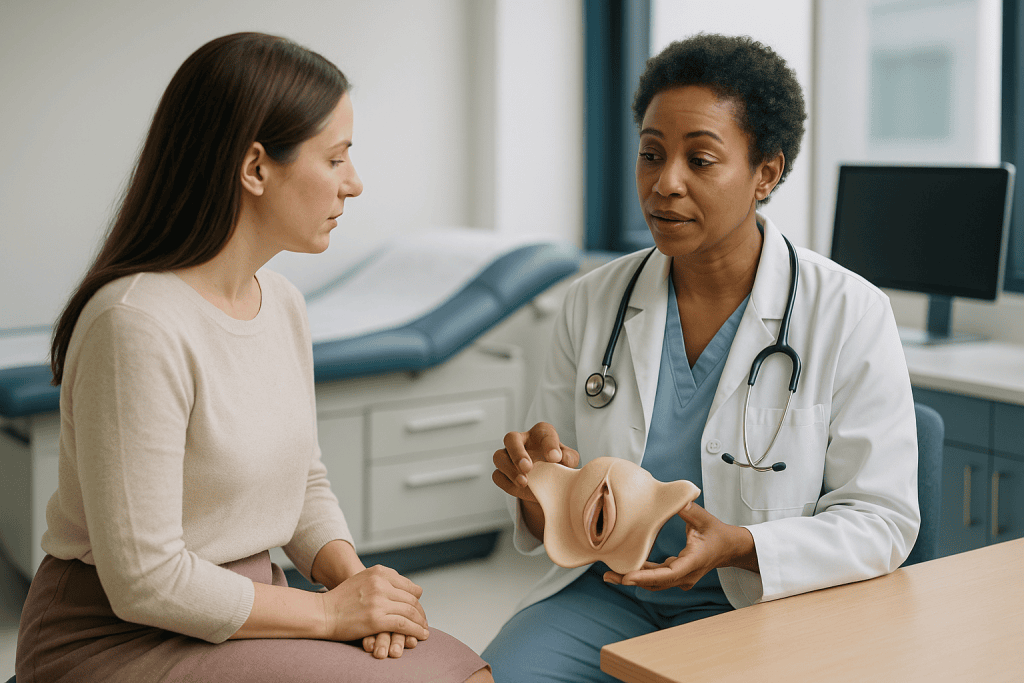
| Approach | What it physically changes | Symptoms it may address | What it cannot do | Evidence quality |
|---|---|---|---|---|
| Labiaplasty | Size and shape of labia | Chafing, discomfort in clothing, appearance concerns | Vaginal laxity, dryness, prolapse, sexual response | Observational; no sham comparison possible |
| Vaginoplasty / perineoplasty | Canal diameter, perineal support | Sensation of looseness, widened opening after childbirth | Hormonal dryness, orgasm, incontinence reliably | Observational; risk of pain and scarring |
| Fractional CO2 or erbium laser | Heats lining to stimulate collagen | Menopausal dryness, mild laxity (claimed) | Anatomical change, prolapse | Mixed; sham-controlled trials largely negative |
| Radiofrequency | Warms tissue diffusely | Mild laxity (claimed) | Anatomical change, atrophy reversal | Small, mostly uncontrolled studies |
| Pelvic floor training | Muscle strength and coordination | Laxity sensation, stress incontinence, some pain | Labial appearance, hormonal dryness | Strong for incontinence; supported by NHS and MedlinePlus |
| Vaginal estrogen | Restores lining thickness and moisture | Dryness, burning, painful sex after menopause | Structural laxity, labial shape | Well established; Mayo Clinic first-line for GSM |
Read the fourth column twice. Surgery cannot fix a hormonal problem; heat cannot fix an anatomical one; muscle training cannot change skin. Every disappointed patient story in this field involves a treatment aimed at the wrong column. The reversible options, training and topical therapy, sit at the top of most guideline pathways for a reason: if they work, nothing has been cut; if they do not, the surgical or device conversation starts from a clearer baseline.
What surgery can address, and where it stops
Surgery’s great strength is that it is literal. Tissue removed is gone; a widened opening brought together is narrower. For a woman whose labia catch, twist or ache during exercise or sex, labiaplasty addresses the physical source, and the NHS acknowledges it can be appropriate for genuine discomfort as well as for distress about appearance. For a perineum that never regained its shape after a third-degree tear, perineoplasty restores a physical structure.
The limits are equally literal. Vaginoplasty narrows a canal but does not restore the pelvic floor’s ability to contract voluntarily, which is what most people mean when they say ‘tight.’ A narrower passive tube can still feel weak, and it can feel painfully narrow if the surgeon over-corrects. Surgery does nothing for lubrication, for the thinning of the lining that comes with menopause, or for orgasm, which depends on nerve supply, blood flow, arousal and relationship factors that no operation reaches. Cleveland Clinic’s patient guidance states plainly that these procedures are not proven to improve sexual function.
Surgery also cannot treat prolapse. A woman with a cystocele (bladder bulging into the front vaginal wall) may feel exactly the looseness that sends people to cosmetic surgeons, yet the NHS pathway for prolapse involves pelvic floor physiotherapy, pessaries (removable silicone supports) and, when needed, specific reconstructive operations by a urogynecologist. A cosmetic tightening procedure in that situation can mask the bulge briefly and complicate later repair.
Then there is what surgery leaves behind: a scar line. Most heal soft and unnoticeable, but some heal thick, tender or with a sensitive edge. Those risks are covered later; the point here is that they are the trade for a permanent structural change, and that trade only makes sense when the structure is genuinely the problem.
Does laser vaginal rejuvenation work? What the trials show
The most-searched question about non-surgical treatment usually names a specific branded laser. The device behind that brand is a fractional carbon dioxide laser, so the honest answer concerns the technology, not the trademark.
Early studies were promising and almost all uncontrolled: women had the treatment, filled in symptom questionnaires afterwards, and reported feeling better. That design cannot separate the laser from the placebo effect, from the natural fluctuation of symptoms, or from the attention of a clinician who asked about sexual health for the first time. Placebo responses in genital symptom studies are large, which is why the field needed sham-controlled trials, where the probe is inserted but the energy is not delivered and neither participant nor assessor knows which happened.
Those trials arrived, and they were sobering. A randomized, sham-controlled trial indexed on PubMed compared fractional CO2 laser with sham treatment in postmenopausal women with vaginal symptoms and found no significant difference between the groups in symptom severity or quality of life at follow-up; the laser group also showed no meaningful histological change in the lining. Other small controlled studies have reported modest benefit, so the picture is mixed rather than uniformly negative, but the strongest designs have not confirmed the early enthusiasm.
Regulators noticed. The US Food and Drug Administration has issued a safety communication stating that energy-based devices have not been cleared for treating vaginal laxity, atrophy or sexual function and reporting adverse events including burns, scarring and pain during sex. Harvard Health and Cleveland Clinic both frame these treatments as unproven for those indications.
So does the laser ‘really work’? For menopausal dryness, vaginal estrogen has decades of evidence and the laser has contradictory trials. For laxity, there is no high-quality evidence it changes anything a partner or patient could measure. It may help some individuals; the evidence does not yet tell us who.
Vaginal laxity after childbirth: what is actually changing?
The crude phrasing people type into search engines hides a precise physiological story, and understanding it points toward the right treatment.
During pregnancy, hormones soften connective tissue throughout the pelvis. During vaginal delivery, the pelvic floor muscles stretch to several times their resting length, and the levator ani (the main muscle sling) can partially tear from the pubic bone in some births, an injury called avulsion. Nerves that signal those muscles are stretched too. The vaginal lining itself, richly elastic, usually recovers well; the muscle and nerve supply are slower and sometimes incomplete. That is why the sensation is often described as ‘less grip’ rather than ‘wider.’
Appearance changes are separate. The labia and perineum can look different after delivery because of stretching, scarring from a tear or episiotomy, and later, because estrogen falls during breastfeeding and again at menopause, reducing the fullness of the outer labia. None of this is damage in the pathological sense; it is what tissue does after a significant event. Feeling that the change is unwelcome is legitimate. Treating it as a defect is where marketing does its work.
Which approach fits which change follows from the anatomy. Weakened muscle responds to training, and the NHS recommends pelvic floor exercises for everyone after childbirth, ideally continued lifelong. A perineum widened by a poorly healed tear is a structural issue that perineoplasty addresses. Labial appearance is a labiaplasty question, if it is a question at all. Energy devices are aimed at the lining, which is the part that usually recovered on its own.
Time is also a treatment. The NHS notes that pelvic floor recovery continues for months after delivery, which is one reason surgeons and physiotherapists alike usually ask new mothers to wait before any irreversible decision.
Why menopausal dryness changes the whole conversation
A surprising share of ‘rejuvenation’ inquiries are not about laxity or appearance at all. They are about a lining that has become thin, dry and easily irritated, and about sex that has started to hurt. The medical term is genitourinary syndrome of menopause, often shortened to GSM and formerly called vaginal atrophy.
The mechanism is straightforward. Estrogen keeps the vaginal lining thick, folded, acidic and well supplied with blood. As ovarian estrogen production falls around menopause, the lining thins, the folds flatten, natural lubrication decreases, and the pH rises, which shifts the bacterial balance and raises the risk of urinary infections. Mayo Clinic lists the results: dryness, burning, discharge, itching, discomfort or bleeding with intercourse, urgency and recurrent urinary infections. Unlike hot flashes, these symptoms tend to persist and often worsen without treatment.
None of that is a surgical problem, and only some of it is plausibly a laser problem. First-line management, according to Mayo Clinic and Cleveland Clinic, is non-hormonal: regular vaginal moisturizers, lubricants for sex, and continued sexual activity or gentle dilator use to maintain elasticity. When those are not enough, low-dose vaginal estrogen, applied locally as a cream, tablet or ring, restores the lining directly with minimal absorption into the bloodstream. Improvement is typically described in weeks. The prescribing decision, including for women with a history of hormone-sensitive cancer, belongs with the treating clinician, who may also consider non-estrogen prescription options.
Why does this matter in an article about surgery versus devices? Because a woman with GSM who has vaginoplasty will still have pain, and one who has laser therapy may spend a great deal for an effect that a well-established prescription might have delivered more reliably. Before any cosmetic procedure, a gynecologist should be asking about menopausal status and examining the lining. If that examination does not happen, the consultation is incomplete.
Who is usually a candidate, and who is asked to wait
Neither surgeons nor device operators publish universal eligibility lists, but mainstream guidance converges on a recognizable profile for each path.
Surgical candidates typically have a specific, describable, stable complaint: labia that cause physical discomfort or persistent distress, or a perineal defect after a childbirth injury. They have finished childbearing or accept that a future vaginal delivery may undo the result. They are non-smokers or willing to stop around surgery, since nicotine impairs wound healing, and they have no active genital infection, uncontrolled diabetes or bleeding disorder. Above all, their expectations match what the operation changes: appearance and comfort, not sexual satisfaction.
Non-surgical candidates for energy-based devices are, in practice, women with mild menopausal symptoms who cannot or prefer not to use estrogen and understand that the evidence is uncertain. Pelvic floor training and topical therapy have far broader candidacy; the NHS recommends pelvic floor exercises across adult life regardless of symptoms.
Who is usually asked to wait, or redirected altogether? Women within the first months after delivery, while tissue and nerve recovery continues. Women who are breastfeeding, because low estrogen alters tissue and can mislead assessment. Anyone with an undiagnosed bulge, heaviness or incontinence, who needs a prolapse evaluation first. Anyone under eighteen, whose labia are still developing; the NHS states labiaplasty should not be performed on girls before then. Anyone whose distress centers on appearance despite anatomy within the wide normal range, where body dysmorphic disorder, a preoccupation with a perceived flaw, should be considered and where a mental health assessment is more useful than a procedure.
Finally, anyone whose motivation traces to a partner’s comments or a relationship crisis is usually asked to pause. Ethical clinicians in this field decline more often than they operate, and that willingness to decline is a reasonable test of the clinician.
What the days and weeks after treatment usually look like
Recovery differs so much between the two paths that comparing them is almost the whole decision.
After labiaplasty, the NHS describes a predictable arc. The first days bring swelling, bruising and soreness managed with rest, cold compresses through clothing, and loose underwear. Most people take a week or two off work. Showering is fine early; soaking baths, tampons, tight clothing and cycling are avoided. Sexual intercourse and vigorous exercise are typically deferred for around six weeks, and the NHS notes that full healing, including the final settled appearance, can take up to two months. Dissolvable sutures loosen and fall away over the first weeks, which can feel alarming but is expected. Vaginoplasty and perineoplasty follow a similar timeline with more internal soreness and stricter restrictions on penetration.
After an energy-based session, there is usually no downtime in the ordinary sense. Mild warmth, spotting or discharge for a day or two is common, and clinicians generally advise avoiding intercourse, tampons and hot baths for a few days. Cleveland Clinic notes that courses usually involve multiple sessions spaced weeks apart, with any benefit building gradually and requiring maintenance sessions to persist. The absence of a scar does not mean the absence of a healing tissue; burns and scarring are the reported harms when energy is misapplied.
Pelvic floor training has the slowest and gentlest curve. MedlinePlus patient instructions frame improvement in weeks, with a plateau over months, and effort is daily rather than episodic. Nothing is being healed; something is being trained, and it regresses if the training stops.
Vaginal estrogen for GSM, when prescribed, is generally described by Mayo Clinic as easing symptoms within weeks, with ongoing use needed to maintain the effect. Every one of these timelines is a typical range from the cited sources, not a promise for any individual.
Risks and complications, laid side by side
Marketing tends to inflate the risks of the approach it does not sell. A neutral list is more useful.
Surgical risks, as described in NHS labiaplasty guidance, include bleeding, infection, wound breakdown, scarring that may be thick or tender, reduced or altered sensation, and asymmetry. Over-resection, removing too much tissue, is irreversible and can leave the vaginal opening exposed and uncomfortable. Vaginoplasty adds the risk of over-tightening that makes penetration painful, injury to the bladder or rectum, and a change in sexual sensation in either direction. Any general anesthetic carries its own small risks. A later vaginal birth can stretch or tear a repaired perineum.
Energy-device risks are less dramatic on paper and less well counted in practice. The FDA safety communication lists vaginal burns, scarring, pain during intercourse and chronic pain among reported adverse events. Because these devices are often used outside formal clinical trials and sometimes by operators without gynecological training, complication reporting is incomplete. Treatment on a lining already thinned by menopause may be less forgiving of heat. The financial risk of repeated sessions for an uncertain benefit is real but outside this article’s scope.
Pelvic floor training’s main risk is doing it wrong: bearing down instead of lifting, or over-training already tight muscles, which can worsen pain. A physiotherapist prevents both. Vaginal estrogen’s local side effects are minor irritation or discharge; systemic absorption at low local doses is small, and suitability for women with a hormone-sensitive cancer history is a decision for the oncology and gynecology teams together.
One risk spans every approach: treating the wrong problem. Undiagnosed prolapse, infection, skin conditions such as lichen sclerosus (a chronic inflammatory condition that can scar the vulva), or pelvic pain syndromes will not improve with any of these and may worsen. Examination first, procedure second, is the whole safety principle.
What people often get wrong
Myths cluster around this topic because embarrassment discourages fact-checking. The most persistent ones deserve direct correction.
Tighter means better sex. Sexual satisfaction depends on arousal, lubrication, nerve sensation, pelvic floor coordination and relationship context. A narrower passive canal changes none of these, and Cleveland Clinic states that rejuvenation procedures are not proven to improve sexual function. Pain from over-tightening is a recognized outcome.
Lasers are the modern, gentler version of surgery. They are a different tool for a different structure. Surgery changes anatomy; energy devices aim to alter lining quality. Choosing between them as if they were strength settings on the same treatment is the most common conceptual error.
No incision means no risk. Burns and scarring are among the harms the FDA has reported with vaginal energy devices, and a treatment that leaves no visible mark can still injure tissue.
Kegels are for incontinence, not for tightness. The sensation people call looseness is largely reduced voluntary muscle contraction. Training that contraction is exactly what pelvic floor exercise does, which is why the NHS positions it before any procedure.
Labia are supposed to be small and symmetrical. The range of normal labial length, color and asymmetry is wide, and the NHS is explicit that most women considering labiaplasty have anatomy within it. Comparison to edited images is not a clinical indication.
Dryness after menopause is a cosmetic issue. It is a hormonal condition with an established treatment pathway, and Mayo Clinic frames it as a medical problem worth raising with a clinician rather than a matter of aging to be accepted or bought away.
Results are permanent. Surgical changes to tissue are, but aging, childbirth and menopause continue. Device effects, where they exist, fade without maintenance. Training regresses when stopped.
The alternatives that get overlooked
Between doing nothing and booking a procedure sits a set of options that rarely appear in advertising because nobody profits much from them.
Supervised pelvic floor physiotherapy comes first. A trained physiotherapist assesses whether the muscles are weak, tight, poorly coordinated or partially avulsed, then tailors a program. Biofeedback and, where appropriate, electrical stimulation help women who cannot find the muscles at all. The NHS recommends supervised training as a first-line treatment for stress incontinence and mild prolapse, and the same muscles produce the sensation of tone during sex. Vaginal weights and app-guided devices exist as home aids, but the technique matters more than the gadget.
Managing the underlying condition comes second. Prolapse may respond to a pessary, a removable support fitted by a clinician, which the NHS describes as a non-surgical option for many women. Recurrent urinary infections, skin conditions, or pain syndromes have their own pathways. Treating them frequently dissolves the perceived need for a cosmetic procedure.
Addressing menopause directly comes third. Moisturizers used regularly rather than only before sex, lubricants chosen for compatibility with condoms and skin, and prescribed vaginal estrogen when indicated address GSM at its cause. Mayo Clinic also notes that continued sexual activity, with or without a partner, helps maintain blood flow and elasticity.
Psychological and relational support comes fourth and is the most undervalued. Body image distress, painful sex with an emotional component, and low desire are treatable through sex therapy and psychological approaches. When the goal is to feel better about one’s body or one’s sexual life, these routes frequently reach it more reliably than an alteration of tissue.
Watchful waiting is also a legitimate choice, particularly after childbirth, when recovery continues for months. None of these excludes a later procedure. They make it a better-informed one.
Questions to ask your care team
A good consultation for surgical vs non surgical vaginal rejuvenation should feel like a diagnostic visit first and a treatment discussion second. If the following questions are welcomed rather than deflected, that is a favorable sign about the clinician.
- What exactly did you find on examination, and which structure is responsible for the symptom I described?
- Have you ruled out prolapse, genitourinary syndrome of menopause, infection and vulvar skin conditions?
- Which of my concerns will this treatment change, and which will it leave unchanged?
- What does the highest-quality evidence, including sham-controlled trials, show for this treatment in someone like me?
- What are the specific complications you have seen, and how are they managed?
- What non-surgical or non-device options should I try first, and for how long?
- How would a future pregnancy or menopause affect the result?
- Who performs the procedure, what is their training in gynecology, and who will I contact if something goes wrong at night or on a weekend?
- What would make you decline to treat me?
- If I do nothing, what is the likely course?
Bring a written note of your symptoms, their timing relative to births and periods, and what you have already tried. Ask whether a pelvic floor physiotherapist or a menopause specialist should be part of the assessment. A second opinion is ordinary practice for elective procedures and a clinician confident in their recommendation will not resist it.
The answers should leave you able to say, in one sentence, what the treatment is expected to change and what it is not. If you cannot form that sentence, the consultation is not finished, and the decision can wait.
When to call your doctor
Some symptoms before or after any of these treatments need prompt medical attention rather than a follow-up appointment in a few weeks.
After surgery, contact the surgical team the same day for bleeding that soaks through a pad in an hour or does not slow with pressure, a wound edge that opens or looks gray or black, spreading redness or warmth, pus or foul-smelling discharge, fever, or pain that escalates rather than eases after the first days. Seek emergency care for heavy bleeding, fainting, difficulty passing urine for many hours, or calf pain and swelling or sudden breathlessness, which can signal a blood clot after any operation.
After an energy-based treatment, call if you have burning or pain that persists beyond a couple of days, blistering, bleeding beyond light spotting, foul discharge, or pain with intercourse that begins after treatment. These are the harms regulators have recorded, and early assessment matters.
At any stage, whether or not you have had a procedure, see a gynecologist rather than a cosmetic provider for a visible or palpable bulge from the vagina, a feeling of heaviness that worsens through the day, new incontinence of urine or stool, vaginal bleeding after menopause, bleeding after sex, a persistent sore, lump or change in vulvar skin color or texture, or itching that does not settle. Each of these has medical causes that a tightening procedure or laser would neither treat nor rule out, and postmenopausal bleeding in particular always warrants evaluation.
Emotional distress about your body that is affecting daily life, relationships or mood is also a reason to seek help, from a primary care clinician or mental health professional, before making an irreversible decision. Every choice described in this article rests with you and the team examining you; this section exists so that the urgent ones are never delayed.
Frequently asked questions
Does the fractional CO2 laser really work for vaginal rejuvenation?
The evidence is mixed and the strongest studies are largely negative. Uncontrolled studies reported improvement, but a randomized sham-controlled trial in postmenopausal women found no significant difference between laser and sham for symptoms or quality of life. The US Food and Drug Administration has stated these devices are not cleared for laxity, atrophy or sexual function. For menopausal dryness, vaginal estrogen has far more established evidence; your clinician can weigh both.
How do I address a feeling of looseness or a changed appearance after childbirth?
Start with a gynecological examination and supervised pelvic floor physiotherapy. The sensation of looseness usually reflects weakened muscle rather than a wider canal, and structured training rebuilds contraction over weeks to months. Appearance changes from stretching or a healed tear are separate and may or may not warrant surgery. Clinicians generally advise waiting until recovery from delivery is complete before considering anything irreversible.
What is the difference between labiaplasty vs vaginoplasty?
Labiaplasty reshapes the external folds of skin around the vaginal opening, addressing chafing or appearance concerns. Vaginoplasty narrows the internal vaginal canal by removing lining and bringing supporting tissue together with sutures. They act on different structures, carry different risks, and neither has been shown to improve sexual satisfaction. A surgeon recommending both should explain which specific symptom each one is meant to address.
Can non surgical vaginal tightening replace surgery?
Not for structural problems. Energy-based devices aim to change lining quality, not anatomy, and high-quality evidence that they tighten anything measurable is lacking. Pelvic floor training does improve muscle tone and is recommended first-line by the NHS, which for many women is the change they were seeking. Where a genuine anatomical defect exists, such as a widened perineum after a tear, only surgery alters it.
Is vaginal laxity after childbirth permanent?
Often not. The pelvic floor continues recovering for months after delivery, and the NHS recommends daily pelvic floor exercises to support that recovery and maintain strength lifelong. Some women have partial muscle avulsion from the pubic bone that does not fully recover, and a pelvic floor physiotherapist can assess this. Persistent symptoms deserve examination rather than assumption, since prolapse can cause a similar sensation.
Does laser vaginal rejuvenation work better than vaginal estrogen for dryness?
Current evidence favors vaginal estrogen. Mayo Clinic describes low-dose vaginal estrogen as an established treatment for genitourinary syndrome of menopause, with improvement typically within weeks. Laser trials with sham controls have not shown consistent benefit. For women who cannot use estrogen, moisturizers, lubricants and non-estrogen prescription options exist. Whether a laser is reasonable in an individual case is a decision for the treating clinician.
How long is recovery after labiaplasty?
NHS guidance describes a week or two off work, avoiding sex and vigorous exercise for around six weeks, and up to two months for full healing and the final settled appearance. Swelling and bruising are greatest in the first days. Dissolvable sutures fall away over the following weeks. Vaginoplasty and perineoplasty follow a similar arc with more internal soreness. These are typical ranges, not guarantees for any individual.
Will vaginal tightening surgery improve sex or orgasm?
There is no reliable evidence that it does. Sexual response depends on arousal, lubrication, nerve sensation, pelvic floor coordination and relationship factors that surgery does not alter, and Cleveland Clinic states these procedures are not proven to improve sexual function. Over-tightening can cause pain during penetration. If sexual satisfaction is the goal, pelvic floor physiotherapy, treatment of menopausal dryness and sex therapy have better-supported track records.
Who should not have vaginal rejuvenation procedures?
Anyone with an undiagnosed bulge, heaviness, incontinence or postmenopausal bleeding needs a gynecological diagnosis first. Women in the months after delivery or while breastfeeding are usually asked to wait. The NHS states labiaplasty should not be done before age eighteen. Active infection, uncontrolled diabetes, smoking and unrealistic expectations are common reasons to defer, and body image distress may warrant psychological assessment before any procedure.
What are the risks of energy-based vaginal treatments?
The FDA safety communication on these devices lists vaginal burns, scarring, pain during intercourse and chronic pain among reported adverse events. Because treatments are often given outside clinical trials, complications are likely undercounted. Thinned postmenopausal tissue may be less tolerant of heat. Persistent burning, blistering or new pain with sex after a session should be reported to a clinician promptly.
References
- NHS: Labiaplasty (vulval surgery)
- NHS: Pelvic organ prolapse
- Cleveland Clinic: Vaginal atrophy
- MedlinePlus: Kegel exercises: self-care
This article is for general information only and is not a substitute for professional medical advice. Please consult a qualified doctor about your individual situation.

More from the Blog

Reverse Tummy Tuck vs Traditional Abdominoplasty: Incision Placement and What Each Corrects
A reverse tummy tuck places the incision in the fold beneath the breasts and lifts loose skin of the upper abdomen upward, without addressing…
Monsplasty Candidacy: Excess Mons Pubis Skin, Fat and What Surgeons Assess First
A typical monsplasty candidate is an adult whose mons pubis (the soft mound over the pubic bone) has loose, sagging skin, stubborn fat, or…
How Hi Def Liposuction Is Performed: Mapping Muscle Lines Before Fat Is Sculpted
Hi def liposuction is performed by first marking the patient standing up, with muscles flexed, to map where the abdominal, chest and flank muscle…

Can Body Contouring Be Done in One Operation? How Surgeons Sequence Multiple Stages Safely
Body contouring after major weight loss can sometimes be completed in a single operation, but surgeons often split it into two or more stages…

Do You Need a Reverse Tummy Tuck? Upper Abdominal Laxity and Who Actually Qualifies
A reverse tummy tuck is usually considered only for people whose loose skin sits mainly above the navel, in the upper abdomen, while the…

How Fat Transfer Works Step by Step: Harvesting, Purifying and Injecting Your Own Fat
Fat transfer, also called fat grafting, is done in three stages during one procedure. A surgeon removes fat from an area such as the…