

The Four Types of Prostatitis: How Urologists Identify Each and Why Treatment Differs

Key Takeaways
- The NIH classification recognizes four types of prostatitis, and only two of them, acute and chronic bacterial, involve an infection that antibiotics can treat.
- Chronic prostatitis/chronic pelvic pain syndrome is by far the most common type, estimated by the NIDDK to affect roughly 10 to 15 percent of American men at some point, and its cultures are negative.
- Urologists distinguish chronic bacterial prostatitis from pelvic pain syndrome by comparing bacterial counts in urine collected before and after prostate massage.
- Vigorous prostate massage is deliberately avoided in acute bacterial prostatitis because it can push bacteria from the swollen gland into the bloodstream.
- Prostatitis can raise PSA levels, so an elevated result during an inflammatory episode is commonly re-checked after the inflammation settles rather than acted on alone.
- Antibiotic courses for prostatitis run longer than for simple bladder infections, with the NHS describing typical durations of 2–4 weeks for acute and 4–6 weeks for chronic bacterial cases, because the drugs penetrate prostate tissue slowly.
The four types of prostatitis, under the NIH classification, are acute bacterial prostatitis (type I), chronic bacterial prostatitis (type II), chronic prostatitis/chronic pelvic pain syndrome (type III) and asymptomatic inflammatory prostatitis (type IV). Urologists separate them by how quickly symptoms began, whether urine and prostatic fluid grow bacteria, and how long pain has lasted. Only the two bacterial types are infections, which is why antibiotics are central for some and largely unhelpful for others.
A man in his forties sits on the edge of an exam table, trying to describe an ache he cannot quite locate. Sometimes it feels like it sits behind the pubic bone, sometimes deep in the perineum, the strip of tissue between the scrotum and the anus. He has finished two courses of antibiotics from two different clinicians. Neither helped much. He wants to know why a condition with one name keeps behaving like several different illnesses.
The honest answer is that it is several different illnesses. The four types of prostatitis share a gland and a label, and almost nothing else. One is a true emergency caused by bacteria flooding a walnut-sized organ. Another is a smoldering pain syndrome in which cultures come back clean again and again. A third has no symptoms at all and is discovered by accident.
Sorting out which type is present is the whole job, because the treatment for one can be useless, or even counterproductive, for another.
What are the four types of prostatitis, and why does the number matter?
The prostate is a small gland, roughly the size of a walnut, that sits just below the bladder and wraps around the urethra, the tube that carries urine out of the body. Its main task is to make part of the fluid in semen. When it becomes inflamed or infected, urologists use a classification developed by the National Institutes of Health that divides prostatitis into four categories.
Type I is acute bacterial prostatitis: a sudden, often severe infection. Type II is chronic bacterial prostatitis: repeated urinary infections traced back to bacteria living in the gland. Type III is chronic prostatitis/chronic pelvic pain syndrome, usually shortened to CP/CPPS: pelvic pain lasting at least three months without a bacterial cause that can be found. Type IV is asymptomatic inflammatory prostatitis: inflammation seen under a microscope in someone who feels nothing.
The number matters because it decides everything that follows. The National Institute of Diabetes and Digestive and Kidney Diseases notes that prostatitis accounts for about two million visits to health care providers in the United States each year, and that CP/CPPS is by far the most common form. Yet the type that most people picture when they hear the word, a bacterial infection treated with antibiotics, is actually the least common.
That mismatch explains a great deal of frustration. If a clinician assumes every prostatitis is an infection, most patients will be treated for something they do not have. The classification is not academic tidiness. It is a map that keeps the right treatment pointed at the right problem.
How prostatitis works: what actually happens inside the gland
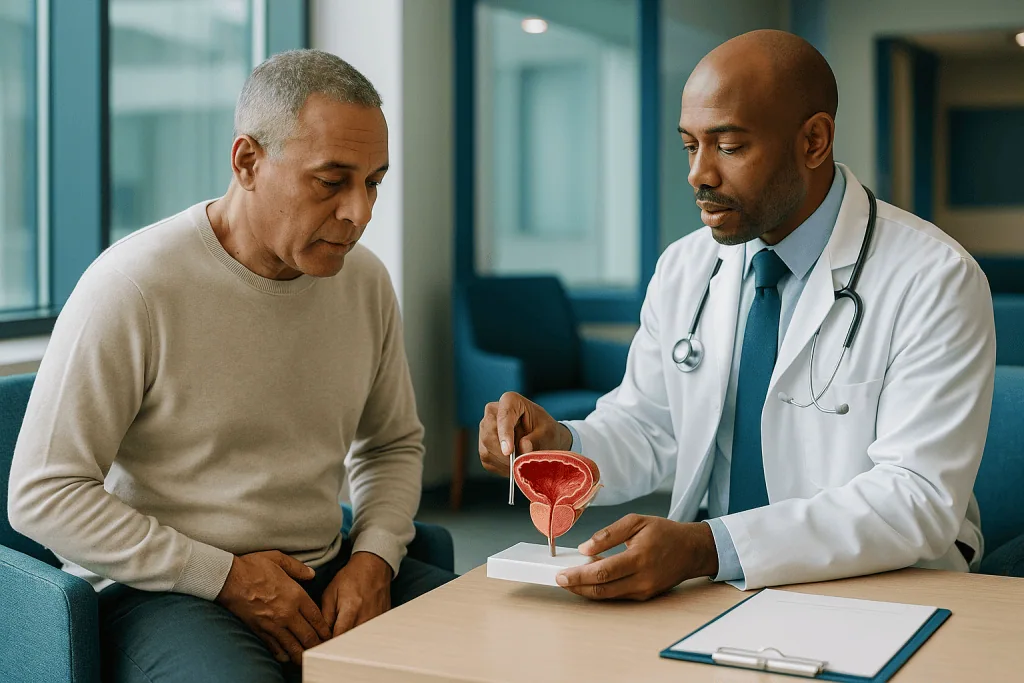
Picture the prostate as a sponge made of dozens of tiny glands and ducts, wrapped in a layer of smooth muscle. Those ducts drain into the urethra. In the bacterial types, organisms that normally live in the bowel, most often Escherichia coli, travel up the urethra or back-flow from infected urine into those ducts. The gland responds the way any tissue does to invasion: blood vessels widen, immune cells pour in, and the sponge swells. Because the prostate encircles the urethra, even modest swelling can squeeze the channel, which is why weak flow and urgency so often accompany fever in acute cases, according to the Mayo Clinic.
Chronic bacterial prostatitis works differently. Bacteria settle in pockets of the gland, sometimes protected by small calcified stones or by biofilm, a slimy protective layer that shields organisms from both immune cells and antibiotics. The infection is quiet most of the time, then seeds the bladder and produces a fresh urinary tract infection.
In CP/CPPS, the story shifts away from bacteria altogether. Current thinking, summarized by the Cleveland Clinic, points to a mix of contributors: a previous infection that left the nerves sensitized, pelvic floor muscles that stay clenched, immune signaling that never fully switched off, and changes in how the spinal cord and brain process pain from the pelvis. The prostate may be only one player, or a bystander.
Type IV inflammation is the immune activity without the alarm. White cells are present in prostatic fluid or tissue, but no pain signal is generated. Why the same inflammation hurts one person and not another remains one of the open questions in urology.
Type I: acute bacterial prostatitis, the one that arrives fast
Acute bacterial prostatitis announces itself. Fever, chills, body aches, pain low in the back or pelvis, and a sudden change in urination, often burning, frequency and a stream that slows to a dribble, typically develop over hours to a couple of days. The NHS describes it as the least common of the four types but also the most serious, because bacteria can spill from the gland into the bloodstream.
Anything that lets bacteria reach the prostate raises the risk: a recent urinary catheter, a prostate biopsy, an existing urinary tract infection, or a blockage that leaves urine pooling. Sexually transmitted infections can also be responsible, particularly in younger men.
Diagnosis is usually straightforward. A urine sample often shows white cells and bacteria, and a urine culture identifies the organism and which antibiotics it responds to. A gentle rectal exam typically finds a prostate that is swollen, warm and exquisitely tender. Urologists deliberately avoid vigorous prostate massage in this setting because pressing on an acutely infected gland can push bacteria into the circulation.
Treatment is antibiotic-based, and it starts before culture results return, guided by the organisms most likely to be involved. Some people need hospital admission for intravenous antibiotics and fluids, especially if they cannot urinate, are vomiting, or show signs of sepsis. The NHS notes that a full course for acute infection commonly runs 2–4 weeks, longer than for a simple bladder infection, because antibiotics penetrate prostate tissue less readily than bladder tissue.
If symptoms do not settle, the team looks for a prostatic abscess, a pocket of pus that may need drainage. With prompt treatment most acute infections resolve, though a minority evolve into the chronic bacterial form.
Type II: chronic bacterial prostatitis, the infection that keeps circling back
Chronic bacterial prostatitis rarely looks dramatic. Instead, the pattern is repetition: a urinary tract infection that clears with antibiotics, then returns weeks or months later, often with the same organism. Between episodes a man may feel almost normal, or notice a dull pelvic ache, discomfort during or after ejaculation, or a low-grade sense that something is not right.

The clue that separates this from ordinary recurrent cystitis is the source. Bacteria have taken up residence inside the prostate, and each recurrence is the gland re-infecting the bladder. The NIDDK lists this as one of the two forms in which bacteria can actually be demonstrated.
To prove it, urologists compare samples. In the traditional four-glass test, urine is collected at the start of the stream, mid-stream, then the prostate is massaged and any expressed fluid is captured, followed by a final urine sample. A simplified two-glass version compares urine before and after massage. If the post-massage samples grow far more bacteria than the pre-massage ones, the prostate is the reservoir. Many clinics now rely on the two-glass method because it is easier for patients and yields similar information.
Treatment again centers on antibiotics, chosen for their ability to reach prostate tissue, and the NHS indicates that courses for chronic infection typically run 4–6 weeks. The challenge is thoroughness rather than strength. Biofilm and prostatic stones can shelter bacteria so that a course wipes out most organisms but leaves a seed population. Some men need repeat or extended courses, and a few with frequent recurrences are offered long-term low-intensity suppression under specialist supervision. Those decisions belong to the treating urologist, who weighs benefit against the risks of prolonged antibiotic exposure, including resistance and side effects.
Type III: chronic prostatitis/chronic pelvic pain syndrome, the most common and least understood
Here is where most of the confusion lives. CP/CPPS is defined by pain or discomfort in the pelvic region for at least three months out of the previous six, with no bacteria found on standard testing. The NIDDK estimates that it affects roughly 10 to 15 percent of the male population in the United States at some point, making it the dominant form by a wide margin.
Pain can sit in the perineum, the lower abdomen, the testicles, the tip of the penis or the lower back. Urination may be urgent, frequent or hesitant. Ejaculation may hurt. Fatigue, low mood and sleep disruption are common companions, partly because chronic pain of any kind wears people down.
Urologists subdivide type III into IIIA, in which white blood cells appear in prostatic fluid or post-massage urine (inflammatory), and IIIB, in which they do not (non-inflammatory). In practice the two subtypes are treated similarly, and the distinction matters more for research than for the person in the chair.
Because no single mechanism explains every case, many specialists use a phenotyping approach that sorts each patient’s picture into domains: urinary symptoms, psychosocial burden, organ-specific findings, possible infection, neurological or systemic pain features, and muscle tenderness. Each domain that applies points to a different intervention. Someone whose pelvic floor is rigid and tender may benefit most from specialized physical therapy. Someone with mainly urinary symptoms may be offered an alpha-blocker, a medication class that relaxes smooth muscle at the bladder neck and within the prostate. Someone whose pain has features of nerve sensitization may be offered medicines that dampen pain signaling. The Mayo Clinic describes this combination approach as the norm rather than the exception.
Type IV: asymptomatic inflammatory prostatitis, found by accident
Type IV has no symptoms by definition. It is discovered incidentally, most often during an evaluation for something else: a fertility workup in which white cells turn up in semen, a raised prostate-specific antigen (PSA) blood test, or a prostate biopsy performed to look for cancer that instead shows inflammatory cells.
PSA is a protein made by prostate cells, and its level in the blood rises when the gland is irritated for any reason. An inflamed prostate can push PSA upward even when no cancer is present. The Mayo Clinic lists PSA testing among the investigations a clinician may order when prostatitis is suspected, and it also works in reverse: an unexplained PSA rise sometimes leads to a diagnosis of silent inflammation.
The important clinical point is that type IV usually needs no treatment at all. Guidelines and mainstream references agree that inflammation without symptoms is not, by itself, a reason to prescribe antibiotics. The exceptions are specific situations, such as a man with infertility whose semen shows inflammatory cells and in whom a treatable infection is identified, or a patient whose PSA needs re-checking after inflammation has had time to settle before further cancer evaluation is planned.
People are often unsettled to learn they have a condition they cannot feel. It helps to reframe it: type IV is a description of what a pathologist or laboratory saw, not a disease that is quietly damaging the gland. Whether any action follows is a judgment for the urologist, made in the context of why the test was done in the first place. For most, the answer is to leave it alone and watch.
How is prostatitis diagnosed, and what will a urologist do at the visit?
A first urology visit for suspected prostatitis follows a recognizable sequence. It begins with questions that are doing quiet diagnostic work: How quickly did this start? Is there fever? How long has the pain lasted? Have there been previous urinary infections, catheters, or procedures? Is there pain with ejaculation? Many urologists also use a standardized symptom questionnaire that scores pain, urinary symptoms and quality-of-life impact, which gives a baseline to measure change against.
Next comes the physical examination, including a digital rectal exam, in which a gloved, lubricated finger is inserted into the rectum to feel the back surface of the prostate. The clinician is checking for size, tenderness, warmth, nodules and the tone of the surrounding pelvic floor muscles. In acute infection the exam is kept brief.
Laboratory work follows. According to the Mayo Clinic, typical tests include urinalysis and urine culture, blood tests for infection markers and sometimes PSA, and, when chronic infection is suspected, the pre- and post-massage urine comparison described earlier. A semen culture may be added.
Imaging and further tests are reserved for specific questions. Ultrasound of the prostate or bladder can reveal an abscess, stones or incomplete emptying. Cystoscopy, in which a thin lighted tube is passed through the urethra to view the bladder, is used when the picture does not fit or when blood in the urine needs explaining. Urodynamic studies measure how the bladder stores and releases urine.
The urologist’s goal at the end of this process is not simply to say “prostatitis.” It is to assign a type, rule out look-alike conditions, and, for CP/CPPS, identify which domains of the problem are driving symptoms. That determines what is offered, and in what order.
The four types of prostatitis at a glance
Seeing the four categories side by side makes the logic of treatment obvious. Two are infections, one is a pain syndrome and one is a laboratory finding. The table below summarizes the features urologists lean on most, drawing on the NIDDK and NHS descriptions.
| Type | Onset and course | Bacteria found? | White cells in prostatic fluid? | Main treatment approach |
|---|---|---|---|---|
| I: Acute bacterial | Sudden, hours to days; fever common | Yes, in urine | Yes | Prompt antibiotics; hospital care if severe |
| II: Chronic bacterial | Recurrent urinary infections over months | Yes, in prostatic fluid or post-massage urine | Yes | Extended antibiotic course targeting the gland |
| IIIA: CP/CPPS, inflammatory | Pelvic pain for 3 or more months | No | Yes | Individualized, multimodal; antibiotics rarely helpful |
| IIIB: CP/CPPS, non-inflammatory | Pelvic pain for 3 or more months | No | No | Individualized, multimodal; often physical therapy and pain-modulating strategies |
| IV: Asymptomatic inflammatory | No symptoms; incidental finding | Usually no | Yes | Usually none; observation |
Two patterns stand out. First, the presence or absence of bacteria, not the severity of pain, is what separates treatable infection from everything else. A man with type III can hurt far more than a man with type II and still gain nothing from antibiotics. Second, the word “chronic” appears in two very different rows. Chronic bacterial prostatitis and chronic pelvic pain syndrome share a timeline but not a cause, and conflating them is the single most common reason people end up on repeated, unproductive antibiotic courses.
Keep this table in mind when reading anything online about prostatitis. If a source does not say which type it is describing, its advice may not apply to you.
What causes prostatitis, and is there a number one cause?
People searching for the single biggest cause of prostatitis usually expect a bacterium, and for the two infectious types that expectation is reasonable. The Mayo Clinic identifies common bacteria, particularly strains that normally live in the intestine, as the usual culprits, entering through the urethra or spreading from infected urine. Risk rises with a recent catheter, a urinary blockage, a prior infection, or a prostate biopsy.
Across all four types, though, no single cause dominates, because the most common type has no confirmed cause at all. For CP/CPPS, which accounts for the great majority of diagnoses, research points to several possible contributors rather than one: a past infection that has cleared but left the pelvic nerves hypersensitive, chronically tense pelvic floor muscles, an immune response that persists in the absence of any organism, and altered pain processing in the central nervous system. Some men trace symptoms to a period of intense stress, a prolonged episode of constipation, or a pelvic injury such as long-distance cycling on an unforgiving saddle. Others can identify nothing.
The Cleveland Clinic summarizes this by noting that the exact cause of chronic pelvic pain syndrome is unknown and probably differs from one person to the next.
So the truthful answer to “what is the number one cause” splits in two. For acute and chronic bacterial prostatitis, gut bacteria ascending the urinary tract lead the list. For prostatitis as a whole, the leading cause is a pain syndrome whose origin is still being worked out. That is unsatisfying, but knowing it protects people from chasing an infection that was never there.
What can be mistaken for prostatitis?
Pelvic pain and urinary symptoms are shared by a long list of conditions, which is exactly why urologists spend time excluding them before settling on a type. Benign prostatic hyperplasia, the non-cancerous enlargement of the prostate that becomes common with age, produces slow flow, frequency and nighttime urination, but usually without pain. A simple urinary tract infection or urethritis, inflammation of the urethra often caused by a sexually transmitted infection, can mimic acute prostatitis without involving the gland.
Bladder conditions are frequent look-alikes. Interstitial cystitis, sometimes called bladder pain syndrome, causes pelvic pain and urgency that ease temporarily after voiding. Bladder stones or a stone lodged in the lower ureter, the tube from kidney to bladder, can cause referred pain in the perineum or testicle.
Musculoskeletal and nerve problems are underappreciated mimics. Pelvic floor muscle dysfunction, pudendal nerve irritation and even lower spine problems can generate pain in the identical region. Inguinal hernias, epididymitis (inflammation of the coiled tube behind the testicle) and chronic testicular pain also overlap.
Two conditions matter most to rule out. Prostate cancer rarely causes pain in its early stages and does not cause acute symptoms, but it can raise PSA, and inflammation can raise PSA too. When a PSA is elevated during an episode of prostatitis, the Johns Hopkins Medicine overview notes that clinicians commonly re-test after the inflammation has had time to settle rather than drawing conclusions from a single value. Bladder cancer can present with urgency and blood in the urine, which is one reason visible blood always prompts further evaluation.
The practical lesson: a prostatitis label given quickly, without a culture and an examination, deserves a second look if symptoms do not behave as expected.
Why treatment differs: who is treated right away and who is asked to wait
The four types call for four different tempos. Acute bacterial prostatitis is treated immediately, often the same day, because delay risks sepsis or abscess. Nobody with fever and a tender prostate is asked to wait for culture results before starting antibiotics; the culture refines the choice later. This is the one form of prostatitis where speed is the priority.
Chronic bacterial prostatitis is treated once the diagnosis is reasonably confirmed, which may take a visit or two to gather pre- and post-massage samples. The urgency is lower because the infection is smoldering rather than spreading, but the commitment is longer, with courses that the NHS describes as typically 4–6 weeks.
CP/CPPS is where patience is deliberately built in. Because antibiotics have shown little benefit in men whose cultures are negative, many urologists will offer at most a single trial course early on, particularly if there is any hint of a missed infection, and then stop prescribing them. From there, treatment is layered and adjusted over months: an alpha-blocker for urinary symptoms, anti-inflammatory medicines for flares, referral to a pelvic floor physical therapist, attention to sleep and stress, and sometimes medicines that reduce nerve-driven pain. Each is typically tried for several weeks before judging its effect, as the Mayo Clinic outlines. People are, in effect, asked to wait and observe rather than to escalate quickly.
Type IV is usually asked to wait indefinitely. Watching is the treatment.
Older men with urinary symptoms and no pain may be evaluated for prostate enlargement instead. Men with a known immune deficiency, diabetes with poor control, or a urinary catheter are handled more cautiously at every stage. All of these judgments rest with the treating team, who can see the whole picture.
What the first days and weeks usually look like
Timelines differ as sharply as the treatments do, and knowing what is typical helps people judge whether things are on track. The ranges below come from the NHS and Mayo Clinic descriptions and are typical patterns, not promises.
With acute bacterial prostatitis, fever and the worst of the pain usually begin to ease within the first few days of appropriate antibiotics. Urinary symptoms lag behind, often improving over one to two weeks as swelling subsides. The NHS stresses finishing the full course even after feeling better, because stopping early leaves surviving bacteria and raises the chance of relapse. A follow-up urine culture after treatment is common.
With chronic bacterial prostatitis, change is slower and less dramatic. The goal is fewer recurrences over the following months rather than an immediate shift in how one feels. Some men notice pelvic discomfort improving gradually across the course. A recurrence within weeks of finishing often prompts a repeat culture and a discussion about longer or different strategies.
With CP/CPPS, the timeline is measured in weeks to months per intervention. Alpha-blockers may take several weeks to show whether they help urinary symptoms. Pelvic floor physical therapy is typically a program of sessions plus daily home exercises, with meaningful change often reported after a couple of months of consistent practice rather than after a visit or two. Symptoms frequently fluctuate, with good stretches and flares, and the Mayo Clinic notes that for many men symptoms improve over time with treatment.
Keeping a simple symptom diary, noting pain level, urinary symptoms and anything that preceded a flare, gives the urologist far better information at follow-up than memory alone. It also makes slow progress visible when day-to-day change is hard to feel.
What people often get wrong about prostatitis
The first misconception is that prostatitis always means infection. It does not. Most men with the diagnosis have CP/CPPS, in which cultures are negative and antibiotics have not been shown to help. Repeated antibiotic courses for a non-bacterial condition expose a person to side effects and resistance without addressing the pain.
The second is the opposite error: that because one course did not work, the antibiotic was too weak and a stronger one is needed. When cultures are negative, the failure is not a matter of strength. The target was never there.
Third, many assume prostatitis leads to prostate cancer. Mainstream references, including the Mayo Clinic, state that there is no evidence prostatitis causes cancer, though inflammation can raise PSA and complicate interpretation of that test for a while.
Fourth, a common fear is that prostatitis is contagious or a sign of infidelity. Bacterial prostatitis is usually caused by a person’s own intestinal bacteria, not by a partner. Sexually transmitted infections can cause it in some cases, which is why a urologist may test for them, but the diagnosis itself implies nothing about how it was acquired.
Fifth, people often believe they must abstain from sex. For most men with chronic forms, sexual activity is not harmful; some find ejaculation temporarily uncomfortable, others find it eases pelvic tension. Individual advice comes from the treating clinician.
Finally, a quiet myth: that nothing can be done for CP/CPPS. It is true that no single treatment works for everyone, but the multimodal approach described earlier helps many people reduce symptoms to a manageable level. Persistence and honest feedback to the care team make more difference than any single prescription.
Questions to ask your care team
A urology appointment moves quickly, and the most useful questions are the ones that pin down type and plan. Writing them down beforehand helps.
- Which of the four types of prostatitis do you think this is, and what finding points you there?
- Have my urine and prostatic fluid been cultured, and did anything grow?
- If antibiotics are being prescribed, what is the reasoning, how long is the course expected to run, and how will we know whether it worked?
- If this is chronic pelvic pain syndrome, which parts of my picture are you targeting first: urinary symptoms, muscle tension, nerve-related pain, or something else?
- Would a referral to a pelvic floor physical therapist be appropriate for me?
- Was my PSA checked, and if it was raised, when should it be re-tested?
- What other conditions have you considered and ruled out?
- Which symptoms should make me call the office urgently rather than wait for my next appointment?
- How should I track symptoms between visits so that follow-up is productive?
- What is a realistic timeframe for judging whether each treatment is helping before we change course?
Two things are worth saying about how to use these. First, it is entirely reasonable to ask for a written summary of the working diagnosis and plan; many clinics provide this through a patient portal. Second, if a diagnosis of prostatitis was made without a culture or an examination, asking for both is not confrontational. It is how the classification is meant to be applied, and a good urologist will welcome the question. The MedlinePlus overview of prostate conditions is a reliable place to read up before the visit so the conversation starts from shared ground.
When to call your doctor
Most prostatitis is managed in the clinic over weeks and months, but a few situations should not wait. The NHS and the Mayo Clinic both flag the following as reasons to seek urgent or emergency care.
Call emergency services or go to an emergency department if you cannot pass urine at all, especially if the bladder feels painfully full. Acute urinary retention can damage the bladder and kidneys and sometimes requires a catheter. The same applies to a high fever with shaking chills, confusion, a racing heart, or feeling faint alongside pelvic or lower back pain; these can signal that infection has reached the bloodstream.
Contact your doctor the same day if you develop a new fever during treatment for prostatitis, if pain escalates sharply rather than easing, if you notice visible blood in urine or semen for the first time, or if you develop severe pain and swelling in a testicle. Vomiting that prevents you from keeping down fluids or prescribed medicines also warrants a same-day call.
Arrange a routine but prompt appointment if urinary infections keep recurring after treatment, if you have completed an antibiotic course and symptoms have returned within weeks, if new medicines are causing side effects that make you want to stop them (do not stop without speaking to the prescriber first), or if pain is affecting sleep, mood or daily function in a way you find hard to manage.
None of these lists replaces judgment. If something feels wrong and you are unsure, calling is always the right choice. Your treating team would rather hear from you early than discover a complication late, and every decision about changing or stopping treatment rests with them, informed by what you report.
Frequently asked questions
Why is prostatitis so hard to get rid of?
Because the most common type is not an infection, and the infectious types hide well. In chronic pelvic pain syndrome, cultures are negative and antibiotics have little to act on, so symptoms persist until the actual drivers, such as pelvic floor tension or nerve sensitization, are addressed. In chronic bacterial prostatitis, biofilm and prostatic stones shelter bacteria from antibiotics, which also reach prostate tissue less readily than bladder tissue. Both problems reward careful typing over repeated prescriptions.
What will a urologist do for prostatitis?
A urologist will take a detailed history, perform a digital rectal exam, and order urinalysis and urine culture, often adding pre- and post-massage urine samples to look for bacteria hiding in the gland. PSA and blood tests may follow, with ultrasound or cystoscopy reserved for unclear cases. The aim is to assign one of the four types, rule out look-alike conditions, and build a treatment plan matched to that type rather than to the label alone.
What can be mistaken for prostatitis?
Several conditions share its symptoms: benign prostate enlargement, urinary tract infection, urethritis from a sexually transmitted infection, interstitial cystitis, bladder or lower ureteral stones, pelvic floor muscle dysfunction, pudendal nerve irritation, epididymitis and inguinal hernia. Prostate cancer rarely causes pain but can raise PSA, as inflammation does. This overlap is why a diagnosis made without culture and examination deserves re-evaluation if symptoms do not respond as expected.
What is the number one cause of prostatitis?
For the bacterial types, the leading cause is intestinal bacteria, particularly Escherichia coli, traveling up the urethra or back-flowing from infected urine, with catheters, biopsies and urinary blockages raising the risk. For prostatitis overall, the most common type is chronic pelvic pain syndrome, whose cause remains unknown and probably varies between people, involving past infection, muscle tension, immune activity and altered pain processing rather than any single trigger.
What are the main chronic prostatitis symptoms, and how long must they last?
Chronic prostatitis typically involves pain or discomfort in the perineum, lower abdomen, testicles, penis or lower back, often with urinary urgency, frequency or hesitancy and sometimes pain during or after ejaculation. For the chronic pelvic pain syndrome diagnosis, symptoms must have been present for at least three months of the previous six, according to the NIH definition. Fatigue and low mood are common alongside the physical symptoms because chronic pain disrupts sleep and daily life.
How does acute bacterial prostatitis treatment differ from treatment for the chronic types?
Acute bacterial prostatitis is treated immediately with antibiotics, sometimes intravenously in hospital, because the infection can spread to the bloodstream; the NHS describes typical courses of 2–4 weeks. Chronic bacterial prostatitis is treated with longer courses, typically 4–6 weeks, aimed at eradicating bacteria sheltered inside the gland. Chronic pelvic pain syndrome usually does not respond to antibiotics and is managed with a combination of alpha-blockers, anti-inflammatories, pelvic floor physical therapy and pain-modulating strategies chosen by the treating urologist.
Can prostatitis turn into prostate cancer?
No evidence shows that prostatitis causes prostate cancer, according to mainstream references including the Mayo Clinic. The two can be confused because inflammation raises PSA, the blood marker used in cancer screening, so an elevated PSA during a prostatitis episode does not by itself indicate cancer. Urologists commonly re-test PSA after inflammation has had time to settle before deciding whether further evaluation is warranted. That decision rests with your treating clinician.
Is prostatitis contagious or sexually transmitted?
Usually not. Most bacterial prostatitis is caused by a person’s own intestinal bacteria reaching the prostate through the urinary tract, and chronic pelvic pain syndrome involves no infectious organism at all. Some cases, particularly in younger men, are caused by sexually transmitted infections, which is why a urologist may test for them. A diagnosis of prostatitis therefore implies nothing on its own about how it was acquired or about a partner’s health.
Does asymptomatic inflammatory prostatitis need treatment?
In most cases, no. Type IV is inflammation seen in prostatic fluid, semen or biopsy tissue in someone with no symptoms, and mainstream guidance does not recommend antibiotics simply because inflammatory cells are present. Exceptions include specific situations such as a fertility evaluation in which a treatable infection is identified, or the need to re-check a PSA result after inflammation settles. Whether any action is taken depends on why the test was done and is decided by the urologist.
Can pelvic floor physical therapy help prostatitis?
For chronic pelvic pain syndrome, yes, it is one of the mainstream components of multimodal care described by the Mayo Clinic and Cleveland Clinic, particularly when examination finds tense, tender pelvic floor muscles. A specialized therapist teaches relaxation, stretching and release techniques, with change typically reported after weeks to months of consistent practice rather than immediately. It is not a treatment for the bacterial types, which require antibiotics. Your urologist can advise whether referral fits your situation.
References
- Prostatitis: Inflammation of the Prostate (NIDDK, National Institutes of Health)
- Prostatitis (NHS)
- Prostatitis (Cleveland Clinic)
- Prostate Diseases (MedlinePlus)
This article is for general information only and is not a substitute for professional medical advice. Please consult a qualified doctor about your individual situation.

More from the Blog

Phosphate Binders and Vitamin D in Kidney Bone Disease: How the Medicine Plan Is Set
In kidney bone disease, the medicine plan is set from repeated blood tests rather than symptoms. Phosphate binders are taken with food to trap…

Why Is My Pee Clear? Hydration, Medicines and When Colorless Urine Needs a Check
Clear pee usually means you are drinking plenty of fluid and your kidneys are diluting urine as designed; on its own it is not…

How Peyronie’s Disease Is Evaluated: Curvature Measurement, Ultrasound and Disease Stage
Peyronie's disease evaluation usually combines a detailed history, a physical examination to feel for scar tissue (plaque), measurement of the curve during an erection,…

Why Do UTIs Keep Coming Back? The Underlying Causes Urologists Look For
UTIs keep coming back mainly because bacteria that live normally in the bowel reach the bladder again, not because an old infection was never…

Hypospadias Repair in Teens and Adults: How the Approach Differs From Surgery in Infancy
Hypospadias surgery in adults follows the same principles as infant repair, straightening the penis and building a new urethral channel toward the tip, but…

Ureteroscopy Recovery With a Ureteral Stent: What the First Days Usually Feel Like
Ureteroscopy recovery with a ureteral stent usually means a few days of flank or bladder discomfort, urgency, frequency and pink-tinged urine, which tend to…