

Traveling With Ozempic or Mounjaro: Storage, Time Zones and Airport Rules

Key Takeaways
- An in-use Ozempic pen may be kept at room temperature below 86°F for up to 56 days, Wegovy for up to 28 and Mounjaro for up to 21, and that allowance is cumulative across the pen's life.
- A pen that has frozen must be discarded even after thawing, so keep pens away from the back wall of hotel mini-fridges.
- Injectable medicines, pen needles and gel cold packs are exempt from the 3.4-ounce liquid rule in US airport screening when they accompany a labeled prescription.
- Baggage X-ray does not affect semaglutide or tirzepatide pens; the scanner caution applies only to electronic devices such as insulin pumps and glucose monitors.
- Both leaflets allow the weekly injection day to be moved provided a minimum gap between injections is kept, and both warn against taking extra to catch up after a missed day.
- Randomized trials put nausea as the most common side effect, while gallbladder problems are the best-documented serious risk and pancreatitis remains an inconsistent signal.
Traveling with Ozempic, Wegovy or Mounjaro is routine if you plan for temperature and timing. Keep pens in carry-on luggage, never checked, inside an insulated pouch with a cold pack. Unopened pens belong in a refrigerator, but the manufacturer leaflets allow limited room-temperature storage, so a day in transit is usually fine. Declare pens at security, carry a prescription label, and ask your prescriber before shifting your injection day across time zones.
The question arrived in a wellness clinic inbox at 4:50 on a Friday afternoon: a traveler standing at an airport gate, phone in one hand, a pen of semaglutide in the other, asking whether the cold pack that had gone soft during a three-hour delay meant the medicine was ruined. It is a scene playing out at departure gates everywhere this season.
As of September 2026, searches for traveling with Ozempic have climbed alongside the number of people using injectable weight-loss and diabetes medicines, and a wave of viral videos claiming pens “spoil” the moment they leave a refrigerator has added anxiety to packing lists. Some of those claims are flatly wrong. Others contain a grain of truth wrapped in exaggeration.
What follows is the practical, evidence-graded version: what the manufacturer leaflets actually say about temperature, what airport screeners can and cannot do, how time zones interact with a weekly injection, and which travel-related symptoms deserve a call to your clinician rather than a shrug.
What changed recently for people traveling with Ozempic
Three developments explain why this topic is trending now. First, the sheer scale: semaglutide, the active ingredient in Ozempic and Wegovy, and tirzepatide, the active ingredient in Mounjaro and Zepbound, have moved from specialist diabetes clinics to everyday prescribing. Semaglutide is a GLP-1 receptor agonist, a medicine that mimics a gut hormone to slow stomach emptying and signal fullness; tirzepatide adds a second hormone target, GIP, which is why you will see it called a dual agonist. More prescriptions mean more suitcases.
Second, supply stabilized. In February 2025 the US Food and Drug Administration formally declared the semaglutide shortage resolved, which ended the temporary allowance that had let compounding pharmacies make copies. That matters for travelers because compounded products carry no standardized storage data and are not approved medicines; they are addressed later in this article.
Third, the leaflets themselves have matured. The patient information published by MedlinePlus and the NHS now spells out that opened or in-use pens tolerate a defined period at room temperature, and that frozen pens must be discarded. Those two sentences are the backbone of sensible travel planning, yet they are rarely quoted in the videos that frighten people.
One more shift is cultural rather than regulatory: airlines and security agencies have grown accustomed to injectable medicines. A pen in a clear pouch no longer prompts a lengthy conversation at most checkpoints. The rules did not change so much as the familiarity did.
How do I travel with my Wegovy, Ozempic or Mounjaro? The essentials
Start with the one decision that outweighs all others: pens go in your carry-on. Checked baggage can sit on a tarmac in summer heat or drop below freezing in a cargo hold, and both extremes can damage a peptide medicine. Carry-on bags stay in a climate-controlled cabin, which is exactly the environment the leaflets describe as acceptable for an in-use pen.

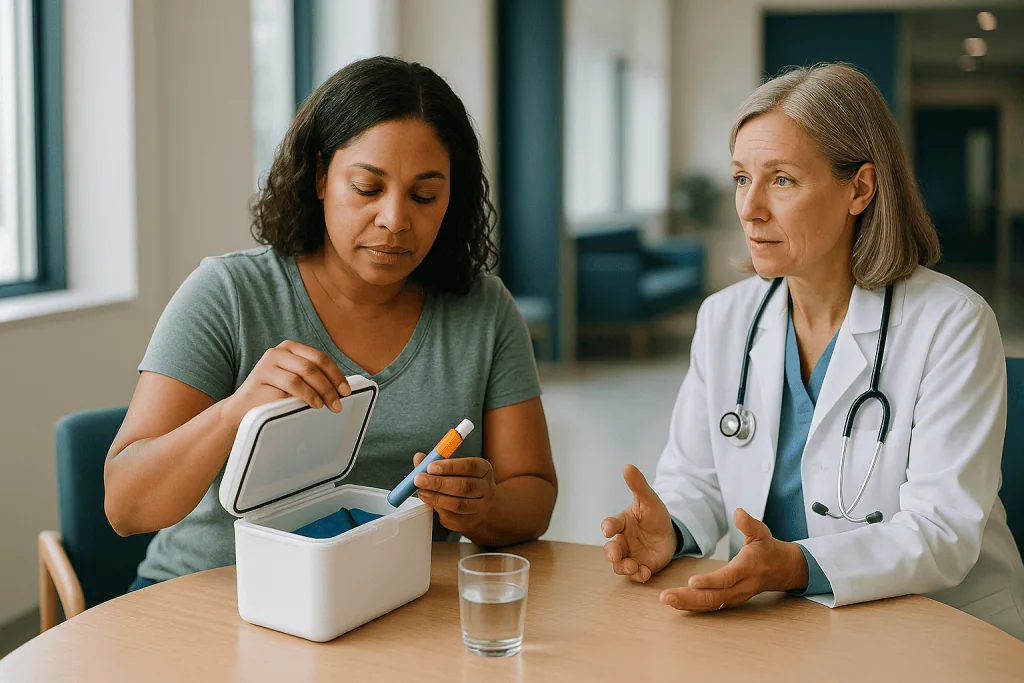
Build a small kit around that principle. An insulated pouch with a gel cold pack keeps pens cool without freezing them, provided the pack is not in direct contact with the pen. Keep the original box, because it carries the pharmacy label with your name and the medicine name, and keep a copy of your prescription or a brief letter from your prescriber. Neither is legally required for domestic US flights, but both shorten conversations at security and at foreign borders.
Pack a buffer. Flight cancellations, missed connections and lost luggage happen, so carry more supply than the trip strictly requires, and ask your pharmacist before you leave how a refill would work if you were stranded. Do not plan on buying replacement medicine abroad; availability, naming and approval status vary by country.
Think through the small things that travel disrupts. Pen needles, alcohol swabs and a small sharps container for used needles belong in the kit. Many airports and hotels will not accept loose needles in general trash, and a rigid container solves the problem. Finally, note your usual injection day in your calendar in both home and destination time zones before you board. That single note prevents most of the confusion covered in the time-zone section below.
How to store Ozempic while traveling: the temperature rules in one table
The storage numbers below come from the manufacturer patient leaflets as reproduced by MedlinePlus and the NHS. They are the result of stability testing, which is laboratory data rather than a clinical trial, but it is the most authoritative information available and it is what regulators approved.
| Medicine | Unopened pens | In-use or unrefrigerated allowance | Never |
|---|---|---|---|
| Ozempic (semaglutide, multi-use pen) | Refrigerator, 36–46°F (2–8°C) | Room temperature up to 86°F (30°C) or refrigerator, up to 56 days after first use | Freeze; expose to direct sunlight or heat above 86°F |
| Wegovy (semaglutide, single-use pen) | Refrigerator, 36–46°F (2–8°C) | Up to 86°F (30°C) for up to 28 days if refrigeration is not possible | Freeze; use if frozen |
| Mounjaro / Zepbound (tirzepatide, single-use pen) | Refrigerator, 36–46°F (2–8°C) | Up to 86°F (30°C) for up to 21 days | Freeze; return to the fridge and count the clock as reset |
Two practical points follow. The unrefrigerated allowance is cumulative, not per trip: once a pen has spent time at room temperature, that time counts against its total even if you put it back in a hotel fridge. A traveler on a two-week vacation who keeps a Mounjaro pen cool most of the time, with a few warm hours in transit, is comfortably within the 21-day window. Someone on a month-long expedition without reliable refrigeration is not, and needs a plan.
The second point is about hotel mini-fridges. Many run colder than a home refrigerator and can freeze items against the back wall. Place pens in the door shelf or the center of the fridge, never touching the rear panel, and check the first morning that nothing has iced over. A frozen pen must be discarded even after it thaws; the leaflets are unambiguous on that.
What happens if Ozempic gets warm?
This is the question behind most of the anxious airport searches, and the honest answer has two parts: what the evidence shows, and where it stops.
Semaglutide and tirzepatide are peptides, short chains of amino acids that fold into a precise shape. Heat can unfold that shape and reduce potency; it does not make the medicine toxic. The leaflets define the boundary as 86°F (30°C). Below that threshold, within the day limits in the table above, the manufacturer’s stability testing supports continued use. Above it, or beyond those days, the manufacturer has not tested and will not vouch for potency, so the leaflets say to discard.
What the evidence does not tell you is how much potency is lost after, say, ninety minutes in a warm taxi. There are no published studies grading partial excursions, and the leaflets do not offer a sliding scale. So the practical guidance is a judgment call: a pen that spent a short time slightly warm in a cabin or car, but was never hot to the touch and never in direct sun, is within the spirit of the room-temperature allowance. A pen left in a car on a hot afternoon, where interior temperatures can exceed 120°F, should be considered compromised.
Look at the liquid itself. Semaglutide and tirzepatide solutions should be clear and colorless. Cloudiness, visible particles or a color change are signs to stop and call your pharmacist, regardless of temperature history.
If you are unsure whether a pen remains usable, the right move is a call to your pharmacist or prescriber, not a guess. A replacement is inconvenient; injecting a degraded medicine for weeks and losing blood-sugar or weight control is worse. The clinician who prescribed the medicine should make that call with you.
Can you take Ozempic on a plane? Carry-on versus checked baggage
Yes, and the rules are friendlier than most travelers expect. In the United States, the Transportation Security Administration allows prescription medicines in both carry-on and checked bags, in liquid, gel or injectable form, with no quantity limit beyond what is reasonable for the trip. Injectable medicines are exempt from the 3.4-ounce liquid rule. You may be asked to remove them from your bag for separate screening, which is why a clear pouch speeds things up.
The carry-on recommendation is about physics, not regulation. Cargo holds on most commercial aircraft are pressurized and heated, but temperatures are less controlled than in the cabin, and bags can spend an hour or more on a hot ramp before loading. Carry-on also protects against the more mundane disaster of lost luggage, which strands a traveler without medicine for days.
Cold packs are permitted. Frozen gel packs pass through security without difficulty; a pack that has partially melted is technically a liquid, but TSA guidance allows ice packs and gel packs that accompany medically necessary items even when slushy. Tell the officer the pack is for medication. If you prefer not to rely on that discretion, freeze the pack solid before leaving home and keep it in the insulated pouch.
Once on board, keep the pouch under the seat in front of you or in your personal item, not in the overhead bin. Overhead bins can warm noticeably on a parked aircraft, and a medicine in your lap is one you can check during a long delay.
One habit worth adopting: photograph the pharmacy label on the box before you travel. If a box is damaged or lost, a clear photo on your phone answers most questions a border officer or pharmacist might ask.
Can insulin pens and GLP-1 pens go through airport security?
Both can, and the process is similar. Insulin pens, GLP-1 pens, pen needles and syringes are allowed through US airport checkpoints when they accompany the medicine they are used with. You do not need a doctor’s note for domestic travel, though officers may ask to see the medicine’s label if needles are present. Declaring the items before the bag enters the scanner is courteous and usually faster.
The X-ray scanner used for carry-on bags does not harm semaglutide, tirzepatide or insulin in pens or vials. Manufacturers of insulin pumps and continuous glucose monitors advise against passing those devices through full-body scanners and some X-ray machines, but pens and cartridges are not electronic and are not affected. If you still prefer a hand inspection, you can request one; expect it to take a few extra minutes.
Outside the United States, security agencies in the European Union, the United Kingdom, Canada and Australia follow comparable principles: medically necessary liquids and injectables are exempt from liquid limits, and supporting documentation is recommended. The sharpest differences appear at customs rather than security. Some countries, particularly in parts of the Middle East and East Asia, restrict controlled substances or require that medicines be declared on entry, and a few ask for a prescription translated into the local language. GLP-1 medicines are not controlled substances in most jurisdictions, but the paperwork habit protects you everywhere.
A practical note for people who use insulin alongside a GLP-1 medicine: keep both in the same pouch, with both labels visible. Mixed kits are common, and a single organized pouch reads as medical rather than suspicious to a screener working through hundreds of bags an hour.
Flying with Mounjaro: what is different from semaglutide
Most of the advice above applies equally to tirzepatide, but a few details differ in ways that matter on the road.
Mounjaro and Zepbound are supplied as single-use pens, each containing one injection, whereas Ozempic is a multi-use pen that stays in service for weeks. The single-use design means a traveler carries several individual pens rather than one, which takes more pouch space and makes it easier to lose one in a hotel drawer. It also means the room-temperature clock starts from the moment each pen leaves the refrigerator, not from first use, so keep unopened pens cool whenever you can.
The unrefrigerated allowance is shorter for tirzepatide, 21 days according to the MedlinePlus and NHS leaflets, compared with 56 days for an in-use Ozempic pen. For a typical vacation that difference is academic. For an extended working trip, a sabbatical or a long cruise, it decides whether you need a dedicated cooling solution such as an insulated case with replaceable cold packs or a battery-powered medical cooler.
Tirzepatide pens also contain an automatic needle mechanism: the needle is hidden and deploys on injection. You will not carry separate pen needles, which simplifies the kit, but you will need a larger sharps container because the entire pen is discarded. Hotels, airports and pharmacies in many countries will accept a sealed sharps container or offer disposal; ask at reception rather than tossing a pen in a bin.
Side-effect profiles overlap substantially. Nausea, reduced appetite and digestive upset are the common early effects for both medicines, and the travel-specific precautions in the symptom section apply to both. The decision about whether and when to adjust anything belongs with your prescriber, not with a forum thread.
Ozempic time zone change: what to do about your injection day
A weekly injection does not care what the clock says, which is both reassuring and the source of confusion. The leaflet guidance for semaglutide and tirzepatide describes a once-weekly schedule, and both leaflets allow the injection day to be moved provided a minimum gap between injections is maintained. The exact gap differs between the two medicines, and the leaflets also describe what to do if an injection is missed. Those instructions are written for the medicine you hold, so read your own leaflet and confirm the plan with your prescriber before departure rather than relying on a general article.
For short trips, the simplest approach is to keep your home schedule. If you normally inject on Sunday morning at home, inject on Sunday at roughly the same local time at your destination; a shift of a few hours in either direction falls well within the flexibility the leaflets describe. Crossing the international date line or flying across more than eight time zones is where it gets fiddly, and a short pre-trip conversation with a pharmacist settles it in two minutes.
Choose consistency over precision. Many clinicians suggest picking a fixed local day and sticking with it for the duration of the trip, then returning to the home day once back, so long as the minimum interval is honored at both transitions. Never take an extra injection to “catch up” or compensate for a missed day; the leaflets specifically caution against this.
Write the plan down. A note on your phone that reads “inject Sunday, local time, next due date X” removes the mental math from jet lag, and jet lag is precisely when mistakes happen. If you are also managing insulin or a blood-sugar-lowering tablet, time zones affect those medicines differently and your clinician should review the whole regimen together.
Traveling with Ozempic abroad: documents, customs and refills
International travel adds a layer of paperwork, and the CDC’s travel health guidance offers the clearest checklist. Keep every medicine in its original, labeled packaging. Carry a copy of each prescription, ideally listing both the brand and generic names, because the brand name may differ abroad. For injectable medicines, a short letter from your prescriber stating the condition treated, the medicine, and the need to carry needles pre-empts most questions.
Check the destination country’s rules before you fly. Most countries permit travelers to bring a personal supply of prescription medicines, but some limit the quantity to a fixed number of days, and a few require advance registration for any injectable. Embassy websites and the destination’s health ministry are the right places to look; a social media post is not. If a country’s rules are unclear, a pharmacist with travel-medicine experience can usually point you to the authoritative page.
Plan refills before you need them. Do not assume a pharmacy abroad can fill a US prescription; most cannot, and the availability of semaglutide or tirzepatide varies by country and can be subject to local restrictions. If your trip is long enough that you will run out, discuss options with your prescriber before departure. In some cases a clinician can arrange an early refill to cover the trip; the decision rests with them and with your insurer’s rules.
Finally, be wary of unapproved products marketed to travelers online as “travel-friendly” versions. Compounded semaglutide and tirzepatide are not FDA-approved medicines, research peptides sold as “not for human use” are exactly that, and neither has standardized storage or potency data. They are not for sale to patients or for self-use, and carrying them across borders can create legal problems that a legitimate prescription never would.
Side effects on the road: nausea, dehydration and unfamiliar food
Travel stresses the same system these medicines act on: the gut. Semaglutide and tirzepatide slow gastric emptying, the rate at which the stomach passes food into the intestine, which is part of how they reduce appetite. Combine that with airline meals, long sitting, unfamiliar cuisine and dehydration from cabin air, and the common side effects can feel louder than at home.
Nausea is the most frequently reported effect in the pivotal randomized trials for both medicines, affecting roughly a fifth to nearly half of participants depending on the medicine and trial, usually early in treatment and easing over weeks. On the road it is wise to eat smaller portions, favor bland foods on travel days and avoid very fatty meals, which sit longest in a slowed stomach. These are expert-opinion adjustments rather than trial-tested rules, but they align with the mechanism.
Hydration deserves more attention than it gets. Vomiting or diarrhea, whether from the medicine or from a travel-related infection, can lead to dehydration, and case reports have linked dehydration on these medicines to acute kidney injury, a sudden drop in kidney function. Carry a water bottle, drink regularly on flights, and treat persistent vomiting as a reason to seek care, not to push through.
Alcohol interacts with the picture in two ways: it can worsen nausea and, in people who also take insulin or a sulfonylurea (an older diabetes tablet that stimulates insulin release), it raises the risk of hypoglycemia, a blood-sugar level low enough to cause shakiness, sweating or confusion. People on GLP-1 medicines alone have a low hypoglycemia risk; the combination changes that.
If symptoms are severe enough that you are considering skipping an injection, that is a decision to make with your prescriber by phone, not alone in a hotel room.
What organ is Ozempic hard on? Separating evidence from headlines
Search engines frame this as if there were one answer. There is not, and the honest version is more useful.
The digestive tract bears the most frequent effects: nausea, vomiting, diarrhea, constipation and abdominal discomfort. These are common in randomized trials, mostly mild to moderate, and tend to settle with time. They are also the ones travel amplifies.
The pancreas is the organ in most headlines. Pancreatitis, inflammation of the pancreas that causes severe upper abdominal pain often radiating to the back, appears as a warning on the labels of both medicines. Trial data show it is uncommon, and large observational studies have given mixed signals; the association is possible but not firmly established, and the leaflets advise stopping and seeking care if symptoms occur.
The gallbladder is better supported by evidence. Meta-analyses of randomized trials show an increased rate of gallstones and gallbladder inflammation with GLP-1 medicines, partly explained by rapid weight loss itself, which raises gallstone risk regardless of how the weight is lost.
The kidneys are not directly harmed by these medicines; in fact, trial evidence suggests semaglutide protects kidney function in people with type 2 diabetes. The risk is indirect, through dehydration from vomiting, which is why fluids matter.
The thyroid warning deserves plain language. In rodent studies, these medicines caused C-cell tumors of the thyroid. Whether this applies to humans is unknown; no clear increase has been shown in human trials, but because of the uncertainty the medicines are not prescribed to people with a personal or family history of medullary thyroid carcinoma or a rare inherited syndrome called MEN2. That is a prescribing decision your clinician has already made with your history in hand.
What the evidence actually says, graded by strength
Different parts of this article rest on different kinds of evidence, and a careful reader deserves to know which is which.
Strong, from randomized controlled trials: the efficacy and common side-effect profile of semaglutide and tirzepatide. The SUSTAIN, STEP, SURPASS and SURMOUNT trial programs enrolled tens of thousands of participants and were conducted under regulatory oversight. When this article says nausea is the most common side effect, that claim comes from controlled, head-to-head data against placebo.
Moderate, from regulatory stability testing: the storage temperatures and day limits. These are laboratory measurements of how much active peptide remains after defined time and temperature exposures, performed by manufacturers and reviewed by regulators. They are reliable within the tested range and silent outside it. No trial has tested a pen left in a warm car.
Moderate, from meta-analyses of trials and observational studies: gallbladder risk, kidney effects and the pancreatitis signal. Gallbladder findings are consistent across trial pooling; pancreatitis evidence is inconsistent, with some large observational studies finding no increase and others a small one.
Weak, from animal studies: the thyroid C-cell tumor warning. Rodent data drive the label language; human relevance is unknown.
Expert opinion only: most of the travel logistics. The advice to keep pens in carry-on, to eat lighter on flight days, and to fix a local injection day across time zones comes from pharmacists, diabetes educators and travel-medicine clinicians applying the label rules to real situations. It is sensible and consistent with the mechanism of the medicines, but no one has randomized travelers to overhead bin versus underseat storage, and no one will.
Knowing the grade lets you weigh the advice appropriately. The label limits are firm. The packing tips are good practice. The viral claims, covered next, are mostly neither.
Common myths about traveling with Ozempic and Mounjaro
Myth: a pen is ruined the moment it leaves the fridge. The leaflets explicitly allow room-temperature storage, 56 days for in-use Ozempic, 28 days for Wegovy and 21 days for Mounjaro, so long as the pen stays below 86°F and never freezes. A warm afternoon in transit is within those limits.
Myth: airport X-ray scanners damage the medicine. There is no evidence that baggage X-ray affects peptide medicines in pens. The caution about scanners applies to insulin pumps and continuous glucose monitors, which are electronic devices, not to pens.
Myth: you cannot bring needles on a plane. Pen needles and syringes are permitted in carry-on bags when they accompany an injectable medicine. Declaring them and keeping the medicine’s label visible is all that is needed.
Myth: it is fine to skip injections on vacation so you can eat freely. Stopping and restarting on your own can bring back early side effects and, for people with diabetes, destabilize blood sugar. Any pause is a decision for your prescriber.
Myth: if you miss a day, take extra to catch up. Both leaflets caution against this. Follow the missed-dose instructions in your own leaflet and ask a pharmacist if unsure.
Myth: a compounded or “research” version is a convenient travel alternative. Compounded semaglutide and tirzepatide are not FDA-approved products, and research peptides sold online are not medicines at all. Neither has validated storage data, neither should be self-administered, and neither is for sale to patients as a substitute for a prescription.
Myth: a cold pack is forbidden through security. Gel and ice packs accompanying medication are permitted, frozen or partially thawed. Freezing them solid before departure avoids any discussion.
Each of these claims circulates because it contains a sliver of plausibility. None survives contact with the leaflet.
When to see a doctor while traveling on Ozempic, Wegovy or Mounjaro
Most travel on these medicines is uneventful, and most side effects are mild. A small number of symptoms are different in kind, and knowing them in advance means you will not waste hours deciding whether to act. Seek medical care promptly, at the nearest urgent care or emergency department, for any of the following:
- Severe, persistent pain in the upper abdomen, especially if it spreads to the back and comes with vomiting, which can indicate pancreatitis.
- Pain in the upper right abdomen, fever, or yellowing of the skin or eyes, which can indicate a gallbladder problem.
- Vomiting or diarrhea that prevents you from keeping fluids down for more than a day, or signs of dehydration such as very dark urine, dizziness on standing or passing little urine.
- Symptoms of low blood sugar that do not improve after eating or drinking something sugary, particularly if you also use insulin or a sulfonylurea: shakiness, sweating, confusion, or drowsiness.
- A lump or swelling in the neck, hoarseness that does not resolve, or difficulty swallowing.
- Signs of an allergic reaction: swelling of the face, lips or throat, difficulty breathing, or a widespread rash.
- Sudden changes in vision, which in people with diabetes can signal worsening of diabetic eye disease.
Less urgent but still worth a call to your prescriber or pharmacist: a pen you suspect was frozen or overheated, a missed injection you are unsure how to handle, nausea that stops you eating or drinking normally for more than a couple of days, or any thought of pausing the medicine.
Before you leave, save your prescriber’s office number, your pharmacy’s number and your insurer’s travel assistance line in your phone. Carry a written list of all your medicines, including over-the-counter products. Every decision about continuing, pausing or adjusting a prescribed medicine belongs to the clinician who prescribed it; a travel article, this one included, can only tell you when to ask.
Frequently asked questions
How do I travel with my Wegovy?
Keep Wegovy pens in your carry-on inside an insulated pouch with a cold pack, with the original labeled box and a copy of your prescription. Unopened pens belong in a refrigerator, but the leaflet allows storage below 86°F for up to 28 days if refrigeration is not possible. Never let pens freeze, and ask your prescriber about timing before crossing several time zones.
Can you take Ozempic on a plane in your carry-on?
Yes. US airport screening permits injectable prescription medicines, pen needles and accompanying cold packs in carry-on bags, exempt from the usual liquid limits. Declare them at the checkpoint and keep the pharmacy label visible. Carry-on is strongly preferred over checked baggage, because cargo holds and tarmac delays expose medicines to temperature extremes and lost luggage leaves you without supply.
What happens if Ozempic gets warm?
Heat can reduce the potency of semaglutide, a peptide, but does not make it harmful. The leaflet permits room-temperature storage up to 86°F within the stated day limits. A short, mild warming in transit is within that allowance; a pen left in a hot car or in direct sun should be considered compromised. Check that the liquid is clear and ask a pharmacist if unsure.
What organ is Ozempic hard on?
No single organ. The digestive tract experiences the most common effects, such as nausea and diarrhea. Trial meta-analyses show a higher rate of gallbladder problems, pancreatitis is a rare and inconsistent signal, and kidney problems arise indirectly through dehydration. The thyroid warning comes from rodent studies whose relevance to humans is unknown. Your prescriber weighed these risks when prescribing.
Can insulin pens go through airport security?
Yes. Insulin pens, GLP-1 pens, vials, syringes and pen needles are allowed through US checkpoints when they accompany the medicine, with no doctor’s note required for domestic flights. Baggage X-ray does not damage pens or vials. If you prefer, you can request a hand inspection, which takes a few extra minutes. Keep everything in one clear, labeled pouch.
How should I handle an Ozempic time zone change on a long trip?
Keep your usual injection day and inject at roughly the same local time at your destination; a few hours’ shift is within the flexibility the leaflet describes. For large shifts or date-line crossings, pick a fixed local day and keep the minimum interval between injections stated in your leaflet. Confirm the plan with your prescriber or pharmacist before departure, and never double up.
How to store Ozempic while traveling without a fridge?
An in-use Ozempic pen can stay at room temperature below 86°F for up to 56 days, so most trips need only an insulated pouch and a cold pack to buffer heat. For extended travel in hot climates without refrigeration, a purpose-built medical cooler with replaceable packs keeps pens within range. Avoid direct sunlight, and never let the cold pack touch the pen directly.
Is flying with Mounjaro any different from flying with Ozempic?
The security rules are identical. The differences are practical: Mounjaro comes as single-use pens, so you carry several and need a larger sharps container, and its unrefrigerated allowance is shorter, 21 days versus 56 for an in-use Ozempic pen. For long trips that shorter window may require a dedicated cooling solution. Side effects and precautions are broadly similar.
What should I do if my pen froze in the hotel fridge?
Discard it. Both the semaglutide and tirzepatide leaflets state that a pen that has frozen must not be used, even after thawing, because freezing can damage the peptide in ways you cannot see. Contact your pharmacist or prescriber to arrange a replacement, and move remaining pens to the door shelf or center of the fridge, away from the back wall.
Can I pause Ozempic for a vacation and restart afterward?
That is a decision for your prescriber, not a travel decision. Pausing can bring back early side effects on restart and, for people with diabetes, can destabilize blood sugar. If you are considering a break for any reason, including nausea, call your clinician before the trip. Do not stop or change a prescribed medicine on your own, and never take extra after a gap.
References
- MedlinePlus: Semaglutide Injection
- MedlinePlus: Tirzepatide Injection
- NHS: Semaglutide (Ozempic, Wegovy)
- NHS: Tirzepatide (Mounjaro)
This article is for general information only and is not a substitute for professional medical advice. Please consult a qualified doctor about your individual situation.

More from the Blog

Ozempic, Blood Pressure and Cholesterol: What the Cardiometabolic Trials Found
In randomized trials, Ozempic (semaglutide) modestly lowered systolic blood pressure, typically by about 2–5 mmHg compared with placebo, reduced triglycerides by roughly a fifth…

Ozempic Not Working? The Common Reasons Weight Loss Stalls and What Doctors Check
If Ozempic is not working, the most common reasons are that the dose is still being stepped up, daily calories remain higher than reduced…

GLP-1 Medicines in Menopause: What Studies Show for Midlife Weight and Metabolic Change
GLP-1 medicines produce substantial average weight loss in randomized trials of adults with obesity, and subgroup data suggest women in and after menopause lose…

Ozempic Injection Site Reactions and Rashes: What Is Normal and What Signals an Allergy
Most Ozempic injection site reactions are mild: a small red, itchy or tender spot where the needle went in that fades within a few…

Ozempic vs Metformin: How the Two Diabetes Medicines Differ, and Why They Are Often Combined
Ozempic (semaglutide) and metformin both lower blood sugar in type 2 diabetes but work differently. Metformin, a daily tablet, mainly reduces glucose released by…

GLP-1 Long-Term Effects: What Multi-Year Studies Show About Staying on These Medicines
Multi-year studies of GLP-1 medicines such as semaglutide and tirzepatide, with follow-up of up to about four years, have not identified new serious long-term…